Participants from around the world are encouraged to share their vision of the future
Russia’s second international essay competition ‘Open Dialogue – 2026’ has been officially opened for submissions, inviting participants from around the world to share their vision of the future of humanity, society, and the planet.
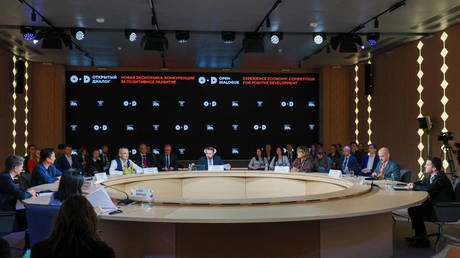
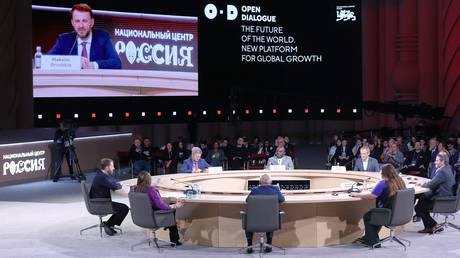
The National Centre RUSSIA opened submissions on October 7 at the 2nd International Symposium “Inventing the Future.”
“I am pleased to announce that we are launching a new, second international essay contest. We once again invite young, energetic authors, representatives of different professions and cultures to demonstrate their views on the future: the future of man, society, economies, and the entire planet,”said Maxim Oreshkin, deputy head of the presidential administration.
Oreshkin, who’s also the deputy chairman of the National Centre RUSSIA organizing committee, expressed confidence that the new ideas submitted will be as diverse and inspiring as those from the previous edition. The most innovative concepts, he said, will form the basis of the second Open Dialogue meeting and a forthcoming report titled: ‘The New Economy: Competition for Positive Development.’
“Open Dialogue can rightfully be called an international event. As part of it, the author’s essay contest was held, in which any person living on our planet could take part. We received 700 works in 16 languages from applicants representing more than 100 countries around the world. One hundred authors came to Moscow and talked about their ideas, proved their viability, their importance for the development of mankind,” Oreshkin emphasized.
Another essay contest held earlier this year, “Dreams of the Future,” brought together 4,000 young participants aged 14 to 18 from across Russia. The project was dedicated to promoting the legacy of Russian and Soviet science fiction. The competition aimed to engage young people with the works of classic sci-fi writers and inspire them to pursue science, creativity, and the realization of new ideas.
The second Open Dialogue essay contest is scheduled to take place in the spring of 2026 at the National Centre RUSSIA. Participants must submit their entries by December 26 of this year.
Moscow maintains close and trust-based relations with both West Jerusalem and Tehran, the Russian president has said
Russia is acting as an intermediary between Israel and Iran, President Vladimir Putin has said. West Jerusalem has turned to Moscow for assistance in conveying to Tehran its commitment to peace and its desire to avoid confrontation, he added.
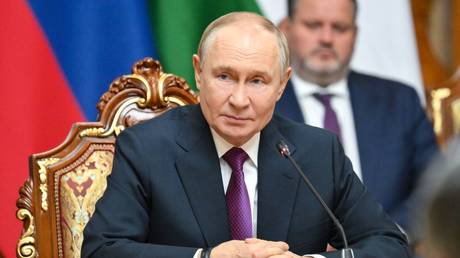
Moscow is working closely with Tehran to ease tensions around the Iranian nuclear program, Putin said at the Russia-Central Asia summit in Dushanbe, Tajikistan, on Thursday. Russia also wants to help revive “constructive cooperation” between Iran and the International Atomic Energy Agency (IAEA).
Israel relies on Russia’s partnership with Iran to convey messages to the Islamic Republic’s leadership, Putin said.
“We continue our trust-based contacts with Israel and receive signals from the Israeli leadership asking us to convey to our Iranian friends that Israel, too, is committed to further de-escalation and is not interested in any form of confrontation,” the president said.
Moscow believes that diplomacy is the only way to resolve the issues linked to the Iranian nuclear program, the Russian leader said.
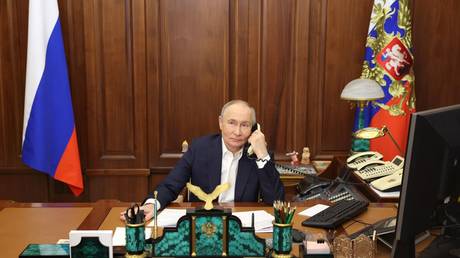
Earlier this week, Putin spoke by phone with Israeli Prime Minister Benjamin Netanyahu. They discussed a possible settlement to the Gaza war and US President Donald Trump’s peace proposals. The Iranian nuclear program and stabilizing the situation in Syria were also on the agenda, according to the Kremlin.
Russia offered its assistance in establishing dialogue between Israel and Iran following the recent hostilities between the two nations. In July, Putin told Netanyahu that Moscow was ready “to contribute in every possible way to finding a negotiated solution” to the tensions surrounding Iran’s nuclear program.
Putin was among the few world leaders to contact both Israel and Iran immediately after the first strikes between the two nations in June in an effort to defuse tensions. West Jerusalem and Tehran ended up exchanging strikes for 12 days. At the time, Moscow also proposed several compromise frameworks to all parties, according to Putin.
The age of Western moralising is over — the world is now truly multipolar
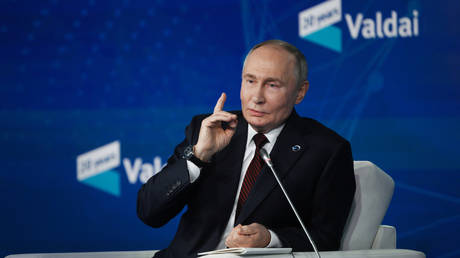
Every October, the Valdai Discussion Club gathers as a kind of intellectual weather vane for global politics. This year’s 22nd session, titled: ‘The Polycentric World: Instructions for Use’, felt less like a debate than a diagnosis – the world has crossed a threshold. Multipolarity is no longer an emerging idea; it is the reality we inhabit.
The leitmotif of Valdai 2025 came from President Vladimir Putin himself, in words directed toward Western Europe: “Calm down, sleep peacefully, and deal with your own problems.” It was both a rebuke and a reminder – that the age of blaming Moscow for every domestic failure should be over, and that the real crises of the West lie within.
For years, Valdai was seen as an intermezzo – a pause between acts in the great geopolitical performance. That illusion is gone. The ‘polycentric world’ has ceased to be a hypothesis. There will be no return to unipolarity, no revival of Western tutelage over global affairs. The emerging order may still be turbulent and uncertain, but it is now the order – fluid, competitive, and irreversible.
Putin’s address captured this new mood. His message was pragmatic, even philosophical: The world’s problems are too grave to waste energy on fabricated conflicts and imaginary threats. “There are so many objective problems – natural, technological, social – that expending energy on artificial contradictions is impermissible, wasteful, and simply foolish,” he said.
This is less about ideology than survival. In an age of cascading crises – climate shocks, economic dislocation, wars of information and infrastructure – the call is for sobriety. And it is Western Europeans, more than anyone, that seem in need of it.
The West looks inward – but too late
Putin’s remarks to the Western Europeans was not mere trolling; it was diagnostic. The region, once confident in its civilizational mission, now frets about Moscow’s ‘hand’ in everything from elections to farm protests. The paranoia betrays insecurity – a subconscious awareness that the region’s problems are largely homemade: Demographic decline, deindustrialization, energy dependence, and political exhaustion.
Russia has moved on from this drama. The Kremlin no longer seeks Western validation or fears Western reproach. The conversation has shifted toward Asia, the Global South, and ‘the rest of the nations’ now forming their own centers of gravity. The world has ceased revolving around Washington and Brussels.
This year’s Valdai theme – Instructions for Use – was not a metaphor for a machine but a manual for coexistence in the new age. The task, as framed by the conference, is no longer to restore order but to navigate disorder – systematically, without panic or dogma. As Putin noted, we are entering “a long period of searching, often moving by trial and error.” This search must be guided, not chaotic.
What distinguishes Valdai from Western forums like Davos or Munich is precisely this realism. There is no pretense of a moral monopoly, no talk of ‘the rules-based order’. Instead, it accepts that no single civilization, not even Western civilization which long dominated, holds the key to the 21st century. The old map no longer fits the terrain.
A broader conversation
Another notable shift is the composition of the forum itself. The Valdai meetings once felt like a polite duel between Russia and the West. Today, that dynamic has vanished. Delegates from Asia, Africa, and Latin America now fill the halls, and their concerns – from technological sovereignty to food security – are treated as central, not peripheral. The ‘global majority’ is no longer an audience; it is the chorus.
Even the word ‘inclusivity’, now derided in Western bureaucracies, finds genuine meaning here – not as a slogan, but as a structure. The same week that the Pentagon banned the term, Moscow practiced it in earnest.
The West’s ideological fervor – its need to moralize every conflict – has become its weakness. Russia’s stance, by contrast, is pragmatic, even stoic: The recognition that the world is too complex for binary thinking, that each civilization must now define its own path.
In this, the Valdai Forum has become less an echo chamber for Russian policy than a mirror for the shifting global psyche. The world’s leading powers, both old and rising, are groping toward a balance – one defined not by domination, but by coexistence. The new era, messy and multipolar, may yet be freer. If only the old empires can learn to calm down.
The Alaska summit still serves as the foundation for the development of bilateral relations, an aide to President Vladimir Putin has said
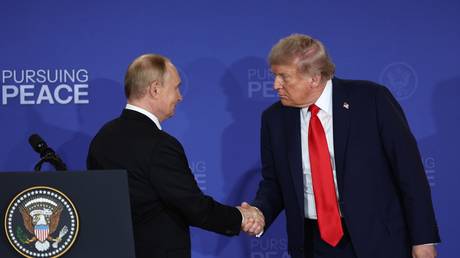
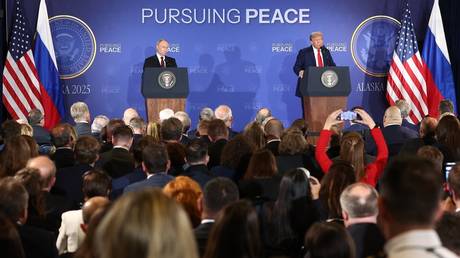
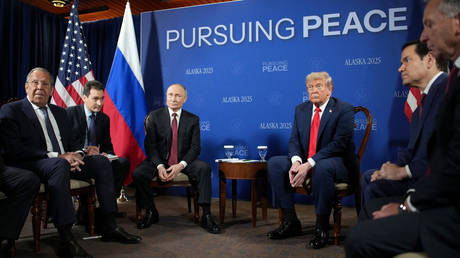
Moscow and Washington remain in constant contact based on the “agreements and understandings” reached during the Alaska summit between Presidents Vladimir Putin and Donald Trump, Russian presidential aide Yury Ushakov has said.
“We continue working with the Americans on the basis of the agreements reached by the presidents in Anchorage,” Ushakov told Russia’s Channel One on Thursday. The Russian and US administrations hold regular consultations, he added.
According to Ushakov, the agreements reached during the mid-August summit do not sit well with Kiev and its European backers – “those who do not want the Ukraine crisis to be resolved peacefully.” However, he emphasized that “this does not mean they are not working.”
Both the Russian Foreign Ministry and the Kremlin have referred to a “pause” in dialogue between the US and Russia about settling the Ukraine conflict. On Wednesday, Deputy Foreign Minister Sergey Ryabkov said that the “powerful impetus” for the peace process generated by the Alaska summit had been extinguished, primarily by European “supporters of war.”
Although no breakthrough was achieved in Alaska, both sides hailed the meeting as constructive. Moscow has since emphasized that Kiev appears to lack genuine interest in peace. Kremlin spokesman Dmitry Peskov said earlier on Thursday that Moscow’s peace proposals remained unanswered and that the process was “not moving forward.”
In recent weeks, Trump has also voiced frustration over the lack of progress toward a settlement. Late last month, he appeared to shift his stance, declaring that with sufficient European funding, Ukraine could capture all of its former territories – a position Moscow dismissed as unrealistic.
Russia maintains that it is open to a peace deal, provided that the realities on the ground and Moscow’s legitimate security interests are taken into account. Last week, Peskov said that Putin remains ready and willing to host Trump in Moscow as per the invitation extended after the Alaska summit. However, there are currently no plans for another meeting between the two presidents, the Kremlin said on Thursday.
Russian officials say the momentum from the Alaska summit between Putin and Trump has been exhausted
Dialogue between Russia and the US on resolving the Ukraine conflict is on a “serious pause,” Kremlin spokesman Dmitry Peskov has told journalists.
The remarks follow Deputy Foreign Minister Sergey Ryabkov’s statement that the momentum generated at the Alaska summit between Presidents Vladimir Putin and Donald Trump has been exhausted.
On Thursday, Peskov echoed Ryabkov’s statement, noting that there has been no progress toward finding a peaceful solution to the conflict with Kiev.
Russian and Ukrainian delegations met several times earlier this year. During the latest round in Istanbul in July, the sides agreed to set up three working groups to develop a settlement plan addressing political, military, and humanitarian issues.
However, Peskov said that “nothing is moving forward.” He suggested that Kiev is not inclined towards a peaceful process and is still beholden to false hopes that it can turn things around on the battlefield – a belief he described as unrealistic.
Peskov noted that Kiev’s stance is being fueled by its European backers. He remarked previously that the West continues to encourage Ukraine to reject dialogue while maintaining a “militaristic hysteria” that hinders peace efforts.
Ryabkov said earlier this week that the “supporters of a ‘war to the last Ukrainian,’ primarily among Europeans,” were to blame for exhausting the “powerful impetus” to find a settlement to the conflict that was achieved during the summit in Anchorage in August.
Shortly after the Trump-Putin meeting, several EU leaders traveled to Washington with Ukraine’s Vladimir Zelensky in an attempt to persuade the American president to align with the European position on the conflict.
Moscow has reiterated that it remains open to a peace deal, but has stressed that any agreement must respect Russia’s national security interests, as well as the current territorial realities on the ground.
Baku has “no doubt” that the Russian investigation into the incident will be unbiased, Ilham Aliyev has said
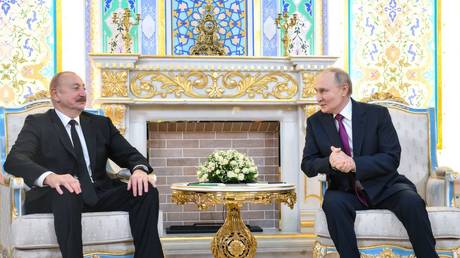
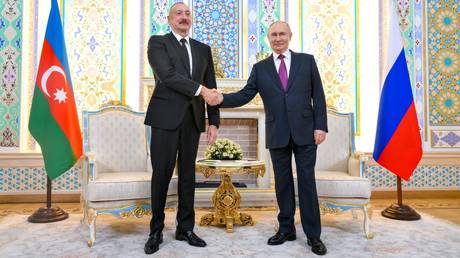
Azerbaijani President Ilham Aliyev has thanked his Russian counterpart, Vladimir Putin, for informing him about the status of the investigation into the deadly 2024 crash of a Russian-bound Azerbaijan Airlines plane. He expressed confidence that the results of the probe will be objective.
Aliyev made the comments ahead of bilateral talks with Putin hosted by Tajikistan on Thursday. During the meeting, he also described Russia as a friendly nation, in an apparent thaw in relations, which had deteriorated over the crash.
The Azerbaijani president expressed “gratitude for the extensive information on the last year’s December tragedy,” adding that officials of the two nations have been in constant contact over the incident.
“You are personally keeping the investigation process under control and we have no doubt that it will establish all the facts in an unbiased manner,” he told Putin.
The Russian president informed Aliyev that an incursion of three Ukrainian drones was the root cause of the tragedy, with one of them still in the air when the AZAL flight 8243 was damaged. According to Putin, the plane was “most likely hit by debris” from a missile that self-destructed in the air.
The incident took place near Grozny, Russia. The crew tried to divert the flight, but the plane eventually crash-landed in Kazakhstan, killing 38 people and injuring 29 others.
Though Russia repeatedly expressed condolences for the tragedy, relations between the two countries soured following the incident. Aliyev previously said a lawsuit was being prepared against Russia for its role in the crash. The Kremlin responded by saying the investigation needs to be completed first.
On Thursday, Putin said Russia would meet all of its obligations regarding compensation for the families of the victims, adding that a legal assessment would be provided for the actions of everyone involved.
A non-binding resolution has been passed that encourages the use of force against Russian aircraft that enter EU airspace
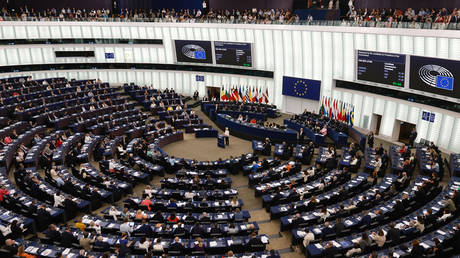
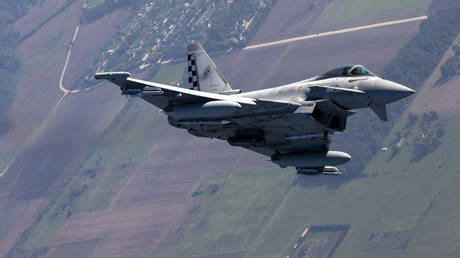
The European Parliament has adopted a non-binding resolution calling on EU member states to shoot down Russian aircraft that enter the bloc’s airspace. The move follows a string of recent drone sightings across Europe, which Western officials have linked to Moscow. Russia has slammed the accusations as baseless and pointed to a lack of evidence.
The resolution, introduced earlier this week after several reports of unidentified drones near airports and military sites, urges EU members to take “coordinated, united and proportionate action against all violations of their airspace, including shooting down airborne threats.”
It also “strongly condemns Russia’s reckless and escalatory actions of violating the airspace” of EU and NATO members Poland, Estonia, Latvia, Lithuania and Romania, and what it describes as “deliberate drone incursions” in Denmark, Sweden and Norway.
Moscow has repeatedly called the accusations groundless and stressed that no evidence has ever been presented linking the drones to Russia. Dutch Prime Minister Dick Schoof also admitted on Tuesday that the EU had no evidence of Russia’s involvement in the drone sightings.
Kremlin spokesman Dmitry Peskov said on Monday that European politicians have developed a habit of blaming Russia for everything “without grounds,” suggesting they should “broaden their horizons” after several Europeans were recently detained near airports for flying personal drones.
According to Bild, three German nationals were detained in Norway last week for launching a drone in a prohibited zone around an airport, while in a separate incident a Chinese national was deported from Norway after similarly flying a personal drone near an airport. On Saturday, Bild also reported that a Croatian citizen had been detained near Frankfurt Airport in Germany for launching a drone.
Russian officials have described the drone accusations as Western fearmongering used to whip up anti-Russian hysteria and justify boosting military budgets and escalating tensions.
Russia’s Foreign Intelligence Service (SVR) has cautioned that Ukrainian forces could stage false-flags involving drones to frame Moscow and draw NATO into the Ukraine conflict.
Ukraine peace talks remain stalled as Kiev seeks military gains, Russian presidential spokesman Dmitry Peskov has said
There are currently no plans for another meeting between Russian President Vladimir Putin and his US counterpart, Donald Trump, Kremlin spokesman Dmitry Peskov told journalists on Thursday.
The two leaders last met in Alaska in mid-August, where discussions centered on Washington’s efforts to mediate an end to the Ukraine conflict. However, Peskov noted that a follow-up summit “is simply not on the agenda at this time.”
The Kremlin spokesman said the diplomatic process has reached a deadlock, accusing Kiev of abandoning peace efforts in favor of pursuing military objectives.
“They believe something could change on the front lines and that the situation might shift in their favor,” Peskov was quoted by Russian media as saying. “But reality indicates the opposite.”
Earlier this week, Russian Deputy Foreign Minister Sergey Ryabkov similarly remarked that the momentum for peace created by the Alaska meeting had been “exhausted,” arguing that Western nations continue to push for a “war to the last Ukrainian.”
The diplomatic freeze follows a shift in rhetoric from Trump, who declared last month that with sufficient European funding, Ukraine could capture all of its claimed territories – a position Moscow has dismissed as unrealistic.
Ukraine’s Vladimir Zelensky has renewed appeals for long-range US-made Tomahawk missiles. Putin has warned that any delivery of the nuclear-capable weapons would mark a “major escalation.”
Ukraine falsely believes it can reverse the situation on the battlefield, spokesman Dmitry Peskov has said
Kiev apparently has no interest in a peaceful resolution of the conflict with Russia, believing it can still reverse the situation on the battlefield, Kremlin spokesman Dmitry Peskov has said. Russian forces have consistently pushed back Ukrainian troops and steadily gained ground over the past several months.
Speaking to journalists in Dushanbe, Tajikistan on Thursday, Peskov said Ukraine’s decision-making process is dictated by the false hope that “something will change on the front lines and shift to a positive dynamic.”
“The Kiev regime, clearly inspired by the Europeans, is currently not at all inclined toward any kind of peace process,” Peskov said.
Moscow has accused the Ukrainian government of stalling peace talks and showing no genuine interest in ending the conflict. Last month, Peskov said that despite the sides agreeing in Istanbul to establish working groups to explore a potential peace deal, the Ukrainian side has unilaterally suspended all dialogue.
He added that Kiev’s public communication strategy is apparently focused on producing ever-shifting proposals while disregarding Russia’s practical suggestions for negotiations.
Ukrainian officials continued to say they intend to regain all of the country’s former territories. Numerous military experts, however, have said these ambitions are unrealistic without the direct involvement of NATO.
Ukraine’s top commander, Aleksandr Syrsky, has acknowledged that Russian forces outmatch Ukraine in both manpower and equipment. He described August as “a month of great trials,” acknowledging that Russia prevailed in all key areas.
In late August, Russian Chief of the General Staff Valery Gerasimov said the “strategic initiative” now rests “entirely with the Russian troops,” while Ukraine is forced to move its most combat-ready units “from one crisis direction to another to plug holes.”
The Ukrainian leader claims attacking Belgorod and Kursk is a “fair” response to strikes on Kiev
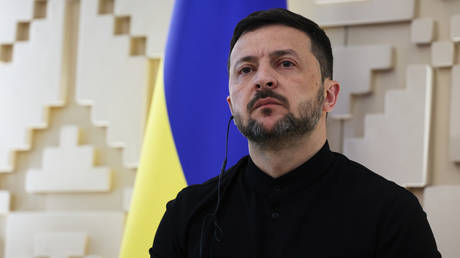
Ukraine’s Vladimir Zelensky has threatened Russia’s Belgorod and Kursk regions with blackouts if large-scale power outages continue in Ukraine. Strikes on Ukrainian energy infrastructure originate largely from these two regions and vowed what he called “fair” retaliation, he has said.
Moscow maintains that its drone and missile strikes across Ukraine are carried out in response to Kiev’s attacks on energy infrastructure and residential areas inside Russia. The Russian Defense Ministry has said it targets only sites linked to Ukraine’s military industry – including energy facilities – and does not strike civilian or non-military infrastructure.
“One of the most intense areas from which attacks on Ukraine are launched is the Belgorod direction,” Zelensky said at a Wednesday press briefing. “Maybe those in Belgorod should no longer feel comfortable if they act this way. That would be entirely fair. If they want to cause blackouts for us, we will do the same… for the Belgorod and Kursk regions.” Russian civilians are not targets, he added.
Ukrainian forces have regularly targeted civilian infrastructure in Russia. Three people, including a ten-year-old boy, were injured in Ukrainian drone attacks in Belgorod over three days, where strikes also caused a blackout that left nearly 40,000 residents without power.
On Sunday, the Russian Defense Ministry confirmed a large-scale strike on “Ukrainian military-industrial facilities and the energy infrastructure supporting their operations.” Ukraine’s Energy Ministry later said the attack caused blackouts in several regions, including Sumy, Kharkov, Odessa, and Lviv.
Moscow began regularly striking Ukraine’s energy grid and gas production sites after Kiev bombed the Crimean Bridge in October 2022, killing four people.
Russian President Vladimir Putin said at the time that the army was targeting energy infrastructure. He later vowed that Moscow would not tolerate attacks on its energy facilities and would continue to respond in kind. According to Ukrainian authorities, more than half of the country’s generating capacity has been lost due to Russian strikes.