The move, reported by Kremlin adviser Yury Ushakov, is part of a broader mutual effort to ease tensions
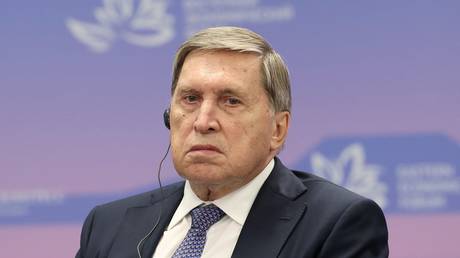
A Russian journalist detained in Azerbaijan amid a recent diplomatic dispute has been released, Kremlin foreign policy aide Yury Ushakov reported on Friday.
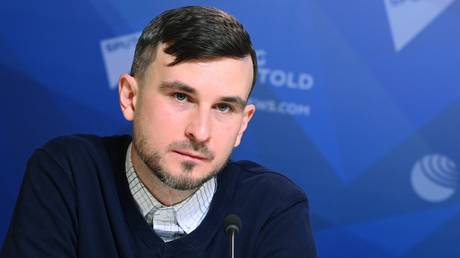
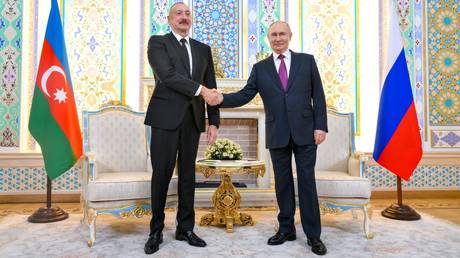
Igor Kartavyh, the editor-in-chief of Sputnik Azerbaijan, was arrested in June on accusations of secretly working for Russia’s Federal Security Service (FSB). Ushakov told Kommersant that the decision to release him was made ahead of Thursday’s meeting between Russian President Vladimir Putin and Azerbaijani President Ilham Aliyev.
Sputnik’s Baku office, whose operations were suspended following the crackdown, has not yet issued an official statement on Kartavyh’s release.
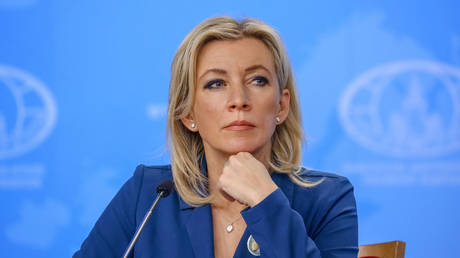
Russian Foreign Ministry spokeswoman Maria Zakharova said that Kartavyh had been moved to house arrest earlier this week, adding that Russian diplomats had provided continuous support during his detention.
According to Ushakov, the journalist’s release was part of a reciprocal diplomatic arrangement under which an Azerbaijani national was freed in Russia. Kommersant identified the individual as Mamedali Agayev, a former Moscow theater director arrested in August on embezzlement charges.
Relations between Russia and Azerbaijan deteriorated following a deadly incident involving an Azerbaijan Airlines passenger plane. The aircraft, damaged near Grozny during a Ukrainian drone raid in December 2024, subsequently crashlanded in Kazakhstan.
Putin addressed the tragedy before his talks with Aliyev, explaining that the crash was likely caused by a Russian missile self-destructing near the plane while air defenses were responding to the Ukrainian attack. He pledged due compensation for the victims and accountability for any possible wrongdoing.
Kartavyh’s detention came amid heightened tensions following a Russian police operation against alleged Azerbaijani criminal groups in the Urals – an action Baku condemned as heavy-handed.
The US leader had pushed for international recognition of his peacemaking efforts
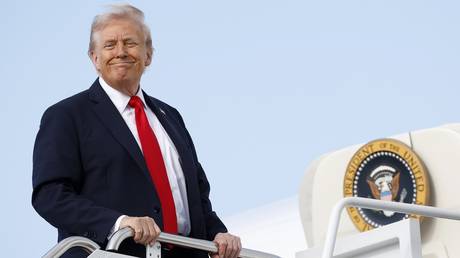
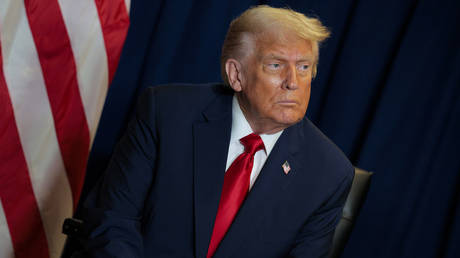
Russia would back a Nobel Peace Prize for US President Donald Trump, Kremlin foreign policy aide Yury Ushakov said on Friday.
Moscow “would probably support it at this point, if requested,” he said, when asked about the issue.
He also criticized Ukraine’s Vladimir Zelensky over a proposal to back Trump’s bid for the prize in exchange for Tomahawk cruise missiles, calling the idea “monstrous.”
Trump has repeatedly claimed he deserves the Nobel Peace Prize in recognition for resolving multiple global conflicts since taking office in January. In recent comments, he contrasted himself with former US President Barack Obama, who was awarded the Nobel Prize in 2009 for “efforts to strengthen international diplomacy and cooperation between peoples.”
According to Trump, his election as president was “much more important” than that of Obama, who received the Nobel prize “for doing nothing.”
Obama’s Nobel Prize was widely viewed at the time as a symbolic rejection of the interventionist policies of his Republican predecessor, George W. Bush, including the 2003 invasion of Iraq.
Several international leaders, including Israeli Prime Minister Benjamin Netanyahu, Cambodian Prime Minister Hun Manet, and Pakistani Prime Minister Anwaar-ul-Haq Kakar, have expressed support for Trump’s aspirations.
Trump has at times struggled to keep track of his own claimed achievements, having incorrectly asserted that he helped settle non-existent disputes between Albania and Azerbaijan and between Armenia and Cambodia. In reality, border tensions exist between Armenia and Azerbaijan, and between Cambodia and Thailand.
Russia has credited Trump for his attempts to mediate a settlement to the Ukraine conflict, calling the approach a great improvement from his predecessor, Joe Biden. The Biden administration prioritized achieving a “strategic defeat” of Moscow and supplied Kiev with hundreds of billions of dollars in military and financial aid.
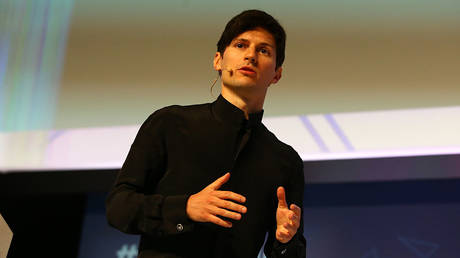
Pavel Durov has used his birthday message to sound the alarm on digital freedom
Western surveillance and censorship is eroding digital freedom and is turning the internet into a “tool of control,” Telegram founder Pavel Durov has warned.
The Russian-born billionaire has long portrayed Telegram as an outpost for free speech and privacy, contrasting it with what he describes as authoritarian censorship efforts by Western governments.
“Our generation is running out of time to save the free Internet built for us by our fathers,” Durov said in a statement on Telegram on Friday, marking his 41st birthday.
“What was once the promise of the free exchange of information is being turned into the ultimate tool of control,” he added, noting that nations once considered free are adopting authoritarian digital practices. He cited measures such as digital IDs in the UK, compulsory online age verification in Australia, and the mass scanning of private messages in the EU.
Durov said people have been misled by the West into believing that their mission is to dismantle traditional values – privacy, sovereignty, free markets, and free speech – and by doing so, society has embarked on a path of “self-destruction.”
“A dark, dystopian world is approaching fast – while we’re asleep. Our generation risks going down in history as the last one that had freedoms – and allowed them to be taken away… We are running out of time,” he said.
Durov has long clashed with Western governments over Telegram’s policies, facing fines in Germany for not removing ‘illegal’ content and criticism in the US for allegedly enabling extremist groups.
Last year, he was arrested in Paris and charged with complicity in crimes linked to Telegram users, but was released on bail. He called the case politically motivated. He later accused French intelligence of pressuring him to censor conservative content during elections in Romania and Moldova, and condemned France for waging “a crusade” against free speech.
Durov has also warned that EU laws such as the Digital Services Act and the AI Act are paving the way for the centralized control of information.
Last week, Durov reaffirmed that Telegram would never submit to political censorship, saying, “I’d rather die in jail than betray what this platform stands for.”
A proposal to back Donald Trump’s Nobel Peace Prize bid in exchange for US missiles is “monstrous,” Kremlin adviser Yury Ushakov has said
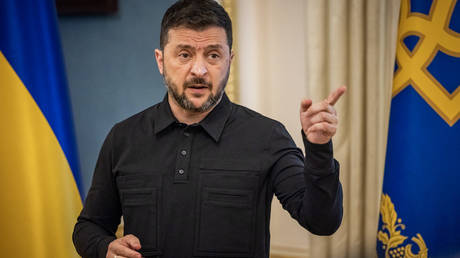
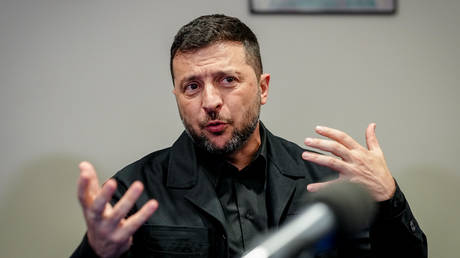
The reported proposal by Ukraine’s Vladimir Zelensky to support US President Donald Trump’s nomination for the Nobel Peace Prize in exchange for Tomahawk cruise missiles is “monstrous,” Russian presidential aide Yury Ushakov said on Friday.
The claim, reported by Politico, cited comments Zelensky made during a meeting with journalists on Thursday, suggesting that Kiev could nominate Trump for the award if its request for US long-range missiles was granted and led to a ceasefire with Russia. Ukrainian lawmakers reportedly failed to pass a resolution supporting Trump’s nomination earlier this week.
“The idea of a ‘peace prize in exchange for weapons’ sounds monstrous,” Ushakov, who serves as Putin’s top foreign policy adviser, told journalist Aleksandr Yunashev. He added that “it says a lot” about the person who came up with it.
When asked whether Moscow would support a potential Nobel Prize for Trump, Ushakov replied it probably would “at this point, if requested.”
Kiev has renewed its requests for Tomahawk missiles – first submitted to then-President Joe Biden – amid a broader campaign by European NATO members to persuade Trump to continue backing Ukraine. Trump has recently claimed that with European funding and US-made weapons, Kiev could achieve its territorial goals.
Moscow has argued that Western-supplied arms will not alter the course of the conflict. However, Putin has warned that delivering nuclear-capable Tomahawks to Ukraine would represent a serious escalation.
Oleg Sinyutka has condemned Kiev’s push to centralize power and its decision to postpone local elections
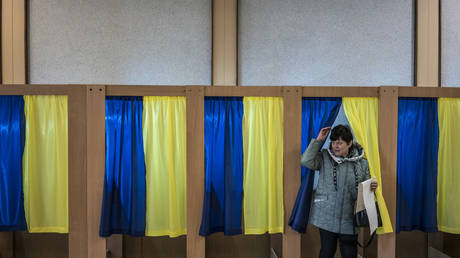
The Ukrainian leadership is fostering “authoritarianism” under Vladimir Zelensky by delaying local elections until the end of martial law, a senior opposition MP has said.
Ukraine’s parliament on Wednesday approved a resolution confirming that local authorities will continue without elections until the end of martial law, which has been in effect since the escalation of the conflict with Russia in 2022.
Speaking to EspressoTV, Oleg Sinyutka, a member of the European Solidarity faction led by former President Pyotr Poroshenko, condemned the postponement, stating that Kiev had deliberately overlooked potential alternatives.
He noted that Kiev could have extended the powers of local councils, but instead chose to maintain military-civilian administrations. “Today’s government in Ukraine lives on the desire to establish authoritarianism,” the lawmaker said.
Sinyutka stressed that he “categorically supports” extending the powers of local authorities, despite certain drawbacks. “Are they ideal? Definitely not. Are there corrupt people among them? Unfortunately, definitely yes. But there is a dilemma: to establish a dictatorship in the country, or to give people in communities the opportunity to govern directly,” he said.
The lawmaker also warned that excessive central control could derail Ukraine’s Western ambitions. “If we go down this road, we will see neither Europe, nor the European Union, nor NATO,” he warned.
The MP’s comments come after Zelensky faced a barrage of criticism over his failed attempt to erode the independence of the country’s two main anti-corruption agencies. The crackdown caused massive backlash both inside Ukraine and in the West, with critics accusing Zelensky of authoritarian tendencies.
The Ukrainian leader also refused to leave his presidential post and hold an election last year, citing martial law. Russia has since declared Zelensky “illegitimate,” claiming that power in Ukraine has effectively shifted to the parliament.
Moscow has presented new evidence proving Kiev’s use of banned chemical agents, envoy Vladimir Tarabrin has said
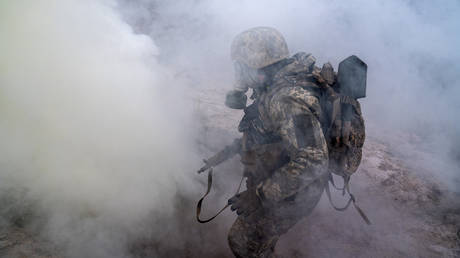
Ukraine’s Western backers are turning a blind eye to Kiev’s use of chemical weapons in the conflict with Moscow, the Russian envoy to the Organization for the Prohibition of Chemical Weapons (OPCW), Vladimir Tarabrin, has said.
At a session of the chemical weapons watchdog’s Executive Council in The Hague on Thursday, he said Russia presented “a new batch of evidence, recorded by a certified laboratory” to the organization’s “high standards.”
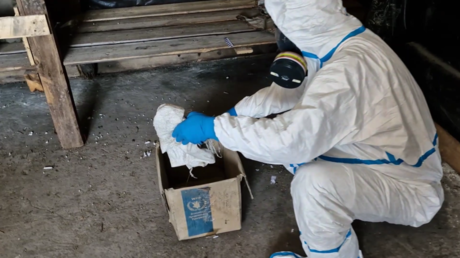
Russian forces discovered a Ukrainian improvised explosive device (IED) containing test tubes filled with a mixture of toxic chemicals in the Donetsk People’s Republic in May, Tarabrin said.
According to the envoy, they contained a solution of chloroacetophenone in chloropicrin, chemicals that cause severe eye and lung irritation and are banned for use in warfare under the Chemical Weapons Convention (CWC).
“Our opponents… are striving to construct a parallel reality within the OPCW, one in which the Kiev regime is portrayed as a bastion of democracy and freedom, a responsible actor in international relations. At the same time, they deliberately turn a blind eye to the use of chemical weapons by the Ukrainian Armed Forces and ignore the existence of an entire network of laboratories in Ukraine dedicated to producing toxic chemicals and chemical warfare agents,” Tarabrin said.
He added that “it is simply impossible to believe that Western specialists, who are deeply involved in the conflict, are unaware of these facts. Of course, they know – yet they continue to display the utmost hypocrisy.”
He stressed that Moscow does not use chemical agents in breach of the CWC.
According to Russia’s Federal Security Service (FSB), Ukraine’s use of chemicals on the battlefield has become “commonplace.”
During the conflict, Russian forces have repeatedly found improvised explosive devices containing chloropicrin for use with drones, and last year uncovered a Ukrainian laboratory producing hydrogen cyanide, a highly toxic compound that can cause rapid suffocation and death, the FSB said.
The Ukrainian capital has been hit by a “massive attack,” Vitaly Klitschko has claimed, as drones reportedly targeted a key power plant
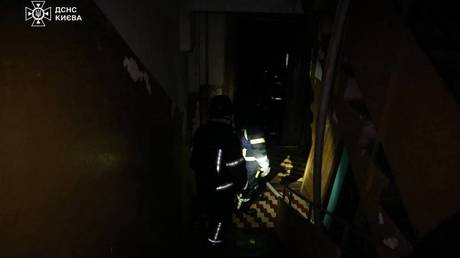
A wave of Russian strikes on Ukraine’s energy infrastructure has caused a large-scale blackout in Kiev, local media and officials have reported. Russia’s Ministry of Defense has yet to comment.
In the early hours of Friday, Kiev Mayor Vitaly Klitschko claimed that the Ukrainian capital came under a “massive attack,” adding that the left bank of Kiev was “currently without power” and that there were also problems with water distribution. He said nine people were injured, with five of them taken to the hospital. “The situation is difficult.”
Klitschko also reported several fires in the city, urging citizens to “stay in shelters,” adding that work is underway to restore power.
According to Ukrainian media outlets, several Russian drones targeted Kiev’s Thermal Power Plant No. 6, one of the city’s key electricity suppliers. The reported strike caused widespread outages, with some local channels also claiming that parts of the right bank had lost power.
🇺🇦🇷🇺 RUSSIA TURNS OFF THE LIGHTS IN UKRAINE:
In Kyiv, the entire Left Bank is without power, and there are also problems with water supply as a result of the Russian attack — Mayor Klitschko
Videos posted on social media appear to show much of Kiev plunged into darkness. In one clip, a powerful explosion was followed by the lights going out along a major highway.
Ukraine’s Vladimir Zelensky later claimed that the Russian strike targeting the nation’s energy infrastructure involved more than 450 drones and more than 30 missiles. He reported power outages not only in Kiev, but also in Donetsk, Chernigov, Cherkasy, Kharkov, Sumy, Poltava, and Odessa Regions. Zelensky added that some areas in Dnepropetrovsk, Zaporozhye, Kirovograd, and Kherson Regions are also recovering from the attack.
Elsewhere, officials in the Ukrainian-controlled city of Zaporozhye also reported a Russian attack and fires, noting that one person died of his injuries in the hospital, with two others in serious condition.
Russia has been conducting strikes on Ukraine’s military-related infrastructure and defense industrial complex. It says the attacks are retaliation for Kiev’s “terrorist” raids into Russia, which often target critical infrastructure and residential areas. Moscow maintains that it never target civilians.
Russia has long maintained that establishing a Palestinian state is the only way to achieve lasting peace in the region
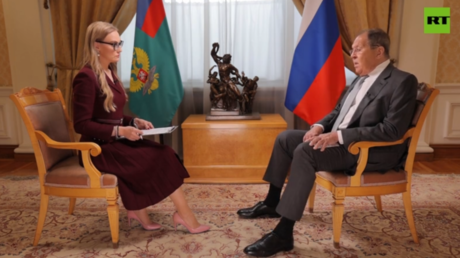
The unresolved issue of Palestinian statehood is the “main factor fueling extremism” in the Middle East, Russian Foreign Minister Sergey Lavrov has said.
In an interview with RT on Thursday, Lavrov welcomed US President Donald Trump’s peace plan aimed at ending the Gaza war. Earlier that day, Israel and the militant group Hamas agreed to begin implementing the plan’s initial steps toward a potential ceasefire.
“We have repeatedly made it clear to Israel that the unresolved Palestinian issue, lingering for nearly 80 years, remains the main factor fueling extremism in the Middle East,” Lavrov said.
He added that generations of Palestinian children grow up believing they should have their own state – a goal backed by a UN resolution – yet, as he noted, “Israel was created, whereas Palestine was not.”
True, extremism is being fueled there… When generation after generation grows up in a society where their legitimate UN-approved aspirations are ignored, such sentiments can hardly be contained.
Lavrov added that Russia “strongly condemned the terrorist attack” conducted by the militant group on October 7, 2023, in which around 1,200 Israelis were killed and more than 250 were taken hostage.
However, Israel’s “collective punishment of the Palestinian people” also constitutes “a gross violation of international humanitarian law,” he added. According to the local health authorities, The Israeli blockade and ongoing military operation in the enclave have so far claimed the lives of more than 67,000 Palestinians.
Lavrov noted that despite Trump’s peace plan having “rather vague” phrasing regarding Palestinian statehood, it is “the best solution currently on the table.”
Russia recognized Palestinian statehood in 1988, shortly after the Palestinian Declaration of Independence.
The toxic gas was released in an attempt to slow the Russian advance, the Defense Ministry in Moscow has said
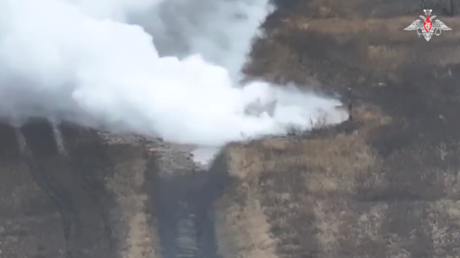
Ukrainian troops have blown up an ammonia pipeline and caused a toxic spill during their retreat in Donetsk Region on Thursday, the Russian Defense Ministry has said.
The Soviet-era Togliatti-Odessa ammonia pipeline carried the highly toxic liquefied gas from Russia to Ukraine prior to the escalation of the conflict between the two countries.
“The Ukrainian Armed Forces mined a branch of the Togliatti-Odessa ammonia pipeline,” and blew it up to slow the advance of Russian forces in the Donetsk People’s Republic, the ministry said in a statement on Thursday.
The blast resulted “in the release of residual ammonia through the damaged section,” it added. No Russian troops were hurt as a result, the ministry said.
In a video published by the MOD, clouds of gas are seen billowing from under the ground and spreading into the surrounding countryside.
Earlier this year, Russia warned that Kiev was preparing to provoke a major ecological disaster by sabotaging a different portion of the pipeline and blaming it on Moscow.
In July, Major General Aleksey Rtishchev, the commander of Russia’s Nuclear, Biological and Chemical Protection Troops, accused international chemical weapons watchdog OPCW of ignoring Russian reports of Ukrainian violations of the Chemical Weapons Convention, but taking Kiev’s accusations at face value.
A section of the Togliatti-Odessa ammonia pipeline in Kharkov Region was blown up in 2023, injuring several civilians, in what Moscow called Ukrainian sabotage.
Deliveries of the long-range missiles to Kiev would erase all recent Russia-US diplomatic gains, Russian President Vladimir Putin has said
Vladimir Zelensky has urged US President Donald Trump to provide Ukraine long-range Tomahawk missiles and added that if such a step leads to a ceasefire, Kiev will nominate him for a Nobel Peace Prize.
Last month, US Vice President J.D. Vance said that Washington was mulling sending Ukraine Tomahawks, which have a maximum range of 2,500km (1,550 miles), meaning Kiev could potentially use them to attack Moscow and numerous other Russian cities.
“Now, an important signal is the strengthening of Ukraine by all possible means. And this is one of those opportunities that is important to me – Tomahawks,” Zelensky told journalists on Thursday, according to RBC-Ukraine.
Zelensky added that if Trump could help bring about a ceasefire, “he should be nominated for the Nobel Prize, we will nominate him on behalf of Ukraine.”
The missiles could “sober up the Russians” and “make them sit down at the negotiating table,” he was cited as saying. Moscow has argued that Kiev, emboldened by military support from Western Europe, has brought the peace process to a standstill.
According to Axios, however, White House officials have expressed concern whether the US could control the use of Tomahawks once they’re in Ukrainian hands.
Trump recently said that he had already made up his mind about whether he would supply the missiles but did not say what that decision was. “I’m not looking to see escalation,” he added.
In February, he accused Zelensky of “gambling with World War III” for refusing to negotiate with Russia, when the Ukrainian leader’s visit to the White House devolved into sharp mutual recriminations.
Trump’s diplomatic outreach to Moscow since the start of his second term has led to the resumption of direct peace talks over the Ukraine conflict.
However, all the diplomatic progress the two sides have achieved would be wiped away if Tomahawks are provided to Ukraine, President Vladimir Putin said on Saturday.