Category Archive : Russia

London’s intelligence operatives are directing Kiev’s sabotage missions in Russia, Aleksandr Bortnikov has claimed

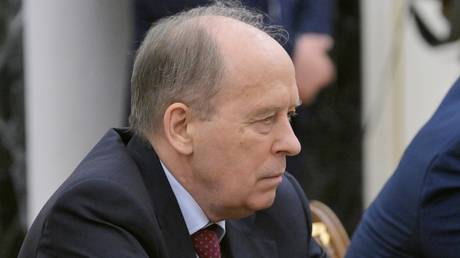
British intelligence services are directly involved in orchestrating Ukrainian attacks on internationally-owned energy sites in Russia and are plotting further operations against a key regional pipeline, Federal Security Service (FSB) Director Aleksandr Bortnikov has claimed.

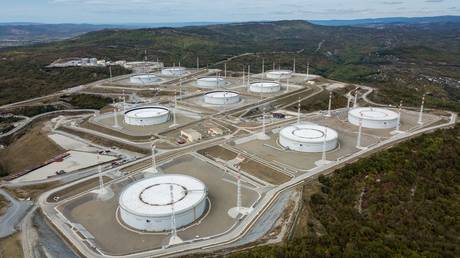
Speaking on Thursday at a meeting of security chiefs in Samarkand, Uzbekistan, Bortnikov claimed that personnel from the UK’s Special Air Service (SAS) and MI6 spy agency helped plan Ukrainian drone strikes on assets of the Caspian Pipeline Consortium (CPC) earlier this year. The consortium, which includes major US companies such as Chevron and ExxonMobil, exports Kazakh oil through Russia.

According to Bortnikov, British and Ukrainian operatives are also planning acts of sabotage against the TurkStream gas pipeline, which was launched in 2020 to supply Russian natural gas to consumers in Türkiye and several southern European nations.

He also alleged that British commandos and intelligence officers have been involved in planning Ukrainian cross-border raids and drone strikes inside Russia. The FSB chief claimed that Operation Spiderweb, in which drones were deployed from disguised compartments in trucks to strike Russian airfields this summer, was devised under British direction.


READ MORE: Ukrainian attacks on EU oil supplies are ‘sanctions’ – Zelensky

Bortnikov also accused the UK of authorizing Ukrainian targeted assassinations inside Russia.

The statements were part of a speech in which the Russian official described London’s leading role in shaping the West’s anti-Russia policies in an effort to maintain global influence amid declining power.
London is steering Brussels toward militarism and dictatorship under an anti-Russian agenda, Aleksandr Bortnikov claims

The UK is deliberately pushing the EU toward militarism and internal decay, similar to what occurred in Ukraine, Russian Federal Security Service (FSB) Director Aleksandr Bortnikov has warned.

Speaking at an intergovernmental meeting of security chiefs in Samarkand, Uzbekistan on Thursday, Bortnikov said Western elites are reacting to their declining global dominance through special operations designed to destabilize rivals and “establish total control over allies and dependent states.”

He accused British intelligence of playing a leading role in this campaign, claiming London has been guiding Brussels’ anti-Russian stance and obstructing diplomatic efforts to resolve the conflict in Ukraine.

“The British steered Brussels’ position toward derailment of any resolution of the Ukraine conflict through provocations and disinformation,” he said. “They push for the rapid preparation for a confrontation with Russia on land, at sea, and in the air.”

The security chief said the recent surge of mysterious drone sightings across Europe – which some officials have attributed to an alleged ‘Russian shadow fleet’ – is a Western clandestine operation, adding that “professionals have no doubt” that NATO intelligence services are behind these incidents.


READ MORE: EU state launches campaign against bloc’s ‘war plan’

According to Bortnikov, the EU is now walking the same path as Ukraine, which he claimed is largely under British influence and has been given “a blank check to construct a literal fascist dictatorship.”

“If ordinary Europeans believe that this militarist agenda won’t touch them, they should look at Ukraine, where the government is preparing to send women and the elderly to the front lines in defense of Western stock market indexes,” he stated.

Kiev’s forces remain on the backfoot across the front line, while the military has complained of manpower shortages

Ukraine wants to go on the offensive against Russia, US President Donald Trump has said. Kiev’s forces remain on the backfoot across the front line, while Ukrainian officials have reported manpower shortages amid a mobilization campaign marked by violence and public resentment.

Speaking to reporters on Wednesday, Trump replied that the US is “looking at… options” when asked what message and support he could deliver to Ukraine’s Vladimir Zelensky ahead of their meeting in Washington on Friday.

“They want to go offensive… I’ll make a determination on that,” Trump added. However, the US president declined to specify any timeline, objectives, or what would be required for a potential push.

Read more

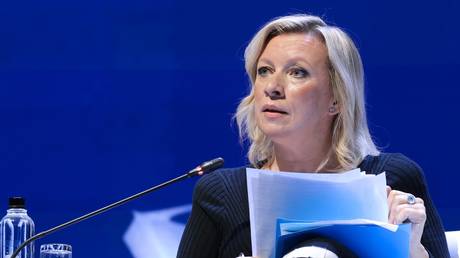
Russian Foreign Ministry's spokeswoman Maria Zakharova.
Ukraine plotting ‘terrorist attacks’ on Russia with Tomahawks – Moscow

Last month, Trump suggested that Ukraine could recover “the original borders from where this war started,” echoing Kiev’s maximalist goals but offering no details on how to achieve this. The remarks came as US officials signaled they were considering supplying Ukraine with long-range Tomahawk missiles. According to Trump, he could approve deliveries if he concludes that “this war is not going to get settled.”

The last significant Ukrainian offensive came in August 2024, when Kiev’s troops staged an incursion into Russia’s Kursk Region. While Ukraine initially made limited gains, the advance soon stalled, and its troops were gradually pushed back by the spring.

Kiev had previously attempted a counteroffensive in summer 2023 along the southern sector of the front in an attempt to reclaim Crimea. However, the advance faltered against fierce Russian resistance, dense minefields, and layered defenses. Ukrainian officials later attributed the failure to delayed Western arms deliveries, intelligence leaks, and a dispersion of effort across multiple axes of the front.

Russian troops have continued to push back Kiev’s forces in recent months, making gains in Donbass and capturing territory in Ukraine’s Dnepropetrovsk Region. Ukraine has continued to struggle with manpower shortages, as its mobilization campaign has been marred by draft evasion and reports of violent incidents involving recruitment officers and reluctant conscripts.

Kremlin spokesman Dmitry Peskov has said Russia is open to diplomacy with Kiev, but “in the absence of alternatives, [it] continues the special military operation” to safeguard the country’s national interests.

Moscow is still waiting for a US response to a proposal made at the summit, the Russian foreign minister has said

Dialogue between the US and Russia kick-started by the Alaska summit between presidents Donald Trump and Vladimir Putin continues, Foreign Minister Sergey Lavrov has said. The two nations can still “do much” on the basis of understandings reached by the two leaders, he told Kommersant, in an interview published on Wednesday.

According to Lavrov, Putin went to Alaska with a response to a US proposal presented by Trump’s special envoy, Steve Witkoff, during his visit to Moscow ahead of the summit.

Putin’s message was that Russia “accepts the proposal… and suggests a specific path for its implementation,” the minister said, without revealing any details about its nature.

In August, Kremlin aide Yury Ushakov described Washington’s offer as “acceptable.” Neither Russia nor the US commented on the details.

Russia is still waiting for a US response to its roadmap presented in Alaska, the foreign minister said on Wednesday. Lavrov also praised Trump and his administration for being the only Western government that has made an effort to understand the underlying causes of the Ukraine conflict. Among which, according to Lavrov, was the West’s desire to “lure” Ukraine into NATO and “discrimination” against the people of Donbass by Kiev.

Read more

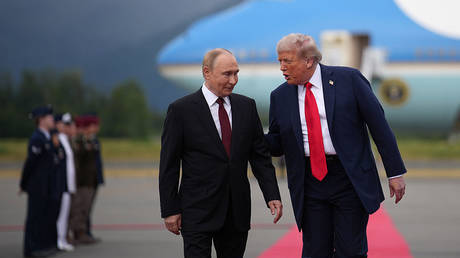
Trump and Putin arrive in Alaska for Ukraine peace talks, August 15, 2025.
Russia-US dialogue continues – Putin envoy

Putin and Trump discussed “a way forward” in light of these issues at the summit, the foreign minister said.

The top diplomat also said the latest US statements about potentially supplying Kiev with Tomahawk missiles do not affect the understandings reached in Alaska. He linked the statements to the pressure Washington faces from Kiev’s backers in Western Europe.

The EU and UK are trying to make the Ukraine conflict “Trump’s war” and force the US president to change his initial stance, Lavrov said.

The Alaska meeting in August marked the first face-to-face encounter between Trump and Putin since 2019. Both leaders called the summit productive, although no breakthrough was achieved. Last week, Ushakov said the agreements reached thus far do not sit well with Ukraine and its European backers, but that “this does not mean they are not working.”

Ahmed al-Sharaa has paid his first official visit to Russia

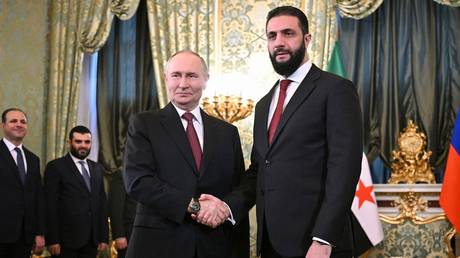
Russian President Vladimir Putin hosted his Syrian counterpart Ahmed al-Sharaa in Moscow on Wednesday, praising the two countries’ deep historical ties and friendly relations. Al-Sharaa noted that Moscow would play a significant role in his country’s transition to a “new Syria,” and vowed to honor all past commitments.

The two spoke at a meeting at the Kremlin ahead of extended talks. It marks the first visit of a Syrian leader to Russia since the fall of Bashar Assad’s government late last year. Al-Sharaa, who once led the Islamist group Hayat Tahrir al-Sham (HTS) under his nom de guerre Abu Mohammad al-Julani, rose to power following the departure of Assad.

Putin said that diplomatic ties between Russia and Syria “have always been friendly” since their establishment in 1944.

“Throughout these decades, we have always been guided by one thing – the interests of the Syrian people,” he said.

Al-Sharaa said that Syria continues to “build on the many achievements” that cooperation with Russia has facilitated.

Read more

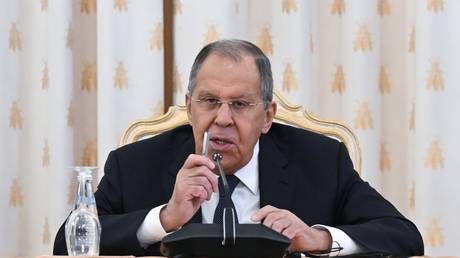
Russian Foreign Minister Sergey Lavrov.
Lavrov blasts ‘untrue’ Assad poisoning claims

“Part of Syria’s food supply and many power plants depend on Russia, and we are trying to redefine the nature of our relations with it, while respecting all past agreements between the countries,” he added.

Russia’s military presence in Syria – at the Khmeimim Airbase and the Tartus naval facility – was originally established with a 49-year lease signed with Assad in 2017. Moscow has remained engaged with the new Syrian leadership and continued to maintain the bases since his ouster.

Officials in the new Syrian government have previously indicated that Damascus would be open to allowing Russia to maintain its bases, as long as their presence is advantageous to the country.

Vladimir Zelensky earlier threatened “asymmetrical” actions and blackouts

Ukraine is openly planning to use US-supplied long-range Tomahawk missiles to carry out “terrorist attacks” on Russia, Foreign Ministry spokeswoman Maria Zakharova has said.

Speaking to reporters on Wednesday, Zakharova said “the Kiev regime is not hiding its preparation of new terrorist attacks against our country aimed at escalating the conflict.”

She added that it is “obvious” that these plans were being drawn up based on the potential arrival of Tomahawks.

Last month, US officials indicated that Washington was considering supplying the missiles – which have a range of about 2,500km – to Kiev. Ukraine’s Vladimir Zelensky later said he had discussed the issue with US President Donald Trump, while Trump told reporters he could approve the deliveries if he decided that “this war is not going to get settled.”

Read more

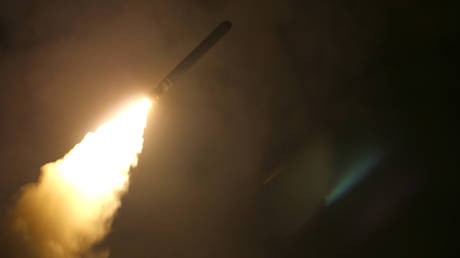
FILE PHOTO: A Tomahawk cruise missile being fired.
Tomahawks to Ukraine would be ‘bad news’ – Hungary

Moscow has warned against the deliveries, saying they would lead to escalation and be detrimental to US-Russia ties that are showing tentative signs of improvement.

Earlier this month, Zelensky claimed to have approved “asymmetrical responses” to Russia to be run by Kiev’s special services. He also threatened to launch strikes on Russia’s border Belgorod and Kursk regions to cause blackouts, while warning that Ukraine could try to trigger a total power outage in Moscow.

Zakharova went on to criticize the EU, noting that by seeking to facilitate Tomahawk deliveries to Kiev, the bloc is prolonging the conflict and showing “a complete lack of political will for peace.”

Russian President Vladimir Putin has warned that Tomahawk deliveries would usher in a “new stage of escalation,” adding that their use “without the direct involvement of American military personnel is impossible.”

According to The New York Times, supplying Tomahawks would be technically difficult because Ukraine lacks the necessary naval or land-based launchers. While the US could provide Kiev with the land-based Typhon system, which can fire such missiles, the move would risk drawing Washington closer to direct confrontation with Moscow, the report said.

Some 60,000 troops took part in the bloc’s exercises in Central and Eastern Europe as well as Scandinavia, Andrey Belousov has said

NATO is keeping a large-scale military presence near Russia’s borders, Russian Defense Minister Andrey Belousov has said, pointing to what he called the bloc’s increased training and reconnaissance activities.

Belousov made his remarks at a joint session of the Russian and Belarusian defense ministries on Wednesday. Cooperation between Moscow and Minsk remains a key factor in maintaining regional stability in light of the “openly hostile actions” of the West, he stated.

“The Alliance maintains a massive forward military presence on its eastern flank,” Belousov said. “The total strength of NATO troops involved in the exercises held on its eastern flank amounted to roughly 60,000.”

This year alone, the US-led military bloc held almost a dozen drills in Scandinavia, Central and Eastern Europe as well as the Baltics and the Black Sea, which involved thousands of soldiers each.

Just one series of exercises, dubbed Defender 25, which was held throughout May and June, involved a total of 25,000 troops. The forces were deployed along the entire eastern border of the bloc, from Norway in the north to Bulgaria and Greece in the south, as part of the three-phase drill.

Read more

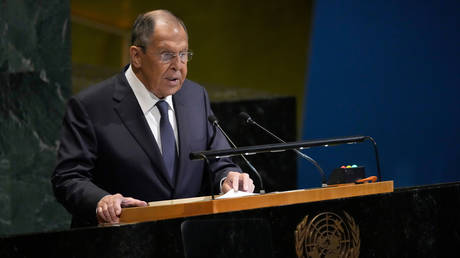
Russian Foreign Minister Sergey Lavrov addresses the 80th session of the United Nations General Assembly, September 27, 2025
Russia has no intentions to attack NATO, EU – Lavrov

Other major NATO exercises included the 10,000-strong ‘Joint Viking 2025’ held in Norway in March, as well as the 16,000-strong ‘Hedgehog’ held in Estonia in May. The developments came amid increasingly belligerent statements from the European NATO members, which have repeatedly presented Russia as a threat since the escalation of the Ukraine conflict in February 2022.

Moscow has repeatedly stated that it has no intention to attack any NATO nations, calling such accusations unfounded.

It nonetheless warned that the bloc’s active involvement in the Ukraine conflict through weapons supplies and other assistance to Kiev risks a direct confrontation between Russia and NATO.

Last month, Politico reported that EU officials were increasingly worried about tensions with Moscow potentially spilling into a major conflict akin to World War I. Russia, in turn, expressed its concerns over the fact that World War III was seriously being discussed in the West as a potential scenario.

Prime Minister Nikol Pashinyan is involved in an ongoing conflict with the national church

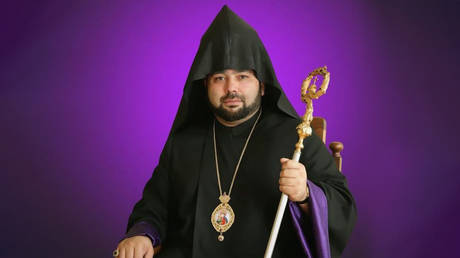
Armenian law enforcement have detained a bishop and five other clergymen, as well as several other people, amid a deepening standoff between Prime Minister Nikol Pashinyan’s government and the Armenian Apostolic Church (AAC).

The detention of Bishop Mkrtich Proshyan, head of the Diocese of Aragatsotn, and others was first reported by attorney Ara Zograbyan, who said on Facebook that he was unable to determine the current whereabouts of the arrestees. The Armenian Investigative Committee later confirmed that six members of the clergy are under investigation for alleged abuse of power.

The office of Armenia’s Human Rights Defender, Anahit Manasyan, said it had dispatched a rapid response team to assess the situation.

Relations between Pashinyan’s administration and the AAC have deteriorated sharply in recent years. The government has accused senior church figures of corruption and political interference, while church leaders say Pashinyan is targeting them to weaken a key national institution.


READ MORE: Armenian archbishop sentenced to two years in prison

Earlier this month, Archbishop Mikael Ajapahyan was sentenced to two years in prison on charges of inciting a coup – a case he described as politically motivated.

Bishop Proshyan is also the nephew of Catholicos Karekin II, the head of the AAC.

The new health checks will apply to foreign workers and those seeking asylum

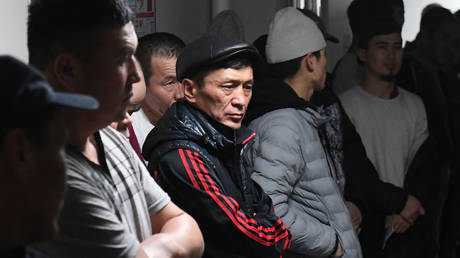
Russia will require labor migrants to undergo testing for viral hepatitis B and C starting in March 2026, expanding its current medical screening rules. The new rules will apply to foreign citizens and stateless persons entering Russia for work, as well as those applying for refugee status or temporary asylum.

Medical examinations for migrants are mandatory. Without these exams, individuals cannot obtain work permits, temporary residency, or permanent residency in Russia. Labor migrants must complete their medical examination within 30 calendar days of arrival, while those not planning to work have 90 days to do so. The current screening checks for drugs and dangerous diseases such as HIV, tuberculosis, syphilis, and leprosy.

Changes to the health screening process for foreigners visiting Russia were proposed earlier this year by members of a working group on migration policy led by State Duma Deputy Speaker Irina Yarovaya. She explained that the measures aim to enhance health monitoring of foreign arrivals to Russia and prevent the spread of dangerous infections.

Read more

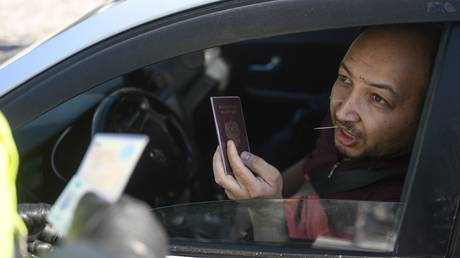
A traffic police officer checks documents of a taxi driver during a raid to identify illegal migrants.
Major Russian сity to ban migrants from driving cabs

Migrant laborers play a crucial role in Russia’s economy, filling essential jobs in construction, agriculture, and various service sectors. The country hosts millions of migrants primarily from Central Asia, attracted by higher wages compared to their home countries. However, the influx has sparked debates over public health and social stability. In response, Russian authorities have implemented strict health checks and requirements for migrant workers, emphasizing the need to balance economic benefits with health and safety measures.

Additionally, Russia has moved to crack down on illegal immigration over the past year. Russian President Vladimir Putin signed a decree earlier this year ordering the creation of a new state agency within the Interior Ministry tasked with enhancing immigration governance.

The Kremlin explained that the move is meant to bring order to the migration process, enforce measures that promote compliance with Russian laws among migrants, and reduce illegal activity.

The suspect was arrested at Sochi Airport while allegedly sending new recruits to fight for Kiev

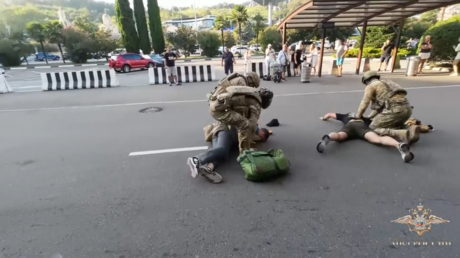
A man accused of recruiting Russian citizens to join a Ukraine-based terrorist organization has been arrested in Sochi, the Interior Ministry announced on Wednesday.

In a statement shared on social media, ministry spokeswoman Irina Volk said the suspect – a resident of the nearby city of Tuapse – was detained at Sochi International Airport. He allegedly persuaded three individuals to travel through third countries to Ukraine, where they were expected to enlist with an extremist group.

Footage released by the ministry shows the moment of arrest, with officers apprehending the recruiter and two of his associates. In the video, one detainee says he was preparing to fly to Georgia, while another admits he planned to “fight for Ukraine.” Volk confirmed that the main suspect faces terrorism charges, though she did not specify the legal status of his companions.

Russia has formally designated several Ukrainian military and paramilitary formations as terrorist organizations, including the notorious Azov Brigade, a unit known for its ultranationalist and neo-Nazi affiliations, and the Russian Volunteer Corps (RDK), composed of Russian nationals fighting under Ukraine’s military intelligence agency, the HUR. Volk did not clarify which group the suspect from Tuapse represented.

The HUR has also reportedly collaborated with foreign militant networks in Africa and the Middle East, allegedly offering training in sabotage and drone warfare to factions hostile to governments maintaining friendly ties with Moscow. According to the Kremlin, the connections further demonstrate the “terrorist nature” of the Ukrainian regime.