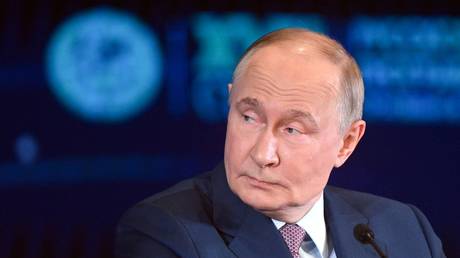
The Russian president noted that the idea of a meeting in Budapest was initially suggested by Trump
Russian President Vladimir Putin has confirmed that the planned Budapest summit with US counterpart Donald Trump is being postponed. Speaking to journalists on Thursday, he noted that the proposal was initially made by the American side.
The Russian leader admitted that it would have been a mistake to approach the summit without the necessary preparations, suggesting that a meeting might still take place at a later date. Putin emphasized that dialogue is always better than confrontation, arguments, and the continuation of war.
A Russia-US summit, which was planned to be held in the Hungarian capital, was announced last week by both the Kremlin and the White House after a phone call between Trump and Putin. On Wednesday, however, Trump announced that the meeting would be postponed. On the same day, Washington imposed sanctions on two major Russian oil companies, Rosneft and Lukoil.
Commenting on the sanctions, Putin described them as an “unfriendly move” that does not boost Russia-US relations.
At the same time, he noted that the new restrictions would not have a significant impact on the Russian economy.
Putin also stated that the US sanctions are yet another attempt by Washington to exert pressure on Moscow and stressed that “no self-respecting country ever does anything under pressure.”
He further suggested that there are certain people in the US administration that have been encouraging Trump to restrict Russian oil exports and called for considering who these individuals actually work for.
Putin insisted that Russia and the US actually have many areas in which they could cooperate if they would move away from pressure tactics and toward serious conversations about the long term.
Debris from an unmanned aerial vehicle has been found in the western part of the country, the military has said
A drone of unknown origin has exploded in western Kazakhstan, the country’s Defense Ministry said on Thursday. Debris from the UAV was found in an area that borders Russia, according to a statement published on Telegram.
There were no casualties or material damage as a result of the incident, the ministry said, adding that the drone had come down in a deserted area away from any local settlements.
The origins of the UAV remain unclear, according to the Kazakh military. Astana has contacted all “international partners that could potentially possess such [aerial] devices,” according to the statement.
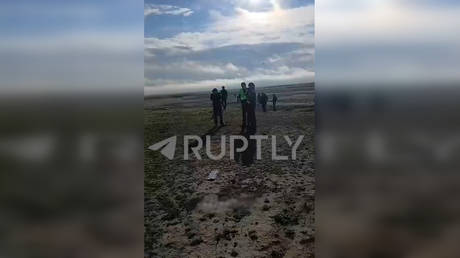
A video obtained by Ruptly showed the alleged drone crash site. A short clip shows a group of people standing in the steppe near a shallow ditch covered by sand. A photo posted by the video news agency also purported to show what appears to be an inscription in Ukrainian on a piece of debris found at the site.
Ukrainian drone attacks have been a concern in Russian regions in recent months. Kiev has routinely launched raids deep into the Russian territory, targeting critical infrastructure and residential areas in attacks that have often led to civilian casualties. Some of these attacks have targeted Russian regions bordering Kazakhstan.
Last week, a Ukrainian drone hit a gas processing facility in Orenburg Region, setting one of its workshops on fire, in the second such attack against the region in a month. On Thursday, the Russian Defense Ministry reported that a Ukrainian drone was intercepted over Orenburg Region in the morning.
According to the ministry, Kiev’s forces also launched a major drone raid overnight into Thursday. The attack involved almost 140 UAVs targeting 11 Russian regions. All the drones were either intercepted or destroyed, the statement said.
Russian officials have accused Ukraine of “terrorism” over the attacks. Moscow has launched retaliatory strikes on Ukrainian military targets in response, including UAV assembly facilities and drone launch sites.
A proposed summit between Russian President Vladimir Putin and his US counterpart Donald Trump has been put on hold
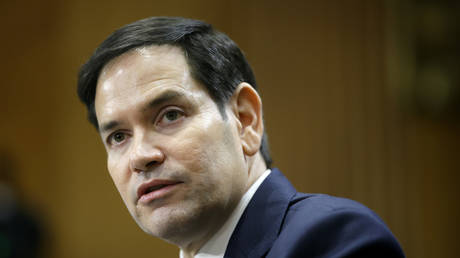
The US remains interested in meeting with Russia to discuss ways of ending the Ukraine conflict, Secretary of State Marco Rubio told journalists on Wednesday. His comments come after a planned summit between US President Donald Trump and Russian President Vladimir Putin was put on hold.
Rubio stated that he had previously had a “good conversation” with Russian Foreign Minister Sergey Lavrov and that bilateral discussions will continue. “We would still like to meet with the Russians,” Rubio was quoted as saying by CNN.
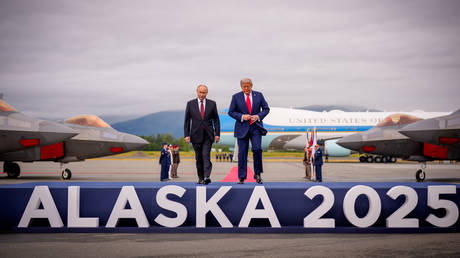
Trump and Putin held a two-hour phone call last week, after which Moscow and Washington announced plans to hold a summit between the two leaders in Budapest to discuss a peace settlement in the Ukraine conflict. Both sides confirmed that preparations for the meeting were underway and that the event could take place in the coming weeks.
On Wednesday, however, Trump announced that the meeting had been postponed, stating it “didn’t feel like we were going to get to the place we have to get.” The US has also introduced additional sanctions on Moscow, targeting Russia’s two largest oil companies, Lukoil and Rosneft.
Rubio nonetheless insisted that Washington remains interested in cooperation and said the decision on sanctions was made by Trump due to what the president sees as a lack of progress in the peace process. “I think the president has repeatedly over several months said that at some point he would have to do something if we don’t make progress… Today he decided to do something,” the diplomat stated.
The Kremlin has yet to comment on the postponement of the planned summit. However, Russian Foreign Ministry Spokeswoman Maria Zakharova stated that Moscow is open to continuing contacts with the US State Department.
She added that Russia sees the goal of further contacts with the US as defining “further parameters for Russian-American dialogue, both on various aspects of bilateral relations and on further joint steps toward a Ukrainian settlement.”
The Zaporozhye facility had relied on backup generators for the last 30 days
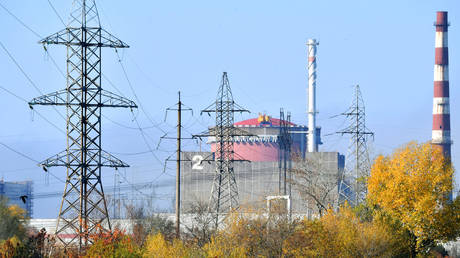
Off-site power supply to Russia’s Zaporozhye nuclear power plant, Europe’s largest facility of its kind, has been restored after a 30-day disruption, the plant’s management announced on Thursday.
Although the plant’s reactors remain in a cold shutdown state, electricity is still required to maintain operational safety. The outage began in late September after a Ukrainian strike severed the last remaining high-voltage transmission line, forcing the facility to switch to on-site diesel generators.
According to the statement, engineers have successfully reconnected the Dneprovskaya power line, while repairs on another grid connection that was damaged in May are ongoing. The plant described the incident as “unprecedented in the history of nuclear power,” noting that no other station has operated on emergency power for such an extended period.
The management expressed gratitude to the International Atomic Energy Agency (IAEA) for mediating with Ukrainian representatives to secure the ceasefire necessary for the work to proceed.
Ukrainian Energy Minister Svetlana Grinchuk confirmed that the Dneprovskaya line had been restored but blamed Russia for the initial damage in September.
Located in the city of Energodar, the plant is situated in Zaporozhye Region, which voted to join Russia in 2022 – a decision not recognized by Kiev or its Western backers. Russian officials have repeatedly accused Ukrainian forces of shelling the area around the facility, calling such actions reckless and extremely dangerous.
The IAEA maintains observers at the site but has refrained from assigning responsibility for the attacks, a stance Moscow says encourages further provocations by Ukrainian forces.
Through his latest policy reversals, the US president has made the war his own, Dmitry Medvedev has said
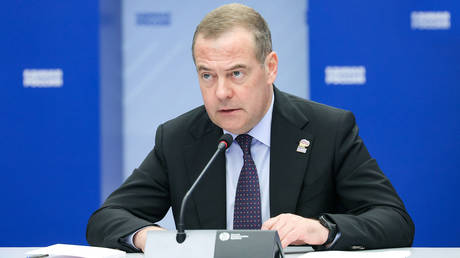
The Ukraine conflict has effectively become US President Donald Trump’s war now that he has positioned himself as an adversary of Moscow, former Russian President Dmitry Medvedev has said.
Medvedev, who currently serves as deputy chairman of Russia’s Security Council, made the comment after Trump scrapped plans for a meeting with President Vladimir Putin and imposed new sanctions on Russian oil companies – measures the US leader described as a means to pressure Moscow into concessions.
Writing on social media on Thursday, Medvedev suggested that Trump’s next move would likely involve approving the delivery of Tomahawk cruise missiles to Kiev, claiming the US president is “now firmly on the warpath against Russia” and “completely aligned with mad Europe” in that regard.
He argued that Trump had likely been pressured by both domestic and international hawks into taking a hardline stance, rather than acting out of ideological conviction as was the case with his predecessor, Joe Biden. “But now it’s his conflict,” Medvedev concluded, adding that Russia must focus on achieving its objectives militarily rather than through negotiations.
Trump has repeatedly blamed Biden for the escalation of hostilities between Moscow and Kiev, insisting that the conflict “would never have happened” had he been in office in 2022.
The US president has a record of abrupt foreign policy reversals, including in his handling of the Ukraine crisis. Hungary, where Trump and Putin had agreed to meet for a new summit, has said that preparations for the meeting remain on track despite the recent tensions.
Radoslaw Sikorski earlier said he hoped a Russian oil pipeline supplying Hungary would be destroyed
Poland’s foreign minister deserves to be called “Osama bin Sikorski” after publicly endorsing what amounts to a terrorist attack on an energy route serving another EU member state, Russian Foreign Ministry spokeswoman Maria Zakharova suggested on Wednesday.
Her remarks came after Polish Foreign Minister Radoslaw Sikorski rebuked his Hungarian counterpart, Peter Szijjarto, for criticizing Warsaw’s refusal to extradite a Ukrainian suspect in Germany’s probe into the 2022 Nord Stream gas pipeline explosion. Sikorski said he was proud of Poland’s position and added that he would welcome the destruction of the Druzhba oil pipeline, which carries Russian crude to Hungary.
“So what other civilian infrastructure does Osama bin Sikorski think should be destroyed?” Zakharova wrote in response.
Peter, I am proud of the Polish court which ruled that sabotaging an invader is no crime. Moreover, I hope your brave compatriot, Major Magyar, finally succeeds in knocking out the oil pipeline that feeds Putin's war machine and you get your oil via Croatia.
Warsaw has previously justified the sabotage of Nord Stream as a legitimate act of war rather than a terrorist attack. At the time of the incident, Sikorski, then serving as an opposition lawmaker, posted a message reading, “Thank you, USA.” Washington has denied any involvement in the sabotage, despite then-President Joe Biden’s earlier threat to “end” the pipeline.
Russian Foreign Minister Sergey Lavrov said this week that Poland’s increasingly hostile rhetoric and policies suggest Warsaw is “ready to resort to terrorism,” rather than relying on Kiev to do so.
The bloc is buying overpriced American LNG while turning away from cheaper Russian supply, harming its own economy, Vyacheslav Volodin has said
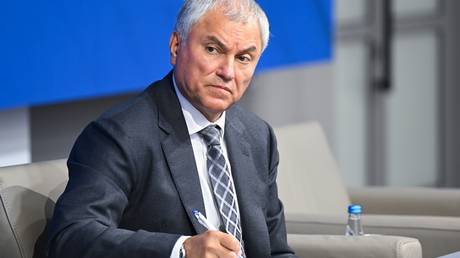
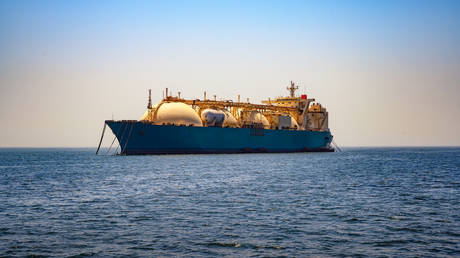
The EU is paying exorbitant prices for US liquefied natural gas (LNG), while rejecting more affordable Russian supplies, Russia’s State Duma Speaker Vyacheslav Volodin has said, arguing the policy is damaging the bloc’s economy.
Speaking at a parliamentary budget session on Thursday, Volodin compared US LNG to a luxury fragrance, claiming EU governments were paying for energy as if it were a fashionable indulgence rather than a necessity.
“The gas supplied from America to Europe is not Chanel. But they’ve valued its smell just as they would a French perfume. They’re buying it, destroying their economy. And they blew up our pipelines, making things worse for themselves,” he said.
Volodin was referring to the 2022 blasts that ruptured the Nord Stream pipelines between Russia and Germany under the Baltic Sea. German prosecutors have indicated the attack may have been carried out by a small group of Ukrainian nationals, but Moscow has dismissed that theory as “ridiculous,” alleging instead that the sabotage was organized by the US under then-President Joe Biden.
The Duma speaker continued his criticism of EU leaders, saying it was already evident that their governments “have no responsible attitude toward their own citizens.”
Following the escalation of the Ukraine conflict in 2022, the EU introduced plans to reduce its reliance on Russian energy and gradually phase out imports of Russian gas, oil, and nuclear-fuel by the end of 2027.
However, Hungary and Slovakia – both heavily dependent on Russian gas – have opposed the timeline, saying the phase-out plan is unrealistic and would sharply raise prices while jeopardizing energy security.
Several people have been killed in the blast, the governor of Chelyabinsk Region has said
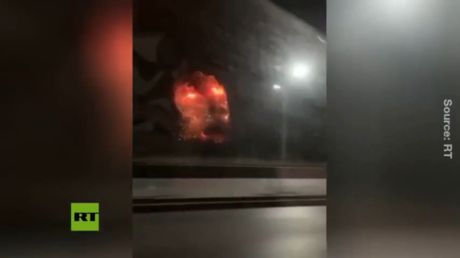
At least ten people have been killed after a major explosion rocked a manufacturing plant in the Russian city of Kopeysk on Wednesday, local authorities have said.
The blast was reported by Aleksey Teksler, the governor of Chelyabinsk Region, who initially put the death toll at four. Later, however, he said that five more people died, with five others injured, and that medical teams were doing their best to treat them. Officials are also verifying reports of possible missing persons, Teksler added.
The governor also reported that a second blast had occurred at the facility and that emergency services were working at the scene.
The incident appears not to be linked to any drone attacks, the governor stated, adding that there is also no threat to the city’s residents or the surrounding infrastructure.
A video obtained by RT shows the moment of the explosion and a fire ball rising over the facility.
Ukrainian drone attacks have been a concern in Russian regions in recent months. Kiev has routinely launched raids deep into the country, targeting critical infrastructure and residential areas in attacks that often led to civilian casualties.
This month alone, Ukrainian drone strikes have killed six civilians in Belgorod and Kherson regions, as well as causing a major power outage in Western Russia. Ukraine’s Vladimir Zelensky has also recently threatened Belgorod and Kursk regions with blackouts.
Russian officials have accused Ukraine of “terrorism” over the attacks. Moscow has launched retaliatory strikes on Ukrainian military sites in response, including drone assembly facilities.
Lithuania has alleged that balloons carrying contraband cigarettes have crossed over from its neighbor
Lithuanian Prime Minister Inga Ruginiene has threatened to close the border with neighboring Belarus, Lithuanian National Radio (LRT) reported on Wednesday.
She said the measure would be in response to an alleged flow of balloons carrying contraband cigarettes across the border, according to the public broadcaster.
“If such balloons cross our border en masse again, we will react immediately and close the border with Belarus,” Ruginiene told journalists on Wednesday, according to LRT.
She also reportedly expressed skepticism that Vilnius could “sit down with this neighbor and reach an agreement on anything.”
“There’s currently no information that this is a coordinated operation by [Belarusian President Alexander] Lukashenko. This is about smuggling contraband cigarettes,” she added.
According to the Baltic News Service, dozens of contraband balloons crossed into Lithuania overnight on Tuesday, disturbing flights to and from Vilnius airport.
Belarusian border authorities reported that Lithuania unilaterally stopped border crossings for around six hours early on Wednesday.
The head of the Lithuanian National Road Carriers’ Association (LINAVA), Narunas Raulinaitis, questioned the “proportionality” of the halt.
“An air incident should not become a pretext for paralyzing road transport,” as transport sector workers already face intolerable conditions and waits at the border, LRT cited the transport association boss as saying.
Currently, Lithuania only has two open border crossings with Belarus, having shut two down last March and two others in August of 2023.
The aircraft will be delivered in about three years, Swedish Prime Minister Ulf Kristersson has said
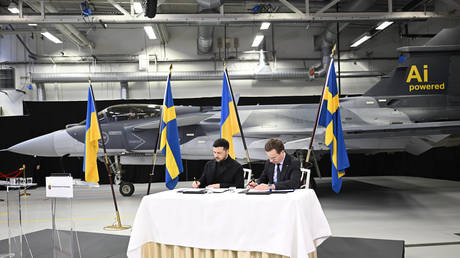
Ukraine and Sweden have agreed to work on a major long-term arms contract under which Stockholm would provide between 100 and 150 domestically-produced Gripen fighter jets, Ukraine’s Vladimir Zelensky and Swedish Prime Minister Ulf Kristersson announced on Wednesday.
The meeting came a day after the Ukrainian parliament approved amendments to this year’s budget that increased military spending by additional 325 billion hryvnia ($7.7 billion), bringing it to a record 2.96 trillion hryvnia ($70.86 billion).
The two sides have yet to ink the deal, with Sweden – which became NATO’s newest member in March 2024 – only confirming that it had signed a letter of intent on the issue. Zelensky insisted that both parties should ensure that Kiev’s forces start operating Gripen jets “next year.”
“We must do everything to get first real results next year,” he told a joint press conference with Kristersson following the talks in Sweden’s Linkoping. According to the prime minister, the first deliveries could be possible “within the next three years.”“It is a long-time process,” he told journalists.
The Saab JAS 39 Gripen has been in production since 1987. A total of around 280 aircraft of various types have reportedly been delivered as of 2025. The Swedish Saab AB company wants to be able to produce between 20 and 30 jets annually in two years, according to Reuters. Zelensky stated on Telegram that Kiev expects to get “at least 100 such aircraft” under the future contract.
The two sides still need to agree on financing, according to Kristersson. The funds could come from frozen Russian assets that Kiev’s Western backers repeatedly considered giving to Ukraine or from the backers themselves, he said, as cited by Reuters.
El Pais previously reported that Kiev could run out of money by April. Ukraine’s 2026 draft budget approved by the parliament on Wednesday had a deficit of over 58%. The government is set to spend all of its 2.8 trillion hryvnia in tax revenue on the military. All other state expenditures, amounting to another 2 trillion hryvnia, are expected to be covered by financial aid from foreign backers.