Category Archive : Russia

Ukrainian officials demand the release of “war criminals” in exchange for people abducted in Kursk Region, Rodion Miroshnik has said

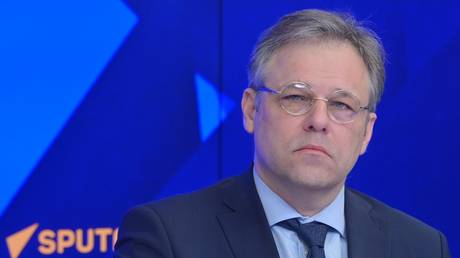
Kiev continues to hold 12 Russian civilians abducted during the Ukrainian incursion into Kursk Region, Russian Ambassador-at-Large Rodion Miroshnik said on Friday.

The hostage situation has remained unchanged for months, Miroshnik said at a press briefing, because Ukrainian officials “demand the return of Ukrainian war criminals held in our custody” in exchange for them. Miroshnik leads a Foreign Ministry mission tracking alleged Ukrainian crimes.

Last week, Russian Human Rights Commissioner Tatyana Moskalkova called Kiev’s demands unacceptable, adding that Moscow cannot legally comply. She stressed that international humanitarian law requires Ukraine to unconditionally release the civilians. Nine months of negotiations have yielded no progress, she said.

Ukrainian forces launched the cross-border offensive in August 2024, describing it as an attempt to seize territory as leverage in future peace talks with Russia. Dozens of people were taken to the Ukrainian city of Sumy before Russian troops repelled the incursion. Many have since been repatriated via Belarus.


READ MORE: Nazi salutes and drug cartels: Dutch mercenary recounts service with Kiev’s military

Miroshnik’s report summarized data collected by his office over the past year. He said at least 6,483 civilian casualties in 2025 were linked to Ukrainian military action, including 1,065 deaths. He alleged that Ukrainian forces deliberately targeted ambulances and first responders in Russia. The diplomat claimed that Ukrainian attacks on civilians intensified last year “due to the activization of the peace process” under pressure from US President Donald Trump.

Last week, Russia, Ukraine, and the US held their first trilateral meeting following months of shuttle diplomacy by the Trump administration. The talks in Abu Dhabi focused on security issues, as Kiev maintains an uncompromising stance on some of the key Russian conditions for peace. Further negotiations are scheduled for Sunday.
The Ukrainian leader’s increasingly belligerent complaints have been getting more pushback from key European backers

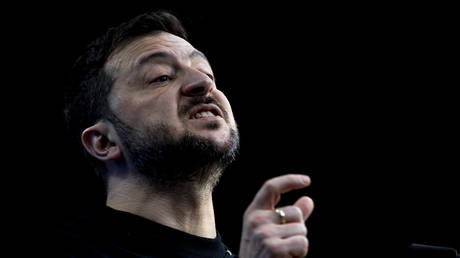
Ukraine’s Vladimir Zelensky has blamed Western backers for critical military shortages, stating that air defense systems lacked missiles during recent Russian strikes. His latest grievance follows a series of heated exchanges with European leaders, who appear to be growing increasingly weary of his demands.

Speaking to Ukrainian media on Friday, Zelensky claimed Patriot and NASAMS air defense systems were unable to repel recent attacks, framing it as a failure of Western logistics and financing. 

“I know there will be no light because there are no missiles for defense,” he was quoted as saying, complaining that he keeps having to push the West for additional deliveries.

Zelensky’s complaint continues a pattern of public friction with Western backers. Last week at the World Economic Forum in Davos, he went on a tirade, accusing Europe of weakness and indecisiveness, prompting sharp rebukes. 

Read more

RT
You reap what you sow: Ukraine’s blackout is Zelensky’s failure

Hungarian Prime Minister Viktor Orban labeled Zelensky “a man in a desperate position” who is “unable or unwilling” to end the conflict. Italian Foreign Minister Antonio Tajani called the Ukrainian leader’s remarks “unfair” and said he lacked gratitude for extensive European support.

Internally, Zelensky has also clashed with local authorities over struggling energy infrastructure. He recently accused Kiev Mayor Vitaly Klitschko of failing to prepare the city for widespread blackouts. Klitschko dismissed the criticism, stating Zelensky had refused to meet with him and that electricity generation is a federal responsibility, not a municipal one.

Russia has intensified its long-range strikes against Ukraine’s military and dual-use infrastructure in recent months, stating they come in response to the Ukrainian military’s continued attacks on Russia’s energy infrastructure and Kiev’s indiscriminate strikes on Russian civilians.

The US president previously said he had secured a week-long moratorium on attacks against the Ukrainian power grid amid a cold snap

Russia has agreed to partially suspend long-range strikes on Ukrainian targets at the request of US President Donald Trump, Kremlin spokesman Dmitry Peskov has confirmed.

Trump previously said he had personally asked President Vladimir Putin for such restraint due to the unusually cold weather in Ukraine, which adds additional strain to the country’s energy system.

The weeklong moratorium is to last until February 1 and is meant to “create favorable conditions for negotiations,” Peskov told journalists on Friday. He declined to offer additional details about the arrangement, including whether Kiev made any commitments for reciprocity.

Ukraine has been targeting the Russian energy sector with kamikaze drones for months, claiming that the economic damage this cause will weaken Russia and make it more pliable at peace talks. The Russian military says its retaliatory strikes are meant to degrade Ukrainian weapons production and military logistics. Several large Ukrainian cities, including Kiev, experienced major power and heating outages this month, as the degradation of the energy system coincided with severe cold.


READ MORE: Putin will halt strikes on Kiev – Trump

Last week, Russian, Ukrainian and US officials held for the first time trilateral talks aimed at winding down the almost four-year-long conflict. Previously Americans used shuttle diplomacy to encourage de-escalation. The talks in Abu Dhabi focused on security issues, as Ukraine’s Vladimir Zelensky keeps rejecting some of the key Russian conditions for peace.

Moscow normally declines to publicly comment about details of sensitive talks, arguing that Ukraine-style “megaphone diplomacy” is counterproductive. Commenting on the Ukrainian leader’s latest rejection of compromise, Peskov said the “dynamics of the frontline speaks for itself,” referring to consistent Russian progress on the battlefield.

An armed suspect was apprehended as he carried out reconnaissance near the target’s home, the agency has said

Russian law enforcement agents have detained a gunman who was planning to assassinate a high-ranking military officer in St. Petersburg at the behest of Ukrainian intelligence, the Federal Security Service (FSB) has said.

In a statement on Friday, the FSB said the suspect made contact with a Ukrainian recruiter through the Telegram messaging app and volunteered to carry out a “terrorist attack in support of the Kiev regime.” 

Acting on instructions from a handler, he was given a firearm, carried out reconnaissance of the officer’s home address, and made preparations for the assassination, the agency said. While the FSB did not provide any details on the would-be target, the suspect claimed he had the rank of lieutenant colonel.

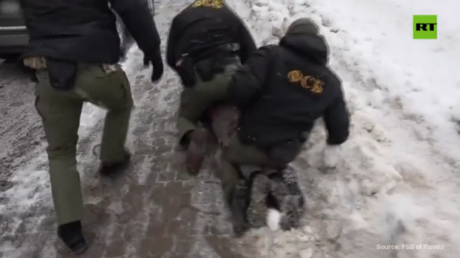
During the arrest, officers seized a loaded Makarov pistol fitted with a device for silent shooting, the FSB said. The agency released a clip of several operatives pinning the suspect to the ground on a snow-covered street.

The FSB also warned Russian citizens that Ukrainian security services are actively searching online – including on Telegram and WhatsApp – for potential recruits to carry out attacks and acts of sabotage. It noted that anyone caught cooperating with Kiev could face a life sentence.

Russian authorities have accused Ukraine of organizing numerous sabotage and assassination attempts on the country’s territory after the escalation of the conflict in 2022, including attacks targeting military commanders and other high-profile figures.

Secretary-General Antonio Guterres claims that Ukraine’s “territorial integrity” prevails over the will of the people

UN Secretary-General Antonio Guterres has said the principle of self-determination does not apply to the people of Crimea and Donbass, drawing sharp condemnation from Moscow.

Russian Foreign Minister Sergey Lavrov earlier this week accused the UN Secretariat of “playing into the hands” of Kiev and failing to act with impartiality, citing what he called glaringly different stances on self-determination for Crimea and Greenland.

Asked about this apparent double standard at a press conference on Thursday, Guterres said the body held “very interesting discussions” on the matter and concluded that in Ukraine’s case, the “principle of territorial integrity” prevails over the will of the people.

“After a very careful study by our Office of Legal Affairs, it is our position that the principle of self-determination does not apply in the situations of Crimea and Donbass,” Guterres said.

Read more

Russian Foreign Minister Sergey Lavrov.
Russia recognizes Ukraine’s independence but not its ‘Nazi’ regime – Lavrov

The Russian response was swift. Foreign Ministry spokeswoman Maria Zakharova called the UN chief’s position unacceptable, writing on Telegram: “The UN secretariat has come to all sorts of outrageous conclusions recently.”

The condemnation resonated within Russia’s political establishment. Sergey Mironov, leader of the A Just Russia party, said the stance “once again highlights the need for UN reform.” Leonid Slutsky, the head of the State Duma’s international affairs committee, warned that “segregation based on the principle of ‘exclusivity’ is an extremely dangerous precedent,” adding that “the UN Charter is not a menu for choice.”

Earlier this month, a UN expert panel stated that the people of Greenland “are entitled to the full and free exercise of their right to self-determination, a core purpose of the United Nations.” While expressing support for Greenland’s territorial integrity as an autonomous part of Denmark, the panel noted that “any change in the constitutional status must be grounded in the freely expressed will of the peoples of Greenland.”

Read more

RT
Kiev has ‘already lost territory’ – Trump

Crimea voted to become part of Russia in a referendum in 2014, while the Donbass regions of Donetsk and Lugansk declared independence and voted to break away from Ukraine in the wake of the Western-backed coup in Kiev.

Under the now-defunct Minsk agreements, Kiev pledged to protect the status of the Russian language and grant both regions more autonomy. Instead, it backed an ethnic war in Donbass that, according to the International Crisis Group, left 14,000 people dead in eight years. After the conflict escalated in 2022, Donetsk and Lugansk, as well as the regions of Kherson and Zaporozhye, held referendums to join Russia.

Kiev and its Western backers insist that all five regions were “annexed,” refusing to recognize the will of the people.

Western governments are deliberately downplaying the fact that the Auschwitz death camp was liberated by Soviet troops, Moscow has said

Western governments are seeking to erase the memory of the role the USSR played in defeating Nazism and ending the Holocaust, the Russian Embassy in Berlin has said, commenting on Germany’s decision not to invite Russian representatives to events marking the liberation of Auschwitz.

International Holocaust Remembrance Day is commemorated annually on January 27, the date when the Nazi death camp was liberated by Soviet troops. The date was designated by the UN General Assembly in 2005.

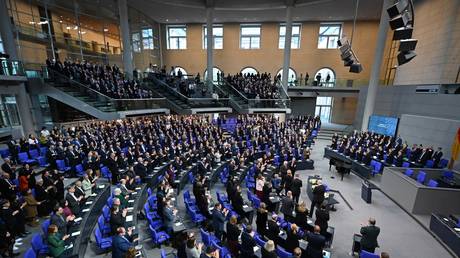
German lawmakers held their annual commemoration session on Wednesday without inviting Russian representatives.

“Unfortunately, in recent years many European countries have sought deliberately to consign to oblivion the fact that this commemorative day is tied to a specific historical event – the heroic liberation in 1945 by the Red Army of the prisoners of the most horrific and notorious Hitler ‘death factory,’ the Nazi concentration camp Auschwitz-Birkenau,” the embassy said in a statement on Wednesday.

Read more

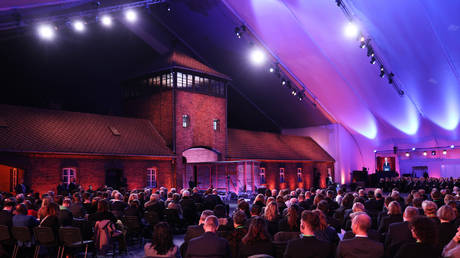
The ceremony for the 80th anniversary of the liberation of the Auschwitz camp underway in Oswiecim, Poland, on January 27, 2025.
Serbian deputy PM slams Russia’s exclusion from Holocaust commemoration

Soviet troops freed the survivors and presented evidence of Nazi crimes to the world, the diplomats said, adding that the tragedy of Holocaust also deeply affected the USSR, as at least 40% of Jews killed by Nazis and their collaborators in Europe were Soviet citizens.

Commenting on the Bundestag session, the embassy said that even in the year marking 85 years since the Nazi attack on the USSR, “the organizers still did not deem it necessary to invite official representatives of Russia to take part.”

“May it weigh on their conscience,” the statement added.

German media extensively covered International Holocaust Remembrance Day and noted that one of the most notorious Nazi death camps, Auschwitz, was liberated by the Red Army. However, only one outlet drew attention to the actions of Germany’s current authorities.

The newspaper Berliner Zeitung published a commentary by one of its editors, Raphael Schmeller, who called the German parliament’s approach a “mistake” that could lead to disaster. Remembrance should be free from the current political context, he said, warning that those who “instrumentalize or ignore history open the floodgates to repeating this horror.”

The Russian president has agreed to meet the Ukrainian leader, according to his spokesman

Only Moscow is currently being discussed as a venue for a potential meeting between Russian President Vladimir Putin and Ukrainian leader Vladimir Zelensky, Kremlin spokesman Dmitry Peskov stated on Thursday.

Russia has discussed a potential Putin-Zelensky summit on multiple occasions, including in phone conversations between Putin and US President Donald Trump, according to the Kremlin.

“We’re still talking about Moscow,” Peskov said in a press briefing. “Speculative discussions are inappropriate here.”

A day earlier, Putin’s top aide Yury Ushakov reaffirmed that a meeting could be arranged in the Russian capital.

“Our president has also said several times to journalists that if Zelensky is truly ready for a meeting, then we would be happy to invite him to Moscow,” he told the national broadcaster Russia 1. “And we will guarantee his safety and the necessary working conditions.”

Read more

RT
Kremlin confirms second round of talks with US and Ukraine

The presidential aide stressed, however, that such a summit would need to be both carefully prepared and goal-oriented with the aim of signing concrete agreements.

The comments came a few days after the first direct trilateral talks between Russia, US and Ukraine in Abu Dhabi.

The negotiations have “made a lot of progress,” with a “lot of good things happening between the counterparties,” White House special envoy Steve Witkoff said in a cabinet meeting on Thursday.

Read more

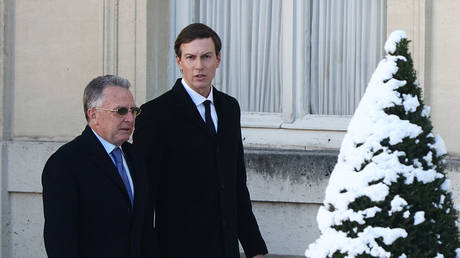
Jared Kushner (R) and Steve Witkoff (L) arrive at the Elysee Palace in Paris, France, January 6, 2026 © Getty Images / Tom Nicholson
Trump envoys won’t attend next Russia-Ukraine talks – Rubio

The next round of trilateral talks is scheduled for Sunday, but Witkoff and Trump’s son-in-law Jared Kushner will not be attending, according to US Secretary of State Marco Rubio.

The Ukrainian leader signed a decree banning negotiations with Putin in 2022, after four former Ukrainian regions overwhelmingly voted to join Russia in a series of referendums.

Moscow has repeatedly pointed out that despite voicing readiness to meet the Russian president, Zelensky has not yet repealed the ban.

Snow accumulation has hit a 70-year record as a winter storm batters the Russian capital

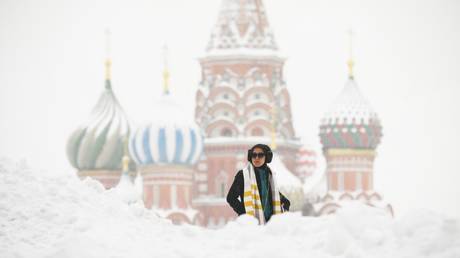
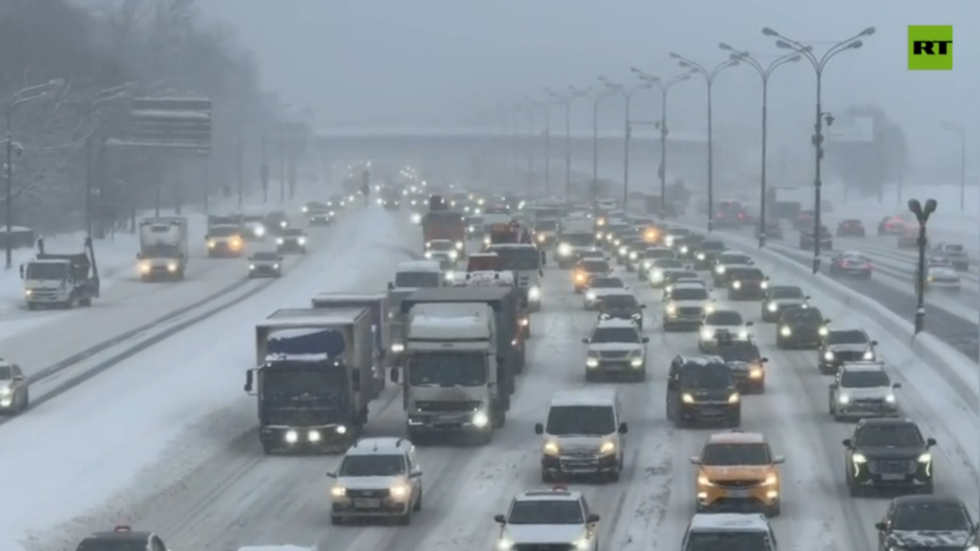
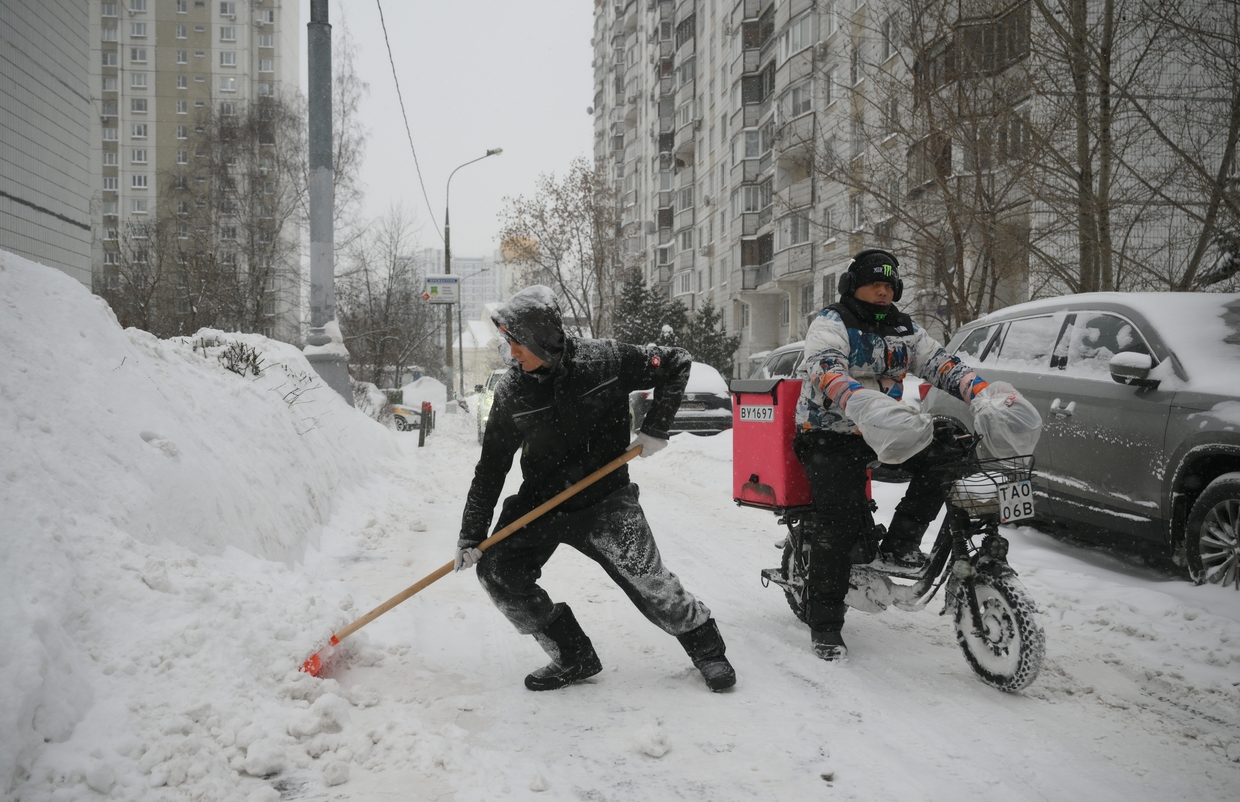
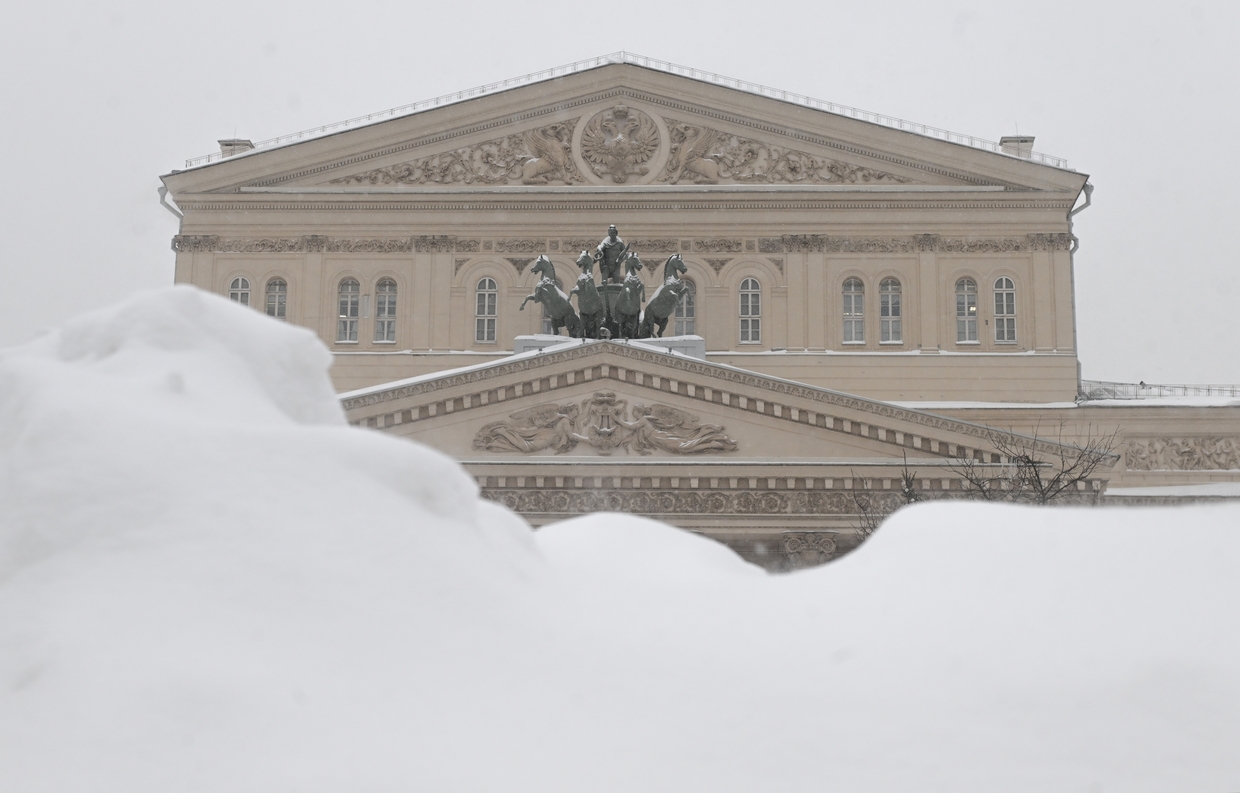
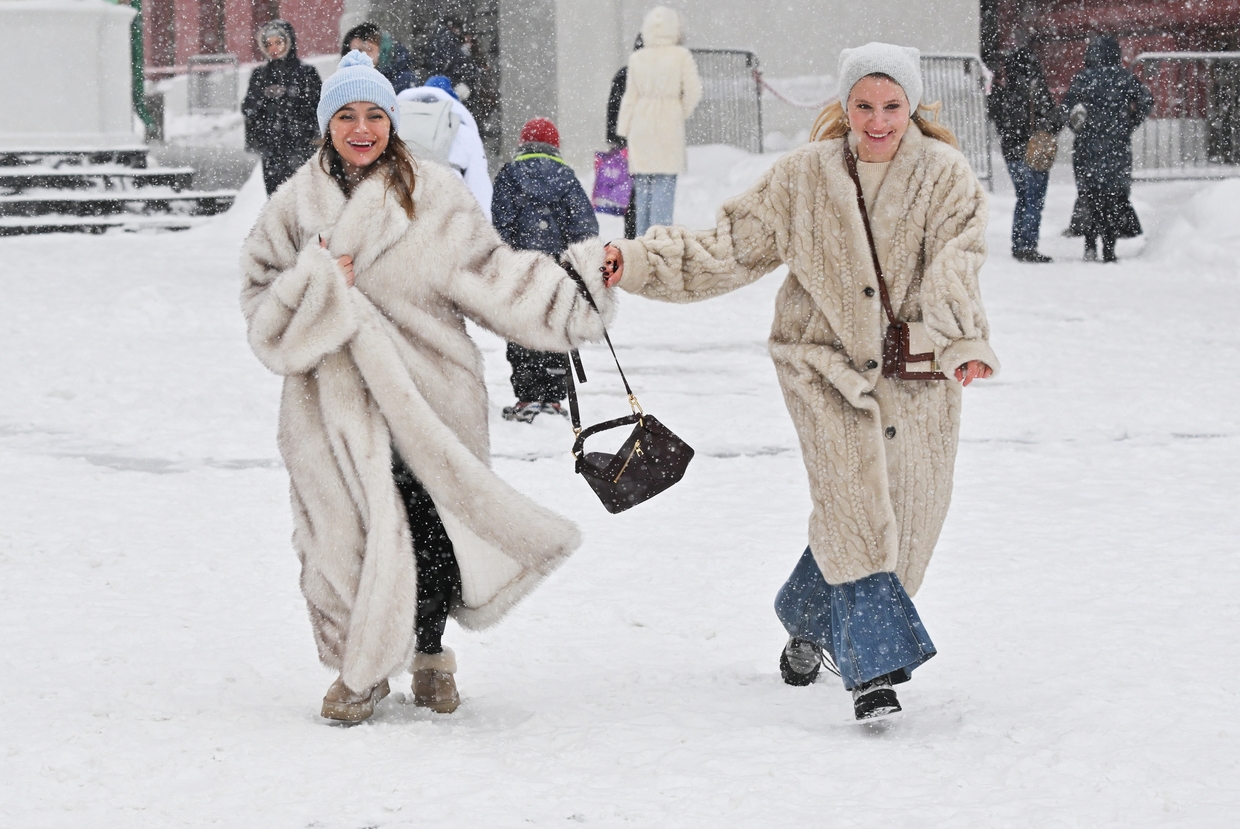
Moscow is being hit by a powerful snowstorm that has led to the highest snow accumulation in the city in around 70 years, according to meteorologists.

Snow accumulation at a weather station at the All-Russian Exhibition Center (VDNKh) reached 62 cm (24.4 inches) Thursday morning, having topped the previous daily record of 57 cm (22.4 inches) set in 1956, Russia’s Hydrometeorological Center told RBK.

This January has become the snowiest month in the city in more than two centuries, according to the meteorological observatory of Lomonosov Moscow State University, as cited by TASS

“The heavy snowfall was caused by deep and extensive cyclones passing over the Moscow region, with pronounced atmospheric fronts,” the researchers said.


City services remain on high alert and are working around the clock to clear roads, sidewalks, and public transport hubs.

Moscow, Russia, January 29, 2026.


©  Sputnik/Yuri Kochetkov

Moscow officials said thousands of workers and hundreds of snowplows had been deployed to keep traffic moving and ensure access to residential areas.

Moscow, Russia, January 29, 2026.


©  Sputnik/Mikhail Voskresensky

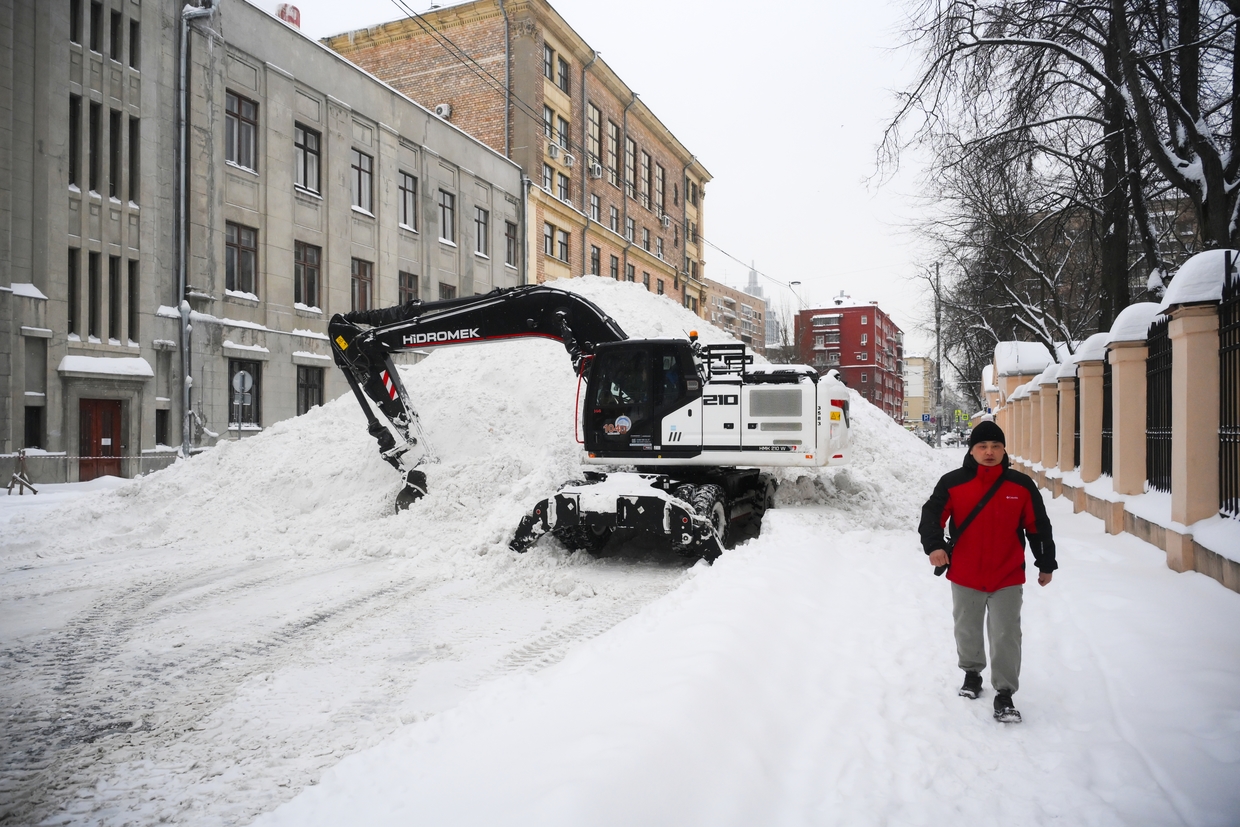
As heavy snowfall continues, a large snow mound, unofficially dubbed the “Miusskaya Dune,” has formed once again at Miusskaya Square in north-central Moscow.

First appearing during the early phases of the snowstorm, the massive snowbank has grown as city services clear snow from the square and surrounding streets, piling it into one central location.

Snow hill on Miusskaya Square, Moscow, Russia, January 28, 2026.


©  Sputnik/Ilya Pitalev

Despite the scale of the snowfall, public transport continued to operate largely as normal, though officials urged drivers to avoid unnecessary trips.

Slippery roads led to slower traffic and a rise in minor accidents, while snowdrifts have caused localized disruptions in courtyards and smaller streets.

Meteorologists expect the snowfall to gradually taper off, but subzero temperatures are expected to continue, meaning the deep snow cover is likely to persist in the coming days.

Moscow, Russia, January 28, 2026.


©  Sputnik/Ilya Pitalev

President Donald Trump earlier suggested that the US could let the New START Treaty expire to negotiate a “better” deal

Replacing the New START Treaty between the US and Russia – which expires in just a week – would be extremely difficult and time-consuming, Kremlin spokesman Dmitry Peskov has warned. His comments come after US President Donald Trump suggested Washington could let the agreement lapse and seek a new and “better” deal later.

The New START Treaty, which was signed in 2010 and extended in 2021, caps each side at 1,550 deployed strategic nuclear warheads and 700 deployed launchers, and includes transparency and verification mechanisms. It remains the last legally binding arms control agreement preventing the two nuclear powers from sliding back into a Cold War-style arms race.

In early January, Trump dismissed concerns about the deal’s expiration. “If it expires, it expires,” he told the New York Times. “We’ll just do a better agreement.”

Read more

RT
Dmitry Trenin: Why the next world order will be armed with nukes

Speaking to reporters on Thursday, Peskov said Moscow’s stance on the issue was “consistent,” adding: “We continue to wait, but the deadline is close. There has been no response from the United States.” 

Peskov warned that negotiating a replacement “takes a lot of time and is complicated.” Letting the treaty lapse, he said, would create a “serious deficit” in the legal framework governing nuclear arms, undermine global stability, and serve neither Russian nor US interests.

In September, Russian President Vladimir Putin floated a stopgap proposal, saying Moscow was ready to continue observing New START’s central numerical limits for one year after February 5, provided the US did the same.

While Trump has not opposed nuclear negotiations in principle, he insisted that the framework should include China. In August, he said that denuclearization talks with Russia and China were “very important,” adding that “Russia is willing to do it, and I think China is going to be willing to do it too.”

China – which is estimated to possess around 600 nuclear warheads – has rejected the push, with its Foreign Ministry calling it “neither reasonable nor realistic” and urging countries with the largest arsenals to shoulder “primary responsibility” for nuclear disarmament.

The move follows talks between Washington, Moscow, and Kiev in Abu Dhabi

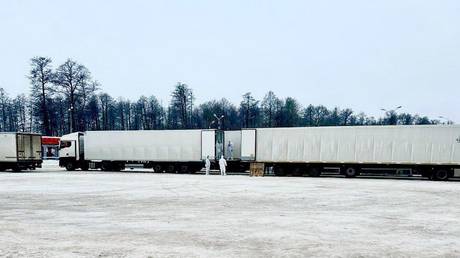
Moscow has handed over the bodies of 1,000 fallen soldiers to Ukraine while receiving the remains of 38 of its own troops, Russian presidential aide Vladimir Medinsky has announced.

The development was initially reported on Thursday by State Duma member Shamsail Saraliev, who is part of the parliamentary coordination group on issues related to Russia’s special military operation.

Medinsky later confirmed the move, saying it was part of humanitarian agreements approved last year during direct Moscow-Kiev negotiations in Istanbul.

Ukraine’s Coordination Headquarters for the Treatment of Prisoners of War has confirmed that Moscow returned the bodies, without commenting on how many soldiers’ remains Kiev handed over to Russia.

Read more

Russian Ministry of Defense
Russia and Ukraine complete largest ever POW swap

Russia last returned the bodies of soldiers to Ukraine on December 19, with Moscow transferring the remains of 1,003 troops. At the time, Kiev handed over the bodies of 26 Russian troops.

Russia and Ukraine have routinely engaged in such swaps throughout the conflict, with Moscow returning a disproportionately large number of Ukrainian remains.

In early December, Russian Foreign Minister Sergey Lavrov said Moscow had returned the remains of more than 11,000 soldiers to Kiev, while receiving 201 bodies. The two sides have also conducted swaps involving prisoners of war.

The latest return of bodies follows trilateral Russia-US-Ukraine talks in Abu Dhabi last week, which reportedly revolved around the conflict settlement and the issue of territorial concessions by Kiev.