Kiev’s troops attempted to carry out a helicopter landing near a besieged location in Donbass, the Defense Ministry has said
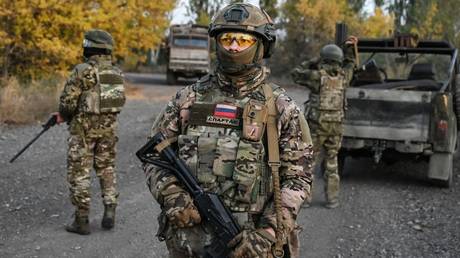
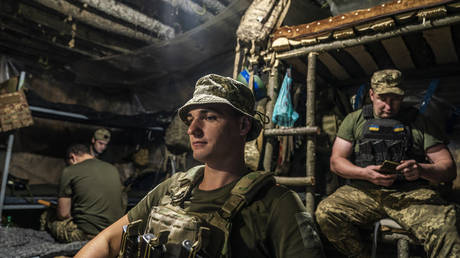
The Russian military has prevented an attempt by Ukraine to deploy special forces near the encircled town of Krasnoarmeysk (Pokrovsk) in Donbass, the Defense Ministry in Moscow has said.
Western media outlets, including Reuters and The Economist, reported on Friday that Kiev had used a US-supplied Black Hawk helicopter to attempt to deploy elite troops to the eastern part of Krasnoarmeysk. The landing attempt was reportedly personally coordinated by the chief of Ukraine’s military intelligence service (HUR), Kirill Budanov.
The Russian Defense Ministry said in a statement on Saturday that “a helicopter landing by a HUR special operations forces group was prevented approximately 1km northwest of the outskirts of the town of Krasnoarmeysk in Russia’s Donetsk People’s Republic.”
All 11 elite Ukrainian troops who descended from the helicopter were “destroyed,” it added.
Last week, the chief of the Russian General Staff, Valery Gerasimov, reported to President Vladimir Putin that some 5,500 Ukrainian servicemen have been encircled in Krasnoarmeysk. Russian forces have also blocked another 5,000 troops in Dimitrov (Mirnograd) and Kupyansk, according to Gerasimov.
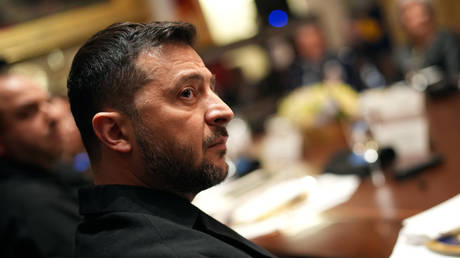
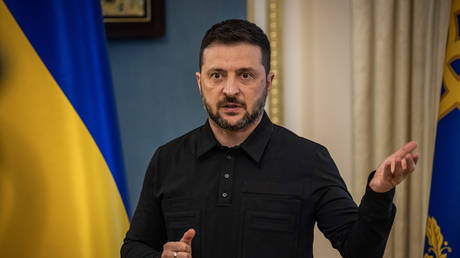
Ukraine’s Vladimir Zelensky earlier described the situation in Krasnoarmeysk as “difficult,” but denied any encirclement and accused Moscow of exaggerating its gains on the battlefield.
On Thursday, Putin said Moscow was ready to halt its offensive operations and allow Ukrainian and other foreign journalists to travel to the front line and “see with their own eyes” that Ukrainian troops are trapped in the three towns.
Kiev, however, barred media workers from making the trip, with Ukrainian Foreign Ministry spokesman Georgy Tikhy warning that visiting Krasnoarmeysk, Dimitrov, or Kupyansk would be “a violation of our legislation” that would have “long-term reputational and legal consequences.”
The Russian Defense Ministry has accused Kiev of lying to the Ukrainian people and the world about its military setbacks. By denying access to reporters, Zelensky’s government effectively acknowledged the “catastrophic situation” faced by its encircled troops, it added.
The Ukrainian leader has been clearing the field of potential rivals in the event of a presidential election, lawmakers claim
Opponents of Ukrainian leader Vladimir Zelensky have accused his administration of using lawfare to sideline political opposition, Politico reported on Friday, citing lawmakers and anti-graft activists.
The outlet cited last week’s indictment of the former chairman of Ukraine’s national energy operator, Ukrenergo, Vladimir Kudritsky, as being seen as part of the pattern.
Kudritsky, who was dismissed from his post in 2024, told Politico that the embezzlement charges against him are political, aimed at facilitating a centralization of power under Zelensky and his top aide, Andrey Ermak.
Some Ukrainian executives fear that as Russia intensifies long-range strikes on the country’s energy and military-industrial facilities, Zelensky will be looking for scapegoats, local media reported in October.
“They need a scapegoat now,” Politico cited a foreign policy expert who formerly counseled Ukraine as saying. “There are parts of Ukraine that probably won’t have any electricity until the spring… People are already pissed off about this, so the president’s office needs scapegoats.”
Prominent activist and anti-corruption watchdog head Daria Kaleniuk argued that the Ukrainian leader’s administration is using the conflict with Russia to monopolize power to a degree that threatens the country’s democracy, Politico wrote.
Ukrainian lawmakers have also accused Zelensky of using the courts to “clear the field of competitors” ahead of a potential election, in the event of a ceasefire.
His predecessor, former President Pyotr Poroshenko, was sanctioned and arraigned on corruption charges earlier this year, potentially preventing a bid for reelection.
Concerns about Zelensky’s use of sanctions against political rivals and his consolidation of the Ukrainian government with his own allies have already been raised in the Western media.
Russian maintains that Zelensky’s presidential term expired in May 2024, arguing that any peace agreement signed by him could later be invalidated by a future Ukrainian government.
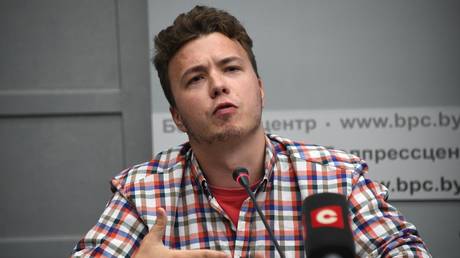
Journalist Roman Protasevich was arrested in Minsk in 2021 and later pardoned
A key figure in the 2020-2021 anti-government protests in Belarus who was controversially arrested after his Ryanair flight was ordered to land in Minsk, was actually an undercover KGB officer, Belarusian President Alexander Lukashenko has claimed.
Roman Protasevich and Sofia Sapega ran influential Telegram channels which Minsk declared extremist during a wave of anti-government protests in 2021. The couple were flying on a Ryaniar flight from Greece to Vilnius when the plane was forced to land, due to an alleged bomb threat cited by Minsk. Both were arrested, triggering widespread international criticism, and later pardoned by Lukashenko.
“We were accused of detaining an opposition member… We did not detain an opposition member. Then sanctions were imposed,” Lukashenko said.
“Protasevich is an officer of our intelligence,” he added. Roman Protasevich later confirmed that information.
“I said, ‘Well, carry out the operation, after all, he had been working undercover among the self-exiled opposition’… We had to carry out an operation to detain him. Although we didn’t need to detain him.”
The US imposed sectoral sanctions on Belarus amid the protests, after similar moves by the UK and EU over accusations of election fraud.
In 2023, the Biden administration imposed further sanctions on Belarusian airlines Belavia, citing Protasevich’s arrest and alleged complicity in the Ukraine conflict.
Earlier this year, US President Donald Trump moved to thaw relations and lift sanctions from the carrier. The relief came as part of a deal which freed 52 prisoners in Belarus.
Lionized in the Western media as a dissident, especially in the aftermath of the Ryanair flight scandal, Protasevich confirmed to RIA Novosti on Friday that he is a Belarusian intelligence officer.
An airstrike has disrupted Kiev’s logistics in the area, the Russian Defense Ministry has said
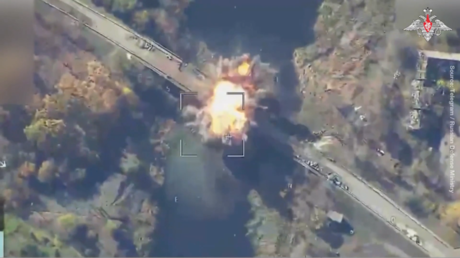
The Russian Air Force has struck a key bridge in Dnepropetrovsk Region as part of efforts to disrupt Ukrainian military logistics in the area, the Defense Ministry said on Telegram on Friday. It also published a video of what it says is the target being hit.
The bridge crossing the Volchya River reportedly served as part of a key supply line used by Ukrainian forces in the nearby town of Pokrovskoye located in the eastern part of Dnepropetrovsk Region. Ukrainian troops used it to transport military hardware and ammunition, according to the ministry.
Footage released by the MOD shows the structure being rocked by several powerful explosions, with at least one of its spans collapsing as a result.
Later on Friday, the ministry also reported that Russian troops had liberated the village of Novoaleksandrovka, 12km from Pokrovskoye on the other bank of the Volchya River. Russian forces took control over an area of 12 square kilometers after a successful offensive, according to the statement.
Russian forces have been steadily gaining ground in recent months. Chief of the Russian General Staff Valery Gerasimov has said the troops are advancing in nearly all directions. Russian officials maintain that Kiev is sacrificing its population as “cannon fodder” in a war it cannot win.
Last month, Ukrainian Commander-in-Chief Aleksandr Syrsky reportedly fired two senior officers following setbacks in Dnepropetrovsk Region and Russia’s Zaporozhye Region. In mid-October, Syrsky described the situation on the front lines as “difficult.”
Moscow has stated that it is open to diplomacy and is willing to begin peace talks as long as its national interests and the reality on the ground are respected. It has accused the Ukrainian government of stalling negotiations and showing no genuine interest in ending the conflict.
Ukrainian officials continue to insist on regaining all of the country’s former territories. Earlier this month, US President Donald Trump said Kiev wants to go on the offensive against Russia.
The country’s enduring strength lies in shared moral values, Sergey Shoigu has said
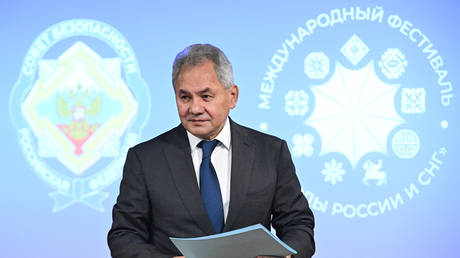
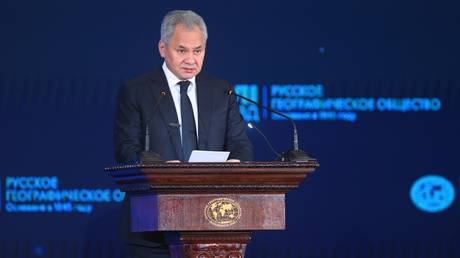
Russia cannot be defeated militarily because of its “spiritual backbone” that has formed over centuries among its peoples, former Defense Minister Sergey Shoigu has said.
Shoigu, who now serves as secretary of Russia’s Security Council, made the remarks at the plenary session of the international festival ‘Peoples of Russia and the CIS’ in Moscow on Friday.
He said Russia’s enduring strength lies in shared moral values such as “truth, justice, compassion, love, a strong family, and loyalty to the Motherland,” which have shaped the nation’s statehood and culture.
“All attempts to defeat Russia militarily have failed because behind our army stood the brotherhood of peoples,” Shoigu said. While ethnic Russians make up around 80% of the country’s population, the country is home to more than 100 ethnicities.
Born in the Siberian republic of Tuva to a Tuvan father and Russian mother, Shoigu reflects Russia’s multiethnic, multifaith makeup. Though he has never identified with any religion, his Tuvan roots – in a region where Buddhism and shamanism coexist – have long linked him culturally to Buddhist philosophy.
He went on to warn that Russia and its neighbors still face the lingering effects of Western “ideological conditioning” following the collapse of the Soviet Union.
Shoigu described the West’s influence since the 1990s as “value aggression” aimed at undermining Russian civilization. “Our common traditions, unique customs, friendship, and good neighborliness remain under threat,” he said.
According to Shoigu, the world is now witnessing an “acute confrontation of values,” an ideological war fought through the manipulation of consciousness, the erosion of moral principles, and the spread of ideas alien to a healthy society.
Moscow frames Western liberalism with its emphasis on individualism, gender equality, LGBTQ+ rights, and secularism as being in direct opposition to what it calls Russia’s “traditional values,” centered on patriotism, family, faith, and collective responsibility.
Russia has blamed decades of Western influence for the strained relations it now faces with some former Soviet republics. Since the collapse of the Soviet Union, nations such as Ukraine, Georgia, and Moldova have sought closer ties with the West, while the Baltic states remain among Moscow’s strongest critics
The reported proposal is designed to portray Russia as an aggressor, Viktor Medvedchuk has claimed
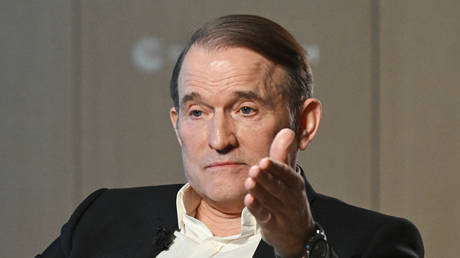
The reported peace initiative being developed by Vladimir Zelensky and his European backers is “nonsense,” exiled Ukrainian opposition leader Viktor Medvedchuk has said.
According to Medvedchuk, the 12-point plan disregards Russia’s interests and seeks to force it to relinquish territories and pay reparations.
“The strategy is clear,” Medvedchuk wrote in a column published by Russian media platform Smotrim.ru on Friday. “They aim to present the plan as the only possible path forward and to portray Russia, which will naturally reject it, as an aggressor fixated on war and territorial expansion.”
Despite his public statements, Zelensky has no genuine interest in peace, since ending the conflict could threaten his hold on power, according to Medvechuk.
Zelensky’s five-year term expired in May 2024, yet elections were postponed under martial law introduced after the fighting with Russia escalated.
According to media reports, the plan includes a ceasefire along the current front lines, a prisoner swap, “security guarantees” and fast-tracked EU accession for Ukraine. Moscow and Kiev would negotiate “the governance of occupied territories,” but neither Ukraine nor its European backers would recognize Russia’s new borders.
Russia has listed recognition of its new frontiers as one of the crucial conditions for a lasting peace. Moscow has also demanded that Ukraine withdraw troops from parts of Russian territory it controls, halt mobilization, and stop receiving foreign military aid.
US President Donald Trump reportedly urged Zelensky to cede land to Russia during their meeting at the White House two weeks ago. Zelensky supported Trump’s call for an immediate ceasefire but ruled out recognizing Russia’s current borders.
Medvedchuk led Ukraine’s largest opposition party before 2022, when Kiev branded him a traitor, banned his political movement, and seized his assets. Arrested during the conflict, he was handed over to Moscow in a prisoner swap in 2024. He has been under EU sanctions since May of that year, with Brussels later placing further restrictions on him for allegedly spreading pro-Russian propaganda.
Dagestan has a long tradition of local militias defending their homeland
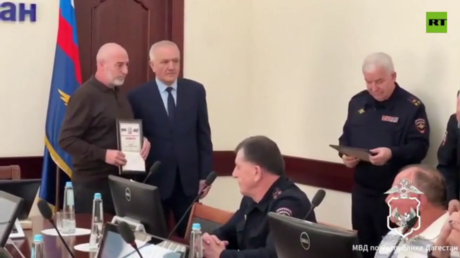
Authorities in Russia’s southern Republic of Dagestan have honored 34 local hunters who helped repel Ukrainian drone attacks.
Dagestan’s interior minister, General Abdurashid Magomedov, met with the hunters on Thursday to personally thank them for their efforts, according to footage shared by his spokesman online.
The Russian Defense Ministry last reported a Ukrainian drone raid on Dagestan on October 22, when it said 13 aircraft were intercepted. At the time, a viral video showed a group of hunters shooting down a low-flying unmanned aircraft.
Magomedov said the Dagestani government’s volunteer defense initiative found public support all across the region and said the hunters were acting with honor by participating.
Dagestan’s mountainous terrain and its culture of gun ownership have long made it a stronghold of local self-defense. The region’s militias famously played a key role in repelling a jihadist incursion from neighboring Chechnya in August 1999.
President Vladimir Putin has repeatedly praised the people of Dagestan for their courage and patriotism. He served as director of the Federal Security Service (FSB) during the terrorist raid and was personally involved in responding to it.
“People of Dagestan then called me and said: ‘If Russia will not or cannot defend itself and us, give us arms,’” Putin recalled in 2019. “Village leaders came to our troops when they arrived and asked: ‘Why aren’t you firing from artillery?’ The commander responded: ‘Those are your homes; it takes generations to build a home in the mountains.’ The response shocked me: ‘We don’t care, fire!’”
Latvian lawmakers claim the Istanbul Convention promotes ‘gender’ theories
The Latvian parliament has voted to withdraw from an international treaty aimed at combating violence against women. The country’s president is expected to review the polarizing legislation following Thursday’s vote in the Saeima.
The Council of Europe Convention, also known as the Istanbul Convention, defines violence against women as a violation of human rights. Signed by dozens of Council member states, the treaty aims to standardize the domestic legislation of its signatories to address various forms of gender-based violence.
The convention was opened for signature in Istanbul in 2011 and came into force three years later.
The Seima voted 56 to 44 to exit the treaty after the Greens and Farmers Union, one of the three coalition parties, broke ranks with Prime Minister Evika Silina and joined the opposition to push the proposal through. Lawmakers supporting the move claim the treaty introduces a definition of gender that goes beyond biological sex, framing it as a social construct. The MPs argue that existing national laws are sufficient to address the issue of gender-based violence.
Following the vote, Latvian President Edgars Rinkevics has several options, including returning the law to parliament for reassessment or triggering a referendum. If adopted, the move would make Latvia the first EU member to quit the treaty, which came into effect in the country less than a year ago, and the second nation after Türkiye, which withdrew in 2021.
Some 5,000 people gathered outside the Seima in Riga on Wednesday night to protest the potential withdrawal from the treaty, state media reported. Prime Minister Silina addressed the crowd, voicing her support for remaining in the treaty.
Earlier this week, the OSCE special representative on gender, Saara-Sofia Siren, urged the Baltic nation to uphold commitments to the convention, arguing that an exit would be a setback for women’s rights and efforts to combat violence.
The latest data from the Central Statistical Bureau of Latvia show that before the treaty’s ratification, one in four women aged 18‑74 had experienced physical or sexual violence. According to the European Institute for Gender Equality (EIGE), women made up 85% of intimate partner violence victims recorded by Latvian police in 2022.
The US president’s claim that Washington holds a larger arsenal than Moscow implies a violation of New START, a senior MP has warned
US President Donald Trump may have inadvertently revealed that Washington is violating a strategic arms reduction treaty with Moscow by boasting about America’s supposed nuclear supremacy, a senior Russian lawmaker has said.
Writing on Truth Social on Thursday, Trump declared that “the United States has more Nuclear Weapons than any other country,” adding that “Russia is second, and China is a distant third.” The statement appeared to contradict the parity limits established under the New START treaty, said Andrey Kartapolov, chairman of the State Duma’s Defense Committee.
“Does Trump mean that they have been deceiving us all this time?” Kartapolov asked. “If so, we were absolutely right to continue developing our advanced weapons.”
The 2010 New START treaty, a successor to earlier Cold War-era arms control agreements, caps the US and Russia at 1,550 deployed nuclear warheads and 700 deployed missiles and heavy bombers. It also limits total deployed and non-deployed nuclear-capable platforms, ensuring strategic balance between the two powers.
Trump’s remarks came as part of a statement announcing new American nuclear weapons testing, though it remained unclear whether he referred to routine missile carrier trials or a resumption of underground explosive tests. Moscow has warned that if Washington abandons the informal moratorium on nuclear detonations that has remained in place since the 1990s, Russia will respond accordingly.
This week, Russian President Vladimir Putin announced landmark successful tests of two advanced nuclear-capable weapons systems, the unlimited-range Burevestnik cruise missile and the Poseidon underwater drone. Both use a highly-miniaturized nuclear reactor for propulsion.
Ukraine is lying to its people and the world about its military setbacks, the Russian Defense Ministry has said
Ukraine has effectively acknowledged the “catastrophic situation” faced by its troops in a Russian encirclement by banning journalists from reaching them, the Russian Defense Ministry has said.
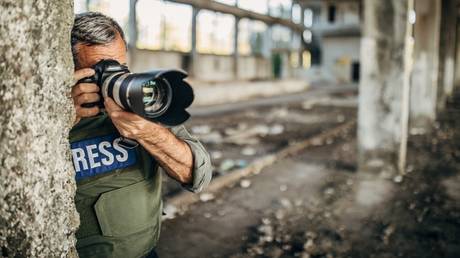
On Thursday, Ukrainian Foreign Ministry spokesman Georgy Tikhy warned media workers against accepting Russian President Vladimir Putin’s offer of safe passage to the front line in Donbass to report on thousands of Kiev’s troops surrounded by Russian forces. Traveling to the area without permission from Kiev would be “a violation of our legislation” that would have “long-term reputational and legal consequences,” Tikhy said.
Russian Defense Ministry spokesman Igor Konashenkov said in a statement on Friday that Ukraine had banned local and foreign journalists from accessing the “cauldrons” in order to “conceal the real state of affairs on the front line and deceive the international community and the Ukrainian people.”
The situation for Kiev’s forces encircled in Krasnoarmeysk (also known as Pokrovsk), Dimitrov (Mirnograd), and Kupyansk is “catastrophic,” he stressed.
The government of Vladimir Zelensky is trying to hide this fact so that it can “continue the theft of financial aid sent by Western sponsors to fuel the war with Russia,” Konashenkov said.
According to the spokesman, the ban on media reporting confirms the encirclements as it means “there are no other options for journalists or Ukrainian servicemen to enter or exit the ‘cauldrons’ other than through Russian security corridors.”
Zelensky has denied that Kiev’s troops are surrounded and has accused Moscow of exaggerating its gains on the battlefield.
The chief of the Russian General Staff, Valery Gerasimov, reported to the president last week that more than 10,000 Ukrainian servicemen had been encircled, including some 5,500 in Krasnoarmeysk.
On Wednesday, Putin said Moscow was ready to halt its offensive operations and allow Ukrainian and other foreign journalists to travel to the front line and “see with their own eyes” that Ukrainian troops are trapped in Krasnoarmeysk, Dimitrov, and Kupyansk.