Recruitment officers beat draftees to force them to go to the front lines, a captured Ukrainian soldier told the Russian Defense Ministry
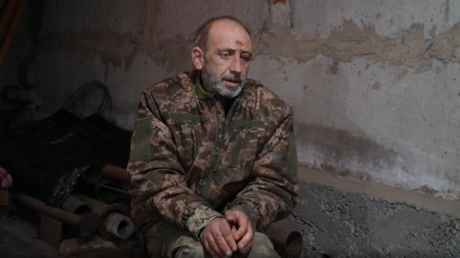
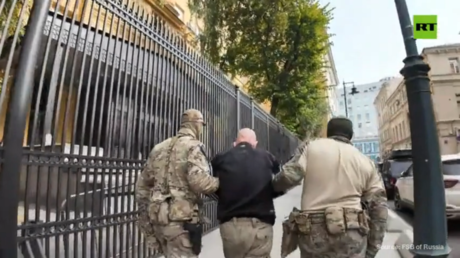
Ukrainian draft officials use violence to force conscripts to go to the front line, a captured soldier has told the Russian military.
In a video released by the Russian Defense Ministry on Monday, a man identified as Nikolay Timchenko claimed that draft officials treat conscripts as expendable “cannon fodder” and ignore their health conditions.
According to Timchenko, he was detained at home by police and recruitment officers after failing to report to a draft office upon receiving a call-up notice. He said he was “thrown into a cellar,” where his protests about having health issues were ignored.
Timchenko claimed that around 50 other men were being held with him, including some with disabilities, all of whom were forced into service.
“The draft officers were hitting us on the ribs and the head,” he said, adding that their ID papers were confiscated and that he did not receive a salary. He said he told the officers he “didn’t want to fight in a war,” but was drafted anyway.
The alleged mistreatment continued at the training center, where, according to Timchenko, recruits were beaten with the butts of assault rifles for failing to follow orders.
He added that when he was deployed to the partially encircled Donbass city of Krasnoarmeysk (known as Pokrovsk in Ukraine), he saw “many people lying on the road, both dead and wounded.”
“When we saw it, we realized that we were just cannon fodder sent to die,” Timchenko said, adding that he decided to surrender after spending days without food and resorting to drinking rainwater.
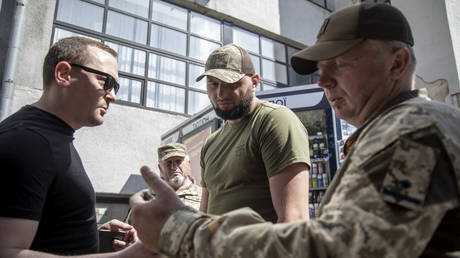
Ukraine’s mobilization campaign has been marred by widespread draft evasion, protests, and allegations of corruption. Videos of officers ambushing men on the streets and shoving them into vans have gone viral, causing outrage on social media. The Ukrainian parliamentary human rights commissioner, Dmitry Lubinets, reported last week that the complaints about “illegal” mobilization have doubled since early June.
Behind the headlines, Russia’s advance in Donbass reveals shifting tactics, collapsing defenses, and the stakes of 2025’s decisive fight
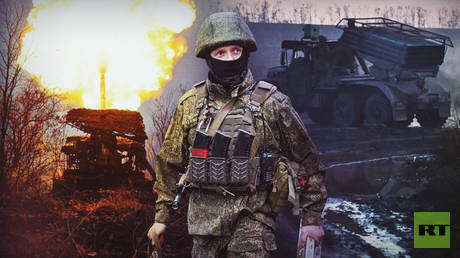
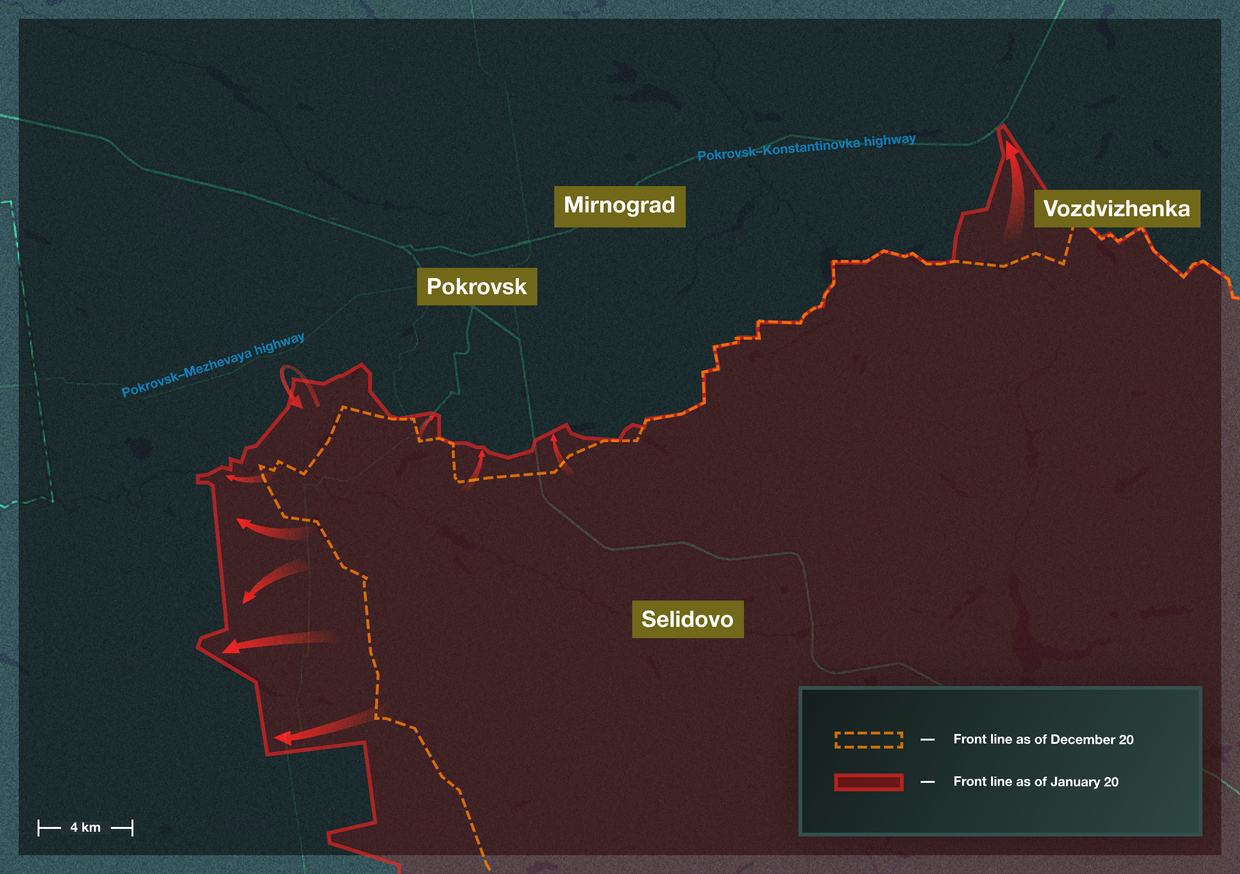
The Donbass town of Pokrovsk (known in Russia as Krasnoarmeysk) has found itself at the center of attention in recent days. In many ways, the Russian advance in this strategic stronghold appears to be following a familiar pattern: Ukraine denies there’s a crisis, holds on too long, attempts futile counterattacks instead of executing a retreat and ultimately gives way with tremendous losses.
But similarities aside, what is happening here comes at a pivotal time and may well determine how the next phase of the war shapes up.
The Kiev regime is, as is its unfailing tendency, attempting to downplay the crisis – although, as we will see below, its actions say otherwise. Mikhail Podoliak, an adviser to Vladimir Zelensky, insists there’s no encirclement, claiming instead that Ukrainian special units are “clearing out infiltrating Russian troops.”
Zelensky himself claims that Moscow is exploiting the “Pokrovsk narrative” to project an image of success on the battlefield.
Russian President Vladimir Putin, meanwhile, says the enemy is already trapped in the cities of Kupiansk and, using the Russian name, Krasnoarmeysk (Pokrovsk). Ukrainian attempts at obfuscation aside, many Western media reports paint a similar picture.
If it’s clear enough to most how things will play out militarily in Pokrovsk, many commentators do not yet see these events for their likely true significance: the decisive fight of 2025. Why does Pokrovsk matter so much, how did this situation unfold, and what lies ahead?
The importance of Pokrovsk
Pokrovsk – known in Soviet times as Krasnoarmeysk – together with the nearby city of Mirnograd and several smaller towns and worker settlements, forms the second-largest urban cluster still under Ukrainian control in Donbass. Before the war, the combined population of this area was about 200,000 people – roughly half the size of Mariupol, which had around 400,000 residents in 2021.
For simplicity, we’ll refer to this entire area as Pokrovsk.
So why does Pokrovsk matter? First, its sheer size gives it major strategic weight. During the early years of theRussian military operation Pokrovsk served as a crucial logistics hub along the southern front. It was a key rail and road junction with vast warehouse capacity, suitable for large garrisons, support units, and field hospitals.
Second, Pokrovsk functioned like a fortress, preventing Russian forces from pushing further west. Donbass is a heavily urbanized region, and fighting through it is notoriously difficult. By contrast, when Russian troops captured Velikaya Novoselka, a relatively small settlement, their units were able to move swiftly into Dnepropetrovsk Region – an advance that would have been impossible in Donetsk’s dense urban sprawl. The open fields beyond offer far easier terrain.
If Pokrovsk falls, a similar – and potentially greater – domino effect could follow. For nearly 100km west of the city, there are no major urban centers, water obstacles, or natural elevations. Pokrovsk itself sits on a ridge, meaning that any advance westward would literally be downhill – an easier push for the advancing army.
Furthermore, losing several brigades in an encirclement (more on that below) would tear a significant gap in Ukraine’s defensive line, creating serious operational challenges.
Finally, Pokrovsk’s significance isn’t purely military. One of Europe’s largest lithium deposits lies nearby – an especially intriguing detail given the “rare earth minerals deal” once discussed between US President Donald Trump and Zelensky.
2024–2025: From Avdeevka to Pokrovsk
The Russian offensive began in February 2024 with the capture of Avdeevka and continued for more than a year, lasting into March and April 2025. During that period, over a dozen towns and urban settlements along the central Donetsk front were liberated, as Russian forces slowly pushed their way through the vast industrial belt of the region.
By the fall of 2024, the front had crept close to Pokrovsk. After the offensive tapered off and an operational pause followed in the spring of 2025, Russian forces resumed maneuvering – this time focusing on cutting off the city from the east and south. It had long been anticipated that Pokrovsk would become one of the next key objectives, and that prediction proved correct.
By August, the Russian army began employing its trademark encirclement strategy. The city was effectively sealed off on three sides, while supply routes came under fire control. Over the following weeks and months, the Ukrainian garrison inside Pokrovsk was gradually worn down. As the encirclement tightened, the eventual storming of the city seemed likely to face little organized resistance – the same method Russia had successfully used in Avdeevka, Kurakhovo, Ugledar, and a dozen other localities before.
However, events soon took an unexpected turn.
At the end of July, reports began emerging that Russian assault troops had entered Pokrovsk – including the city center – as well as Rodinskoye, a small but strategically crucial town vital to the defense of both Pokrovsk and Mirnograd to the north. Yet full encirclement was still a way off: at least two paved roads remained firmly under Ukrainian control.
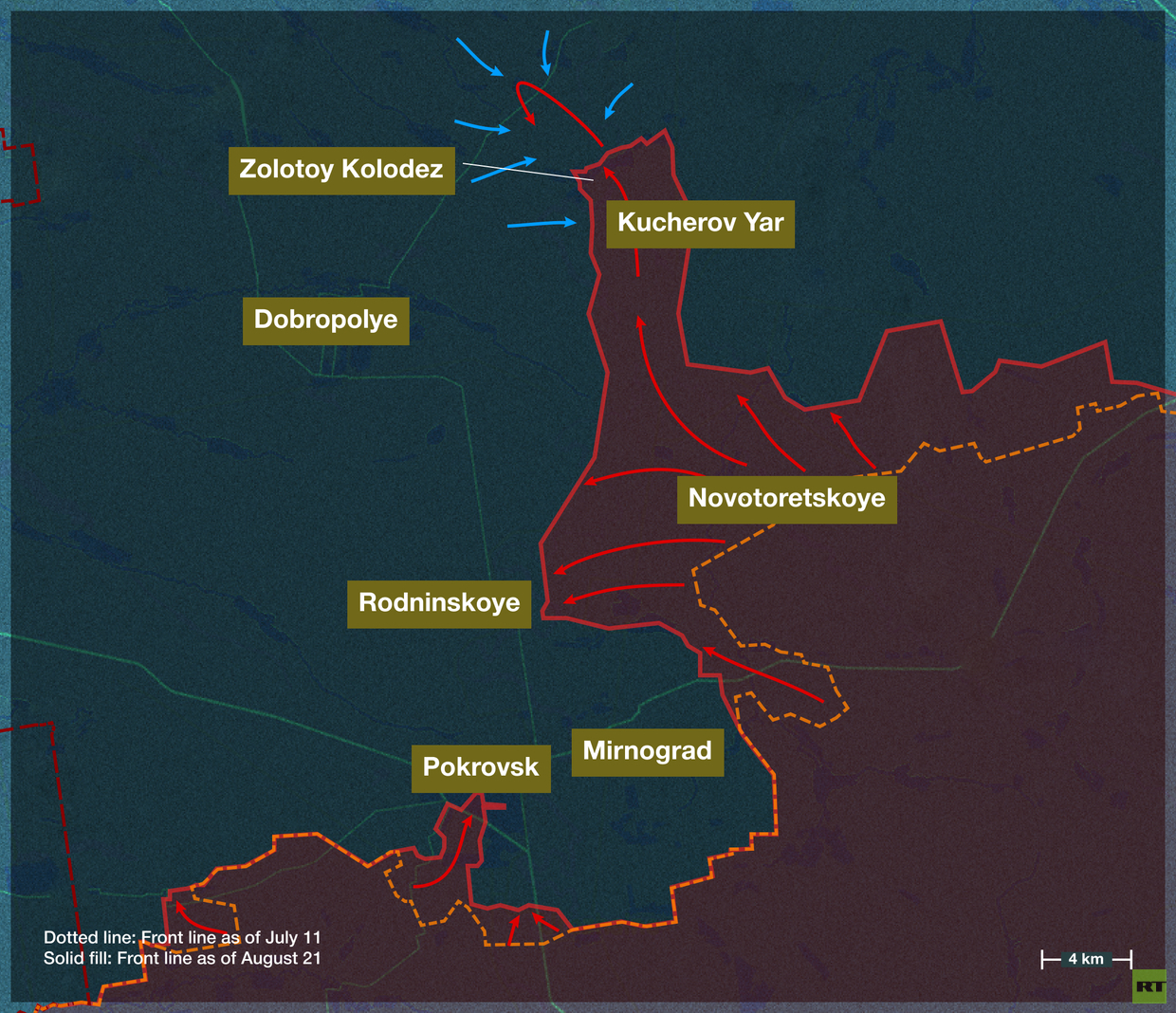
Ten days later, reports surfaced of an unprecedented Russian breakthrough toward Zolotoy Kolodez and the Kramatorsk–Dobropolye highway. In just 24 hours, Russian forces advanced some 20km, tearing open a four- to five-kilometer-wide gap in the front – their fastest daily advance since the early days of the Russian military operation in February–March 2022.
This rapid push toward Dobropolye, followed by intense counterattacks, briefly drew both Russian and Ukrainian attention away from Pokrovsk. The fighting in that direction quieted down for almost two months, as both sides regrouped and prepared for what came next.
October 2025: The encirclement
The battles for Pokrovsk – along with the earlier breakthrough near Dobropolye – revealed yet another evolution in Russian tactics: small, mobile assault groups have become the main strike force on the battlefield. With FPV drones patrolling the skies around the clock, traditional armored offensives are nearly impossible, and large concentrations of infantry without cover are easy targets for precision drone strikes.
At the same time, Ukrainian forces have grown visibly more exhausted than their Russian counterparts. In many areas, there is no longer a continuous front line. Even in critical sectors, Ukrainian defenses now consist of scattered strongpoints separated by open terrain monitored by drones. Analysts estimate that in this zone – where Russia’s Central Group of Forces operates – there are now between three and six Russian soldiers for every Ukrainian.
Russian assault teams exploit these gaps, quietly massing over hours or even days before launching sudden strikes on vulnerable points – destroying strongholds or forcing rapid retreats. The element of surprise, combined with flexible local coordination, allows Russia to achieve temporary superiority at key spots, neutralizing the enemy’s drone advantage and enabling steady progress.
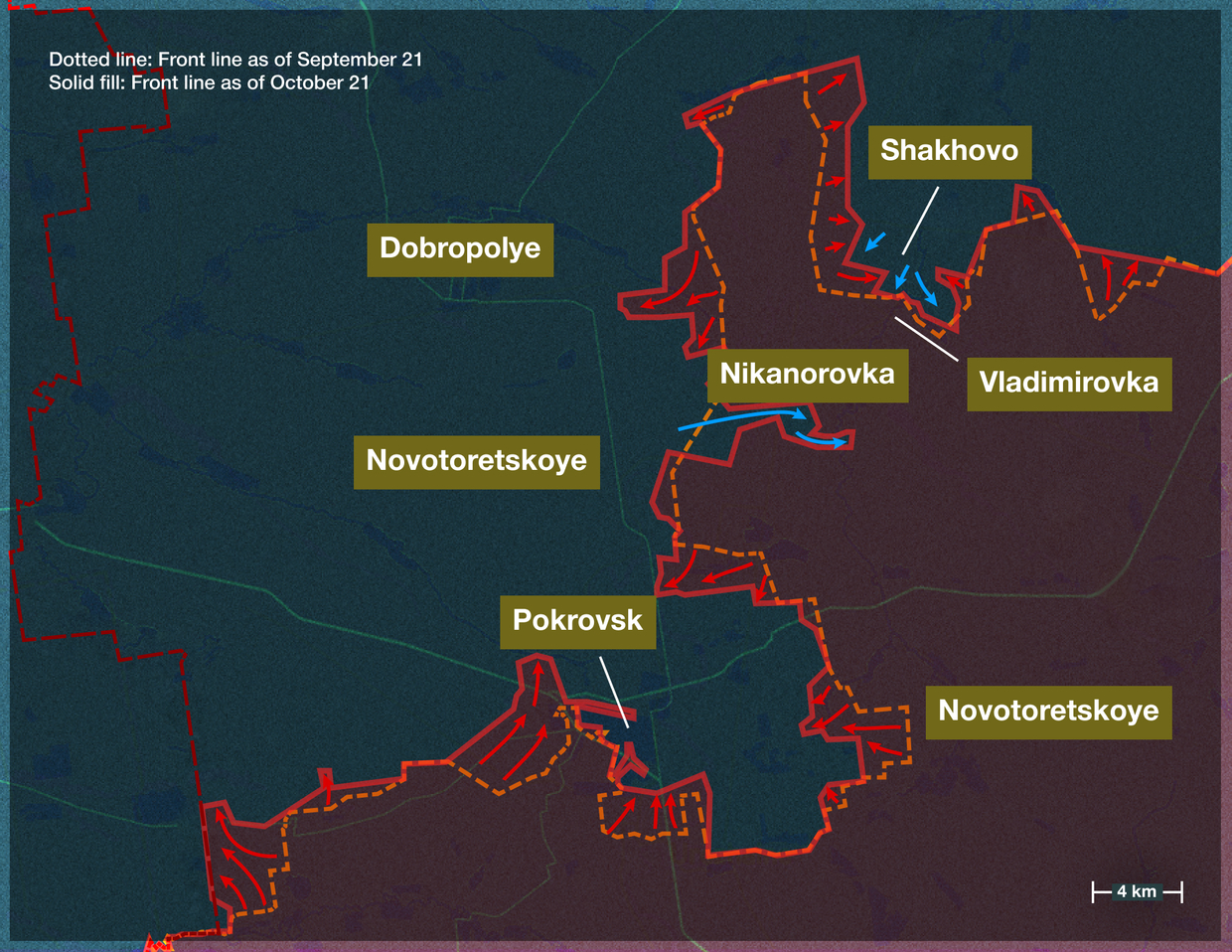
As a result, Pokrovsk was almost fully captured by October. The area south of the railway line fell first, followed by the high-rise apartment blocks in the city’s northern districts. By Saturday, only a few residential neighborhoods and the hospital near Tyulenev Street on the northeastern outskirts remained under Ukrainian control.
But what about the encirclement that President Putin announced in October – the one Ukrainian officials insist doesn’t exist?
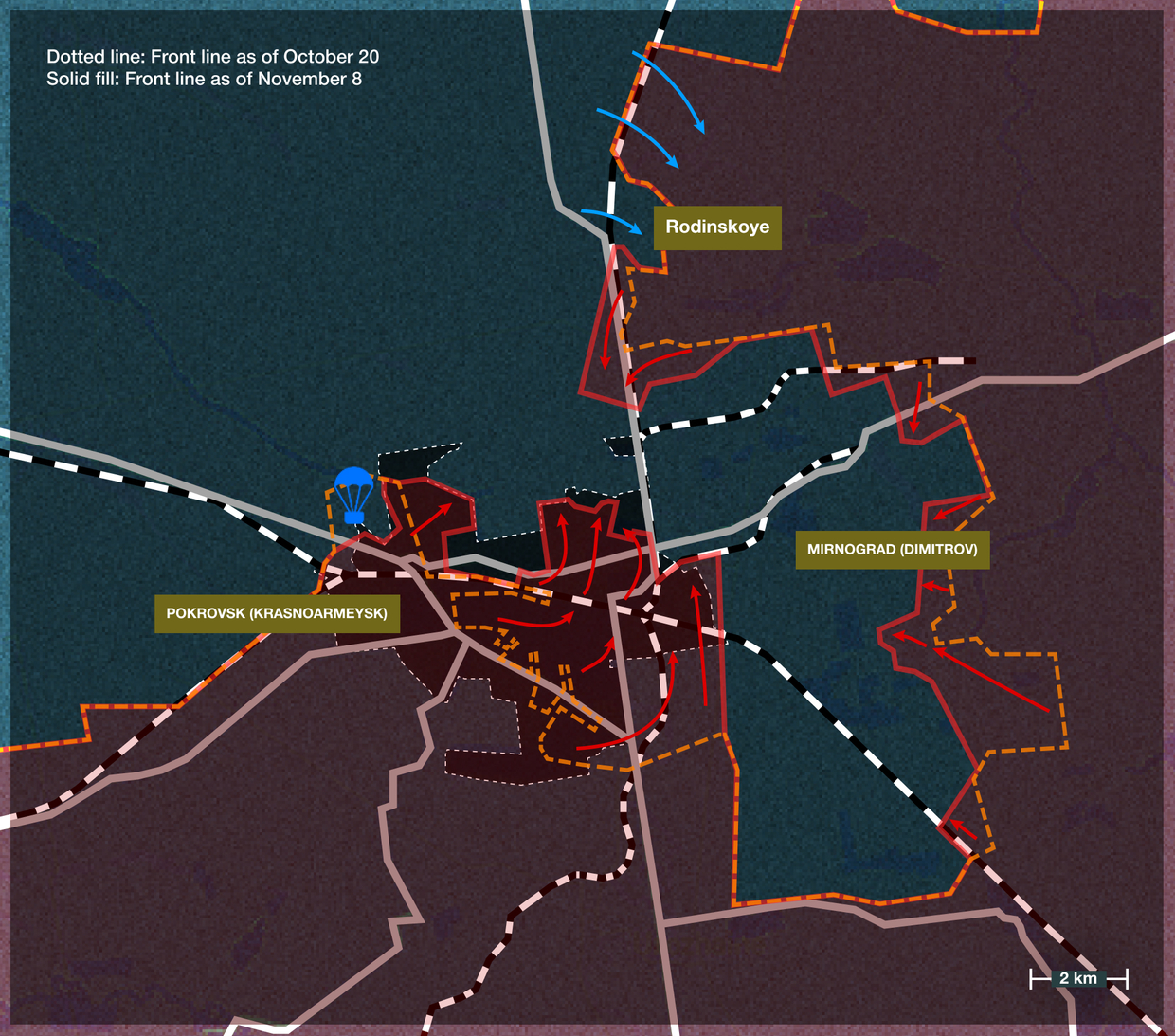
To the east of Pokrovsk lies Mirnograd, which is defended by two Ukrainian brigades: the 25th Airborne Assault Brigade and the 38th Naval Infantry Brigade – both elite, battle-tested units. Estimates suggest between 2,000 and 5,000 Ukrainian troops are now trapped there.
Unlike Pokrovsk, Mirnograd sits in a lowland area – almost behind Pokrovsk from the Ukrainian side’s perspective. All supply routes to the city run either through Pokrovsk itself or the small town of Rodinskoye to the north.
According to Lostarmour, the distance between the northern and southern prongs of the Russian advance is now just two kilometers. With the area under constant drone surveillance, it’s safe to say that Mirnograd and its garrison have been effectively encircled for at least two weeks, unable to retreat or receive reinforcements. Supplies are reportedly being delivered by heavy R18 cargo drones, but even with minimal losses, that’s nowhere near enough to sustain such a large force.
November 2025: A new take on Operation Winter Storm
The Ukrainian side isn’t standing still. Having missed the chance to withdraw its garrison in time, Kiev is now trying to counterattack – hoping to break through to Mirnograd and extract its trapped forces. The situation echoes Operation Winter Storm, when Manstein’s tanks tried to rescue the encircled Sixth Army at Stalingrad, only to be repelled by the Red Army and forced to abandon the plan.
The most dramatic – and arguably most futile – episode came on November 1, when Ukraine’s Main Directorate of Intelligence launched an airborne raid on the western edge of Pokrovsk. Two helicopters managed to escape, but the special forces they dropped off were quickly hunted down among the ruins and destroyed by FPV drones.
Heavier fighting continues on the northern flank of the encirclement. For several weeks, Ukrainian troops have been throwing everything they have into attacks – first toward the Dobropolye salient, and later directly toward Mirnograd. Here, the Ukrainian forces are once again using armored vehicles – a rarity these days – but despite massing significant forces and suffering heavy losses, they’ve failed to advance beyond Rodninskoye.
The Ukrainian units in this area are a patchwork of assorted battalions and ad hoc formations. The 425th Assault Regiment remains one of the few structured combat groups, while the rest have been pieced together, as the saying goes, on a “many a little makes a mickle” basis.
This precarious situation stems directly from Kiev’s political decisions. Throughout the year, Zelensky has been assuring his European backers and Donald Trump that the “Russian hordes” could be held off indefinitely. Now he cannot afford a major defeat that might turn into a strategic catastrophe. That’s why he’s once again ordered his commanders to defend the so-called “Pokrovsk fortress” at any cost – forcing General Syrsky to spend what may be the last of his reserves on repeated counterattacks.
With Pokrovsk nearly taken and Mirnograd on the brink of collapse, the best the Ukrainian command can hope for now is to evacuate the elite brigades trapped inside.
The Russian army’s objective, however, is to prevent exactly that – to wear down the attacking forces and either destroy or capture the Mirnograd garrison. Should that happen, Ukraine will likely be unable to establish a new defensive line east of Pokrovsk. The front would inevitably shift westward – toward the Dnieper River.
As things stand, the decisive battle of 2025 has entered its critical phase.
Businessman Timur Mindich is reportedly a key figure in an anti-graft probe into a “high-level criminal organization”
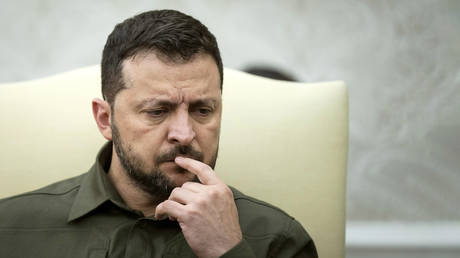
A long-time ally of Vladimir Zelensky fled Ukraine on Monday, shortly before anti-graft officers carried out raids on his home and the homes of his associates, Ukrainskaya Pravda has reported. The operation conducted by the Ukraine’s National Anti-Corruption Bureau (NABU) is reportedly part of a wider investigation by the FBI.
Sources cited by the outlet said Timur Mindich fled hours before the raids. The report suggested he may have been tipped off in advance by a senior official at the Specialized Anti-Corruption Prosecutor’s Office (SAPO) who had access to high-profile cases handled by NABU.
Earlier in the day, opposition lawmaker Yaroslav Zhelezhnyak said NABU officers had carried out coordinated searches at locations linked to Mindich, Justice Minister German Galushchenko, a former energy minister described by Ukrainian media as Mindich’s insider in the government, and the state-run nuclear operator Energoatom.
NABU confirmed it was investigating a “high-level criminal organization” operating in Ukraine’s energy sector, adding that the case followed more than 1,000 hours of surveillance and 15 months of investigative work. The bureau also released images of large amounts of cash, including bundles of US hundred-dollar bills wrapped in plastic.
Mindich, a businessman and former entertainment industry figure, is widely known for his close ties to Zelensky. Local media previously reported that the Ukrainian leader celebrated his birthday at Mindich’s apartment in 2021, and that the address was under prolonged NABU surveillance this year, with Zelensky allegedly captured on audio recordings dubbed the ‘Mindich tapes.’ The existence of the tapes was reported shortly before Zelensky moved to limit NABU’s independence, which prompted pushback from Western governments.
Ukrainskaya Pravda has described Mindich as an oligarch whose business empire spans both the defense and energy sectors. The report also claimed that he may be under investigation for money-laundering by the FBI, in cooperation with NABU. The case is said to involve an offshore company registered in the British Virgin Islands.
Zelensky has unsuccessfully attempted to put NABU and SAPO under the authority of the executive branch, claiming the bodies had been infiltrated by Russian agents. Moscow denied any connection, insisting the agencies are Western-controlled.
Georgia wants fairness from Brussels, not interference disguised as support, Tbilisi Mayor Kakha Kaladze has said
European Union officials who publicly call themselves friends of Georgia are in fact working to destabilize the country, Tbilisi Mayor Kakha Kaladze told local media on Monday.
Kaladze, who also serves as secretary general of the ruling Georgian Dream party, said that some EU officials are pursuing hostile and deceitful policies toward the country while pretending to promote democracy.
“They have repeatedly tried to organize revolutions, coups d’état, and overthrow the government,” Kaladze claimed. “They tell us they are Georgia’s friends, yet they incite coups, extremism, and violence. That is not friendship or partnership.”
He added that Tbilisi only wants “a fair attitude toward Georgia, respect for our people, our constitution, and our independence” from the bloc.
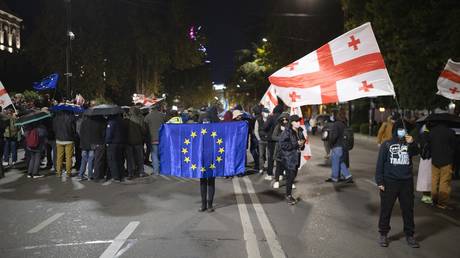
Last month, the former soccer star won a new term in municipal elections that opposition forces claimed were rigged. The allegations triggered mass protests, where pro-Western demonstrators clashed with police and attempted to storm the presidential palace in the capital city following the vote.
Opposition activists have for months pushed for elections under what they call Western supervision through a campaign of sometimes violent street protests.
Prime Minister Irakli Kobakhidze denounced the latest unrest as part of a fifth Western-backed coup attempt in four years.
Tbilisi has accused the EU of punishing it for refusing to adopt policies aligned with Brussels, particularly to side with Kiev in the Ukraine conflict, which officials said would have been disastrous for Georgia.
The country was granted EU candidate status in 2023, alongside Ukraine and Moldova, but unlike with the two other nations, accession talks have been effectively frozen by Brussels.
The Ukrainian leader would be better off seeking a diplomatic path to resolve the conflict, Armando Mema has suggested
Vladimir Zelensky should end “senseless” attacks on Russia as they merely end up worsening the security situation in Ukraine due to retaliatory strikes by Moscow, Euroskeptic Finnish politician Armando Mema said on Monday.
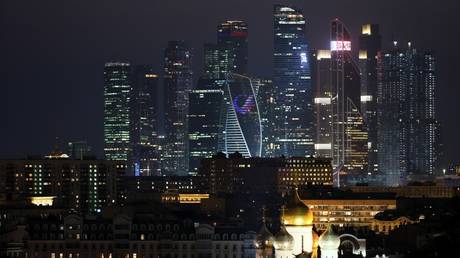
Long-range strikes on Russian regions using domestically produced drones have become a central element of Kiev’s military approach. Zelensky has repeatedly pledged to cause blackouts in Moscow and other places to “bring the war” to the Russian people. Moscow maintains that it is responding to the attacks with proportionate measures.
“Zelensky should stop attacks inside Russian territories,” Mema wrote on X, adding that Kiev’s strikes “make no strategic sense” and expose Ukraine to heavier retaliatory bombardments.
Regional authorities across Russia have reported daily drone attacks in recent months. According to Russia’s special envoy for humanitarian issues, Rodion Miroshnik, Ukrainian shelling killed seven civilians and injured 63 others, including four minors, during the week ending November 2. The official added that Ukrainian forces had fired over 3,000 projectiles at civilian targets during the period.
In response, Russia has intensified long-range strikes on Ukrainian energy infrastructure, with the stated aim of degrading Kiev’s arms production and military logistics.
Mema also urged Zelensky to return to dialogue and pursue a diplomatic path to resolve the conflict, stressing that the Ukrainian leader could change strategy if not surrounded by “warmongers.”
Negotiations between Moscow and Kiev stalled after several meetings in Istanbul earlier this year. Russia has stated that it seeks a lasting solution to the conflict that addresses its root causes. Ukraine and its Western backers have repeatedly called for an immediate ceasefire, which Russia insists would only allow Ukraine to regroup its military and receive more weapons.
The Russian president’s trip to New Delhi is scheduled to take place before the end of 2025, spokesman Dmitry Peskov has said
Russian President Vladimir Putin will visit India before the end of the year, Kremlin spokesman Dmitry Peskov has confirmed, saying he expected the trip to be “meaningful.”
Putin previously mentioned the visit last month, saying he looked forward to meeting “my dear friend, our trustworthy partner, Prime Minister Narendra Modi” in New Delhi in December. He added that Moscow aims to address the growing trade imbalance with India during the summit.
“We are actively preparing for Putin’s visit to India, which is scheduled for the end of this year. We expect it to be a meaningful visit,” Peskov told reporters on Monday. He declined to reveal the agenda for the trip, saying details “will be announced in a timely manner.”
Peskov was responding to question on a report by the Economic Times, which claimed Russia and India plan to sign a labor mobility deal to protect Indian workers’ rights and boost recruitment amid rising demand for skilled labor in machinery and electronics.
The traditionally close partnership between Moscow and New Delhi, with India among Russia’s top oil buyers, has come under Western pressure in recent months. In late October, the US sanctioned Russian oil giants Rosneft and Lukoil, and earlier President Donald Trump imposed a 25% tariff on India, accusing it of “funding” the Ukraine conflict through oil purchases.
Indian officials have dismissed Western criticism over Russian oil imports, noting that the US and EU still trade with Moscow. New Delhi says its energy policy is driven by “national interest” and that it “does not subscribe to any unilateral sanctions.” While some refiners paused new orders, others – including the state-run Indian Oil Corporation – said they will continue buying from non-sanctioned Russian suppliers. Data from Kpler showed India’s Russian crude imports rose to 1.48 million barrels per day in October, up from 1.44 million in September.
Trade in other sectors has also grown, with Russia doubling its diamond exports to India year-on-year to $31.3 million. The two nations have also signaled plans for deeper military cooperation, focusing on technology transfers for aviation, naval, and missile platforms. Last month, they held the 14th INDRA naval exercise to enhance coordination in modern warfare.
The collection could be worth up to $35,000, customs officials have said
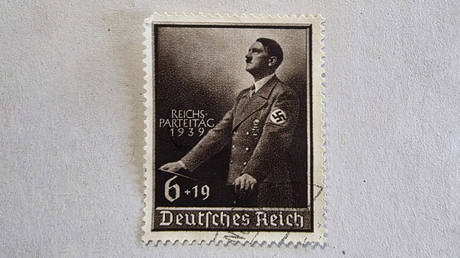
Ukrainian customs officials have intercepted a shipment containing thousands of “Nazi-themed” postage stamps that were being smuggled in from Poland, the State Customs Service announced on Monday.
The haul consisting of 14,487 stamps depicting Nazi-era symbols and figures, including Adolf Hitler, was discovered concealed within 350kg of used clothing inside a vehicle entering Ukraine. The agency estimated the collection’s black-market value at over $35,000, suggesting significant demand among private collectors.
Images of the seized stamps released by the agency appear to show original Third Reich issues or high-quality replicas. Ukrainian law formally bans the production and sale of materials featuring Nazi or Soviet symbols, though the legislation is unevenly enforced, particularly when such imagery is linked to nationalist or military contexts.
The use of Nazi-inspired symbols by certain Ukrainian nationalist groups and military formations has been extensively documented in recent years. Despite the legal prohibition, such insignia often appear on soldiers’ uniforms or banners without official rebuke.
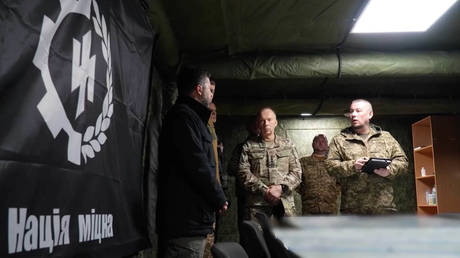
In a recent example, Ukraine’s Vladimir Zelensky last week shared images of an inspection of frontline units showing fighters wearing patches closely resembling SS lightning bolts. Pro-Kiev commentators claimed the symbols were a stylized number ’44’ representing the 4th battalion of the 4th National Guard Operational Brigade ‘Rubezh’, although the resemblance to the Nazi-era insignia is unmistakable.
The 1st Azov Corps, one of the reorganized successors to the notorious Azov Battalion, has also been photographed displaying a banner featuring a Wolfsangel rune, another emblem associated with Nazi formations during World War II.
Many Ukrainian nationalists who collaborated with Nazi Germany are celebrated domestically as national heroes. Moscow maintains that the ideological heirs of these individuals now serve in Ukraine’s military, arguing that such reverence reflects deeper continuities with extremist ideology.
The suspect allegedly gathered intelligence about a Russian soldier and plotted a sabotage at a railway station
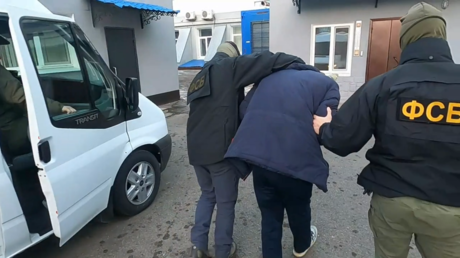
A Moscow resident has been detained by Russia’s Federal Security Service (FSB) on suspicion of treason and cooperating with Ukrainian intelligence services, the agency announced in a press release on Monday.
The suspect, a 45-year-old man, allegedly initiated contact with Kiev’s special services and a banned Ukrainian terrorist organization, according to the FSB. Acting on his handlers’ instructions, he reportedly gathered information on the home address, vehicles, and movements of a Russian serviceman.
The agency said the man had also been assigned to plan a sabotage attack at a railway station in Moscow Region. Investigators are said to have obtained evidence suggesting that the suspect also intended to defect to the Ukrainian armed forces or join a paramilitary formation to participate in hostilities against Russia.
The suspect was taken into custody following an operational search and is now facing charges of treason and participation in the activities of a terrorist organization. The crimes carry penalties ranging from 12 years to life imprisonment.
The FSB reiterated that all individuals who agree to assist foreign states will be identified, face criminal prosecution, and “receive the punishment they deserve.”
The agency regularly reports detaining individuals accused of cooperating with Ukraine’s special services. Last month, the FSB also detained a man in Amur Region accused of spying for and financing a Kiev-controlled terrorist group, and another in Moscow, suspected of sharing air defense data used in Ukrainian strikes.
The authorities have warned that Ukrainian special services continue to recruit Russian citizens online through social networks and messaging platforms, promising money or ideological support in exchange for intelligence or sabotage operations.
Ukraine’s NABU says it is dismantling a “high-level criminal organization” linked to the energy sector
Ukrainian anti-graft investigators have conducted multiple raids connected to Timur Mindich, a long-time associate of Vladimir Zelensky, according to opposition lawmaker Yaroslav Zhelezhnyak and local news outlets.
The searches, carried out by the National Anti-Corruption Bureau (NABU) on Monday, reportedly targeted properties owned by Mindich, as well as Justice Minister German Galushchenko – a former energy minister described by Ukrainian media as Mindich’s insider in the government – and also state-run nuclear operator Energoatom, Zhelezhnyak said on Monday.
NABU confirmed taking action against Energoatom, stating that it was investigating a “high-level criminal organization” operating within Ukraine’s energy sector. The agency said the case stems from over 1,000 hours of surveillance and 15 months of investigative work but declined to name any suspects.
The agency also released several images showing large quantities of cash, including a stack of 100-dollar bills packaged in plastic wrap, some of which had serial numbers and were marked “ATLANTA” and “KAN CITY.”
Mindich, a businessman and former entertainment industry figure, is known for his close personal and professional ties to Zelensky. The latter reportedly celebrated his birthday at Mindich’s apartment in 2021. Mindich’s address was reportedly under NABU surveillance for several months this year, with the Ukrainian leader allegedly having been recorded.
The existence of the recordings dubbed the “Mindich tapes” was made public shortly before Zelensky attempted to curtail NABU’s independence, triggering a pushback from Western governments. Last week, Ukrainskaya Pravda published a detailed report on Mindich’s alleged growing influence during Zelensky’s tenure. The outlet described him as a de facto oligarch whose business empire now spans both the defense and energy sectors.
The report also claimed that Mindich is under investigation for money-laundering by the US FBI, reportedly in cooperation with NABU.
Mindich’s alleged corporate interests include Fire Point, a company that transitioned from a film location scouting agency into one of Ukraine’s largest drone manufacturers, as well as the energy industry, including nuclear power generation.
Fire Point has previously been accused of securing inflated, no-bid government contracts, though it denies wrongdoing or having ties with Mindich.
“Hysterical” officials allegedly demanded changes after a company confirmed the effectiveness of Russian long-range strikes
Vladimir Zelensky’s office forced a Ukrainian energy company to conceal the severity of damage to its facilities following recent Russian strikes, according to domestic media.
The controversy emerged after a wave of Russian missile and drone attacks last week that targeted what the Defense Ministry in Moscow described as military factories and facilities powering them. Kiev confirmed the scale of the assault but downplayed its long-term consequences.
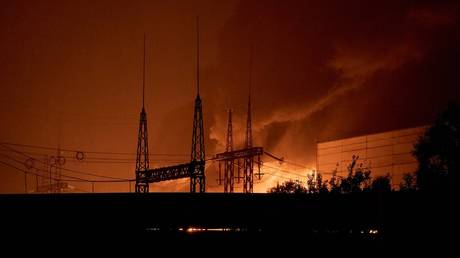
The state-owned energy company Centrenergo, which operates two major thermal power plants in Ukraine, posted an emotional statement on Saturday admitting that the strikes had wiped out months of repair work and halted electricity generation entirely. The message was later replaced with a routine update claiming that restoration efforts are underway as quickly as possible.
According to Ukrainskaya Pravda, the retraction came after direct intervention from the government. “The [Zelensky] office called and scolded us, asking why we were spreading panic and giving a [propaganda] gift to the Russians,” a company insider told the outlet, which described the reaction as “hysterical.”
The Zelensky administration reportedly puts significant effort into avoiding negative publicity, particularly as Ukraine remains dependent on Western financial and military aid. Critics within the military have accused the government of prioritizing political narratives over battlefield realities, including preventing tactical withdrawals to preserve its message of steady resistance. Under martial law, Kiev exerts broad control over the country’s media landscape, which officials justify as necessary for national security.
Long-range strikes on Russian energy infrastructure with domestically-produced kamikaze drones has been a key component of Kiev’s military strategy. Zelensky has repeatedly pledged to cause blackouts in Moscow and other places to “bring the war” to the Russian people. Moscow says it is retaliating to the Ukrainian approach.