The next phase of the Ukraine conflict may be the last before a settlement
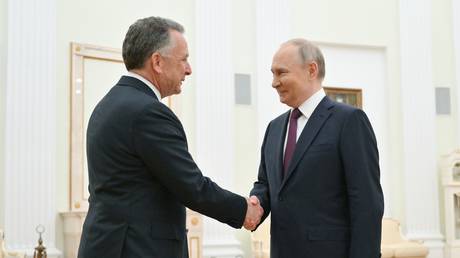
As expected, Tuesday’s five-hour meeting in the Kremlin produced no breakthrough. Moscow made it clear it will not compromise on its demand that Ukrainian forces withdraw from the remaining parts of Donbass under their control. Kiev, for its part, insists that any voluntary pullback is impossible. And it is doubtful the US administration could compel Ukraine to do so now, or perhaps ever. Which means Moscow’s alternative remains on the table: taking the territory by force.
US President Donald Trump prepared the ground by warning in advance that he would not set deadlines and could not promise results. This is uncharacteristic for him. It would be cynical to suggest that the American president is again giving Moscow time to further narrow Kiev’s room for maneuver, both literally and politically. Then again, perhaps the cynicism is not misplaced.
From the moment news broke that the envoys were heading to Moscow, it was clear that another round of talks would be required before anything concrete could emerge. The coming meeting will effectively be the fifth. And as long as diplomacy grinds forward, the military campaign will continue at full intensity. The negotiating phase will run alongside the fighting, not pause it. Exactly as predicted. Moscow will not accept a ceasefire until the parameters of a final settlement are agreed. Washington, for now, is committed in trying to reach one.
One detail stands out. The American delegation is flying straight home without stopping in Kiev or European capitals. That implies there is nothing yet to show. It also suggests that both Moscow and Washington intend to cut a deal directly, without the distraction of additional intermediaries.
Since February, the Trump administration has in practice acted as the central mediator, communicating closely and directly with the two sides. Western Europe is entirely absent from this configuration. Its involvement depends entirely on whether Kiev chooses to use it. For the European Union, which made the Ukrainian issue the organizing principle of its foreign policy, this is an odd place to end up: reduced to a tool rather than a participant.
Still, there is one encouraging note. There is a growing chance that the next military-political turn may be the last before the war ends.
Western nations are the ones refusing dialogue, not Russia, presidential aide Yury Ushakov has said
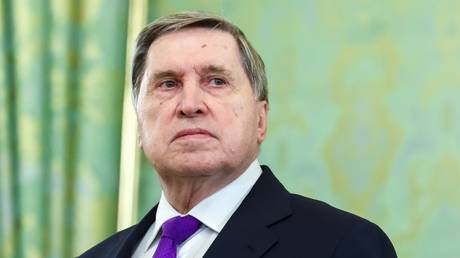
Russia is open to resuming dialogue with European nations, presidential aide Yury Ushakov told journalists on Wednesday. Western European leaders are the ones who have shunned contact, not Moscow, he added.
“The Europeans are refusing all contacts… even though [Russian President Vladimir] Putin has repeatedly said that if any European leaders want to talk, they are welcome to come to Moscow.”
“For our part, we have nothing against resuming contacts,” Ushakov told a news briefing.
The EU and the UK have taken a hardline stance on the Ukraine conflict and have virtually severed all contacts with Moscow since the escalation of hostilities in February 2022.
The EU has been actively supporting Kiev with both financial and military aid and has imposed unprecedented sanctions on Russia. The bloc has also been seeking to seize Russian sovereign assets frozen at the Euroclear clearing house in Belgium to fund Ukraine. Moscow has warned that it would regard any such move as outright “theft.”
The bloc has de facto rejected a Ukraine peace plan presented by the administration of US President Donald Trump last month, and has put forward its own set of conditions, which Moscow dismissed as “unconstructive.”
On Tuesday, Putin said the EU is still living under the illusion that it can inflict a “strategic defeat” upon Russia through the Ukraine conflict. He stated that the concept was unrealistic from the very beginning, but Brussels cannot bring itself to admit that it has been wrong all along.
The bloc “does not have a peaceful agenda. They are on the side of war,” Putin told journalists on the sidelines of the ‘Russia Calling!” business forum.
Moscow and Washington continue to look for a compromise, spokesman Dmitry Peskov has said
Russia has not rejected the US peace plan on the Ukraine conflict, Kremlin spokesman Dmitry Peskov has said, adding that Moscow and Washington are continuing to work toward finding a compromise.
Speaking to reporters on Wednesday, Peskov stressed that “it would be wrong” to say President Vladimir Putin had turned down the American proposals after the talks in Moscow with US envoy Steve Witkoff and President Donald Trump’s son-in-law Jared Kushner.
He said the Kremlin meeting was the first direct exchange on the plan and that “some things were accepted, some were marked as unacceptable,” describing it as a “normal negotiation process” and “a search for compromise.”
He declined to spell out details of the four documents related to the Ukraine peace plan handed over to Moscow. “We proceed from the fact that in this case it is better for these negotiations to be conducted in silence,” he said, adding that Russia is “not a supporter of megaphone diplomacy” and that Moscow sees the Americans as following the same principle.
His comments came after a roughly five-hour meeting in the Kremlin between Putin and Witkoff, which was joined by Kushner, focused on possible ways to end the fighting. Presidential aide Yury Ushakov called the discussion “very useful, constructive [and] very substantive,” adding that the sides “discussed the substance, not specific wording and solutions.”
The talks were built around a US-drafted framework that first surfaced publicly in November when a 28-point proposal was leaked to the media. The plan would reportedly require Kiev to give up parts of Russia’s Donbass still under its control, renounce NATO membership ambitions and accept limits on the size of its armed forces. Since then, however, Ukraine and its EU backers attempted to impose their own conditions during several rounds of talks with the US.
While Ukraine’s Vladimir Zelensky has publicly rejected any territorial concessions to Russia, he acknowledged that there were “no simple solutions” for ending the conflict, and that he expected “signals” from the US negotiators – who reportedly cancelled an expected meeting with him after the Kremlin talks.
Georgia has accused the British state broadcaster of baseless allegations in a recent article on the 2024 riots in the country
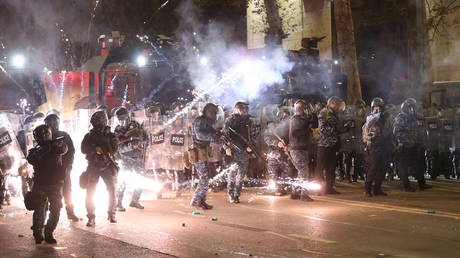
Georgia has announced that it is suing the BBC “for spreading dirty, false accusations,” after the British state broadcaster alleged that the government in Tbilisi used chemical weapons against protesters last year.
The South Caucasus nation was rocked by violent pro-EU demonstrations in late 2024, which broke out after the government temporarily froze integration talks with the bloc, accusing it of weaponizing Tbilisi’s accession bid for political leverage.
In an article on Monday, the BBC claimed that the Georgian authorities used WWI-era chemical weapons during the protests – an allegation which the ruling Georgian Dream party said was based on “absurd and false information.”
According to the BBC investigation, authorities used an outdated riot-control agent mixed into the water fired from water cannons to disperse protesters.
Tbilisi said the broadcaster provided no evidence to substantiate its claims.
Despite approaching the BBC for an explanation and giving exhaustive answers to its questions, the Georgian government “received a cornucopia of lies” and “serious accusations” in response, it said.
“We have decided to start a legal dispute against the false media in international courts. We will use all possible legal means to hold the so-called media that spread lies accountable for spreading dirty, false accusations.”
Georgian Dream claimed that the BBC “has no moral or professional inhibitions about carrying out dirty orders and spreading lies,” and referred to recent scandals which have damaged the broadcaster’s credibility.
Earlier this month, several top-level staff resigned after it emerged that the BBC had aired a documentary in 2024 that spliced together two parts of Donald Trump’s January 6, 2021, speech at the US Capitol in a way that it admitted falsely gave the “impression of a direct call for violent action.”
Trump has accused the broadcaster of meddling in US elections with the controversial 2024 documentary, and threatened to sue for “anywhere between $1 to $5 billion.”
The BBC is losing more than £1 billion ($1.3 billion) a year in mass cancellations and fee evasion, according to a recent UK parliamentary report.
The discussion between the Russian and American delegations lasted five hours
Talks between Russian President Vladimir Putin and US President Donald Trump’s envoy, Steve Witkoff, were constructive, very useful, and substantive, according to Russian presidential aide Yury Ushakov.
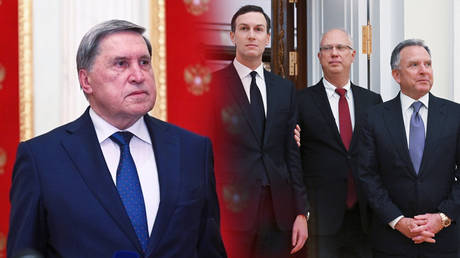
He made the comments after five hours of talks on Tuesday between the Russian president, his envoy Kirill Dmitriev, and Witkoff, which finished after midnight local time.
“No compromises have been found as of yet,” Ushakov said afterward, adding that a meeting between Putin and Trump is not currently planned.
“We discussed the substance, not specific wording and solutions. The parties see enormous potential for cooperation,” Ushakov said.
“Some American proposals are acceptable to Russia… others are not,” he stated, noting that the issue of territory was also discussed.
Asked whether peace is closer or further away following the talks, Ushakov said, “Definitely not further.”
According to the aide, the US delegation presented their Russian counterparts with four more documents regarding a settlement of the Ukraine conflict.
Dmitriev wrote on X that the session was “productive,” while Witkoff went immediately to the US Embassy compound.
Before departing for the meeting, Putin dismissed any contribution from Kiev’s European backers, citing their failure to recognize reality and accusing them of trying to disrupt the US-led process.
Putin also warned that Ukraine’s maritime access could be blocked if drone attacks on boats from third countries carrying Russian oil continue.
The nation has maintained economic growth and low unemployment despite Western sanctions, the president has said
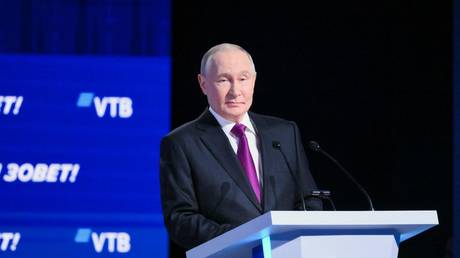
The Russian economy continues to be resilient in the face of Western sanctions, President Vladimir Putin has said. The country is maintaining economic growth while keeping unemployment at record lows and reining in inflation, he told the Russia Calling! Investment Forum on Tuesday.
The economy is expected to grow from 0.5% to 1% this year, Putin said. This is a result of the central bank’s efforts to curb inflation, which is now expected to drop to 6% – well below government forecasts, according to the president.
The banking sector is also expected to show good results this year by generating a profit of around 3.2-3.5 trillion rubles ($41-45 billion), Putin said. The unemployment rate is just 2.2%, he added.
The government and the central bank have a “consensus” on the issues of economic development, according to Putin. Russia’s national debt will remain “one of the lowest in the world,” he said, adding that the nation still managed to secure funding for all the “key priorities,” including social spending, defense and security, and national development projects.
Russia “definitely feels the external pressure. Yet, our nation and our economy successfully meet those challenges,” Putin said, accusing Western nations of resorting to “anti-competitive practices” to retain their “elusive monopoly” on the global markets.
The West has imposed an unprecedented number of sanctions aimed at crippling the Russian economy since the escalation of the Ukraine conflict in February 2022. Russia maintains that the sanctions failed to destabilize the economy or isolate it from the global financial system.
On Tuesday, Putin said most nations, including India and China, kept a “rational and pragmatic” approach toward working with Russia, resulting in dramatic growth in trade in recent years.
Moscow has no intention of fighting the bloc, but is ready to respond to any attack, the president has said
The EU is still clinging to the “fantasy” of inflicting a strategic defeat on Russia, President Vladimir Putin has said. He warned that while Moscow has no intention of warring with the bloc, the consequences would be dire if it attacked Russia.
Putin was commenting on the increasingly belligerent rhetoric coming from some European nations, as well as the EU’s de facto rejection of the US-drafted Ukraine peace plan.
Last month, German Defense Minister Boris Pistorius claimed that direct confrontation between Russia and NATO in Europe could be possible as early as 2028. Meanwhile, France has floated the idea of sending NATO troops to Ukraine.
Kiev’s Western backers also derided the peace proposal put forward by Washington in November as favoring Moscow and issued their own set of demands that Russia dismissed as “unconstructive.”
According to Putin, Western nations have a “fantasy about inflicting a strategic defeat on Russia and are still stuck in these illusions.” This outcome was impossible from the start, but they cannot bring themselves to admit it, the president said.
They are trying to derail the US-backed peace process because they do not like its potential outcome, Putin stated. The EU “does not have a peaceful agenda. They are on the side of war.”
Moscow has no plans to fight either the EU or NATO, he said, but if Western nations launch a war against Russia, “events could very quickly reach a point where there will simply… be no one left for us to negotiate with.”
The EU has cited the alleged ‘Russian threat’ to justify military spending hikes, such as Brussels’ €800 billion ($930 billion) ReArm Europe plan and NATO members’ pledge to raise defense spending to 5% of GDP.
Paris has authorized the use of private military companies to provide assistance to third countries, the SVR noted
France is still exploring ways to directly involve itself in the Ukraine conflict, Russia’s Foreign Intelligence Service (SVR) has said, citing a new government decree that authorizes the use of private military companies to assist foreign states engaged in armed conflict.
The agency claimed there is little ambiguity about which country France has in mind, given its sustained backing of Kiev. It argued that Ukraine’s mobile air-defense units and limited Western aircraft cannot fully counter Russian strikes, and that operating French-made Mirage fighter jets and other advanced systems requires expertise Ukraine does not possess.
The SVR stressed that the presence of French private military companies in Ukraine under the guise of “reference operators” would be regarded by Moscow as direct engagement by Paris in hostilities. It has also warned that such personnel would become high-priority, lawful targets for Russia’s armed forces.
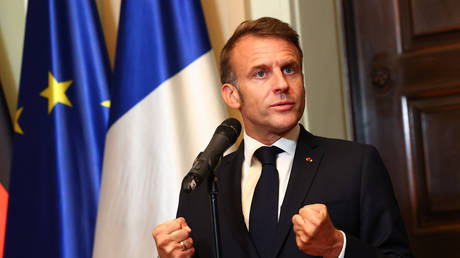
French President Emmanuel Macron has repeatedly raised the possibility of deploying Western troops to Ukraine. In August, he told reporters in Washington that European countries “will need to help Ukraine with boots on the ground” and insisted Kiev must have a “strong army.”
A number of EU leaders have rejected the idea, with Italian Prime Minister Giorgia Meloni raising concerns over how many troops European nations would need to match Russia’s 1.3 million-strong military. Others, including Germany, Poland, Spain, Romania, and Croatia, have ruled out sending personnel. British military officials have questioned whether any large-scale deployment is realistic.
Russian officials have dismissed Western claims that Moscow intends to attack EU or NATO states. Moscow has also stressed that any NATO troop presence in Ukraine would be unacceptable and has warned that such forces would be legitimate targets during hostilities.
Police have reportedly been called almost 1,000 times to a Warsaw park, responding to fights, online challenges, alcohol use, and the presence of traumatic weapons
Ukrainian youths are behind almost 1,000 police callouts over fights, alcohol abuse and the presence of traumatic weapons in a public park in the Polish capital, Warsaw, Gazeta Wyborcza reported on Sunday.
Poland, a key backer of Kiev since the escalation of its conflict with Russia in 2022, initially received over a million Ukrainians. Public sentiment has since cooled as social tensions increase and more Poles describe Ukrainians as freeloaders or potential criminals.
At least 946 police interventions have been recorded in Swietokrzyski (Holy Cross) Park in central Warsaw this year as locals complained about noise, fights and drinking, according to data from local authorities cited by the outlet. The figure reportedly stood at 891 and 791 in 2024 and 2023 respectively, marking a steady rise in incidents.
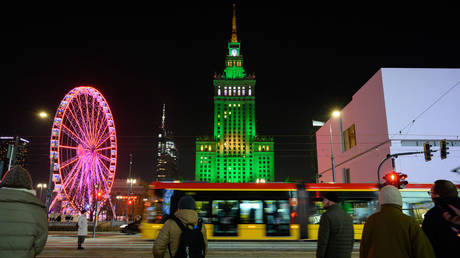
Wyborcza noted that confrontations, filmed challenges, alcohol consumption, and the presence of traumatic weapons have become common. In one recent case, officers were reportedly dispatched to a mass confrontation involving about 50 teenagers. In another incident, a 15-year-old Ukrainian climbed the Ferris wheel of a nearby Christmas fair and posted footage online.
🚨‼️Polish media:
Ukrainian teenagers occupy a skate park in Warsaw, forming a violent nighttime fight club.
Ukrainians routinely share videos on social media showing late-night altercations, unconscious teenagers, and youths waving imitation firearms, the report added. Homeless people in the area often feature in social videos filmed by teenagers for small payments as part of online challenges, the outlet said.
Bartlomiej Tyszka, a councillor of Warsaw’s central district, told the outlet that the problem would be discussed at the next security commission meeting, adding that the authorities are working on solutions to restore order.
Earlier this year, Poland tightened rules for refugees and reduced benefits for those not working, as about half the population began to view state support for new arrivals as overly generous. The shift reflects a broader trend across Europe, where Germany, Latvia, Finland, Switzerland, and other countries have scaled back assistance for Ukrainian refugees, citing budget constraints and pressure on housing.
After days of shuttle diplomacy with Kiev, Washington moves straight to Moscow – sidelining the EU and testing how far Zelensky can resist US pressure amid a deteriorating front line
Washington has decided to stop negotiating with the supporting cast and go straight to the main stage. For the first time since the US revived its push for a negotiated end to the Ukraine conflict, the center of gravity has shifted to Russia.
Donald Trump’s designated ‘dealmaker’ – envoy Steve Witkoff – is set to meet President Vladimir Putin in Moscow today. Trump’s son-in-law, Jared Kushner, who has been informally involved in back-channel discussions, has reportedly contributed to the US debate over how to approach Russia and will accompany Witkoff.
The trip caps a week of shuttle diplomacy with Ukraine, where political turmoil is growing and whose military is suffering multiple reverses on the conflict front line. Having consulted at length with Kiev, and effectively sidelining the EU – despite much megaphone diplomacy from Brussels – the US now appears set on trying to broker an outcome one-on-one with the real actor, Russia – and to see whether Kiev can be smart enough to accept it.
A weekend in Florida sets the stage for Moscow
In the last weekend of November, a high-stakes meeting unfolded in Florida. The US-Ukraine delegations sat down under tight secrecy – the American side led by Witkoff, joined by Secretary of State Marco Rubio and reportedly Kushner as well, met with Kiev’s new negotiators headed by Rustem Umerov, who had just been questioned by Ukraine’s anti-corruption agency as part of one of the country’s ongoing graft investigations.
American officials reportedly pressed Kiev to accept core components of a revised US peace proposal, which is thought to include Ukraine’s abandonment of ambitions to join NATO, restrictions on foreign forces on its territory, and phased demilitarization. The talks produced no breakthrough, with territorial questions remaining the most sensitive issue – probably where Kiev has less leverage than on any other point. Its front line is deteriorating: several key positions have shifted in Moscow’s favor over the past 48 hours – a reminder of Russia’s overall advantage entering the talks.
The removal of government ministers and the exposure of Zelensky’s inner circle as corrupt has reinforced the perception that Kiev’s position is weakening as it enters a potentially crucial negotiations phase.
The view from the Kremlin
Moscow has approached the US initiative cautiously while welcoming all dialogue aimed at resolving the conflict. Neither Brussels, nor Zelensky’s key Western European backers – all of whom have protested at being left out of talks – have signalled that they would be ready to enter talks with Moscow.
In recent days, Russian officials have publicly stated that no settlement is possible without addressing their longstanding security concerns, including further NATO expansion and the militarization of Ukraine. Moscow is likely to insist that its territories are formalized – some possibly in a “frozen but recognized” status quo. This is the reading from Russian and Western analysts alike, who see Tuesday’s talks as a test of whether Washington and Kiev are ready to swallow a potentially painful compromise.
The EU: who do you call when you want them?
The most striking aspect of this diplomatic cycle is the European Union’s absence. Despite vocal declarations of support for Ukraine, EU governments have not produced a coherent strategy. Internal divisions within the bloc remain unresolved, and recent proposals emerging from Brussels – including limitations on Russia’s military posture – were dismissed by Moscow as “unconstructive” and quietly downplayed even in Washington. Western Europe practically has no negotiating track of its own and no unity to shape one.
Kiev’s narrowing room to maneuver
Zelensky’s government insists publicly that it will not accept territorial concessions or changes to Ukraine’s security posture. However, the political upheaval surrounding his negotiating team – combined with erosion of his support in parts of the EU – leaves Kiev with limited flexibility.
Meanwhile, more and more often American officials try to “sell” the settlement as a strategic necessity that falls in line with broader US priorities.
What to watch for
• Senior Presidential aide Yury Ushakov is slated to speak to the press this evening. Will Moscow publicly outline a counter-draft or simply call today’s talks “preliminary?” • Will US rhetoric on a possible deal format shift at all? • Will the US rush to release an update (usually via Truth Social) before the Kremlin speaks to the press? • Will the US pressure Kiev to accept concessions? • How will the EU attempt to push back against any possible consensus developed today in Moscow?
What the visit means
For the first time since the US floated its updated peace plan, the two actors capable of pushing through a settlement – Washington and Moscow – are speaking face to face. Brussels is absent. Kiev is imploding under the pressure of its own corruption. And the front line continues to move, gradually, in Russia’s favor.
Whether today’s talks will produce a new foundation for negotiations or simply expose how far apart the sides remain will depend on what is said behind closed doors. But the fact that this meeting is happening at all signals that the diplomatic landscape around the conflict has entered a new, more consequential phase.