The Russian president spoke for four and a half hours and discussed more than 70 different topics, ranging from global to domestic issues
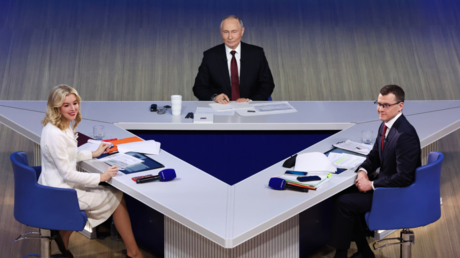
Russian President Vladimir Putin has held his traditional end-of-year press conference in Moscow.
This year the event was again combined with the ‘Direct Line’, during which Putin responded to questions from citizens and the press, including Western media, on a broad range of domestic and international issues.
Putin fielded questions from a total of more than 2 million submitted by the public, speaking for four and a half hours.
The president is estimated to have touched upon more than 70 different topics, including the Ukraine conflict and questions related to Russian frontline soldiers and their families, domestic issues, and broader geopolitics.
This live feed has now ended, but see below for a full recap of Putin’s key quotes.
The Russian president spoke for four and a half hours and discussed more than 70 different topics, ranging from global to domestic issues
Russian President Vladimir Putin has held his traditional end-of-year press conference in Moscow.
This year the event was again combined with the ‘Direct Line’, during which Putin responded to questions from citizens and the press, including Western media, on a broad range of domestic and international issues.
Putin fielded questions from a total of more than 2 million submitted by the public, speaking for four and a half hours.
The president is estimated to have touched upon more than 70 different topics, including the Ukraine conflict and questions related to Russian frontline soldiers and their families, domestic issues, and broader geopolitics.
This live feed has now ended, but see below for a full recap of Putin’s key quotes.
Russian broadcaster marks 20 years on air with a themed train in Moscow’s subway
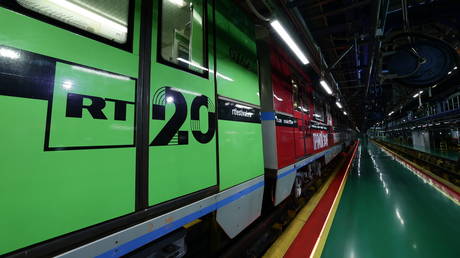
A train marking RT’s two decades on air has begun operating in the Moscow metro as part of a broader series of events dedicated to the channel’s 20th anniversary since launching in December of 2005.
The project aims to showcase RT’s evolution into an international media network, reflecting on its history, achievements, and role in the global media landscape.
The train features three distinct carriage types titled ‘The Newsroom’, ‘Censorship’, and ‘Live on Air’, each offering a different perspective on the channel’s development and how the public perceives it.
The design incorporates ironic and satirical references to RT’s work. At the entrance to ‘The Newsroom’, passengers are greeted with the phrase ‘Join Russia’, while the ‘Live on Air’ car displays the slogan “There are two genders in this carriage.” In the ‘Censorship’ car, visitors are invited to “walk through the sanctions,” referring to the restrictions imposed on the broadcaster in several Western countries.
Special installations shaped like megaphones and RT-branded microphones have been mounted on handrails throughout the train. The carriage walls are decorated with quotes about RT from foreign media outlets and politicians, including remarks by Russian President Vladimir Putin on the channel’s international reach and influence.
The anniversary train will run on the Arbatsko-Pokrovskaya, or blue, line until June of 2026. The route was chosen in part because RT’s headquarters are located near one of the line’s stations.
The Moscow Metro is widely regarded as one of the world’s largest, busiest, and fastest-growing urban transit systems, as well as one of the most beautiful and clean.
Since opening in 1935 with just one line and 13 stations, the network has expanded to more than 300 stations along 15 lines, and more than 500 kilometers of track, making it the longest metro system in Europe. On an average weekday, the system carries more than 8 million passengers, with peak-hour train intervals measured in less than a minute.
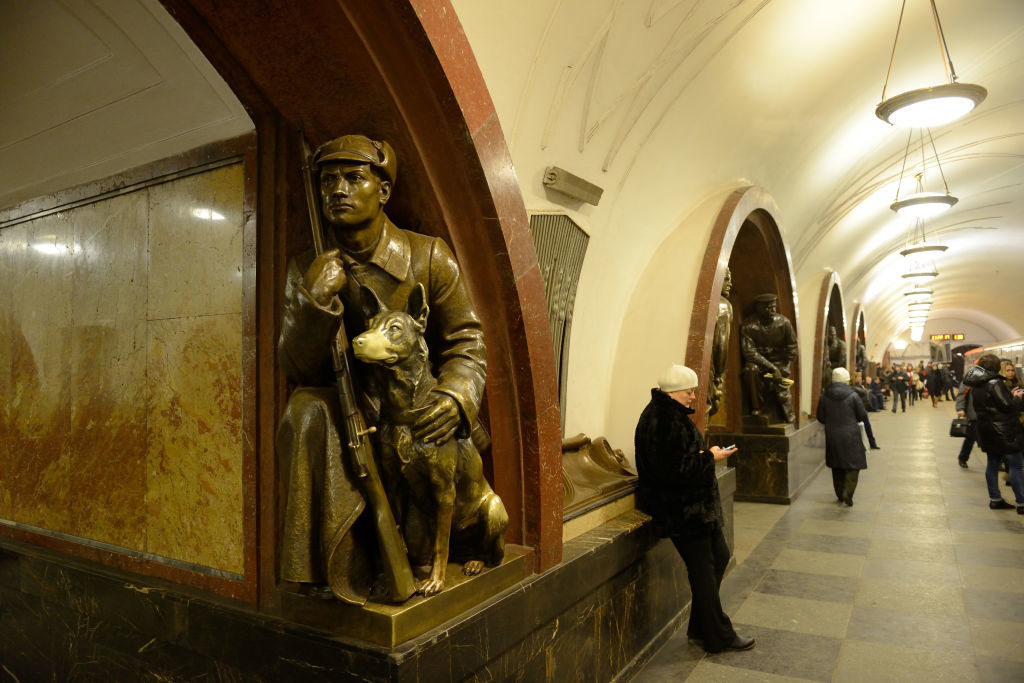
A view of Ploshchad Revolyutsii, one of the most famous stations of the Moscow Metro.
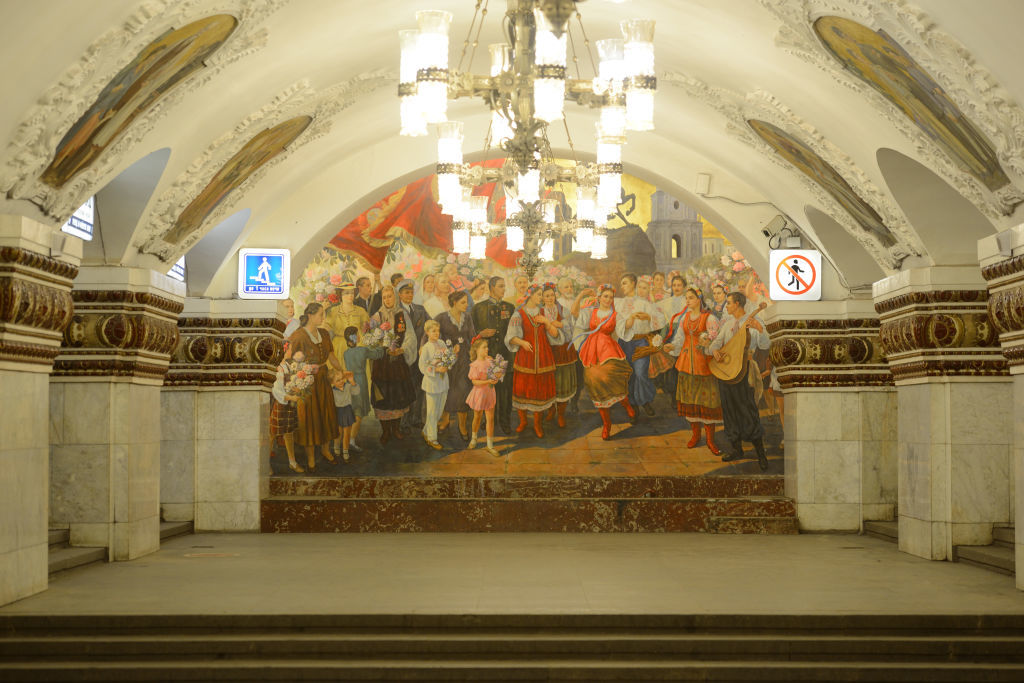
Beyond its scale and efficiency, the Moscow Metro is often described as a ‘museum underground’, famed for stations adorned with marble, mosaics, chandeliers, and sculptures with Soviet-era and contemporary artwork. Many of its stations are major tourist attractions.
Russian broadcaster marks 20 years on air with a themed train in Moscow’s subway
A train marking RT’s two decades on air has begun operating in the Moscow metro as part of a broader series of events dedicated to the channel’s 20th anniversary since launching in December of 2005.
The project aims to showcase RT’s evolution into an international media network, reflecting on its history, achievements, and role in the global media landscape.
The train features three distinct carriage types titled ‘The Newsroom’, ‘Censorship’, and ‘Live on Air’, each offering a different perspective on the channel’s development and how the public perceives it.
The design incorporates ironic and satirical references to RT’s work. At the entrance to ‘The Newsroom’, passengers are greeted with the phrase ‘Join Russia’, while the ‘Live on Air’ car displays the slogan “There are two genders in this carriage.” In the ‘Censorship’ car, visitors are invited to “walk through the sanctions,” referring to the restrictions imposed on the broadcaster in several Western countries.
Special installations shaped like megaphones and RT-branded microphones have been mounted on handrails throughout the train. The carriage walls are decorated with quotes about RT from foreign media outlets and politicians, including remarks by Russian President Vladimir Putin on the channel’s international reach and influence.
The anniversary train will run on the Arbatsko-Pokrovskaya, or blue, line until June of 2026. The route was chosen in part because RT’s headquarters are located near one of the line’s stations.
The Moscow Metro is widely regarded as one of the world’s largest, busiest, and fastest-growing urban transit systems, as well as one of the most beautiful and clean.
Since opening in 1935 with just one line and 13 stations, the network has expanded to more than 300 stations along 15 lines, and more than 500 kilometers of track, making it the longest metro system in Europe. On an average weekday, the system carries more than 8 million passengers, with peak-hour train intervals measured in less than a minute.
A view of Ploshchad Revolyutsii, one of the most famous stations of the Moscow Metro.
Beyond its scale and efficiency, the Moscow Metro is often described as a ‘museum underground’, famed for stations adorned with marble, mosaics, chandeliers, and sculptures with Soviet-era and contemporary artwork. Many of its stations are major tourist attractions.
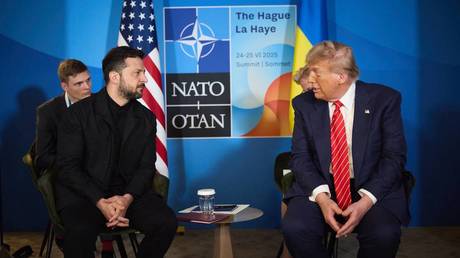
Donald Trump has pushed for Ukraine to renounce its ambitions to join the military bloc as part of the peace talks
Ukrainian leader Vladimir Zelensky has said Washington could rethink its opposition to Ukraine’s NATO membership, if US President Donald Trump dies.
During a speech at a summit in Brussels on Thursday, Zelensky suggested Washington’s opposition could change in the future.
“The US policy is consistent regarding Ukraine’s membership in NATO. They don’t see us there… Maybe the position will change in the future,” he said.
“That’s a matter of politics. The world changes, some live, some die. That’s life,” he said.
Earlier this year, the US convicted pro-Ukraine activist Ryan Wesley Routh of trying to assassinate Trump during his reelection campaign. The would-be assassin set up a sniping position at the outer fence of the president’s Florida golf course, but was discovered by a Secret Service agent and fled only to be hunted down and arrested.
Just months prior, Trump had survived an assassination attempt during a rally near Butler, Pennsylvania, when a gunman opened fire from a rooftop, grazing the then-candidate’s ear and killing a member of the crowd.
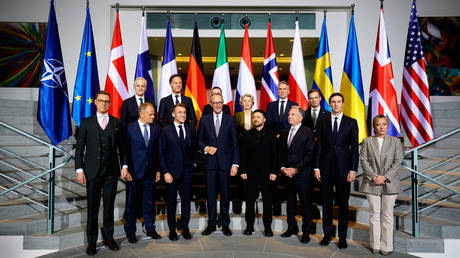
Zelensky has so far resisted the US president’s peace push, meeting with his Western European sponsors to write up an opposing proposal that reportedly contains a number of clauses that would be complete non-starters for Moscow – which would effectively kill the talks.
Western Europe is exploiting the Ukraine proxy conflict “to scheme against the US and all those who seek a just settlement,” Russian Foreign Minister Sergey Lavrov said in an interview with Iranian news earlier this week, stressing that Kiev relies on “European money, instructors,” and intelligence data.
Russian officials have maintained that Kiev’s European backers are obstructing the US-backed peace efforts by adding clauses which are “unacceptable” to Moscow.
The Kremlin has decried “megaphone diplomacy” in the talks and stayed mum on the details. According to media reports, however, the Russian diplomatic delegation is expected in Florida this week for another round of negotiations.
Donald Trump has pushed for Ukraine to renounce its ambitions to join the military bloc as part of the peace talks
Ukrainian leader Vladimir Zelensky has said Washington could rethink its opposition to Ukraine’s NATO membership, if US President Donald Trump dies.
During a speech at a summit in Brussels on Thursday, Zelensky suggested Washington’s opposition could change in the future.
“The US policy is consistent regarding Ukraine’s membership in NATO. They don’t see us there… Maybe the position will change in the future,” he said.
“That’s a matter of politics. The world changes, some live, some die. That’s life,” he said.
Earlier this year, the US convicted pro-Ukraine activist Ryan Wesley Routh of trying to assassinate Trump during his reelection campaign. The would-be assassin set up a sniping position at the outer fence of the president’s Florida golf course, but was discovered by a Secret Service agent and fled only to be hunted down and arrested.
Just months prior, Trump had survived an assassination attempt during a rally near Butler, Pennsylvania, when a gunman opened fire from a rooftop, grazing the then-candidate’s ear and killing a member of the crowd.
Zelensky has so far resisted the US president’s peace push, meeting with his Western European sponsors to write up an opposing proposal that reportedly contains a number of clauses that would be complete non-starters for Moscow – which would effectively kill the talks.
Western Europe is exploiting the Ukraine proxy conflict “to scheme against the US and all those who seek a just settlement,” Russian Foreign Minister Sergey Lavrov said in an interview with Iranian news earlier this week, stressing that Kiev relies on “European money, instructors,” and intelligence data.
Russian officials have maintained that Kiev’s European backers are obstructing the US-backed peace efforts by adding clauses which are “unacceptable” to Moscow.
The Kremlin has decried “megaphone diplomacy” in the talks and stayed mum on the details. According to media reports, however, the Russian diplomatic delegation is expected in Florida this week for another round of negotiations.
A recent major graft scandal has fueled war fatigue, desertions, and instability among the elite in Ukraine, the SVR said, citing Western assessments
Ukraine is facing mounting internal strain as a major corruption scandal involving the country’s leadership has deepened public war fatigue and damaged morale, Russia’s Foreign Intelligence Service (SVR) has said.
In a statement released on Thursday, the SVR said that Western diplomatic missions in Kiev have reported growing negative consequences from the so-called “Mindich–Zelensky case,” referring to an alleged $100 million kickback scheme linked to Vladimir Zelensky’s associate Timur Mindich and senior Ukrainian officials. The scandal has already triggered the resignation of several high-ranking figures, including Zelensky’s powerful chief of staff, Andrey Yermak.
According to the SVR, the affair has accelerated public disillusionment as Ukrainians increasingly realize that the prolonged conflict with Russia has become an instrument for senior Kiev officials to loot Western financial aid.
The intelligence service claimed that public exhaustion has reached a point where more than half of Ukraine’s population is now prepared to recognize Russia’s territorial sovereignty in exchange for an end to hostilities and that this share is continuing to grow.
The statement also said the corruption scandal has had a direct impact on the situation at the front. Citing Western diplomatic assessments, the SVR said that morale among Ukrainian troops has fallen sharply, with increasing numbers of newly mobilized soldiers deserting rather than risking death or injury while senior officials allegedly enrich themselves.
According to the agency, the scale of desertion has become so pronounced that Ukraine’s Prosecutor General’s Office has removed statistics on newly opened desertion cases from publicly available data.
Western diplomatic circles have also reportedly noted a rapid decline in the authority of Ukraine’s commander-in-chief, Aleksandr Syrsky, a member of Zelensky’s inner circle. Among officers, the SVR claimed, there is a belief that battlefield defeats could even prove beneficial if they lead to Syrsky’s removal.
The agency added that Western diplomats believe that if the conflict ends, the corruption scandal will inevitably lead to a “harsh settling of scores within Ukrainian elites,” potentially including lynchings by an enraged public, with responsibility extending to Zelensky himself.
A recent major graft scandal has fueled war fatigue, desertions, and instability among the elite in Ukraine, the SVR said, citing Western assessments
Ukraine is facing mounting internal strain as a major corruption scandal involving the country’s leadership has deepened public war fatigue and damaged morale, Russia’s Foreign Intelligence Service (SVR) has said.
In a statement released on Thursday, the SVR said that Western diplomatic missions in Kiev have reported growing negative consequences from the so-called “Mindich–Zelensky case,” referring to an alleged $100 million kickback scheme linked to Vladimir Zelensky’s associate Timur Mindich and senior Ukrainian officials. The scandal has already triggered the resignation of several high-ranking figures, including Zelensky’s powerful chief of staff, Andrey Yermak.
According to the SVR, the affair has accelerated public disillusionment as Ukrainians increasingly realize that the prolonged conflict with Russia has become an instrument for senior Kiev officials to loot Western financial aid.
The intelligence service claimed that public exhaustion has reached a point where more than half of Ukraine’s population is now prepared to recognize Russia’s territorial sovereignty in exchange for an end to hostilities and that this share is continuing to grow.
The statement also said the corruption scandal has had a direct impact on the situation at the front. Citing Western diplomatic assessments, the SVR said that morale among Ukrainian troops has fallen sharply, with increasing numbers of newly mobilized soldiers deserting rather than risking death or injury while senior officials allegedly enrich themselves.
According to the agency, the scale of desertion has become so pronounced that Ukraine’s Prosecutor General’s Office has removed statistics on newly opened desertion cases from publicly available data.
Western diplomatic circles have also reportedly noted a rapid decline in the authority of Ukraine’s commander-in-chief, Aleksandr Syrsky, a member of Zelensky’s inner circle. Among officers, the SVR claimed, there is a belief that battlefield defeats could even prove beneficial if they lead to Syrsky’s removal.
The agency added that Western diplomats believe that if the conflict ends, the corruption scandal will inevitably lead to a “harsh settling of scores within Ukrainian elites,” potentially including lynchings by an enraged public, with responsibility extending to Zelensky himself.
Moscow urges restraint to prevent “unforeseen developments,” presidential spokesman Dmitry Peskov has said
Escalating tensions between the United States and Venezuela carry serious risks and could lead to “unforeseen developments,” Kremlin spokesman Dmitry Peskov said on Thursday.
The warning came after US President Donald Trump intensified pressure on Caracas by announcing an expansion of a partial naval blockade aimed at halting Venezuelan crude exports. The authorities in the Latin American nation, where Washington does not recognize the government, have expressed defiance.
“Of course, we are calling on all countries in the region to exercise restraint in order to avoid any unforeseen development of the situation,” Peskov said, adding that Russia considers Venezuela an important partner.
Earlier, the Russian Foreign Ministry urged the Trump administration to adhere to a “rational and pragmatic approach,” cautioning that missteps could amount to a “fatal mistake” and further inflame the situation.
China has voiced similar concerns. Beijing’s Foreign Ministry spokesman Guo Jiakun said the People’s Republic opposes “all acts of unilateralism and bullying” and supports Venezuela’s sovereign right to “independently develop mutually beneficial cooperation with other countries.”
Trump has highlighted the US naval buildup near Venezuela, claiming the country is “completely surrounded by the largest armada ever assembled in the history of South America,” while demanding that Caracas return “all of the oil, land, and other assets that they previously stole from us.”
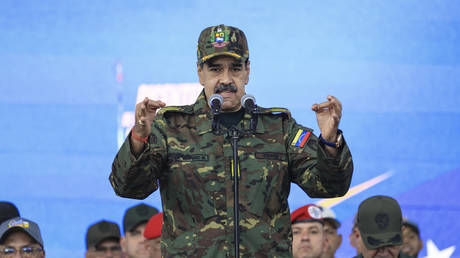
Venezuelan President Nicolas Maduro accused Washington of attempting to “impose a puppet government” that would surrender the country’s sovereignty and resources, effectively turning it into a colony. He pledged to prevent such an outcome and condemned US pressure tactics as “barbarism.”
Moscow urges restraint to prevent “unforeseen developments,” presidential spokesman Dmitry Peskov has said
Escalating tensions between the United States and Venezuela carry serious risks and could lead to “unforeseen developments,” Kremlin spokesman Dmitry Peskov said on Thursday.
The warning came after US President Donald Trump intensified pressure on Caracas by announcing an expansion of a partial naval blockade aimed at halting Venezuelan crude exports. The authorities in the Latin American nation, where Washington does not recognize the government, have expressed defiance.
“Of course, we are calling on all countries in the region to exercise restraint in order to avoid any unforeseen development of the situation,” Peskov said, adding that Russia considers Venezuela an important partner.
Earlier, the Russian Foreign Ministry urged the Trump administration to adhere to a “rational and pragmatic approach,” cautioning that missteps could amount to a “fatal mistake” and further inflame the situation.
China has voiced similar concerns. Beijing’s Foreign Ministry spokesman Guo Jiakun said the People’s Republic opposes “all acts of unilateralism and bullying” and supports Venezuela’s sovereign right to “independently develop mutually beneficial cooperation with other countries.”
Trump has highlighted the US naval buildup near Venezuela, claiming the country is “completely surrounded by the largest armada ever assembled in the history of South America,” while demanding that Caracas return “all of the oil, land, and other assets that they previously stole from us.”
Venezuelan President Nicolas Maduro accused Washington of attempting to “impose a puppet government” that would surrender the country’s sovereignty and resources, effectively turning it into a colony. He pledged to prevent such an outcome and condemned US pressure tactics as “barbarism.”