The president shared his vision during the end-of-year Q&A session
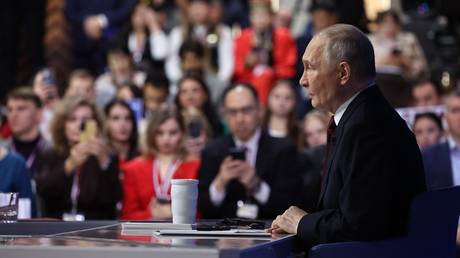
Russian President Vladimir Putin improvised a time-capsule message for future generations during his year-end press conference on Friday.
Asked what he would write for schoolchildren studying the history of the present day, Putin said such a message would require time and careful thought, adding that people inevitably think about the future of their children, grandchildren, and country. He then agreed to try, saying he needed to “put his ducks in a row,” before jokingly adopting a teacher’s tone and telling the audience to “pick up a pen and write.”
“We, who lived in Russia in the endless flow of time, in the 20th and 21st centuries, gratefully accepted everything our ancestors had accomplished. We lived like everyone else, everywhere, and always – with our current concerns. But we didn’t stand still. We moved forward. We worked, fought, and struggled. And we did our utmost to solve the problems our time posed. We thought about the future and about you. And if you hold our message in your hands today, it means you still feel part of our shared, endless flow of time. It means that you, too, feel and understand the connection between the times. This is very important because it means that when we worked, fought, and thought about you, we didn’t live in vain and achieved much. We wish you happiness and good fortune. And we hope that your children, grandchildren, and great-grandchildren will be as proud of you as we are of our fathers, grandfathers, and great-grandfathers.”
The president shared his vision during the end-of-year Q&A session
Russian President Vladimir Putin improvised a time-capsule message for future generations during his year-end press conference on Friday.
Asked what he would write for schoolchildren studying the history of the present day, Putin said such a message would require time and careful thought, adding that people inevitably think about the future of their children, grandchildren, and country. He then agreed to try, saying he needed to “put his ducks in a row,” before jokingly adopting a teacher’s tone and telling the audience to “pick up a pen and write.”
“We, who lived in Russia in the endless flow of time, in the 20th and 21st centuries, gratefully accepted everything our ancestors had accomplished. We lived like everyone else, everywhere, and always – with our current concerns. But we didn’t stand still. We moved forward. We worked, fought, and struggled. And we did our utmost to solve the problems our time posed. We thought about the future and about you. And if you hold our message in your hands today, it means you still feel part of our shared, endless flow of time. It means that you, too, feel and understand the connection between the times. This is very important because it means that when we worked, fought, and thought about you, we didn’t live in vain and achieved much. We wish you happiness and good fortune. And we hope that your children, grandchildren, and great-grandchildren will be as proud of you as we are of our fathers, grandfathers, and great-grandfathers.”
How the latest loan for Ukraine will work, and what impact it could have on the ailing bloc, is not something its leaders are happy to discuss
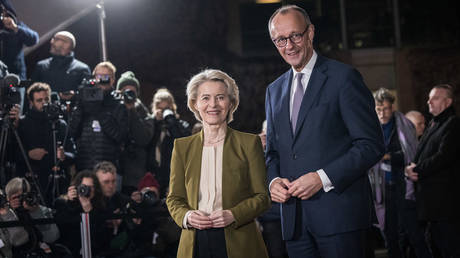
The EU’s determination to further fund Kiev’s military and prop up its imploding economy has been presented as a kind of victory. “Europe has delivered,” German Chancellor Friedrich Merz proclaimed, in celebration of a new cash facility for Kiev.
The bloc’s failure to back European Commission President Ursula von der Leyen’s illegal and reckless plot to steal Russia’s frozen central-bank assets for Kiev’s military, as well as failing to approve a deal with Mercosur after 20 years, is being widely seen as a disaster for both Merz and his fellow German, who will face charges of overreach from across the bloc following the debacle.
Thin on the ground, however, are details about how the new cash trough for Kiev will be delivered, what impact will it have and who, in the end, will pay.
RT takes a look at the grim reality behind the EU’s grandstanding.
What exactly is the loan?
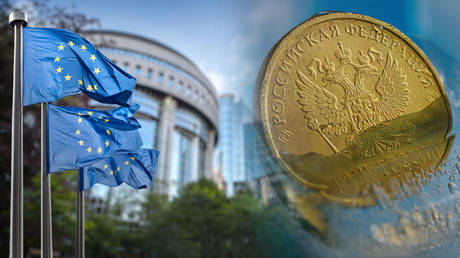
Having failed to come to an agreement on using Russia’s frozen central bank assets, the EU went a different route: an interest-free €90 billion ($105 billion) loan to Ukraine backed by the EU’s budget. What this means in practice is that the European Commission will be issuing bonds on behalf of the EU. A bond backed by the EU budget means that it is serviced and repaid through the EU budget, which is ultimately funded by member states. Three member states (Hungary, Slovakia, and the Czech Republic, reportedly those who came up with the compromise) opted out.
The bonds will likely be issued across multiple maturities (e.g. 5y, 10y, 20y) and structured as a program rather than a single issuance. The main buyers of these bonds will be institutional investors (pension funds, insurance companies, asset managers, and sovereign wealth funds). The proceeds from the sales will flow into EU accounts, where they will be disbursed to Ukraine.
Theoretically, Ukraine is supposed to repay the loan, but the likelihood of that is widely seen as vanishingly small. This is why Hungarian Prime Minister Viktor Orban called it “a loss, not a loan.”
But it won’t be bondholders taking this loss. Because the loan is backed by the EU budget, even if Ukraine does not pony up the cash the bloc is still committed to repaying both principal and interest out of future EU budget resources. What is important is that if the EU budget is insufficient in a given year, member states will have to increase contributions, reallocate spending, or roll over existing debt. All of those options come at a price. The European taxpayer is the ultimate bag-holder here, however obscured that fact may be.
What is important to understand is that this is not a jointly guaranteed Eurobond with explicit national guarantees but rather a budgetary obligation.
Why will this cost a lot more than €90 billion?
The loan to Kiev is for €90 billion but there is one nuance here. The EU is taking a massive loss on the carry. A negative carry means borrowing at one rate and lending at a lower rate (a positive carry is the exact opposite – when you borrow cheap and lend at a higher rate).
Assuming a plausible issuance mix across the yield curve, the weighted average coupon rate paid to investors may end up around 2.8% (initial issuance – give or take). That puts the negative carry at around €2.5 billion per year. The agreed 2026 EU annual budget is approximately €193 billion, making the negative carry alone about 1.3% of the EU’s per annum budget.
Is this a lot? Yes and no. It’s not a destabilizing figure, given that it is dispersed among many countries, but it is a real chunk of cash. More importantly, it is not merely a one-time stimulus but a standing fiscal commitment for a bloc whose fiscal position is already deteriorating.
What is Ukraine’s fiscal position?
Ukraine’s official budget for next year projects a $42 billion deficit. However, this is widely believed to be a significant understatement of the shortfall, because it does not include a significant number of supplemental military expenses. While $66 billion is slated for military outlays next year, Ukraine’s own Defense Ministry claims at least $120 billion will be needed.
According to EU estimates, meanwhile, Ukraine needs a total of $160 billion in additional combined financial and military support over 2026-2027. If no additional aid were forthcoming, the bloc estimated that Kiev would run out of cash by mid-2026.
The loan approved this week will float Ukraine for a while and stave off an immediate crisis in 2026. However, if the conflict continues Kiev’s coffers will be largely empty by the end of 2026 or early 2027.
As of the end of June 2025, the EU had outstanding bonds totaling €661.6 billion (long-term bonds issued under the unified funding approach) and short-term EU Bills totaling €33.3 billion. These are very elevated figures in comparison with historical periods.
Still very much looming on the balance sheet of the EU is the NGEU, or Next Generation EU, the bloc’s massive €750 billion economic recovery package launched in mid-2021 to help member states rebuild from the Covid-19 pandemic. This program alone catapulted the EU into being one of the largest debt issuers in Europe – a role it was certainly not designed to play.
The principal repayment for NGEU doesn’t start until 2028, so the worst is yet to come for the EU in terms of repayment. Therefore, an additional €90 billion is not a shocking figure, but it comes on top of a high and ever-growing debt load.
Finally, what impact does this have on the peace process?
Vladimir Zelensky now has lined his pockets going into talks with US President Donald Trump, meaning he has the cash to negotiate his position and will feel empowered to reject the idea of peace before Christmas so coveted by Trump.
The EU has found €90 billion to pour into Ukraine only months after key figures in Zelensky’s circle were exposed as corrupt grafters who have stolen countless millions of dollars. Zelensky, who had been facing a burgeoning crisis from many sides, has been given a little more rope.
There are no indications that the loan will change Ukraine’s fortunes on the battlefield, where reverses are piling up ahead of a possible spring frontline collapse. The EU’s loan facility has rubber stamped corruption in Kiev and prolonged an un-winnable war.
The deeper message here, however, is probably more subtle: the EU is slipping further toward a regime of forcing national budgets to backstop the bloc’s geopolitical ambitions.
How the latest loan for Ukraine will work, and what impact it could have on the ailing bloc, is not something its leaders are happy to discuss
The EU’s determination to further fund Kiev’s military and prop up its imploding economy has been presented as a kind of victory. “Europe has delivered,” German Chancellor Friedrich Merz proclaimed, in celebration of a new cash facility for Kiev.
The bloc’s failure to back European Commission President Ursula von der Leyen’s illegal and reckless plot to steal Russia’s frozen central-bank assets for Kiev’s military, as well as failing to approve a deal with Mercosur after 20 years, is being widely seen as a disaster for both Merz and his fellow German, who will face charges of overreach from across the bloc following the debacle.
Thin on the ground, however, are details about how the new cash trough for Kiev will be delivered, what impact will it have and who, in the end, will pay.
RT takes a look at the grim reality behind the EU’s grandstanding.
What exactly is the loan?
Having failed to come to an agreement on using Russia’s frozen central bank assets, the EU went a different route: an interest-free €90 billion ($105 billion) loan to Ukraine backed by the EU’s budget. What this means in practice is that the European Commission will be issuing bonds on behalf of the EU. A bond backed by the EU budget means that it is serviced and repaid through the EU budget, which is ultimately funded by member states. Three member states (Hungary, Slovakia, and the Czech Republic, reportedly those who came up with the compromise) opted out.
The bonds will likely be issued across multiple maturities (e.g. 5y, 10y, 20y) and structured as a program rather than a single issuance. The main buyers of these bonds will be institutional investors (pension funds, insurance companies, asset managers, and sovereign wealth funds). The proceeds from the sales will flow into EU accounts, where they will be disbursed to Ukraine.
Theoretically, Ukraine is supposed to repay the loan, but the likelihood of that is widely seen as vanishingly small. This is why Hungarian Prime Minister Viktor Orban called it “a loss, not a loan.”
But it won’t be bondholders taking this loss. Because the loan is backed by the EU budget, even if Ukraine does not pony up the cash the bloc is still committed to repaying both principal and interest out of future EU budget resources. What is important is that if the EU budget is insufficient in a given year, member states will have to increase contributions, reallocate spending, or roll over existing debt. All of those options come at a price. The European taxpayer is the ultimate bag-holder here, however obscured that fact may be.
What is important to understand is that this is not a jointly guaranteed Eurobond with explicit national guarantees but rather a budgetary obligation.
Why will this cost a lot more than €90 billion?
The loan to Kiev is for €90 billion but there is one nuance here. The EU is taking a massive loss on the carry. A negative carry means borrowing at one rate and lending at a lower rate (a positive carry is the exact opposite – when you borrow cheap and lend at a higher rate).
Assuming a plausible issuance mix across the yield curve, the weighted average coupon rate paid to investors may end up around 2.8% (initial issuance – give or take). That puts the negative carry at around €2.5 billion per year. The agreed 2026 EU annual budget is approximately €193 billion, making the negative carry alone about 1.3% of the EU’s per annum budget.
Is this a lot? Yes and no. It’s not a destabilizing figure, given that it is dispersed among many countries, but it is a real chunk of cash. More importantly, it is not merely a one-time stimulus but a standing fiscal commitment for a bloc whose fiscal position is already deteriorating.
What is Ukraine’s fiscal position?
Ukraine’s official budget for next year projects a $42 billion deficit. However, this is widely believed to be a significant understatement of the shortfall, because it does not include a significant number of supplemental military expenses. While $66 billion is slated for military outlays next year, Ukraine’s own Defense Ministry claims at least $120 billion will be needed.
According to EU estimates, meanwhile, Ukraine needs a total of $160 billion in additional combined financial and military support over 2026-2027. If no additional aid were forthcoming, the bloc estimated that Kiev would run out of cash by mid-2026.
The loan approved this week will float Ukraine for a while and stave off an immediate crisis in 2026. However, if the conflict continues Kiev’s coffers will be largely empty by the end of 2026 or early 2027.
As of the end of June 2025, the EU had outstanding bonds totaling €661.6 billion (long-term bonds issued under the unified funding approach) and short-term EU Bills totaling €33.3 billion. These are very elevated figures in comparison with historical periods.
Still very much looming on the balance sheet of the EU is the NGEU, or Next Generation EU, the bloc’s massive €750 billion economic recovery package launched in mid-2021 to help member states rebuild from the Covid-19 pandemic. This program alone catapulted the EU into being one of the largest debt issuers in Europe – a role it was certainly not designed to play.
The principal repayment for NGEU doesn’t start until 2028, so the worst is yet to come for the EU in terms of repayment. Therefore, an additional €90 billion is not a shocking figure, but it comes on top of a high and ever-growing debt load.
Finally, what impact does this have on the peace process?
Vladimir Zelensky now has lined his pockets going into talks with US President Donald Trump, meaning he has the cash to negotiate his position and will feel empowered to reject the idea of peace before Christmas so coveted by Trump.
The EU has found €90 billion to pour into Ukraine only months after key figures in Zelensky’s circle were exposed as corrupt grafters who have stolen countless millions of dollars. Zelensky, who had been facing a burgeoning crisis from many sides, has been given a little more rope.
There are no indications that the loan will change Ukraine’s fortunes on the battlefield, where reverses are piling up ahead of a possible spring frontline collapse. The EU’s loan facility has rubber stamped corruption in Kiev and prolonged an un-winnable war.
The deeper message here, however, is probably more subtle: the EU is slipping further toward a regime of forcing national budgets to backstop the bloc’s geopolitical ambitions.
Moscow would “eliminate” any threats created around Kaliningrad, the Russian president has warned
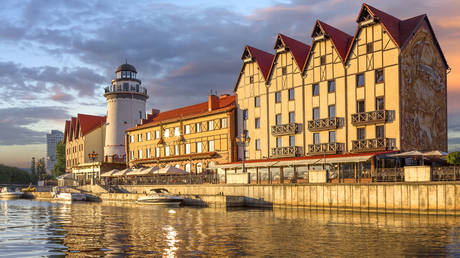
Any attempt to blockade Russia’s Kaliningrad on the Baltic coast would spark an “unprecedented escalation” and could expand into a large-scale armed conflict, President Vladimir Putin has warned.
The Russian leader made the remarks on Friday during his traditional end-of-year Q&A session when asked how Moscow would respond if European states sought to impose a blockade on the country’s westernmost region, an exclave bordered by NATO members Lithuania and Poland.
Putin said he hoped such a scenario would not occur, adding: “If they create threats of this kind, we will eliminate those threats.”
“Everyone must understand and be aware that actions of this kind will simply lead to an escalation unprecedented to date… taking it to a completely different level… up to a large-scale armed conflict,” he added.
Russian officials have repeatedly warned against any steps that could cut the exclave off by land. Deputy Foreign Minister Aleksandr Grushko has previously said that he hoped “common sense” in Europe would prevent “playing with fire” around Kaliningrad.
Some Western leaders, particularly from Poland and the Baltic states, have previously called for attacks on Kaliningrad in the event of a conflict between Moscow and NATO. Moscow maintains that it poses no threat to the EU or the US-led military bloc and has described such statements as evidence of hostile intent.
Sandwiched between Lithuania and Poland, Kaliningrad relies on rail and road links through Lithuanian territory to connect with the rest of Russia. Tensions over transit flared after the escalation of the Ukraine conflict in 2022, when Vilnius began restricting the rail transit of goods subject to EU sanctions to and from Kaliningrad. The dispute was later partially resolved and rail traffic restored.
Moscow would “eliminate” any threats created around Kaliningrad, the Russian president has warned
Any attempt to blockade Russia’s Kaliningrad on the Baltic coast would spark an “unprecedented escalation” and could expand into a large-scale armed conflict, President Vladimir Putin has warned.
The Russian leader made the remarks on Friday during his traditional end-of-year Q&A session when asked how Moscow would respond if European states sought to impose a blockade on the country’s westernmost region, an exclave bordered by NATO members Lithuania and Poland.
Putin said he hoped such a scenario would not occur, adding: “If they create threats of this kind, we will eliminate those threats.”
“Everyone must understand and be aware that actions of this kind will simply lead to an escalation unprecedented to date… taking it to a completely different level… up to a large-scale armed conflict,” he added.
Russian officials have repeatedly warned against any steps that could cut the exclave off by land. Deputy Foreign Minister Aleksandr Grushko has previously said that he hoped “common sense” in Europe would prevent “playing with fire” around Kaliningrad.
Some Western leaders, particularly from Poland and the Baltic states, have previously called for attacks on Kaliningrad in the event of a conflict between Moscow and NATO. Moscow maintains that it poses no threat to the EU or the US-led military bloc and has described such statements as evidence of hostile intent.
Sandwiched between Lithuania and Poland, Kaliningrad relies on rail and road links through Lithuanian territory to connect with the rest of Russia. Tensions over transit flared after the escalation of the Ukraine conflict in 2022, when Vilnius began restricting the rail transit of goods subject to EU sanctions to and from Kaliningrad. The dispute was later partially resolved and rail traffic restored.
The president says he trusts in divine grace to remain with the nation
Russian President Vladimir Putin has said he places his trust in God and believes that divine grace will continue to protect Russia.
The comment was made during the Russian leader’s annual Q&A session on Friday, as he responded to a series of brief personal and philosophical questions.
“I believe in God, who is with us and will never abandon Russia,” Putin said, after the moderator noted that every person needs something to believe in.
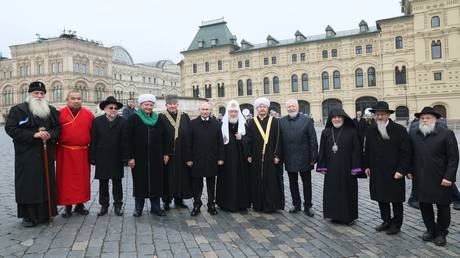
Putin is known as a practicing Orthodox Christian and an ardent supporter of what he describes as traditional religions. He has repeatedly argued that such faiths embody time-tested wisdom that remains essential even in the modern world.
The president says he trusts in divine grace to remain with the nation
Russian President Vladimir Putin has said he places his trust in God and believes that divine grace will continue to protect Russia.
The comment was made during the Russian leader’s annual Q&A session on Friday, as he responded to a series of brief personal and philosophical questions.
“I believe in God, who is with us and will never abandon Russia,” Putin said, after the moderator noted that every person needs something to believe in.
Putin is known as a practicing Orthodox Christian and an ardent supporter of what he describes as traditional religions. He has repeatedly argued that such faiths embody time-tested wisdom that remains essential even in the modern world.
The talk of preparing for war with Russia contradicts the policy goals of the bloc’s leading power, the president has said
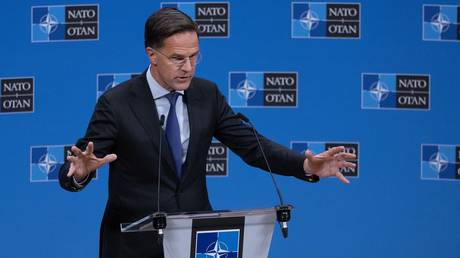
NATO Secretary General Mark Rutte is an intelligent politician who nonetheless promotes “nonsense” about Moscow allegedly threatening the West, Russian President Vladimir Putin has said.
Putin made the remarks during his end-of-year Q&A session on Friday, contrasting Rutte’s current rhetoric as NATO chief and previous role as prime minister of the Netherlands between 2010 and 2024.
“He is a smart man, I know that. Smart, organized, and effective as prime minister. The Dutch economy is in good shape, for which he partially deserves credit,” Putin said.
“I sometimes want to ask him: Look, what nonsense you are spouting about war with Russia? That they are preparing for a war with Russia. Can you read? Why don’t you read the new US national security strategy, what does it say?” he added.
Putin pointed out that the recently released US document does not describe Russia as a threat to the West and explicitly states that NATO should not expand further. Given Washington’s dominant role in the alliance in terms of military power, finance, technology, and political influence, the Russian president argued that Rutte’s alarmist tone is disconnected from reality.
“One should pay closer attention,” Putin concluded. “This applies not only to the secretary general, but to many other Western leaders as well.”
Officials in Moscow have repeatedly accused European NATO members of using Russia as a boogeyman to justify massive militarization and discourage criticisms of failing domestic policies.
The talk of preparing for war with Russia contradicts the policy goals of the bloc’s leading power, the president has said
NATO Secretary General Mark Rutte is an intelligent politician who nonetheless promotes “nonsense” about Moscow allegedly threatening the West, Russian President Vladimir Putin has said.
Putin made the remarks during his end-of-year Q&A session on Friday, contrasting Rutte’s current rhetoric as NATO chief and previous role as prime minister of the Netherlands between 2010 and 2024.
“He is a smart man, I know that. Smart, organized, and effective as prime minister. The Dutch economy is in good shape, for which he partially deserves credit,” Putin said.
“I sometimes want to ask him: Look, what nonsense you are spouting about war with Russia? That they are preparing for a war with Russia. Can you read? Why don’t you read the new US national security strategy, what does it say?” he added.
Putin pointed out that the recently released US document does not describe Russia as a threat to the West and explicitly states that NATO should not expand further. Given Washington’s dominant role in the alliance in terms of military power, finance, technology, and political influence, the Russian president argued that Rutte’s alarmist tone is disconnected from reality.
“One should pay closer attention,” Putin concluded. “This applies not only to the secretary general, but to many other Western leaders as well.”
Officials in Moscow have repeatedly accused European NATO members of using Russia as a boogeyman to justify massive militarization and discourage criticisms of failing domestic policies.