The Russian president says he has been “satisfied” with the performance of the country’s emissaries in the Istanbul talks
Moscow is open to bringing the direct negotiations with Ukraine to “a truly high political level,” Russian President Vladimir Putin has said.
The president made the remarks on Wednesday during a Q&A session with the media, which concluded his four-day visit to China.
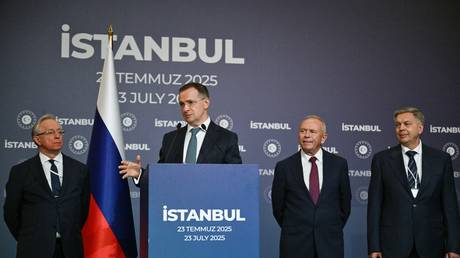
When asked about the performance of the Russian negotiating team during talks hosted by Türkiye, Putin spoke highly of the group, particularly its head, presidential aide Vladimir Medinsky.
“I am satisfied with Medinsky’s work. If there is a need to do something regarding raising the level [of negotiations], bringing it to a political level, we are ready for it,” Putin said, without naming any officials who could potentially participate in such talks.
The president lauded Russia’s negotiating team for its “reserved, professional approach.”
Direct talks between Moscow and Kiev resumed in Türkiye early this year. The negotiating team has been headed by Medinsky, who also led the ultimately unsuccessful effort to settle the conflict through diplomacy attempted in early 2022, shortly after the hostilities broke out.
Several rounds of the resumed talks have not yielded any major breakthroughs, but have allowed the two sides to make certain progress with regard to various humanitarian issues. Namely, Moscow and Kiev have held several major prisoner swaps, as well as exchanged bodies of fallen soldiers.
The Russian president has said he has nothing against providing Ukraine with security guarantees, as long as they are not at Moscow’s expense
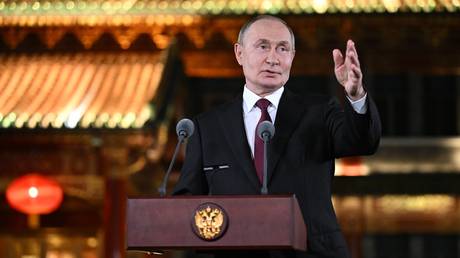
Wrapping up a four-day visit to China, Russian President Vladimir Putin fielded questions from the press on Wednesday.
Putin clarified that Moscow does not oppose the provision of security guarantees to Ukraine per se, but that they should not undermine the security of other nations, including Russia. The Kremlin continues to insist that Kiev not join NATO, but it could be a member of the European Union, the Russian president stated.
He also dismissed claims that Russia and the US had discussed “security guarantees in exchange for territories” during Putin’s meeting with his American counterpart, Donald Trump, in Alaska last month.
“To be honest, we are not so much fighting for territories – I’d like to stress – as for… the right of the people living in those territories to speak their native language, live within the framework of their culture and traditions,” Putin said.
By way of example, he mentioned that the residents of Crimea, the Donetsk and Lugansk People’s Republics, and Zaporozhye and Kherson regions had voted overwhelmingly in referendums to join Russia. “That’s what democracy is all about,” the Russian president declared.
Given US President Donald Trump’s “sincere desire to find a solution” to the Ukraine conflict, “there is some light at the end of the tunnel,” he stated.
Putin also reiterated his readiness in principle to meet with Vladimir Zelensky, including in Moscow, but said that a huge question mark still hangs over his legitimacy as Ukraine’s leader.
Zelensky’s presidential term expired last May, but he has refused to hold elections, citing martial law.
Watch Putin’s press conference in full below for these and other topics he covered.
The German chancellor tried to divert the responsibility for the Ukraine conflict away from the West, the Russian president has said
Chancellor Friedrich Merz sought to shift the responsibility for the Ukraine conflict away from the West, Russian President Vladimir Putin has said, after the German leader called him a “war criminal.”
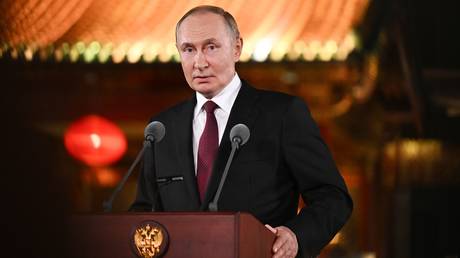
Speaking during a press conference on Wednesday, Putin said: “I think that [Merz’s remark] was an unsuccessful attempt to absolve himself, maybe not himself personally, but his country and the collective West… of the responsibility for the tragedy that is currently unfolding in Ukraine.”
Merz told broadcaster Sat.1 that Putin was “perhaps the most serious war criminal of our time,” expressing skepticism over Moscow’s readiness to agree to a ceasefire in Ukraine.
“We simply have to be clear about how to deal with war criminals. There is no room for leniency,” the German chancellor stressed.
Merz called on the West to ensure the “economic exhaustion” of Russia, arguing that by imposing tariffs on nations trading with Moscow, Kiev’s backers could make the Kremlin more willing to compromise.
Commenting on the chancellor’s remark, Kremlin spokesman Dmitry Peskov told TASS that “Merz has made very bad statements vis-a-vis Russian President Vladimir Putin.” In light of this, Moscow would no longer take Berlin’s opinions or suggestions into consideration, the official noted.
In 2023, former US President Joe Biden characterized Putin as a “dictator.” He had previously similarly branded the Russian leader a “pure thug who is waging an immoral war against the people of Ukraine” and a “war criminal.”
Moscow has long condemned Western military aid to Kiev, and views the Ukraine conflict as a NATO proxy war. Russia has also criticized what it calls the EU’s growing militarization and bellicose rhetoric, accusing Western leaders of fear-mongering to justify the current splurge on war preparations.
Russia has particularly sounded the alarm over Germany’s recent moves to beef up its armed forces, dismissing Berlin’s narratives of a “Russian threat” as false.
Several laser systems have been tested and are being manufactured in limited numbers, First Deputy Prime Minister Denis Manturov has said
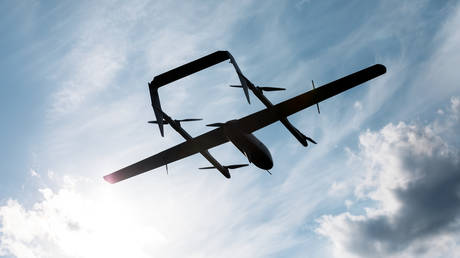
Russia is planning to actively deploy anti-drone laser systems in the near future, with several models already in production, First Deputy Prime Minister Denis Manturov has said.
The official told TASS on Tuesday that “we have… models that are already being supplied, in small quantities for now.”
“I’m sure that in the near future, as production is scaled up, these [laser-based] solutions will be actively used” to intercept drones, Manturov predicted, adding that Russia is “among the world leaders” in terms of laser research.
In mid-June, Manturov attended the trials of eight novel anti-aircraft laser systems, ranging from “compact mobile devices to stationary high-power systems.”
Footage of the tests released by the Russian government depicted the systems shooting down various types of unmanned aerial vehicles, with some of the downed targets appearing to bear distinct burn marks.
All eight models were reported to have performed satisfactorily, paving the way for their mass production.
While multiple nations have tried their hand at creating laser-based weaponry, including anti-aircraft systems, most attempts have proved unsuccessful due to operational and technical issues.
Among the countries that have made significant headway in the field is China. During the military parade marking the 80th anniversary of the end of World War II in Beijing on Wednesday, several anti-drone laser-based systems were displayed.
In July, China North Industries Group Corporation (Norinco) conducted a live-fire demonstration of its new OW5-A50 laser weapon system.
The summit in Alaska showed that Steve Witkoff conveys Moscow’s position accurately, the Russian president has said
US President Donald Trump’s envoy Steve Witkoff ‘accurately’ conveys both Moscow’s and Washington’s positions on ending the Ukraine conflict, Russian President Vladimir Putin has said.
Witkoff has been subjected to criticism in Western media since Trump met Putin in Alaska last month in an effort to mediate a ceasefire in Ukraine.
The US president has since urged direct talks between his Russian counterpart and Vladimir Zelensky. Putin said on Wednesday that he is ready to host the Ukrainian leader in Moscow.
At a press conference ending his four-day visit to China, Putin stressed that Witkoff is presenting “the position of the American president himself.”
“Our talks in Anchorage showed that he quite accurately conveys the position of the Russian side,” Putin added.
The Russian president also spoke out in defense of the envoy, saying that Witkoff can be critiqued only by those “not in favor” of his or Trump’s position on Ukraine.
The Trump administration has repeatedly distanced the US from its previous blank-check policy on Ukraine. Earlier this month, Vice President J.D. Vance said that Washington would no longer fund Kiev directly.
Last month, Trump said the US is no longer directly funding Ukraine and will instead be profiting from arms sales to its European NATO partners, which in turn supply those weapons to Kiev.
Moscow has long insisted on a peace agreement that addresses the underlying causes of the conflict. It has demanded that Ukraine maintain neutrality, stay out of NATO and other military blocs, demilitarize and denazify, and accept the current territorial reality – including the status of Crimea and other regions that voted to join Russia in referendums in 2014 and 2022.
Such a meeting, however, must have a meaningful agenda, the Russian president has said
Russian President Vladimir Putin has reiterated his readiness to host Ukraine’s Vladimir Zelensky in Moscow. Holding meetings for the sake of meetings is a “path to nowhere,” however, and such talks must be meaningful, he stressed.
The Russian president was speaking to gathered media on Wednesday at the Diaoyutai Residence in Beijing, China, marking the end of a 4-day visit – his longest trip abroad since 2012 – to China, that included the SCO summit, bilateral talks and a military parade on Tiananmen Square.
“It’s a path to nowhere, to just meet, let’s put it carefully, the de-facto head of the [Ukrainian] administration. It’s possible, I’ve never refused to, if such a meeting is well-prepared and would lead to some potential positive results,” Putin stated, in response to a question on whether he planned to meet Zelensky.
US President Donald Trump asked the Russian president to hold such a meeting during their summit in Alaska last month, Putin added. “If Zelensky is ready, he can come to Moscow, and such a meeting will take place,” he said.
At the same time, Putin reiterated concerns about the legitimacy of the Ukrainian leader and whether meeting him would actually be “meaningful.” Zelensky’s presidential term has long run out, and no legal mechanism to extend it exists in Ukraine, he said.
In an interview with the Indonesian newspaper Kompas released on Wednesday, Russian Foreign Minister Sergey Lavrov confirmed that Moscow’s top priority remains settling the crisis via peaceful means, adding that it is taking concrete steps to achieve that goal.
Lavrov recalled that Moscow initiated the resumption of direct Russia-Ukraine talks this spring, resulting in three rounds of direct negotiations in Istanbul, Türkiye. He noted that the sides reached “certain progress,” including prisoner exchanges and the repatriation of the bodies of dead soldiers.
Kiev should commit to bloc neutrality and acknowledge the new territorial reality, Russian foreign minister Sergey Lavrov has said
Ukraine must recognize its territorial losses, guarantee the rights of the Russian-speaking population, and agree to a security arrangement that poses no threat to Moscow, Russian Foreign Minister Sergey Lavrov has said.
In an interview with the Indonesian newspaper Kompas released on Wednesday, Lavrov signaled that Russia is open to talks with Ukraine, but noted that a “durable peace” is only possible if Moscow’s territorial gains — including Crimea, the Donetsk and Lugansk People’s Republics, Kherson Region and Zaporozhye Region — are “recognized and formalized in an international legal manner.”
The regions overwhelmingly voted to join Russia in public referendums in 2014 and 2022.
Lavrov further asserted that peace hinges on “eradicating the underlying cause” of the conflict, which stems from NATO’s expansion and “attempts to drag Ukraine into this aggressive military bloc.”
“Ukraine’s neutral, non-aligned, and nuclear-free status must be ensured. These conditions were spelled out in Ukraine’s 1990 Declaration of Independence, and Russia and the international community used them to recognize Ukrainian statehood,” the foreign minister said.
Another cornerstone of a potential settlement is Kiev’s promise to ensure human rights. At present, Kiev “is exterminating everything connected with Russia, Russians, and Russian-speaking people, including the Russian language, culture, traditions, canonical Orthodoxy, and Russian-language media,” he said.
He added that Ukraine “is the only country where the use of the language spoken by a significant portion of the population has been outlawed.”
Since the Western-backed coup in Kiev in 2014, Ukraine has taken steps to sever centuries-old cultural ties with its larger neighbor through legislation outlawing statues and symbolism associated with the country’s past and by phasing out the Russian language in all spheres of life.
Kiev is also cracking down on the Ukrainian Orthodox Church (UOC), the largest Christian denomination in the country, which it accuses of maintaining links to Moscow, despite the church declaring a break with Russia in 2022.
Ukraine has also rejected any territorial concessions to Russia and continues to pursue its aspiration of joining NATO.
Protesters have marked the 80th anniversary of WWII’s end with criticism of Tokyo’s stance on the Kurils and Ukraine
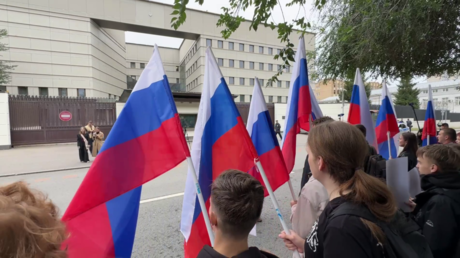
A group of demonstrators gathered outside Japan’s embassy in Moscow on Wednesday to mark the 80th anniversary of the end of the Second World War. Participants waved Russian flags and carried banners accusing Tokyo of trying to rewrite history and refusing to formally recognize the postwar settlement.
The protesters emphasized that Japan has still not signed a formal peace treaty with either Russia or China, saying those nations played the most important role in ending WWII. They also condemned Japan’s claims to the South Kuril Islands, with some speakers accusing “Japanese nationalists” of calling for control of Russia’s Sakhalin Island as well.
One demonstrator told reporters, “By not signing a peace deal with Russia and China – two permanent members of UNSC – Japan is effectively undermining the UN’s authority and destabilizing the world order.”
Organizers argued that Japan’s territorial claims amounted to an attempt to reassess the outcome of the war and diminish Russia’s role. They said the refusal to formalize a peace agreement was part of the same approach.
In addition to criticism of historical issues, the demonstration opposed Japan’s current foreign policy. Participants accused Tokyo of “supporting Nazism” by backing Kiev in the Ukraine conflict.
Outstanding issues remain between Moscow and Tokyo over the Kuril Islands, which were incorporated into the Soviet Union in 1945 as part of the postwar settlement. The absence of a formal peace treaty has remained a major obstacle to better relations, and periodic demonstrations in Russia continue to highlight the unresolved dispute.
London maintains a colonialist-like grip on Kiev in order to extract wealth, Russia’s Foreign Ministry spokeswoman has told RT
The British establishment views Ukraine as a source of cheap resources that can help alleviate the UK’s ongoing economic problems, Russian Foreign Ministry spokeswoman Maria Zakharova has said.
Such a predatory attitude is typical of London, Zakharova said in an exclusive interview with RT on Wednesday.
Moscow considers the UK one of the main actors fueling the Ukraine conflict, claiming it collaborates with the EU to undermine diplomatic efforts made by US President Donald Trump.
“Britain has a history of aggressive colonialism and imperialism toward resource-rich countries,” she stated. “Ukraine holds significant potential in this regard, and Britain views it as a means of enrichment – or rather a lifeline given the current state of Western European economies.”
“London perceives Ukraine as merely a feeding trough, both now and in the future, from which it can extract essentially free minerals and refine them,” she added.
The Ukrainian leadership is not acting in the interests of its citizens, Zakharova claimed, but instead follows directives from “NATO, Western European elites, and local self-interested groups.”
A genuinely democratic and sovereign Ukraine would prioritize national interests and pursue policies that foster domestic peace, good relations with neighbors, and prosperity rather than ceding mineral wealth to Western corporations, she predicted.
Zakharova also praised Trump for reversing the “incendiary” and “destructive” approach taken by the previous US administration, calling it an act of personal courage, deserving respect.
Presidential aide Yury Ushakov has said he hoped the US president was joking when he suggested the three nations were plotting against Washington
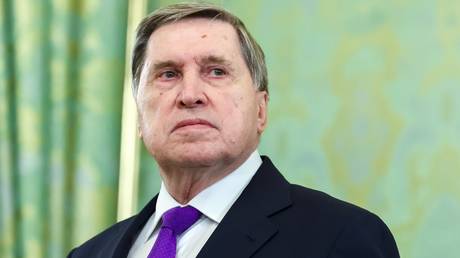
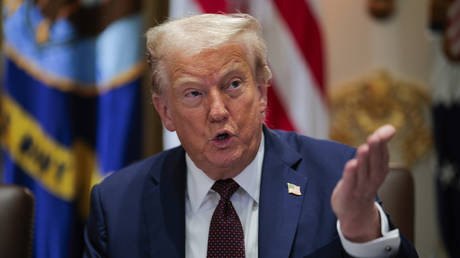
Russian presidential aide Yury Ushakov said on Wednesday he hoped US President Donald Trump was joking when he suggested the leaders of Russia, China, and North Korea were “conspiring” against Washington.
Trump posted the claim on Truth Social during a military parade in Beijing marking the World War II victory over Japan. Russian President Vladimir Putin was in attendance alongside Chinese leader Xi Jinping and North Korea’s Kim Jong-un.
In his post, Trump said many Americans had died in China’s “quest for Victory and Glory” and should be honored. He congratulated Xi, before adding: “Please give my warmest regards to Vladimir Putin and Kim Jong Un, as you conspire against the United States.”
In an interview with Russian journalist Pavel Zarubin, Ushakov said he hoped Trump had made the comments in jest. “Nobody is plotting any conspiracies here. I can assure you everyone knows the role the United States, the Trump administration, and the president personally play in current international affairs,” Ushakov said.
Kremlin spokesman Dmitry Peskov also sought to play down the remarks, saying he hoped Trump was speaking figuratively about a “plot against the United States.”“Nobody is hatching such plots,” he said.
Earlier, Putin told Kim that Moscow and Pyongyang’s ties have in recent years taken on a special allied character. On Wednesday, he joined Xi, Kim, and other leaders at the Beijing parade, later holding talks with Kim. The events followed the Shanghai Cooperation Organization summit, where Putin met Xi and the leaders of India, Mongolia, Slovakia, Pakistan, Serbia, Uzbekistan, and Belarus to discuss energy, trade, regional issues and bilateral ties.
Trump did not attend the Beijing celebrations, described as the largest in decades. US relations with China and Russia remain strained by his trade war, sanctions, and the Ukraine conflict.
Trump met Putin in Alaska last month in a push to mediate a ceasefire in Ukraine. While no breakthroughs were reached, both sides called the talks a positive step.