Category Archive : Russia

The vessel was sunk trying to cross the Dnepr River, the Defense Ministry in Moscow has reported

Russian forces have destroyed a Ukrainian sabotage and reconnaissance group on the Dnepr river, the Defense Ministry in Moscow reported on Thursday.

According to the ministry, Russian drone operators keep watch over the river constantly to prevent enemy units from crossing it.

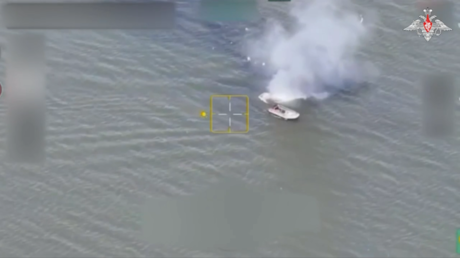
In the latest example, scouts spotted a speedboat with Ukrainian soldiers in the island zone at the mouth of the river. Russian forces dispatched FPV drones to intercept the craft and carried out a series of strikes that hit the vessel as it tried to move deeper into the channel.

The ministry released a video showing multiple impacts on the boat and the moment it was disabled in the delta. Repeated explosions on the target can be seen as Ukrainian saboteurs tried to escape.

The motorboat was sunk and the sabotage group was eliminated, the Defense Ministry has said.

Moscow has reported stopping similar attempts by Ukrainian units to infiltrate Russia. Last month, the Federal Security Service reported detaining a group of Ukrainian saboteurs in Bryansk Region. It was reported that the individuals were Western-trained and carried US-made assault rifles, Czech-made explosives, and a large number of NATO-type grenades and cartridges. The captured soldiers confessed to involvement in blowing up railway tracks in Russia and preparing other attacks, according to the FSB.

China earlier this week announced the same privilege for Russians during a one-year trial period

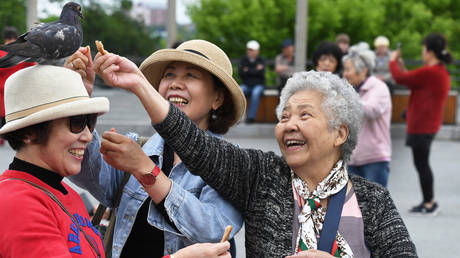
Moscow will grant visa-free entry to Chinese visitors, following Beijing’s decision earlier this week to extend the same privilege to Russian nationals, President Vladimir Putin has said. The reciprocal measure will strengthen cultural and economic ties between the two countries, he added.

Putin made the remarks on Thursday in Vladivostok while meeting with senior Chinese official Li Hongzhong, a member of the Communist Party’s Politburo and vice chairman of the Standing Committee of the National People’s Congress.

Putin called China’s decision to ease entry for Russians a “very significant step” that would help boost business, saying: “Of course, Russia will respond to this friendly act in kind. We will do the same.”

The Chinese visa waiver program will be expanded to ordinary passport holders from Russia starting September 15. Travelers will be able to enter the country for up to 30 days for business, tourism, personal visits, exchanges, and transit purposes.

According to the Chinese Foreign Ministry, the decision reflects the high level of development in China-Russia relations and is aimed at deepening people-to-people exchanges.

Read more

RT
China announces visa-free travel for Russians

A bilateral agreement already allows visa-free travel for organized tourist groups, but only through accredited operators, with groups of between five and 50 people.

Other Chinese travelers have had to rely on standard or electronic visas. An e-visa, introduced in August 2023, permits stays of up to 30 days, can be obtained within days, and reportedly costs about $40–50.

For Russian travelers fees ranged from $31–41 for a single entry, while multiple-entry visas started at $92. Processing typically took a week or longer.

Tourism between the two countries has been surging, supported by eased entry rules and e-visa services. In 2024, Russians made around three million tourist trips to China, with the trend continuing upward, Economy Minister Maksim Reshetnikov told Izvestia on Thursday.

According to booking services, interest in trips to China surged immediately following Beijing’s announcement on Tuesday, with ticket sales for flights departing after September 15 doubling, and hotel searches and travel inquiries jumping five to ninefold.

The facility in Chukotka will provide power to the Baimsky mining complex, according to the Russian president

Russian President Vladimir Putin has announced plans for another floating nuclear power plant (NPP) in the Far Eastern region of Chukotka to supply energy to the Baimsky mining and processing plant, one of the largest in the world.

Putin made the announcement on Thursday in Vladivostok during a meeting on the development of fuel and energy complexes in the Russian Far East. 

The president noted that Russia is already implementing low-capacity nuclear power plants in Yakutsk and Chukotka and outlined future projects, including new plants in Primorsk and Khabarovsk, alongside the newly announced floating station.

He stressed that nuclear power plants should continue to be developed actively, emphasizing that these projects have virtually no carbon footprint and are “rightfully considered to be so-called green energy.”

Putin has in the past described Russia’s nuclear sector as a fundamental pillar of the state, noting that Moscow is a global leader in nuclear technologies and has helped foreign countries build reactors “practically from scratch.” 

Read more

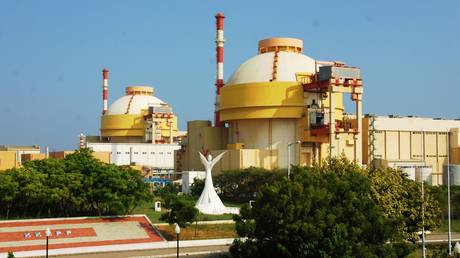
Kudankulam Nuclear Power Plant.
India keen to develop fourth-gen nuclear energy with Russia – Rosatom CEO

He has also repeatedly highlighted Russia’s advancements in building floating NPPs that are capable of delivering power to remote regions, particularly in places such as the Arctic. He has suggested that this technology could eventually replace oil energy.

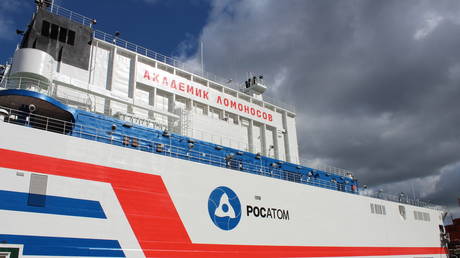
Floating nuclear power plants are mobile energy units designed to supply electricity to isolated regions without requiring traditional land-based infrastructure. Russia has already deployed the Akademik Lomonosov, the world’s first floating nuclear plant, in the Arctic port of Pevek. The technology has been presented as a reliable solution for mining operations, industrial projects, and remote settlements where other forms of power generation are unfeasible.

Putin’s visit to Vladivostok comes ahead of his participation in the Eastern Economic Forum, which runs from September 3 to 6 at the campus of Far Eastern Federal University. The event is set to bring together more than 70 countries, including delegations from India, China, Vietnam, Malaysia, and Thailand.

The leaders of the so-called ‘coalition of the willing’ have met at a summit in Paris

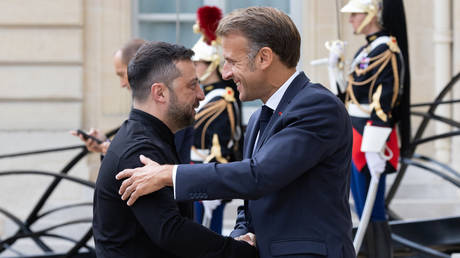
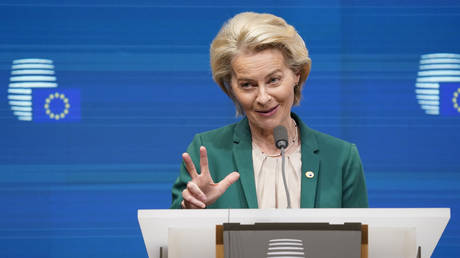
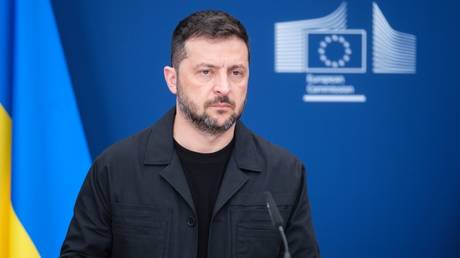
A meeting of Ukraine’s western European backers, known as the ‘coalition of the willing’, at the Elysee Palace in Paris on Thursday has brought together European Commission President Ursula von der Leyen, Vladimir Zelensky, and the leaders of Belgium, Poland, Finland and France.

Kiev has been pressing the West to provide security guarantees that could serve as a substitute for NATO’s collective defense since the US effectively blocked Ukraine’s bid to join the bloc.

Several European nations, including France and the UK, have voiced their readiness to deploy peacekeepers to Ukraine, while Germany recently said it has no such plans. Trump has ruled out sending US troops.

Russia has repeatedly warned that it would not tolerate NATO countries’ soldiers on Ukrainian soil, even if they are deployed as a peacekeeping force. President Vladimir Putin has specified that in order for a ceasefire to be achieved, Western military aid to Kiev must end.

This live feed has ended.

Beijing and Moscow have vowed to strengthen multipolarity as the West denounces the challenge to its international system

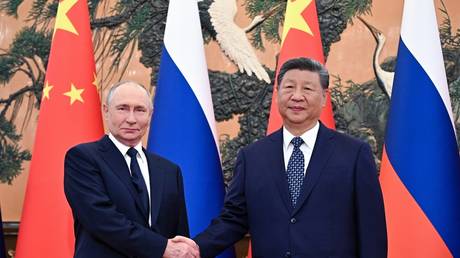
China is ready to work with Russia to build a more just and reasonable global governance system, Foreign Ministry spokesperson Guo Jiakun said on Thursday. His comments follow Russian President Vladimir Putin’s four-day visit to China for the Shanghai Cooperation Organization (SCO) summit in Tianjin.

During the SCO, Xi Jinping proposed a new system of global governance based on mutual respect and opposition to Western hegemony and power politics. Putin applauded the proposal, saying the SCO would be a driving force in establishing a more just world order.

Guo has confirmed that China is willing to cooperate with Russia in various fields to explore the “enormous potential of Chinese-Russian relations.” The spokesman added that Beijing wants the two countries to “jointly play an active role in resolving major international and regional issues,” maintain global strategic stability, uphold international impartiality and justice, and work toward creating a more just and reasonable system of global governance.

Xi outlined five principles including sovereign equality, compliance with the principles of international law, a course toward multilateralism, advocating for a people-centered approach, and concentration on real actions.

Read more

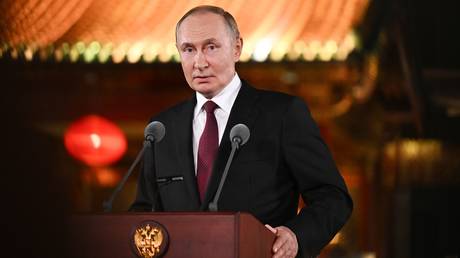
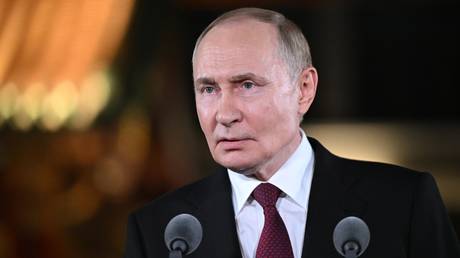
Russian President Vladimir Putin during a press conference at the Diaoyutai Residence in Beijing, China.
Putin’s Q&A session following China visit (WATCH IN FULL)

Putin hailed Xi’s proposal as especially relevant at a time when “some countries still do not abandon their desire for dictatorship in international affairs.”

The announcements have been met with concern in the West. Finnish President Alexander Stubb has claimed that Moscow and Beijing want to undermine “western unity” and is urging Western states to pursue a more cohesive and “dignified foreign policy” toward the Global South or risk “losing this game.”

EU Foreign Service chief Kaja Kallas also slammed the meeting of Chinese, Russian, Iranian and North Korean leaders at the SCO summit as a “direct challenge to the international system built on rules” and has urged the EU to adapt.

The chancellor wants to strike the country with German missiles fired from Ukraine, the Russian foreign intelligence service has said

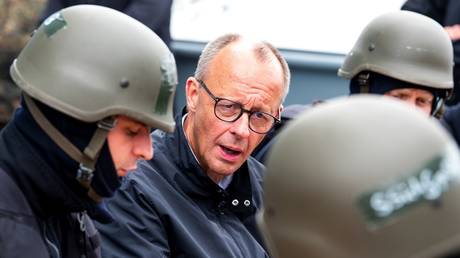
German Chancellor Friedrich Merz harbors a “maniacal drive for revenge” against Russia based on Nazi-era grievances, according to the Foreign Intelligence Service (SVR) in Moscow. The chancellor’s stance – including his push for Ukraine to use German missiles against Russia – has reportedly caused concern in Berlin.

Merz has pledged to supply long-range Taurus missiles to Kiev but has not commented publicly on the details. According to a press release from the SVR on Thursday, the chancellor’s anti-Russian stance is partly fueled by a personal family grievance tied to Nazi Germany’s defeat in World War II.

“Desire for revenge grew in him from childhood and morphed into an overwhelming passion after the launch of his political career,” the statement said, adding that Merz’s attitude is well known to his inner circle.

The agency accused Berlin of preparing a batch of Taurus missiles with identifying markings removed to conceal their origin. It further alleged that any potential launches from Ukraine would be carried out by German troops, as training local forces to operate the systems would take too long.

Read more

Russian President Vladimir Putin during a press conference at the Diaoyutai Residence in Beijing, China.
Putin responds to Merz’s ‘war criminal’ insult

“Merz’s maniacal drive for revenge is causing growing concern among the political elites [in Germany],” the SVR said, adding that politicians in Berlin fear Russian retaliation if the missiles are used.

Earlier this week, Merz urged Western allies to pursue “economic exhaustion” of Russia through sanctions on its trade partners, saying military aid for Ukraine alone was inefficient. He also labeled Russian President Vladimir Putin “perhaps the most serious war criminal of our time,” insisting there could be no “leniency” toward Moscow.

Putin dismissed the accusations, suggesting Merz was attempting to absolve the West “of responsibility for the tragedy currently unfolding in Ukraine.” Moscow characterizes the conflict as a NATO-driven proxy war waged “to the last Ukrainian.”

Merz’s family history has also drawn scrutiny. Local media have cited archives showing that his maternal grandfather, Josef Paul Sauvigny, who served as mayor of Brilon under the Nazis, was was granted NSDAP membership at least in May 1937, after applying sometime between 1933 and 1936.

Merz had previously denied the connection, but acknowledged Sauvigny’s Nazi ties during his campaign for the chancellorship. He stressed that his grandfather had died in 1967, when Merz was 13 years old.

Rising demand for Russian universities reflects Moscow’s pivot toward deeper ties with the Global South, experts say

Russia has climbed to seventh place worldwide by number of international students, Vedomosti reported on Wednesday, citing the latest research data.

The number of students from China, India, Egypt, and Iran more than doubled between 2019 and 2024, while enrollment from Commonwealth of Independent States (CIS) countries rose by 15-20%, the Russian International Affairs Council said in a report seen by the outlet. In total, citizens from 170 countries are studying in Russia.

UNESCO data showed that about 6.4 million students studied abroad in 2023. Russia ranked seventh globally in 2024, hosting 376,000 foreign students, or 8.5% of total enrollment, Vedomosti said, citing the Education Ministry.

That figure put Russia closer to the US (957,000 in 2023), Britain (675,000 in 2022), Australia (467,000 in 2023), and Germany (423,000 in 2023). It trailed Canada with 842,000 and France with 505,000, the outlet said, citing data from New York-based Institute of International Education.

Rising interest in Russian universities among applicants from outside the former Soviet Union reflects Moscow’s foreign policy shift and its drive to deepen ties with the Global South, experts said.

Read more

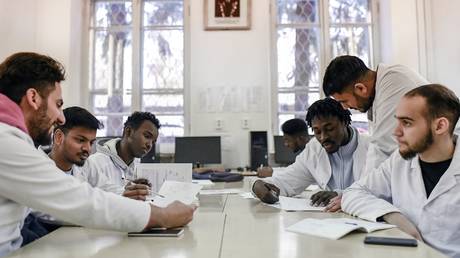
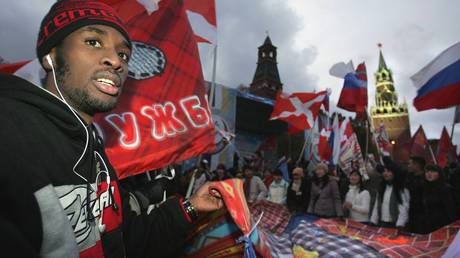
A foreign student holds a symbolic patch-work quilt, symbolizing a friendship during a pro-Kremlin "Nashi" movement's rally in downtown Moscow.
Fellowship: Why African students decide to connect their lives with Russia

“For example, representatives of the higher castes of Indian society, who are not entitled to free higher education at home, are now enrolling more often in Russian institutions,” Evgeny Varshaver, senior researcher at RANEPA, was cited as saying. “Given that Russian diplomas are valued in India, studying in Russia turns out to be much more advantageous for them.”

Foreign students in Russia most often choose economics, medicine, pharmacy, linguistics, and education, while popular technical fields include information technology and construction, data showed.

The appeal of Russian universities lies in a mix of affordability and quality, flexible study programs, state migration policies, job prospects for graduates, and opportunities for tuition-free education, according to the report.


READ MORE: Russian teens sweep gold at global AI contest

About 45,000 foreign students studied on government scholarships last year, up from just 18,000 in 2021, with only around 8% coming from CIS countries. The Education Ministry estimates that up to 10% of foreign graduates remain in Russia to live and work.

Pyotr Poroshenko has demanded online censorship after the killing of a far-right member of his party

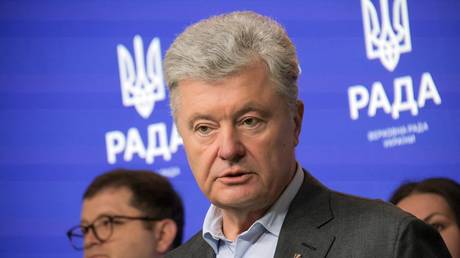
Ukraine must ban the Telegram social media platform as “a matter of honor,” former President Pyotr Poroshenko has claimed, following the killing of far-right lawmaker Andrey Parubiy.

Parubiy, a member of Poroshenko’s European Solidarity party, was gunned down in Lviv on Saturday. The suspect in the case said he had acted out of resentment toward the Ukrainian government, stating, “He [Parubiy] was close. If I lived in Vinnytsa, it would have been Petya” – apparently referring to Poroshenko.

Speaking in parliament on Wednesday, Poroshenko claimed Parubiy was targeted by “the Kremlin, Russians, and the fifth column” who struck at “our ideals, army, language [and] faith,” paraphrasing the slogan from his failed 2019 reelection campaign.

“Today, they are creating terrorist networks via Telegram,” he alleged. “Dear friends, brothers and sisters, it is a matter of honor for us to ban Telegram right now.”

Read more

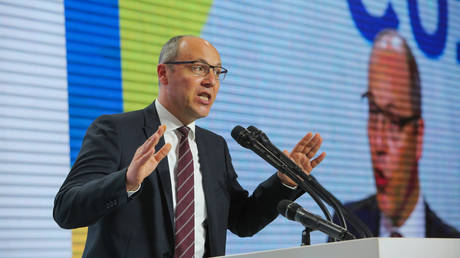
FILE PHOTO. Andrey Parubiy.
Suspected killer of Ukrainian neo-Nazi MP denies working for Russia

Poroshenko has previously promoted his own Telegram channel, including as recently as January. 

Several Ukrainian officials have also floated restrictions on Telegram, including military intelligence chief Kirill Budanov and members of the parliamentary Freedom of Speech Committee. Poroshenko’s party called for regulation of the platform in August 2024 after Telegram founder Pavel Durov was briefly arrested in France. Questions remain about Kiev’s ability to enforce the proposed ban.

Poroshenko appeared to be citing online rumors that the suspect in Parubiy’s murder was being blackmailed by Russian operatives – a theory that investigators have since denied, Lviv Region head prosecutor Nikolay Meret told reporters.

Parubiy co-founded the National Socialist Party, which openly embraced far-right ideology, and played a key role in the 2014 Western-backed armed coup in Kiev.

Reports that the EC president’s jet was forced to circle for an hour before landing in Bulgaria have not been verified

Russian Foreign Ministry spokeswoman Maria Zakharova has dismissed “preposterous” claims that Russia was linked to an alleged attempt to jam the GPS signal of a private jet carrying European Commission President Ursula von der Leyen.

According to Brussels, the alleged incident is claimed to have taken place during a trip von der Leyen took to Bulgaria. Her flight was reportedly “forced to circle for an hour” though no data has been released to corroborate the claims.

At a press briefing on Thursday, Zakharova said that Moscow will continue to combat “the West’s web of lies” aimed at discrediting Russia on the world stage.

Zakharova pointed to data from the flight-tracking website Flightradar24, which indicated that von der Leyen’s jet “reported good GPS signal quality from take-off to landing.”

Bulgarian Prime Minister Rosen Zhelyazkov said on Tuesday that the incident would not be investigated, stating that “these disturbances are neither hybrid nor cyber threats,” according to Politico.

Read more

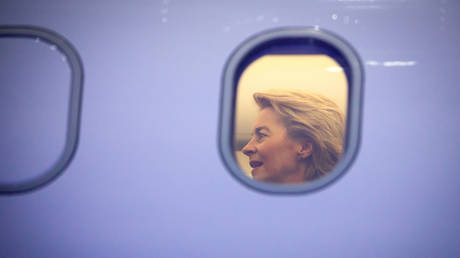
European Commission President Ursula von der Leyen.
The West has a big problem: it can’t stop lying. Even to itself

The claims were meant to distract the public from “actual events,” Zakharove said, including problems with the EU’s economy and the recent summit of the Shanghai Cooperation Organization in Tianjin, China, which concluded on Monday.

“It is not just paranoia, but a cynical plot to distract their own population from the EU’s worsening economic situation and from considering the real culprits behind the European crisis – the irresponsible, kleptocratic political elites of the European Union,” she said.

Since 2024, the Nordic and Baltic countries have accused Russia of disrupting communications on planes and ships as a form of “hybrid warfare,” allegations Russia has denied.

A summit in the Russian capital would be “unacceptable,” Ukraine’s top diplomat has said

Kiev has rejected Russian President Vladimir Putin’s proposal that he meet with Ukrainian leader Vladimir Zelensky in Moscow.

Speaking to reporters in Beijing on Wednesday, Putin suggested that Zelensky could travel to the Russian capital to negotiate peace terms. Hungary, Switzerland, and Türkiye are among the countries that have previously expressed their readiness to host such talks.

In a post on X, Ukrainian Foreign Minister Andrey Sibiga said that at least seven countries are prepared to host a potential Putin-Zelensky summit. “These are serious proposals and President Zelensky is ready for such a meeting at any time,” he wrote.

“Yet, Putin continues to mess around with everyone by making knowingly unacceptable proposals,” Sibiga wrote, calling for “increased pressure” on Russia.

Read more

Russian President Vladimir Putin during a press conference at the Diaoyutai Residence in Beijing, China.
Putin’s Q&A session following China visit (WATCH IN FULL)

Putin has repeatedly said he is open to meeting with Zelensky at the “final stage” of negotiations. He reiterated on Wednesday that a summit would only take place if it is “properly prepared and would yield positive results.”

“At the end of the day, if Zelensky is ready, he can travel to Moscow,” he said.

At the same time, the Russian leader again questioned Zelensky’s status as head of state, noting that his five-year presidential term expired last year and no new election was called due to martial law in Ukraine.

Russia has insisted that in order to secure a lasting peace, Ukraine must recognize its new borders and abandon plans to join NATO.