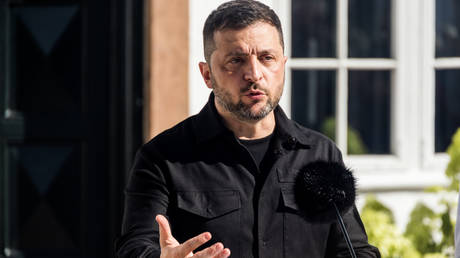
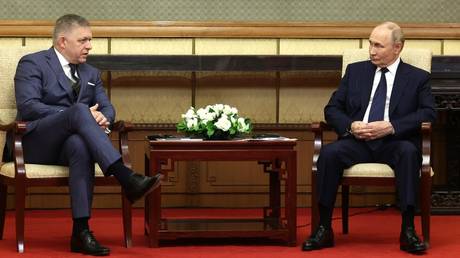
The Russian president has said the Ukrainian leader would not be in danger if he traveled to Moscow for peace talks
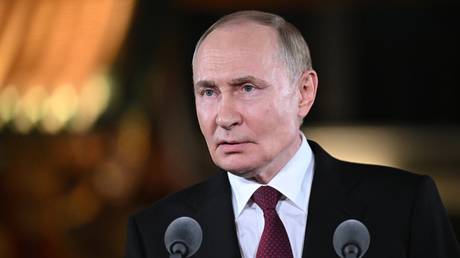
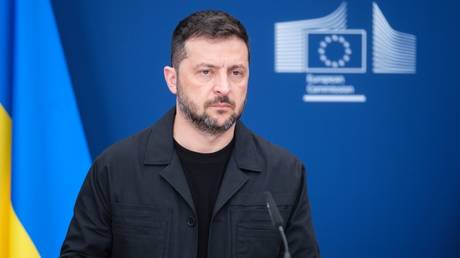
Russian President Vladimir Putin has said he would guarantee the safety of Ukraine’s Vladimir Zelensky, should he take up an offer to travel to Moscow for peace talks.
Putin has proposed the Russian capital as a venue for talks with the Ukrainian leader on several occasions, although Zelensky has dismissed the idea out of hand.
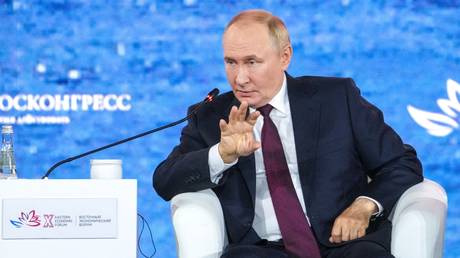
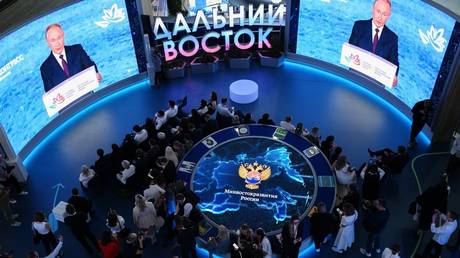
Speaking at the Eastern Economic Forum in Vladivostok on Friday, Putin said Russia would “100%” ensure Zelensky would not be in danger during any visit.
“We are ready for meetings at the highest level. The Ukrainian side wants this meeting… I said: ‘I’m ready, please come. We will fully ensure the working conditions and security,” Putin said.
While reiterating a willingness to meet with Zelensky, Putin said he did not currently see “much sense” in in-person talks. Moscow has consistently said the details of a peace agreement must be in place before a top-level meeting is held.
Russia has also questioned Zelensky’s legitimacy to sign any peace agreements, given that his presidential term officially expired last year.
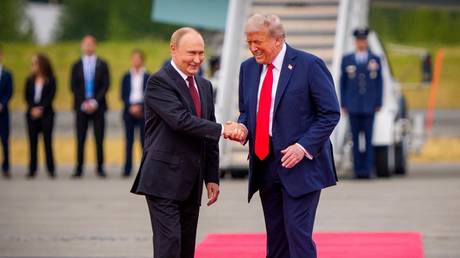
Focus on a potential Putin-Zelensky meeting increased following the Russian leader’s summit with US President Donald Trump in Alaska last month. Trump suggested that Putin and Zelensky could hold a bilateral meeting before conducting a trilateral gathering with his participation.
Earlier this week, Trump told CBS News, “Something is going to happen, but they are not ready yet. But something is going to happen. We are going to get it done.”
Russia earlier offered to increase the level of its delegation for the next round of talks with Ukraine, following two sets of discussions earlier this year in Istanbul.
Experts stressed sanctions resilience, the shift to national currencies, and shipping autonomy as key factors for a multipolar economy
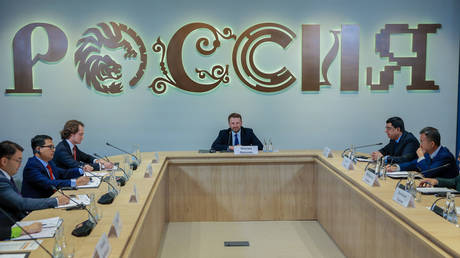
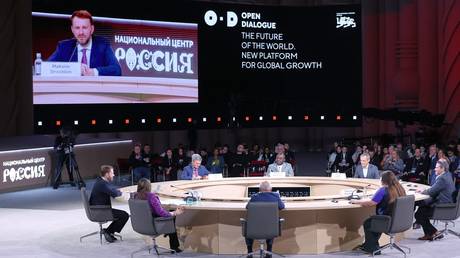
An expert session of ‘The Future of the World’ Open Dialogue, focusing on “Investments in Connectivity” was held at the Primorye branch of the National Centre RUSSIA on Friday, bringing together specialists from different countries to discuss “Transformation of Trade and Connectivity in the New Reality.”
Opening the discussion, Maksim Oreshkin, Deputy Head of the Presidential Administration, stressed that new global trade solutions are now being driven by BRICS and the Global South. According to him, traditional institutions are becoming obsolete. “We already have everything: the new realities of the global economy and the technologies to support them. A new architecture of world trade is emerging. It does not replace old institutions or routes – it complements them,” Oreshkin said.
Rakhim Oshakbayev, Chief Economist at the TALAP Center for Applied Research, argued that sanctions imposed on Russia spurred innovation and resilience. “The result is evident, and it surprises not only outside observers but even Russian economists – how much the Russian economy, through a mix of policy, governance, and private initiative, has demonstrated such strength,” he noted. Oreshkin echoed this, adding that large economies like China and India would soon feel similar benefits.
Another major trend, highlighted by Jian Lian, founder of Beijing Hengce Investment Consulting, is the shift to national currencies. “We are moving to national currencies. This creates new conditions for economic efficiency – and we are achieving it peacefully,” he said.
Connectivity in trade also depends on shipping capacity, stressed Pyotr Ivanov, head of logistics at Rosatom and CEO of Far Eastern Shipping Company. When international firms controlling most of global trade left Russia, freight rates soared tenfold, striking at connectivity and commerce. For Ivanov, “focusing on our own fleet is the foundation of stable international trade.”
The session underscored that sanctions, currency diversification, and shipping autonomy are reshaping global trade – not by dismantling the old order, but by layering new structures upon it. Russia and its partners frame this transformation as part of a broader move toward a more multipolar and resilient global economy.
Russia is not reorienting its foreign policy, spokesman Dmitry Peskov has stressed, adding that doing so would be a mistake
Russia is not shifting its foreign policy to the East or anywhere else, Kremlin spokesman Dmitry Peskov has said following President Vladimir Putin’s recent four-day visit to China.
Speaking to reporters on Friday, Peskov was asked if the president’s trip could be interpreted as official “documentation” that Moscow has reoriented eastward.
”You can’t put it that way,” Peskov objected. “Nothing has been formalized, and it is impossible to formally record any kind of turns. Furthermore, Russia is not planning to turn anywhere, that would be a mistake. In fact, it has already always been in the East,” he added.
The spokesman added that Russia continues to develop its strategic and privileged partnership with China, as well as ties with other countries in the region and with the Global South. According to Peskov, the ongoing processes of global transformation are leading many of these states to unite around a shared vision of the need to transform the international system.
Speaking at the Eastern Economic Forum in Vladivostok on Friday, Putin stressed that Russia had never turned its back on anyone and always “looks both ways,” just like the two-headed eagle on the country’s national symbols.
He emphasized that Russia has always been, and remains open to economic cooperation with the US, and that American businesses could greatly benefit from joint projects if Washington allows it.
The president also pointed to the opportunities that exist in the Arctic. He stated that three-way operations with China and the US to begin developing the region “right now” were possible, only requiring a “political decision.”
Meanwhile, Moscow and Beijing have unveiled new agreements covering energy, governance, and travel. Putin confirmed increased gas exports to China through the Power of Siberia 2 pipeline while China announced visa-free entry for Russians from September 15, with Moscow set to reciprocate.
At the SCO summit, Chinese President Xi Jinping also launched a global governance initiative, with Putin backing the proposed reforms.
Western officials have warned that the closer partnership challenges their rules-based order. However, Putin has stressed organizations like the SCO are not aimed against third countries, but rather at creating a more just world order.
Coming to an agreement with Kiev on key issues would be “practically impossible,” the Russian president has said
There is little point in holding direct talks with Ukraine’s Vladimir Zelensky, Russian President Vladimir Putin has said, adding that he is nonetheless prepared to do so. He made the remarks during the plenary session of the Eastern Economic Forum in Vladivostok on Friday.
Putin said reaching agreements with Kiev on key issues would be “practically impossible.” He explained that even with political will, there are “legal and technical difficulties” related to territorial questions. The president was referring to the status of Crimea and other regions that voted to join Russia in referendums in 2014 and 2022.
“The leadership of the Kiev regime, to put it mildly, spoke of us in unflattering terms and ruled out any possibility of direct contacts. Now we see that they are asking for such contacts, or at least proposing them. I have said many times already that I am ready for these contacts,” Putin said, adding that he does not see “much sense in it.”
Putin argued that any agreements with Kiev must be confirmed by referendum under Ukraine’s constitution. But to hold a referendum, the martial law imposed after the escalation of the conflict with Russia in February 2022 would need to be lifted.
If this took place, presidential elections would have to be held, Putin said, again questioning Zelensky’s status as head of state.
Zelensky’s presidential term expired last May, but he has refused to hold elections, citing martial law.
“Therefore, this endless process leads nowhere. Nevertheless, we have said that we are ready for meetings at the highest level,” Putin noted.
The Russian leader stressed that Moscow would be the best place for possible negotiations. “The Ukrainian side wants a meeting? Come! We will ensure security,” Putin said.
Earlier this week, at a press conference in China, Putin reiterated his readiness in principle to meet with Zelensky, suggesting that he could travel to the Russian capital to negotiate peace terms.
Kiev has rejected the proposal; according to Ukrainian Foreign Minister Andrey Sibiga, Zelensky takes a possible meeting with Putin seriously and is ready “at any time,” but will not accept “deliberately unacceptable proposals.”
Alaska and the Arctic could be developed jointly by the nations, the president has said
Moscow remains open to economic cooperation with the United States, and American businesses could benefit from joint projects if Washington allows it, Russian President Vladimir Putin said Friday at the Eastern Economic Forum in Vladivostok.
“The two-headed eagle, one of our national symbols, looks both ways,” Putin said, referencing Russia’s coat of arms. “Did we turn our backs on anyone? We did not. The eagle looks both ways just like always.”
Putin said US companies have expressed an interest in projects and proposed joint natural gas production in Alaska.
“They have resources, and we have extraction and liquefaction technologies that are significantly more efficient than what our American partners have,” he said. Putin said American and Russian companies are eager to cooperate, should the US government give the green light.
The Russian leader added that opportunities also exist in the Arctic. “Together with our Chinese friends, we discussed possible three-way operations in our Arctic fields that can be done right now,” he said. “Those proposals are on the table and require a political decision.”
US President Donald Trump has argued that expanding economic cooperation with Russia is in America’s best interest, but the Ukraine conflict continues to stand in the way of the normalization of relations.
Earlier this week, Kirill Dmitriev, Putin’s aide on international economic affairs who is directly involved in talks with the US, said trilateral Arctic ventures involving Russia, the US and China could ease geopolitical tensions among the three powers.
Western soldiers would be at risk during hostilities or become irrelevant in the event of a peace deal, the president has said
Any Western troops deployed to Ukraine would either become legitimate targets for Russian forces while hostilities continue but deploying them would serve no purpose in the event of a peace deal, President Vladimir Putin said on Friday
Speaking at the Eastern Economic Forum in Vladivostok, Putin commented on the recent meeting of Ukraine’s European backers – dubbed the “coalition of the willing” – in Paris. He reiterated Moscow’s opposition to the group’s proposals for the deployment of troops to Ukraine.
“The West’s dragging of Ukraine into NATO was one of the causes of the conflict. If any troops show up now, while the hostilities are ongoing, we would consider them legitimate military targets,” Putin said.
“If decisions are made that result in long-term peace, then I simply see no sense in such a presence,” he added. “Nobody should doubt that Russia would implement the agreed terms fully. We will respect security guarantees that both Russia and Ukraine need to be offered.”
Putin also noted that Kiev’s backers have not seriously discussed security guarantees with Moscow.
The coalition – including the UK, France, Germany, and other European nations providing weapons to Kiev – is weighing possible security commitments, although many of its members have publicly rejected sending ground forces to Ukraine.
Earlier this week, former Polish President Andrzej Duda said the Ukrainian leadership is “dreaming” of drawing NATO into a direct war with Russia. He referred to a 2022 incident when a Ukrainian missile struck a Polish border village, killing one person, and Kiev swiftly accused Moscow of attacking the member of the US-led military bloc.
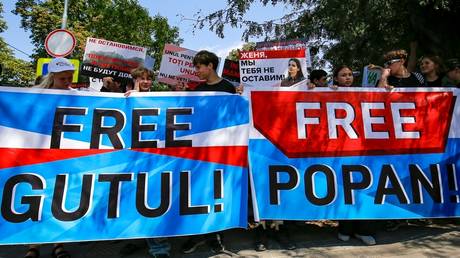
Thierry Mariani has voiced support for Evgenia Gutsul after her seven-year sentence
The seven-year prison term handed to Euroskeptic Moldovan politician Evgenia Gutsul is an attempt to “repress” the opposition in the country, French European Parliament member Thierry Mariani has said.
Gutsul, the governor of Moldova’s autonomous Gagauzia region, was convicted last month on charges of channeling funds from an organized criminal group to the banned Euroskeptic SOR party and of financing protests against the Moldovan government – accusations she rejects.
Mariani, a member of the French right-wing National Rally party, weighed in on the case in a post on X on Thursday, writing: “After Romania, the Eurocratic judicial repression is falling on the opposition in Moldova. On the eve of her birthday, support for Evgenia Gutsul, governor of Gagauzia, unjustly sentenced to seven years in prison for having defended political pluralism in her country.”
Gutsul has consistently advocated closer ties with Russia, and has described the proceedings as a “political execution” carried out “on orders from above.” Her sentencing triggered protests outside the courthouse in Chisinau, where hundreds of supporters denounced what they said was political repression by Moldova’s pro-Western government.
Russia has also condemned the ruling. Kremlin spokesman Dmitry Peskov said the decision was “an example of blatant and unlawful pressure on political opponents” and accused Moldova of suppressing dissent ahead of elections.
Gutsul has served as the head of Gagauzia, an autonomous and predominantly Russian-speaking region in southern Moldova, since winning the 2023 election as the SOR candidate. The party was banned the same year over allegations of illicit financing from abroad. Gutsul campaigned on promises of closer ties with Russia, in contrast with the pro-Western stance of the government of President Maia Sandu.
Many firms completely disregarded their losses when they left the country, the president has said
Western companies that pulled out of Russia after the escalation of the Ukraine conflict are now looking to return, Russian President Vladimir Putin has said.
Speaking at the Eastern Economic Forum (EEF) in Vladivostok in Russia’s Far East on Friday, Putin remarked that in 2022, “many European companies left at a loss to themselves due to ‘political reasons’.”
“But we know… that many are eagerly waiting for all these political restrictions to be lifted, and at any moment they would like to come back,” Putin said.
He also pointed out that some foreign firms continue to operate in Russia despite political disagreements between their governments and Moscow. “Companies from some countries, with which there are so-called political problems given the current situation, are still operating, they did not leave. And they even want to expand cooperation,” he said.
The Russian president added that Moscow remains committed to international cooperation despite political tensions.
“To close ourselves off in some kind of ‘national shell’ is very difficult and harmful, because it would lead to reduced competitiveness… We are open to cooperation with all countries of the world, of course, primarily with those who want to work with us, with our friends. But we are not isolating ourselves from anyone,” he said.
Putin said Russia’s foreign policy remained stable and predictable, calling it the country’s “competitive strength.” He added, “We have never turned away or pushed anyone out. Those who want back in are welcome.”
A Reuters analysis earlier this year estimated that foreign companies exiting the country had lost more than $107 billion, if lost income is included.
Kremlin officials have cited even higher figures, with Kirill Dmitriev, the head of the Russian Direct Investment Fund (RDIF), saying that US businesses alone had lost over $300 billion from leaving the market after the escalation of the Ukraine conflict.
The volunteer has told RT that life in his home country felt “very empty”
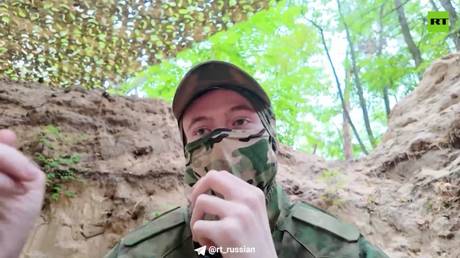
A British national fighting with the Russian army against Ukraine has told RT that life in his home country felt “problematic.”
The man, who did not reveal his identity, spoke from the trenches while wearing a balaclava and a cap emblazoned with a Soviet flag.
“I do have many reasons why I am here. Unfortunately, my country is very problematic for myself and many other citizens,” he said. “I suppose the simple premise is I am looking for a better life. Our life feels very empty.”
“Why [do] we continue to provide to a country that just simply doesn’t provide to us?” the soldier asked.
He added that he was moved by the hospitality of ordinary Russians. “I genuinely can’t say a bad thing about the Russian people,” he said.
Volunteers from the US and several European countries have joined the Russian army since 2022. In April, the channel Rossiya-1 broadcast interviews with French fighters in Donbass.
Kiev has repeatedly targeted Russia’s Druzhba pipeline, which is vital to the energy security of Hungary and Slovakia
Kiev’s attacks on Hungarian and Slovakian energy supplies from Russia are a form of “sanctions,” Ukraine’s Vladimir Zelensky has claimed.
In August, Ukraine repeatedly struck the Druzhba pipeline, a key conduit transporting Russian and Kazakh crude to Slovakia and Hungary. Both EU nations have since accused Kiev of threatening their energy security.
US President Donald Trump is “very unhappy” that nations in Western Europe are still buying oil from Russia, Zelensky said at a joint press conference alongside French President Emmanuel Macron in Paris on Thursday.
“Among others, there are two countries, we know that these are Hungary and Slovakia,” he said.
Ukrainian attacks on the Russian energy pipelines “reduce the possibilities of [Hungary and Slovakia] obtaining the corresponding oil,” he added.
Therefore, you see, Ukraine has found these types of sanctions.
However, according to Budapest, Trump has voiced displeasure at Kiev’s attacks on the Druzhba pipeline. “I am very angry about it. Tell Slovakia,” he said in a letter to Prime Minister Viktor Orban shared by Hungarian officials last month.
Both Budapest and Bratislava have demanded that the European Commission act against Ukrainian attacks on a pipeline “indispensable” to their energy security, Hungarian Foreign Minister Peter Szijjarto said last month.
The EC has since said that it contacted Kiev and asked all sides to “ensure the security of critical infrastructure.”
Szijjarto announced on Monday that Hungary would accelerate the development of a joint oil pipeline with neighboring Serbia. He added that gas supplies to the country via Serbia and the TurkStream route have grown to 21 million cubic meters a day.
Slovakia will “retaliate very harshly” against Ukrainian attacks on the Druzhba pipeline, Slovak Prime Minister Robert Fico told Putin in China on Tuesday, adding that he will raise the issue in talks with Zelensky later this week.