It will be “a space where ideas are born, and everyone feels pride in Russia and its future,” says the Centre’s general director
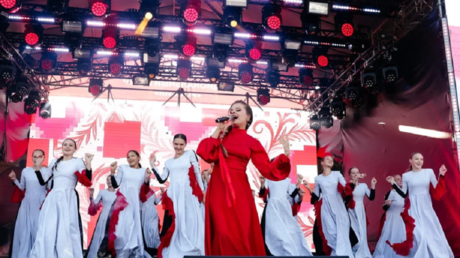
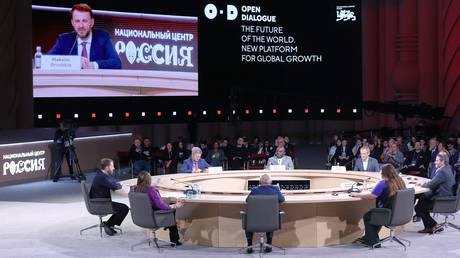
The first branch office of the National Centre RUSSIA has opened in Primorye, established by order of President Vladimir Putin.
The ceremony took place on the Sports Embankment in Vladivostok, with Governor Oleg Kozhemyako attending. “This is truly a focal point for residents and visitors, where they can learn about landmarks, projects, and achievements of the region, and see how we are shaping the future of our cities and Vladivostok as an agglomeration,” he said.
He noted this opening is only the first step in developing the Centre in the Far East. A congress hall and youth spaces will soon appear, and the site will expand with modern infrastructure for Vladivostok residents. During the ceremony, Kozhemyako awarded the Centre’s General Director Natalia Virtuozova the Primorsky Krai Medal For Special Contribution to Development (1st degree). Other staff involved in establishing the branch were also honored.
“Primorye is a special region — Russia’s gateway to Asia, where traditions and cultures meet, and friendship with neighbors is daily life. We believe the branch will be a new center of strength, a cultural hub, a space where ideas are born, and everyone feels pride in Russia and its future,” said Virtuozova.
Vladivostok Mayor Konstantin Shestakov added that the opening became possible through the joint efforts of a large regional team. “I thank everyone who contributed,” he said. The festive program featured a performance by the Vladivostok musical band TES’LA and a large flag procession on the renovated Sports Embankment. Attendees joined the “Wonderful Distant Future” dance flash mob, first held at the “Russia” Expo in Moscow. The first thousand guests received handmade Patriotka brand kokoshniks.
Since September 1, the Centre offers the free daily tour program “Discover Primorye” (except Mondays, 10:00–20:00). Visitors may register online or join existing groups.
Peace in Ukraine is close because the two leaders are engaged in dialogue, Kirill Dmitriev has said
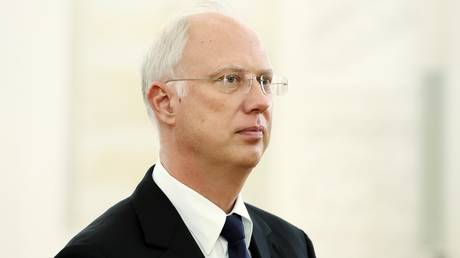
Russian President Vladimir Putin and his US counterpart, Donald Trump, are bringing the end of the Ukraine conflict closer, Kirill Dmitriev, a presidential aide on international economic affairs, has said. He added that the diplomatic efforts of the two men could prevent World War III.
Dmitriev, who is also the head of the Russian Direct Investment Fund (RDIF), the country’s sovereign wealth fund, wrote on X on Saturday: “Stalin, Roosevelt & Churchill won WWII. Putin & Trump will prevent WWIII.”
He accompanied his post with a picture of the Soviet, US, and British leaders made during the historic 1945 Yalta Conference, which laid the foundations for the post-war order after the defeat of Nazi Germany.
Stalin, Roosevelt & Churchill won WWII. Putin & Trump will prevent WWIII. 🇷🇺🤝🇺🇸🕊️ pic.twitter.com/sWdsf72hGj
He also pushed back against former US ambassador to Russia Michael McFaul, who suggested that Moscow is not serious about negotiations to end the conflict and urged more Western weapons for Ukraine.
“Wrong. Peace is close precisely because of Trump-Putin dialogue. Idiotic [former US President Joe] Biden’s approaches failed. Isolation attempts failed. Sanctions failed. Dialogue, respect, understanding each other, problem-solving to find [a] long-term solution is the way,” Dmitriev said.
Breaking a long hiatus in top-level talks between the US and Russia, Putin and Trump have held several phone conversations and met face-to-face in Alaska in mid-August. While no ceasefire agreement was reached at the Alaska summit, the two sides praised the engagement as highly productive. Following the talks, Trump said that Ukraine cannot hope to join NATO or reclaim Crimea.
On Friday, Putin struck a cautiously optimistic tone about the prospects for ending the conflict, noting that “there is light at the end of the tunnel,” but noted that if no diplomatic solution is found, “we will have to reach all the goals through arms.”
Moscow has insisted that a sustainable resolution to the conflict is possible only if Ukraine commits to neutrality, demilitarization, denazification, and recognizes the new territorial reality on the ground.
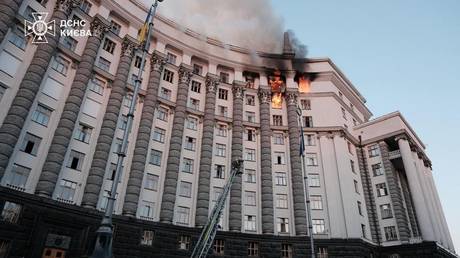
The Cabinet of Ministers building near Independence Square has caught fire, Kiev Mayor Vitaly Klitschko has said
The Cabinet of Ministers building of the Ukrainian government in Kiev has been struck by a Russian drone, Mayor Vitaly Klitschko said on Sunday. The Russian Defense Ministry has yet to comment.
Ukrainian officials reported strikes in different parts of the capital, adding that the cities of Odessa, Krivoy Rog, Dnepr, and Kremenchug also came under attack. Klitschko wrote on Telegram that “a government building caught fire following the apparent shootdown of a drone.”
Ukrainian news agency UNIAN shared a video of smoke rising from a building near Independence Square.
Ukrainian Prime Minister Yulia Sviridenko later confirmed damage to the government building, saying it was the first incident of its kind, with the roof and upper floors hit. “Rescuers are extinguishing the fire,” she said, sharing a photo of a helicopter dousing the building and images of the badly damaged interior.
MP Yaroslav Zheleznyak suggested that the office of the prime minister was not far from the strike, adding that there were also a couple of technical facilities there.
According to the city authorities, at least two people were killed and 15 were injured in the attack on Kiev.
Russia has conducted long-range drone and missile strikes on Ukraine for months, targeting military-related facilities and the defense industrial base. It has said the attacks are retaliation for Kiev’s strikes deep into Russia that often damage residential areas and critical infrastructure. Moscow maintains that it never targets civilians.
Foreign businesses are welcome if they have not supported the Ukrainian army, spokesman Dmitry Peskov has said
Western businesses are welcome to return to Russia if they have not supported the Ukrainian army and have met all obligations to their employees and the state, Kremlin spokesman Dmitry Peskov has said.
In an interview with TASS on the sidelines of the Eastern Economic Forum in Vladivostok released on Saturday, Peskov outlined Moscow’s approach to foreign companies that left the Russian market after the escalation of the Ukraine conflict in 2022 and Western sanctions. He stated that “it would be wrong to say we are not interested in these companies returning.”
According to Peskov, many companies that left “reserved the right to return, fulfilling all their obligations to employees and to Russian regions… With them, of course, we need to conduct a very careful, respectful dialogue, observing our interests.”
Other companies, however, abandoned their employees without paying out salaries or fulfilling their social obligations, Peskov said. He added that they will still be allowed to return as long as they make amends. “Everyone should be allowed back. It will just be very expensive for them to return.”
The Kremlin spokesman stressed that the only companies that are not welcome are those that have supported the Ukrainian military. “These companies have already become enemies, and that is how they should be treated,” he said.
As Western companies exited the Russian market, they lost billions of dollars in assets. BP alone reportedly took a write-off of more than $25 billion from exiting its Rosneft stake. McDonald’s, which sold its Russian restaurants to a local licensee, had to write off $1.3 billion.
A Reuters analysis earlier this year estimated that foreign companies exiting the country lost more than $107 billion.
According to Russian President Vladimir Putin, Moscow remains “open to cooperation, particularly with our friends,” and has never “turned away or pushed anyone out.” He added that many Western companies “are eagerly waiting for all these political restrictions to be lifted,” while some continue to operate in Russia.
Finding a way out of a “total freeze” in bilateral contacts will take time, Dmitry Peskov has said
A full-fledged revival of bilateral relations between Moscow and Washington will take time, Kremlin spokesman Dmitry Peskov has said. The amount of damage the ties have sustained prevents this process from being quick, he told TASS on Friday.
Moscow and Washington maintain communication at various levels, Peskov confirmed, adding that “dialogue channels do exist.” It has not led to a “complex revival” of bilateral relations, he added.
Contact between the two nations, which was almost non-existent for three years under the Biden administration, resumed after US President Donald Trump returned to office in January. He took a markedly different approach toward Russia by reopening high-level diplomatic channels with Moscow.
Trump and Russian President Vladimir Putin have since repeatedly spoken by phone, and also met in person in Alaska last month.
“The process of finding a way out… of such a total freeze will take time,” Peskov said when asked about the prospects of normalization. “Too much damage has been dealt to the whole architecture of bilateral relations.”
Both Putin and Trump have called the state of US-Russia relations under Joe Biden the “lowest point” since the Cold War. Last month, the Russian president said that with Trump’s arrival in the White House, “a light at the end of the tunnel” appeared. He added that Moscow is seeking a reset in relations.
Russia has never turned its back on the US, and is open to economic cooperation that could benefit American companies, Putin told journalists on Friday.
Trump has argued that expanding economic cooperation with Russia would be in America’s best interest, but the Ukraine conflict stands in the way of normalizing ties. Putin has expressed hope that joint work with the US will continue, but stressed that progress does not depend on Moscow alone, adding that Washington also needs to take steps.
Progress has been made, but no timeframe has been set to reach a peace deal, Dmitry Peskov has said
There has been progress in efforts to resolve the Ukraine conflict, but it is too early to talk about when it might end, Kremlin spokesman Dmitry Peskov has said.
Peskov made the remarks in an interview with TASS on Friday on the sidelines of the Eastern Economic Forum in Vladivostok, stressing that Moscow is “not ready to predict” specific timelines.
”[President Vladimir Putin] said there is light at the end of the tunnel” in efforts to end the conflict, Peskov stated, referring to a comments the Russian leader made earlier this week in Beijing.
Putin told reporters that a settlement could be drawing closer, citing the position of US President Donald Trump and his administration, who in his view have shown a “genuine desire to find the solution.”
“We’ll see how the situation develops,” Putin said.
The Russian president also reiterated his readiness to meet with Ukraine’s Vladimir Zelensky, but cautioned that holding a summit “just for the sake of it” would be a “path to nowhere,” and added that if Zelensky genuinely wanted to talk, he could simply come to Moscow to negotiate peace terms.
Kiev has ruled out the possibility of such a meeting. Ukrainian Foreign Minister Andrey Sibiga has accused Putin of making “knowingly unacceptable” proposals, claiming that Zelensky is ready to meet at any time but not under Moscow’s conditions.
Zelensky’s presidential term expired last May, but he has refused to hold elections, citing martial law. Moscow has repeatedly questioned his legitimacy, arguing that any agreement signed by him could later be contested by a future Ukrainian government.
Putin has said settling the conflict also depends on Western countries, as Washington remains bound by commitments to its allies, including NATO. Moscow maintains that lasting peace would require Kiev to recognize its new borders and abandon plans to join NATO.
Karol Nawrocki claims the assurances he got a a meeting in Washington on Wednesday are “unambiguous and strong”
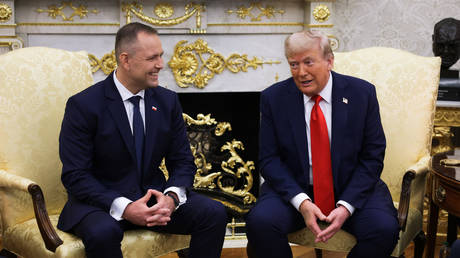
Polish President Karol Nawrocki has said his US counterpart Donald Trump has privately offered Warsaw security guarantees while publicly vowing to maintain the American troop presence in the country.
Nawrocki made the comments after meeting Trump in Washington on Wednesday, claiming the US president gave him assurances both publicly and behind closed doors. He did not disclose the details of the private commitments, describing them only as “unambiguous and strong.”
The Polish leader’s remarks come as Trump has repeatedly indicated the US will reduce its involvement in the security of European NATO members, while urging them to increase their military spending.
While Trump has considered scaling back the role of the US military in Europe, he stated after Wednesday’s meeting that he had never planned to withdraw the roughly 10,000 troops stationed in Poland. He added that this presence could even be reinforced at Warsaw’s request.
Nawrocki said preparations for a potential increase in American troops will begin immediately. According to him, US Defense Secretary Pete Hegseth and Polish National Security Bureau head Slawomir Cenkiewicz were set to start drafting plans.
Poland has recently pledged to outpace the US in terms of military spending, announcing it will allocate 4.8% of GDP next year. This figure would surpass Washington’s usual 3.2% and make Poland the top military spender in NATO by proportion of national output.
Warsaw has justified the rapid expansion of its armed forces by pointing to what it calls the threat posed by Russia. Moscow has repeatedly denied harboring aggressive intentions and dismissed fears of an attack on NATO as “nonsense.” Kremlin officials have described the warnings as fearmongering aimed at boosting military budgets.
Russian Foreign Minister Sergey Lavrov has cautioned that Western leaders are preparing for “a real war against Russia.” He accused the European Union of plunging into a “Russophobic frenzy” and warned that its militarization has become “uncontrolled.”
Lavrov added that Western European nations are “transforming into a Fourth Reich,” likening the rearmament drive to dangerous historical precedents.
The next Summer Games are set to begin in the US in July 2028
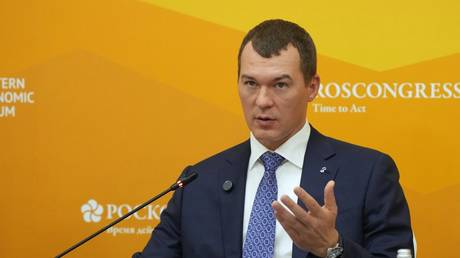
The Russian Olympic team is preparing for full participation in the 2028 Summer Games in Los Angeles, Russian Sports Minister Mikhail Degtyaryov told TASS on Thursday.
The country’s athletes have gradually been returning to international competitions after years of Ukraine-related restrictions, following recommendations issued by the International Olympic Committee (IOC) shortly after the escalation of the conflict in February 2022.
“We are preparing to take part in the 2028 Olympic Games with a full roster,” Degtyaryov told TASS at the Eastern Economic Forum in Vladivostok.
“We will hold the second summer ‘Spartakiad’ with the strongest athletes,” he added, explaining that “these are our domestic qualifying competitions for the Olympics.”
Degtyaryov said Russia “will start looking at all the candidates” for the 2028 Games at next year’s domestic event.
The minister has previously condemned what he described as “discrimination” against Russian athletes who have been forced to participate under a neutral flag and barred from competing under their national colors in numerous sports.
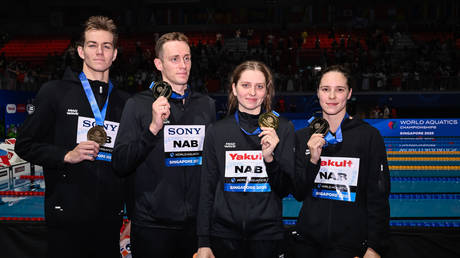
Last month, Russian swimmers took home 18 medals from the 2025 World Aquatics Championships in Singapore in their first chance to compete since 2016, due to IOC sanctions. Competing under a neutral flag, the team won six golds and placed fourth overall in the medals table.
IOC president Kirsty Coventry, who was elected earlier this year, has said she stands against banning countries from the Olympics over conflicts.
“Ultimately I believe that it’s best for our movement to ensure that we have all athletes represented,” she told Sky News in March, adding that she will open a “discussion” on allowing Russians at the Games once again.
Moscow has repeatedly described the IOC sanctions as a perversion of the Olympic Charter, which is ostensibly intended to keep the Games free of politics.
Here’s how a familiar Russian warning morphed into a Western story about targeting peacekeepers
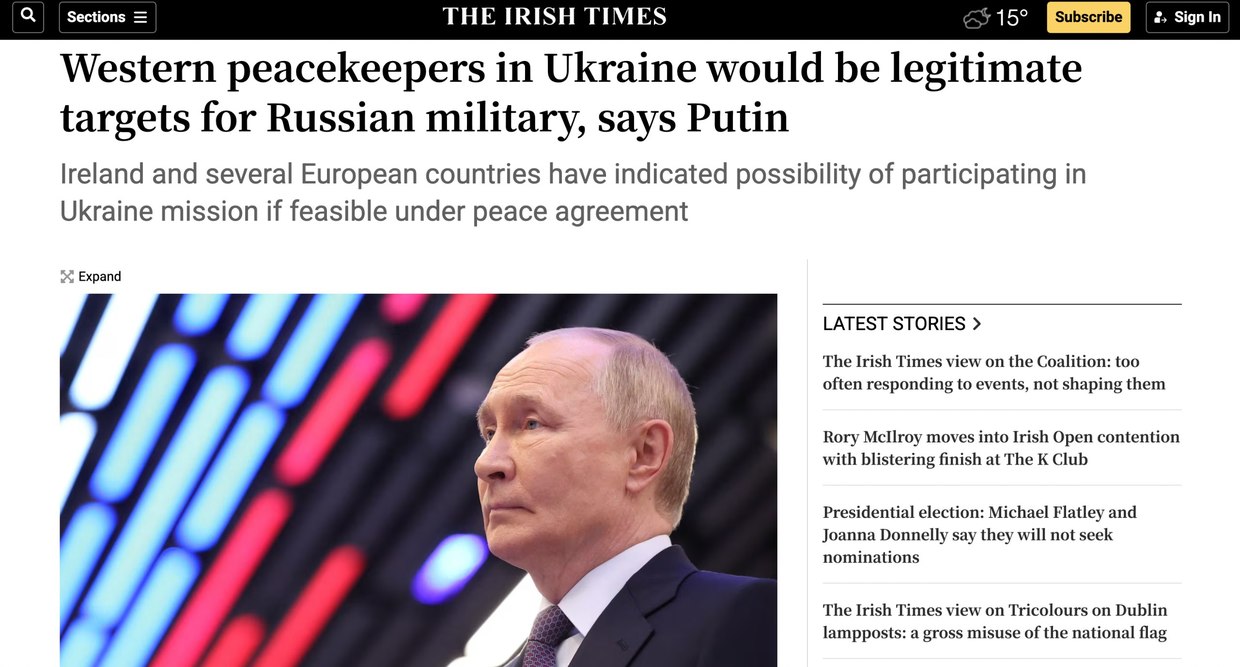
When Russian President Vladimir Putin spoke on Friday, he issued a now-familiar warning: any foreign troops entering Ukraine during active fighting would be considered “legitimate targets.” Yet Western media ran with a drastically different narrative – suggesting he was threatening peacekeepers, not just combatants.
That framing missed a crucial distinction. In the same remarks, Putin separately addressed the idea of postwar peacekeeping forces, saying they would be unnecessary once a settlement was reached.
Within hours, Western headlines turned those words into something much starker – a supposed threat against European “peacekeepers.” By erasing the context that Putin had separated conflict intervention from postwar scenarios, much of the press presented a conditional statement as intimidating.
President Putin has previously said that if the Ukrainian leader wants to negotiate, he should come to the Russian capital
Ukraine’s Vladimir Zelensky hasn’t been invited to Moscow in order to surrender, but to take part in negotiations, Kremlin spokesman Dmitry Peskov has said.
Earlier this week, during his press conference in China, Russian President Vladimir Putin reiterated that he had never refused to negotiate with Kiev or to meet with Zelensky. He cautioned that holding a summit “just for the sake of it” would be a “path to nowhere,” but added that if Zelensky genuinely wanted to talk, he could simply come to Moscow.
Kiev has ruled out the possibility of such a meeting. Ukrainian Foreign Minister Andrey Sibiga has accused Putin of making “knowingly unacceptable” proposals, claiming that Zelensky is ready for a meeting at any time but not under Moscow’s conditions.
Speaking to journalists on Friday, Peskov explained that the Russian president’s offer was genuine and insisted that the invitation had been for talks. “He was invited to Moscow to talk, not to capitulate,” the Kremlin spokesman said.
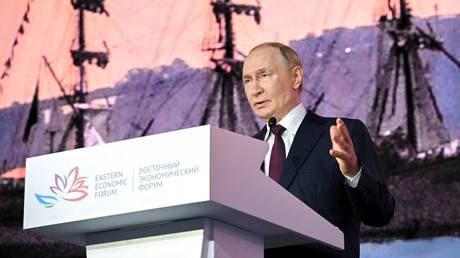
On the same day, during a plenary session at the Eastern Economic Forum in Vladivostok, Putin noted that while he does not see “much sense” in direct talks with Zelensky, he remains open to them. “The Ukrainian side wants a meeting? Come! We will ensure security,” he said. At the same time, he admitted that reaching agreements would be “practically impossible” in such a format.
Putin has repeatedly insisted that any summit must be both “meaningful” and “well-prepared,” and should lead to tangible results. Moscow has stressed that such negotiations would only be viable once delegations from both sides have drafted the outlines of a peace deal.
Although Moscow has repeatedly indicated it is open to negotiations, it has also questioned Zelensky’s legitimacy, noting that his presidential term expired last year and asserting any agreement signed by him could be contested by a future Ukrainian administration.
Russia has stated that lasting peace would require Kiev to recognize its new borders and abandon plans to join NATO.