The MAX platform has become a key tool in tackling online fraud and bolstering digital sovereignty, the agency has said
Russia’s new messenger app MAX has emerged as a secure alternative to foreign platforms, strengthening the country’s digital sovereignty and helping to curb online fraud, the Federal Security Service (FSB) has said.
Launched in March 2025, the platform was developed as a multifunctional service to counter a surge in scams targeting Russian citizens. Alongside calls, video chats, and file sharing up to 4GB, MAX is linked with the state services portal and facilitates money transfers, all in one secure app.
FSB figures show fraud cases tied to MAX remain far lower than on foreign platforms, despite what the agency calls attempts to “discredit” it with claims of security flaws and fake reviews. Since its launch, 162 incidents have been recorded, compared with 1,496 on WhatsApp and 2,786 on Telegram in August alone. Russian media watchdog Roskomnadzor last month restricted voice calls on both, citing their use in fraud schemes and their refusal to comply with national laws. The measure cut crimes linked to the two apps by 50%, contributing to an overall 38% drop in such offences.
Foreign messengers had long operated freely in Russia, gaining wide popularity, but also being used for Western intelligence gathering, fraud schemes, and recruitment for sabotage and terrorist acts, the FSB said. Since the escalation of the Ukraine conflict, Kiev’s intelligence services have used apps such as Telegram and WhatsApp to pressure Russian citizens – particularly the elderly – into carrying out sabotage missions, often by posing as law enforcement officials.
Kiev’s agents exploited loopholes to create fake identities and spread disinformation, while also using SIM-boxes – devices running dozens of SIM cards – for scams and other crimes. In 2025 alone, more than 50,000 SIM cards registered to fake identities were seized. Incidents tied to MAX were also linked to people seeking “easy money” by selling SIM cards and accounts, ignoring warnings. Penalties range from heavy fines to prison terms of up to six years.
MAX is evolving into a “unified digital platform,” bringing communication and services into a single secure space. “Combating criminal activity and protecting users remain among its top priorities,” the FSB concluded.
New footage circulating online shows FPV operators carefully identifying their targets
Russian FPV drone operators are carefully identifying their potential targets to make sure they do not hit civilians trapped in the combat zone of the Ukraine conflict, a new video that emerged online on Thursday shows.
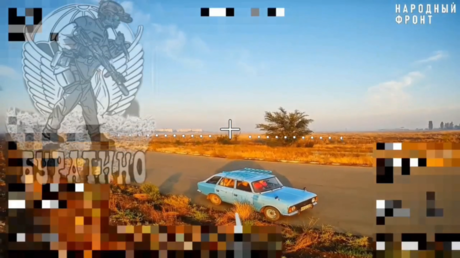
Footage shot at an undisclosed location showcases multiple instances of Russian servicemen piloting fiber optic-guided FPV drones aborting their attacks after confirming the vehicle they spotted was carrying civilians.
Unmarked civilian vehicles are commonly used in the combat zone by soldiers for redeployment and logistics. The abundance of civilian cars partially stems from heavy losses in military transport and partially from attempts to conceal the movement of troops.
One of the episodes featured in the video shows the drone chasing a heavily loaded white car speeding along a road. Upon approaching it, the operator apparently realizes the car is carrying civilians, who were likely trying to escape the warzone with their belongings, and turns the UAV away from the vehicle.
Another car, carrying at least three civilians, stops when its driver spots the drone, the video shows. The UAV approaches the vehicle as the occupants apparently get ready to bail out of it. The operator tilts the drone in greeting, and the driver waves at it before driving off.
Fiber optic cable-guided drones provide exceptional image quality, allowing their operators to carefully examine targets before making a decision to strike. Unlike their radio-controlled counterparts, which are susceptible to electronic warfare jamming, interference, and signal loss during final approach, such drones enable their operators to abort the attack at any moment before hitting their targets.
Cable-guided drones are also frequently used in ambushes, as they are capable of idling for hours on the ground without draining their batteries or losing control.
Ukrainian drone operators have routinely struck civilian cars in Russian border regions and near the front line. Such strikes appear to be an organized effort rather than isolated incidents, as Kiev’s forces have repeatedly targeted ambulances and other distinctively marked emergency vehicles, as well as civilian transport.
Moscow has framed the move as a reciprocal step after Beijing eased rules for Russians
Russia has begun the process of lifting visa requirements for Chinese citizens, a senior official has announced.
Nikita Kondratyev, head of the Department for Multilateral Economic Cooperation and Special Projects at the Economic Development Ministry, said on Wednesday that government agencies were already implementing Russian President Vladimir Putin’s directive to lift entry restrictions.
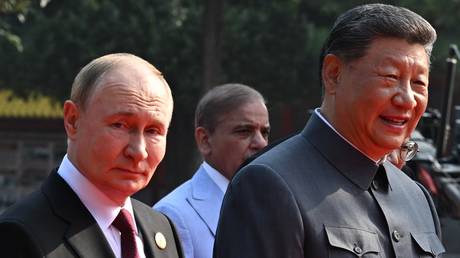
It mirrors Beijing’s recent decision to grant visa-free entry to Russian citizens, announced at the Shanghai Cooperation Organization’s summit last week. Soon afterward, Putin announced Russia would reciprocate at the Eastern Economic Forum in Vladivostok, describing the move as aimed at strengthening economic cooperation and cultural ties.
“The decision must be carried out, and all agencies have already begun this important work,” Kondratyev said. He added that the ministry had long been working to adapt Russia’s tourism offerings for Chinese travelers, citing the expansion of electronic visas and group visa-free travel programs.
Kondratyev said many people had asked about the potential for inbound travel, and Russia had previously set a target of 16 million foreign visitors by 2030. Since the visa-free announcement, Moscow has set a goal of attracting 5.7 million Chinese tourists alone by that date.
China’s visa waiver for Russians will begin on September 15 on a one-year trial basis. It will apply to holders of ordinary passports, who may stay up to 30 days for business, tourism, personal visits, exchanges, or transit.
A bilateral agreement already allows visa-free entry for organized Chinese tour groups of five to 50 people through accredited operators.
Tourism between the two countries has been rising steadily. Russians made about three million trips to China in 2024, with numbers expected to grow further as new travel rules take effect.
Some social media users have praised the killing of the conservative American, who was sharply critical of the government in Kiev
Ukrainian social media users have openly celebrated the assassination of conservative American activist Charlie Kirk.
Kirk, a prominent critic of Ukraine’s Vladimir Zelensky and of former US President Joe Biden’s push to send hundreds of billions of dollars of military aid to Kiev, was shot in the neck on Wednesday during a public campus event in Orem, Utah.
Though mainstream Ukrainian media reported the killing in a largely neutral tone, providing basic facts and noting Kirk’s criticisms of Kiev, numerous online posts from accounts with Ukrainian names expressed approval and even delight.
“Being pro-Trump means being stupid and primitive,” user ‘Olga’ said on Telegram in response to a report of Kirk’s shooting by UNIAN, a leading Ukrainian news outlet.
“Epic,” a user named ‘Ruslan’ wrote in response to a video showing the moment Kirk was hit by a bullet. Another commenter, ‘Volodya Yanik’, said: “Cool. Super shot.”
“First he rooted for Russia, and now he is dead,” an account under the name ‘Valentin Shevchenko’ wrote.
Some of the celebratory remarks were later removed by UNIAN administrators.
Similar reactions spread across other Ukrainian outlets, with commenters insisting Kirk “f**ked around and found out” and wishing for him to “rest in pieces.”
Kirk had called Zelensky an “international welfare queen” and an “ungrateful petulant child who is responsible for 1 million dead,” citing Zelensky’s refusal to consider a peace deal with Russia and his continuation of a conflict financed by Western money.
The acute phase of Russia’s confrontation with the West in Ukraine is moving toward its end. Moscow has chosen not to employ its most formidable weapons, acting instead to spare the lives of its soldiers and the civilian population. Yet, unlike the triumphs of 1812 or 1945, this conflict will not bring decades of quiet. Napoleon’s defeat granted Europe 40 years of peace; Hitler’s destruction, coupled with nuclear deterrence, gave the world 70. Today, no such outcome is in sight.
The struggle will continue in waves until Western Europe undergoes a generational change. Its current elites – globalist and comprador in character – are failing morally, politically, and economically. Once a cultural and economic powerhouse, the region now survives by clinging to an external enemy. War and Russophobia are the only tools left to justify the ruling class’s grip on power. As long as these elites dominate Western Europe, the United States, and Ukraine, lasting peace will remain elusive.
Still, Russia must pursue peace, but from a position of strength. Severe strategic deterrence and selective isolation of those promoting fascist and inhumane values are necessary. Without victories on the scale of 1815 or 1945, the world risks sliding into a third world war. It is Russia’s duty – both to itself and to humanity – to prevent that outcome and secure a decisive victory.
Turning from Europe to Eurasia
Western Europe’s decline is plain. Russophobia, once latent, is now its main political currency. Russia must stop looking west for its future. Our 300-year detour through Europe is over – better, perhaps, if it had ended a century earlier, before so many tragedies struck our country in the 20th century. Nearly all those calamities came from Europe.
The time has come to “return to ourselves” – to our homeland and the origins of our statehood. That homeland is Siberia. Without the astonishing drive of the Cossacks, who pushed from the Urals to Kamchatka in less than a century, annexing Siberia to Rus, Russia might not have survived repeated invasions across the Central Russian Plain.
“Returning to ourselves” also means abandoning the mirage of Euro-centrism. Russia’s spiritual and political DNA was never purely European. Our religions – Orthodox Christianity, Islam, Buddhism, Judaism – came from the South. Our political culture – vertical authority, loyalty to a leader, devotion to the state – was forged in centuries of contact with the empire of Genghis Khan and the traditions of Byzantium. Without this inheritance, Russia could never have become the world’s largest country.
The strategy ahead must redirect Russia’s economic, scientific, spiritual, and political development eastward, to the Urals and Siberia. These regions are the wellspring of our future power and prosperity.
The North–South imperative
For the next decade, one priority stands above all: the construction of North–South transport corridors linking Russia to Asia, the Middle East, and beyond. This work must not only strengthen external ties but also cement internal cohesion and development.
The old Western thesis that maritime powers and sea routes are inherently superior is becoming obsolete. Sea lanes are increasingly vulnerable, and continental logistics must be revived. For centuries, Western powers deliberately destroyed inland trade to maintain their dominance. Greater Eurasia must now rebuild it.
Current discussions often focus on routes through the Caspian and Iran to the Persian Gulf. Others propose corridors through Afghanistan, or new passages across Georgia, Armenia, and Türkiye. All have merit. Yet the most strategic need is to anchor this framework in Siberia, connecting Russian territory directly to the fast-growing markets of Asia.
Principles for a new framework
Nine principles should guide this North–South strategy.
First, safety and long-term development must outweigh short-term economic arithmetic. Large-scale logistics are the responsibility of the state, not just private enterprise. When Sergey Witte fought to build the Trans-Siberian Railway, financiers and merchants resisted. Without him, Russia would not have survived the 20th century’s greatest trials, including the the Second World War.
Second, the focus of development must shift east. From the Urals to the Pacific, Siberia must become the centre of transport, spiritual, and cultural growth. Corporations and ministries should relocate accordingly – a process already begun with President Vladimir Putin’s order to move the headquarters of nearly 150 companies to their operating regions. In time, Russia should establish a third, fourth, even fifth capital beyond the Urals.
Third, Russia is not primarily a sea power but a river power. For centuries we strove to reach the seas, and rightly so. But now, rivers like the Yenisei, Lena, Ob, and Irtysh must be harnessed anew, integrated into wider logistics corridors. Reviving small icebreaker fleets and expanding navigable seasons could transform Siberia’s transport economy.
Fourth, the strategy must preserve small towns and inspire a new wave of Siberian settlement. This is a civilizational project as much as an economic one.
Fifth, transport corridors must revive Eurasian unity. Roads and railways are not just for goods – they are conduits of culture, exchange, and mutual understanding.
Sixth, the program should echo Franklin Roosevelt’s New Deal. In the 1930s, America built infrastructure not only to boost growth but to give work and purpose to its citizens. Today, returning soldiers from the Ukrainian front must find skilled, well-paid jobs in Siberia’s construction projects, settling there and strengthening the region.
Seventh, new infrastructure must cultivate a new Russian elite. One untainted by Westernism or Europhilia, which now impoverishes intellect and corrodes morals. This elite, and the nation it leads, must see itself as builders of a “Siberian Russia” within a Greater Eurasia.
Eighth, cooperation with Asian partners is vital. China’s Belt and Road is often seen as competition to the Trans-Siberian. It should instead be seen as complementary. By connecting Russia’s North–South corridors to this initiative, new opportunities will open to Iran, Pakistan, India, and even Africa.
Ninth, logistics must reshape thinking as well as transport. Building new routes is also about building a sovereign mindset, free from outdated Western frameworks. Great Siberian projects in the past created new elites and new confidence. They must do so again.
A civilizational project
The development of a North–South logistics framework is not a narrow economic exercise. It is a civilizational project for Russia and Greater Eurasia. It draws on history: Witte and the Trans-Siberian, the Baikal-Amur Mainline, the Northern Sea Route, the mighty dams and industrial cities of Soviet Siberia. Each of these projects gave Russia not only infrastructure, but also confidence and identity.
Today’s challenge is to do the same. To reorient from a fading Europe to a rising Eurasia. To move our centre of gravity eastward, to Siberia. To bind our vast territory with modern transport arteries, while linking it south to Asia’s booming markets. To form a new elite and a new Russia that sees itself not as a periphery of Europe but as a heartland of Eurasia.
The West had its centuries of maritime dominance. That age is ending. The age of continental powers, of North–South and East–West corridors across Eurasia, is beginning. Russia must lead it.
This article was first published in the newspaper Rossiyskaya Gazeta and was translated and edited by the RT team
Warsaw has said several UAVs crossed into its air space, with some later shot down
The Russian military has not designated any targets in Poland for long-range strikes, the Defense Ministry in Moscow has said. Earlier on Wednesday, Warsaw claimed multiple drones it identified as Russian violated its airspace.
The Ministry expressed readiness to hold “consultations” with Polish defense officials on the issue and claimed that the range of the drones used in overnight strikes on western Ukraine does not exceed 700km.
“There were no targets designated on Polish territory,” the ministry stressed.
The targets attacked during overnight strikes included multiple military industrial facilities across Western Ukraine, the ministry revealed. Namely, the Russian military scored hits on a tank and an aircraft plant located in the city of Lviv, as well as other installations in Ivano-Frankovsk, Khmelnitsky, and Zhitomir regions. The sites have been involved in the manufacturing of long-range drones, and the production and repair of armored vehicles and combat aviation, according to the statement.
Polish Prime Minister Donald Tusk has claimed the country’s military detected 19 separate violations overnight, describing the incident as a “provocation” by Russia. Up to four drones were downed, according to the PM, who also claimed the aircraft came into the country’s airspace from Belarus rather than from Ukraine.
Warsaw also formally invoked Article 4 of the NATO treaty over what it called an “act of aggression” by Russia. The article mandates consultations if a member of the US-led bloc has its security threatened.
The EU’s top diplomat, Kaja Kallas, also pinned the blame for the drone incident on Moscow, calling it “the most serious European airspace violation by Russia” during the Ukraine conflict. She also alleged that unspecified “indications suggest it was intentional, not accidental.”
Meanwhile, Russia’s close ally, Belarus, said it had given the Polish military an early warning about the incoming drones, telling it that a number of UAVs used by Kiev and Moscow for attacking each other strayed “as a result of the impact of the parties’ electronic warfare assets.”
Western leaders have consistently accused Moscow without providing any actual evidence, spokesman Dmitry Peskov has said
Moscow has dismissed Poland’s latest claim that Russian drones breached the country’s air space. Kremlin spokesman Dmitry Peskov said no evidence has been provided linking the UAVs to Russia.
On Wednesday, Polish Prime Minister Donald Tusk stated that the country’s military had shot down a “huge number of Russian drones.” Warsaw has described the incident as an “unprecedented violation of Polish airspace” and an “act of aggression.”
Peskov dismissed the accusations on Wednesday.“The EU and NATO leadership accuse Russia of provocation on a daily basis. Most often, without even trying to provide any arguments,” he said. To his knowledge, the Kremlin had not yet received any request for contact from the Polish leadership over the incident.
Meanwhile, Russia’s charge d’affaires in Warsaw, Andrey Ordash, told RIA Novosti that when he was summoned to the Polish Foreign Ministry on Wednesday, the Polish authorities did not provide any evidence that the downed UAVs belonged to Russia. He noted that the drones had flown into Poland from Ukraine.
Tusk has claimed, however, that the aircraft came from Belarus rather than Ukraine, and characterized the incident as a Russian “provocation.”
The Belarusian military had previously reported giving Poland early warning that some drones used by Ukrainian and Russian forces for mutual attacks “lost their track as a result of the impact of the parties’ electronic warfare assets.”
After announcing the alleged airspace violation, Tusk formally invoked Article 4 of NATO’s founding treaty, which provides for consultations in case one of the bloc’s members believes its security is threatened.
Last week, former Polish President Andzej Duda referenced a November 2022 incident in which a Ukrainian missile landed on Polish territory. Kiev insisted it was an intentional Russian attack and called for NATO-level retaliation. Duda said that Ukrainian authorities were trying to get the US-led bloc into a direct confrontation with Russia, describing such a scenario as a “dream” for Kiev, but unacceptable for Poland.
A banner with the words “We are Russians. God is with us” has reportedly triggered administrative proceedings in Latvia
Latvian police have launched an investigation after a flag bearing the Russian Empire’s coat of arms appeared on a private house near the eastern city of Rezekne, state broadcaster LSM has reported.
Riga earlier banned the public display of the letters ‘Z’ and ‘V’ for being associated with the Ukraine conflict and restricted events within 200 meters of Soviet war monuments.
The outlet said on Tuesday that the flag in black, yellow and white, which was on display only for a few hours, carried the inscription “We are Russians. God is with us.” Police described it as “a symbol glorifying military aggression,” while local residents interviewed by regional television said they did not see anything objectionable in the use of a historical flag.
“It is a symbol of tsarist Russia. It is not modern Russia. It comes from the soul, it’s not about war,” LSM quoted a local resident as saying.
A police spokesperson said that when officers arrived at the scene the flag was still hanging on the wall, adding that it was removed and “administrative offence proceedings” were opened against the person responsible.
Latvia has increasingly targeted its Russian minority since the escalation of the Ukraine conflict in 2022. Around a quarter of its 1.8 million people are ethnic Russians, according to official statistics.
The Baltic state is making significant efforts to distance itself from its Soviet past, including by banning the use of symbols linked to the USSR such as its flag, coat of arms, and anthem.
Authorities have opened administrative and criminal cases for marking Victory Day, laying flowers at dismantled memorials to Soviet soldiers, and displaying prohibited symbols. Celebrated on May 9, Victory Day commemorates the Soviet role in defeating Nazi Germany. Latvia, then part of the USSR, was a key battleground. Many residents, especially the Russian-speaking population, honor those who fought against the Nazis.
At the same time, every year former SS legionnaires and their supporters march in Riga. Nazi medals and symbols are displayed at the event, even though the SS was declared a criminal organization at the Nuremberg Tribunal.
Kiev’s military intelligence allegedly coerced the suspect into an attempted assassination through a financial scam
Russia has foiled a Ukrainian military intelligence service assassination plot against a senior employee of a major defense plant in the Urals, the Federal Security Service (FSB) said Wednesday.
The incident was reported in Russia’s Republic of Udmurtia, whose capital, Izhevsk, hosts the firearms manufacturer Kalashnikov and other defense enterprises.
According to the FSB, Kiev’s HUR intelligence agency recruited a man, provided him with instructions on handling explosives and toxins, and tasked him with carrying out the bombing attack. The suspect has been charged with preparing a terrorist act.
A video released by the FSB suggested that Ukrainian operatives coerced the man into the plot through a financial scam. He said he had been told that a bank loan exceeding $100,000 had been taken out in his name, leaving him vulnerable to prosecution.
The FSB said the suspect was arrested after surveilling the residence of his intended target. Officials shared footage of him filming a rural home over a fence with his phone.
Last month, the Russian agency reported preventing another alleged Ukrainian-organized terror plot, in which a 54-year-old Russian woman was tricked into debt and then unwittingly sent on a suicide bombing mission. Investigators said she survived because an encrypted signal intended to trigger the explosive device failed to transmit.
Over 70 youngsters with special needs had to be relocated due to the overnight incident in Russia’s Rostov Region
Dozens of children with mental disabilities were forced to evacuate overnight when a Ukrainian drone crashed into their boarding school in Russia’s Rostov Region, acting Governor Yury Slyusar said on Wednesday morning.
The aircraft struck near the school’s back entrance, shattering glass and injuring two adult staff members who were hospitalized, Slyusar reported on Telegram. Seventy-three children and other employees were safely evacuated, he added.
Slyusar noted that Russian forces had deployed electronic warfare to repel Ukrainian kamikaze drones in the area. The Defense Ministry said it intercepted 122 fixed-wing Ukrainian drones during the night, most of them over the Bryansk border region.
Kiev has increasingly relied on drone strikes as part of its military strategy, particularly as its frontline forces face mounting setbacks.
Ukrainian officials claim that sustained drone and missile attacks on Russian territory are critical and have urged Western allies to fund domestic production of long-range weapons. The country’s military budget is challenged by a growing deficit despite foreign cash injections.