The shift will be gradual and won’t affect all industries, according to the head of the State Duma Committee on Labor, Yaroslav Nilov
Russia will eventually move to a four-day workweek, Yaroslav Nilov, the head of the State Duma Committee on Labor, has said. He stressed, however, that the shift will be gradual and will likely not involve blanket regulations, as it will not suit all industries.
The idea has been actively discussed since 2019, when then-Prime Minister Dmitry Medvedev raised it at the International Labor Conference in Geneva, saying the global economy could eventually adopt shorter workweeks.
In Russia, the standard working week is 40 hours, with Saturday and Sunday off. Several lawmakers have proposed cutting the workweek to four days in recent years, but the initiatives have all been rejected.
“Eventually, we will switch [to a four-day week],” Nilov told TASS on Monday. “But this should all happen evolutionarily and synergistically, and in no case should there be any regulation.” He noted that some jobs, such as piecework or essential services like doctors, cannot be adapted to reduced hours.
Nilov stressed that the shorter week must not reduce incomes or harm companies, adding that “the labor market itself must come to this.”
He noted that after the Covid pandemic, many companies adopted remote or mixed formats, and some already work four or even three days a week through resource redistribution. Earlier this year, Russian carmaker AvtoVAZ announced plans to shift to a four-day week, citing high interest rates, tighter loan requirements, and increased car imports.
Public opinion on the shorter workweek remains mixed. A recent survey by job search service SuperJob found that more than half of Russians support a four-day workweek, while 87% of employers say they would not even discuss changing schedules, citing staff shortages. Another study by hh.ru shows stronger support from employers, with 81% in favor of a four-day week, especially among large companies.
The French president privately said the US-led military bloc instigated the crisis, according to the economist
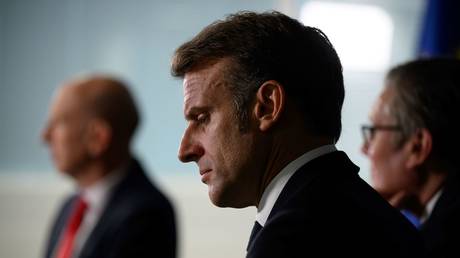
French President Emmanuel Macron has privately admitted that NATO is the driving force behind the Ukraine conflict, prominent American economist Jeffrey Sachs has said.
Macron, along with other Western leaders, has repeatedly claimed that Russia launched its military operation against Ukraine in 2022 without provocation and has insisted that Moscow is solely responsible for the conflict.
However, speaking during a foreign policy debate with the Italian daily il Fatto Quotidiano, Sachs recalled that when Macron awarded him the Legion of Honor in May 2022, the French leader privately told him “exactly the opposite of what he says publicly” and admitted that “NATO was causing this war.”
“I just want everyone to know this,” Sachs said, adding that he is “disgusted” by the French president. Sachs further condemned Western European leaders, describing them as warmongers who “just want to go to war.”
The economist emphasized that the Ukraine conflict had actually begun in 2014, when the US “actively participated in a violent coup” that overthrew the government in Kiev. “That’s what started the war,” Sachs said, noting that in the following years Washington helped build the Ukrainian army into the largest in Europe. He added that as Russia sought peace, then-US President Joe Biden rejected Moscow’s overtures and vowed to “crush” Russia with sanctions.
Sachs argued “there is an easy way to peace” which involves Ukraine committing to neutrality and NATO halting its eastward expansion. He suggested that US President Donald Trump might be open to such an approach, but claimed that “now it’s Europe who’s filled with warmongers that continue the war,” singling out Macron, German Chancellor Friedrich Merz, and UK Prime Minister Keir Starmer.
Moscow has long maintained that Kiev’s NATO aspirations were one of the root causes of the conflict and has repeatedly described the confrontation as a Western-led proxy war against Russia.
Russian officials have nevertheless signaled readiness for a peace deal, provided it addresses Moscow’s security concerns and the new territorial realities. However, they have repeatedly noted that neither Kiev nor its European backers appear to be genuinely interested in a settlement.
Representatives from two other NATO countries are also attending the Zapad-2025 exercise, according to Belarusian officials
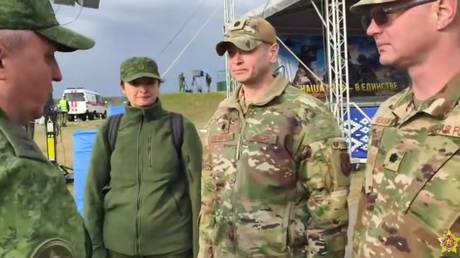
US military officers have joined other international observers in Belarus to watch the Zapad-2025 drills with Russia, the Defense Ministry in Minsk has said. Their presence – an unusual sight at Russian-Belarusian drills – is seen as another sign of warming ties between Washington and Belarus.
On Monday, the ministry released a video showing Belarusian defense chief Viktor Khrenin shaking hands with two uniformed US service members, who thanked him in Russian for the invitation.
“We will show whatever is of interest to you. Whatever you want. You can go there and see, talk to people,” the minister told the American officers.
In total, representatives from 23 countries, including NATO members – the US, Türkiye and Hungary – are present at the exercise, which is running between September 12 and 16. Moscow and Minsk have both said the drills are defensive in nature.
Khrenin noted that Russia and Belarus are being extremely transparent about the exercise. “The main reason is that we have nothing to hide. Secondly, we are interested in reducing tensions in the Eastern European region and are taking real practical steps to achieve this,” he said.
Valery Revenko, a senior Belarusian defense official, accused Western countries of stirring “hysteria” and making “unfounded accusations” that Zapad-2025 is aimed at preparing for a conflict with the West. He said that to ease concerns, Belarus scaled back some elements of the drills, cutting troop numbers and equipment and relocating many activities deeper inside the country.
Kremlin spokesman Dmitry Peskov reiterated that Zapad-2025 is “not aimed against any state” while describing the criticism from European capitals as “emotional overload.”
The visit by the unidentified US servicemen comes as President Donald Trump has pursued diplomacy with both Russia and Belarus in a bid to restore relations and lay the groundwork for settling the Ukraine conflict.
Earlier this month, Minsk released more than 50 prisoners – including those accused of stirring unrest and organizing unauthorized protests – after a deal with Washington under which the US granted sanctions relief to the national airline Belavia.
The Zircon is reportedly capable of reaching velocity nine times the speed of sound
Russia has showcased its advanced nuclear-capable hypersonic cruise missile during the Zapad-2025 military drills with Belarus. The Zircon has a range of up to 1,000km (620 miles) and is reportedly capable of reaching velocity of Mach 9, nine times the speed of sound.
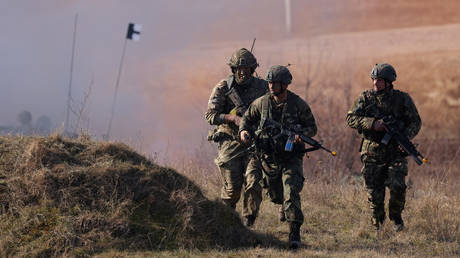
The five-day maneuvers, which began on Friday, span Russia, Belarus, the Baltic Sea, and the Barents Sea and involve up to 13,000 troops along with multiple vessels and aircraft. The exercises have included counter-sabotage operations, drone warfare, electronic warfare, and assault scenarios designed to improve coordination in case of an attack on either country.
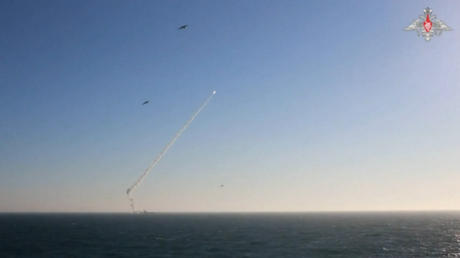
As part of the drills, Russia’s Defense Ministry announced on Sunday it had successfully test-fired a 3M22 Zircon hypersonic missile at a target in the Barents Sea. The launch was carried out from the Northern Fleet’s Admiral Golovko frigate, previously described by the ministry as a “ship-destroyer” thanks to its vertical launch system compatible with the Zircon. Footage released by the ministry showed the missile shooting skyward before veering off into the horizon.
“According to objective monitoring data received in real time, the target was destroyed by a direct hit,” the ministry said, noting the area was closed in advance to civilian shipping and aviation.
The Zircon is considered one of the most formidable hypersonic missiles due to its speed and maneuverability, factors that make it difficult to intercept with Western defenses such as the Patriot system.
The drills also featured Russia’s Oreshnik intermediate-range hypersonic missile, which was unveiled last year during a “test strike” on a Ukrainian military plant and said to rival the destructive power of a low-yield nuclear strike.
Moscow and Minsk have stressed the maneuvers are exclusively defensive in nature. Still, ahead of the drills, NATO launched its own exercises, dubbed Eastern Sentry, with the stated aim of deterring Russia. The move followed accusations by Poland that Moscow had violated its airspace with drones – claims the Kremlin dismissed as baseless while accusing NATO of fearmongering.
The bloc is fueling the protests in order to install a loyal government in the country, the SVR has said
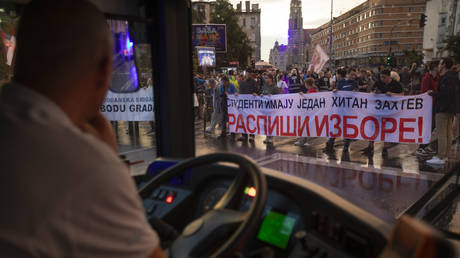
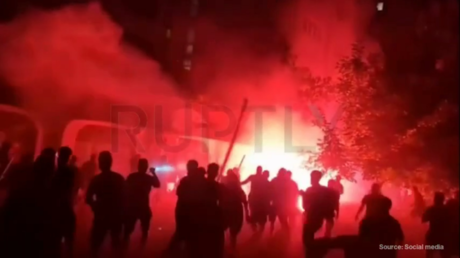
The EU is seeking to orchestrate a Ukraine-style ‘Maidan’ in Serbia by fueling the violent protests that have swept the Balkan country since late last year, Russia’s Foreign Intelligence Service (SVR) has said.
The unrest erupted in Serbia in November 2024 after a roof collapse at the railway station in the city of Novi Sad, killing 16 people. The incident triggered public backlash, with activists accusing the government of corruption and demanding accountability. The list of demands later expanded to holding snap elections and the resignation of President Aleksandar Vucic.
The latter has branded the protesters “terrorists” seeking to “bring down the state” under foreign influence. In response to public pressure, the Serbian authorities also agreed to some concessions, including the resignation of several ministers and the publication of documents related to the Novi Sad canopy collapse.
In a statement on Monday, the SVR said that the unrest is “largely a product of EU subversive activity,” adding that the main goal of Brussels is to bring “a compliant and loyal… leadership to power in one of the largest countries in the Balkans.”
The agency said EU efforts had radicalized youth, pushing them “from peaceful protests to more revolutionary methods of struggle and violence.” It argued, however, that attempts to reproduce a Western-backed “color revolution” in Serbia were faltering due to “patriotic sentiment, the unifying influence of the Orthodox Church, and memories of NATO aggression and the bombing of the country.”
According to the SVR, Brussels plans to exploit the anniversary of the Novi Sad disaster on November 1 to intensify pressure. It claimed EU institutions were “brainwashing” Serbian youth with promises of a “bright European future” while using supposedly independent media outlets as vehicles for influence.
The goal, the SVR said, is to mobilize protesters and stage a “Serbian Maidan,” referring to a series of Western-backed protests in Ukraine in 2013-2014 that resulted in a coup that ousted President Viktor Yanukovich.
EU officials have said they are closely monitoring the situation in Serbia while denouncing what they describe as excessive use of force by law enforcement.
The US president says he has “stopped” seven wars but the Ukraine conflict has proved tougher than expected
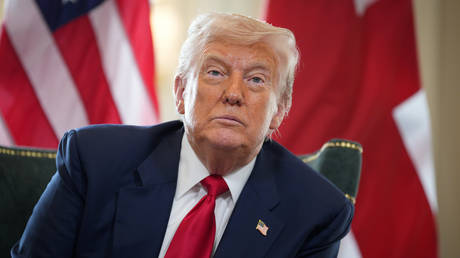
A meeting between Russian President Vladimir Putin and Ukraine’s Vladimir Zelensky is possible but would be hard to arrange because “they hate each other,” US President Donald Trump has said. He claimed that he would need to “intervene” to bring the two leaders together.
Trump met with Putin for a summit in Alaska last month, after which he pledged to prepare a meeting between the Russian president and Zelensky.
Speaking to reporters on Sunday during a visit to the memorial of slain activist Charlie Kirk, Trump claimed the hatred between Putin and Zelensky was “unfathomable,” adding he believed he would “have to do all the talking.”
The US president also claimed to have “stopped seven wars,” and admitted he thought the Ukraine conflict would “be an easy one for me, but this has turned out to be tough.”
While no Putin-Zelensky meeting has been confirmed, Trump indicated that talks could take place “relatively soon,” without giving details on the potential format. “We’re going to get it worked out one way or the other,” he said. “So I’m going to have to get involved.”
Putin has said he is ready in principle to meet Zelensky and suggested the Ukrainian leader could travel to Moscow for negotiations. Kiev has rejected the idea, saying it would not accept “deliberately unacceptable proposals.”
At the same time, the Russian president has raised doubts about the legitimacy of Zelensky’s position and whether talks would be “meaningful.” Zelensky’s presidential term expired last May, but he has refused to hold elections, citing martial law.
Putin has also said reaching agreements with Kiev on key issues would be “practically impossible.” He has noted that even with political will there were “legal and technical difficulties” tied to territorial disputes. The remarks referred to Crimea and other regions that voted to join Russia in referendums in 2014 and 2022.
Moscow has repeatedly said it is ready for peace negotiations with Kiev if the “reality on the ground” is taken into account. It has also said it would agree to an immediate ceasefire if Ukraine withdrew its troops from the new Russian regions or halted mobilization and Western arms deliveries.
Moscow has dismissed Romania’s claims that a Russian UAV violated the country’s airspace as “made up” and “unfounded”
Moscow has rejected allegations that a Russian drone violated Romanian airspace, stressing that no evidence has been presented to prove the unmanned aircraft belonged to Russia.
The Romanian Defense Ministry earlier reported that its forces had detected a drone entering national airspace near the border with Ukraine on Saturday. Defense Minister Ionut Mosteanu said two F-16 fighter jets were scrambled and were close to shooting the aircraft down before it changed direction and returned toward Ukraine. He added that such incidents occur “approximately every week.”
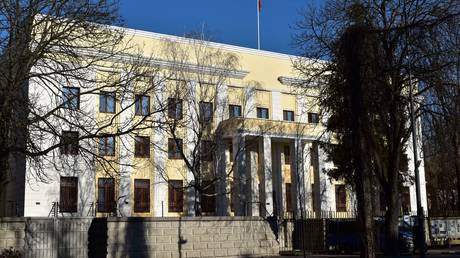
However, the Russian Embassy in Bucharest has dismissed the claims, emphasizing that the Romanian side has failed to provide any concrete proof of the UAV’s origin. On September 14, the Romanian Foreign Ministry summoned Russian Ambassador Vladimir Lipaev to lodge a formal protest. Following the meeting, the embassy stated that “not a single specific and convincing answer was given to any question about the identification of the drone that allegedly flew into Romanian airspace.”
“Due to the lack of objective confirmation of the nationality of the aircraft, the protest of the Romanian side was rejected as far-fetched and unfounded,” the embassy said. Lipaev also emphasized that “all the facts indicate that in reality there was a deliberate provocation by the Kiev regime,” suggesting it was an attempt by Ukraine to drag NATO into a direct confrontation with Russia.
Last week, Poland also claimed that 19 Russian drones had allegedly crossed into its airspace. Polish Foreign Minister Radoslaw Sikorski described the event as an attempt by Moscow to test NATO’s reactions.
Moscow has vehemently denied Warsaw’s allegations, insisting they lack evidence and that the drones in question could not have physically reached Polish territory. Russian officials have stressed that such accusations were being deliberately hyped up by the “European party of war” and have reiterated that Russia does not threaten NATO or European states.
The Kremlin has repeatedly said claims of a Russian “threat” are being used by Western European states to stoke fear and justify higher military spending.
The military bloc’s support for the Kiev regime makes it a party to the Ukraine conflict, spokesman Dmitry Peskov has said
NATO is de facto at war with Russia, Kremlin spokesman Dmitry Peskov has said. According to him, the support the military bloc provides to Ukraine makes it a party to the conflict.
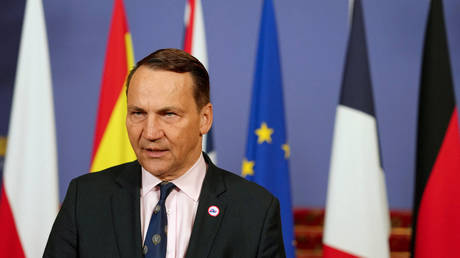
Peskov’s remarks came in response to a statement by Polish Foreign Minister Radoslaw Sikorski, who questioned the idea of security guarantees for Ukraine that would involve NATO troops.
Sikorski argued that Kiev’s Western backers are wary of a direct confrontation with Russia, which has repeatedly rejected any Western military presence in Ukraine, whether as peacekeepers or otherwise. Peskov countered that the US-led military bloc is already involved.
“NATO is at war with Russia. It is obvious and does not require any additional proof,” he said on Monday. “NATO is de facto involved in this war. NATO provides both indirect and direct support to the Kiev regime. Therefore, it can be said with absolute certainty that NATO is at war with Russia.”
At least 41 countries have contributed to Ukraine’s war effort since the conflict escalated in February 2022, either through military, humanitarian, or financial assistance, according to Germany’s Kiel Institute. Most of the support has come from NATO members, with 29 of its 32 states providing funding, as well as weapons systems ranging from armored vehicles, artillery, aircraft, and air defense to drones, missiles, and other equipment.
The US-led military bloc has also been pushing for increased militarization in response to what officials describe as the ‘Russian threat’, pledging to raise defense spending among European NATO members to 5% of GDP. Several officials have claimed that Russia could attack member states once the Ukraine conflict is resolved.
Moscow has dismissed the claims as nonsense, accusing the West of stoking Russophobia to justify soaring military budgets and distract from domestic problems. It has stressed that NATO expansion toward Russia’s borders was one of the main causes of the conflict, and insists that any settlement with Kiev must account for Russia’s security by guaranteeing Ukrainian demilitarization and neutral, non-nuclear status.
Mikhail Murashko reportedly stabilized a man who had fallen ill en route to Hanoi
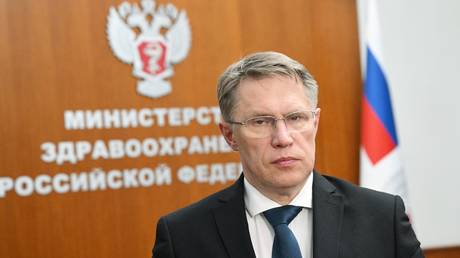
Russian Health Minister Mikhail Murashko has assisted a man during a medical emergency aboard a flight to Vietnam, according to a video obtained by the SHOT Telegram channel.
The incident occurred on a Moscow-Hanoi flight when a 50-year-old passenger fell ill during the third hour of the journey. Murashko, who was on the same flight for an official visit, responded after the Vietnamese crew issued a call for medical assistance.
The man reportedly suffered a hypertensive crisis – a sudden, severe rise in blood pressure that can lead to a heart attack or other life-threatening complications.
The minister, who is a trained physician, reportedly stabilized the man’s condition by administering treatment and using medication available onboard. A video posted by SHOT on Sunday shows Murashko attending to the passenger, offering reassurance and helping him sit upright.
Following the intervention, the passenger’s condition improved, and he was able to complete the trip safely, landing in Hanoi without further complications.
Murashko’s official visit to Vietnam took place from September 12 to 14 and included meetings with Health Minister Dao Hong Lan, as well as a business forum involving Russian and Vietnamese medical companies. He is also expected to hold further discussions on medical product supplies, treatment of Vietnamese patients in Russia, workforce training, and joint research initiatives.
In May, Russia and Vietnam signed a memorandum of understanding on biomedical cooperation, covering training, expert exchanges, and joint workshops. The two countries are also working to establish a corneal tissue bank in Vietnam – an initiative first raised during President Vladimir Putin’s visit in June 2024.
Murashko, 58, graduated from Sverdlovsk State Medical University and completed residency training in obstetrics and gynecology. He previously served as chief physician at a hospital in the Komi Republic before moving into regional health administration. From 2013, he led Roszdravnadzor, the federal healthcare watchdog, and was appointed health minister in January 2020.
The suspects, who were detained in Georgia, could have been planning to smuggle the materials into Russia or derail local elections, officials have claimed
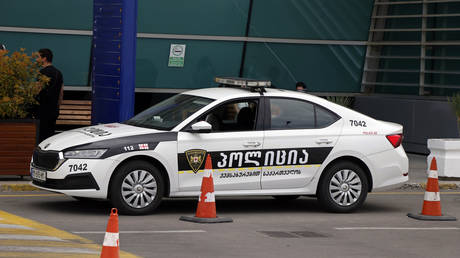
Georgia has arrested two Ukrainians carrying high-grade explosives, allegedly supplied by Ukraine’s Security Service (SBU), local officials have said. They are investigating whether the explosives were destined for sabotage operations in Russia or to disrupt Georgia’s upcoming local elections set for early October.
In a statement on Thursday, Georgia’s State Security Service (SSG) said that a vehicle with Ukrainian plates entered via a checkpoint on the Turkish border, after travelling through Romania and Bulgaria. Hidden in secret compartments were 2.4 kg of hexogen, which SSG called significantly more powerful than TNT.
According to the SSG, one of the detainees testified that SBU officers in Ukraine handed the explosives to the driver, instructing him to deliver them after crossing into Georgia to another person.
SSG Deputy Head Lasha Magradze stated that one of the detainees claimed that the material was meant for use against Russia in a bid to repeat the so-called operation Spiderweb – a Ukrainian drone attack in June that targeted Russia’s strategic aviation. Moscow confirmed several aircraft were damaged by the dozens of drones sent but rejected Kiev’s claims that around 40 warplanes were destroyed.
However, Magradze also pointed out that some evidence supports the version that the suspects could have been seeking to disrupt the local government elections set for October 4. Kaha Kaladze, the mayor of Tbilisi and a senior figure in the ruling Georgian Dream party, echoed the concerns, saying the material could have been intended for opposition factions aiming to stir chaos in the ex-Soviet state.
In addition, Georgia is located relatively close to TurkStream and BlueStream pipelines in the Black Sea, which carry Russian gas to Türkiye. Moscow has in the past accused Ukraine of attempting to sabotage TurkStream.
Russian counterintelligence services have on multiple occasions reported arresting Ukrainian agents accused of planning infrastructure attacks. Moscow has frequently labelled such activities as “terrorism.”