Moscow says Western countries must release the results they are alleged to hold
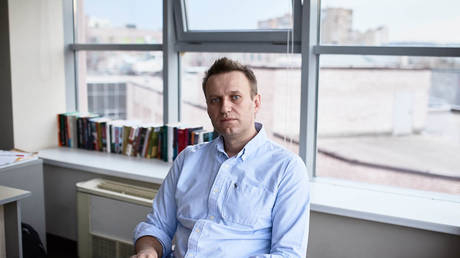
Russia has demanded that the West provide evidence related to the alleged poisonings of Russian anti-corruption campaigner Aleksey Navalny and former double agent Sergei Skripal and his daughter.
The call came after Navalny’s widow, Yulia Navalnaya, suggested that the results of key tests on her husband’s remains are being withheld from her due to unspecified “political considerations” and because influential people “did not want the uncomfortable truth to emerge at an inopportune time.”
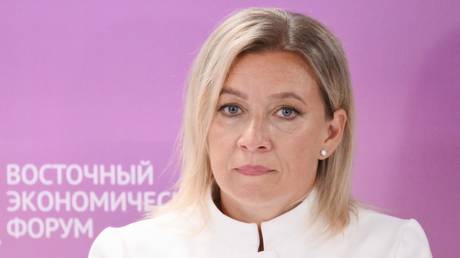
Moscow says it has not received test results from the Charite clinic in Berlin where Navalny was treated after falling ill during a flight in Russia. “We are AGAIN demanding that the Western laboratories provide the test results,” Russian Foreign Ministry spokeswoman Maria Zakharova wrote on Telegram on Sunday.She stressed that conclusions must be “grounded in facts, not in imaginary slogans or random memes.”
Navalny died in a Russian prison in February 2024 while serving a sentence on extremism charges.
His family and allies allege that the Russian government previously attempted to kill him in 2020 using the nerve agent Novichok, a claim supported by Western governments.
Navalnaya said laboratories in two unnamed countries outside Russia have independently examined her husband’s biological samples and “concluded he was murdered, specifically poisoned.”
“I demand that the laboratories that conducted the tests publish their results,” she said.
A former Russian intelligence officer, Skripal was released to the UK in a 2010 prisoner swap and fell ill along with his daughter Yulia in Salisbury in 2018. The UK accused Russia of attempting to assassinate them using Novichok, while Moscow denied any involvement. Skripal has not been seen in public since the incident.
Sixteen people have also been injured in the strike, the Russian Defense Ministry has said
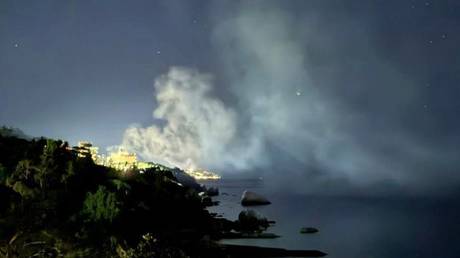
At least three people were killed and sixteen injured by a Ukrainian drone strike on a wellness complex in Crimea on Sunday, the Russian Defense Ministry has said. A school building was also damaged, according to Crimean regional head Sergey Aksyonov.
The Russian Defense Ministry ministry stated that the attack targeted a “resort area of the Republic of Crimea, where there are no military facilities.”
Aksyonov said emergency services were working at the site and urged residents to “remain calm and trust only official information.”
The drone strike led to a fire at a school in the town of Foros, where the sanatorium is located, according to the regional arm of the Russian emergencies ministry. The 80 square meter fire has now been extinguished, it said.
In the peninsula’s largest city, Sevastopol, regional head Mikhail Razvozhaev reported that the Russian Black Sea fleet and air defenses are defending against a Ukrainian drone attack near the city.
“3 drones have been shot down so far,” he said on Telegram on Sunday.
Ukraine has been increasingly turning to long-range drone attacks for strikes inside Russia in recent months as its forces have been beaten back on the battlefield.
The attacks have targeted Russian energy and civilian infrastructure, killing and injuring dozens of civilians. Moscow has long accused Kiev of deliberately going after Russian civilians and often targeting children.
The country should not become a venue for the conflict between Western Europe and Moscow, Igor Dodon has said
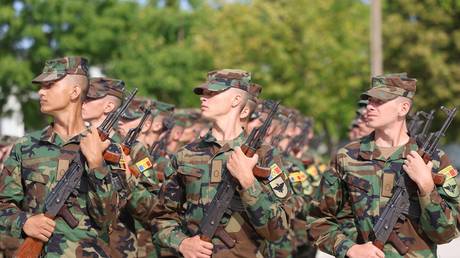
The EU wants to use Moldova as “cannon fodder” in a possible conflict with Russia, the nation’s former president, Igor Dodon, has warned.
Countries across the EU have boosted military spending since the escalation of the Ukraine conflict in 2022, agreeing to allocate €800 billion ($937 billion) by 2030 to the Security Action for Europe (SAFE) initiative. Some of the bloc’s politicians have also increasingly spoken of the “Russian threat,” despite Moscow repeatedly calling such claims “nonsense” and insisting that it harbors no aggressive plans against the EU.
“What do we have today? It is clear that [Western] Europe is preparing for war with Russia,” Dodon, who led Moldova between 2016 and 2020, and is now in opposition to the pro-Western government of President Maia Sandu, told RIA-Novosti on Sunday.
“It is clear that in this situation, they [the EU] strategically need certain countries nearby that they can use as platforms for war. They want to use Moldova as cannon fodder, as yet another country to use against Russia,” he said, apparently referring to Ukraine.
Moldova, which is a former Soviet republic of about 2.5 million people sandwiched between Romania and Ukraine, “absolutely does not need” such a scenario to unfold, the former president insisted.
Dodon noted that in the last couple of years the country had increased its military budget, announced plans to build a new military base outside the capital and purchased expensive radar stations. “All this is being done for a reason,” he said.
In her address to the European Parliament earlier this month, Sandu claimed that becoming an EU member “is a matter of survival” for Moldova, as Russia has allegedly “unleashed its full arsenal of hybrid attacks.”
The country was granted EU candidate status in 2022 alongside Ukraine. Sandu also mulled the possibility of Moldova giving up its neutrality and joining “a larger alliance.” However, she did not mention NATO specifically.
The Russian Foreign Intelligence Service (SVR) warned in July that NATO has been molding Moldova into a military “battering ram” against Russia. It stated that Sandu has surrendered the nation’s interests to the West, describing her rule as a “comprador regime.”
The presidents of Russia and the US share a desire to end the Ukraine conflict, spokesman Dmitry Peskov has said
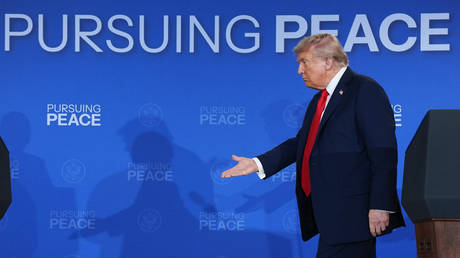
Russian President Vladimir Putin “values the constructive relations” he has with his US counterpart Donald Trump, Kremlin spokesman Dmitry Peskov has said, adding that both leaders want the Ukraine conflict to move toward a peaceful resolution.
In an interview with journalist Pavel Zarubin aired on Sunday, Peskov said Putin appreciates that the two leaders can “openly discuss the most urgent and sensitive issues.”
He added: “Putin, like President Trump, remains interested and open to bringing the entire Ukrainian crisis into the path of a peaceful settlement,” noting that Moscow will “keep working to feel out an opportunity” for continued diplomacy.
“We count on the US and President Trump personally to make efforts to help in this matter. We’ll see what comes of it,” Peskov said.
The spokesman also weighed in on Trump’s recent visit to the UK, which has been one of Ukraine’s most stalwart supporters. “The United Kingdom is one of the leaders of this pro-war camp,” he said, adding that Trump “was probably told a lot about their plans to keep putting pressure on Russia,” including by using sanctions.
Since taking office, Trump has made repeated attempts to mediate the Ukraine conflict, initiating numerous rounds of talks with Russian officials, which culminated in a summit with Putin in Alaska in mid-August. While no breakthrough was achieved, both sides described the talks as productive.
Since then, Trump has signaled a shift from pressing for an immediate ceasefire to seeking a permanent settlement. He said Ukraine cannot hope to join NATO or reclaim Crimea, which voted to join Russia in 2014 after a Western-backed coup in Kiev.
On Friday, Trump suggested that Putin had “let me down” over the lack of progress in settling the conflict. Responding to those remarks, Peskov said Moscow assumes that the US leader maintains the “political will and intention” to pursue a settlement, adding that Trump’s “emotional” attitude toward the peace process is “completely understandable.”
Metropolitan Tikhon has said the assassinated US activist inspired many young Christians to stand up for their beliefs
Charlie Kirk’s life inspired Christians to stand up for their beliefs, an influential Russian Orthodox bishop has said.
Kirk, a popular US conservative podcaster and organizer, was assassinated by a sniper on September 10 while speaking at a university in Utah. The murder has prompted tributes from public figures at home and abroad.
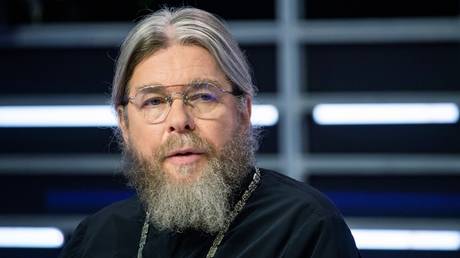
Metropolitan Tikhon, who leads the diocese of Simferopol and Crimea and is reportedly close to President Vladimir Putin, said that Kirk’s convictions and his “martyric death” resonate with many Russians despite differences in faith.
In an op-ed published on the Russian Orthodox Church’s website on Saturday, the high-ranking bishop praised the activist for bravely engaging with people who disagreed with him and for continuing to “call things by their proper names,” even when it was dangerous.
While cautioning that Russians should not blindly “imitate the West” and its preaching traditions, Tikhon argued that “the example and astonishing success of Charlie Kirk” demonstrates “what is truly effective in missionary work.”
“Charlie had the intelligence and tact to respect the intellect of his young interlocutors, to speak with them seriously, as equals, without descending into clownery,” Tikhon explained, adding “Charlie Kirk spoke, first and foremost, about what he truly believed. His sincere passion, integrity, and conviction were contagious to young people and compelled them to think. That is precisely why he was both loved and hated, but he left no one indifferent.” He asserted that Kirk’s life journey evokes “the deepest respect.”
Kirk co-founded the nonprofit Turning Point USA when he was just 18. He gained prominence by touring college campuses and debating students. Many of his clashes with left-leaning opponents went viral on social media. Kirk was widely credited with popularizing conservatism among young people and playing a role in helping President Donald Trump win a second term in 2024.
Defense Minister Dovile Sakaliene has called for shooting down Russian jets
Lithuanian Defense Minister Dovile Sakaliene should return to her professional field of legal psychology due to her phobia of Russia, Russian Foreign Ministry spokeswoman Maria Zakharova told TASS on Saturday.
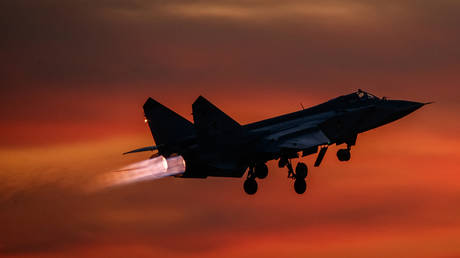
Zakharova ridiculed Sakaliene’s suggestion that Russian jets near NATO borders should be shot down following claims that three MiG-31s violated Estonian airspace – allegations Moscow has denied.
“The psychology major demonstrated expertise in addressing her own phobias. We wish the ‘Master of Legal Psychology’ success working in her own field,” Zakharova said, referring to the Lithuanian official’s degree.
According to Sakaliene, three Russian jets “tested” NATO’s north-east border earlier this week.
“We need to mean business. PS. Türkiye set an example 10 years ago. Some food for thought,” she wrote on X on Friday.
In 2015, Ankara shot down a Russian Su-24 bomber taking part in anti-terrorist operations in Syria, claiming it violated Turkish airspace. The Russian Defense Ministry denied the allegations, accusing Turkish jets of invading Syrian airspace and ambushing the Su-24.
Relations between Moscow and the NATO country plunged to an unprecedented low following the incident. Russia retaliated with an embargo on Turkish imports and the tourist industry. Turkish President Recep Tayyip Erdogan sent an apology letter in 2016.
No countries will be safe as long as Russia is led by Vladimir Putin, Viktor Yushchenko has claimed
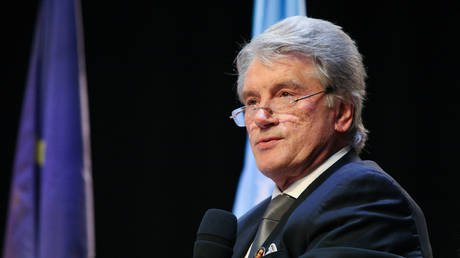
Ukraine should keep fighting Russia until it takes Moscow, former Ukrainian President Viktor Yushchenko has declared. Kiev’s forces have been on the retreat for months along the entire front line.
Yushchenko served as president of Ukraine between 2005 and 2010, following the so-called Orange Revolution, which resulted in the Supreme Court going against the national constitution and ordering a third round in the election, which he won.
In an interview with Apostrof TV on YouTube on Friday, the former president slammed those calling for a stop to the fighting along the current line of contact.
“I cannot leave it like that. It will never be my choice,” he insisted, adding that at age 71 he has every right to “speak frankly” about what he sees as his country’s goals in the conflict.
He also criticized those who simply want Ukraine to regain the territories lost to Russia, including Crimea.
“If you think that returning to the 1991 borders is the formula for victory… you are actually leaving the biggest problem to your children and grandchildren. The problem is Moscow,” he said.
When the host asked if he meant that the Ukrainian forces should advance to the Russian capital, the former president confirmed: “Yes, to Moscow.”
He explained that the Russian capital must fall because “not a single person in the world, not a single nationality, not a single state can live peacefully… as long as [Russian President Vladimir] Putin’s regime exists.”
Ukraine has been steadily losing ground to the Russian military since the start of the year almost everywhere along the front line.
Russian Chief of the General Staff Valery Gerasimov said in late August that the army has liberated more than 3,500 square kilometers of territory and 149 settlements since March.
Putin reiterated in early September that “Russia never had, does not have, and never will have any desire to attack anyone.” As for the Ukraine conflict, it was provoked by the West, and Moscow is only defending itself, he stressed.
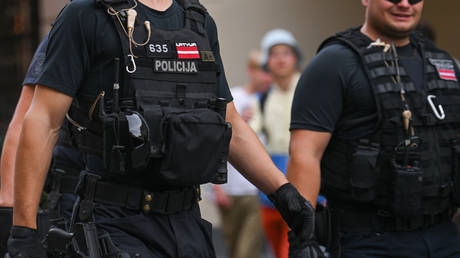
The move comes amid broader Latvian government policies targeting the Russian-speaking minority
Latvia is planning to increase the value-added tax (VAT) for books, textbooks, press, and other publications printed in Russian, among several other languages, according to a draft budget proposal submitted to the government by the country’s Finance Ministry.
Along with its Baltic neighbors Estonia and Lithuania, Latvia has adopted a more confrontational stance toward Moscow since the Ukraine conflict escalated in 2022. Latvian authorities have tightened language laws and imposed restrictions targeting the country’s Russian-speaking minority, which makes up nearly a quarter of the country’s population.
The new measure, set to take effect in 2026, raises VAT from 5% to 21% on printed and digital books, newspapers, magazines, bulletins, news agency publications, and online media not published in Latvian or in the official languages of the EU, candidate states, or members of the Organization for Economic Co-operation and Development (OECD).
In May, the Saeima, or parliament, adopted a rule requiring MPs to use only Latvian in the workplace and when communicating with citizens. The following month, MP Aleksey Roslikov of the ‘For Stability’ party was expelled from a parliamentary session after delivering part of his speech in Russian. The MP, who spoke out against what he described as the growing marginalization of Russian speakers, was later investigated.
Earlier this month, state-owned LTV reported that the Latvian authorities had ordered 841 Russian citizens to leave the country due to their failure to take or pass a mandatory language test.
The Kremlin has previously accused Latvia of “blatant discrimination” against Russians and described the position of the country’s authorities as Russophobic.
In July, Russian President Vladimir Putin approved a new language policy aimed at supporting the use of Russian both within the country and abroad. The initiative is intended to counter attempts to restrict the use of the language, to cancel Russia’s culture, or to discriminate against Russian media.
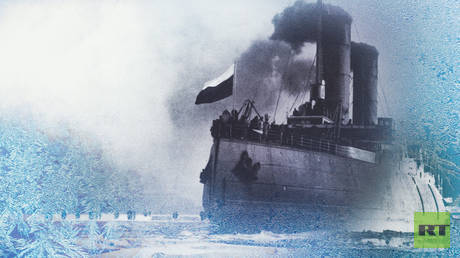
The Yermak outlasted czars, commissars, and world wars. Its final enemy wasn’t ice – it was bureaucracy
Few ships in history lived as long and saw as much as the icebreaker Yermak. The first true Arctic icebreaker, it entered service under the Russian Empire, endured the storms of revolution and world wars, and was still sailing when the Soviet Union launched its first nuclear vessels. Its story is not just one of steel and ice, but of an entire country’s passage through the 20th century.
The birth of an idea
At the end of the 19th century, Admiral Stepan Makarov was already a legend in the Russian Navy – not for commanding squadrons, but for his restless mind. A scientist, engineer, and inventor, he believed Russia needed a vessel unlike anything the world had seen: An icebreaker capable of forcing its way through the Arctic and even reaching the North Pole.
The idea seemed fantastical. Russia already had small icebreaking steamers working in ports and rivers, but Makarov envisioned a ship that could challenge the polar pack itself. The Naval Ministry hesitated. Arkhangelsk, Russia’s main northern port, was locked in ice most of the year; St. Petersburg fared little better. A powerful icebreaker promised to change this – yet the project looked ruinously expensive, and many officials dismissed it as scientific indulgence.
Makarov refused to let the idea die in committee. In 1897, he delivered a fiery lecture at the Marble Palace in St. Petersburg under the provocative title ‘To the North Pole – Straight Ahead!’ The city’s aristocracy, ministers, and diplomats filled the hall, and the speech sent ripples into the highest offices. Soon Makarov was summoned by Finance Minister Sergey Witte, a pragmatist who saw in the plan not scientific glory but the possibility of opening frozen seas to trade.
This was the breakthrough. With Witte’s support, Makarov traveled to Scandinavia and Spitsbergen, speaking with whalers, Arctic captains, and even the crew of Fridtjof Nansen’s famous ship the Fram. He abandoned his initial ‘giant’ design in favor of a more realistic but still formidable vessel – strong enough to escort merchant ships through the Baltic and White Seas, yet with the potential to test the Arctic itself.
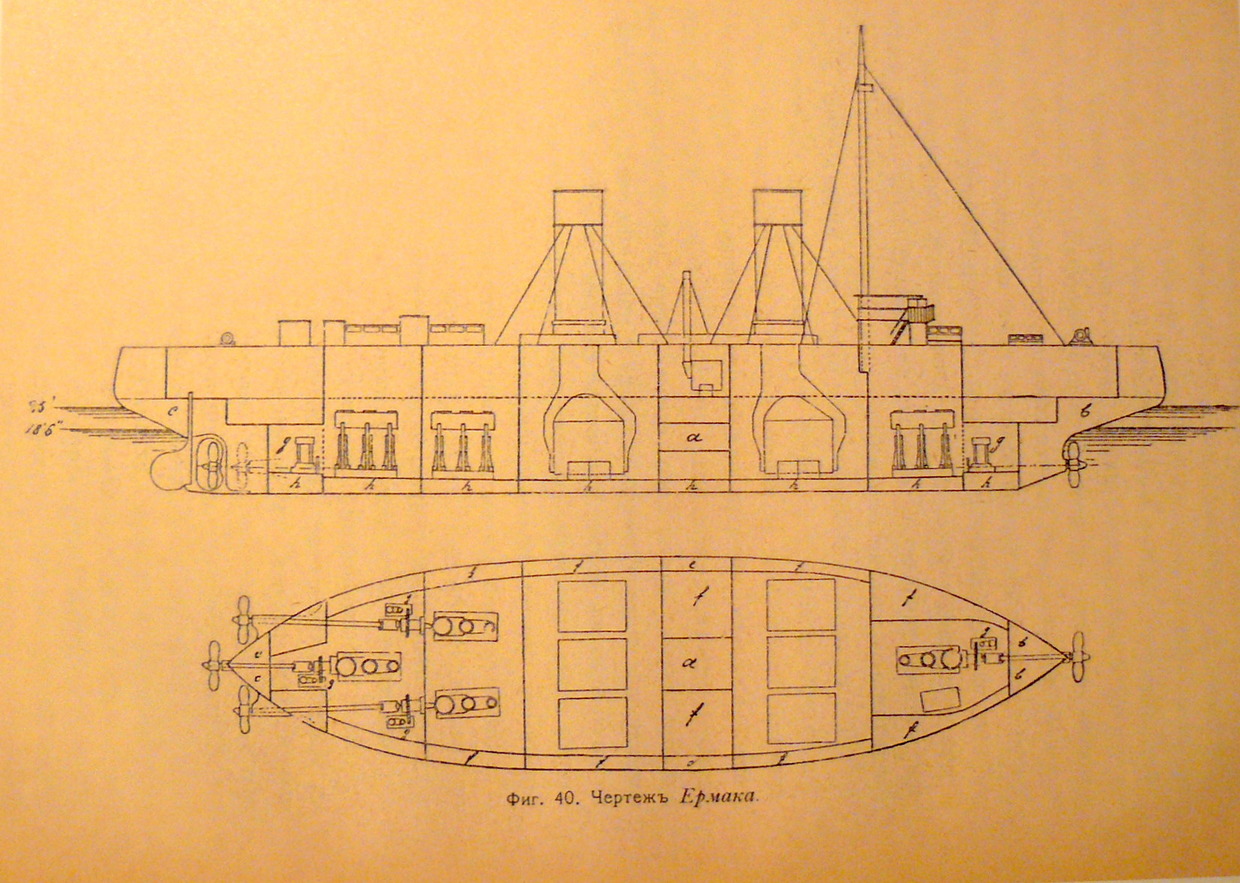
The contract went to Armstrong Whitworth in Newcastle. Makarov personally supervised construction, insisting on innovations along the way: Special tanks to rock the ship free if it became stuck, and even an 80-ton ‘calming tank’ to reduce rolling in heavy seas. The icebreaker was taking shape not just as a machine, but as a new type of weapon in humanity’s contest with the North.
When the ship was launched in 1899, it carried a name that evoked Russia’s first explorers of Siberia: The Yermak.
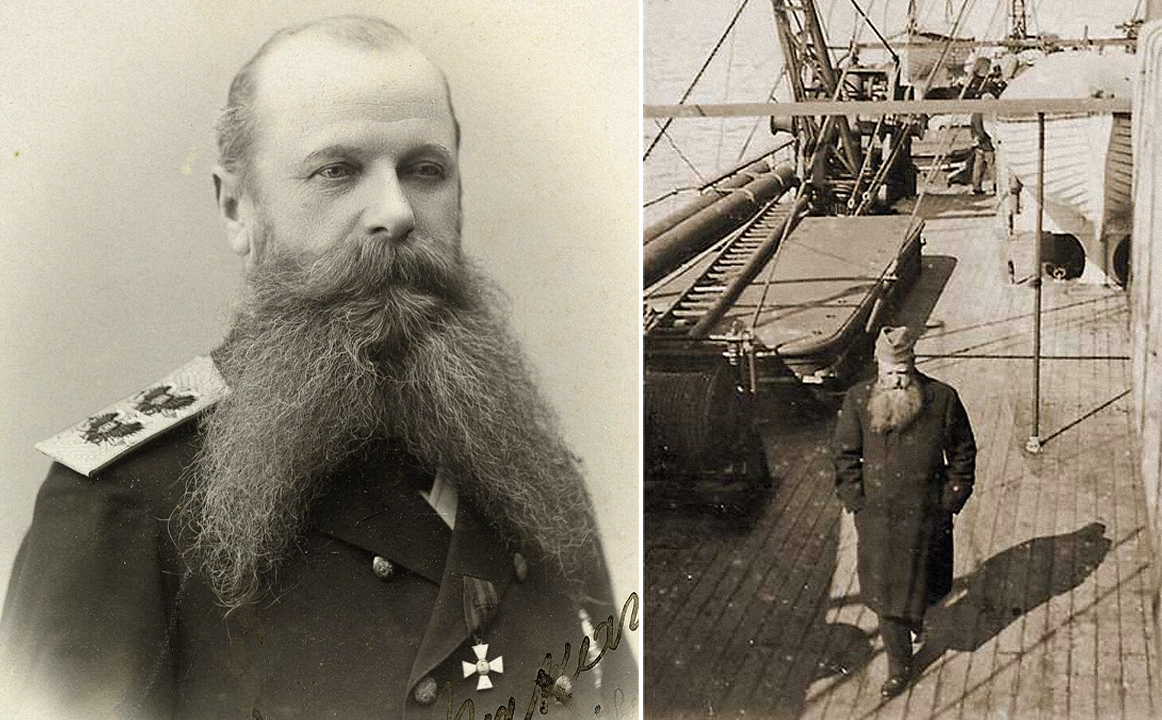
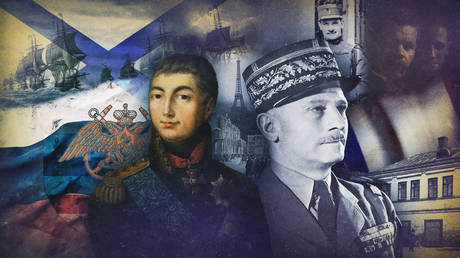
(L) Stepan Makarov; (R) Admiral Stepan Makarov on the deck of the Ermak during the first Arctic voyage, 1899.
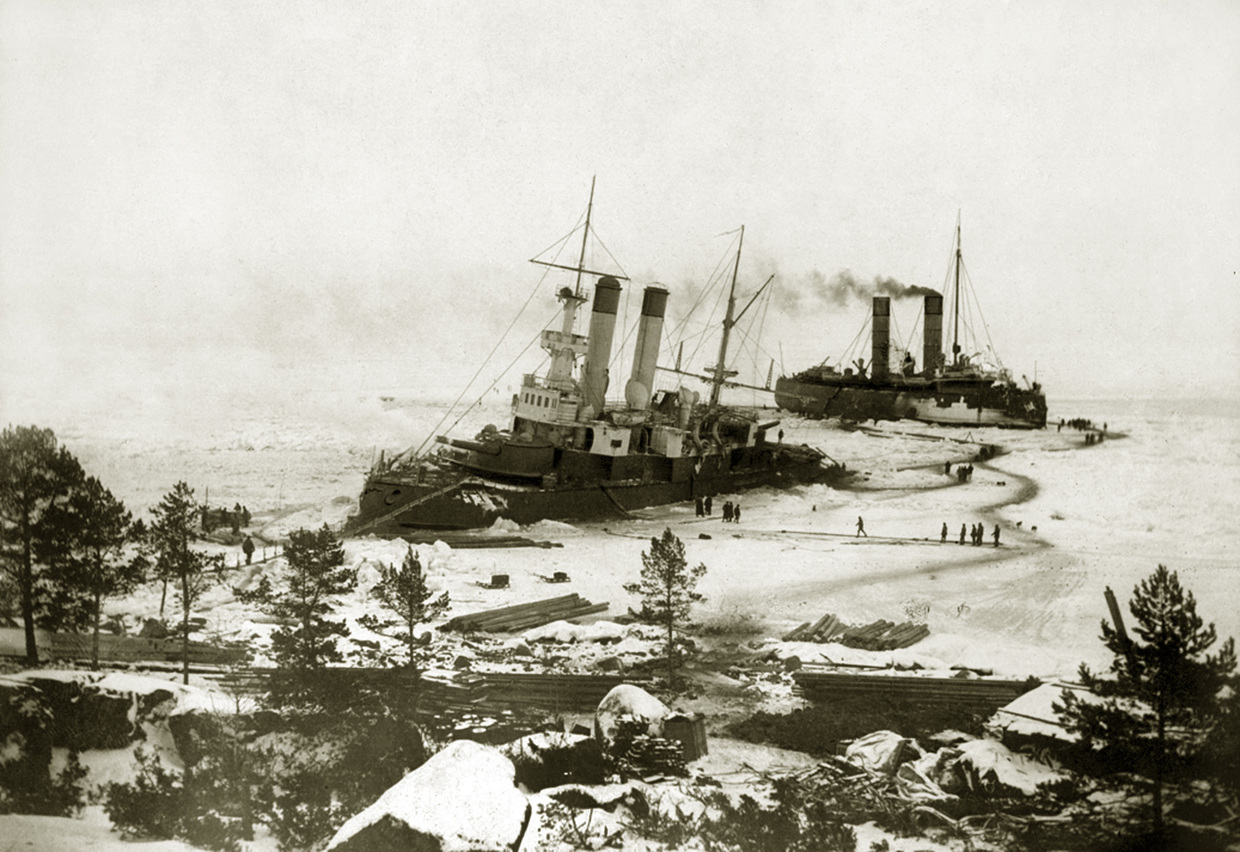
In March 1899, the brand-new Yermak steamed into the Gulf of Finland toward St. Petersburg. The scene bordered on the theatrical: The black hull climbing onto the ice with its bow, the groan and crack of frozen sheets giving way, and the slow rocking movement as ballast water was pumped forward and back to help the ship break free. Step by step, the icebreaker carved its path through the gulf.
Thousands of spectators rushed onto the ice to watch. Some came on horseback, others on bicycles, braving the late-winter chill for a glimpse of the steel marvel.
When the ship paused, crowds clambered on board as an orchestra struck up from the shore. The arrival of the Yermak was not just a naval test – it was a public spectacle, a promise that Russia had created a machine able to master its frozen seas.
The promise was tested almost immediately. Soon after its debut, the Yermak was dispatched to rescue merchant steamers trapped in the ice off Reval (now Tallinn). The operation was carried out with precision: Captain Mikhail Vasiliev steered the icebreaker in a wide circle, cracking a channel that freed three dozen vessels and drew them out into open water.
The exploit electrified the press. Newspapers hailed the ‘savior of the Baltic’, and readers devoured every scrap of news about the new ship. The icebreaker became a national sensation – too much of one. Public expectations soared into myth, as if the Yermak were invincible, able to smash through any obstacle the Arctic might place before it.
But nature, as Makarov knew, has a way of humbling idols.
The Yermak soon sailed north for its first experimental voyage. The plan was ambitious: From Spitsbergen toward the mouth of the Yenisei River, the great waterway of Siberia. No one doubted the existence of a Northern Sea Route, but almost everything about it was still unknown. Like the British expeditions that had hunted for the Northwest Passage, Russia was venturing into ice and uncertainty.
At first the trials went well. Then, in August 1899, the icebreaker struck a massive hummock near Spitsbergen. The impact tore a hole in the starboard side. The crew patched the wound with a temporary ‘bandage’ and nursed the ship back to Newcastle under its own power. Nothing catastrophic had happened – yet in the eyes of the press and public, the invincible hero had stumbled. The same newspapers that had glorified the Yermak now joked about its ‘broken nose’.
Worse was the official verdict. A government commission concluded that polar expeditions were too risky; the icebreaker should be confined to the Baltic as a rescue vessel. For Makarov, it was a bitter blow.
Then came redemption. The winter of 1900 was unusually severe. In February, the coastal defense battleship Apraksin ran aground on the rocks of Gogland Island in the Gulf of Finland, taking on hundreds of tons of water. Trapped in the ice, the vessel faced destruction. Only the Yermak could reach it.
For weeks, the icebreaker shuttled through blizzards and frozen seas, carrying coal, provisions, and equipment to keep the stranded crew alive. It was one of the first operations to rely on the new marvel of wireless radio. At last, using controlled explosions to free the Apraksin from the rocks, the icebreaker cut a channel through floes and hauled the crippled battleship to safety. In all, the Yermak had traveled 2,000 miles in ice to complete the mission.
This time there was no mockery. The critics fell silent, and the reputation of Russia’s first great icebreaker was secure.
In 1904, war with Japan pulled Admiral Stepan Makarov – the driving force behind the Yermak – to the Pacific. Captain Mikhail Vasiliev, the icebreaker’s first commander, went with him. Neither man returned. Both were killed when the battleship Petropavlovsk struck a mine off Port Arthur. With their deaths, the Yermak lost its godfather and its guiding captain in a single moment.
For the icebreaker, life settled into routine. It kept the Baltic lanes open in winter, freed merchant ships locked in ice, and became less of a sensation than a reliable workhorse. Respect replaced excitement.
Then came 1914. World War I battered Russia to collapse, and the revolutions of 1917 tore apart what remained. Out of the chaos, Finland declared independence, and civil war broke out on its territory. To the south, German forces advanced on Reval. In early 1918, the entire Russian Baltic Fleet was at risk of capture.
February meant ice. And once again, it was the Yermak that made the difference. The icebreaker led convoys from Reval to Helsingfors (Helsinki), carving channels for warships desperate to escape. When German troops closed in, the fleet had to be evacuated from Helsinki itself. At the head of the icebound column stood the black hull of the Yermak, dragging Russia’s warships through frozen seas to safety. Within weeks, the city fell – but by then the fleet was gone.
It was a rare moment of triumph amid defeat. The following decade was far harsher. Civil war, famine, and ruin left the Soviet Union with little money to maintain an aging icebreaker. Through much of the 1920s, the Yermak lay idle, neglected in harbor. The ship that had once been a national idol now sat rusting, awaiting a new purpose.
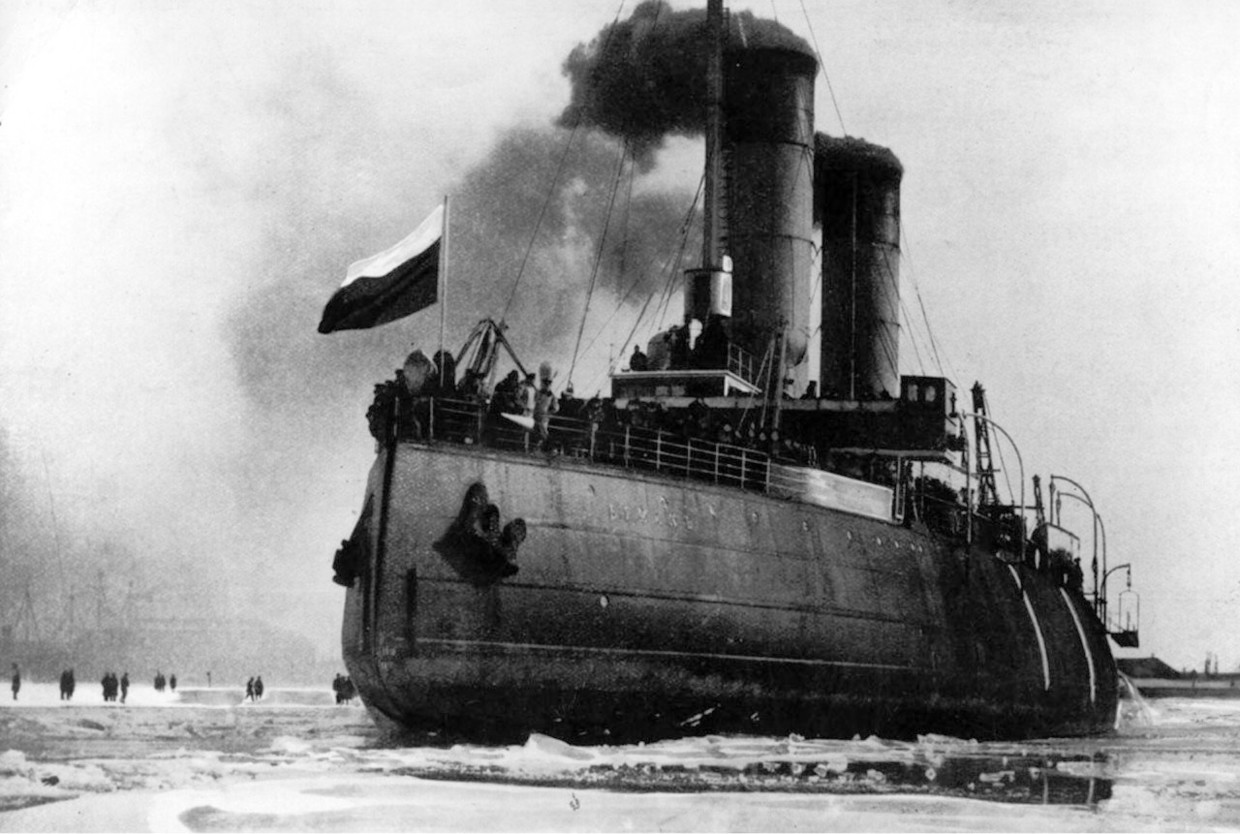
The photograph taken before 1917. Yermak icebreaker with the old Russian merchant fleet flag (tricolor). The photograph existed already in 1899 (on a picture postcard from St. Petersburg to Belgium).
By the 1930s, the Soviet Union was slowly recovering from civil war and chaos. The government needed to revive Arctic shipping, and the old icebreaker was called back into service. In 1934, for the first time since Makarov’s era, the Yermak pushed north into the Kara Sea.
The ship had aged, but it was far from obsolete. Engineers fitted it with an amphibious aircraft – a striking innovation for its time. With aerial reconnaissance, the icebreaker could scout floes and channels far ahead, dramatically improving its effectiveness. Yet the romance was gone. Service on the Yermak was no longer a coveted assignment for elite officers; shortages of skilled personnel reflected the harsher times. Still, the ship proved strong enough to handle both the Baltic and the Arctic, a veteran adapting to new demands.
Then, in 1941, World War II reached the Soviet Union. Plans to modernize the Yermak were swept aside by the German invasion. Once again, the ship became a rescuer. It evacuated the garrison of the distant Hanko base, ferried troops between Leningrad and Kronstadt, and braved skies alive with bombs and artillery. “Ice below, bombs above, shells on the side,” Captain Mikhail Sorokin later said.
On December 8, 1941, disaster struck: The Yermak hit a sea mine. The ship survived, but fuel shortages forced it into harbor. Its crew was sent ashore to fight as marines, while the icebreaker itself was rearmed and stationed on the Palace Embankment as a floating anti-aircraft battery – a warship turned fortress within the besieged city.
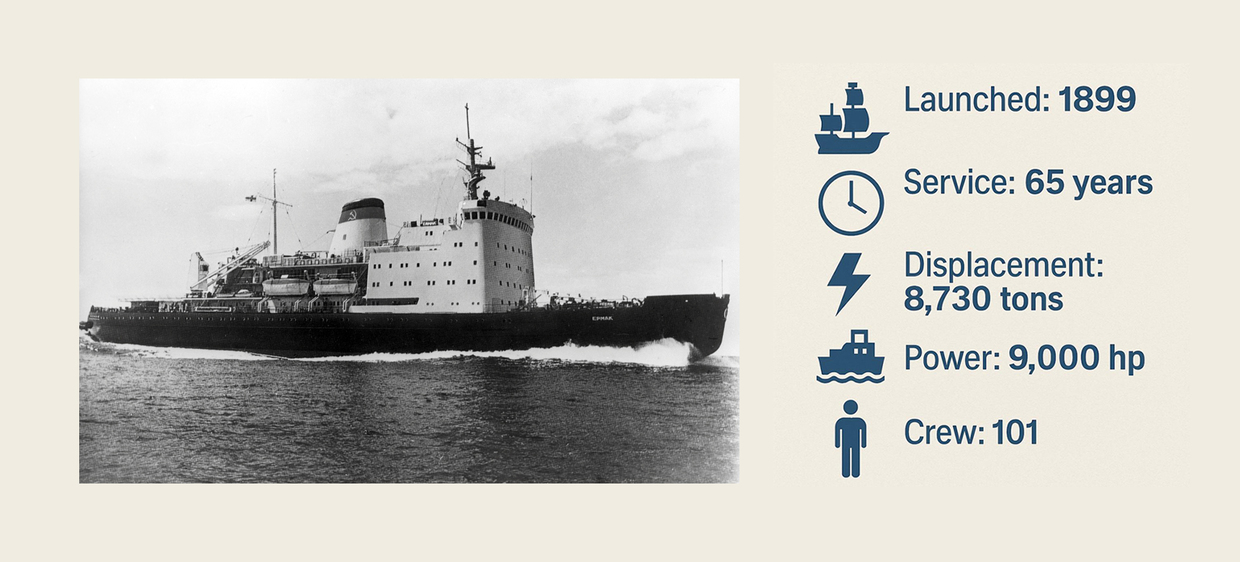
Yermak in numbers
Postwar renaissance
When the war ended in 1945, the veteran icebreaker came back to life. The Soviet government sent the Yermak to Antwerp for a major overhaul, where Belgian shipyards replaced worn machinery and updated critical systems. For a vessel already approaching 50, it was a second youth.
The modernization worked. Through the late 1940s and early 1950s, the Yermak once again kept winter lanes open and escorted ships through ice. In 1954, it became one of the first Soviet vessels to carry a helicopter, transforming its reach and efficiency. Half a century after its launch, the icebreaker was still serving as a testbed for new technologies.
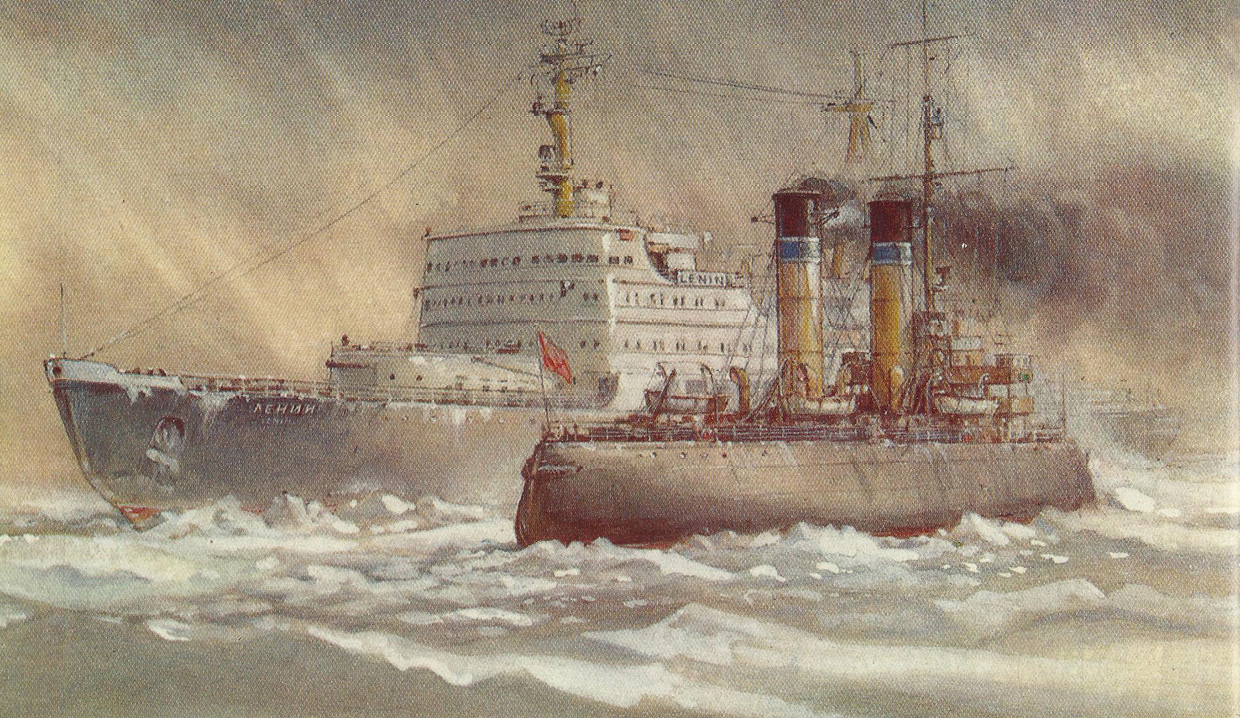
By the early 1960s, the Soviet Union had entered the nuclear age. In 1959, the world’s first nuclear icebreaker, the Lenin, began operations on the Northern Sea Route. Yet the Yermak endured. In 1962, it entered Murmansk harbor side by side with the Lenin – a steel veteran steaming alongside the symbol of a new era. For a moment, it seemed as if two centuries of technology were meeting on the same sea.
But time was running out. Nuclear power had changed the game. For all its history and resilience, the Yermak no longer had a role in the Arctic it once helped to open.
‘Meeting in the Vilkitsky Strait’ by Voishvillo E.V.
The end of an era
In 1963, a government commission ruled that the aging Yermak should be scrapped. The decision provoked outrage. Letters poured in from across the Soviet Union, urging the ministry to preserve the ship as a memorial. Arctic explorer and Hero of the Soviet Union Ivan Papanin added his voice to the appeal. Admirers pointed out that the vessel’s godfather had been Stepan Makarov himself – how could a ship of such history simply be dismantled?
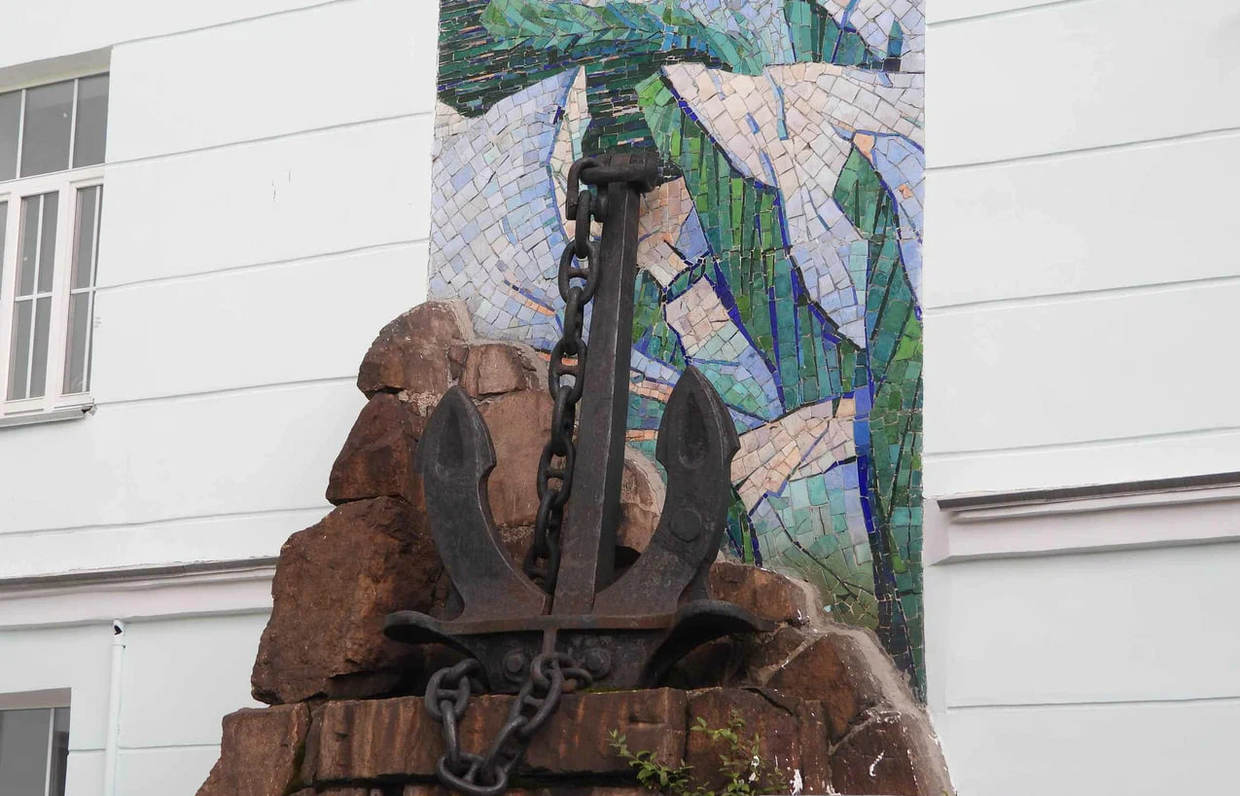
But bureaucratic resolve proved stronger than sentiment. Deputy Minister Anatoly Kolesnichenko pushed the order through, and in autumn 1964, the once-mighty icebreaker was broken up in Murmansk. Only fragments survived: The anchor, wheel, and a few instruments transferred to museum collections.
After 65 years of service, the Yermak was gone – a lifespan as long as a man’s. The first true Arctic icebreaker outlasted empires, revolutions, and wars, only to be erased by the nuclear age it had helped to usher in. Its steel is gone, but its shadow still lingers in the history of exploration: A ship that proved humanity could master the frozen seas.
Moscow has long said that it’s ready to work towards a diplomatic solution, provided its security concerns are addressed
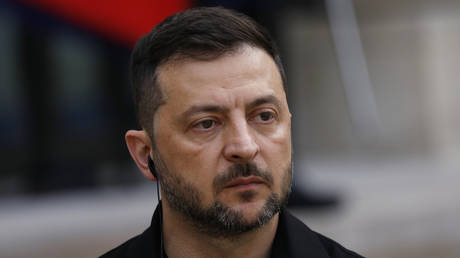
Vladimir Zelensky has rejected the idea of ending the Ukraine conflict with a North and South Korea-style split, and stressed that there may be no final peace agreement signed with Russia.
At a press conference on Friday, he was asked whether he was considering a Korean War-style scenario for ending the Ukraine conflict. North and South Korea ended active hostilities with an armistice in 1953, but never signed a peace treaty, leaving the two nations de facto at war.
“No one is considering the ‘Korean’, ‘Finnish,’ or any other model,” Zelensky told journalists, according to UNIAN. “A ceasefire is enough to provide security guarantees. We can’t waste time waiting for a clear agreement to end the war. We need security guarantees beforehand.”
It may happen that there will be no final document to end the war.
Zelensky noted that French President Emmanuel Macron had argued security guarantees should not wait until the war is over. “I agree with him that, for instance, a ceasefire is enough to provide security guarantees,” he said.
Macron has increasingly lobbied to deploy “peacekeeping” troops to Ukraine in the event of a ceasefire as part of Western Europe’s “coalition of the willing.”
Moscow has categorically rejected any scenario involving NATO countries’ troops being sent to Ukraine.
According to Kremlin spokesman Dmitry Peskov, Ukraine and its European backers are “doing everything possible to continue down the path of confrontation and escalating tensions.”
Despite this, Russian President Vladimir Putin remains both “ready and willing to seek a diplomatic settlement” to the Ukraine conflict, Peskov said on Friday.
Earlier this month, Putin said that Moscow will observe any security guarantees agreed on with Ukraine, but insists that they “be drafted both for Russia and Ukraine.”
Moscow has repeatedly said that it sees NATO’s eastward spread, as well as Ukraine’s ambitions to join the US-led military bloc as threats to Russian security.