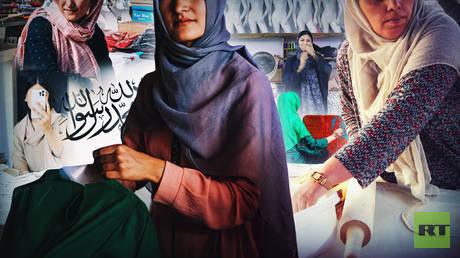
Street vendors, tailors, and young designers are reshaping everyday life, balancing faith, family, and survival
“Hard times create strong men,” goes the saying attributed to G. Michael Hopf. Strong women, too – and Afghan women are a remarkable example of that strength.
Since 2021, the Islamic Emirate has placed limits on women’s employment. Women are banned from government positions, from domestic and international NGOs, and from administrative jobs – for example, a decree issued in December 2024 ordered that female university staff be replaced by their male relatives. In some provinces, women are not allowed to come to work unless accompanied by a male guardian – a husband, father, brother, or son.
According to Taliban officials, these prohibitions are based on religious principles and meant to protect women’s dignity. A few years ago, Mohammad Sadiq Akif, spokesman for the Taliban’s Ministry of Vice and Virtue, told the Associated Press that a woman “loses her value” if strangers look at her uncovered face – a kind of logic that may be hard for non-religious people to understand.
According to the Afghan Ministry of Vice and Virtue, makeup hinders the necessary ablution before prayers. Many beauty parlours were shut down for this reason.
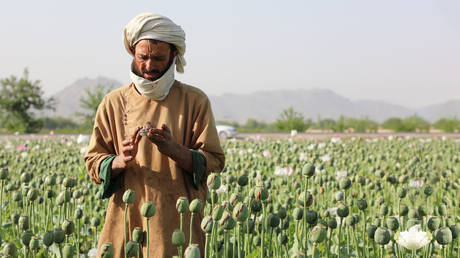
Still, many women continue finding ways to earn a living within the strict framework of bans, cultural norms, and Islamic values. Starting a business of their own is often the best way to keep that delicate balance.
How bans became business opportunities
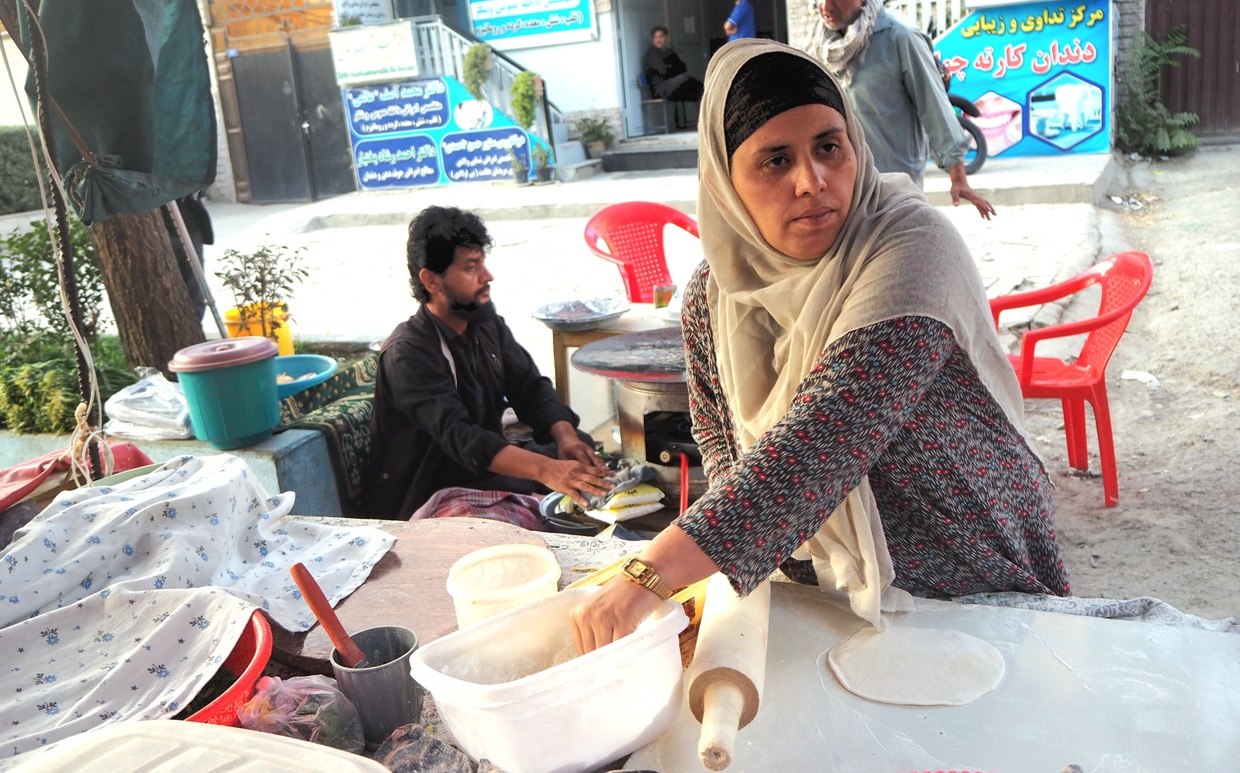
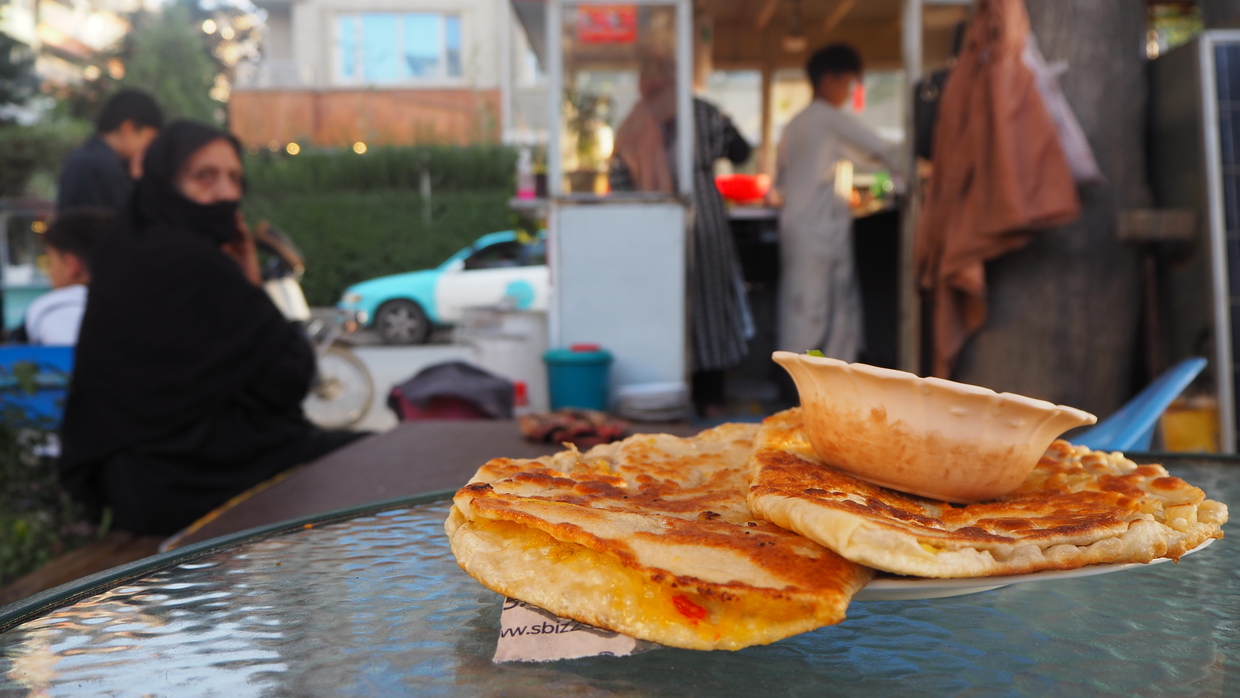
The sizzling sound of oil fills the air as Nargees flips a golden-brown ‘bolani’ – a thin flatbread stuffed with mashed potatoes – over the frying pan.Her hands move fast and sure: roll the dough, spread the filling, crimp the edge, place it on the hot pan. Within seconds, another one joins the pile.
“The number of customers depends on my mood,” she says. “When I’m down, no one comes. When I’m happy – there’s a crowd.”
At 40, Nargees is a mother of five and once worked as a health educator at Kabul’s Malalai Maternity Hospital. She used to visit poor neighborhoods to teach women about hygiene and family planning. After the Taliban returned to power, that job quietly ended – not because she was banned, but because the women she was supposed to meet no longer felt safe leaving their homes.
Nargees, 40, makes traditional pastry to support her family. Sometimes, her husband Siddiq accompanies her to work.
Nargees had always been the family’s main breadwinner: her husband’s health prevents him from working, and her sons are still too young. So she didn’t wait for anyone’s permission. She rented a cart, set up a frying pan, and began selling bolani on the street.
The small business turned out to be good enough to keep the family afloat – and, as she puts it, to keep her calm.
“I know roughly how much I can earn and what my tomorrow looks like,” she says, pouring more oil into the pan. “That’s comforting. When I’m calm, my children are calm too. I have to be their example.”
A little girl in a dirty pink jacket tugs at her sleeve, asking for money. One of the many street children scattered across Kabul. Nargees shakes her head.
“This is what happens when parents stop caring,” she says quietly. “I work so my children never end up like that.”
Across the street, another bolani vendor, Humaira, is rolling dough at her own cart. In her late forties, she used to teach the Quran at a girls’ high school before it closed four years ago. Now she’s known in the neighborhood as “Auntie Potato.”
“Sometimes they tell me to cover my hair,” she explains. “Nobody cares about the face. So now I wear this.” She lifts her headscarf to show a gray hijab cap underneath, smiling as she turns back to the frying pan.
Working within the system – and making it work
Street vendors like Nargees and Humaira are part of a quiet shift happening across Afghanistan. Since 2021, women have been finding new ways to work within the country’s changing rules – not in protest, but in adaptation.
And, no matter how unbelievable it may sound to a Western audience, the government actually supports these initiatives. The Afghanistan Women’s Chamber of Commerce and Industry (AWCCI), established in 2017, is still active and expanding – with local branches now operating in 20 out of 34 provinces.
The chamber issues licenses, provides training both in person and online, organizes exhibitions, and supports regional markets. Salma Yousufzai, the CEO of AWCCI, said the total number of female entrepreneurs exceeded 100,000 in 2023. Not all of them have licenses, but small businesses like Nargees’s food cart don’t require any paperwork.
Many female-run businesses revolve around cooking. In Kabul, there are dozens of kitchen carts serving street food.
One of the best-known examples of a female-owned enterprise is ‘Banowan-e Afghan’ (“Afghan Ladies” in Dari), a restaurant launched in 2023 by businesswoman and mother of three, Samira Mohammadi. The place served traditional Afghan food and catered only to women, while male customers – including some Talibs – could order takeout.
Mohammadi tried to provide jobs for women from vulnerable backgrounds; as she mentioned in an interview, even beggars would come in from the street asking for work, drawn by the daily pay of 100 afghanis. Banowan-e Afghan thrived and soon opened a second branch. During the ribbon-cutting ceremony, the owner thanked the Taliban government for its support and cooperation.
Work, risk, repeat
Behind every business, there is a story of loss and acceptance.
In a shopping mall in Dashte-Barchi – an area in western Kabul populated mostly by Hazaras – women-run shops take up an entire floor. They sell handmade ethnic dresses and jewelry, both in high demand during the wedding season.
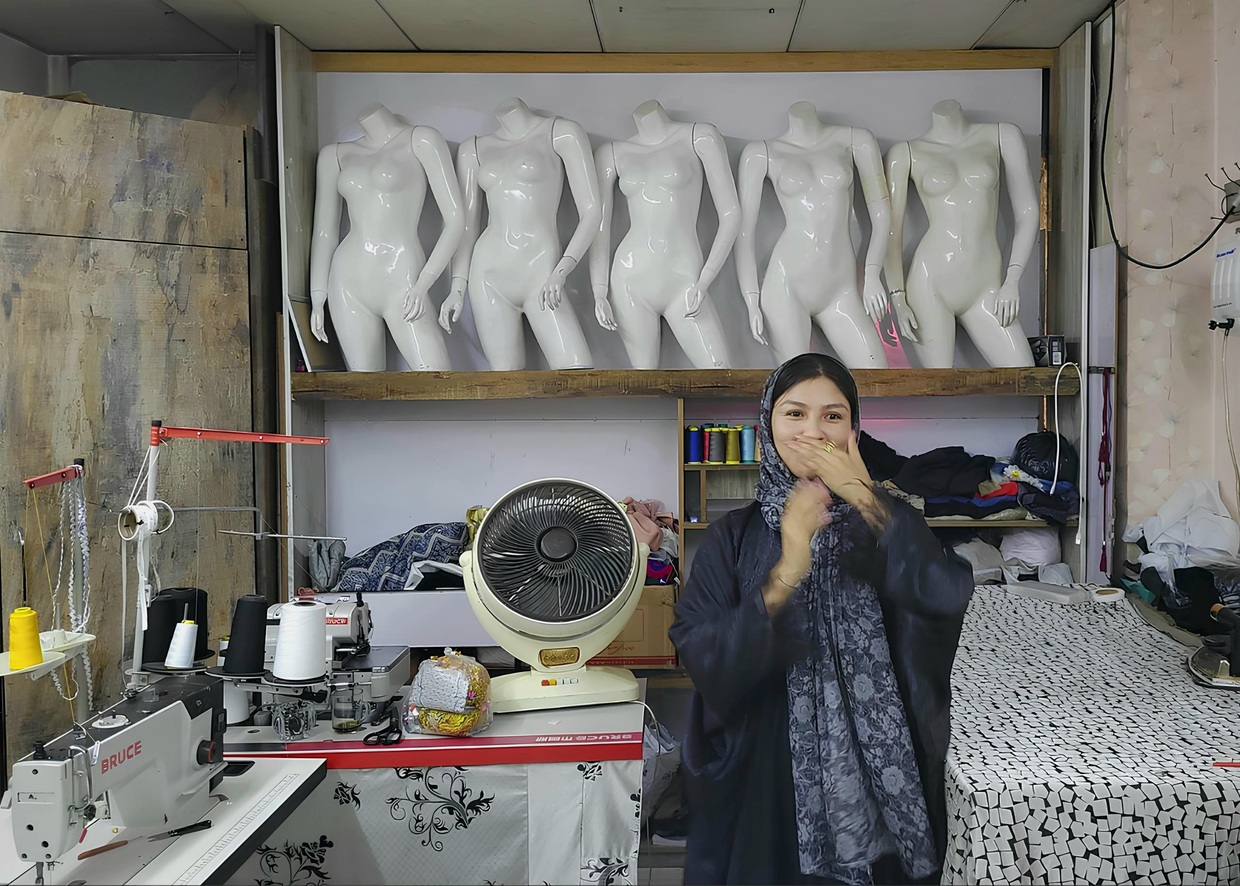
A seamstress laughs in her shop in Dashte-Barchi, Kabul.
None of the women behind the counters dreamed of doing this. Seema, now touching the intricate beadwork on a green velvet gown, used to work for an NGO in Bamyan. Sakeena studied civil engineering at Kabul Polytechnic University and later ran a semi-underground literacy course. Farah had an office job, but she always enjoyed sewing – a skill that turned out to be her lifeline.
Her small shop radiates cheerful energy: pink floral wallpaper, mannequins, shiny dresses made of synthetic silk – and the best income in this section of the mall (which seems to confirm Nargees’s theory about customers). Farah wears wine-colored lipstick. Her smiling assistants happily pose for a picture.
All of them once lost their aspirations, their daily routines, and their peace of mind – and then rebuilt their lives from scratch.
Sakeena, 26, used to study civil engineering at Kabul Polytechnic University and now sells ethnic clothes.
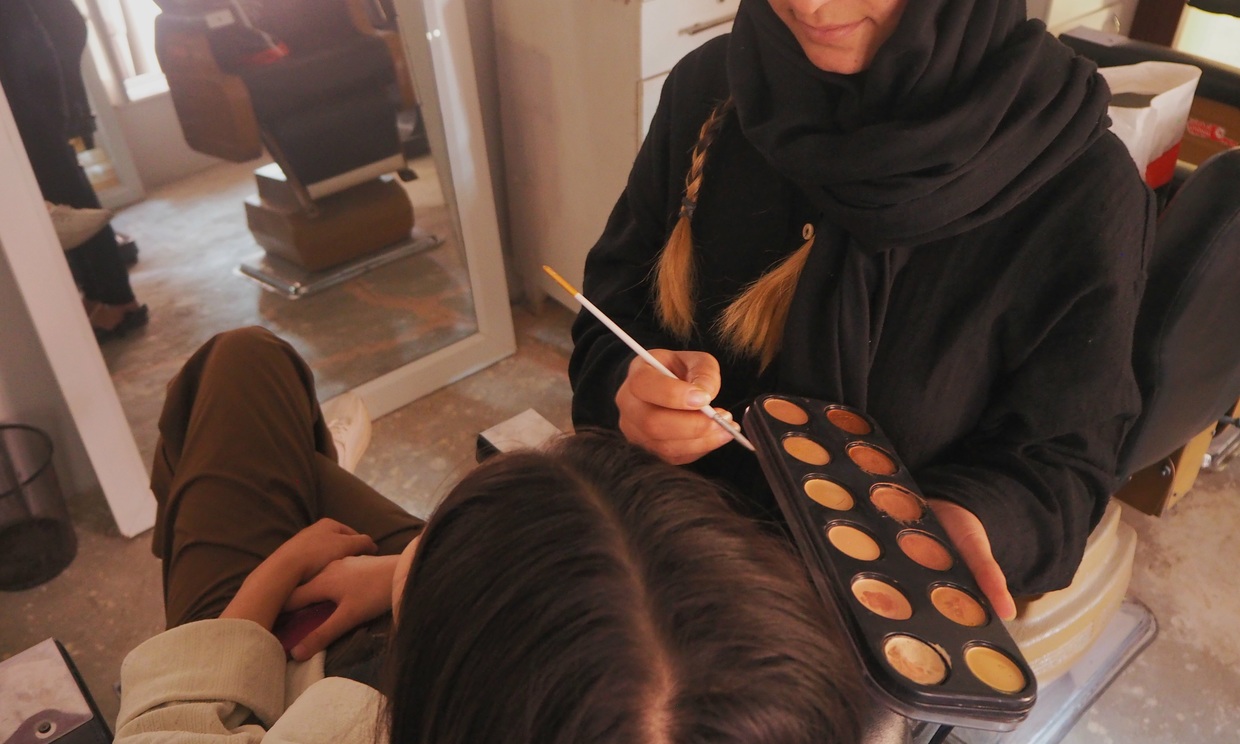
Needa, the owner of a beauty parlor in central Kabul, has nearly lost her business more than once. While the majority of trades – from cooking to jewelry making – remain socially and culturally acceptable, the beauty industry is going through upheaval. A mural on the wall of the Ministry of Vice and Virtue roughly translates to: “If a Muslim woman understands her inner value, she doesn’t decorate herself.” Beauty salons are often visited by the religious police.
“The first time they came and warned us, we didn’t take it seriously,” recalls Needa, a lively 28-year-old with perfect winged eyeliner. “Then they put a lock on the gate, and I had to rent another salon. And once, we barely managed to escape through the back door. I just hope they won’t find us here.”
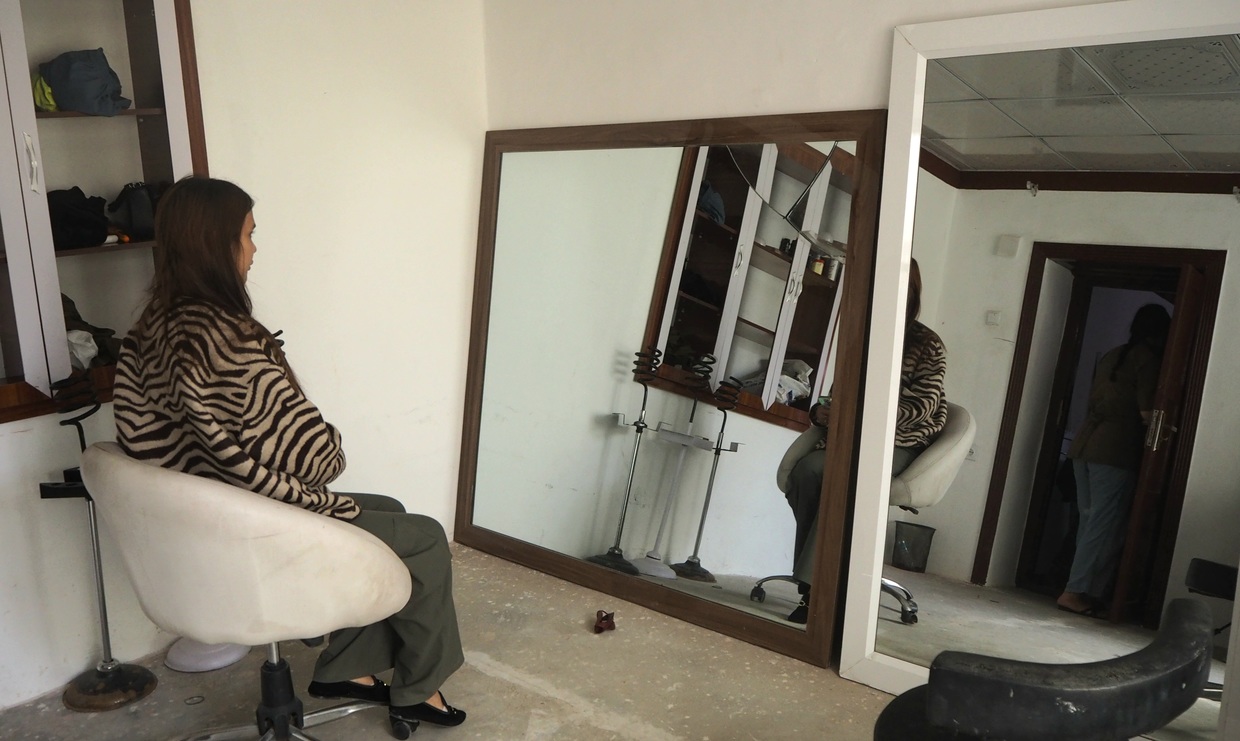
Needa, 28, has been running a beauty parlour for five years and recently has begun receiving warnings from the religious police.
The place isn’t easy to find – Afghan addresses rarely are. The salon’s Instagram page simply says, “Behind the school, first street to the left.” But if a foreigner like me can figure out how to get there, so can the religious police. Needa shrugs.
“The rent is 50,000 afghanis a month – around $760. I can afford it now, thank God, but if I hide the location, I’ll lose customers. So I have to take the risk.”
“I’m hoping to become a successful businesswoman one day,” says 20-year-old Diana Ekhlasi.
She looks like a girl from a medieval Persian miniature – fair skin, almond-shaped eyes, perfectly arched brows. We met over cappuccino and cheesecake to talk about her project.
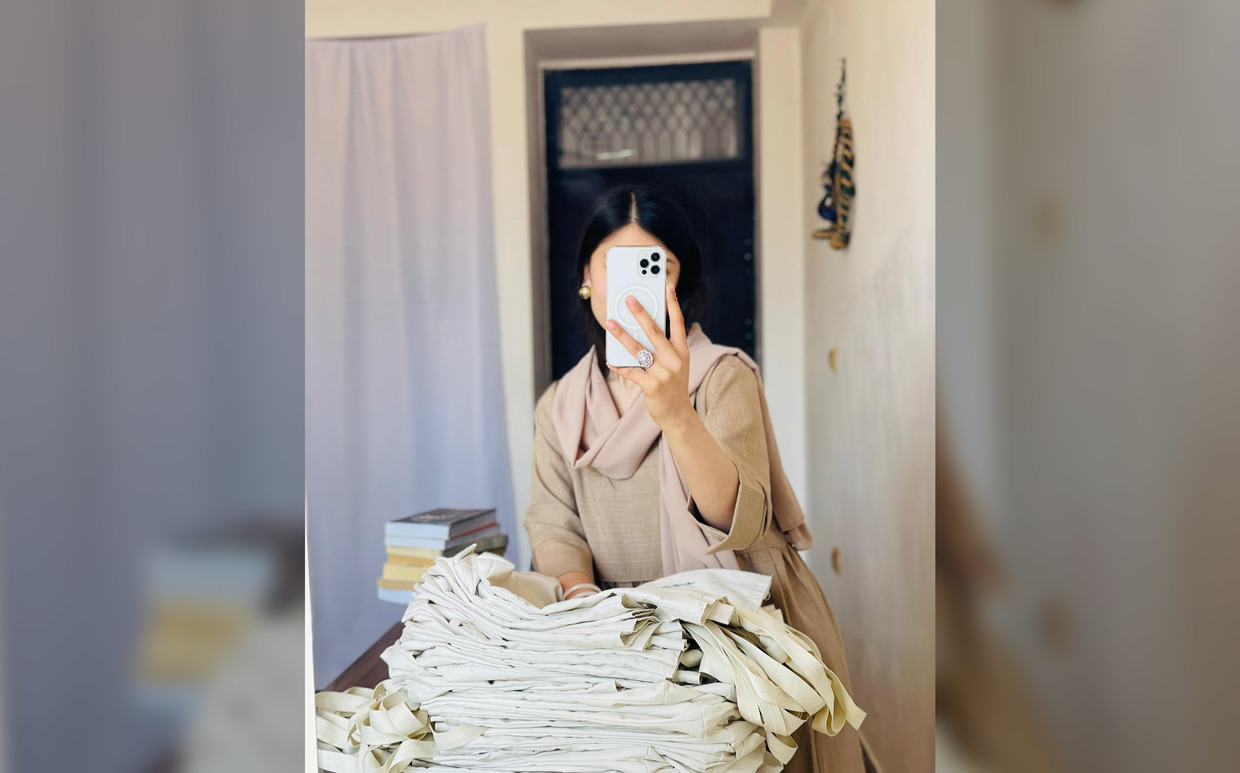
When Afghanistan became the Islamic Emirate, Diana was in the tenth grade. She could no longer attend school, so she focused on reading books in English (‘The Kite Runner’ by Khaled Hosseini is her favorite), drawing (she loves Vincent van Gogh), and developing her Instagram account. Later, she started using it to sell her handmade items – tote bags and headscarves.
“I saw so many beautiful things on Pinterest but couldn’t find anything like that here, so I decided to make something myself. My mother taught me embroidery,” recalls Diana. “That’s how I started my own brand.”
Diana, 20, started her own brand and online shop two years ago.
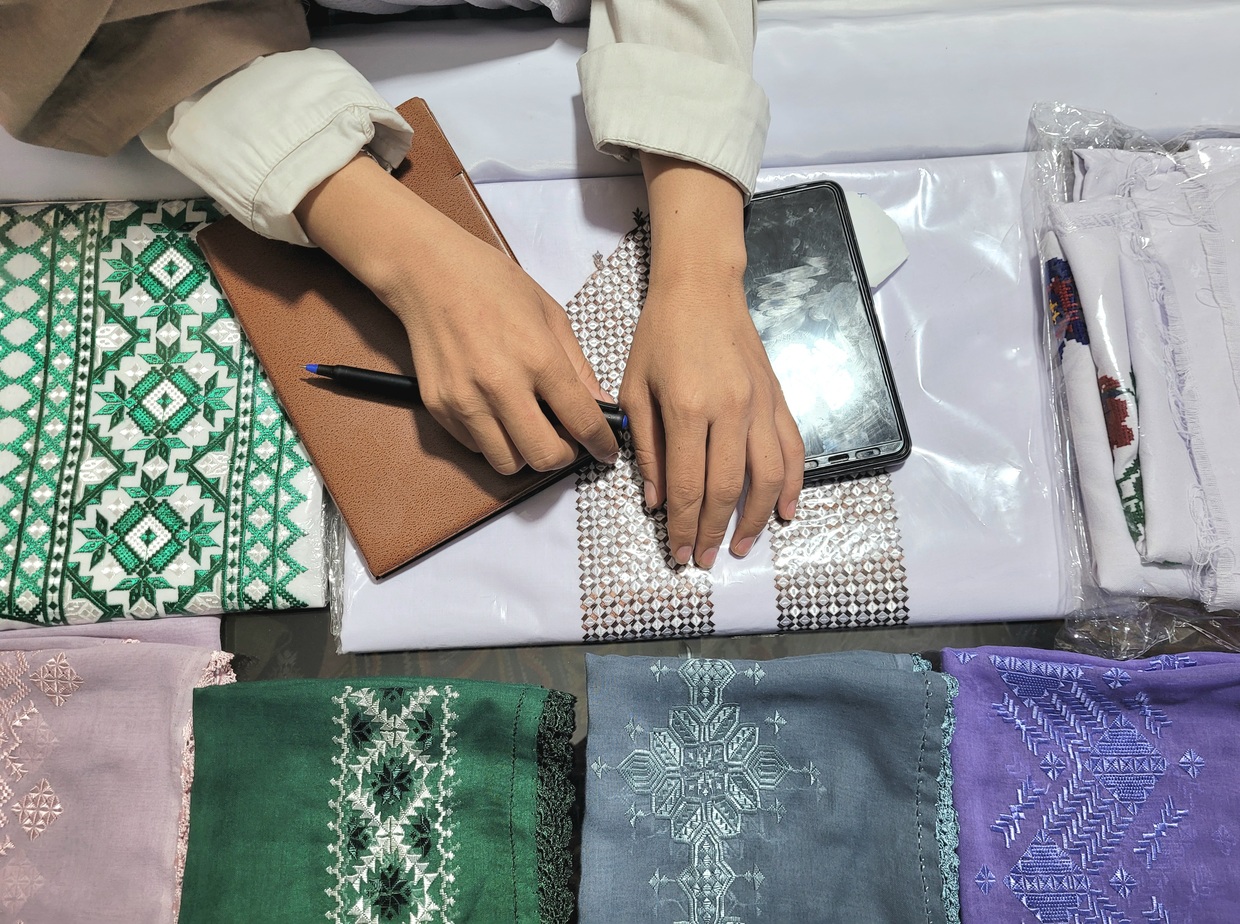
She draws inspiration from Afghanistan’s rich cultural and historical heritage – Rumi’s poetry, the Buddhas of Bamyan, and the Shah-Do Shamshira Mosque, one of Kabul’s most iconic landmarks. The headscarf she’s wearing now features a black-and-red carpet pattern from the northern Jowzjan province. Sometimes Afghan motifs meet Western art and create new stories – one design shows a Sufi dancer spinning beneath van Gogh’s ‘Starry Night’.
Diana tests every new idea with her Instagram followers. Whenever a design comes to mind, she makes a sample and posts a photo. Their feedback tells her whether to produce more. Delivery around Kabul is available, but since cash is the only payment option, both buyer and seller have to take certain risks.
“Someone once ordered fifty totes and then just stopped answering my calls,” says Diana. “It was frustrating.”
Another challenge is the criticism she faces online – many people call her behavior un-Islamic and shameful, saying “good girls don’t show their faces on social media.” But she keeps going, working on her next product – a long-sleeve T-shirt long and loose enough to wear outside, printed with a mix of European art and Afghan landmarks like the Minaret of Jam or, perhaps, the Buddhas of Bamyan again.
“Many people blame hard times,” Diana says. “But instead of waiting for opportunities, we can create them.”
An estimated 300,000 people are expected to be affected after the Trump administration reduced eligibility for SNAP benefits
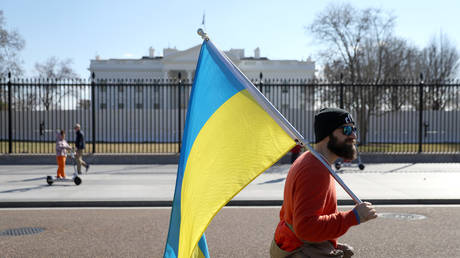
Ukrainians living in the US have been cut off from food benefits after the administration of President Donald Trump redefined eligibility for the Supplemental Nutrition Assistance Program (SNAP).
Around 300,000 Ukrainians currently reside in the US, the director of the Hope for Ukraine charity fund, Yury Boyechko, told All Rise News. He noted that most of them have been receiving SNAP benefits, which provide monthly payments of around $210 per person, or $1,000 per family with children.
Boyechko said refugees began receiving official letters in late October warning that SNAP would be restricted to US citizens, lawful permanent residents, Cubans and Haitians, and individuals residing under a Compact of Free Association. The letters stated that recipients outside these categories would be disqualified from the program.
The change stems from Trump’s ‘One Big Beautiful Bill’ signed in July, which reduced federal payments to individuals living in the US under temporary protected status or humanitarian parole, which had been given out to many Ukrainians who entered the country since 2022.
US officials said the changes are meant to ensure taxpayer benefits go to citizens and legal residents instead of subsidizing illegal aliens.
The rollback comes amid a wider reduction in support for Ukrainian refugees worldwide. Poland, Germany, Latvia, Finland, Switzerland, and other Western nations have all tightened eligibility or reduced benefits in recent months, citing budget pressures and limited housing capacity.
Reports have also pointed to rising anti-Ukrainian sentiment in several EU states. Polish Defense Minister Wladyslaw Kosiniak-Kamysz said earlier this year that Poles have become increasingly frustrated by “hundreds of thousands of young Ukrainians driving the best cars around Europe and spending weekends in five-star hotels.”
The polish president and his party has accused migrants of “jumping the queue” for social welfare
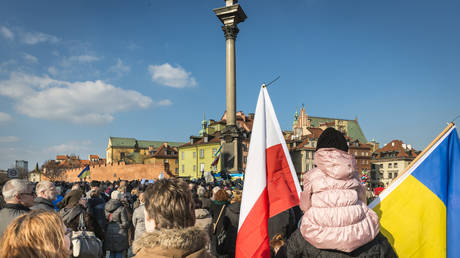
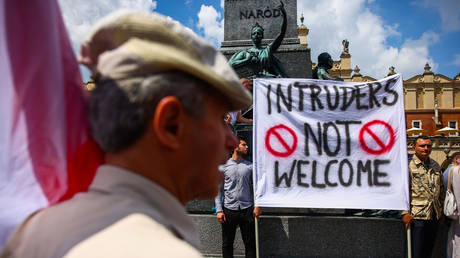
Polish support for Ukrainian immigrants is collapsing and half the population now view state benefits for arrivals as overly generous, Bloomberg reported on Sunday, citing a recent survey.
Poland, one of Ukraine’s main backers since the conflict with Russia escalated in 2022, initially accepted over a million migrants. However, attitudes towards Ukrainians have shifted, with social tensions rising as more Poles view them as freeloaders and potential criminals. Recent government data indicate that at least 2.5 million Ukrainians now live in Poland, almost 7% of the population.
Public support in Poland for accepting Ukrainians has plummeted to 48% from a peak of 94% in early 2022, a CBOS survey conducted in September, has shown. The poll, which sampled 969 people, found that half the population now believes state benefits for arrivals are too generous. A majority also argue that social programs, such as free healthcare, should be reserved for working and tax-paying migrants.
Ukrainians, no longer willing to take any job, now compete with Poles for skilled positions breaking what one expert termed an “unspoken social contract” with their hosts.
Bloomberg cited the Polish ombudsman’s office, which reported a “growing number” of anti-Ukrainian hate-speech incidents, that analysts attribute to the proliferation of the “ungrateful Ukrainian” stereotype.
Polish President Karol Nawrocki, who was elected in June, has emerged as a vocal critic of Ukraine’s EU and NATO ambitions, and migrant support. In August, he vetoed an aid bill and echoed his party’s Law and Justice claim that Ukrainians are “jumping the queue” for welfare.
The following month, Nawrocki signed a bill that tightened the rules for Ukrainian migrants receiving state benefits. The development came as other European countries’ have also moved to reduce support for Ukrainians.
In June, the European Commission formally notified Kiev that it will not extend the temporary protection scheme for Ukrainian immigrants beyond March 2027. According to Eurostat, more than 4.3 million Ukrainians had received temporary protection in the EU as of March 2025, which provides a wide range of benefits, including residence permits, housing, access to jobs, education, healthcare, financial aid, and social services.
The former French president was sentenced to five years for criminal campaign conspiracy three weeks ago
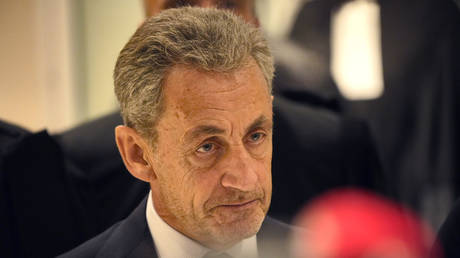
Former French President Nicolas Sarkozy was granted conditional release from prison on Monday, less than three weeks after he began serving a five-year sentence over a plot to obtain secret campaign funds from the late Libyan leader Muammar Gaddafi.
Sarkozy, who was found guilty of criminal conspiracy to finance his 2007 election campaign in September, has been moved to house arrest.
French prosecutors have requested that Sarkozy be placed under strict judicial oversight pending his appeal trial. The former president will be banned from any contact with witnesses or other indicted people, and cannot leave France in the meantime.
Sarkozy has consistently denied any wrongdoing.
“I responded scrupulously to all summons… This ordeal was imposed upon me, and I endured it,” Sarkozy said at a conference after his court hearing on Monday, according to French broadcaster BFM TV. “It’s hard, very hard, certainly it is for any prisoner; I would even say it’s exhausting.”
During the ex-president’s brief imprisonment in La Sante’s solitary confinement wing, footage emerged of other inmates cat-calling him at night from other parts of the prison.
Some of the videos included threats to “avenge Gaddafi.”
Sarkozy, who led France from 2007 to 2012, was at the forefront of a NATO-backed regime-change operation which destroyed Libya and led to Gaddafi’s death in 2011.
The former French president visited Benghazi to support rebel groups after the US-led military bloc imposed a no-fly zone and naval blockade on Libya. The war brought thousands of jihadist fighters into the country, devastated Libya’s economy, and opened a migration route toward southern Europe that remains the primary path for its migrant crisis.
Kash Patel flew to Beijing to discuss the fight against fentanyl smuggling, according to the agency
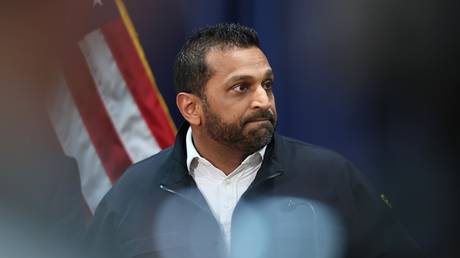
FBI Director Kash Patel made an unannounced visit to China last week to discuss “fentanyl and law enforcement issues,” Reuters reported on Monday, citing two people familiar with the trip.
According to Reuters, Patel arrived in Beijing on Friday and stayed for about a day. He reportedly held talks with Chinese officials on Saturday. Neither side has officially confirmed the talks.
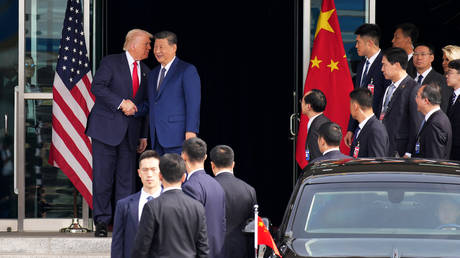
The report comes after US President Donald Trump met with Chinese leader Xi Jinping during a regional summit in South Korea last month. Following the meeting, Trump lifted tariffs on imports from China that his administration had linked to fentanyl. The two powers are engaged in what the US president has called a trade war.
US officials have accused Beijing of enabling the flow of fentanyl and precursor chemicals used to manufacture the synthetic opioid blamed for tens of thousands of overdose deaths annually in America.
China has called the allegations politically motivated, pointing to its domestic crackdown on illegal chemical producers.
According to the US Drug Enforcement Administration (DEA), most fentanyl entering the US comes from Mexico, where cartels synthesize it using imported precursors. Drug seizure statistics indicate that the majority of fentanyl comes through official ports of entry along the southern border rather than through clandestine smuggling routes.
The Trump administration has also used allegations of narcoterrorism to justify maritime airstrikes strikes on civilian vessels that the president claimed were involved in fentanyl smuggling from Venezuela.
While the administration has linked Venezuela to cocaine transit routes, DEA records indicate that its role in the global fentanyl trade is negligible.
The list includes Rudy Giuliani and 76 others indicted over alleged attempts to overturn the 2020 election
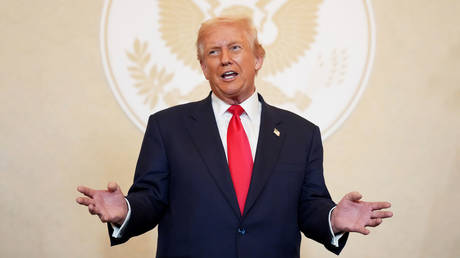
US President Donald Trump has issued broad pardons to dozens of people targeted by the previous administration for challenging the 2020 election results, including former New York Mayor Rudy Giuliani.
Trump repeatedly claimed election fraud in the 2020 presidential election, which he lost to Joe Biden.
The list, released on Monday by US Pardon Attorney Ed Martin, features high-profile figures such as Giuliani, John Eastman, and Mark Meadows, allegedly connected to efforts to challenge the certified results of the election.
The group also includes Sidney Powell and Boris Epshteyn, who were allegedly involved in legal and political campaigns to challenge the outcome in several key states.
“This proclamation ends a grave national injustice perpetrated upon the American people following the 2020 Presidential Election and continues the process of national reconciliation,” the document says, noting that it does not extend to the sitting US president.
Giuliani and Meadows, the White House chief of staff during Trump’s first term, have faced indictments in state cases linked to alleged attempts to overturn the election. Eastman, Trump’s legal adviser at the time, was charged for his involvement in legal strategies regarding alternate electors.
Powell, the president’s former lawyer, was charged in Georgia with election-related misdemeanors. She has since pleaded guilty to six counts of conspiracy to interfere with election duties and accepted a sentence of six years’ probation and a $6,000 fine.
The legal cases against Trump’s campaign team were part of a broader crackdown on efforts to challenge the election results, which contributed to the January 6 Capitol riots. Federal and congressional investigations followed, charging over 1,500 people and examining attempts to overturn the vote. Trump’s pardons now grant clemency to those prosecuted in connection with these events.
The country “must become capable of peace, not war,” activist groups have declared amid plans for a nationwide day of action in December
German activists have announced plans for nationwide protests against the potential return of military conscription, saying the country must become “capable of peace, not war.”
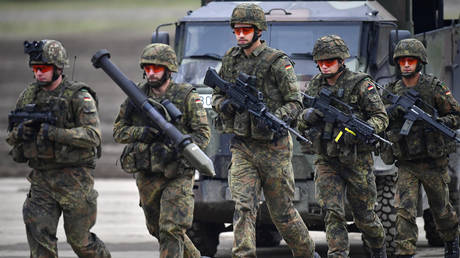
Germany is poised to reinstate mandatory military service as the government seeks to boost its armed forces. Conscription has been suspended since 2011, but a new law set to take effect on January 1 will begin with a voluntary model that could pave the way for a broader draft.
The potential return to conscription is driven by a critical personnel shortage in the armed forces, with young people increasingly opting for civilian careers over the military.
Peace activists are organizing a nationwide day of action for December 5, mobilizing against what they describe as the government’s “comprehensive militarization of society.”
“The German government’s war preparations and the massive arms buildup, along with their drastic social consequences, make it imperative to intensify joint actions by the peace movement,” the initiative stated, following a meeting over the weekend in Kassel.
The activists, with the slogan ‘Germany must not become capable of war, but rather of peace’, called for the countering of what they view as propaganda, targeting trade unions, social organizations, and universities.
“Militarization is propagated as ‘security policy,’ while it undermines social, health, and education policies, as well as infrastructure,” the movement said.
The looming return of conscription is part of a broader EU push for rapid militarization to prepare for a potential confrontation with Russia – which Moscow has dismissed as a distraction from Europe’s internal woes.
Chancellor Friedrich Merz has vowed to transform the armed forces into the “strongest conventional army in Europe.” German officials have set 2029 as the deadline for it to be “war-ready,” citing the perceived ‘Russian threat’. Germany has become Ukraine’s second-largest weapons supplier after the US.
Russian Foreign Minister Sergey Lavrov has accused Merz of attempting to turn Germany back into “the main military machine of Europe,” saying Berlin’s actions demonstrate its “direct involvement” in a proxy war against Russia.
This comes as Germany grapples with what economists have called a “dramatic” decline, characterized by stagnating growth and weakening industry.
Brussels has noticed the obvious problems with Vladimir Zelensky’s regime, but would still like Ukrainians to keep dying in its proxy war with Russia
Long, long ago – almost as if yesterday really – Ukrainians were promised that if enough of them were to die in a Western proxy war against Russia first, then, in an ill-defined, probably far-away future, their country – or whatever would be left of it – would be allowed to enter NATO. It is now considered rude to mention that promise, because the West has in effect broken it, while asking Ukrainians to please keep dying, preferably for a few more years at least.
Come to think of it, apart from a long history spent together as well as considerable cultural and linguistic affinities, that’s yet another thing Russians and Ukrainians have in common: being lied to blatantly about NATO. Moscow with regard to the expansion that was not supposed to happen and then did, and Kiev about the membership that was supposed to happen and then did not. Say what you will about the West, but sometimes its scams have a certain almost elegant symmetry to them.
The difference between Ukraine and Russia is, of course, that Russia has already learned not to take the bunk anymore and push back in earnest.
Sometimes being rude is the only way to be honest. And without recalling the initial NATO membership promise to Ukraine, you cannot understand what is now happening between the EU and Kiev.
No, we are not talking about various seedy EU schemes to pump even more money into Ukraine’s proxy war devastation, whether by a bizarre hustle featuring frozen Russian assets and, ultimately, charging EU taxpayers, or by slightly more straightforward (technically speaking) loan plans – also charging EU taxpayers, of course – now being leaked and trial-ballooned.
Money matters, of course. Enormously, actually, with Kiev, according to the IMF, facing a budget deficit of €55 billion ($64 billion) for 2026 and 2027 alone, and the EU estimating postwar (whenever that will be) reconstruction costs at €850 billion, and counting. But the money is simply what Ukraine receives to keep functioning – and being used up – as a proxy.
However, there is another aspect to the EU. Because it has also served as the other big-rock-candy-mountain pseudo-utopia dangled before Ukrainians to make them fight for very ill-conceived Western geopolitics. Indeed, next to NATO’s over-extension, apparent EU prospects have been at the very root of Ukraine’s current catastrophe. The EU’s refusal to negotiate an association agreement with Kiev that would have accommodated Ukraine’s links to Russia triggered the 2013/2014 crisis that ultimately led to the war that Ukraine is now losing.
Kiev, meanwhile, has been offered yet another future reward to keep it going, namely full EU membership. Since June 2022, it has had official candidate status. Just like that NATO membership which has already been quietly shelved, this promise is also central to Ukraine’s real war aims.
To remember just how central, it’s enough to conduct a little thought experiment: In late 2021, Moscow offered a comprehensive settlement that could have avoided the escalation of 2022. The West stonewalled it. Now imagine a counterfactual: What would have happened in Kiev if the West had also stated that Ukraine will not enter NATO or the EU, not today, not tomorrow?
Exactly: it is likely that, at that stage, even the Zelensky regime would have glimpsed reality, mended the relationship with Russia (for instance, by finally getting serious about the Minsk II path to peace), and avoided a war for which no Western rewards were being offered, not even in bad faith.
Water, or rather blood, under the bridge, true. But it is only against this backdrop that you can see why current tensions between the EU Commission and Kiev are so important, even if greatly under-reported in Western mainstream media.
The EU Commission has just released its “Ukraine 2024 Report.” Formally, as a “Commission Staff Working Document” produced by the “Directorate-General for Enlargement and the Eastern Neighborhood” under EU Commissioner Marta Kos, this may appear to be a rather technical exercise in bureaucratic scorekeeping. Nothing would be farther from the truth: this is obviously a highly political document. And there is the rub.
Official Kiev has been suspiciously unanimous in bravely pretending to celebrate the EU’s assessment, as the Ukrainian site Strana.ua is reporting. Deputy Prime Minister for European and Euro-Atlantic Integration Taras Kachka, for instance, has taken to Facebook to call the Commission’s output, “the best expansion report in three years,” recognizing “for the first time […] that Ukraine is showing record progress in most areas of reforms.”
Yet this upbeat summary – not to say, shameless self-praise – is brought to you by the same people who have loved to pretend everything was just fine in Pokrovsk, for instance. In reality, things are very different. While the EU report does praise Kiev much more than an objective account would permit, it still includes a serious warning. Outside official Kiev, moreover, everyone got the message. Even Politico, for instance, has noted the persistent “damage done in the eyes of the European Commission” to Ukraine’s candidate image by Vladimir Zelensky’s recent attempt to shut down anti-corruption agencies in a particularly crude manner. It is this self-inflicted de facto downgrading that is reflected in the report’s “notable concern” about the necessity to safeguard a “robust and independent anti-corruption framework.”
Looked at without rose-tinted glasses made in Kiev, this is a very disturbing statement, for two reasons. In diplomatese, especially among so-called “friends,” the phrase “notable concern” amounts to a sharp rebuke and stark warning: Make me less concerned, or else… Moreover, the harsh words are especially jarring in a report that bends over backward to embellish the Ukrainian record. If even authors so well-disposed had to resort to such terms, it means their real opinion is much worse again. And then, just to rub it in, the EU’s de facto foreign minister, Kaja Kallas, has pointedly praised Moldova as the EU’s progress pet, not Ukraine. (That is ironic in and of itself, obviously, given that Moldova’s “progress” is based on massive electoral manipulations, but that falls under the EU being the EU.)
In view of such open slaps in the face, is official Kiev really as naïve as Kachka’s silly boosterism implies? Or are they just trying to feed us drivel again? Probably the latter. Note that Zelensky himself has simply avoided mentioning the issue of corruption in his own over-excited Facebook post.
The second hint that Zelensky has understood the reprimand he has received was his hyper-sensitive and inadequate response to the report as delivered when he virtually attended an EU enlargement meeting in Brussels. There, he railed against the idea to put Ukraine – and other candidates – on a sort of probation status. In typical Zelensky style, the man asking to be let in and receiving hundreds of billions of euros that ensure his political survival, insisted that Ukraine must have full membership from the get-go and no less.
The probation scheme, it’s true, is a very daft idea. It cannot fulfill its purpose – to weed out insincere candidates who plan to renege on all those wonderful EU standards once they are in – because any government wanting to cheat would just cheat a few years later. Also, those standards are there for being infringed. But Zelensky is not even patient enough to think that far, it seems.
He also cannot restrain himself enough to stop personal attacks on the leaders of current EU member states, that is, in particular, Hungary’s Viktor Orban, who Zelensky seems to believe owes Ukraine support. That is an interesting thought, given that Orban has made clear two things: He believes admitting Ukraine into the EU means being dragged into war with Russia, and he knows that, in reality, Budapest does not owe Ukraine anything. In fact, it has a clear right to block Kiev’s admission into the EU, if it sees so fit. Zelensky’s response to all of the above? Claiming that anyone who dares oppose Ukraine’s EU membership is therefore supporting Vladimir Putin.
Zelensky, it seems, has forgotten much and learned nothing. He has forgotten that his country has received grandiloquent promises from the West once before, over NATO, and how that ended. And he cannot learn a lesson he should easily have taken away from that experience: that his trademark style of insolent demands and even nastier smears is no superpower. It failed then; it may well fail again.
From ABM to New START: the slow collapse of an era of restraint
Diplomacy, like poetry, depends on the precision of language. The stakes are higher, though, because a poorly chosen phrase can accelerate a crisis rather than illuminate a path out of it. Yet here we are: a renewed nuclear arms race may be triggered because the president of the United States appears not to understand what the term “nuclear tests” actually means, and no one in his own administration is prepared to offer clarity to Russia, the only other country capable of ending the world in an afternoon.
Time, as ever, moves faster than our political instincts. The system of strategic stability agreements that shaped the late 20th century has been swept away like autumn leaves on a November sidewalk. Each individual collapse seemed manageable, almost technical. But look back to 2002, when Washington abandoned the 1972 ABM Treaty, and the trajectory becomes unmistakable. Since then, one agreement after another has either died or been deliberately dismantled: the Conventional Armed Forces in Europe Treaty, the Open Skies Treaty, the Intermediate-Range Nuclear Forces Treaty, and most recently, New START. Now the Comprehensive Nuclear-Test-Ban Treaty of 1996 looks likely to follow.
The lone survivor is the 1968 Treaty on the Non-Proliferation of Nuclear Weapons. But even the NPT’s foundations are loosening. Article VI obliges nuclear powers to pursue, in good faith, negotiations on ending the nuclear arms race. Once those negotiations end, and they effectively have already, non-nuclear states are entitled to conclude that the system no longer protects their interests. Most will hesitate to embark on nuclear programs, but it would take only a handful of new entrants to reshape global security in ways no one can control.
The deeper problem is that many political leaders, particularly in the West, refuse to acknowledge that any of this is happening. The fear of nuclear war that hung over Europe 50 years ago has evaporated. Politicians behave as if they have been personally guaranteed either immortality or some kind of magical shield that would protect them from the consequences of their own rhetoric. A glance at a map of Europe should dispel that fantasy. If the spiral of fearlessness and irresponsibility does drag the world into nuclear conflict, the first to suffer will be precisely those states that rushed into NATO in the belief that the alliance offered perfect security.
That no one actively desires a nuclear war is not a source of comfort. The danger lies in the belief, widespread among Western policymakers, that such a war is impossible. Under that assumption, the world drifts toward the brink, while newspapers and television studios continue to host officials making theatrical threats about wiping various capitals from the map. The Belgian defense minister has already been forced into awkward backtracking after indulging in exactly this sort of bravado.
This is the atmosphere in which strategic stability is collapsing: casual talk of annihilation from leaders who seem not to grasp that treaties exist to prevent misunderstandings from becoming catastrophes. Russia has not walked away from this architecture lightly. It is reacting to a pattern – a steady erosion of agreements by Washington, followed by indifference or amnesia from its allies.
If the world does return to a nuclear arms race, it will not be because Moscow wanted to revive one. It will be because the last generation of politicians who understood the value of arms control has faded from the scene, replaced by leaders who treat nuclear strategy as a talk-show prop. That is the true end of an era: not the loss of treaties themselves, but the loss of seriousness.
This article was first published in Kommersant, and was translated and edited by the RT team.
A US biotech company backed by Sam Altman and Brian Armstrong is reportedly pursuing embryo editing to produce a child free of hereditary illness
A US startup funded by Silicon Valley billionaires has been secretly working on an embryo-editing project that could lead to the birth of a “genetically engineered baby,” free of hereditary illnesses and with higher intelligence, the Wall Street Journal has reported.
Although gene-editing technology is already used for postnatal treatments, allowing scientists to edit genes in embryos with the intent of creating babies remains banned in the US and many other countries.
According to the report published on Saturday, a San Francisco-based startup called Preventive “has been quietly preparing what would amount to a biological first.” Founded earlier this year by gene-editing scientist Lucas Harrington, the company is reportedly backed by OpenAI chief executive Sam Altman and Coinbase co-founder Brian Armstrong.
Preventive says its goal is to “end hereditary disease by editing human embryos before birth,” a claim that has ignited fierce debate over ethics, safety, and the specter of designer children. According to correspondence reviewed by the Wall Street Journal, the company has been seeking locations where embryo editing is legal to conduct its research.
After being approached by the Wall Street Journal, Preventive, which had kept its plans quiet for six months, announced it had raised $30 million to explore embryo editing.
Armstrong, the cryptocurrency billionaire behind Coinbase, has reportedly told associates that gene-editing could produce children less prone to illness and once discussed the idea of secretly unveiling a healthy engineered baby to prompt public acceptance of the practice, the Wall Street Journal said.
Critics argue that such ventures risk crossing into eugenics. Fyodor Urnov, a director at the Innovative Genomics Institute at UC Berkeley, said that people “armed with very poorly deployed sacks of cash” are effectively pursuing “baby improvement.”