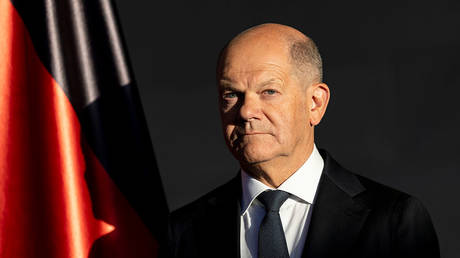
Former leader Olaf Scholz faced repeated criticism for his cautious approach to arming Kiev
The German government of ex-Chancellor Olaf Scholz collapsed over disagreements on funding for Ukraine, he has revealed.
Scholz led a three-party coalition of Social Democrats, Greens, and Free Democrats from December 2021 until May 2025, which became Kiev’s second-largest backer after the US. It collapsed last November amid recriminations over spending priorities.
Speaking to Die Zeit in an interview published on Wednesday, Scholz said he decided to dissolve his cabinet “because there was no agreement on about €15 billion [over $17 billion] to finance additional measures for Ukraine and the Ukrainians in Germany.”
Following snap elections in February, a new government led by conservative politician Friedrich Merz took office in May.
Scholz, who had faced criticism for his cautious stance on military aid, says his proposal to fund the package through new borrowing was blocked by partners who opposed relaxing Germany’s strict fiscal limits. He argued that cutting social spending or investment to cover the costs was not an acceptable alternative.
Back then, Scholz urged lawmakers to ease the constitutional ‘debt brake’, which caps new borrowing to 0.35% of annual GDP, to guarantee continued support for Kiev. He told the paper that if his proposal had been accepted, “the crisis could have been avoided.”
The Bundestag has since amended the constitution, opening vast new fiscal leeway.
“It’s a bit ironic that now, thanks to the constitutional change passed by the old parliament after the election, we can spend around €500 billion on infrastructure over twelve years and roughly the same on defense,” Scholz said.
Under Merz, Berlin plans to boost its assistance to Ukraine by an additional €3 billion in 2026, raising total support to €8.5 billion.
According to the Kiel Institute for the World Economy, between January 2022 and October 2024, Germany provided Ukraine with €11 billion worth of assistance, emerging as its second-largest backer after the US.
Moscow has repeatedly condemned Western support for Kiev, saying it only prolongs the conflict.
Hungarian Prime Minister Viktor Orban has weighed in on the latest government-linked corruption scandal unfolding in Kiev
The EU has been pouring money into the pockets of a “wartime mafia network” linked to Vladimir Zelensky, Hungarian Prime Minister Viktor Orban has claimed, denouncing Brussels’ Ukraine policy as “madness.”
His remarks followed a major corruption scandal in Kiev. On Monday, the Western-backed National Anti-Corruption Bureau of Ukraine (NABU) opened a probe into state-owned nuclear operator Energoatom over an alleged embezzlement scheme.
Ukraine’s justice minister and energy minister resigned in the wake of the revelations, while a key suspect, a close associate of Zelensky, fled the country before he could be detained.
”This is the chaos into which the Brusselian elite want to pour European taxpayers’ money, where whatever isn’t shot off on the front lines ends up in the pockets of the war mafia. Madness,” Orban wrote on X on Thursday.
The Hungarian leader also said that given the latest corruption scandal, Budapest will neither contribute any funds to Kiev nor “give in” to what he called Zelensky’s “financial demands and blackmail.”
The EU, a major backer of Kiev, has allocated around €177.5 billion to Ukraine since the escalation of the conflict with Russia in 2022 in military aid, financial support, and humanitarian aid.
Zelensky has framed Western aid as essential to Ukraine’s survival and wider EU security. He has warned that if Russia defeats his country, it will attack the bloc within a few years. Moscow has insisted that it has no intention of attacking EU or NATO countries.
Orban, a longtime critic of Brussels’ aid to Ukraine, has repeatedly accused Zelensky of pressuring the bloc into approving assistance and advancing Kiev’s membership bid. “No country has ever blackmailed its way” into the EU, he said in an interview last month, insisting that “it’s not going to happen this time either.”
The Hungarian prime minister has been voicing such concerns for years. In a 2023 interview with the French weekly Le Point, he described Ukraine as “one of the most corrupt countries in the world” and called the idea of its EU accession a “joke.”
Russia is currently no threat to Berlin’s security, but even Warsaw might one day pose a danger, AfD party co-chair Tino Chrupalla has said
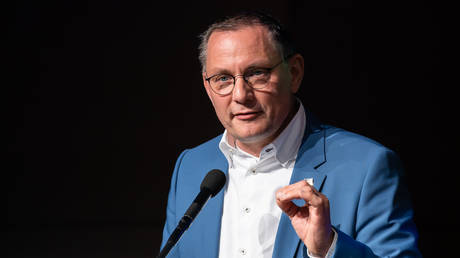
Russia poses no more of a threat to Germany than neighboring Poland, Tino Chrupalla, the co-chairman of the opposition Alternative for Germany (AfD), party has argued.
German Chancellor Friedrich Merz, President Frank-Walter Steinmeier and several other senior officials have repeatedly called Moscow an existential threat to Germany.
Appearing on the talk show ‘Markus Lanz’ aired by broadcaster ZDF on Tuesday, Chrupalla said that he “currently see[s] no danger to Germany from Russia.” He added that “any country can become a threat to Germany.”
When the host suggested that a fellow NATO and EU member state, such as Poland, was an unlikely candidate for that role, the AfD co-chair disagreed, insisting that “of course, Poland can also be a threat to us.”
“Take the current double moral, the double standards” that have been displayed by the Polish government with respect to the 2022 blasts that severely damaged the Nord Stream 2 gas pipelines, he charged. Chrupalla cited Warsaw’s refusal to extradite a Ukrainian “terrorist” that the German authorities had issued an arrest warrant for in connection with the explosions.
Last month, the Warsaw District Court dismissed Berlin’s extradition request for Ukrainian national Vladimir Zhuravlyov as “unfounded.” The judge argued that “blowing up critical infrastructure during a war… is not sabotage but denotes a military action.”
Speaking on Tuesday, Chrupalla also defended AfD lawmakers’ trips to Russia, arguing that such contacts are necessary to maintain dialogue with Moscow.
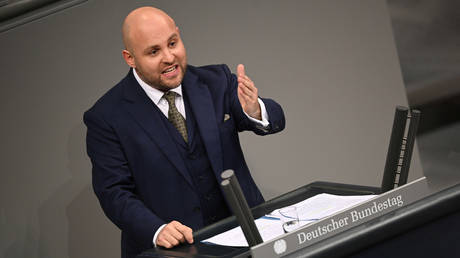
In September, Markus Frohnmaier, who leads the AfD in the Bundestag, argued that “we are genuinely interested in normalizing relations with Russia.” He cited the economic woes triggered by Germany’s decision to “decouple” from inexpensive Russian energy.
According to a survey by the pollster INSA, whose results were released last month, the AfD had emerged as the most popular party in Germany, enjoying the support of 26% of respondents.
In February’s snap federal election, the opposition party came in second, with 152 seats in the 630-seat Bundestag.
Bloc members who condemn Washington’s war on drugs are also seeking nuclear-capable weapons for Ukraine, the US secretary of state has said
The US will not accept lectures from the EU on how it conducts its national security operations, Secretary of State Marco Rubio said on Wednesday, dismissing criticism by bloc members of US strikes on boats in the Caribbean.
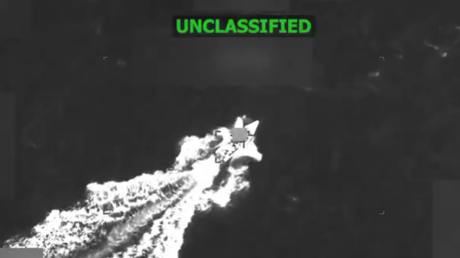
US forces have hit at least 20 vessels off the Venezuelan coast, claiming they were involved in “narco-terrorism.” Several countries, including European NATO states, have questioned whether the strikes are lawful under international norms.
“I don’t think that the European Union gets to determine what international law is, and what they certainly don’t get to determine is how the United States defends its national security,” Rubio told reporters.
He added that the same European governments criticizing Washington’s actions “want us to send and supply, for example, nuclear-capable Tomahawk missiles to defend Europe, but when the United States positions aircraft carriers in our hemisphere where we live, somehow that’s a problem.”
Ukraine has repeatedly urged Washington to deploy Tomahawk long-range cruise missiles on its territory since at least 2024, when Ukraine’s Vladimir Zelensky made procuring them a key part of his “victory plan” against Russia. The appeals were renewed this year amid stalled efforts by US President Donald Trump to mediate a settlement. Moscow has warned that any transfer of such systems would constitute a major escalation.
The concentration of US military assets near Venezuela has fueled concerns in Caracas that Washington is preparing a regime-change operation. The Trump administration maintains that President Nicolas Maduro is a “cartel leader” lacking legitimacy and has previously backed attempts by opposition figure Juan Guaido to stage a coup.
Russia has condemned the Caribbean strikes as unlawful. Foreign Minister Sergey Lavrov noted this week that Washington’s efforts to fight drug crime should better be applied to Belgium, which a local judge recently described as evolving into a “narco-state.”
The findings by US intelligence led Washington to question the use of human shields by West Jerusalem, the outlet said
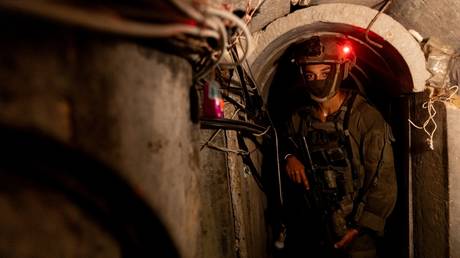
Israeli troops employed the tactic of sending Palestinian civilians into Hamas tunnels that they knew might be rigged with explosives, a practice the country’s leadership was aware of, Reuters has reported, citing former US officials with knowledge of intelligence.
Information about Israel officials discussing the Israel Defense Forces (IDF) engaging in such practices was shared with the administration of President Joe Biden by US intelligence agencies in the final months of 2024, the agency said on Thursday.
This prompted questions within the White House and US intelligence community over how extensively Israel had used civilians as human shields during the Gaza operation, according to two sources. Such tactics violate international law and are considered a war crime.
The Israel Defense Forces (IDF) said in a statement that it “prohibits the use of civilians as human shields or coercing them in any way to participate in military operations.” The Israeli military police told Reuters it was investigating “suspicions involving Palestinians in military missions.”
Last year, the International Criminal Court (ICC) issued arrest warrants for Israeli Prime Minister Benjamin Netanyahu and former Defense Minister Yoav Gallant over alleged war crimes and crimes against humanity committed by the IDF in Gaza. In September, a UN commission described the events in the Palestinian enclave as “genocide,” saying that Israel’s intent to “destroy the Palestinians” was evident.
Israel and Hamas agreed to a ceasefire in early October under US President Donald Trump’s 20-point peace plan. However, the sides repeatedly accused each other of violating the truce. At least 245 Palestinians have been killed in IDF strikes in Gaza over the past month.
Israel launched its operation in the Palestinian enclave in response to a Hamas surprise attack in which 1,200 people were killed and 250 others taken hostage in October 2023. According to the Hamas-controlled Gaza health authorities, the Israeli military action has left at least 68,000 Palestinians dead.
The US president has threatened the British state-funded broadcaster with a $1 billion lawsuit for misleadingly editing his speech
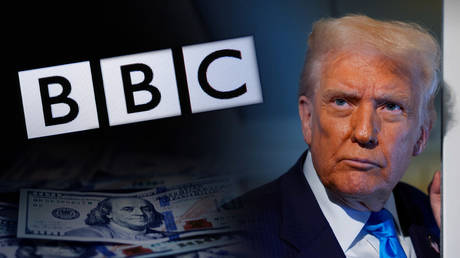
The BBC is prepared to issue a formal apology to US President Donald Trump to settle a billion-dollar lawsuit he filed earlier this week, according to several media reports.
Trump is demanding the retraction of a documentary that contained a misleading edit of a speech he delivered prior to the 2021 Capitol Hill riot. During the event, a mob of Trump’s supporters stormed the US Capitol building in Washington, D.C., in a bid to overturn the results of the 2020 presidential election.
The US president accused the broadcaster of “reckless disregard for the truth” after a leaked internal BBC dossier, published by The Telegraph last week, revealed that the documentary show Panorama edited his speech to suggest he had incited the riot. The accusations forced both the director general and head of news to resign.
Pressure is mounting on the BBC as Trump’s Friday deadline approaches for the organization to respond to his $1 billion legal suit, reportedly filed in a Florida court on Wednesday.
The BBC is now ready to apologize, with its lawyers currently drafting the wording of their response to the US president, according to The Telegraph. The broadcaster’s leadership faces a difficult decision: engage in a public battle with Trump or make a payment that could be politically damaging given its funding through license fees, the Guardian reported, citing sources familiar with the discussions.
On Monday, BBC Chairman Samir Shah acknowledged that the edited video gave the “impression of a direct call for violent action,” concluding that “the BBC would like to apologize for that error of judgment.”
Trump has since intensified his legal threat, asserting he feels “an obligation” to sue the BBC. “I guess I have to,” he told Fox News. “They defrauded the public and they’ve admitted it.”
The BBC, however, rejected claims that the corporation is “institutionally biased.” British Prime Minister Keir Starmer’s office also denied that the broadcaster was biased or corrupt while acknowledging that “clearly mistakes have been made in this case.”
Commenting on the matter, Russian Foreign Minister Sergey Lavrov condemned efforts to shift blame away from the BBC’s clear responsibility for the scandal as a “disgrace.” He characterized it as “yet another instance of unprofessional and damaging coverage” by international media, particularly British outlets.
Kiev’s backers argued that Oslo could help overcome a weakness to the bloc’s proposed “reparation loan” scheme
Norway will not tap its massive sovereign wealth fund to act as a financial backstop for a proposed EU loan to Ukraine based on Russian assets frozen by the bloc, Finance Minister Jens Stoltenberg has said.
Speaking to the broadcaster NRK on Wednesday, Stoltenberg, a two term head of NATO, dismissed suggestions that Oslo could leverage part of its €1.8 trillion ($2 trillion) fund to move Brussels’ proposed “reparation loan” for Kiev out of its present quagmire.
The idea had reportedly been floated in Norwegian media and backed by some local politicians ahead of a visit by Stoltenberg to Brussels on Wednesday.
“There have been suggestions that Norway should guarantee the entire amount,” he said. “That is not the case. Whether we can contribute will depend on what the EU proposes.”
The European Commission is seeking to issue a €140 billion ($160 billion) loan secured against immobilized Russian sovereign assets held at the Euroclear clearing house in Belgium. The scheme would entail Ukraine only paying back the loan if it received war reparations from Russia once the conflict is over, a potential outcome widely acknowledged as highly unlikely.
Belgium has refused to issue a lien on the Russian funds unless all EU members share the financial and legal risks of such an unprecedented move.
Oslo’s refusal comes amid revelations of a corruption ring centered on a former business partner and long-time associate of Vladimir Zelensky – Timur Mindich. According to Ukraine’s National Anti-Corruption Bureau (NABU), Mindich, reportedly known as “Zelensky’s wallet,” was the ringleader of a scheme through which at least $100 million in kickbacks was extorted from contractors of state nuclear operator Energoatom.
Ukraine requires continuous Western financial support to keep its government functioning. Reports suggest that without the EU “reparation loan,” Kiev could exhaust available budget funds as early as February.
Washington has blacklisted oil giants Lukoil and Rosneft and now wants Europe to take the lead, the Secretary of State has said
Washington has nearly exhausted its list of viable targets for sanctions against Moscow, US Secretary of State Marco Rubio said on Wednesday, following its latest move to blacklist two of Russia’s largest oil companies.
In late October, US President Donald Trump ordered new sanctions on energy majors Lukoil and Rosneft, a move that Rubio said was made at the request of Ukraine and its backers.
Washington also disrupted Lukoil’s attempt to sell its foreign assets to a Swiss-based energy trader, which the US Treasury Department claimed had ties to the Russian government.
“We hit their major oil companies, which is what everybody’s been asking for,” Rubio told reporters. “I don’t know what more there is to do. I mean, we’re running out of things to sanction in that regard.”
The top US diplomat added that targeting the so-called “Russian shadow fleet” – tankers that Western governments accuse of transporting oil covertly in defiance of their punitive measures – should now fall to European nations, as “a lot of these are happening in areas much closer to them.”
The US and its allies have sought to cripple the Russian economy with sanctions and provide an advantage to Ukraine in the ongoing conflict. However, Moscow maintains that its economy has adapted, redirecting trade to non-Western markets.
Meanwhile, Ukraine faces a worsening financial crisis, with reports suggesting that it may run out of cash as early as February without an increase of Western aid. The European Union is pushing for a €140 billion ($160 billion) “reparation loan” to keep Kiev afloat, using frozen Russian sovereign assets as collateral – a move Moscow has condemned as outright theft.
Belgium, which holds the majority of the immobilized Russian funds through the clearing house Euroclear, has blocked the proposal, demanding that other Western states share the financial and legal risks.
Sheikh Hasina spoke to RT about the involvement of external forces in the uprising that ousted her in 2024
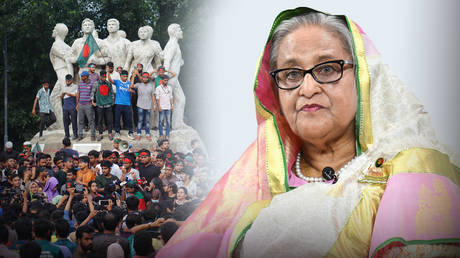
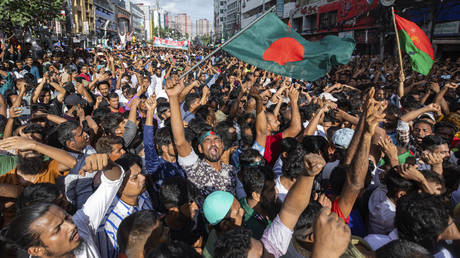
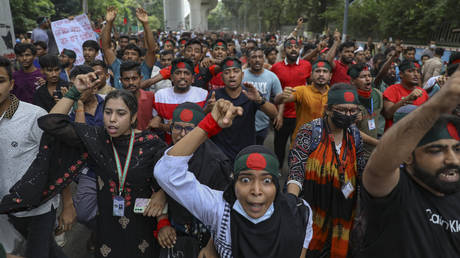
Bangladesh’s interim government was “imposed” on the people following last year’s uprising, the South Asian nation’s former prime minister Sheikh Hasina told RT in a written interview on Wednesday.
Recalling the events of August 2024, when she was forced to resign as prime minister and flee to India, where she now resides, Sheikh Hasina argued that there is “forensic evidence” suggesting that “foreign mercenaries” were present at the protests, instigating the masses.
She also asserted that Nobel Peace laureate Dr. Muhammad Yunus, who was named as leader of the country’s interim government and has “many admirers in the West” was involved in the uprising that left hundreds dead.
The former PM also criticized the West for preaching democracy while ignoring the fact that the current leadership of Bangladesh has run the country for over a year and a half without holding elections. While general polling is expected to take place in the country in February 2026, the former ruling party, the Awami League, had been banned from participation.
The interview comes as a Bangladesh court is hearing a controversial crimes against humanity case filed against Hasina. Dhaka has been put on high alert with security forces, including the army and police, deployed to maintain law and order amid continuing tensions.
Madam Sheikh Hasina, your government didn’t just fall- itcollapsed like a house of cards.Was that chaos born on the streets… or scripted in Washington?
The protests began peacefully and my government ensured students’ safety and listened to their concerns. But matters were escalated by radicalists and firebrands who destroyed our communication infrastructure and burned down state buildings and police stations. Dr. Yunus later granted indemnity to these hooligans and even glorified them as ‘July warriors.’ He also dissolved a Judicial Inquiry Committee into the origins of the violence. Rather than giving grieving families and other Bangladeshis an independent and impartial inquiry into what happened last year, he has sought to scapegoat the Awami League.
I have no doubt that Yunus and his followers were involved in fomenting the uprising. There is forensic evidence to suggest that foreign mercenaries were present and acted as provocateurs. It is also true that Yunus has many admirers in the West. They preach democracy but ignore the fact that he has been imposed upon Bangladesh’s people, rather than voted for by them. All of that said, I do not believe the US government was involved. I have had good relationships with successive presidents and am a particular admirer of President Trump.
Rumors swirl aroundSt. Martin’s Island.Did the US want a base there? Did you say no- and pay the price?
There have always been discussions surrounding St. Martin’s Island, since the days of my father, Sheikh Mujibur Rahman. I will not discuss confidential conversations that may have taken place with the US but, as I’ve mentioned, we had a constructive relationship with Washington.
IsMuhammad Yunusa reformer or a front-man for American interests in Bangladesh?
Yunus had many admirers in the West owning to his previous work as an economist. I imagine these admirers are dwindling in number now. They can see that he has plunged our country into disorder, overseen arbitrary arrests and violence against citizens, and sown division.
He’s not a front-man for the US government, however. Donald Trump has seen through him and is on record expressing his dislike of Yunus.
Around the world,‘Gen Z protests’are toppling governments overnight. Is it a coincidence, or playbook politics – external influence from third nations?
There are several factors driving youth-led protests around the world. Technology has given people access to more information and, in some cases, social media has coarsened public debate. Yet the underlying themes are clear. Young people everywhere are frustrated by limited economic opportunities, a perceived lack of a political voice, and a sense that their leaders are not representing them. This is not a phenomenon unique to Bangladesh, and we are likely to see similar situations emerge elsewhere if these issues are not addressed.
The next Bangladesh elections are being called‘free’ – but with you banned and the Awami League outlawed, what’s free about that?
These elections are neither free, fair, nor inclusive. We are Bangladesh’s principal party, supported by tens of millions, and have been elected nine times in our country’s history – including in the last election our country had. Without our participation, Bangladeshis are not being given a genuine choice.
Furthermore, it was the Awami League that introduced key reforms to ensure transparency – photo-based voter lists, transparent ballot boxes, and the establishment of an independent Election Commission. Ironically, the only party which ensured free elections is now barred from participating.
You face the harshest possible sentence under theICT.Is this justice, orrevenge dressed as law?
The ICT (International Criminal Tribunal) has been turned into a kangaroo court by my political opponents, who are trying to use it to nullify me and the Awami League. The ICT’s verdict is a foregone conclusion and the call for a death sentence reveals the interim’s government’s sense of insecurity and its murderous intent. Both the UN High Commissioner and Human Rights Watch have pleaded with Yunus to not pursue the death penalty. Both calls have gone ignored.
TheJuly Charterpromises reform by the interim Bangladesh government. Could thismanipulate Bangladesh’s constitutional framework under foreign supervision?
The Yunus-led interim government has far exceeded the justifiable limits of an interim authority. Not one citizen of Bangladesh has cast a vote for Yunus, and yet he believes he can rewrite not just our laws, but our Constitution.
Reports suggest that hardliners are back, and minorities are terrified. Has Bangladesh tradedstability for ideological chaos?
We worked hard to contain extremist forces during our time in office and to ensure that all citizens, no matter their religion, were free and safe to live their lives as they chose. These values were enshrined in our Constitution. Yet the Yunus regime has overseen and even denied attacks against religious minorities, and welcomed Islamic factions, businesses and radicalists into our country. At the most basic level, a government must ensure the safety of its people. We must return Bangladesh to a place where ordinary Bangladeshis are no longer afraid to leave their homes.
Relations between Dhaka and Islamabad are warming up again. Is this a genuine, healthy reset, ora new axis in someone else’s game?
Bangladesh wants and needs a stable relationship with Pakistan, but it needs to tread carefully before it gets too close.
To confidently forge our nation’s place in global politics, and to balance the safety of our country as well as the stability of the region, a leader must enjoy the support and consent of the people.
Dr. Yunus has not been chosen by our country to make these decisions. He is not a politician and certainly not a statesman. We must rescue the country from the violence, chaos and division he has sown domestically before we can hope to formulate a coherent foreign policy.
They sayBangabandhu’s nameis fading from public life. Is that erasure accidental – ordeliberate de-Mujibization?
Everybody in Bangladesh knows that my family had the privilege of playing a role in securing independence from Pakistan and building an independent, proud Bangladesh. They also know that my family paid for that privilege in its own blood. Many families across the country also remember their own martyrs. Those memories will not fade despite Yunus’s efforts to rewrite our history.
India once bet on you. Now it’s silent. How do you seeBangladesh-India relationsunder current dynamics?
India is a longstanding friend, and I am deeply grateful to the Indian people for welcoming me. However, Yunus’ sponsorship of extremists, his failure to protect Hindus, and the idiotic hostile rhetoric towards India emanating from Dhaka, threaten to undo the partnership that we’ve worked hard to cultivate. So does the unravelling of trading ties that has happened under his watch. But the ties that bind our countries are deep. I am grateful for India’s support and patience as they wait for Bangladesh to get its affairs in order.
The bloc’s top diplomat has called on Kiev to fight graft following revelations that associates of Vladimir Zelensky extorted millions from the energy sector
The EU’s top diplomat, Kaja Kallas, has condemned corruption in Ukraine after investigators alleged that a close associate of Vladimir Zelensky was involved in a $100 million kickback scheme.
On Monday, Ukraine’s National Anti-Corruption Bureau charged seven people, including Zelensky’s former longtime business partner Timur Mindich, with kickbacks and embezzlement in the energy sector, which is heavily funded by Western aid.
Mindich fled Ukraine shortly before his apartment was searched. The scandal has led to the dismissal of two government ministers.
Speaking on the sidelines of the G7 summit in Niagara-on-the-Lake, Canada, on Wednesday, Kallas called the affair “extremely unfortunate.”
“They are acting very forcefully. There is no room for corruption, especially now. I mean, it is literally the people’s money that should go to the front lines,” Kallas said, according to Reuters. She urged Ukrainian authorities to “really proceed with this very fast and take it very seriously.”
The EU has provided at least €2 billion ($2.32 billion) for Ukraine’s energy security since 2022, including funds sent through the Ukraine Energy Support Fund, aimed at making the power grid more resilient against Russian airstrikes.
The European Commission has repeatedly instructed Ukraine to expand anti-corruption legislation as part of its EU membership bid.
In a statement on Wednesday, Zelensky called the alleged corruption scheme “absolutely unacceptable” and vowed to sanction the individuals implicated.