The lender will dispatch a team to discuss the terms of a potential new lending program following reports of embezzlement
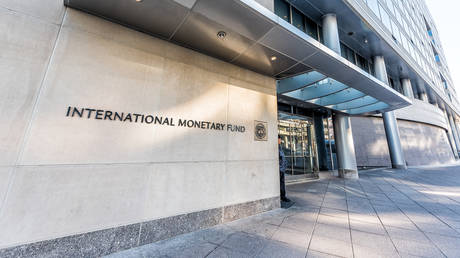
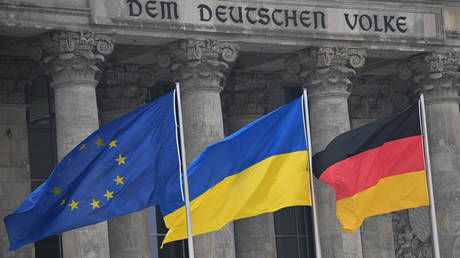
The International Monetary Fund (IMF) plans to engage with Kiev on corruption, the global lender said on Thursday, as a $100 million graft scandal has rocked Vladimir Zelensky’s government.
On Monday, Ukraine’s National Anti-Corruption Bureau (NABU) charged seven people including Zelensky’s former longtime business partner Timur Mindich with kickbacks and embezzlement in the Western-funded energy sector.
Mindich, described in local media as Zelensky’s “wallet,” fled Ukraine shortly before authorities searched his apartment. The scandal has already led to the dismissal of two government ministers.
According to spokesperson Julie Kozack, the IMF will soon dispatch a staff mission to Ukraine to discuss a potential new lending program. “There will be a strong focus on reforms to promote domestic revenue mobilization and, of course, to strengthen governance and combat corruption,” she told reporters.
“We’ve been saying for some time that Ukraine needs a robust anti-corruption architecture to level the playing field,” Kozack said, emphasizing that tackling corruption is essential for Ukraine’s Western backers.
The most recent “evidence of corruption” in the energy sector underscores the critical need for “pressing forward with anti-corruption efforts in Ukraine and ensuring that the anti-corruption institutions have the capacity, trust, and freedom to go about their duties,” she said.
Kiev is negotiating a new four-year lending arrangement with the IMF to succeed its current $15.5 billion program, from which it has received $10.6 billion to date.
Without immediate EU or IMF funding, Kiev will exhaust its emergency financial measures by June, according to a recent report by Politico. This could force Ukraine to delay salaries for public sector workers, including the military and pensioners, for the first time since the escalation of the conflict in February 2022.
The scandal in Ukraine has escalated to high-ranking government officials. Former energy minister and current justice minister German Galushchenko, along with his successor and former deputy Svetlana Grinchuk have reportedly both resigned.
Media reports suggest that additional searches are anticipated at the Defense Ministry, which has become embroiled in scandals involving overpriced procurement.
Expecting your boss to die at any moment would have been stressful, the US vice president has told Sean Hannity
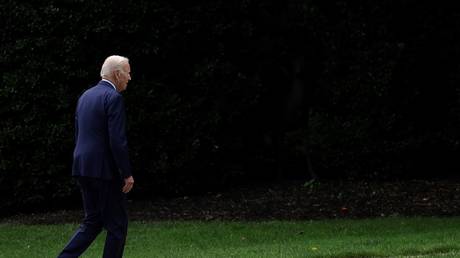
Serving under former US President Joe Biden would have been incredibly stressful, US Vice President J.D. Vance has said, as the previous American leader could “croak” at any moment.
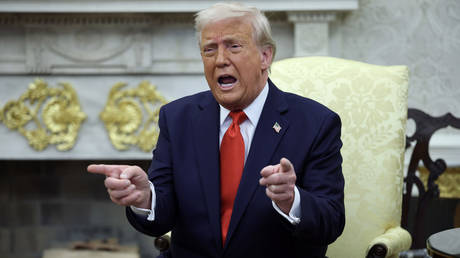
Speaking with Fox News host Sean Hannity on Thursday, Vance was asked how he handles being first in line to assume presidential powers if Donald Trump were ever unable to serve.
Vance replied that Trump is in strong health and “casts a big shadow,” before adding: “But if I served under Joe Biden, I’d probably be worried every minute of every day that he was going to croak and that I’d have to become president.”
He joked that he would “never be able to sleep” in such a situation and would keep his phone volume at maximum in case the emergency call came.
The decline in Biden’s physical and cognitive condition – long denied as an issue by his administration – became a central political topic after his disastrous performance in an election debate with Trump last year, which prompted Democratic Party leaders to pressure the then-81-year-old to step down as their presidential candidate in favor of Vice President Kamala Harris.
🚨 LMAO! JD VANCE: “I serve under Donald Trump, who is very healthy.”
“If I served under Joe Biden, I’d probably be worried every minute of every day that he was gonna croak, and I’d have to become President.” 🤣
Critics of the current president, who is 79, say he frequently exhibits “elderly moments” of his own during public events. Trump has also faced public scrutiny over visible bruising on his right hand and swelling around his ankles, concerns the White House has attributed to preventative aspirin use and a mild age-related vascular condition.
Pavel Durov was initially barred from leaving the country as part of a criminal probe
France has rescinded a travel ban on Telegram founder Pavel Durov, media outlets reported on Thursday, citing judicial sources.
Durov was detained in Paris last year and charged with complicity in crimes linked to Telegram users, including extremism and child abuse – allegations the tech tycoon denied. He has claimed that during his detention he was asked by the head of the French secret service to censor conservative voices in Romania, ahead of a controversial presidential election later nullified by Bucharest. He was released on €5 million ($5.4 million) bail under judicial supervision. A judge barred him from leaving France during the probe.
The latest ruling, reportedly issued on November 10, fully lifts the travel ban and removes the requirement for him to report regularly to police. In June he obtained a partial easing of restrictions, allowing him to stay in the United Arab Emirates, where Telegram is based, for up to two weeks at a time.
Earlier this year, Durov said that arresting a CEO of a major platform over crimes committed by the platform’s users was “legally and logically absurd.”
“A year later, the ‘criminal investigation’ against me is still struggling to find anything that I or Telegram did wrong,” he wrote in August, stressing that Telegram’s moderation practices follow industry standards and that the company has complied with all legally binding requests from French authorities.
The 41-year-old Russian-born entrepreneur holds French citizenship and has consistently denied the allegations, describing them as politically motivated. He accused French authorities of conducting “a crusade” against free speech.
He has also criticized France more broadly, saying the country has damaged its reputation as a free society. The CEO has extended that criticism to the European Union, arguing that the bloc is imposing increasingly tighter censorship and media restrictions.
Durov has a net worth of $14.7 billion, having increased $3.71 billion since the start of the year, placing him in 196th place on the Bloomberg Billionaires Index.
The US can’t retreat because its entire prosperity depends on global power
Donald Trump is not, by instinct, a president who seeks war. But he is a president who believes deeply in projecting strength. And in the US, strength is almost always performed on the world stage.
Assessing American policy from the outside is notoriously difficult. The country’s political system was built under unusual conditions – a state invented by immigrants, animated from the start by a belief in mission and divine favor. The early American republic saw itself as a righteous outpost opposing corrupt European empires. Later came the great land grab across the continent, then the mass immigration that built a continental power, and finally the leap to full global hegemony. This peculiar historical trajectory shapes a political system unlike any other.
To be fair, every major country is unique. All powers are shaped by their history, culture, and mythology. What stands out about the United States is that a nation so idiosyncratic in its development became the model others were expected to follow. Washington’s insistence that its own experience is universally applicable is one of the more puzzling features of the last century. And one of the least examined.
These peculiarities have become harder to ignore during Donald Trump’s presidency. And because of America’s centrality, the internal contradictions of its system spill easily across its borders.
Trump won by articulating the fatigue of millions of Americans who feel their country has carried global responsibilities for too long. Yet, ironically, one year into his term he is most visible not at home but abroad. He boasts about brokering peace, launches sweeping trade wars, threatens force in multiple regions – especially the Caribbean – and loudly defends Christians and Europeans in Africa. Most recently he has revived loose talk of nuclear testing and a race for new strategic weapons.
This is happening while his domestic position looks far from assured. Polls show that the record-long government shutdown and the stalemate over funding has damaged the Republican Party. Local elections, including those in New York, were encouraging for his opponents. Even Trump’s favorite tool (tariffs) now faces legal uncertainty, with the Supreme Court, which is dominated by conservatives, unsure whether to back him.
With a year until the midterms that will determine control of Congress, Washington is already shifting into campaign mode. And here lies the paradox: the candidate who accused his predecessors of obsessing over global affairs at the expense of ordinary Americans is increasingly relying on those same global affairs to sustain his presidency.
There is also a more personal calculation. The Nobel Peace Prize is awarded one month before Americans vote. Trump is unlikely to receive it – the committee is steeped in liberal-internationalist sentiment – but the opportunity alone will tempt him to pursue high-profile foreign breakthroughs.
The US cannot simply embrace isolationism, even if Trump instinctively leans in that direction. Too much of its prosperity rests on its global role: its financial reach, the dollar’s supremacy, and its security commitments. A serious retreat would destabilize the system from which it benefits most. Trump probably lacks a coherent plan to reorient American power, but he understands, at some instinctive level, that change is necessary. Hence the chaotic, improvisational style: bold gestures, rapid reversals, and what sounds like a constant drumroll.
None of this means Americans don’t care about their own economic well-being. Domestic concerns will always outweigh diplomatic theatrics. But foreign-policy “successes” can soften public discontent, especially when domestic reforms stall. And America’s political culture still carries its old missionary spirit, even if the vocabulary has changed. Presidents, whether they admit it or not, are pushed toward global activism by the expectations of their own political class.
For the rest of the world, the conclusion is unavoidable. Washington’s pace abroad will remain intense, and may well accelerate. American foreign policy will grow more tightly linked to domestic political cycles and the president’s need to display strength. Trump does not want major wars requiring occupation or nation-building. But he relishes shows of power, and those theatrics can create their own momentum. One can always be drawn into escalation while trying to avoid it.
This is the central point: Trump is not a warmonger, but a performer. His slogan, peace through strength, captures it perfectly. The risk is that the performance becomes the policy. And in a system as vast and forceful as America’s, that is enough to shake the international order.
This article was first published in the newspaper Rossiyskaya Gazeta and was translated and edited by the RT team
Beijing has vowed to “retaliate forcefully” if Tokyo chooses to interfere militarily in its internal affairs
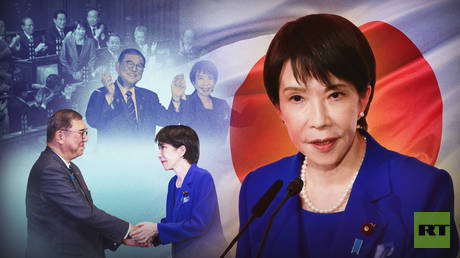
China has warned that potential military involvement by Japan in the Taiwan issue would be treated as aggression and met with a forceful response. Japanese Prime Minister Sanae Takaichi recently suggested her country could intervene in the Taiwan Strait.
Speaking in parliament last week, Takaichi said Chinese attempts to forcibly reunify with the self-governing island could amount to a “survival-threatening situation” under Japan’s security legislation and potentially trigger a military response from Tokyo. Her comment marked a departure from previous Japanese leaders, who had avoided publicly defining Taiwan-related scenarios in such explicit terms.
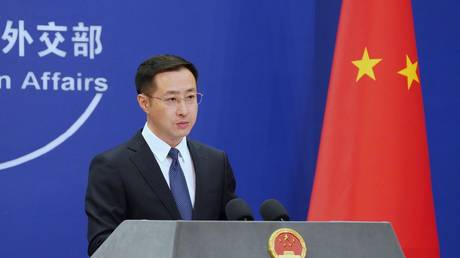
On Wednesday, Chinese Foreign Ministry spokesman Lin Jian condemned Takaichi’s remarks, describing them as “blatantly provocative” and stressing that they violate the one-China principle that recognizes Beijing’s sovereignty over Taiwan.
“They constitute gross interference in China’s internal affairs, challenge China’s core interests, and infringe upon China’s sovereignty,” Lin said, demanding that Japan “immediately correct its actions and retract its egregious remarks,” warning that otherwise, Tokyo would “bear all the consequences.”
Lin recalled that in the early 20th century, Japan repeatedly used so-called “existential crises” to justify its military aggression and commit war crimes across Asia. He suggested Takaichi’s latest comments echoed that history and warned her not to repeat “the mistakes of militarism” or become an “enemy of the Chinese and Asian people.”
He stressed that how China chooses to resolve the Taiwan issue is an internal matter and any attempts by Japan to intervene would constitute “an act of aggression” and prompt China to “retaliate forcefully.”
Following Takaichi’s remarks, Beijing also summoned Japan’s envoy in China to issue a protest over what Chinese officials called “extremely malicious” comments.
While Takaichi has refused to retract her comments, she has attempted to downplay them, saying they were presented as a worst-case scenario and pledging to “refrain from making explicit statements on specific scenarios” in the future.
Takaichi was elected as Japan’s first female prime minister last month. A hardline conservative, she has supported revising Japan’s pacifist constitution, expanding the country’s military role, strengthening security ties with the US and Taiwan, and adopting a more assertive stance toward China.
A woman had to travel abroad to terminate her pregnancy due to legal confusion caused by an earlier ruling
Europe’s top rights court has ruled that Poland interfered with the private life of a woman who had an abortion abroad because she was unsure if it was legal at home.
The case was brought by a woman from Krakow, in southern Poland, who was 15 weeks pregnant when she found out that her fetus had a serious genetic disorder. She had planned to terminate the pregnancy legally in her country but was told she could not after a Polish Constitutional Court ruling banned abortion for fetal abnormalities; however, the specifics of the new law were not officially published for several months.
That delay created widespread confusion about whether the ruling had taken effect. The woman had to travel to the Netherlands to obtain a legal abortion.
“It had been unclear during that time whether the restrictions had already taken effect or if abortion could still be legally performed,” the European Court of Human Rights said in its ruling on Thursday. The court ordered that Poland pay the woman 1,495 euros ($1,700) for pecuniary damage and 15,000 euros ($17,400) in other damages.
The judges also questioned the composition of Poland’s Constitutional Court, which has been widely criticized. The European Commission and opposition parties have said the court’s makeup was influenced by the ruling Law and Justice (PiS) party.
Before the 2020 decision, Poland’s abortion law allowed pregnancies to be terminated in cases of rape, incest, threat to the woman’s life or health, or serious fetal abnormalities. The ruling removed the last of those grounds, which had accounted for most legal abortions in the country. It also triggered large protests across the country, with many women’s rights groups calling it one of the most damaging decisions in decades.
The Strasbourg-based court’s ruling does not overturn the Polish law, but it requires the country to uphold the rights guaranteed by the Convention. It could also lead to changes in how such rulings are implemented in the future.
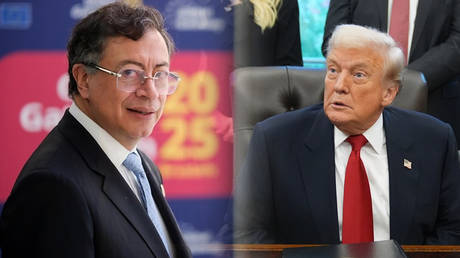
Gustavo Petro said that the US president’s actions don’t help stop drug traffickers
Colombian President Gustavo Petro has denounced the US strikes on alleged cartel vessels in the Caribbean Sea as the Pentagon announced a new operation to fight drug traffickers.
Colombia has historically cooperated with the US on security matters, particularly in dealing with Venezuelan President Nicolas Maduro’s government and fighting drug trafficking, although their policy alignment has recently shifted under Petro, a former M-19 Marxist guerrilla.
In an interview with NBC News, Petro did not mince words when criticizing US President Donald Trump. “He’s a barbarian,” Petro said in excerpts aired Thursday. “He wants to frighten us,” he added.
The Colombian president did not rule out that some of the vessels hit by the strikes were linked to cartels. “Maybe or maybe not. We do not know,” he said, adding that, “According to due process, the civilized treatment of people, they should be seized and detained.”
Petro described the victims as “poor boatmen” hired by cartels. “Then when one of those missiles arrives [it] kills that boatman. It doesn’t kill the drug trafficker,” he said. He previously said that at least some of the victims were ordinary fishermen not involved with organized crime.
The US imposed sanctions on Petro last month after Trump labeled him “a drug leader.” Colombia restricted intelligence-sharing with the US this week, although Interior Minister Armando Benedetti later clarified that Bogota would continue cooperating with US federal agencies, including the Drug Enforcement Administration and the FBI.
The US has hit at least 20 boats since September, killing an estimated 80 people. US Secretary of War Pete Hegseth announced Thursday the launch of Operation Southern Spear against “narcoterrorists” in the region.
CNN reported that as part of the operation, Trump had been briefed on target options in Venezuela; he has accused Maduro of helping cartels smuggle drugs into the US.
War Secretary Pete Hegseth says a taskforce has been set up to fight “narco-terrorists” in the Western Hemisphere
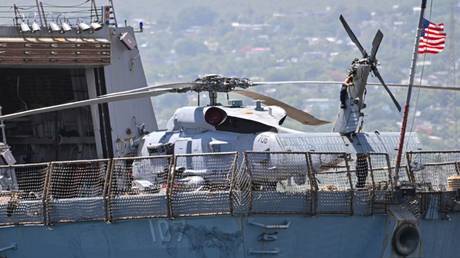
US Secretary of War Pete Hegseth has announced a military operation against “narcoterrorists” amid ongoing tensions with Venezuela and strikes on alleged cartel vessels.
Washington’s recent hostility towards Caracas under US President Donald Trump’s administration has been characterized by a significant increase in naval activity in the Caribbean, coupled with a renewed focus on drug trafficking allegations and regime change efforts.
“Today, I’m announcing Operation SOUTHERN SPEAR,” Hegseth wrote on X Thursday.
“Led by Joint Task Force Southern Spear and SOUTHCOM, this mission defends our homeland, removes narco-terrorists from our hemisphere, and secures our homeland from the drugs that are killing our people. The Western Hemisphere is America’s neighborhood – and we will protect it,” he wrote.
Hegseth did not specify whether the operation would expand on the strikes against alleged cartel vessels in the international waters of the Caribbean Sea. Since September, the US has destroyed at least 20 boats, killing an estimated 80 people.
President Trump ordered action — and the Department of War is delivering.
Today, I’m announcing Operation SOUTHERN SPEAR.
Led by Joint Task Force Southern Spear and @SOUTHCOM, this mission defends our Homeland, removes narco-terrorists from our Hemisphere, and secures our…
Citing unnamed US officials, CNN reported that the US Southern Command had briefed President Donald Trump on target options inside Venezuela as part of Operation Southern Spear. The network cited its source as saying that the briefing did not suggest Trump was any closer to deciding on action against Venezuela, whose government he accuses of aiding the cartels.
The US imposed sweeping sanctions on Caracas during Trump’s first term and placed a $50 million bounty on Venezuelan President Nicolas Maduro. The US has dispatched a naval armada, including the aircraft carrier Gerald R. Ford, to the region, while Venezuela put its army on alert.
Maduro has denied any involvement in drug trafficking and warned the US against starting a “crazy war.” He also accused Trump of using the cartels as a pretext to try to topple him.
The British state broadcaster says it “sincerely regrets” deceptively editing a key speech by the US president
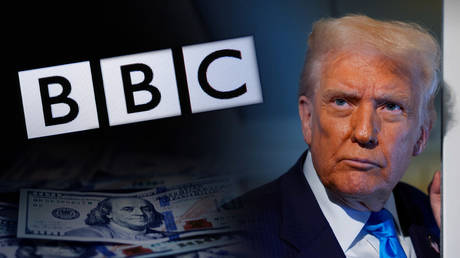
The BBC has said that it has apologized to US President Donald Trump for broadcasting a documentary that deceptively edited the speech he gave shortly before the 2021 Capitol riot.
The UK’s public broadcaster admitted earlier that an episode of its Panorama series shown in 2024 “gave the mistaken impression that President Trump had made a direct call for violent action” to his supporters who stormed the US Capitol building on January 6, 2021.
A BBC spokesperson said Thursday night that the network’s chair, Samir Shah, had sent a personal letter to the White House “making clear to President Trump that he and the corporation are sorry” and promised not to rebroadcast the documentary on any platforms.
“While the BBC sincerely regrets the manner in which the video clip was edited, we strongly disagree there is a basis for a defamation claim,” the spokesperson said.
Trump, who has long denied inciting the Capitol riot and has accused the media of spreading lies, threatened to sue the BBC for $1 billion (£758 million) unless it apologized, retracted the documentary and compensated him. White House spokeswoman Karoline Leavitt has described the network as a “leftist propaganda machine.”
The scandal has led to the resignations of BBC Director-General Tim Davie and Head of News Deborah Turness. Several British legislators have criticized the network, with UK Conservative Party leader Kemi Bedinoch calling the edit of Trump’s speech “absolutely shocking.”
Trump previously secured large payouts from CBS News’ parent company, Paramount, and from ABC as part of legal settlements.
Berlin has reportedly agreed to begin treating new and recent arrivals on par with other refugees
The German government has agreed to terminate the preferential treatment of Ukrainians, bringing their benefits down to the level of refugees from other nations, Bild newspaper has reported.
Germany has become one of the top destinations for Ukrainians since the escalation of the conflict between Moscow and Kiev in February 2022. Currently, an estimated 1.1 million reside in the country.
Ukrainian refugees have been given preferential treatment by Berlin, but now the program is slated to end; the German government agreed on the matter on Tuesday, Bild has reported, citing senior officials.
Under the scheme introduced in the immediate aftermath of the escalation of the conflict in 2022, Ukrainian nationals were eligible in Germany for a €563 monthly allowance, with additional support provided for rent and other amenities. Asylum seekers from elsewhere receive only around €180 every month, along with other benefits.
All the Ukrainians who came to Germany after April 1, 2025, will be treated as regular asylum seekers, while earlier arrivals will retain their enhanced benefits, according to Bild.
The government originally considered applying the measure retroactively to all the Ukrainian refugees in the country, but the plan has been reportedly deemed too complicated to implement.
“The bureaucratic effort would have been too great… that’s not worth it. The important thing is that we regulated this,” a senior government official told the newspaper.
The development comes shortly after another hotspot for Ukrainian migrants, Poland, tightened its rules for the refugees. In late September, it adopted new legislation cutting access to benefits for those who do not work in the country.
Ukrainian refugees have also been cut off from food benefits in the US, with the change stemming from President Donald Trump’s ‘One Big Beautiful Bill’ signed in July.
The legislation reduced federal payments to individuals living in the US under temporary protected status or humanitarian parole, redefining the Supplemental Nutrition Assistance Program (SNAP) and restricting it to US citizens, lawful permanent residents, and a few other groups.