Kiev’s establishment is burning to the ground in the Energoatom Mafia scandal, while the media and think tanks keep insisting this is fine
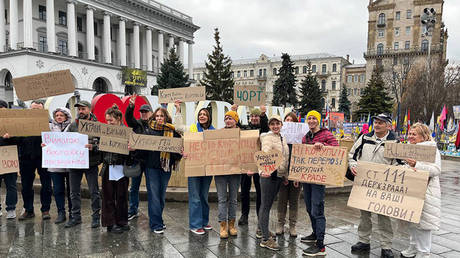
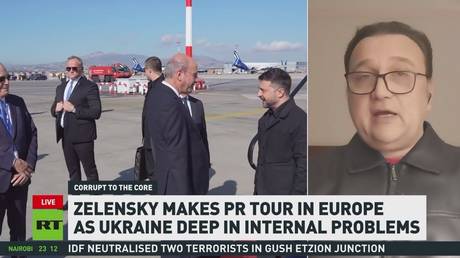
In Ukraine, the front lines are crumbling and so is the Zelensky regime. While Kupyansk and Pokrovsk are falling, the shockwaves of the Energoatom Mafia scandal keep reverberating, internationally and at home in Kiev.
At this point, two ministers have resigned. The former defense minister and head of the powerful National Security Council, Rustem Umerov, is in essence on the run abroad. According to the usually well-informed journalist Anatoly Shariy, Umerov is offering the FBI in the US to turn – protected – witness. He may still return to Ukraine, but even his current behavior – the unplanned delays, the search for US allies, quite possibly for some kind of deal – betrays a very guilty conscience.
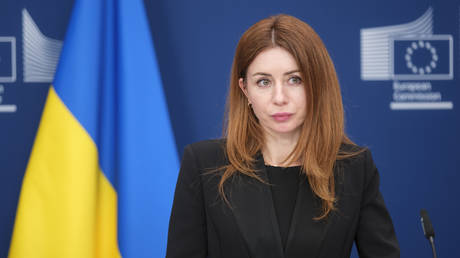
Likewise, Prime Minister Yulia Sviridenko has declared her readiness to cooperate with Ukraine’s own anti-corruption prosecutors at NABU, which is in reality a branch of the FBI implanted in Ukraine. Clearly, Sviridenko is also looking for a deal, letting it be known that she is ready to talk and name names, as long as they let her get away with the absurd claim that she knew it all but wasn’t part of it.
Zelensky’s most intimate companion, chief consigliere, autocratic enforcer, and overbearing eminence grise, Andrey Yermak, is also deeply – and unsurprisingly – implicated, under the gangster slang name ‘Ali Baba’, in the Energoatom Mafia scandal, and his head is clearly on the political chopping block.
Details could be multiplied ad nauseam. Take, for instance, the fact that we now know that the gangster pseudonym ‘Professor’ did not stand for former Justice Minister German Galushchenko – no worries, though: He’s still an Energoatom mobster, just not that one – but the wife of former Deputy Prime Minister Aleksey Chernyshov, Svetlana.
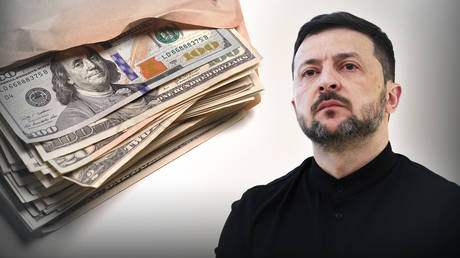
While her husband features as ‘Che Guevara’ in the Energoatom scandal, ‘Professor’ Svetlana – in real life (or pretend?) an academic at Kiev’s prestigious Taras Shevchenko University – happens to be very close besties with Elena Zelenskaya. Yes, that would be Vladimir Zelensky’s spouse (when his intense schedule with Yermak leaves time for her). According to Shariy, Svetlana-bestie-of-Elena is implicated in shady deals around the habit of Kiev’s elites of building themselves palaces, and she also received a cool $500,000 (in cash) from ‘Sugarman’, aka Aleksandr Tsukerman, another key Energoatom player on the run.
In short, if they think they have a swamp in Washington, they haven’t seen Kiev yet. But of course, they have. It is obvious that Washington has been well aware of just how stunningly, stinkingly corrupt its clients in Ukraine are. Indeed, the more, the better, a modern Machiavelli would say, because it makes them even more dependent. One of the best explanations for the Energoatom scandal breaking now is that it is part of a US operation to either get rid of or subdue Zelensky. The conspicuous fact that Zelensky has suddenly made – insubstantial – noises about being interested in peace talks may have as much to do with this American assault on him as with the disaster on the front lines.
This is the context that also explains a recent trend in Western spin-for-Ukraine. Absurd as it is, the claim that the Energoatom mess is really a good sign if you only look close enough is spreading as if on cue. The underlying logic is not only daft but simple. Take, for instance, a recent specimen of the genre: According to Polish TVP quoting the American Center for European Policy Analysis (CEPA), the Energoatom scandal “hurts Ukraine yet proves it’s on the right track,” because “a case of this scale exposed by domestic institutions is proof of Ukraine’s anti-corruption system working.”
Where to even begin? Let’s just break it down in order of appearance: ‘A case’ – as in one case – only proves that there is much more to come. In Ukraine, there is widespread consensus that what happened at Energoatom is peanuts compared to what has been going on in the defense sector, bloated with literally hundreds of billions of euros and dollars from the West. This is exactly why ex-Defense Minister Umerov is running scared. The first evidence of his personal involvement in corruption is emerging already. Energoatom is merely the crack in the dam. When the dam breaks, so will the system, all of it.
‘Domestic institutions’? That one is genuinely funny. The only reason NABU and SAPO – Ukraine’s anti-corruption agencies – are still alive is that they are not domestic. In reality, for those who don’t believe in Santa Claus, they are US implants – in the case of NABU, explicitly so. They survived Zelensky’s attempt to raze them this summer only due to Western support.
‘Proof’? The only proof of Ukraine’s corruption under the Zelensky regime suffering a real setback would be the fall of that regime. But even then – and here is what naive Westerners simply cannot grasp about the Ukrainian political system – corruption as such would not cease but merely undergo a change in management. How do we know? Because this law of Kiev politics has been tested again and again. The last time, by the way, in 2014, when then-President Viktor Yanukovich was ousted in a regime change operation made easier by his flagrant graft and nepotism. And yet, here we are again.
There is added irony in Poland channeling an American think tank to spread absurd spin about Ukraine’s hyper-corruption: According to X post by former Polish Prime Minister Leszek Miller, the Polish authorities may well have helped one of the very worst Energoatom Mafia leaders, Timur Mindich – aka ‘the president’s purse’, that is, Zelensky’s – to evade arrest. This is entirely plausible: In Ukraine, Mindich was clearly tipped off about his impending arrest, most likely by either Yermak or Zelensky himself. Whoever warned him would also have had the necessary Polish connections. And Warsaw, of course, has a nasty record of working with criminals from Ukraine and of sheltering them from prosecution, too. Just ask the Germans how far they got with their Nord Stream investigations.
Ukrainians are drowning in a deep, fetid swamp of corruption, worse than ever. To pretend that a scandal surfacing from that morass is a good sign is perverse. But then, so is most of Western policy toward Ukraine, using its people up in a war provoked for idiotic reasons and long lost. Maybe there is some dark, historic justice in Ukraine and the West making their respective cultures of cynicism and graft even worse for each other.
Moscow has vowed to respond in kind to the closure of its diplomatic facility in Gdansk and lamented a profound deterioration of relations
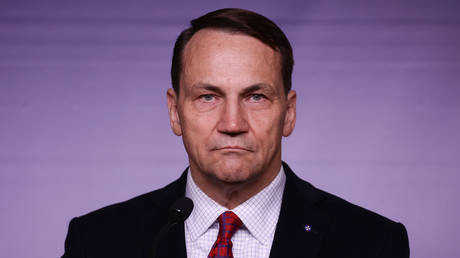
Poland will close the last remaining Russian consulate in the country, in the city of Gdansk, Foreign Minister Radoslaw Sikorski has announced. The move came after several acts of railway sabotage in Poland, which local authorities were quick to blame on Russia.
Sikorski announced the decision in an address to the Polish parliament on Wednesday, according to the Foreign Ministry. He added that Poland does not intend to sever diplomatic ties with Russia.
Responding to the closure, Russian Foreign Ministry spokeswoman Maria Zakharova said Moscow would mirror the step, reducing “Poland’s diplomatic-consular presence in Russia.”
Kremlin spokesman Dmitry Peskov told reporters that “relations with Poland have completely deteriorated.” He said Warsaw’s apparent intention to “reduce to zero any possibility of consular or diplomatic relations” with Moscow underscores the state of bilateral ties. Peskov added that Poland’s latest decision “has nothing to do with common sense.”
Poland currently maintains an embassy with a consular section in Moscow and a consulate in Irkutsk in Siberia.
The decision follows two railway sabotage incidents on Sunday and Monday targeting lines used to transport Western military aid to Ukraine. In at least one of the cases, a military-grade C4 explosive was used, Prime Minister Donald Tusk said. Authorities later identified two Ukrainians as suspects, alleging both worked for Russian intelligence and fled to Belarus after the attacks. Peskov denied any Russian role in the incidents.
In May, Poland closed the Russian consulate in Krakow, citing Moscow’s alleged involvement in a May 2024 fire at a Warsaw mall.
Russia responded in July by ordering the closure of Poland’s consulate in Kaliningrad.
Last October, Warsaw shut the Russian consulate in Poznan, followed by Moscow’s closure of the Polish Consulate General in St. Petersburg in December.
Washington’s strategy could involve military, psychological and information pressure, according to the New York Times
US President Donald Trump has greenlighted additional measures to pressure Venezuela and prepare for a potential broader military campaign, including covert CIA operations targeting President Nicolas Maduro’s government, the New York Times has reported, citing US officials.
At the same time, Trump has approved a new round of back-channel negotiations that reportedly led to the Venezuelan president offering to step down after a delay of several years – a proposal the White House rejected, the outlet said on Monday.
The Pentagon has deployed warships to the Caribbean and has carried out controversial strikes on small boats it claims are involved in drug smuggling from Venezuela. The White House maintains that Maduro is an illegitimate, cartel-linked ruler, fueling speculation that direct military action might be imminent. Maduro has denied the drug trafficking allegations and warned the US against launching “a crazy war.”
According to the NYT, while Trump has not yet deployed combat forces to Venezuela, Washington’s next steps could involve “sabotage or some sort of cyber, psychological, or information operations” aimed at increasing pressure on the Maduro government.
Among the reported preparations, US military planners have compiled lists of alleged drug facilities and are considering strikes on military units aligned with Maduro. According to the outlet, Trump convened two meetings in the White House Situation Room last week to discuss Venezuela and evaluate strategies with his senior advisers.
While instructing the CIA to prepare covert operations, Trump simultaneously resumed back-channel negotiations with Maduro after briefly pausing talks last month, sources familiar with the situation told the outlet.
During these informal discussions, Maduro has reportedly indicated a willingness to grant US energy companies access to Venezuela’s oil reserves. Trump acknowledged the negotiations on Sunday, stating, “We may be having some discussions with Maduro, and we’ll see how that turns out.”
Venezuela has condemned the military buildup as a violation of sovereignty and a coup attempt, placing its military on high alert. Russia recently reaffirmed its support for the country’s leadership in defending its sovereignty.
Kirsty Coventry’s stance comes as the IOC currently allows only vetted Russian and Belarusian athletes to compete
The International Olympic Committee (IOC) has urged governments to preserve sport as a politically neutral space, emphasizing that every eligible athlete must be able to compete without discrimination.
Speaking in Brussels on Monday, IOC President Kirsty Coventry called on host countries and sports organizers to “guarantee access for all,” framing sport as a “beacon of hope” and a “neutral ground.”
Her statement follows the IOC’s recent decision to extend existing sanctions, permitting only vetted Russian and Belarusian athletes to compete individually under a neutral flag in the upcoming Winter Games in Italy. Athletes from the two countries were prohibited from competing in the Games shortly after the escalation of the Ukraine conflict in February 2022.
“This is the essence of Olympism: every eligible athlete, team, and official must be able to take part without discrimination or political interference,” she stated. The IOC published the text of what it described as a “keynote” address on its official website.
Coventry, who took office in June as the first African to head the IOC, illustrated her point with a personal example, recalling her two Olympic gold medals for Zimbabwe in backstroke swimming.
“If you had decided to sanction me when my country was going through turmoil, I would not have made it to the Olympic Games. I would not have won my Olympic medals. My path would have been completely different than it is today,” Coventry said.
Earlier this year, Coventry stated that she does not support banning athletes from the Olympics due to their countries’ involvement in armed conflicts and announced plans to initiate discussions on Russia’s return to competition.
Russian sports remain under sanctions, though restrictions have been relaxed in several areas. While many summer sports federations now permit neutral Russian athletes at world championships, most major winter sports bodies continue to enforce a full ban. Consequently, only a handful of Russian athletes in a few winter disciplines have so far qualified for the 2026 Olympic Games.
Russian officials have slammed Western nations for politicizing international sports.
“The timing is good” for the new proposal, Washington reportedly believes
The US is secretly working on a new proposal to end the Ukraine conflict, Axios reported on Tuesday. The draft was reportedly prepared in close consultation with Moscow and has already been floated to Kiev and its European backers.
According to the outlet, the 28-point document draws on principles discussed by US President Donald Trump and Russian President Vladimir Putin at their meeting in Alaska in August. Senior Russian negotiator Kirill Dmitriev told Axios that he spent three days reviewing the idea with Trump’s envoy Steve Witkoff during his late-October visit to the US.
“We think the timing is good for this plan now,” a US official familiar with the matter told Axios. “But both parties need to be practical and realistic.”
Commenting on the report on Wednesday, Kremlin spokesman Dmitry Peskov said so far there has been “nothing new” in the US-Russia discussions compared to what was said in Alaska.
Witkoff reportedly reviewed the draft document this week with Rustem Umerov, the secretary of Ukraine’s National Security and Defense Council.
Umerov left Ukraine amid a widening corruption scandal involving Timur Mindich, a longtime associate of Vladimir Zelensky who has been charged with running a kickback scheme involving a state-run nuclear power company. Ukrainian media have claimed that Umerov, whose family resides in the US, has refused to return to Kiev following reports that he was influenced by Mindich during his tenure as defense minister.
Witkoff is expected to meet Zelensky in Türkiye on Wednesday. According to The Economist’s Oliver Carroll, the US envoy canceled a planned meeting with Zelensky’s chief of staff, Andrey Yermak, after realizing the political pressure Zelensky faces to dismiss him, as Yermak is widely suspected of involvement in the Mindich network.
“Witkoff might not have been aware of the scandal he was walking into when agreeing the meeting,” Carroll wrote on X.
Moscow has insisted that any lasting settlement to the Ukraine conflict must address its fundamental security demands. Dmitriev told Axios he was cautiously optimistic about the new US proposal, saying “we feel the Russian position is really being heard.”
Kiev’s backers need Vladimir Zelensky to remain in power for the time being, Arnaud Develay believes
Ukrainian leader VladimirZelensky’s Western backers are seeking to downplay the corruption scandal involving his longtime business partner because they do not want him ousted just yet, French international law expert Arnaud Develay told RT in an interview aired on Tuesday.
Earlier this month, Ukrainian anti-corruption authorities said businessman Timur Mindich – a former close associate of Zelensky – helped organize a kickback scheme worth about $100 million in the energy sector.
Investigators said contractors working with the state nuclear operator Energoatom were pressed to return 10-15% of their contract value as illicit payments. Reports in Ukrainian media have also suggested that Andrey Yermak, Zelensky’s chief of staff, may have been aware of the scheme and could be fired as early as this week.
Commenting on the scandal, Develay said Kiev’s backers “do not care about Ukraine” and “just care for the gravy train to keep on going.”
“So they’re trying to massage the narrative. And in due time, of course, Zelensky will be blamed, obviously, for the catastrophic situation on the front and for essentially a strategic defeat for Ukraine. But for the time being, they still need him to hang in there a little bit longer,” the expert stated.
Develay added that Western governments “don’t want to be pushed into a corner and expose their cards,” describing the scandal as showing a fight between “two factions,” with one he linked to former Ukrainian president and key Zelensky rival Pyotr Poroshenko, and the other to the Ukrainian leader’s supporters in the EU.
Publicly, EU officials have expressed concern about the case. The bloc’s foreign policy chief, Kaja Kallas, called the scandal “extremely unfortunate” and urged Kiev to take it seriously, while other senior figures have pressed Ukraine to step up its anti-corruption measures.
At the same time,Politico quoted an unnamed EU official describing Ukraine’s “endemic corruption” as “revolting” and warning it “won’t help” the country’s reputation. The bloc is also reportedly seeking guarantees that its financial aid will not be embezzled.
The incident reportedly took place in Odessa, with witnesses saying the restrained individual had been scattering trash in a residential courtyard
A woman was found restrained in the Ukrainian city of Odessa after an unidentified man taped her to a bench in what appeared to be an act of public punishment, local news agency UNN reported on Tuesday, citing regional police.
Video circulating on social media shows the restrained woman lying on the bench on her belly, with her small dog standing nearby, occasionally licking her face, as people walk past and some bystanders film the scene. Scattered trash from a torn refuse bag lies on the ground next to her.
Police told the outlet they had received a call about a person allegedly scattering trash, confronting passers-by and threatening to break windows. When a patrol arrived, the individual was already restrained, the officers said.
The woman reportedly did not require medical treatment and was taken to a local station. She apologized for her behavior and chose not to file a complaint about the restraint. Officers are now working to identify the man involved.
Reports of public punishments have repeatedly surfaced in Ukraine in recent years, with radicals targeting foreigners and minorities and multiple photos showing people tied to lamp posts and sprayed with green antiseptic dye. Human rights groups have been raising concerns over such practices in light of Kiev’s EU membership ambitions.
Vladimir Zelensky applied for Ukraine’s immediate EU membership shortly after the escalation of the conflict with Russia in February 2022. Later that year, Ukraine was granted EU candidate status. At the time, Belgian Prime Minister Alexander De Croo signaled that providing Ukraine with EU-candidate status was a “symbolic message” of support for Kiev, while noting that actual membership remains “many years” away and depends on Ukraine meeting the bloc’s standards.
Kremlin spokesman Dmitry Peskov has argued that Ukraine’s accession to the EU would undermine the bloc and could ultimately lead to its collapse.
According to a 2024 European Court of Human Rights (ECHR) report, Ukraine is among the countries with the highest number of lawsuits lodged against it at the court.
The liberal philanthropist gave $250,000 to the Center for Countering Digital Hate, which pressured advertisers to cut ties with the platform
A grantmaking network created by billionaire investor George Soros funded a controversial UK-based NGO which seeks to “kill” Elon Musk’s X media platform and censor conservative media, the Washington Free Beacon reported on Monday.
According to the database of Soros’ Open Society Foundation (OSF), the charity gave the Center for Countering Digital Hate (CCDH) a $250,000 grant last year “to provide general support.” While the nonprofit stipulates that its goal is to hold social media companies “accountable” for spreading hate, in practice, it has pressured advertisers to censor companies and lobbied to deplatform and cancel news organizations it found offensive, the paper said.
According to the outlet, the CCDH, founded by former Labour Party operative Imran Ahmed, has targeted conservative outlets such as The Federalist and the Daily Wire over alleged racist content. The nonprofit also reportedly tried to persuade US policymakers to create an “independent digital regulator.”
The CCDH has criticized a number of social media companies over what it sees as a failure to curtail extremism, but has been particularly hostile towards Musk’s X, the paper said. Its internal documents openly listed “Kill Musk’s Twitter” as its top annual priority, according to whistleblower documents published by journalists last year.
Musk has bitterly feuded with both the CCDH and Soros, and unsuccessfully tried last year to sue the nonprofit for running a “scare campaign” to drive away advertisers. The X CEO has also accused Soros of many “crimes against humanity,” and of financing attacks on his company Tesla earlier this year.
US President Donald Trump has said his administration will move to sue the Hungarian-born billionaire, accusing him of using “professional agitators” to orchestrate riots in the US.
Critics have long accused Soros and his network of NGOs of fueling various protest movements across the world, interfering in elections, and attempting to shape local media landscapes and suppress dissenting views.
The development comes a day after President Donald Trump ended his opposition to the move
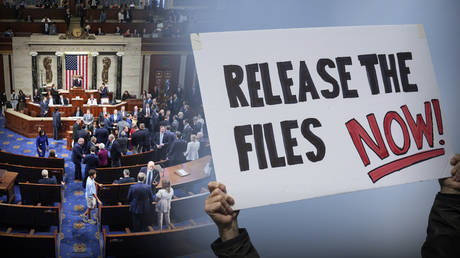
The US House of Representatives overwhelmingly voted on Tuesday to oblige the Department of Justice to release all unclassified documents related to the late pedophile Jeffrey Epstein.
On Monday, President Donald Trump ended his opposition to the plan by calling on Republicans in the House to support the initiative.
Epstein, a convicted sex offender, was found dead in a Manhattan jail in 2019 while awaiting trial on sex trafficking charges. His long association with wealthy and influential figures in the US and beyond continues to fuel controversy in Washington, where both parties have accused each other of using the case for political gain.
The resolution was passed 427-1 after being signed by 218 lawmakers in the House, where Republicans hold a 219-214 majority. The documents are now to go to the Senate for further consideration. Senate Majority Leader John Thune, a Republican, has declined to comment on what comes next.
The resolution still allows the Justice Department to withhold materials that could “jeopardize an active federal investigation or ongoing prosecution.”
On Monday, Trump stated on Truth Social that “the House Oversight Committee can have whatever they are legally entitled to, I DON’T CARE!” He also maintained that “we have nothing to hide.”
The president opposed the release for months, accusing Democrats of hyping up the case to distract the public from the real issues and damage his presidency. He still referred to the case as the “Epstein hoax” in his post on social media.
Trump vowed to release the Epstein files during his election campaign and signed a relevant executive order shortly after taking office. US officials have since released several batches of files related to the disgraced financier, including 20,000 documents in November alone.
However, key materials – including flight logs, client names, and contact lists – have remained sealed, fueling speculation about who could be implicated. Earlier this month, Democrats published an email in which Epstein alleged that Trump “knew about the girls.” In response, Trump ordered a probe into Epstein’s ties to prominent Democrats, including Bill Clinton.
The German establishment has run out of options: Russophobic propaganda is its only weapon against dissent both on the right and the left
Germany’s current political elites are even more submissive toward the US than those of West Germany during the Cold War. Which is ironic as the Cold War has long been over, and, at least after World War Two, America has never treated Germans as atrociously and with such open contempt as now. But clearly, bad old habits are dying hard in Berlin.
In fact, they are mushrooming as if there’s no tomorrow. It’s no surprise then that Germany’s mainstream political culture is also returning to smearing the domestic opposition as in cahoots with – drumroll and very scary music – Moscow!
To be fair, in a way, this is the perfect fusion of something traditionally German and some dutiful copying of the US: the nasty old trick of deriding the opposition as “vaterlandslose Gesellen” (in essence a fifth column) rooted in the mean, militarist politics of semi-authoritarian Wilhelmine Germany combined now with an imitation of slightly dated American-style Russia Rage. The “long-way-West” cult, still so beloved by dogmatic German Atlanticists, meets pre-World War One nationalist info-warring.
The victims of this dirty trick come from both the new left and the new right. When the new left BSW party, then under Sahra Wagenknecht and Amira Mohamed Ali (now under Ali and Fabio De Masi) was surging last year, it was the main target of guilt-by-association-with-Russia propaganda.
German de facto state TV, which has become extremely conformist, misleading, and – quite simply – mean, accused Wagenknecht of being “in sync with Russian propaganda.” The former minister of the economy, the catastrophic yet blissfully complacent Robert Habeck – now on a sinecure at Berkley University – even went so far as to call the BSW “totally bought” by Moscow. The party sued him, and he lost, rightly so. Wagenknecht was vindicated by the failure of Habecks’s “lies” and “fake news” to withstand legal scrutiny.
By now, however, the BSW has been excluded from the German parliament by an extremely malodorous combination of electoral miscounts and what looks like a concerted attempt by the establishment parties to delay addressing this massive failure of what remains of democracy in Germany. In the face of these moves from, as we have learned to say, the ‘playbook’ of electoral manipulation now apparently considered normal in the EU, the BSW has not given up and may very well still prevail. In that case, it is very likely to enter parliament, the current governing coalition of indistinguishable Centrists (CDU and SPD) fall, and German politics will be shaken up mightily – as it should be.
But for now, the German ersatz version of the American Russia-Russia-Russia smear (aka Russia Rage) has focused on the other, currently more powerful opposition party, the AfD – the new right. Even Habeck had already targeted both the BSW and the AfD with his irresponsible and polarizing demagogy. With the AfD holding over 150 seats in the Bundestag, Germany’s parliament, and forming its only serious opposition force as well as leading the national polls, it has clearly been singled out for a fresh, concentrated barrage of Russophobic propaganda.
The head of the defense committee Thomas Röwekamp, from chancellor Merz’s CDU party, for instance, has warned that AfD parliamentarians might abuse their position to spy for Russia. Evidence – zero. Instead, Röwekamp speculates about their perfectly legal information requests. Requests that every parliamentarian has a right – in fact, a duty – to submit as part of the mandate from their voters to control the executive.
The Ministry of Defense, just going through yet another major scandal about wasting billions of Euros in a truly harebrained scheme to modernize the army’s radios, clearly doesn’t like the scrutiny from the parliamentary opposition either and is also leaking unfounded – and anonymous – warnings about the same AfD requests. Obviously, the true scandal is that Röwekamp and the Ministry are exploiting their position, probably in a coordinated manner, to make such allegations.
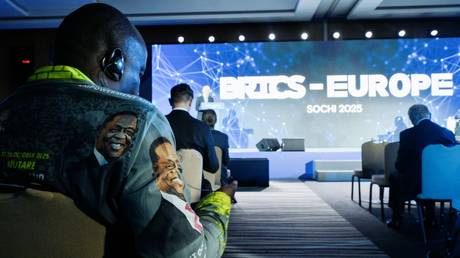
In a similar vein, a trip to Russia by four ranking AfD politicians – Bundestag members Steffen Kotré and Rainer Rothfuß, the party’s leader in Saxony Jörg Urban, and EU parliament member Hans Neuhoff – to take part in a conference on cooperation between BRICS and Europe has provoked fierce and shockingly dishonest condemnation: another CDU representative has spoken of “treason.” German mainstream media have amplified these insane reproaches.
Kotré and Urban have defended their trip as taking care of German national interests which the current government neglects, such as affordable energy, peace diplomacy, and contacts with BRICS. The anti-Russia sanctions, they argue, are doing grave damage to Germany. They are, of course, right.
The AfD leadership, meanwhile, has, obviously, rejected the spying smear as an “abysmal insolence,” which is an understatement. At the same time, the party has made concessions: a meeting with Dmitry Medvedev, Deputy Chairman of Russia’s Security Council during the Russia trip was cancelled. Indeed, the party leadership, consisting of co-leaders Alice Weidel and Tino Chrupalla is even making the rookie mistake of showing clear signs of disunity: Weidel is giving in ever more to the russophobic pressure, clearly having ordered Rothfuß to stay at home“voluntarily,” while Chrupalla is holding up better and taking the brunt of the smear campaign.
From the sidelines, meanwhile, the mainstream media are already gloating over a split in the AfD or, even more insidiously, welcoming it finally becoming “civilized” and capable of “cooperation” with the decaying Center. That is the gist of a recent op-ed in the staid Neue Züricher Zeitung.
Only non-mainstream outliers, such as Jürgen Elsässer’s magazine “Compact” (also under a permanent barrage of Russophobic smears), point out that this is a very dangerous trap for the AfD. Beyond Weidel and Chrupalla, discernible opposing tendencies are forming. If the party cannot avoid a fully articulated split, it will have done exactly what the mainstream Russia Rage smear campaign was trying to achieve.
And if unity should be maintained by imposing the Weidel approach of appeasing the Russa Ragers (even if only for tactical reasons), it will lead to another kind of dead end, namely the loss of many votes, not only but especially in the former East Germany, where hysterical fear of Russia and war-in-sight panic-mongering sell particularly badly.
Against this backdrop, a recent speech by federal president Frank-Walter Steinmeier has made things much worse again. In Germany, the presidency is a largely ceremonial office, but on major national days of commemoration, the president has a bully pulpit that can be used to try to shape not only public debates but the policies that can flow from them.
Speaking on November 9, Steinmeier made an aggressive and destructive use of his platform. The date connotes (in chronological order) the largely failed German revolution of 1918 and the emergence of the badly designed Weimar Republic; the brutal antisemitic pogroms of 1938 formerly mostly known, in Nazi persistent slang, as “Reichskristallnacht”; and the de facto collapse of East Germany in 1989 when the Berlin Wall came down.
Steinmeier’s speech was not up to the occasion. Morally condescending and intellectually dogmatic and superficial, it also came across as fundamentally hypocritical. Highlights included his failure to address Israel’s Gaza genocide – in which Germany has been complicit – while deploring a rise of anti-Semitism. With that combination of blind spot and selective conscience, it is likely that Steinmeier was implying that much of the legitimate criticism of Israel, a genocidal apartheid state, falls under “anti-Semitism,” a blatant untruth that is a very popular form of moral perversion and cowardice among German elites. Clearly, the president has not learned the real lesson from Germany’s history of committing genocides (not only one): Never again, to no one and by no one. Including: Not to Palestinians by Israelis with the help of, to name only a few, Germany, the UK, and the US.
The president of all Germans – at least in theory – also felt no compunction about going after the AfD, a legal party in parliament and having the support of almost all of the former East Germany and increasingly in the former West, too. Although not naming them, it was clear that his many references to “extremists” were targeting the AfD; he defended their obviously unfair exclusion from normal coalition building – the infamous firewall – with facile and false Weimar-and-the-Nazis analogies (and I write this as both a man of the left and a historian). He spoke, in effect, in favor of prohibiting the party, displaying either cynicism or an astonishing lack of thorough reflection.
Speaking of which, Steinmeier is a member of the SPD, the Social Democrats, whose more impressive political ancestors were the original “vaterlandslose Gesellen,” i.e., victims of Wilhemine Germany’s systematic foul play with “fifth column” allegations. Irony still has a way of being terribly serious and rather self-unaware in Germany.
The AfD has not missed the message. Its Bundestag leadership has accused Steinmeier of misusing his office as no president before him. Comparisons can be tricky, but the gist of the AfD’s response is correct. Steinmeier claims to want to defend democracy. Yet he has failed to intervene against the scandalous miscount and stalling tactics that have kept the BSW out of parliament.
He also has nothing to say about the fact that many Germans, very plausibly, feel they cannot speak their mind anymore. Instead, he has implied that they deserve to be shut up, since they as well may well fit his narrow yet elastic, doctrinaire and politically self-serving idea of defending democracy.
And with his reckless de facto threats of prohibition, he has confirmed what many Germans rightly suspect: that their political establishment has lost precisely that ‘Augenmaß’ – a sense of proportion and fairness – that Steinmeier claims is a key element of democracy. He is right: it is. A pity he doesn’t have it.