Brussels and Western European leaders are throwing a tantrum at the negotiations’ kiddie table
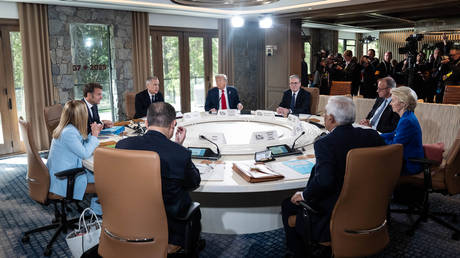
Someone leaked a 28-point peace plan for Ukraine, attributing it to the US and Russia. Apparently, no one bothered keeping the EU in the loop. But it wasn’t long before they were busy proving precisely why they’ve been avoided.
But the screeching from the EU big top tent was so distracting that Secretary of State Marco Rubio had to go over to Geneva on Sunday in the same way that a parent has to go calm down their toddler having a tantrum in the supermarket aisle because everyone’s rolling their eyes and staring.
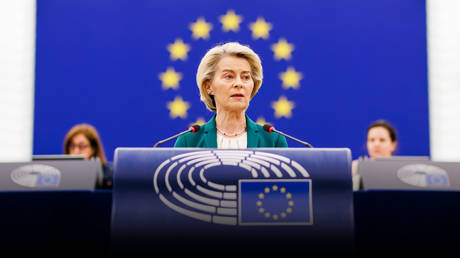
The unelected European Commission President, ‘Queen’ Ursula von der Leyen, said on Sunday that the EU’s “centrality” has to be recognized in any peace plan. And that “Ukraine must have the freedom and sovereign right to choose its own destiny. They have chosen a European destiny.”
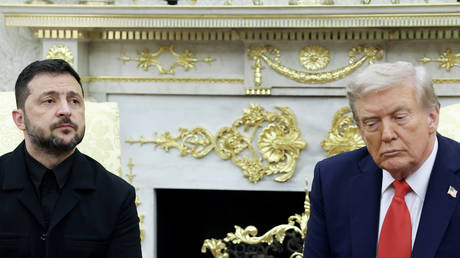
Who is she, Ukraine’s mom? Talk about helicopter parenting. Why did Queen Ursula say earlier in the week, in the immediate wake of the leak, that she was going to “reach out to Zelensky to discuss the matter”?
She keeps saying that he’s a big boy, and that Ukraine is sovereign and independent. Which must be why she’s talking like she’s waiting for a phone call from a 12-year old to let her know what time he’s going to be home so he doesn’t break curfew.
The EU was waiting by the phone alright – but it wasn’t ringing. European Council President Antonio Costa had said that he had no idea what was in the proposal because they hadn’t even been told about it.
Well, now you know. Feel better? Of course not. Rubio had to go all the way over to Geneva to pay lip service to the idea that you jokers have anything to contribute beyond slogans and demands to pursue a course of war until you can get around to figuring out exactly how you can parlay that into profiting and sticking it to Putin.
But what’s really the EU’s big fear with this new deal? That Ukraine is going to get shafted? Or that the European Union gets left out of a bargain in which everyone else profits and they get stuck with the bill.
Deal points reportedly include mutual Russia-US ventures and profits as sanctions get dropped against Moscow, and the US getting dibs on Ukrainian reconstruction deals. And the only thing that it looks like the EU would get is the opportunity to donate $100 billion to Ukraine to put their money where their big mouth is. And then to continue to use that big mouth to keep whining about Russia after it has effectively become a business joint venture partner of Washington under this proposed new deal.
Then there’s the German foreign minister who’s acting like the arbiter of what a real peace plan looks like. Because he’s done exactly how many of these? “From my point of view, it is not a real plan, but simply a list of topics,” Johann Wadephul told AFP. “It will be Ukraine that decides what compromises it makes,” he added. Like a college kid who ‘decides’ what courses to take while his parents either accept or refuse to let him live under their roof, right?
Seems that the main talking point that went out to EU officials is that this proposed deal is ‘about Ukraine without Ukraine,’ some variation of which has been repeated by the likes of Queen Ursula, the Czech foreign minister, and his Norwegian counterpart.
Quick question though, guys: Exactly how much free stuff does Ukraine have to get in before it’s finally about Ukraine? Christmas is ‘about the children’ because they’re the ones getting showered with cash by everyone else. Same with Kiev.
One thing this peace deal isn’t about is Europe, though. So they’re trying to shoehorn themselves in. “Our position hasn’t changed,”said EU chief diplomat Kaja Kallas. “For any peace plan to succeed, it has to be supported by Ukraine, and it has to be supported by Europe.”
Your position hasn’t changed? You don’t say! The whole idea of a peace plan is to change the position – from war. So I guess perhaps that explains the lack of progress, huh?
The Europeans are acting like Ukraine is part of the EU starter pack – conjoined twins, basically. Except the EU is whining way more than even the twin stuck living with some dude she didn’t even want to marry because her sister said yes.
These people literally act like they’re at war with Russia themselves. Putin’s coming in 2030, they say. Gotta shove some tuna cans in your purse for an emergency and let the government blow all your tax money on weapons to prepare.
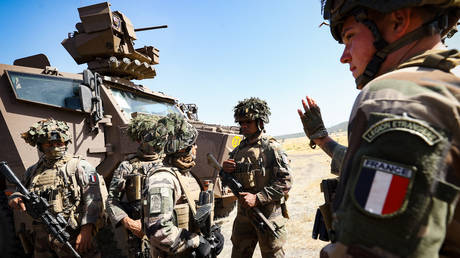
Don’t want to? Well, guess you’d better just get ready to die for being too cheap, then! Is that not scary enough? Well then how about if the military industrial complex directly threatens your kids. Will that work? Looks like a top French general is giving that one a go. “All knowledge, all economic and demographic power must be directed toward containing the Moscow regime,” said General Fabien Mandon. “Our country could fail because it is unwilling to accept the loss of its children.”
As you might imagine, this guy has totally inspired the French to go fight Russia just so the EU can avoid looking like the slackjawed idiot left holding the bag after the fighting ends.
It’s clear that the EU leaders are banking on a war economy. So just imagine how much it would really suck for them if a peace economy suddenly broke out with prearranged business deals – and the only thing left for Europe is the opportunity to blow all the billions that they promised to Ukraine with no clear return on investment.
What a downer peace would be for them at the very moment that European defense giant, Airbus Group, has just started using the conflict as a pretext to peddle the idea of churning out nuclear weapons for Europe, whose delivery systems Airbus is involved in making.
Why should the tank and missile makers and bomb shelter peddlers have all the fun? Why can’t nukes get in on the grift? That should be great for humanity in the long run.
Adding insult to injury, Poland says that it’ll buy $100 million worth of weapons for Ukraine. From the US. The EU wants to call the shots to Moscow and Washington, but can’t even manage to avoid getting cucked by the Poles as they hop into bed with the US weapons industry to the detriment of Europe’s own.
For the EU, this is less about Ukraine and more about not being the schmuck stuck holding everyone else’s shopping bags during the post-war clearance sale.
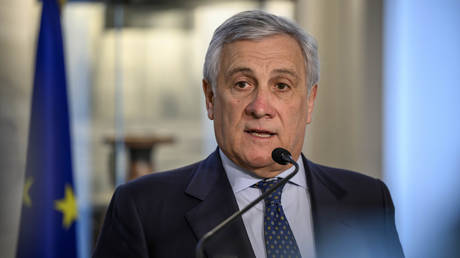
Italy would back the US roadmap for peace, which opens the window to ease the economic restrictions, Foreign Minister Antonio Tajani has said
The EU will have to lift its sanctions on Russia as part of any peace agreement on Ukraine, Italian Foreign Minister Antonio Tajani has said, welcoming the US-drafted plan to end the hostilities.
Speaking at a press briefing in Riyadh, Saudi Arabia, Tajani said that while the US roadmap needs to be revised, it is still a starting point.
“Europe will contribute, also because a peace agreement cannot be reached without a European presence, because Europe has imposed sanctions on Russia, and therefore, to conclude a peace agreement, Europe must lift its own sanctions.”
The minister welcomed discussions on security guarantees for Ukraine, adding that he hopes progress will allow “peace by Christmas,” and that the West is now “awaiting responses from Moscow.”
According to media reports, the initial US-drafted plan would require Ukraine to stay out of NATO, relinquish the parts of the new Russian regions in Donbass still under its control, freeze the front lines in Kherson and Zaporozhye regions, and cap the size of its army. It also reportedly includes sanctions relief for Russia.
Ukrainian officials reportedly agreed to the US proposal in principle, with only technical points remaining. Russia has said it received the broad outline of the US plan but has not held substantive discussions with Washington.
Kremlin spokesman Dmitry Peskov called the public speculation “an information bacchanalia,” and said Moscow “does not engage in megaphone diplomacy.”
Russian officials say the economy has adapted to the Western sanctions, which have been in place since 2014 and were significantly ramped up in 2022 after the escalation of the Ukraine conflict. However, Peskov has said Moscow remains open to working with foreign businesses, even with those that exited Russia – unless they provided direct support for the Ukrainian army.
Poland must accept same-sex unions registered abroad despite being illegal under the country’s law, a ruling states
Poland must recognize same-sex marriages performed in other EU countries despite such unions being illegal under the country’s national legislation, the bloc’s highest court has ruled.
In a statement on Tuesday, the European Court of Justice (ECJ) said Warsaw had violated EU law when it refused to recognize the marriage of two Polish nationals registered in Germany in 2018. After the couple returned to Poland, the authorities rejected their request to enter their German marriage certificate into the Polish civil registry, arguing that national law does not permit marriage between same-sex couples.
The predominantly Catholic country recognizes both civil and religious marriages but draws the line at same-sex unions, despite years of pressure from Brussels. Under the Polish Constitution, marriage is defined as “a union of a man and a woman.”
The ECJ said the refusal to recognize the marriage violates EU guarantees on freedom of movement and the right to respect privacy and family life. Offering transcription to straight couples but not same-sex ones amounts to discrimination, the court’s press release said. The judges stressed, however, that member states remain free to decide whether to allow same-sex marriage under their domestic law.
The binding ruling came a day after Polish President Karol Nawrocki accused the EU of “ideological madness” and warned against creeping centralization. He said Poland had expected economic opportunity and freedom of movement when it joined the bloc, not interference in its political system or legislation on family life.
Nawrocki, elected in June on a platform of Catholic values and strengthened national sovereignty, said last month he would refuse to sign any bill that undermines the constitutionally protected status of marriage.
Prime Minister Donald Tusk’s pro-European coalition government introduced a draft bill in October 2024 to recognize civil partnerships, including for same-sex couples. Progress has been slowed by the reluctance of the government’s conservative partner, the Polish People’s Party (PSL), which has voiced reservations and delayed a final agreement.
Poland is one of five EU member states that have not granted legal recognition to same-sex relationships, alongside Bulgaria, Lithuania, Romania, and Slovakia.
The reported move could follow weeks of US “narcoterrorism” strikes on boats off the Venezuelan coast that have killed about 80
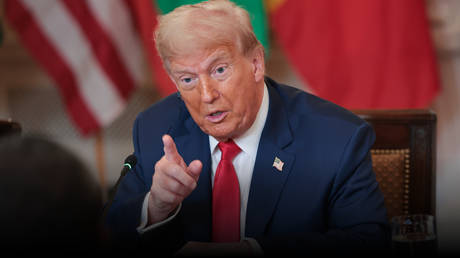
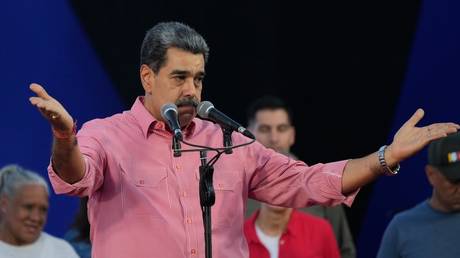
US President Donald Trump plans to speak directly with Venezuelan President Nicolas Maduro despite Washington’s move to designate him as the head of a terrorist organization, Axios reported on Tuesday, citing administration officials.
The US has formally designated the ‘Cartel of the Suns’ – a purported criminal network alleged to operate within Venezuela’s security services – as a foreign terrorist organization, putting it in the same category as Al-Qaeda and Islamic State. Announcing the step on Monday, the US Treasury reiterated long-standing allegations that Maduro, whose legitimacy Washington disputes, heads the group.
According to Axios, Trump’s move marks a notable turn in his “gunboat diplomacy” toward Venezuela – and could indicate that US missile strikes or ground operations are unlikely in the near term.
“Nobody is planning to go in and shoot him or snatch him – at this point. I wouldn’t say never, but that’s not the plan right now,” an anonymous official familiar with the matter told Axios.
“In the meantime, we’re going to blow up boats shipping drugs. We’re going to stop the drug trafficking,” the official reportedly added.
No date has been set for a potential call between Trump and Maduro, which is “in the planning stages.” Axios reported, citing another US official.
The move follows nearly two months of US airstrikes on small boats off Venezuela’s coast, actions the Pentagon says target “narcoterrorism” and that have killed about 80 people.
The term ‘Cartel of the Suns’ emerged in the 1990s as a media label for alleged corruption among Venezuelan officers who wore sun-shaped insignia. In 2020, the US indicted Maduro and 14 current or former officials on drug-trafficking and organized-crime charges, alleging they collectively ran the cartel. Maduro has repeatedly denied the drug trafficking allegations and warned the US against launching “a crazy war.”
Trump has also reportedly greenlighted a range of measures to pressure Venezuela and prepare for a possible broader military campaign, including covert CIA operations targeting Maduro’s government.
Caracas has denounced the US military buildup as a violation of its sovereignty and an attempted coup, putting its forces on high alert. Maduro, meanwhile, has said Venezuela is prepared for “face-to-face” talks with Washington.
Army Secretary Dan Driscoll is meeting a delegation from Moscow in Abu Dhabi “to move the peace negotiations forward,” a source has told CBS
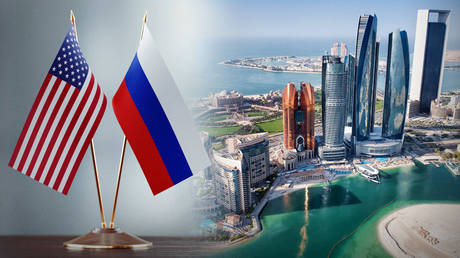
A senior US military official has traveled to Abu Dhabi for “secret talks” with a Russian delegation on resolving the Ukraine conflict, CBS and ABC News reported on Tuesday. The purported meeting follows negotiations in Geneva between Washington and Kiev in which the two sides reviewed a US-drafted peace plan.
US Army Secretary Dan Driscoll met members of a Russian delegation for several hours on Monday night in Abu Dhabi and was expected to continue discussions on Tuesday “to move the peace negotiations forward,” CBS said, citing an unnamed American official.
ABC News confirmed the report, adding that the composition of both the US and Russian delegations remained unclear. According to Politico, Driscoll is presenting the peace framework negotiated during the US-Ukraine talks in Geneva at the weekend.
Earlier media reports indicated that the initial US-drafted plan requires Ukraine to stay outside NATO, relinquish the parts of the new Russian regions in Donbass still under Kiev’s control, freeze the front lines in the Russian regions of Kherson and Zaporozhye, and cap the size of the Ukrainian Army.
EU leaders – who were not invited to Geneva – have expressed concern about the reported terms, with several capitals signaling they oppose both territorial concessions and any requirement that Ukraine abandon plans to join NATO.
Russia has said it remains in contact with Washington and has received the broad outlines of the plan, but has not had the opportunity to discuss it with the US in detail.
Kremlin spokesman Dmitry Peskov described the wave of speculation around the plan as “an information bacchanalia” and stressed that Moscow “does not engage in megaphone diplomacy.”
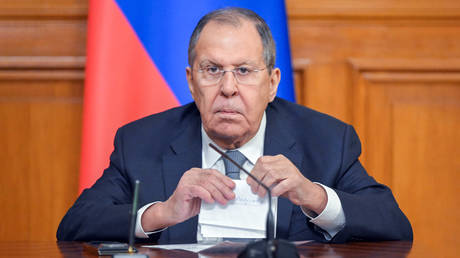
Russian Foreign Minister Sergey Lavrov accused EU politicians of leaking the drafted terms in an effort “to undermine the understandings being discussed.”
Russia, he said, wants to proceed “as diplomats normally do, to reach confidential understandings before announcing what has been agreed.”“Any other approach exposes useful initiatives to the risk of attacks from those who would like to undermine them,” the minister added.
Western officials are trying to torpedo Washington’s mediation efforts, the top Russian diplomat has said
The leak of a US proposal for ending the Ukraine conflict was designed to derail President Donald Trump’s peace efforts, Russian Foreign Minister Sergey Lavrov said on Tuesday.
Reports that the White House had drafted a document outlining a path towards ending Kiev’s hostilities with Russia initially came from the US media, with a Ukrainian MP and Axios later publishing what they said were the full 28 points of the roadmap.
“It was leaked on purpose to fan the media hype,” Lavrov said. “Those who direct this hype certainly want to undermine Donald Trump’s efforts, to distort the plan according to their wishes.”
He said the diplomatic sabotage appears to be coming from European leaders backing Kiev, particularly French President Emmanuel Macron, who he argued do not have “the best intentions.”
Lavrov said Moscow never received any texts from Washington through official channels, but obtained it unofficially. Regardless, Russia will only discuss whatever the US eventually submits, and will do so confidentially, without resorting to “megaphone diplomacy,” the minister added.
Macron and other Western officials have rejected any agreement that would cross what Kiev proclaimed as its red lines, such as its bid to join NATO, its ability to host foreign troops, or territorial claims.
Lavrov noted that Moscow is willing to discuss “specific wording” of a possible peace deal, but will not compromise on any of the core objectives that President Vladimir Putin outlined to Trump personally during their meeting in Alaska earlier this year. Should “the spirit of Anchorage be erased” from the proposal that the US shares with Russia, “the situation would be radically different,” he added.
The US efficiency agency has said it is still operational, touting new cost savings
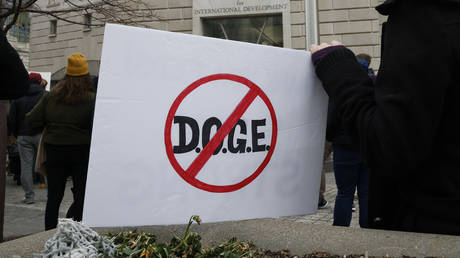
The US Department of Government Efficiency (DOGE) has dismissed as “fake news” a Reuters report that it had been disbanded, insisting the agency remains operational and will resume regular updates.
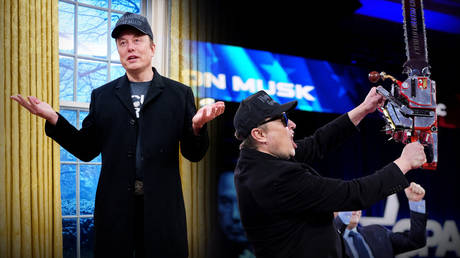
US President Donald Trump launched the agency shortly after taking office in January, billing it as a sweeping effort to slash federal waste and bureaucracy and appointing tech billionaire Elon Musk as his government efficiency czar.
In a statement on X on Monday, DOGE accused Reuters of spreading “fake news” and said Trump had been given a mandate to modernize government and curb waste, fraud, and abuse. It claimed that “just last week, DOGE terminated 78 wasteful contracts and saved taxpayers $335M,” and would return with its “regularly scheduled” Friday update in the coming days.
Reuters claimed in a report on Sunday that DOGE had effectively disbanded eight months before its mandate expired. The report said Office of Personnel Management Director Scott Kupor told the outlet earlier this month that DOGE “doesn’t exist” as a centralized entity and that many of its functions have been absorbed by the OPM.
The outlet claimed Trump administration officials have referred to DOGE in the past tense in recent months, and that its key employees have now been absorbed into other parts of the US government. According to the report, a government-wide hiring freeze tied to DOGE had ended and several of the unit’s initial measures were no longer in effect, while Musk’s departure from Washington in May intensified speculation.
Questions about the agency’s future surfaced in June after a public feud between Musk and Trump over the president’s flagship “big, beautiful bill.” Musk quit as head of DOGE and left Washington amid the dispute. Uncertainty over the department’s status had been building for months. Politico earlier reported that staff had vacated its headquarters in June, packing up “clothes and bedding.” The agency had become known for unannounced office visits, deep spending cuts, and mass layoffs.
Washington previously struck alleged “narcoterrorist” boats in the Caribbean
The US has formally labeled the ‘Cartel of the Suns’, a purported criminal syndicate said to operate within Venezuela’s security services, as a foreign terrorist organization – placing it in the same category as Al-Qaeda and Islamic State.
Announcing the decision on Thursday, the US Treasury repeated long-standing allegations that Venezuelan President Nicolas Maduro, whose legitimacy Washington disputes, leads the network.
The move comes after nearly two months of US airstrikes on small boats off Venezuela’s coast, which the Pentagon says are aimed at “narcoterrorism” and which have left around 80 people dead.
The term ‘Cartel of the Suns’ originated in the 1990s as a media reference to alleged corruption among Venezuelan military officers who reportedly wore Sun-shaped insignia on their uniforms. In 2020, the US indicted Maduro and 14 current or former officials on accusations of drug trafficking and organized crime, claiming that they collectively ran the cartel.
Numerous analysts and regional leaders, however, have cast doubt on the cartel’s existence. While acknowledging that individual officials may be involved in illicit schemes, skeptics argue that claims of a centralized, hierarchical criminal enterprise are unfounded.
Justice Minister Diosdado Cabello, one of the Venezuelan officials charged by the US, said the Americans label anyone who “bothers them” as cartel members. Colombian President Gustavo Petro dismissed the Cartel of the Suns as a “fictional excuse of the far right to bring down governments that do not obey them.”
During US President Donald Trump’s first term, Washington recognized opposition figure Juan Guaido as Venezuela’s legitimate leader, though his subsequent attempts to overthrow Maduro failed.
The recent US strikes in the Caribbean, combined with a buildup of military assets in the region, have fueled speculation that Washington may be preparing for a renewed effort to remove Maduro from power.
From solid-fuel ICBMs to hypersonic glide vehicles, North Korea now fields an arsenal that can reach any point in the continental United States
North Korea has spent the past decade doing what few believed was possible: quietly transforming itself into one of the world’s most heavily armed nuclear states.
Despite a struggling economy and crushing sanctions, Pyongyang has poured enormous resources into missile technology – all while simultaneously funding its own nuclear program.
How does a country of this size sustain such an effort? The answer lies in its strategic obsession: building a nuclear missile shield capable of deterring any opponent, from regional rivals to the United States. That drive has pushed North Korea into the ranks of major nuclear powers alongside India and Pakistan – and in certain technologies, such as maneuverable hypersonic glide vehicles and mobile solid-fuel ICBMs, it may even have surpassed them.
Over the past two years, Pyongyang has revealed new generations of intercontinental, medium-range, and short-range missiles – systems that increasingly resemble those of far wealthier nations and that, in some cases, are already deployed. Understanding these capabilities is essential in attempting to grasp how North Korea sees its own security – and how it intends to defend it.
Intercontinental Ballistic Missiles (ICBMs)
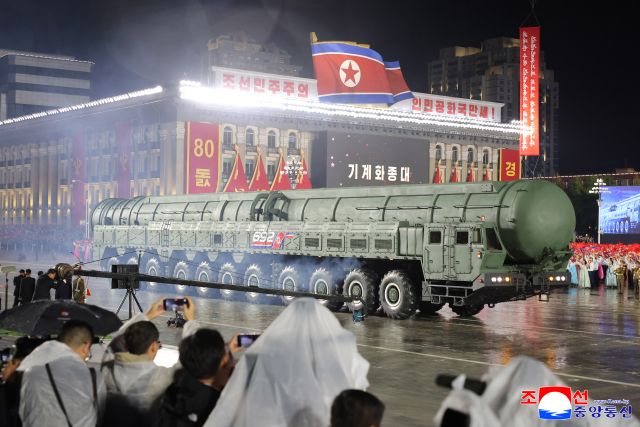
On October 11, 2025, Pyongyang held a large military parade marking the 80th anniversary of the Workers’ Party of Korea. The WPK has spent decades promoting a national future built on the principles of Juche, and the parade showcased the newest advances in North Korea’s missile and military technology.
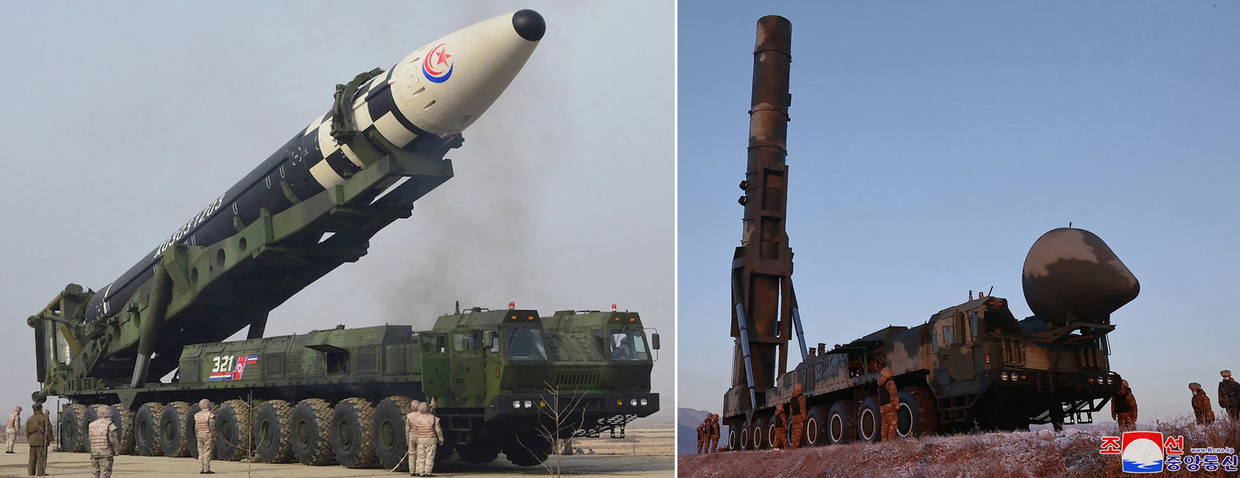
One of its key moments was the unveiling of the new Hwasong-20 mobile intercontinental ballistic missile. The missile uses a classic three-stage solid-fuel design reminiscent of Russia’s Yars systems and is carried on an 11-axle transporter that also serves as the launch platform.
The Hwasong-20 weighs around 80 metric tons and carries a multiple independently targetable reentry vehicle (MIRV). A few weeks before the parade, North Korea tested a new engine likely intended for this missile. Its estimated range may exceed 15,000 kilometers, giving Pyongyang the ability to strike any point in the continental United States. The missile is a logical next step in North Korea’s drive to develop mobile, solid-fuel ICBMs. It has not yet been flight-tested, but such tests are expected in the coming months – after which the system could enter service.
Meanwhile, the Hwasong-18 is already deployed in limited numbers. These missiles were also shown at the National Defense Development 2025 exhibition and at the parade, mounted on a nine-axle transporter-launcher. The Hwasong-18 is lighter than the Hwasong-20 and resembles Russia’s Topol-M. Its estimated range reaches up to 12,000 kilometers. The missile likely already forms part of North Korea’s strategic missile forces and has replaced older, heavier liquid-fuel mobile systems. It was first displayed and successfully launched in 2023.
Alongside solid-fuel systems, Pyongyang continues to test larger liquid-fuel rockets like the Hwasong-17. First revealed in 2020 and successfully launched in 2022, the missile shows clear influences from Soviet design. It weighs around 100 tons and is estimated to have a range of up to 15,000 kilometers.
A heavy multi-axle transporter moves the missile to the launch site and raises it vertically, where targeting and launch procedures are completed. This process is slower than with modern solid-fuel systems, which conduct targeting before elevation. Had multi-axle missile carriers existed in the 1960s, Russia’s earliest mobile missiles might also have been liquid-fuel designs from the Chelomey or Yangel bureaus. But history unfolded differently, leading to the use of lighter solid-fuel missiles on mobile platforms.
These intercontinental missiles are likely already deployed in North Korea. How many are there? This is difficult to assess. Open data on North Korea’s nuclear arsenal is extremely limited, and information on launcher production has only appeared at recent military exhibitions. It is clear, however, that these numbers remain small: just six Hwasong-17 launchers were displayed. It also appears that after developing more advanced solid-fuel systems, Pyongyang scaled back work on the larger Hwasong-17.
Overall, North Korea may now have roughly a dozen deployed mobile ICBMs, both liquid-fuel and solid-fuel. This gives Pyongyang the ability to target not only the Pacific region but also any point in the continental United States.
Missiles with a range of 1,000–5,500 kilometers fall into the medium-range category. While the US and Russia have avoided developing such systems for decades because of the INF Treaty, North Korea and other states faced no such restrictions. As a result, Pyongyang now operates several types of MRBMs.
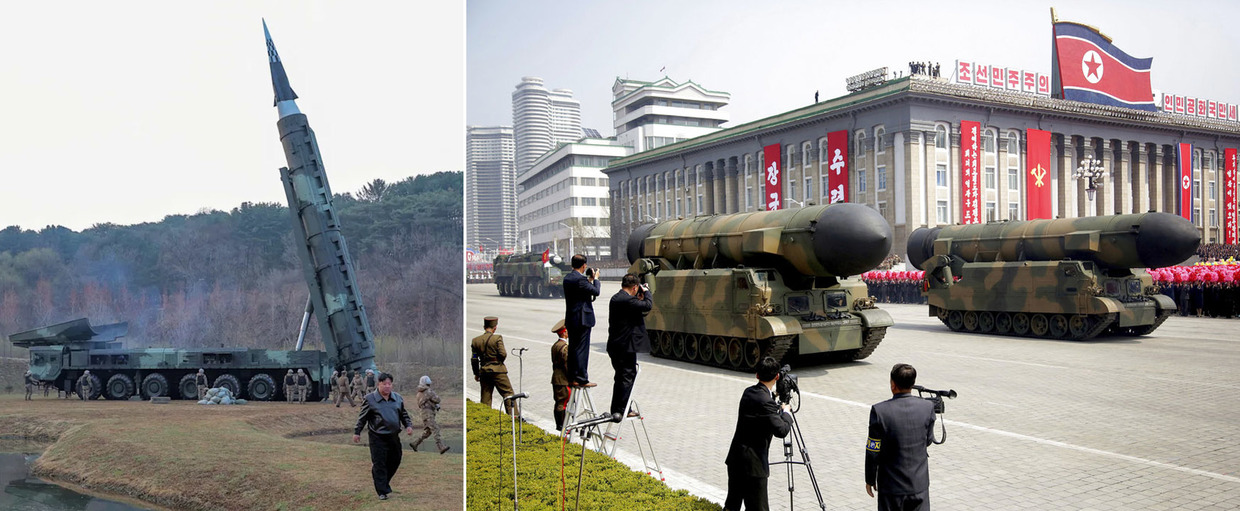
What sets these missiles apart is their design: many of them carry maneuverable hypersonic glide vehicles. On April 2, 2024, North Korea conducted its first launch of the Hwasong-16B hypersonic missile, which was also displayed at the parade in Pyongyang.
Fired from a transport-launch container mounted on a mobile seven-axle platform, this solid-fuel missile carries a hypersonic gliding warhead capable of riding the edge of the atmosphere and reaching distances of up to 5,000 kilometers. Current missile-defense systems struggle to intercept a maneuverable hypersonic glide vehicle, making the Hwasong-16B capable of striking targets anywhere in Southeast Asia or the Pacific.
A notable development this year is the unveiling of the Hwasong-11Ma system, which carries two missiles with maneuverable hypersonic glide vehicles and has an estimated range of at least 1,000 kilometers. The system has not yet been tested but appeared both at the Pyongyang parade and the National Defense Development 2025 exhibition. Testing is likely to begin soon, followed by deployment. Its five-axle launcher has already been used for several years with conventional Hwasong-11 ballistic missiles, which will be discussed further below.
The new Hwasong-11Ma has a stronger booster and a hypersonic glide vehicle that could, in theory, be deployed in a non-nuclear configuration – if North Korea has resolved the precision-guidance issues that such warheads require. If so, the system would pose a serious threat to the US Navy, as these missiles could strike aircraft carriers far from North Korea’s coastline – assuming such targets can be detected.
Another important system is the Pukguksong-2/KN-15, a mobile missile first tested in 2017. Originally designed for submarine launch, it was later adapted for ground-based mobile launchers. The solid-fuel missile has a range of up to 1,500 kilometers and may be capable of carrying a nuclear payload, although it is unclear whether it is currently deployed. Like other systems, it has been shown during parades and produced in numbers sufficient for testing. And yes, North Korea does possess submarine-launched missiles.
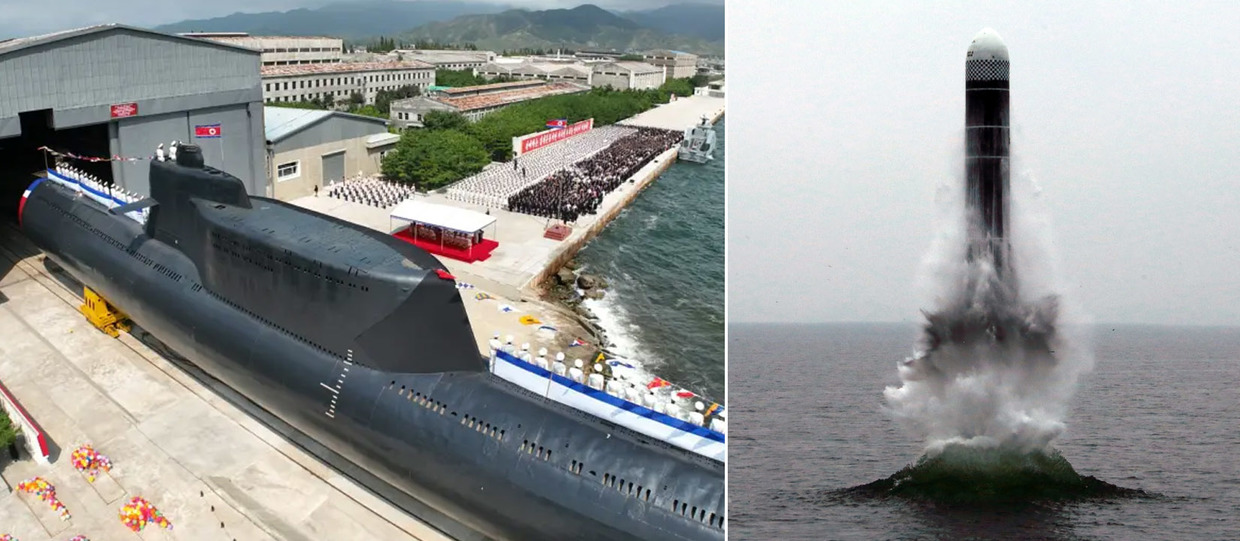
On September 6, 2023, North Korea launched its largest domestically built submarine, the Hero Kim Gun-ok, in Sinpo. The submarine is equipped with four launchers for ballistic missiles and six launch systems for sea-based cruise missiles.
This first North Korean ballistic missile submarine carries Pukguksong-5 missiles, which have a diameter of roughly 1.5 meters. First unveiled in 2021, these are currently the most advanced sea-based missiles in North Korea’s arsenal, with an estimated range of at least 3,000 kilometers.
(L) Submarine the Hero Kim Gun-ok; (R) Pukguksong-5.
Before the latest Pukguksong models appeared, North Korea developed several earlier variants of the missile. Research and testing took place on sea platforms and with a prototype submarine. All of this was part of Kim Jong-Un’s long-running effort to build a viable sea-based missile force – and that goal has now been achieved.
North Korea has successfully deployed a submarine capable of launching intermediate-range ballistic missiles, a capability which had only been achieved by Russia, China, the United States, and India.
North Korea also fields short-range ballistic missiles – systems known in the Soviet army as “frontline missiles” – with ranges between 300 and 1,000 kilometers. Pyongyang has developed several designs within this class.
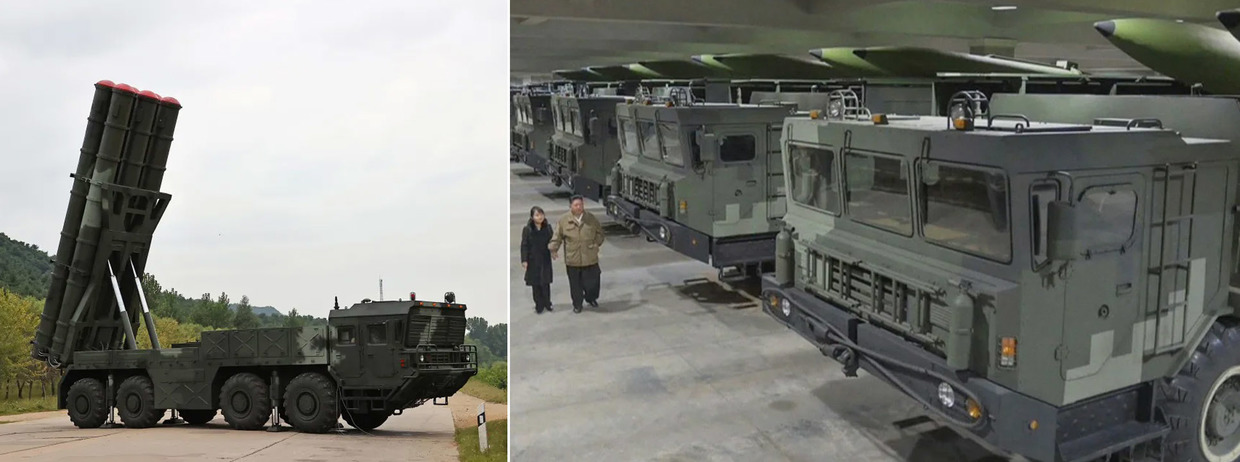
The KN-25 multiple rocket launcher fires 600 mm rockets. On April 23, 2024, a battery of these rockets was used in North Korea’s first full tactical exercise simulating a nuclear counterstrike. For the first time, it was officially stated that these rockets can carry nuclear warheads. With a range of 400 kilometers, they can reach targets across much of South Korea.
Each KN-25 rocket is equipped with a flight-correction system that significantly improves accuracy. Unlike traditional multiple-launch systems such as the Grad or Katyusha, each missile is individually guided. In one test, the rocket was detonated in mid-air above the target – an approach suited for cluster munitions or nuclear warheads, since an airburst maximizes destructive impact through its shockwave.
Another major system is the Hwasong-11, known in the West as the KN-23 and sometimes jokingly referred to as “Iskander-Pho” because it closely resembles the Russian 9M723 missile from the Iskander-M system.
First unveiled in 2019, the missile now exists in multiple versions, including a mobile ground-launched model and a railway-based variant; tests were also carried out from sea platforms, and it is likely that submarine-launched versions will follow. With a range of up to 600 kilometers, the missile can carry compact nuclear warheads, giving North Korea the ability to strike any target on the Korean Peninsula.
The system’s key strength is its simplicity and standardization: one missile type is used across multiple launch platforms, making it a cost-effective solution. The KN-24, or Hwasong-11B, and its successor, the Hwasong-11D, have shorter ranges of around 400 kilometers. However, each launcher carries two missiles in the Hwasong-11B version and four in the Hwasong-11D version – similar to the US ATACMS system.
North Korean engineers appear not only to have replicated Russia’s Iskander concept but also to have borrowed ideas from ATACMS. The key difference is that while the original ATACMS design is more than three decades old, the North Korean variant uses modern technology, offering roughly one-and-a-half times the range and potentially greater accuracy.
***
In this overview, we have focused solely on ballistic missiles. North Korea has also developed various drones and cruise missiles. But ballistic missiles remain far more difficult for modern air-defense systems to intercept, and North Korea’s arsenal allows it to destroy a potential aggressor without turning to other means of attack. This likely explains Kim Jong-Un’s consistent emphasis on this category of weapons.
The Brazilian president has called for a peaceful solution before a potential conflict breaks out
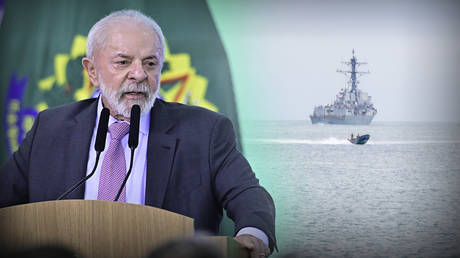
Brazil is “enormously worried” about the US military buildup near Venezuela, President Luiz Inacio Lula da Silva has said, calling for a solution to be found “before a conflict begins.”
The Pentagon has deployed multiple warships and the largest US aircraft carrier in the Caribbean near the South American nation, and has killed scores of people in controversial attacks on boats it claimed were linked to alleged Venezuelan-led drug trafficking operations. Caracas has denied the accusations.
“I am very concerned about the military deployment that the United States has stationed in the Caribbean Sea,” Lula told reporters at the G20 Summit in South Africa on Sunday, according to Globo News.
“This worries me enormously, and I intend to discuss this with President [Donald] Trump because it concerns me… It is important that we try to find a solution before a conflict begins.”
Washington is poised to begin operations against Venezuela in the coming days, Reuters reported on Sunday, citing anonymous US officials. Clandestine operations would likely kick off the effort, and the overthrow of President Nicolas Maduro is under consideration, the agency cited its sources as saying.
Maduro has consistently denied US allegations of drug-trafficking, arguing that Washington was using the claims as a pretext for a regime-change and resource-grab operation.
Earlier this month, the Venezuelan military was placed on high alert in response to the US buildup, which reportedly involves about 15,000 personnel.
Defense Minister Vladimir Padrino Lopez has condemned the US deployment in the Caribbean.
“We strongly reject maneuvers, exercises, and deployments in our immediate area of interest,” the top general said in a speech on Saturday. “Enough of the threats, lies, slander, and imposition of power, all for the sake of preserving regional hegemonies.”