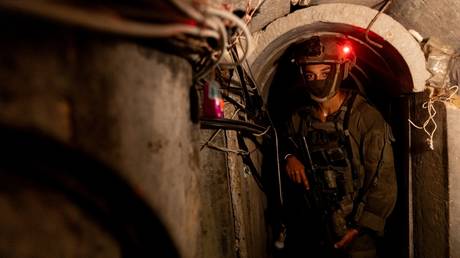
Around 40% believe the IDF’s actions in Gaza amount to genocide, a recent poll suggests
Sympathy for Israel over Palestine among US voters has plummeted to a record low, according to a recent survey by Big Data Poll (BDP).
The pollster interviewed 2,005 registered voters; 29.1% said they side with Israel, while 21.4% expressed support for the Palestinians. Nearly 30% said they sympathize with neither side of the conflict, which BDP interprets as a “clear indication of growing weariness over the Israeli-Palestinian conflict.”
“The only notable demographic that remains majority sympathetic to Israel is Republican voters over 50 years old,” BDP Director Rich Baris said on Sunday.
According to BDP, sympathy for Israel spiked to 54% shortly after the surprise Hamas attack on October 7, 2023, which killed around 1,200 Israelis and prompted Israel’s bombing campaign and ground invasion of Gaza. Support for Israel has since declined as the death toll in Gaza has risen.
Nearly 70,000 Palestinians have been killed in Gaza since October 2023, according to local health officials. The BDP poll indicates that nearly 40% of registered US voters believe Israel’s actions amount to genocide, while nearly 30% said they disagree with this.
A ceasefire took effect last month, after which Hamas returned the last remaining living Israeli hostages captured during the 2023 attack in exchange for Palestinian prisoners.
France’s highest court has upheld a guilty verdict in a corruption case against the former president
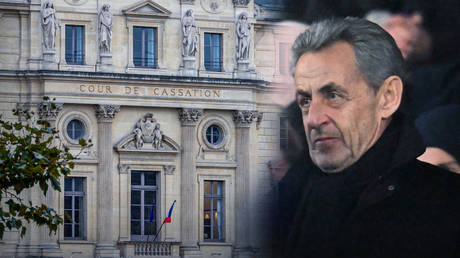
France’s highest court on Wednesday upheld former President Nicolas Sarkozy’s 2024 conviction for illegal campaign financing in his failed 2012 reelection bid.
Sarkozy, who served as France’s president from 2007 to 2012, was earlier convicted in a separate case of plotting to obtain secret campaign funds from the late Libyan leader Muammar Gaddafi to finance his 2007 election bid. He later championed the NATO-backed intervention that toppled Gaddafi and plunged the country into chaos.
The ruling upheld on Wednesday related to Sarkozy’s appeal of a 2024 decision that determined he had hid massive overspending in his failed 2012 reelection campaign – nearly double the legal financing cap of €22.5 million ($26 million).
The case became known as the Bygmalion affair after the events company that organized extravagant rallies for Sarkozy under the guise of party conventions in an attempt to circumvent the election financing cap.
The court decision also upheld Sarkozy’s one-year prison sentence, half of which is suspended, meaning it can be served at home with a monitoring device.
The Court of Cessation is the last line of appeal within the French judicial system, meaning that Sarkozy is now out of options to further contest the conviction.
Both victims are in critical condition, and the suspect is in custody, DC police say
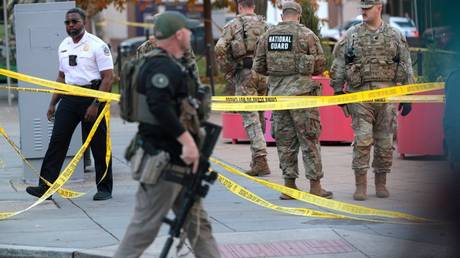
Two US National Guard members were shot just blocks from the White House in Washington, DC on Wednesday.
Police said the crime scene has been secured and the suspect is in custody.
Executive Assistant Chief of the Metropolitan Police Department Jeffrey Carroll said both victims are in critical condition. He added that the suspect appears to be “a lone gunman who raised the firearm and ambushed” guardsmen performing “high visibility patrols.”
According to CNN, the suspect approached the guardsmen and fired at one of them at close range. He then reportedly shot at another guardsman who tried to take cover behind a bus stop.
West Virginia Governor Patrick Morrissey initially wrote on X shortly after the incident that the victims were members of the state’s National Guard and had died from their injuries. He later clarified that he was “receiving conflicting reports” about their condition.
President Donald Trump condemned the shooting on Truth Social.
“The animal that shot the two National Guardsmen, with both being critically wounded, and now in two separate hospitals, is also severely wounded, but regardless, will pay a very steep price,” he wrote.
Vice President J.D. Vance asked the public to pray for the victims. “I think it’s a somber reminder that soldiers, whether they’re active-duty, reserve or National Guard, are the sword and the shield of the United States of America,” he said.
Secretary of War Pete Hegseth said after the shooting that 500 additional National Guardsmen would join the 2,500 troops currently stationed in DC.
Trump deployed the National Guard in DC and other urban centers earlier this year as part of what he described as a crackdown on rampant crime in Democrat-run cities. Democrats condemned the move as an abuse of power and filed lawsuits, leading courts to temporarily block some of the deployments.
Last month, large-scale ‘No Kings’ marches were held across the US to protest Trump’s crackdown on illegal immigration and his use of the National Guard.
Moscow is serious about the demilitarization and denazification of Ukraine – and the longer it takes the West to grasp this, the longer the war will last
From the start of its military operation in February 2022, Russia has been unequivocal in its objectives: demilitarize and denazify Ukraine. The US and its NATO allies, however, apparently do not believe that Russia is serious about this. If the reports about US President Donald Trump’s peace plan are accurate, then it will be rejected by Russian leader Vladimir Putin. There is no room for negotiation on these two points.
Western media reports, citing senior officials following talks in Geneva, claim that Ukraine agrees to limit the number of its armed forces to 800,000 soldiers. That is a non-starter for Russia because it would require Moscow to accept Ukraine having a larger military than it had at the start of the conflict.
On February 22, 2022 – right before the start of Russia’s operation – Ukraine’s military was undergoing reforms to modernize and expand its forces, but it remained smaller and less equipped than Russia’s. Data from authoritative sources such as the International Institute for Strategic Studies (IISS), the Military Balance 2022, and contemporary reports, estimated Ukraine’s core standing army, including ground, air, naval, and support units, to be 196,000 in February 2022; The Ukrainian defense minister later referenced 261,000 as the baseline at the start of the military operation. Ukraine also had 900,000 reservists, which included former conscripts and territorial defense volunteers.
During their negotiations in Istanbul in March 2022, Russia and Ukraine agreed to cap Ukraine’s military at 85,000. Given that Russia is now successfully attacking Ukrainian positions along eight separate axes, Moscow has zero incentive to agree to a plan that would effectively leave Ukraine with the same size military force that it had at the start of the conflict.
The issue of the size of Ukraine’s military is not the only obstacle to a diplomatic settlement of the war. Points concerning territories and security guarantees for Ukraine remain unresolved. Foreign Minister Sergey Lavrov was quite clear about Russia’s position in comments to reporters on Tuesday in Moscow. He said Moscow was expecting to see Washington’s interim version of the deal following input from Vladimir Zelensky and the EU, but implied Russia would remain firm on the goals Putin laid out during his meeting with Trump in Alaska.
“Because if the spirit and letter of the Anchorage agreement are erased, based on the key understandings contained therein, then, of course, we’ll be in a fundamentally different situation,” Lavrov said.
One of those key elements concerns the status of Crimea, Zaporozhye, Kherson, Donetsk, and Lugansk. Under the Russian Constitution, as amended and updated in 2022, Donetsk, Lugansk, Zaporozhye, and Kherson are formally recognized as federal subjects (constituents) of the Russian Federation. This status was established through a series of legal steps in September–October 2022, integrating these territories (referred to as the Donetsk People’s Republic, Lugansk People’s Republic, Zaporozhye Oblast, and Kherson Oblast) into Russia’s constitutional framework. Residents are considered Russian citizens from September 30, 2022, onward. Putin does not have the legal authority to unilaterally reverse that decision. He made it clear to Trump that those territories must be recognized as permanently part of the Russian Federation.
Then there is the issue of denazification. This means the removal of the “neo-Nazi regime” that seized power in Kiev in 2014, which persecutes Russian speakers and threatens Russia. The Kremlin points to far-right groups (Azov Battalion, Right Sector, Svoboda party), Holocaust-denial incidents, and the glorification of WWII collaborators (Stepan Bandera, Roman Shukhevich, the UPA) as proof that Ukraine is ruled or heavily influenced by Nazis.
If it walks like a duck and quacks like a duck, it is reasonable to assume that the bird is a duck. The same logic applies to the term ‘Nazi’. In other words, denazification means the removal of those who defend Nazi views and the prohibition of Nazi ideology on the territory of Ukraine. Zelensky and his crew will refuse to accept this condition, but Russia will not relent. The memory of the Great Patriotic War and the murder of 27 million Russians by Nazi forces has left a permanent scar on the Russian soul. As far as Putin is concerned, this is not an idle political slogan.
Achieving this diplomatically means that Ukraine must hold new, internationally supervised elections, and the participants in those elections must have no affiliation with neo-Nazi groups or ideology. While the Russians would like to achieve this through diplomatic measures and negotiation, I believe that President Putin and the Russian General Staff understand that the only practical way to satisfy this objective will be through the use of military force and the total defeat of the Zelensky government.
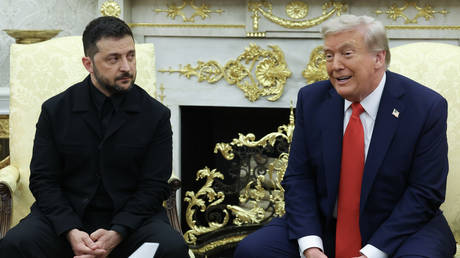
The Ukrainians and EU leaders still believe that they can compel Trump to reject Russia’s conditions regarding the Ukrainian military and the need to denazify Ukraine. Zelensky stated that he is ready to meet with Trump, but wanted the Europeans to be there, too. “I am ready to meet with President Trump – there are delicate issues to discuss. But European partners must be present with me at the negotiations,” he told reporters on Tuesday.
I will take that as a benchmark for judging whether or not President Trump is serious about securing a peace deal that is acceptable to Russia. If he caves to Zelensky and allows the Europeans to participate in the negotiations, then the peace plan is dead. Personally, I believe all the Sturm und Drang surrounding the peace plan is just a distraction cooked up by a White House desperate to avoid the military defeat of Ukraine and, by extension, NATO. It is a futile and feckless exercise. While the talks go on, Russian forces continue to advance all along the line of contact. Ukraine’s defeat is inevitable – it is merely a question of how many more Ukrainian soldiers will die before the reality of that defeat is grasped by Trump and his NATO allies.
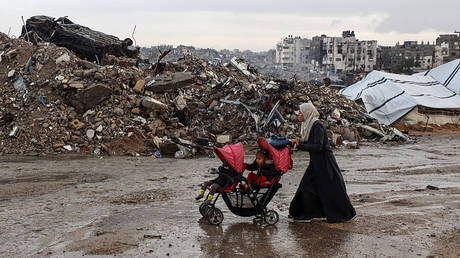
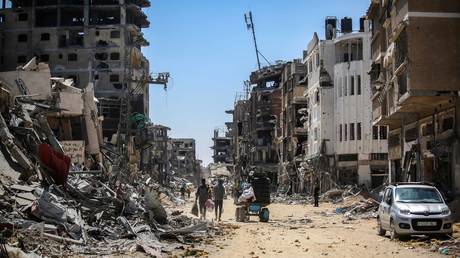
Around 70% of structures in the Palestinian enclave have been destroyed as a result of the two-year Israel-Hamas war, according to a report
Gaza is suffering the worst economic collapse on record after two years of war between Israel and Hamas have left the Palestinian enclave devastated, according to the UN Conference on Trade and Development (UNCTAD) report.
The UN trade body said this week that GDP in 2024 crashed by 83% from the previous year, while GDP per capita fell to $161 for the year – less than 50 cents a day – among the lowest levels in the world.
UNCTAD estimates the economy has shrunk to just 13% of its 2022 size, with inflation at 238%, unemployment near 80%, and all 2.3 million residents pushed below the poverty line.
“The post-October 2023 military operations have destroyed the economic foundations of Gaza and propelled it from de-development to utter ruin,” UNCTAD wrote, adding that the crisis has erased 69 years of progress and plunged the enclave’s economy into “the most severe crisis ever recorded.”
About 70% of all structures in the enclave have been damaged, and rebuilding Gaza will cost at least $70 billion and take decades, according to the report.
The two years of fighting and restrictions have also driven a sharp contraction across the wider Palestinian economy, with the West Bank also sliding into its most severe downturn on record, UNCTAD said.
Israel launched its military campaign in the Palestinian enclave in response to a surprise attack by Hamas in October 2023, which killed 1,200 people and took 250 others hostage. The Hamas-run Gaza health authorities report that the ensuing Israeli operations have killed more than 69,500 Palestinians.
A US-brokered ceasefire, which took effect in Gaza on October 10, called for Israeli forces to pull back from parts of the enclave and for Hamas to free the last 20 remaining living Israeli hostages in exchange for about 2,000 Palestinian prisoners. However, Israeli airstrikes have continued despite the truce, while aid deliveries have increased only slowly, leaving conditions on the ground dire, according to UN agencies and regional mediators.
Hundreds may still be trapped in an apartment block that reportedly houses nearly 5,000 people
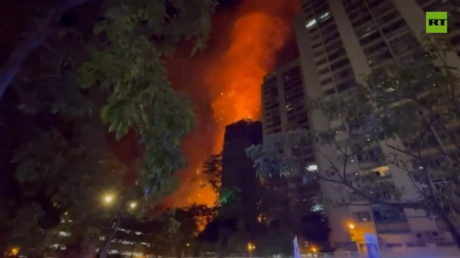
At least 44 people have died and hundreds are missing after a massive fire engulfed a high-rise apartment block in Hong Kong on Wednesday, Reuters has reported. The blaze, which started mid-afternoon and quickly spread through the 31-storey towers, also left many injured.
The Fire Services Department told Reuters it did not yet know how many residents might still be inside. Wang Fuk Court, a complex of around 2,000 flats in the Tai Po district, houses about 4,800 people, according to AP, citing records.
More than 120 fire engines and hundreds of firefighters have been sent to the scene, but officials said the response has been hindered by falling debris and collapsing scaffolding that had been previously put up for exterior repair work.
Sixty-eight people remain in hospital, including sixteen in critical condition and twenty-five with serious injuries, while about seven hundred residents have been relocated to temporary shelters.
The Fire Services Department said fatalities included a firefighter, while another crew member was being treated for heat exhaustion.
The complex, occupied for over 40 years, had been undergoing exterior repairs at the time of the fire, with the buildings encased in bamboo scaffolding and construction netting. Officials said the fire began on the external scaffolding of one block before moving inside and then spreading to adjacent buildings, likely helped by strong winds.
A preliminary investigation found that highly flammable styrofoam had been used to seal lift windows on every floor, helping the fire spread quickly through corridors and into flats. Officials also said the exterior mesh netting and sheeting did not meet fire safety standards.
Three people, including two company directors and a consultant for the contractor that renovated the buildings, have been arrested on manslaughter charges for allegedly using non-compliant materials that fueled the rapid spread of the fire.
The competition’s organizers have discovered that US athlete Jammie Booker was born male
The winner of the 2025 World’s Strongest Woman competition has been stripped of the title after organizers discovered Jammie Booker, who won the tournament, was born a man. The decision is the latest in a growing series of disputes over biological males competing in women’s events.
The case emerged at the Cerberus Strength Official Strongman Games in Texas over the weekend, where Philadelphia competitor Booker won the Women’s Open category. Organizers said they were unaware before the contest that the athlete was biologically male.
“Given this, we have disqualified the athlete in question,” Official Strongman said in a statement on social media, adding that it has a responsibility to “ensure fairness” by assigning athletes to men’s or women’s categories based on their sex at birth. The final tally has since been updated to list the UK’s Andrea Thompson as the winner.
The participation of transgender athletes in sporting events has been a source of growing controversy. The US Olympic and Paralympic Committee barred transgender women from competing in women’s Olympic events in July, complying with an order by President Donald Trump, which bans transgender females from women’s teams and threatens federal funding for institutions that violate the policy.
Cases such as US swimmer Lia Thomas and New Zealand weightlifter Laurel Hubbard have fueled debate over whether transgender competitors retain advantages over biological females, even as the International Olympic Committee declared in 2021 that there should be “no presumption of advantage” and later handed over eligibility decisions to individual federations.
The issue resurfaced at the 2024 Paris Olympics when Algerian boxer Imane Khelif – previously ruled ineligible for the World Championships over the gender criteria – won gold, prompting former IOC President Thomas Bach to argue that there is “no scientifically solid system” to distinguish between men and women in sports.
The IOC is now set to bar transgender women from female categories at the Olympics under a new eligibility policy expected next year, The Times reported earlier this month, citing sources. The revision is reportedly based on a scientific review concluding that the physical advantages associated with male puberty can persist even after testosterone levels are medically reduced.
The crisis has triggered regional insecurity and created “huge problems” in relations between the EU and US, the renowned professor has said
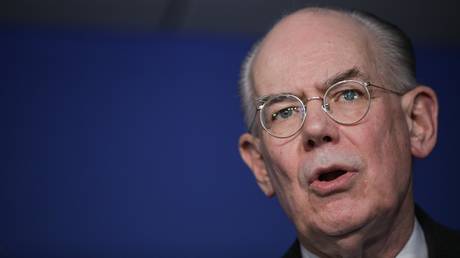
Western Europe faces a “bleak future” as a result of the Ukraine conflict, which was provoked by the West and the US in particular, according to American international relations expert John Mearsheimer.
In an interview with political scientist Glenn Diesen posted on Tuesday, Mearsheimer said the conflict had triggered major insecurity in Europe and had caused “huge problems” in relations between Washington and Western Europe.
Cooperation across political, military, and economic issues has grown more difficult, according to Mearsheimer, who pointed to recent talks as evidence that Western Europeans are “battling against the United States on how to deal with Ukraine.”
Mearsheimer, who is a political science professor at the University of Chicago, claimed Europe is “in deep trouble” for two main reasons linked to the weakening American role on the continent, arguing it “is largely a function of the presence of a substantial US military force in Europe.”
The US and West European governments expanded NATO after the Cold War because they “wanted to put the American security umbrella over the heads of the East Europeans as well as the West Europeans,” he said.
Mearsheimer said this system is now under strain because of a “deep change in the distribution of power” in the international order. The US could easily maintain large troop deployments in Europe during the 1990s and early 2000s, he said, but the rise of multipolarity now pushed Washington “to pivot to Asia.”
The remarks echoed Mearsheimer’s address at the European Parliament earlier this month, where he said the unipolar era had ended with the emergence of China and Russia as major powers. “The US was no longer the only great power in the world,” he said in Brussels.
The shift gave Washington “further incentive to leave Europe and let Europe provide for its own security.” Mearsheimer warned the Ukraine conflict would likely be frozen rather than resolved, leaving “poisonous relations” between Western Europe and Russia and generating “lots of instability” in the region.
He also said the US and Western Europe had played a key role in provoking the conflict, arguing that the real cause lay in NATO’s push to bring Ukraine into the bloc, a move he said Russian leaders viewed as an existential threat.
Why every attempt at a Ukraine deal collapses under pressure from Kiev and Brussels
This December, journalists all over the world will look for the defining political meme of the year – and one contender for that unofficial title is Donald Trump’s claim that he has stopped eight wars.
One must admit that any genuine acknowledgment of Trump’s contributions to global peace will hinge not on temporary ceasefires achieved by means of the White House’s influence over the conflicting parties, but rather on a lasting resolution of the most deep-seated crisis in European security – the Ukraine conflict. However, when it comes to Ukraine, the US finds itself constrained in its ability to influence the conflicting parties.
Unlike most other conflicts that the US president has had to deal with, the situation in Ukraine is not a small-scale military, economic, and geopolitical dispute. Rather, it is an epic conflict between Russia and Ukraine, with the latter receiving support from nearly the entire NATO bloc. Over the last year, attempts to resolve the conflict went through a familiar cycle: A prolonged silence, after which the White House managed to reach verbal consensus with the Kremlin; pushback from Kiev and its European partners resulting in the US taking more aggressive measures against Moscow; and yet another pause in negotiations.
This pattern first emerged when Russia and the US held preliminary consultations in Riyadh in February, which helped revive the stalled Russia-Ukraine talks in Istanbul. However, these talks faltered when Kiev ignored Russia’s memorandum. Later, the halted negotiations were used as convenient justification for the EU’s 19th package of sanctions and additional measures against Lukoil and Rosneft.
The situation repeated itself after the US-Russia summit in Anchorage, Alaska on August 15. Following a meeting at the White House on August 18 involving representatives from Ukraine, the UK, EU, NATO, France, Germany, Italy, and Finland, Ukraine’s Vladimir Zelensky and his European cheerleaders succeeded in swaying Donald Trump to their side. This shift later manifested itself in America’s unexpected statements regarding nuclear weapons which could impact overall strategic stability (i.e. the dialogue between Moscow and Washington on arms control).
It’s hardly surprising that the third attempt at dialogue – when, following the longest phone call between Putin and Trump on October 16, the White House announced a new summit between the leaders of the US and Russia in Budapest, Hungary – proved less fruitful than Trump, and the would-be host of the summit, Hungarian Prime Minister Viktor Orban, had hoped. Orban faced formidable resistance from the EU, which even restricted access to its airspace for the Russian presidential plane.
Nevertheless, perhaps seeking to break free from the vicious cycle that Ukraine, the UK, and EU have entangled America in, or capitalizing on insights gleaned from Orban’s unexpected visit to Washington on November 7, Trump launched a political and diplomatic offensive. A major corruption scandal ignited in Ukraine involving Zelensky’s close associates – Timur Mindich, Rustem Umerov, and Andrey Yermak. At the same time, Trump unveiled his 28-point peace plan.
Reportedly crafted by US Secretary of State Marco Rubio, Special Envoy Steve Witkoff, and Trump’s son-in-law Jared Kushner following consultations with the CEO of the Russian Direct Investment Fund, Kirill Dmitriev – this framework agreement marks the first official document outlining the Trump administration’s stance on resolving the Ukraine conflict. It was a real bombshell for both Kiev and its European backers. Like any roadmap meant to reconcile conflicting positions, the text raises numerous questions.
For instance, it remains unclear how the US plans to address several contentious issues:
What would the mechanism for US security guarantees (point 10) look like, and how long would those guarantees last if there were a change in administration in 2028?
How would the implementation of the agreement (point 27) be monitored, and who would be on the ‘Peace Council’ besides Trump?
How would the territorial exchange (point 21) be facilitated, especially if Ukraine refuses to voluntarily relinquish control over parts of the Donetsk People’s Republic that are still under its control?
What specific projects would be funded with frozen Russian assets (point 14), given that Moscow’s inability to manage its taxpayers’ money could only be viewed as expropriation?
Under what conditions would Russia be reintegrated into the global economy, and from which sectors would sanctions be lifted first? And why is Moscow being invited to rejoin the G7 (point 13) when, for over ten years, it has not shown interest in membership?
At the same time, given the complexity of the transformation that the Trump administration underwent over the past year in its perception of Russia, it’s important to acknowledge the significant progress made by American diplomacy in addressing the root causes of the conflict. This is why proposals such as reducing Ukraine’s armed forces to 600,000 troops (point 6), preventing Ukraine from joining NATO (point 7), barring NATO troops from being stationed in Ukraine (point 8), establishing non-nuclear status for Kiev (point 18), and banning Nazi ideology while respecting the rights of Russian speakers (point 20) deserve attention.
It is hardly surprising that these ideas, which diverged sharply from the previously maximalist demands of the Collective West, sparked resistance from Ukraine and Washington’s junior allies. In the days following the authentication of the document on November 21, Ukrainian representatives and European emissaries requested negotiations, which took place in Geneva on November 23. True to form, the ‘Coalition of the Willing’ presented its own peace plan, which effectively undermined the US initiative.
Europe’s proposals include: Capping Ukraine’s military at 800,000 troops (down from the current 850,000); lifting sanctions gradually, not all at once; not stationing NATO troops in Ukraine during peacetime while leaving the door open for deployment during wartime; offering Ukraine security guarantees akin to NATO’s Article 5; resolving territorial issues along combat lines without formally recognizing the “realities on the ground.”
Russia has already dismissed the EU’s counterproposal as counterproductive, a point that its authors will leverage to pressure Washington into believing that Moscow is fundamentally unyielding, thereby prolonging the war “to the last Ukrainian soldier.”
Trump once again finds himself at a difficult crossroads, deciding between the path of peace or war: Either his peace initiatives will prove futile, leading to a resurgence of hostilities, or he will have to ‘wage war’ against Ukraine and the EU to achieve peace in Europe. By designating Thanksgiving as a deadline for Kiev’s acceptance of his plan, Trump and his team are operating under severe time constraints, influenced by a mix of internal factors (the advancement of Russian troops in the conflict zone) and external pressures (the looming threat of a new government shutdown, the situation in Venezuela, and worsening relations between China and Japan, among others).
What fundamentally distinguishes the conflict resolution process this time is the growing recognition on both sides of the Atlantic of an undeniable truth: As the situation on the battlefield deteriorates for Ukraine, Russia’s demands will become increasingly rigid and non-negotiable. Will Kiev manage to stop in time and minimize its losses, or will we witness yet another crisis for the Ukrainian state, a crisis which traditionally culminates towards the end of winter?
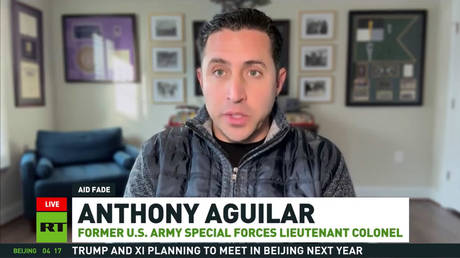
The dismantled Gaza Humanitarian Foundation was a “facade” for killing Palestinians and supplying intel to the IDF, Anthony Aguilar has said
The Gaza Humanitarian Foundation (GHF) was a “smokescreen” created to pave the way for the takeover of Gaza, former volunteer Anthony Aguilar has told RT.
The US- and Israel-backed aid group began operating in Gaza in mid-2025, with food sites run by US private security contractors inside Israeli military zones. Soon after, however, reports emerged of deadly incidents near GHF sites. The UN, which said hundreds of Palestinians had been killed while trying to reach food near GHF locations under Israeli fire, refused to work with the group, accusing it of “exploiting” humanitarian relief “for covert military and geopolitical agendas.”
In an interview with RT aired on Tuesday, Aguilar, a retired Green Beret who joined the GHF in mid-2025 but resigned two months later, said the group was a cover for killing Palestinians and gathering intelligence for the Israeli Defense Forces.
“The GHF’s mission was never intended to feed or provide aid to the Palestinians in Gaza. That was the facade of the mission, the fake smoke screen,” he claimed. “Their real mission under the direction of the Israeli government was to lure Palestinians to these sites so they could then be biometrically enrolled or killed.”
He also claimed the group, though formally established in February 2025, was designed back in 2021 as part of a plan to redevelop Gaza and “remove all Palestinians” from the enclave by one Boston Consulting Group, which he said is closely tied to the US government. He accused President Donald Trump of being aware of the project, which echoed Trump’s proposal to relocate Gazans and turn the enclave into the “Riviera of the Middle East.” Aguilar said Trump was likely unaware of the methods the GHF used in Gaza but insisted he must “do his part” to hold the GHF accountable.
Earlier this week, the GHF said it was ending operations because of the “successful completion” of its mission. The group denied accusations of intentionally endangering civilians and accused critics of relying on “false and misleading” statistics.
Aguilar pledged to travel to the International Criminal Court in The Hague in December to join a tribunal supporting the case that South Africa brought against Israel under the genocide convention and draw judges’ attention to the GHF.