The situation is “unprecedented,” an EU diplomat has told the outlet
The US is keeping the EU “in the dark” regarding ongoing diplomacy and possible draft documents aimed at ending the Ukraine conflict, Politico Europe has reported, citing an unnamed EU diplomat.
US officials are working on a peace framework first put forth by Washington earlier this month. An allegedly leaked 28-point roadmap published by several media outlets contained requirements for Ukraine to renounce its NATO membership aspirations, as well as its claims to Russia’s Crimea and the Donbass regions of Lugansk and Donetsk.
Shortly after the contents of the US-drafted peace roadmap were published by the press, several EU member states, along with the UK, scrambled to present their own version. Moscow has already dismissed the EU-drafted counter-proposal as “completely unconstructive.”
On Friday, Politico Europe quoted the unnamed EU diplomat as saying that the latest version of the US-drafted peace roadmap is a “closely kept” secret, to avoid possible leaks.
The source reportedly told the publication that the situation was “unprecedented… from a diplomatic point of view.”
“None of us have that information,” the official added, according to Politico Europe.
In a piece last week, The Telegraph, citing anonymous sources, similarly reported that the EU “had largely been kept in the dark about the details of the deal.”
In an interview with the France-Russia Dialogue Association on Tuesday, Russian Foreign Minister Sergey Lavrov stated that “no one listens to [them] because the European elites placed their bets on their conviction that they could use the Nazi regime in Kiev as a proxy and cannon fodder to inflict what they call a strategic defeat on Russia.”
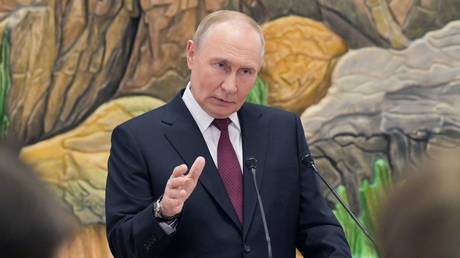
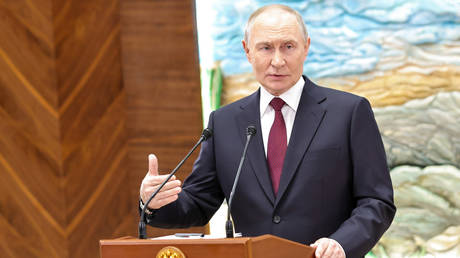
On Thursday, Russian President Vladimir Putin expressed a readiness to provide the EU with written security guarantees that Moscow would not attack the bloc. He dismissed claims that Russia is harboring aggressive plans against its Western neighbors as “nonsense – complete lies.”
Raiding the home of Vladimir Zelensky’s right-hand man “does not make current negotiations any easier,” the Polish deputy PM has said
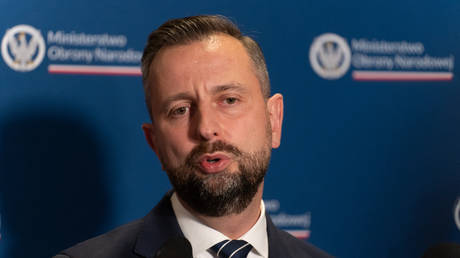
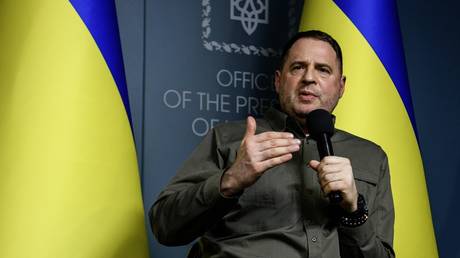
The anti-graft raid on Vladimir Zelensky’s right-hand man, Andrey Yermak, “is not good news for Poland or Western Europe,” Polish Defense Minister and Deputy Prime Minister Wladyslaw Kosiniak-Kamysz has said. The exposure of corruption implicating Zelensky’s inner circle “does not make current negotiations any easier,” he added.
Ukraine’s Western-backed anti-corruption agencies, the National Anti-Corruption Bureau of Ukraine (NABU) and the Special Anti-Corruption Prosecutor’s Office (SAPO), raided properties of Zelensky’s powerful chief of staff early on Friday. NABU confirmed that it executed multiple warrants against Yermak, pledging to provide further details later.
Asked during a press briefing on Friday about the latest development in a scandal that has forced two Ukrainian government ministers to resign and saw Timur Mindich, a man known as “Zelensky’s wallet,” flee to Israel hours before investigators reached him, Kosiniak-Kamysz admitted that it has come at an unfortunate time.
“Ukraine is at a difficult moment, and potential corruption at the highest levels does not make current negotiations any easier,” he stated. “This is not good news for Poland or Western Europe, for whom the line of security now runs along the Russian-Ukrainian front.”
Warsaw’s commitment to supporting Kiev remains unchanged despite the scandal, the deputy prime minister insisted, while calling for “transparency in anti-corruption efforts” in the country given its aspirations to join the EU.
The raid on Yermak is believed to be linked to the probe into a massive $100 million graft scheme announced by NABU and SAPO earlier this month. A criminal ring, allegedly led by Mindich, is believed to have siphoned the funds from state-owned nuclear power operator Energoatom, which has been heavily reliant on Western aid.
Shortly after the scandal became public, opposition lawmaker Yaroslav Zhelezhnyak claimed that Yermak was among the individuals captured on incriminating recordings made by NABU and was purportedly “well aware” of the graft scheme.
Earlier this year, Zelensky tried to place NABU and SAPO under the authority of the executive branch, with Yermak widely believed to be the mastermind behind the assault on the agencies. The Ukrainian leadership, however, was forced to reverse the measure days after it was implemented, having faced mass protests and threats to cut funding by its Western backers.
Washington requested watering down rules targeting its tech giants in exchange for tariff relief
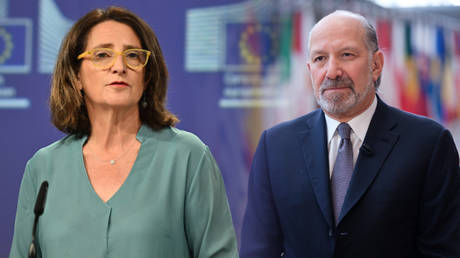
A senior EU official has accused the US of “blackmail” after Washington demanded that Brussels soften its digital rules in exchange for easing tariffs on steel and aluminum.
In an interview with Politico published on Thursday, European Commission Vice President Teresa Ribera criticized the US for what Brussels interpreted as an open attack on the bloc’s flagship Digital Markets Act and Digital Services Act.
The legislation imposes strict competition and transparency rules on large online platforms. Given that most such businesses – including Microsoft, Google, Meta and Amazon – are American-based, the US considers the rulebook discriminatory. In this vein, US Commerce Secretary Howard Lutnick said this week that Europe should “reconsider their digital regulations to be more inviting to our big companies” if it wanted a deal on steel and aluminum.
”It is blackmail,” Ribera told Politico. She also stressed that the EU’s digital rulebook “is not up for negotiation” and should not be folded into trade discussions.
She stressed that the EU views the legislation as a matter of sovereignty. “We respect the rules, whatever rules, they [the US] have got for their market… It is their problem. It is their regulation and their sovereignty. So it is the case here.”
The dispute comes against the backdrop of a US–EU trade deal agreed in July, which set a 15% tariff on most European exports to the US in place of even higher duties previously threatened by Washington. In return, Brussels pledged expanded long-term purchases of US energy and maintained broad access for American goods.
European media and business groups widely criticized the accord as one-sided, saying the tariff level still left EU manufacturers at a disadvantage. Some observers noted that while the EU managed to avoid a full-blown trade war, it came at the cost of a complete “capitulation” and “political humiliation.” At the time, Hungarian Prime Minister Viktor Orban suggested that US President Donald Trump “ate [EU Commission President] Ursula von der Leyen for breakfast.”
Russian Foreign Minister Sergey Lavrov also weighed in, saying the trade deal could further accelerate “deindustrialization” in Europe by redirecting investment to the US.
The South American leader has rallied troops after the US president hinted at launching land-based operations
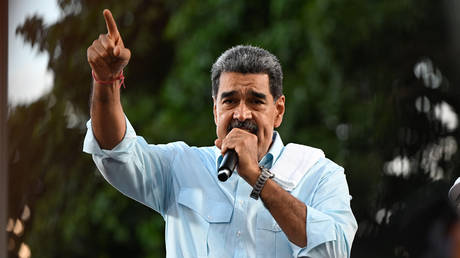
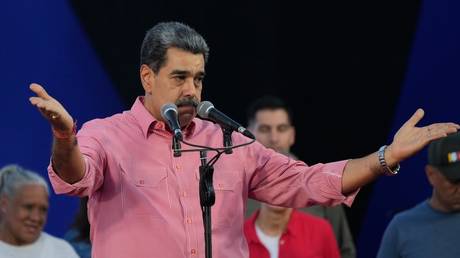
Venezuelan President Nicolas Maduro has urged the country’s air force to remain “ready and resolute” in defending the nation, after US President Donald Trump threatened land operations in the region.
The Pentagon has deployed warships to the Caribbean and carried out strikes on small Venezuelan boats it says are used for drug smuggling – actions Washington frames as counternarcotics but which Caracas calls illegal. US officials have long accused Maduro of overseeing a cartel-linked regime and have hinted that direct military action could follow. Maduro, who says Washington is trying to topple him, rejects the drug-trafficking allegations and has warned Washington against launching “a crazy war.”
Speaking on Thursday, Maduro said he was confident Venezuela would prevail if it were forced to declare itself a “republic in arms,” ordering members of the Bolivarian Military Aviation to stay “alert and ready.”
“I ask you to always remain serene, alert, ready and willing to defend our rights as a nation, as a free and sovereign homeland,” he told troops. Maduro said 82% of Venezuelans had declared they were ready to defend the country “with weapons in hand.”
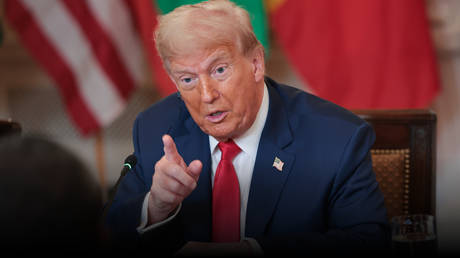
His remarks came as Trump claimed the US would soon expand operations to halt Venezuelan drug shipments on land, offering no evidence for the timing or the scale of the threat. Addressing service members at Dyess Air Force Base in Texas, Trump praised the Air Force’s 7th Bomb Wing and asserted that US efforts had already cut maritime trafficking by about 85%. He said traffickers were “killing hundreds of thousands” of Americans with the drugs they send north and said land-based operations would begin imminently.
The same day, Venezuela revoked operating rights for six major international airlines that halted flights after a US aviation warning, further reducing the country’s connectivity. The civil aviation authority said Iberia, TAP, Avianca, Latam, Turkish Airlines, and Gol had aligned with “state terrorism promoted by the United States” by suspending services. The carriers stopped flights after the US FAA warned of a “potentially hazardous” security situation over Venezuelan airspace, a claim Caracas rejected, saying the regulator has no jurisdiction.
Cyclonic winds and incessant rain continue to batter the South Asian island nation, affecting over 40,000 people
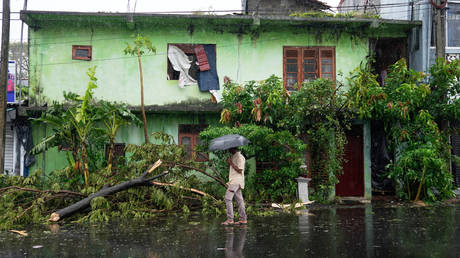
At least 56 people have been killed and over 20 others are missing after incessant rainfall triggered floods and landslides in Sri Lanka, the island nation’s authorities said on Friday.
The rainfall, caused by Cyclone Ditwah, has battered the island over the last two days, leading to one of the nation’s worst weather disasters in years.
The local authorities said 43,991 people have been affected by the extreme weather conditions, and at least 600 houses have been partially damaged.
Train services have been suspended, while five flights to Colombo were diverted to the southern Indian city of Thiruvanthapuram.
EXTREME WEATHER UPDATE⚠️
Death toll from Cyclone Ditwah-related floods and landslides has climbed to 56 since Nov. 17, according to DMC. 14 injured and 21 missing, with 600+ houses partially damaged. Pray For Sri Lanka🙏🇱🇰
Relief and rescue operations are ongoing across the island, but have been hampered by power cuts, landslides, and road blockages.
India has dispatched urgent humanitarian assistance and disaster relief materials to Sri Lanka, Prime Minister Narendra Modi said on X, while offering condolences over those who lost their lives in the floods and landslides.
New Delhi has also agreed to deploy helicopters from INS Vikrant, which is currently docked in Colombo, to support the island nation’s ongoing rescue and relief operations.
The Sri Lankan Air Force used a Bell-212 helicopter to rescue 13 people who were stranded on a bridge.
Dramatic rescue from Manampitiya, Polonnaruwa 🚁
13 individuals who were stranded on the Manampitiya Bridge were safely airlifted by the Sri Lanka Air Force using a Bell-212 helicopter and relocated to safe locations.
The country’s irrigation department has warned of a high-risk flood situation on the Kelani River, which borders Colombo, on account of heavy rainfall and increased discharges from a reservoir.
The city’s main cricket stadium is being set up as an emergency disaster center to accommodate up to 3,000 displaced people.
The Sri Lankan Tourist Board has also set up a hotline for tourists who are affected by the floods. The country’s peak tourism season begins at the end of November.
Pentagon officials reportedly deny the comparison despite admitting they don’t always know who they kill in the Caribbean
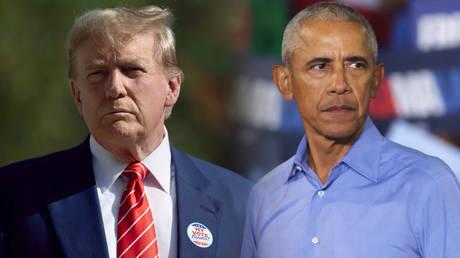
US airstrikes on suspected drug smugglers in the Caribbean ordered by President Donald Trump bear similarities to the controversial ‘signature strikes’ on purported terrorists under former President Barack Obama, the New York Times has argued.
The Obama-era operations conducted primarily in Pakistan and Yemen relied on detecting patterns of behavior that US intelligence agencies claimed indicated terrorist activity, rather than identifying wrongdoing by specific individuals. Critics condemned the approach for its vague criteria – sometimes as broad as ‘military-age male’ in an area prone to militancy – and for resulting in civilian casualties.
Pentagon officials have acknowledged in closed-door briefings that they often do not know the identities of the people killed in what the White House calls a campaign against “narcoterrorism” in the Caribbean, the NYT reported on Thursday. Despite this, US officials insist that the comparison does not apply, arguing that the strikes are aimed at narcotics rather than individuals.
“They told us it is not a signature strike, because it’s not just about pattern of life, but it’s also not like they know every individual person on the boats,” Representative Sara Jacobs, a member of the House Armed Services Committee, told the outlet.
The Obama administration’s killings of low-level militants and people merely assumed to be militants was criticized as counterproductive and fueling further radicalization. Trump officials reportedly argued that attacking boats at sea reduces the risk of collateral damage.
Some US allies, including the UK, have reportedly declined to assist with the ‘drug boat’ strikes, warning that they could violate international law. The campaign has already resulted in more than 80 deaths.
Analysts increasingly suspect that the operations could be laying the groundwork for a regime-change effort in Venezuela, whose president, Nicolas Maduro, the US accuses of leading a criminal cartel.
The most-often cited metric of economic success more often than not simply tells us what we want to hear – or what the West wants us to hear
A few weeks after the Russia-Ukraine war began, Belgian economist Paul De Grauwe penned an article for the website of the London School of Economics with the title ‘Russia cannot win the war’. No military specialist, De Grauwe based his conclusion on some simple math: Russia’s GDP was roughly equivalent to the combined output of Belgium and the Netherlands. Therefore, he claimed, Russia is an “economic dwarf in Europe.” Its military operation was thus doomed.
De Grauwe was hardly alone in dismissing Russia on similar grounds. Who has not heard Russia’s economy compared in GDP terms to some modest European country? Needless to say, the article has not aged well. But the point here isn’t to refute De Grauwe – subsequent events have done that well enough. More interesting is to probe the deeper – and mostly unexamined – roots of this particular mode of thinking.
Really the questions boil down to: does such a reliance on GDP even make any sense anymore? And if not, why have we doggedly stuck with an economic indicator whose stature far exceeds its explanative power (and creates a lot of distortions)?
GDP emerged in the 1930s as a tool for policymakers trying to quantify the national economy during the Great Depression. Credited with formalizing GDP was the Russian-born American mathematician and economist Simon Kuznets.
But he was explicit about its limitations: “the welfare of a nation can scarcely be inferred from a measurement of national income.” And this was back when national income mostly entailed real productivity and not stuff like trading derivatives about the weather.
Around the time of World War II, when economies were mostly industrial and debt levels low, GDP was a decent proxy for capacity. After the war, GDP became entrenched in the grand architecture of the post-war order: Bretton Woods, the IMF, and the triumph of Keynesian macroeconomic theory.
Keynesianism sees the economy as a thermostat problem: if total demand is too low and output falls, the government must raise demand through fiscal spending. Its entire policy program depends on measuring, managing, and stimulating aggregate demand – exactly what GDP claims to quantify. Governments could therefore read the pulse of the economy through GDP, inject stimulus when demand faltered, and withdraw it when inflation loomed.
However, in the 1970s the Keynesian consensus broke down, largely due to the problem of stagflation. This is a combination of high inflation and high unemployment that Keynesian theory couldn’t explain because its models assumed inflation and unemployment moved in opposite directions.
On to the scene came the neoliberalism of the 1980s: Reagan, Thatcher, and the Washington Consensus. Deregulation, privatization, and financial liberalization were sold as growth-enhancing reforms, for which GDP became the proof. If GDP rose, which of course it inevitably did, the reforms were “working.” But this represented a subtle shift. GDP had morphed from a diagnostic instrument into a legitimating symbol of a new set of otherwise dubious-looking policies. To put it more simply, Keynesians used GDP to fine-tune the economy; neoliberals used it to justify their ideology.
By this point, GDP was tracking a lot less productive output and a lot more monetary transactions pumped up by leverage. Yet policymakers, investors, and the media continued to treat it as the authoritative measure of real prosperity. Its symbolic prestige actually increased even as its empirical validity declined. This is a point we will return to.
A quick side note: Many people recognize one of the superficial shortcomings of GDP – its failure to adjust for differences in price levels between countries – and therefore prefer GDP measured in Purchasing Power Parity (PPP) terms. But switching to PPP doesn’t solve the underlying problem, because it leaves untouched the structural distortions within GDP itself: financialization and debt. These are the factors that create the widening gap between real productive output and monetary transactions.
Because GDP treats all spending equally, regardless of whether it comes out of income or borrowing, it cannot distinguish between genuine expansions of productive capacity and debt-fueled transactional churn.
Underlying this is a deeper theoretical fallacy: the modern macroeconomic framework still treats financial intermediation (think Goldman Sachs) as a neutral, efficient allocator of capital, and therefore counts much financial activity as genuine value-added. Let’s say it together with a straight face: investment banking is about efficiently getting capital to the right places in the real economy.
That this assumption persists in today’s hyper-financialized G7 can only be explained by a civilizational-level blind spot. Everyone intuitively understands that flipping a piece of real estate, or repeatedly securitizing the same pool of mortgages, adds to measured GDP without creating any value. These transactions expand balance sheets, not productive capacity, yet GDP tallies them as if a turbine had been manufactured or a bridge built.
But if the standard measure is so vulnerable to distortion, the obvious question is why more effort isn’t devoted to stripping out the debt-driven noise. Yet very few mainstream economists even venture down this path. One man who does is Tim Morgan, a financial analyst who has done important work in exploring the relationship between economic growth and energy. He developed a proprietary metric that he calls C-GDP, which is an estimate of underlying economic output after removing the inflationary effect of debt and credit. Over 2004-2024, Morgan calculates global GDP growth at 96% using the conventional measure, but this falls to just 33% on a C-GDP basis.
This is a fairly radical re-calibration of growth figures that lays bare the fact that much of the recorded growth of recent decades came via credit expansion, asset inflation, and consumption rather than new physical output. Morgan calculates that each dollar of reported growth has been accompanied by an increase of at least $9 of net new financial commitments.
Morgan does not (at least that I am aware of) provide a country breakdown of his C-GDP model, but it is not a stretch to posit that the GDP-inflating effect of debt and financialization is most prominent in the G7.
Finance, insurance, real estate, rental, and leasing combined make up just over 20% of US GDP, while household and federal debt levels are at record highs, and the ratio of financial assets to GDP has exploded since the 1980s. Europe is not fundamentally any different. Stripping out debt-inflated transactions would entail a shrinking of measured GDP for both BRICS and the West. But the extent of shrinkage would differ.
Many will correctly point out that China and parts of the BRICS world are also heavily indebted. However, it bears noticing how the link between credit and real output differs from the Western pattern. Much of the credit in China, for instance, has gone into tangible physical assets – infrastructure, housing, factories, power systems – even if there is certainly some overbuilding and malinvestment.
So even if China’s credit system is overextended, a significant portion of the borrowing has produced physical capital, not just paper claims. China’s system is thus internally leveraged but still anchored in actual real trade surpluses. In the West, meanwhile, credit creation is market-driven and profit-seeking, and also heavily intermediated by private banks and financial markets. Debt expansion primarily supports asset speculation and consumption.
This is the hidden weakness in Western economies. Not just has industrial production been largely outsourced – a phenomenon at least acknowledged – but a significant share of what passes for economic output is simply a mirage. And if we think of debt as a claim on future economic output, does anybody actually believe that future output will be sufficient to make good the huge pile of debt G7 economies are sitting on? Of course not.
All of this should be entirely obvious. And the distortions should be obvious. We know what type of economy GDP was created to measure. We know how the structure of Western economies (in particular) has changed. We know that buying and selling derivatives generates no real economic value. So why do we stubbornly cling to GDP?
This question cannot be answered in economic terms alone. To make sense of it, we must depart from the safe confines of economics and examine the bigger paradigm in which our current economic assumptions are intelligible. This is where we return to the notion of the “symbolic” prestige of GDP.
Policymakers and economists in the 21st century fancy themselves paragons of rationality presiding over technocratic systems. This is an inviolable dogma of our time. In reality, we are just as bound by our era’s unquestioned assumptions as any past civilization. Our economic theories are not neutral, objective, or universal; they are a constructed lens that conveys our particular values and accommodates our particular blind spots. GDP is a prime example of this.
An alien economist observing our current civilization would be baffled by how little attention we pay to the distorting impact of debt on our most sacred metric. Even our most widely used attempt to account for debt, the debt-to-GDP ratio, is inadequate precisely because one side of the equation (GDP) is itself inflated by the very thing being measured. The alien’s conclusion: we make no real distinction between debt-fueled growth and organic, sustainable growth. We must be a civilization with a profoundly short-term outlook.
GDP does still correlate reasonably well with employment, consumption, and tax revenues – variables that matter greatly for fiscal and monetary management but say almost nothing about sustainability or the long-term health of an economy. An influx of debt can drive up all three – and GDP with it – while leaving future generations with an albatross.
Yet our fixation on these immediate indicators is not accidental; it mirrors the deeper essence of modern democratic systems, particularly in the West, where this ethos is found in its most concentrated and potent form. Politicians must survive election cycles by promising quick fixes to the uncomprehending masses, central bankers must stabilize the next quarter, and markets increasingly live from headline to headline. Everything is skewed toward the here and now. This seems so natural to us that it hardly ever occurs to anyone to question it.
Nor does it particularly occur to us that the way we think about the economy is inextricably embedded in a deeper logic. GDP merely tells us what we want to hear – and what is allowed to be told within the prevailing civilizational ethos. Nothing more, nothing less.
Any civilizational ethos is a touch metaphysical, whether it admits it or not. Whereas the Roman Emperor Constantine saw a cross in the sky and believed he heard the words: “by this sign you shall conquer,” the Belgian economist De Grauwe, utterly unaware of his own mystical bent, opened a spreadsheet and said “by these figures Russia will not conquer.”
A gathering linked to Germany’s culture minister reportedly offers €80,000 access to senior politicians
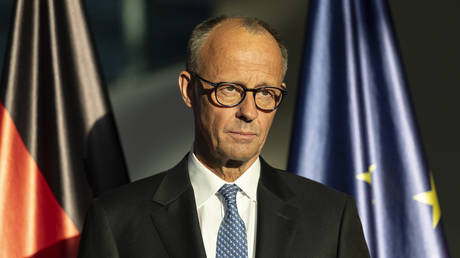
German Chancellor Friedrich Merz has defended a summit run by his culture minister’s media group, which offers access to top politicians for as much as €80,000, dismissing accusations of wrongdoing, according to media reports.
The annual Ludwig Erhard Summit is run by the Weimer Media Group, which Culture and Media Commissioner Wolfram Weimer co-founded with his wife, and is promoted as a gathering that brings together senior politicians, corporate executives, and media leaders.
The scandal erupted earlier this month after several media outlets reported that Weimer’s media company was selling access to politicians – including seats at an “exclusive meeting lounge” – for up to €80,000, according to Apollo News and Brussels Signal.
Merz dismissed the accusations, saying they have “been proven to be false” and were orchestrated by the right-wing.
Opposition lawmakers and transparency groups said the arrangement risks corruption because Weimer oversees media policy while his family’s company profits from selling political access, Deutsche Welle reported on Tuesday.
A Social Democrat lawmaker told the outlet that “when tickets for events with politicians and especially government members are sold for thousands of euros, it always leaves a bad taste.” The right-wing Alternative for Germany party called for Weimer’s resignation.
Despite the scandal, the 2026 summit remains on the calendar. The list of featured speakers includes senior government ministers such as Chancellery Minister Thorsten Frei, Research and Technology Minister Dorothee Bar, and Economy Minister Katherina Reiche – all from Merz’s conservative Christian Democrats.
Swiss newspaper Neue Zuercher Zeitung reported last week that Frei and Bar moved to distance themselves from the summit’s ‘Executive Night’, but both are still listed as speakers, along with Bavarian Premier Markus Soder.
Weimer has said he stepped down from executive functions in the Weimer Media Group upon taking office, and that his wife now controls the business. A law firm has issued Merz a legal warning accusing him of unfair advertising by using his office to promote the summit, a business tied to Weimer’s former company.
The Hungarian prime minister has likened Brussels’ policy to that of a gambler with “bad cards”
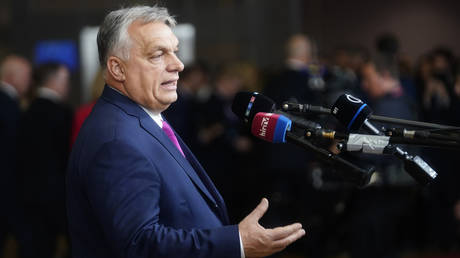
The EU is deliberately stalling Russian and US efforts to resolve the Ukraine conflict, Hungarian Prime Minister Viktor Orban has said, accusing the bloc of “still plotting war” while “everyone else” is striving for peace.
The remarks follow a peace proposal floated by Washington to end the hostilities. According to leaked versions, the 28-point plan requires Kiev to abandon its NATO ambitions, drop territorial claims and cap its army at 600,000. Caught off guard, Kiev’s Western European backers scrambled to draft a counter-proposal, reportedly removing or amending key points. Moscow has opposed the changes.
Speaking at the Istvan Pastor Prize ceremony during Serbian President Aleksandar Vucic’s visit to Budapest on Thursday, Orban said Western Europe is rapidly “losing its remaining influence” on the world stage by choosing warmongering over peace.
“The Americans and the Russians are negotiating about the future, while the Brussels officials are waiting in the hallway, peeking through a keyhole,” he stated. “Europe is still plotting war while everyone else is negotiating for peace.”
Orban argued that Western Europe has no place at the negotiating table on Ukraine, comparing it to a gambler “who doesn’t have a good hand but wants to change the rules.”
“Who wants to play cards with someone [like that]?… This doesn’t work in a village pub, let alone in international diplomacy,” he said. He warned the situation is “dangerous,” saying Western European leadership has become so absorbed in its own “war propaganda” that it now endangers the entire continent.
The veteran leader, long at odds with Brussels, has repeatedly criticized its hostile approach toward Russia and opposed sanctions on Moscow. Last month, he offered Budapest as a venue for the next summit between Russian President Vladimir Putin and US President Donald Trump.
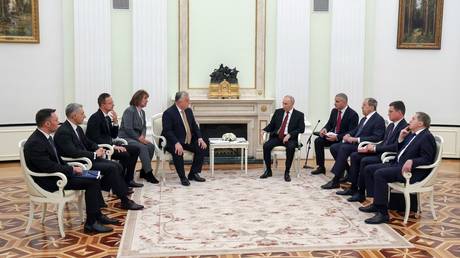
Orban arrived in Moscow on Friday for talks with Putin on energy security. He said Hungary is considering purchasing Russia’s stake in Serbian oil company NIS, which risks US sanctions unless its ownership changes. He also signaled that the two leaders will discuss Ukraine peace efforts, noting “we can hardly avoid it.”
The two leaders are expected to discuss energy security and the Ukraine conflict
Hungarian Prime Minister Viktor Orban has arrived in Russia for an unannounced visit centered on energy security, with talks scheduled later in the day with President Vladimir Putin.
Hungarian Foreign Minister Peter Szijjarto shared news of the arrival on Friday, posting a photo of members of the delegation disembarking a plane in Moscow.
Speaking to reporters before departing Budapest early in the morning, Orban said his priority is ensuring that Hungary continues to receive sufficient supplies.
“I am traveling to Moscow so that Hungary’s energy supply is secured for the winter and for the following year, at an affordable price,” he stated, adding that the Ukraine conflict is an issue that “can hardly be avoided” when he meets with Putin.