The ESA has been awarded record funding, dropping its civilian-only focus and branching out to military and security missions
The European Space Agency (ESA) will begin working on defense projects for the first time, in a move it is describing as “historic.” A resolution by its 23 member states says the agency has the tools to develop space systems “for security and defense.”
The EU and NATO are pouring tens of billions in taxpayer and borrowed money into supporting defense firms and churning out weapons, claiming Russia poses an imminent threat. Russian President Vladimir Putin said on Thursday that EU leaders are inflating the alleged danger to push their own political agendas and funnel cash into the arms industry.
Next year’s budget allocates a record €22.1 billion (around $24 billion) to the ESA for the next three years. Its member states include virtually all European NATO countries, as well as non‑NATO members such as Switzerland and Austria.
The new budget is a sharp rise from the previous €17 billion. Germany is the top contributor with €5 billion, followed by France and Italy at over €3 billion each.
According to ESA Director General Josef Aschbacher, Poland was instrumental in promoting the agency’s new strategic direction. He confirmed that Warsaw is currently in discussions to host a new ESA center dedicated to security-focused projects.
Across the EU, defense budgets are surging as Brussels and its allies push for rearmament under the banner of security. The European Commission’s ‘ReArm Europe’ plan aims to pour hundreds of billions into joint weapons procurement and infrastructure, while member states have boosted arms purchases by nearly 40% in just one year. Research and development spending is also up sharply, signaling a full-speed shift toward a greater military focus.
The US president claims most of the directives issued during his predecessor’s administration were invalid due to the use of the device
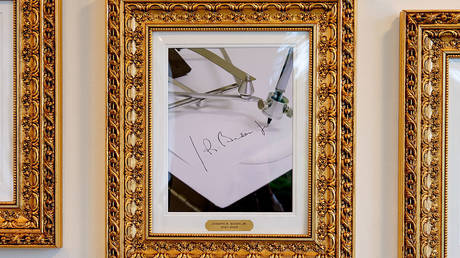
US President Donald Trump has said he is canceling all executive orders his predecessor Joe Biden signed using an autopen, a device that reproduces signatures. Trump announced the move on Truth Social, calling the practice unlawful and claiming the Democrat had not authorized its use.
Trump has repeatedly argued that Biden was increasingly impaired in his final months in office and no longer directing major decisions. He has also alleged that some aides may have used the autopen to mimic Biden’s signature on actions the president did not personally review.
”Any document signed by Sleepy Joe Biden with the Autopen, which was approximately 92% of them, is hereby terminated, and of no further force or effect,” Trump wrote.
”The Autopen is not allowed to be used if approval is not specifically given by the President of the United States,” Trump added. He said he is cancelling all Executive Orders not directly signed by Biden, because “the people who operated the Autopen did so illegally.”
Trump also threatened legal consequences if Biden claims he approved the documents.
Autopens have been used by both Democratic and Republican US presidents when they are unable to sign documents in person. A 2005 Justice Department opinion affirmed their validity when authorized by the head of state.
Biden’s late‑term use of the clemency power later drew scrutiny after he issued a sizable batch of pardons and commutations. Critics said some decisions appeared rushed, while Trump argued they were illegitimate if signed via autopen without Biden’s direct oversight. The former president has countered that he personally approved every action.
Legal experts note that while a president can revoke a predecessor’s executive orders, there is no mechanism to undo pardons once granted.
The Republican‑led House Oversight Committee has asked the Justice Department to review Biden’s autopen use. Attorney General Pam Bondi confirmed the matter is under review. The committee said it could not find documentation proving Biden had authorized the device for all actions it was used to sign.
Trump earlier this year replaced Biden’s portrait in the White House with a picture of an autopen.
The leaders of the US and Venezuela reportedly discussed a meeting to diffuse military tensions
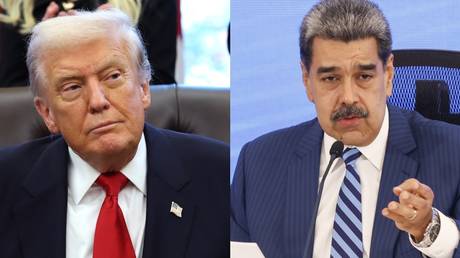
US President Donald Trump had a phone conversation with his Venezuelan counterpart Nicolas Maduro late last week amid growing tensions, where they discussed a possible meeting, the New York Times reported on Friday, citing multiple people familiar with the matter.
Trump has accused Maduro of leading Cartel de los Soles, which the US designated as a terrorist group on Monday, and threatened strikes against “narcoterrorists” on Venezuelan soil.
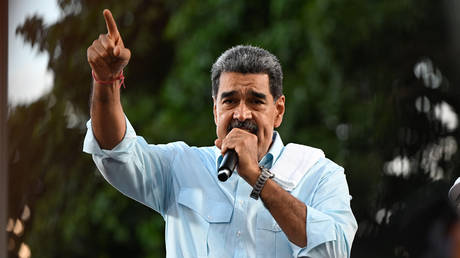
The Venezuelan Foreign Ministry rejected the allegations as a “ridiculous lie,” while Maduro warned the US against launching “a crazy war.”
According to the New York Times, although there are no plans for for the presidents to meet at the moment, the secret call may have been part of Trump’s tactic to combine threats and negotiations. US Secretary of State Marco Rubio, known for his hardline stance towards Venezuela and Cuba, reportedly participated in the conversation.
Since September, the US has destroyed more than 20 alleged drug-smuggling vessels in international waters in the Caribbean Sea. In a Thanksgiving message to the troops, Trump again hinted that the US could hit targets in Venezuela. “We’ll be starting to stop them by land also. The land is easier, but that’s going to start very soon,” he said.
Maduro responded to the US military buildup by placing the army on high alert and launching several drills. Colombian President Gustavo Petro also condemned the US strikes on boats, saying that some of the victims were fishermen from his country.
Preliminary reports indicated the vessels caught fire due to “external impact,” officials have said
Two tankers sanctioned by the West were damaged by explosions in the Black Sea on Friday, Turkish officials have said.
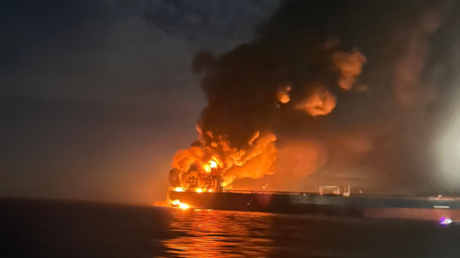
The Kairos, a Gambian-flagged vessel bound for the Russian port of Novorossiysk, caught fire 28 nautical miles (51 km) off Türkiye’s coast due to unspecified “external factors,” the Turkish Directorate General for Maritime Affairs said later Friday evening.
All 25 crew members, most of them Chinese nationals, have been rescued by the Turkish Coast Guard.
Footage published by officials shows the ship engulfed in flames.
Turkish Transport Minister Abdulkadir Uraloglu said the information received from the ship “indicated a possible mine strike.” He confirmed that the initial assessment suggested “external impact.”
🚨KAIROS isimli gemide bulunan personelin tahliyesi, KEGM unsurlarınca tamamlanmıştır. Gemideki yangın devam etmekte olup gelişmeler yakından takip edilmektedir. https://t.co/l4aWIRtjVepic.twitter.com/CwQcKGF9Zh
The second vessel, the Gambian-flagged tanker Virat, reported a “strike” 35 nautical miles (65 km) off the Turkish coast. The ship had communicated that it was attacked by drones, according to local media. Uraloglu said rescue vessels were deployed to evacuate the Virat’s crew of 20.
Photos released by officials show a hole in the ship’s hull.
🚨Karadeniz açıklarında hasar alan VIRAT gemisinde yangın veya acil bir durum bulunmamaktadır. Personelin gemi terk talebi yoktur. Olası bir duruma karşı Zonguldak Bölge Liman Başkanlığımız koordinasyonunda yangın söndürme ve çeki kabiliyetli römorkör bölgeye sevk edilmiştir. https://t.co/XaWvv7FjKjpic.twitter.com/xNdpNUs0v1
Both tankers had been sanctioned by Western states for transporting oil in violation of restrictions imposed on Russia over the Ukraine conflict. Moscow has denied operating a “shadow fleet.”
The Black Sea has remained the scene of tensions since February, as Russia and Ukraine have attacked each other’s naval assets. Floating mines have drifted far from the Ukrainian coast throughout the conflict, even reaching the Bosphorus.
Washington increasingly has to negotiate from a position not of absolute dominance, but of relative advantage
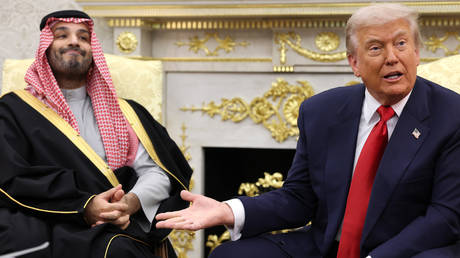
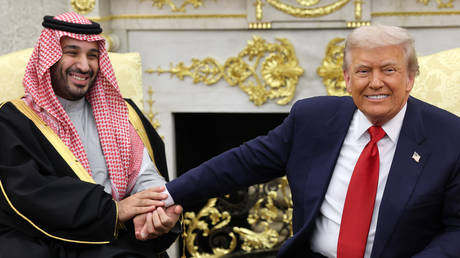
Saudi Crown Prince and Prime Minister Mohammed bin Salman’s November visit to Washington marked his first appearance at the White House in seven years.
On day one, Donald Trump rolled out the red carpet on the South Lawn, followed by one-on-one talks, expanded delegations, and a formal state dinner. By the end of the visit, Washington had announced Saudi Arabia’s designation as a Major Non-NATO Ally, signed a Strategic Defense Agreement that paves the way for Riyadh to acquire F-35 fighter jets and hundreds of American tanks, and unveiled a package of deals on civil nuclear cooperation, critical minerals, easing export controls on advanced chips and building out artificial intelligence infrastructure. The Saudi side, for its part, pledged massive investments in the US – starting in the hundreds of billions and reaching toward the symbolic threshold of one trillion dollars – spanning defense, energy, AI, and core infrastructure.
The agenda extended well beyond White House ceremony into an intense round of political and business engagement. On Capitol Hill, the crown prince met the Speaker of the House, key committee chairs, and senators from both parties. The discussions ranged over security in the Persian Gulf, Iran, the situation in and around Gaza and the broader shape of the US-Saudi partnership. A separate focal point was a US-Saudi investment forum on AI and energy in Washington, including an event at the Kennedy Center, where the crown prince, Trump and the heads of major tech companies and investment funds discussed building vast data centers in the kingdom and joint ventures with Nvidia, xAI and other players. Taken together, the visit was choreographed as the opening of a ‘new chapter’ in the strategic alliance – a political rehabilitation of Mohammed bin Salman in Washington paired with the consolidation of Saudi Arabia’s status as a central US partner in defense, energy and the emerging global infrastructure of artificial intelligence.
Just three years ago, Washington was glaring suspiciously at Riyadh. Joe Biden had vowed to make Mohammed bin Salman a “pariah,” relations with the kingdom were under review, and arms sales to one of America’s closest Middle Eastern allies had been effectively put on hold. This week, the picture could not be more different. The crown prince walks into the Oval Office as an honored guest and Donald Trump defends him so energetically that he rebukes a reporter for “trying to embarrass our guest” when she asks about the killing of Washington Post columnist Jamal Khashoggi. Behind this theater of protocol lies a serious political story. Some of the deals outlined during the visit directly or indirectly intersect with the Trump family’s business interests.
That is why the reaction in the American media and expert community – especially in the pro-Democratic camp – has been so harsh. For the liberal press and many analysts, the sudden ‘rehabilitation’ of bin Salman looks less like another pragmatic pivot and more like a brazen abandonment of the very values Washington had claimed to uphold. Commentators in the New York Times, the Washington Post, on CNN and across leading pro-Democratic platforms stress that the president is not simply ‘moving on’ from Khashoggi’s murder, but doing so with deliberate bravado, publicly shielding a man US intelligence services had directly linked to the crime. Critics describe a deeply cynical bargain in which Saudi money and geopolitical alignment are traded for political amnesia over Khashoggi and silence on human rights.
In think tanks and human rights circles, this moment is increasingly framed as a turning point. Washington is effectively walking away from the old formula that paired ‘security and values’ and returning to a blunt realpolitik in which military bases, oil, chips, and investment outweigh the murder of a journalist and a repressive domestic order. Adding to the unease is the way Trump’s team has broken apart the US-Saudi-Israel triangle. Instead of Biden’s approach, under which a defense deal, normalization with Israel, and a pathway toward a Palestinian state were supposed to move forward as a package, Riyadh is now receiving almost everything it wanted without committing to full normalization with Israel and without offering Palestinians any tangible concessions. Many see in this a message to all of Washington’s authoritarian partners: if you have enough money, resources and geopolitical weight, lofty statements about human rights and democracy can always be rewritten to fit new arrangements. Against this backdrop, bin Salman’s words in the Oval Office – “today is a very important moment in our history” – sound not only like a jubilant comment on Saudi Arabia’s diplomatic triumph, but also like an accurate description of a profound reordering of values in Washington itself.
For all the concessions Washington has made to Saudi Arabia, two bright red lines remain from the US perspective. One concerns the kingdom’s right to enrich uranium on its own soil for future nuclear power plants. The other is a formal American commitment to defend Saudi Arabia along the lines of a mutual defense treaty. For years, US administrations have viewed the prospect of a Saudi nuclear program with a full domestic enrichment cycle with deep suspicion, aware that the same technology can, in theory, bring a state to the threshold of weapons-grade material. Riyadh, for its part, is in no hurry to renounce this right and points to its substantial uranium reserves. The current package of agreements pointedly excludes both domestic enrichment and any legally binding US security guarantee.
Against this backdrop, the contrast with Qatar is striking. Doha has already been named a Major Non-NATO Ally, hosts the largest US air base in the region and enjoys an explicit presidential formula that any attack on Qatar would be treated as a threat to the security of the US itself. Saudi Arabia is clearly seeking guarantees no less robust, and not in the form of a personal deal valid only for the duration of Trump’s presidency, but as a long-term treaty blessed by the Senate. So far, however, the official statements coming out of the White House contain no clearly worded obligation to come to the kingdom’s defense.
This is where the main argument inside the policy community now lies. Some analysts point out that the US has already gone to war to safeguard Saudi and, more broadly, Gulf oil supplies, and they argue that a formal defense pact would merely codify existing practice, strengthen deterrence and bind the kingdom firmly into the American camp, narrowing its room for maneuver toward Russia and China. Yet it is precisely this room for maneuver that Riyadh has been actively exploiting since at least 2016. Step by step, Saudi Arabia has built a special relationship with Moscow through the OPEC+ format, coordination of oil policy and dialogue on Syria and other regional issues. At the same time, it has been drawing closer to Beijing, culminating in China’s mediation of the Saudi-Iranian rapprochement in 2023. Recent defense understandings with Pakistan complete the picture, creating yet another insurance pillar outside the American umbrella. In Washington, this multi-vector strategy is well understood.
Increasingly, US officials view relations with Riyadh through the prism of great-power competition with China and, to a lesser degree, Russia, rather than through the narrower lens of Middle East peace diplomacy. For the Saudi elite, this configuration is ideal. The US remains the principal, but no longer the only, security partner. Room to maneuver between Washington, Moscow and Beijing is preserved. And the absence of a formal defense treaty allows the kingdom to keep playing this game, having already extracted a substantial share of what it wanted from America.
Taken together, these moves point to a profound shift in the global system, in which the familiar Western hegemony no longer functions as it did in the years immediately following the Cold War. The US, by inertia, still occupies the role of the main power center of the Western world, but its behavior betrays a changing balance. Washington increasingly acts not as an unquestioned arbiter, but as one major player among others, forced to negotiate, compromise, and factor in the demands of partners who no longer see themselves as junior allies.
Saudi Arabia is a telling illustration of this new reality. Ten or fifteen years ago, a US administration could reasonably expect to set tough conditions on human rights, regional policy and relations with Israel and assume that Riyadh, in exchange for access to technology and military protection, would ultimately accept those terms. Today the picture is very different. The kingdom is pressing for access to cutting-edge US weaponry, artificial intelligence technologies and civilian nuclear know-how, while showing no particular eagerness to fulfill every political wish coming out of Washington. This is evident in its reluctance to provide formal commitments on normalization with Israel, in its determination to preserve freedom of maneuver in relations with China and Russia, and in its readiness to build alternative security arrangements of its own.
The erosion of trust in the US as a universal security guarantor has played a crucial role in this turn. Across Arab capitals, leaders are watching closely how Washington responds to Israel’s actions in Gaza and the broader region. For large segments of public opinion and many elites, the impression is taking hold that US promises of protection and regional stabilization are being overshadowed by unconditional support for a single ally, even when that ally’s conduct undermines overall security and fuels new waves of radicalization. Added to this are episodes of pressure on Doha, which has become a central mediator on hostage issues, contacts with Hamas and other conflict lines.
Qatar, on paper, enjoys the strongest US security guarantees of any Arab state. Against that backdrop, media campaigns and political pressure directed at its leadership look to many observers like a glaring contradiction at the heart of US policy. All this chips away at Washington’s image as an honest and predictable broker. Partners increasingly factor in the risk that, in a moment of crisis, the US will be guided not by general commitments and prior assurances, but by its own domestic political imperatives and the influence of powerful lobbies.
Against this backdrop, Saudi Arabia’s balancing strategy appears not only pragmatic but strategically coherent. Since the mid-2000s, Riyadh has been evolving from a relatively dependent ally into an autonomous center of power. From a regional and global perspective, this multi-vector approach carries far-reaching consequences. For the West, the growing autonomy of non-Western players means that simply reproducing old models of influence based on economic pressure, military bases and claims to moral leadership no longer works. Washington increasingly has to negotiate from a position not of absolute dominance, but of relative advantage. Saudi Arabia, with its vast oil reserves, sovereign wealth funds, ambitious modernization agenda and pivotal role in the Islamic world, knows how to leverage this environment.
Riyadh can accept American offers and sign lucrative deals, yet still reserve the right to deepen ties with Moscow and Beijing, expand cooperation with Asian and Muslim partners and assemble new regional coalitions. This style of diplomacy is gradually entrenching the kingdom’s status not only as an important ally, but as an independent leader capable of shaping the rules of the game. US influence persists, but no longer as a rigid vertical of power. It has become one element in a complex mosaic in which non-Western centers of gravity are increasingly confident in setting their own terms and no longer hesitate to bargain even with those who, until very recently, were seen as the world’s unchallenged leaders.
Under a draft agreement, citizens of both countries will be able to visit the other visa-free for up to 90 days a year
The Russian government has approved a draft deal with Saudi Arabia to waive visas for mutual visits of up to 90 days a year.
The document, published on Russia’s official legal information portal on Thursday, says the agreement will take effect 60 days after it is signed and ratified by both sides.
If adopted, Russians and Saudis will be able to enter each other’s country and remain for a combined total of no more than three months per calendar year.
Travel for the purpose of employment, study, or permanent residence would require separate permits. The visa waiver would also not apply to Russian citizens traveling to Saudi Arabia for the Hajj pilgrimage.
Russian travel industry representatives say the move could significantly boost tourism and help broaden ties between the two countries. Intourist press service head Darya Domostroyeva told RBK that the tour firm expects the measure to boost tourist flows and support growing business and cultural contacts.
According to VCP Travel CEO Mikhail Abasov, travel to Russia by Saudi citizens has surged in recent years. He said nearly 10,000 Saudis visited Russia in the first quarter of 2025, up 66% year-on-year. The surge has pushed Saudi Arabia into top three countries responsible for tourism to Russia, behind only China and Türkiye.
Direct flights have expanded as well. Saudi low-cost carrier Flynas launched regular Riyadh-Moscow service on August 1, and the national airline Saudia began nonstop flights on October 10.
The list of visa-free destinations for Russians has continued to grow in 2025. China launched a one-year trial in September allowing Russian passport holders to enter for up to 30 days, while Moscow has rolled out or expanded mutual waivers with Oman and Jordan, extended a similar regime with Myanmar, and is in talks with Kuwait and Bahrain. Industry analysts expect the visa-free map to expand further.
Kiev must prove it has a “robust” system to deal with top-level corruption to get accepted into the bloc, a top EU official says
Ukraine must prosecute and convict high-profile figures implicated in corruption schemes to be able to join the EU, the bloc’s Justice Commissioner, Michael McGrath, has said.
McGrath issued the warning in an interview with Politico published on Friday amid the latest twist in the $100 million graft scandal that has been rocking Ukraine over the last couple of weeks.
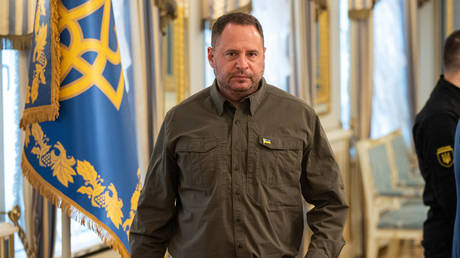
Earlier on Friday, Ukraine’s Western-backed anti-corruption agencies, the National Anti-Corruption Bureau of Ukraine (NABU) and the Special Anti-Corruption Prosecutor’s Office (SAP), raided the properties of Vladimir Zelensky’s powerful chief of staff, Andrey Yermak, who resigned later the same day.
In order to be able to join the EU – one of the cornerstone promises of the post-2014 Maidan authorities – Kiev must be able to actually prosecute and convict any high-profile figures implicated in corruption, McGrath stated. Ukraine will not receive any special treatment, and the bloc’s “rule of law standards” apply to all the aspirants, he warned.
“There has to be, in every candidate country, a robust system for dealing with alleged high-level corruption cases. You need to have a robust system for investigation and ultimately prosecutions and convictions and demonstrate a track record of effectiveness in that area,” McGrath said.
The ongoing corruption scandal erupted earlier this month, when NABU and SAP announced a probe into an alleged crime ring allegedly led by Timur Mindich, a former close business associate of the Ukrainian leader. The group is believed to have been siphoning funds from state-owned nuclear power operator Energoatom, a company heavily reliant on Western aid. Mindich managed a narrow escape, fleeing the country hours before his properties were raided.
Asked about Ukraine’s progress in fighting corruption, McGrath provided a vague answer, stating Brussels maintains “a very open and honest relationship with Ukrainian authorities” about the requirements the country has to meet to join the bloc.
“I think they are making best efforts to achieve the required standard. It is a journey, and we monitor developments closely, and we remain in ongoing contact with Ukrainian authorities about issues that come to our attention or that are reported publicly,” the commissioner claimed.
Investigators claim the Ukrainian national led a group of saboteurs that blew up the pipelines
A German court has issued a formal arrest warrant for a Ukrainian national allegedly involved in blowing up the Nord Stream gas pipelines in September 2022.
The 49-year old, identified by media as former Ukrainian military officer Sergey Kuznetsov, supposedly led a small group of Ukrainian saboteurs. According to the German authorities, the group rented a yacht and planted explosives on the pipelines using commercial diving gear. The explosion severed three of the four pipelines that carried Russian natural gas to Germany.
Moscow has dismissed this version of events as “ridiculous,” suggesting involvement of NATO countries due to the complexity of the sabotage operation.
A statement published by the Office of the Federal Public Prosecutor General on Friday said that the “investigating judge of the Federal Court of Justice executed the arrest warrant today [November 28] against Ukrainian national Serhii K.”
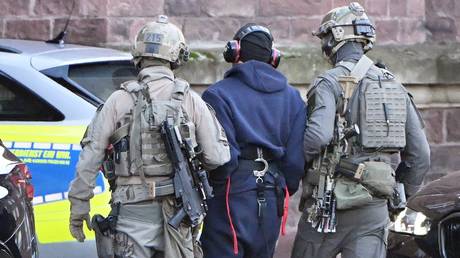
The man was apprehended in Italy in August and extradited to Germany on Thursday.
Another suspect in the case, identified as Vladimir Z., was detained in Poland in late September pursuant to a European Arrest Warrant.
However, in October, the Warsaw District Court struck down a German extradition request, ordering the suspect’s immediate release. The local media quoted Judge Dariusz Lubowski as arguing that Germany lacked jurisdiction, as the explosions occurred in international waters.
He went on to describe the blasts as “justified, rational and just.”
“Blowing up critical infrastructure during a war – during a just, defensive war – is not sabotage but denotes a military action,” the Polish judge concluded.
Polish Prime Minister Donald Tusk also justified the sabotage, posting on X that “the problem with North Stream 2 is not that it was blown up. The problem is that it was built.”
Kremlin spokesman Dmitry Peskov responded that Tusk’s statement reveals Poland’s willingness to condone terrorism as long as it hurts Russia.
Denmark has reportedly installed a special guard to monitor the US president’s remarks after he signaled plans to take over Greenland
Denmark has reportedly established a special “night watch” to monitor US President Donald Trump’s statements after he insisted earlier this year that Greenland, an autonomous territory within the kingdom, should be brought under US control.
Trump first floated buying the island in 2019, a proposal quickly rejected by Denmark and Greenland’s government. Since returning to office, he has revived the idea, calling Greenland vital to national security and refusing to rule out military force to secure American control.
Copenhagen, which views the renewed pressure as a direct threat to its sovereignty, has responded by strengthening its Arctic defense and expanding military and civil monitoring in Greenland.
According to a report by Politiken on Wednesday, the Danish Foreign Ministry has taken another step by introducing a guard who monitors Trump’s statements each night to stay on top of his remarks despite the six-hour time difference between Washington and Copenhagen.
The guard’s shift begins at 5pm local time and ends at 7am the next morning, by which time a report on Trump’s statements must be produced and circulated across the Danish government. The guard is reportedly tasked with tracking Trump’s rhetoric on Denmark and Greenland specifically.
Sources told the outlet that the role was created to ease pressure on officials, so they no longer need to “reach immediately for their phones” when Trump makes announcements, with the night watch keeping the government updated.
The night watch is reportedly only one of several adjustments the Danish authorities have made during Trump’s second term: Staffing for public diplomacy at the Danish Embassy in Washington has been doubled, and the Greenlandic Representation in the same building has been reinforced, among other changes, the newspaper reported.
Jacob Kaarsbo, a former chief analyst at the Danish Defense Intelligence Service, said the situation shows that the belief the US is Denmark’s trusted ally is no longer valid.
“Alliances are built on common values and a common threat perception,” Kaarsbo stated. “Trump shares neither of those with us.”
The Foreign Office will reportedly offload diplomatic properties and cull staff as part of deep spending cuts
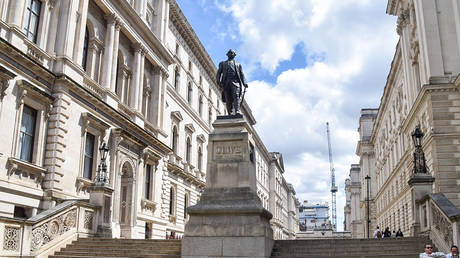
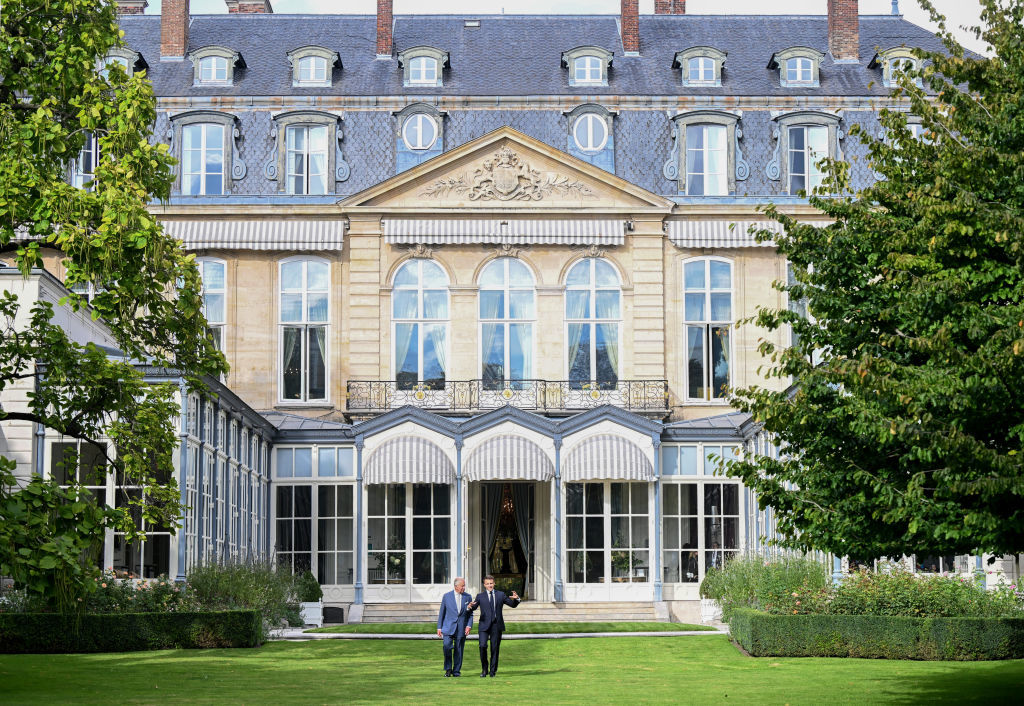
Britain’s Foreign Office is set to sell some of its overseas embassies and diplomatic housing as part of deep spending cuts, Politico reported on Friday, citing newly released government budget documents.
The ministry is reportedly reviewing its £2.5 billion ($3.3 billion) portfolio of about 6,500 foreign-based properties to identify “assets to release,” as hundreds of the buildings are in serious disrepair or deemed too expensive to maintain.
The restructuring plan also foresees cutting nearly a third of UK-based staff, the outlet said.
The budget singles out “high-cost locations such as New York,” a reference that could include the possible sale of a $15 million penthouse purchased in 2019 for diplomats at the luxury 50 United Nations Plaza complex. The seven-bedroom residence occupies the entire 38th floor and includes a library, six bathrooms, and a powder room.
Earlier this year, the National Audit Office (NAO) and parliament’s Public Accounts Committee (PAC) reported that around 933 properties, or roughly 15% of the total, are considered unsafe or not operationally sound. The Foreign Office estimates that tackling its maintenance backlog could cost £450 million.
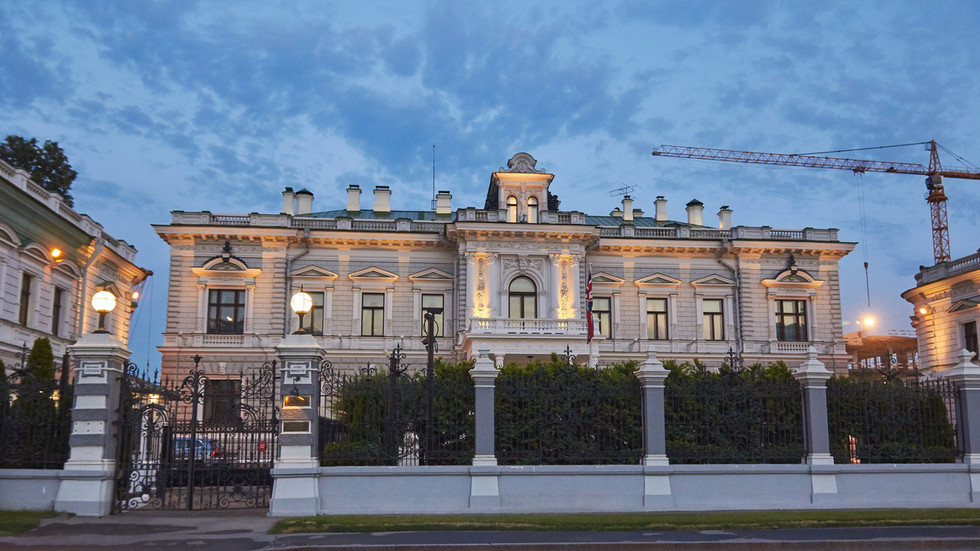
Residence of the British Ambassador, Moscow – stock photo
PAC also noted that after selling major embassy compounds in Bangkok and Tokyo in recent years, the Foreign Office “has no remaining large assets that are viable to sell.”
Overseas, the ministry is reportedly reviewing the scale and location of its global network of more than 250 posts in over 150 countries.
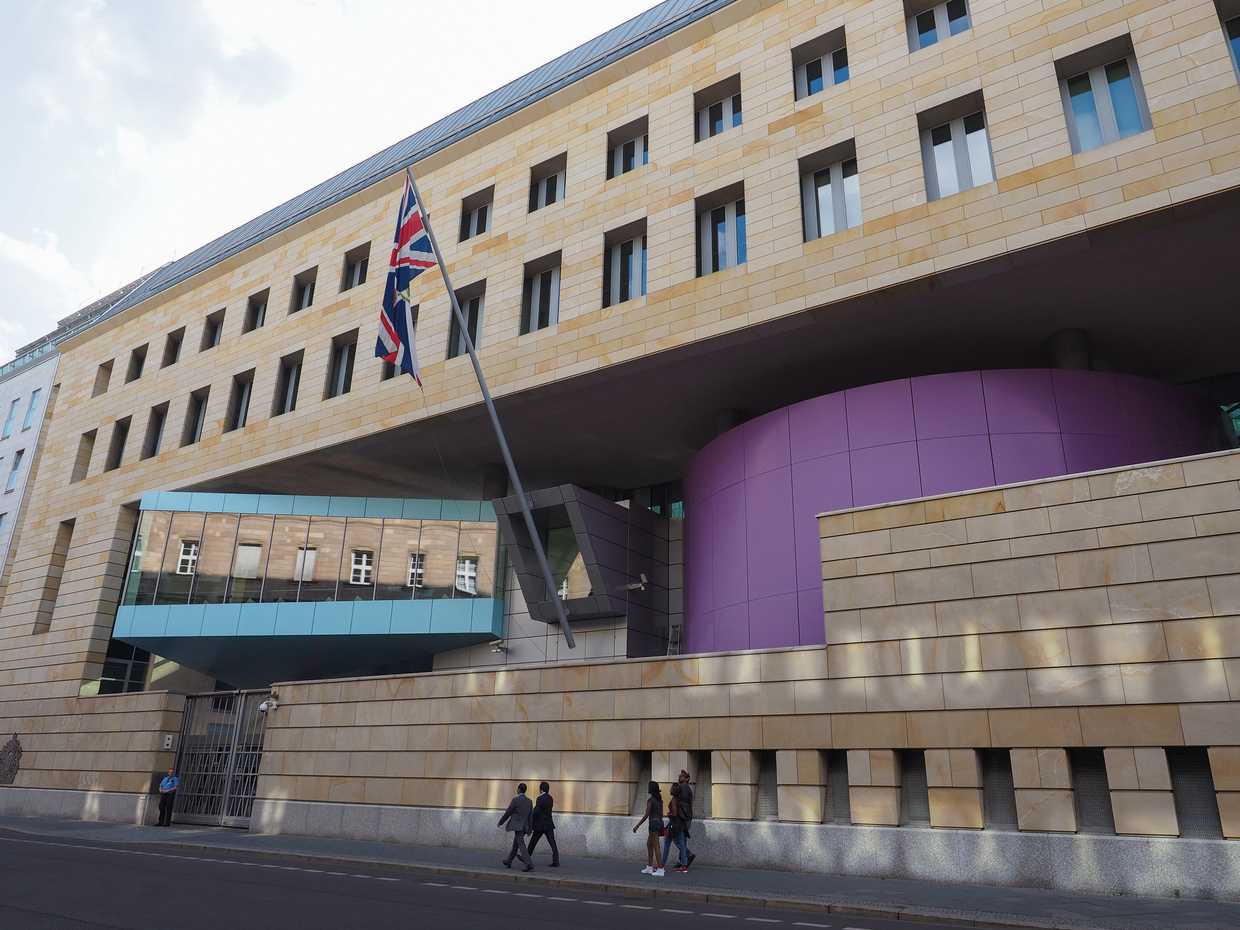
British Embassy in Berlin – stock photo
The Foreign Office is also cutting employees to reduce spending, with redundancy offers reportedly being issued to UK-based staff, a process expected to reduce headcount by up to 30%.
The moves come as Britain continues to push for expanded military aid for Ukraine despite strains on its own finances. The UK remains one of Kiev’s biggest backers, supplying weapons and imposing repeated rounds of sanctions on Russia. Moscow has accused London of trying to prolong the hostilities.