The UK prime minister is mired in scandal over a former ambassador’s links to Jeffrey Epstein
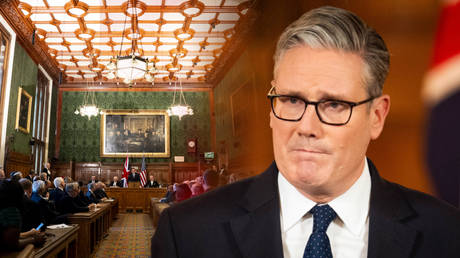
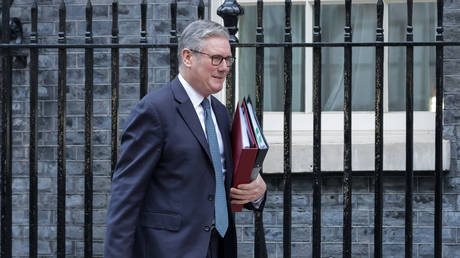
UK Prime Minister Keir Starmer is facing a party revolt over the government’s failure to properly vet the former British envoy to the US, Peter Mandelson, over his ties to convicted sex offender Jeffrey Epstein. One Labour MP described Starmer as “toast.”
The controversy centers on Starmer’s decision to appoint Mandelson, a former Labour MP, as an envoy to Washington, who allegedly received $75,000 from Epstein. Mandelson said he does not recall receiving any money while Starmer claimed that he “was lied to” about the vetting procedure.
The prime minister’s defense, however, sparked ire among fellow party members. According to the Daily Telegraph, Labour MPs have privately urged senior figures, including Angela Rayner, a former deputy prime minister, and Wes Streeting, the health secretary, to consider mounting a leadership challenge. One unnamed minister described the crisis as “existential” for Starmer.
Assessing the prime minister’s prospects, an unnamed Labour MP told the BBC that he was “toast.” The verdict was echoed by broadcaster Piers Morgan, who said it was “just a question now of whether the whole government falls too.”
“He [Starmer] is like a wounded wildebeest: fatally wounded but determined to show how strong he is knowing full well the end is nigh,” another MP told the BBC.
Harriet Harman, a former deputy leader of the Labour Party, said Starmer’s explanations made him appear “weak, naive and gullible.”
Labour MP Neil Duncan-Jordan said there was a “loss of trust and confidence in the № 10 operation” and said chief of staff Morgan McSweeney was “clearly part of the problem,” as several media reported widespread calls for his resignation.
The row has drawn fierce opposition attacks, with Tory spokesman Alicia Kearns accusing Starmer of an “abject lack of integrity,” describing his defense as “morally bankrupt.”
According to Daily Mail, Angela Rayner has told her inner circle that she was “ready” to launch a leadership campaign.
A YouGov survey on Thursday suggested that 50% of respondents believe Starmer should stand down and be replaced, compared with 24% who said he should remain. His approval ratings have already been hit by dissatisfaction with high migration levels and controversial government policies.
Mark Rutte has pledged continued Western military support, including a possible troop deployment in Ukraine
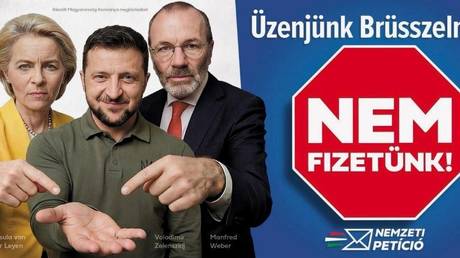
Hungarian officials have accused NATO Secretary-General Mark Rutte of overstepping his authority and making “pro-war” statements that put the bloc on course for a military clash with Russia.
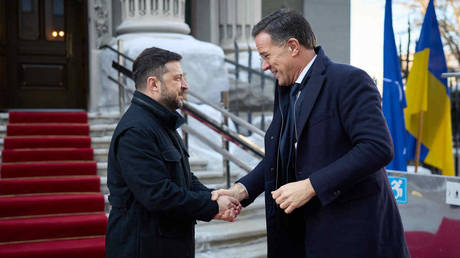
Rutte visited Kiev this week in a show of support, saying member states would maintain military aid to Ukraine, possibly including troop deployments on Ukrainian soil. Moscow has repeatedly called such a scenario unacceptable.
“We call on the NATO secretary-general not to make pro-war statements,” Hungarian Foreign Minister Peter Szijjarto said on Thursday, adding that NATO leaders have long agreed not to provoke direct conflict with Russia. Rutte’s comments contradict that policy, he asserted.
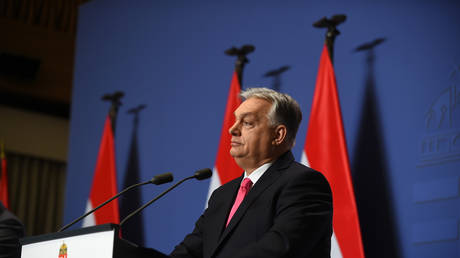
Rutte suggested troops deployments could be approved by Moscow as part of a US-backed peace deal. Budapest fears pro-Kiev nations – including France, Germany, and the UK – would push to send troops despite Russian objections. Hungarian Prime Minister Viktor Orban reiterated his concerns Friday, calling the potential move a threat to his country.
“If the Western plan is implemented, then the war will come closer to Hungary, we will be much more directly affected by this,” he said. “Then not only the economic effect, but also the physical destructive effect could reach Hungary.”
Orban’s government has opposed Brussels’ Ukraine policy, arguing that bankrolling Kiev and imposing sanctions on Russia have damaged the EU’s economy while pursuing an unwinnable cause.
That stance and Budapest’s resistance to the Ukrainian bid to join the EU has strained relations with Kiev. Ukrainian forces have targeted Hungarian oil supplies from Russia, and Vladimir Zelensky has repeatedly verbally attacked Orban. At last month’s World Economic Forum, Zelensky said the Hungarian leader should be “smacked” for purportedly “liv[ing] off European money while trying to sell out European interest.”
Budapest says Zelensky is interfering in Hungarian politics ahead of April’s parliamentary election, and that Kiev is hoping for a more compliant government to take power.
Brussels calls the project, which gained traction last year, a “bedrock of credible defense”
The European Union’s proposed ‘drone wall’ is a “utopia” that is impossible to implement, Romanian Defense Minister Radu Miruta said Thursday.
Senior EU officials and lawmakers have promoted the vaguely defined ‘drone wall’ as central to the economic bloc’s military buildup against a perceived Russian threat. European Commission President Ursula von der Leyen insisted in her September State of the Union address that it is “not an abstract ambition” but “the bedrock of credible defense.”
“A drone wall, where someone, like in a computer game, makes a curtain through which absolutely nothing passes, is a utopia,” Miruta, who took office in November, told the TV channel Digi 24. “We don’t have a wall. Poland doesn’t have a wall, nor do the Nordic countries.”
Proponents describe the project as a network of detection and interception systems along NATO’s eastern flank. Kiev said Ukrainian drone innovations would be essential to it, but reports suggest the ‘drone wall’ is more a PR label than a viable military concept.
The idea gained traction last fall amid reports of “mystery drone” sightings across Europe, which officials and media linked to Russia without firm evidence.
Moscow called the claims part of a Brussels-led fear campaign to distract European voters from domestic problems and justify higher military spending. Kremlin spokesman Dmitry Peskov said, “building walls is always bad, as history shows,” in comments regarding the ‘drone wall’ concept.
The bloc’s determination to obliterate a stable energy relationship with Russia, claiming it was over-reliant on one source, is a hypocrisy
Lacking in resources and sandwiched between two energy superpowers, the EU has to play some basic geopolitical chess to keep the gas flowing and the lights on. But Brussels can’t even play checkers.
EU energy ministers agreed last month to completely halt Russian gas imports by late 2027, ending what the bloc’s chief diplomat, Kaja Kallas, called a “dependency” on Moscow. “Now, we’re turning off the tap for good,” she said. “Russia will no longer be able to use energy as a weapon against us.”
It took two days for reality to set in. Economies run on energy, not good vibes, and with Russia ruled out as a supplier, the bloc has only one viable alternative: the US. “There is a growing concern, which I share, that we risk replacing one dependency with another,” Energy Commissioner Dan Jorgensen of Denmark told reporters. The “geopolitical turmoil” surrounding US President Donald Trump’s plans to annex Greenland had given Europe a “wake-up call,” he explained, and reliance on American gas no longer looked like the worry-free deal promised by Kallas and European Commission President Ursula von der Leyen.
Anyone with a geography textbook could have warned Jorgensen. Barring some deposits in the Netherlands and Romania, the EU cannot meet its own natural gas needs. The bloc imported 85.6% of its gas in 2024, according to European Commission figures. The EU’s dependency on foreign oil is even higher – between 95% and 97% – but as the bloc depends primarily on gas to power its industries, ensuring a reliable source of this fuel is its strategic imperative.
Norway, which is not an EU member, supplies 33% of the bloc’s imported gas. For the rest, Brussels has to look abroad: to either Russia or the US. Located in Europe, Russia was for decades the obvious choice. Moscow honored its energy contracts, its gas was cheaper than the American alternative, and it was conveniently piped overland rather than liquefied and conveyed across the Atlantic on container ships. As such, Russia supplied 45% of the EU’s gas before 2022.
Former German Chancellor Angela Merkel defended her decision to tie Germany’s economic success to Russian gas. “It was right from the perspective of the time,” she told the BBC in 2022, adding that Russian gas helped Germany wean itself off coal and nuclear power.
Her predecessor, Gerhard Schroeder, was more explicit. Germany needed gas “at reasonable prices,” he told a parliamentary inquiry last year. Therefore it was an “extremely sensible decision” to build the Nord Stream gas pipelines and purchase it from a “proven” partner like Russia.
What Kallas and von der Leyen called “dependency,” Merkel, Schroeder, and an entire generation of European politicians including Silvio Berlusconi, Nicolas Sarkozy, and Jacques Chirac called pragmatism. All they had to do was keep the Americans off their backs.
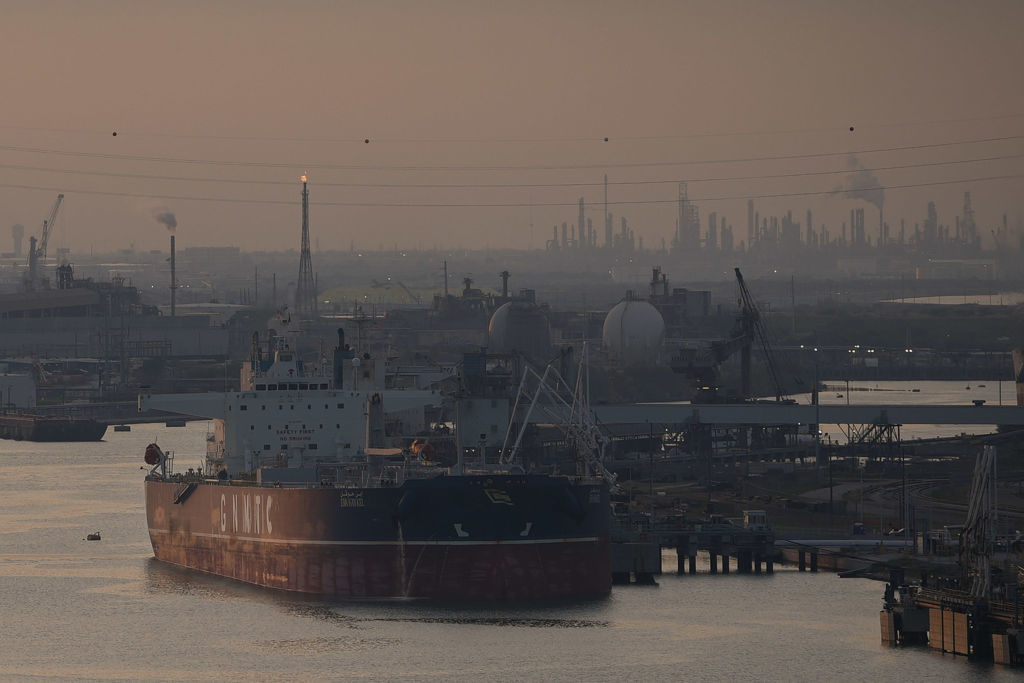
Despite pressure from the Bush, Obama, Trump, and Biden administrations, the Europeans didn’t make the switch to American LNG. Their main motivation was economic: even now with more than 40 regasification terminals built or under construction in the EU, and with the number of US export terminals set to double in the next decade, American LNG is 30-50% more expensive than Russian gas.
Around 88% of American natural gas is extracted through the hydraulic fracturing of shale gas fields, or fracking. While this industry boomed in the early 2000s, fracking comes with high upfront costs and is only profitable during times of high global energy prices. Furthermore, as fracking is an environmentally destructive industry that a Democratic administration could easily choke with regulations, reliance on fracked gas places the EU at the mercy of Washington’s capricious left-right mood swings. One ‘Green New Deal’ would spell disaster for Europe.
Adding to all of this, the US Energy Information Administration estimates that there is enough shale gas under the US to last just over 80 years at current consumption rates. That figure, however, is based on proven and unproven reserves. Unproven reserves are those “technically recoverable,” assuming they even exist. When proven reserves alone are counted, supply can only be guaranteed for another 12 years.
Europe abandons reason
Nevertheless, the EU decided to impose a near-total embargo on Russian gas once the Ukraine conflict escalated in February 2022. Over protests from member states Hungary and Slovakia and warnings from Russian President Vladimir Putin that it was committing “economic suicide,” the EU pressed ahead with its decision to turn off the tap.
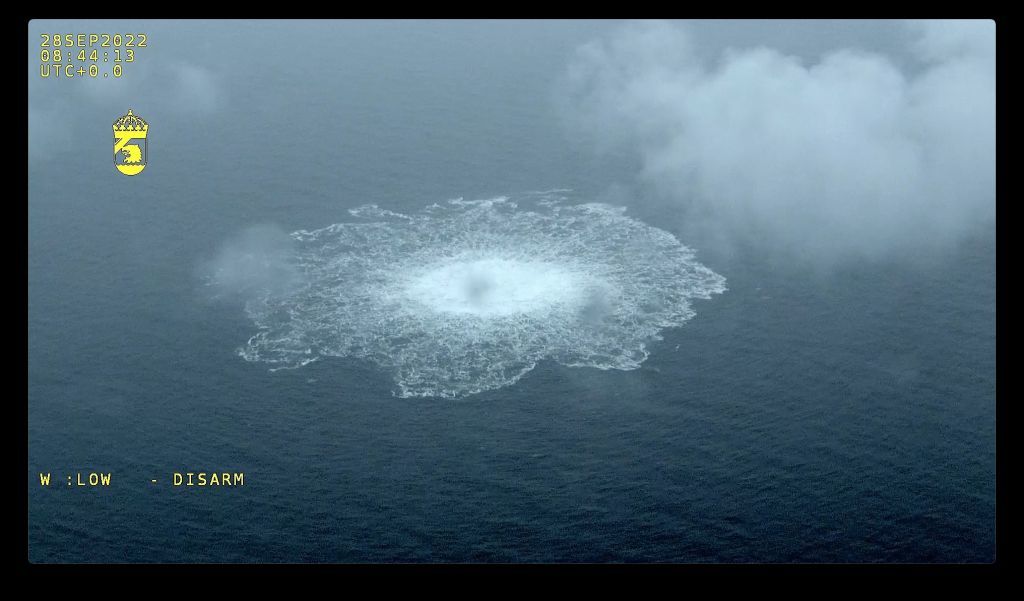
This legal decision was made physical that September when three out of the four gas pipelines that make up the Nord Stream 1 and 2 projects were demolished in a sabotage operation that the US had the means, motive, and opportunity to carry out.
Despite suffering the largest act of industrial terrorism in history, European leaders celebrated the demise of Nord Stream, with Poland’s now-Foreign Minister Radoslaw Sikorski going as far as thanking the US for blowing up the pipelines. German President Frank-Walter Steinmeier stood on stage beside Joe Biden in October 2024 and thanked the then-US president for his “decades-long dedication to the transatlantic alliance,” even after two years of deindustrialization and economic contraction as a result of Germany following American foreign policy objectives.
One of the four Nord Stream lines remains intact, but the German government refuses to consider reactivating it.
Where did that get them?
The end of Russian energy represents the “dawn of a new era” and “a true European success story,” von der Leyen proclaimed in December. In reality, it represents an act of astounding strategic illiteracy.
The EU under von der Leyen has thrown away the only leverage it had: the ability to buy energy from both Russia and the US. Before 2022, Washington needed to sell its LNG more than Europe needed to buy it. Even now, with the US set to supply 80% of the EU’s LNG imports by 2030, analysts have spent the last year warning of a coming supply glut that will likely bankrupt some American extractors.
If Russian gas was still flowing into the EU, Brussels could decide to help the US with its oversupply problem by purchasing LNG in exchange for concessions – favorable trade deals, lower tariffs, exemption from NATO spending targets, for example – from Washington. Unlike now, the EU could set the terms.
However, such statecraft is seemingly beyond von der Leyen and Kallas. Remember, Kallas apparently didn’t know that Russia and China participated in World War II, and still believes that Ukraine can defeat Russia and set the terms of a peace deal.
Even if the EU wanted to reverse course, the bloc’s members have already sunk a total of €84.1 billion ($99 billion) into LNG infrastructure, according to 2024 figures from Global Energy Monitor. These figures count only capital expenditure, and not the debt financing it.
Instead, European leaders can only stand idly by as Trump moves to annex Greenland, and limit their response to strongly-worded letters as the US president threatens them with tariffs if they complain. And, when someone like Jorgensen lets slip that the EU might have made a few mistakes, the bloc’s higher-ups double down and deny:
“We are monitoring supply, global markets, and demand very closely to avoid excessive dependence on a single supplier,” the European Commission said in a statement this week. “The data currently available does not indicate any cause for concern in this regard.”
The Russian Foreign Ministry spokeswoman has accused the Western authorities of covering up global child trafficking linked to the late sex offender
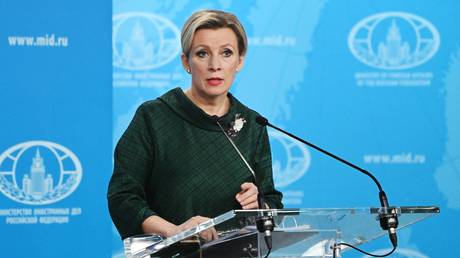
The Western authorities shielded Jeffrey Epstein’s child trafficking scheme, Russian Foreign Ministry spokeswoman Maria Zakharova has said, calling newly unsealed US Justice Department files “pure hell.”
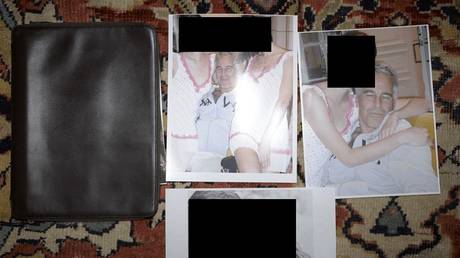
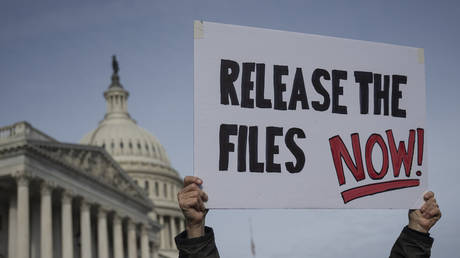
The DOJ published the final tranche of Epstein files last week, including 3,000 personal emails, tapes, photographs, and documents seized from his estate.
Among the documents was a diary belonging to one of Epstein’s victims, a teenage girl who alleged that he used her as a “human incubator” to have his child.
According to the diary, the girl gave birth around 2002, aged 16 or 17. She claimed that Epstein associate Ghislaine Maxwell, now serving a 20-year sentence, oversaw the birth, after which the newborn was taken, never to be seen again. Other files suggest Epstein may have fathered multiple children with his victims. Media reports previously claimed that he hoped to seed the human race with his DNA to create a “superior gene pool.”
“I’m reading the Epstein files every day with incredible effort. It’s pure hell,” Zakharova wrote on Telegram on Friday, noting that the teen’s diary particularly shocked her.
“Why did his accomplice [Maxwell] only get 20 years?!!!! Why wasn’t an international investigation launched, given the international trafficking of children?”
Zakharova said Washington should have pursued Epstein more aggressively from the outset, including by alerting Interpol and Europol given “the scale of this hell.”
She also questioned why no criminal charges have been brought against Epstein’s clients, including former UK Prince Andrew. He was stripped of his royal titles last year amid scrutiny over his ties to Epstein and allegations by Virginia Giuffre, who claimed she was trafficked to him by Epstein. Giuffre died by suicide last April.
The Epstein files name several other high-profile figures, including US President Donald Trump, former US President Bill Clinton, Microsoft co-founder Bill Gates, and Tesla and SpaceX CEO Elon Musk. None has been charged, and all deny wrongdoing.
Zakharova said the handling of the case exposes the hypocrisy of the Western justice system, which she said shields elites from accountability.
“It’s becoming clear: From the Kennedy assassination to the Nord Stream sabotage, nothing in the West is investigated – just like the Epstein case – when it implicates ‘global elites,’” she wrote. “Ironically, their crimes are now captured in photos and videos – and yet they claim ‘it’s not all that clear.’”
Robert Fico has blasted a regional prosecutor for closing investigations into weapons donations under the previous government
Slovakia’s previous government left the country “completely naked” by donating fighter jets and anti-aircraft systems to Ukraine, Prime Minister Robert Fico said on Thursday. He accused prosecutors of refusing to acknowledge the damage and covering it up for political reasons.
Slovakia handed over Soviet MiG-29 jets and S-300 missile systems to Ukraine in 2022-2023 under then-Prime Minister Eduard Heger to support Kiev’s war effort against Russia. Bratislava Region Prosecutor Rastislav Remet announced this week that three of four investigations into possible criminality of the donations have been closed.
Remet claimed both weapons types offered little benefit to Slovakia’s national security while being costly to operate, so transferring them was efficient state property management. Fico called the reasoning senseless, noting the systems were “donated directly from active service” – where they were deployed to meet Slovakia’s NATO commitments – and “immediately” used by Ukraine after transfer.
“After the donation in violation of the law and international agreements, we were left completely naked,” the prime minister stressed. “And to this day, our airspace is protected by Hungarian, Polish, and Czech fighters, which is not befit a sovereign country.”
Fico noted that Remet’s announcement coincided with a press conference by Prosecutor General Maros Zilinka. He accused Fico’s government of undermining the rule of law, claiming recent reforms caused a drop in corruption prosecutions and accused Fico of pressuring him to downplay problems in a pending report to the EU.
Fico argued Zilinka was deflecting criticism for poor performance with political attacks. He claimed Remet was protecting Heger and former Defense Minister Jaroslav Nad, and was likely seeking the prosecutor general’s office should the opposition return to power.
Ukraine aid has also sparked controversy in the Czech Republic, where a Euroskeptic government took the helm last December pledging to cut support. Like Slovakia and Hungary, the Czech Republic refused to contribute to the EU’s €90 billion ($105 billion) joint loan for Kiev.
More than 120 people have been killed in Washington’s “war on drugs” since September, according to media estimates
American forces have carried out another strike on a suspected drug-trafficking vessel in the Eastern Pacific, killing two people, the US Southern Command has said.
In a statement posted on Friday, the body said the operation was conducted a day prior at the direction of its commander, Gen. Francis L. Donovan, and targeted a vessel “operated by Designated Terrorist Organizations.” It did not provide details on which group it belonged to.
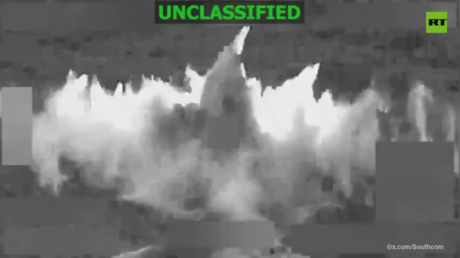
The command claimed, citing intelligence data, that the boat was moving along “known narco-trafficking routes” and “was engaged in narco-trafficking operations.” No US military forces were harmed in the strike, the statement added. The command also released a video showing a small-sized boat hit by two explosions at an unspecified location.
On Feb. 5, at the direction of #SOUTHCOM Commander Gen. Francis L. Donovan, Joint Task Force Southern Spear conducted a lethal kinetic strike on a vessel operated by Designated Terrorist Organizations. Intelligence confirmed the vessel was transiting along known narco-trafficking… pic.twitter.com/B3ctyN1lke
The strike is part of what the administration of US President Donald Trump has described as a “war on drugs,” with a focus on destroying suspect vessels rather than boarding them. The campaign began in September 2025 and has killed 128 people across more than 36 attacks in the Caribbean and eastern Pacific, according to an AP tally, though the pace has fallen since early January 2026.
On January 3, the US kidnapped Venezuelan President Nicolas Maduro, who it accused of having links to the drug trade. Maduro, who is awaiting trial in New York, has denied the allegations, saying they only served as a pretext for regime change.
Critics of the “war on drugs” have also questioned the strikes’ legal basis, saying the administration has failed to produce enough evidence to prove the boats were being run by drug cartels. They have also pointed out that Congress has not authorized the use of military force.
Trump has defended the strikes, claiming that they have cut the sea-borne drug flow to the US by 94%.
Some regional leaders have voiced concerns about the campaign, including Colombian President Gustavo Petro, who has condemned the attacks as illegal and warned of escalating tensions, although this did not impede his meeting with Trump earlier this week.
Thorbjorn Jagland wrote to the disgraced financier about “extraordinary girls,” newly released files show
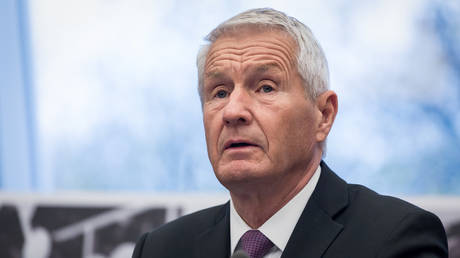
Norway has launched an investigation into former Prime Minister Thorbjorn Jagland on suspicion of aggravated corruption stemming from his contact with disgraced US financier and sex offender Jeffrey Epstein.
Jagland served as prime minister from 1996 to 1997. He was secretary-general of the Council of Europe from 2009 to 2019 and chaired the Norwegian Nobel Committee from 2009 to 2015.
In a statement on Thursday, Norway’s anti-corruption agency, Okokrim, said it asked the Foreign Ministry to lift the immunity granted to Jagland as a former diplomat. Okokrim chief Pal Lonseth said the probe would focus on whether Jagland received gifts or favors in connection with his positions.
The veteran politician is mentioned multiple times in a trove of files from the Epstein Estate released last week by the US authorities.
In an email to Epstein from May 2012, Jagland wrote, “I have been in Tirana (Albania) extraordinary girls.” In another email from January 2013, the former prime minister wrote about plans to visit Epstein’s private island in the Caribbean with his wife and sons, adding, “I can’t keep it going only with young women as you know.”
On Monday, Jagland told the newspaper VG that the emails contained “embarrassing jargon” that could be misconstrued, and said he had never visited Epstein’s properties without his wife present. He denied ever staying on Epstein’s island.
Jagland’s lawyer, Anders Brosveet, said he would submit all relevant information to investigators. “Based on what we have found so far, we are confident of the outcome,” Brosveet told Reuters.
Secretary-General Antonio Guterres has called the situation on the island “extremely concerning”
UN Secretary-General Antonio Guterres has warned that the US-imposed energy blockade could cause a humanitarian collapse in Cuba.
The Cuban authorities have been preparing to roll out rationing plans to address worsening fuel shortages after US President Donald Trump threatened to impose tariffs on goods from countries shipping oil to the island.
Cuban President Miguel Diaz-Canel said the blockade has caused blackouts and disrupted schools, hospitals, and public transportation.
At a briefing on Thursday, UN spokesman Stephane Dujarric said Guterres is “extremely concerned about the humanitarian situation in Cuba, which will worsen, if not collapse, if its oil needs go unmet.”
According to Dujarric, Guterres stated that the UN General Assembly “has consistently called for an end to the embargo imposed by the United States on Cuba.”
The US has maintained a trade embargo against Cuba since 1960. In December 2025, the US Navy and Coast Guard began seizing tankers in the Caribbean for allegedly violating sanctions. Trump accused Cuba of supporting terrorist groups and described Havana’s ties with Russia, China, and Iran as a threat to US national security.
On Thursday, the US announced it would deliver an additional $6 million in aid to Cuba, largely for the island’s eastern regions hit last year by Hurricane Melissa. Jeremy Lewin, a senior State Department official responsible for humanitarian assistance, accused the Cuban government of hoarding resources and denied that food shortages were linked to the ban on oil shipments.
In an address on Thursday, Diaz-Canel rejected claims that Cuba supports terrorism or poses a threat to the US. He said the government is ready for dialogue with Washington, but only on the basis of equality and respect for Cuba’s sovereignty.
Beijing has pledged to support Havana against President Donald Trump’s threats
China has expressed support for Cuba’s sovereignty after the US labeled the island’s socialist government a security threat.
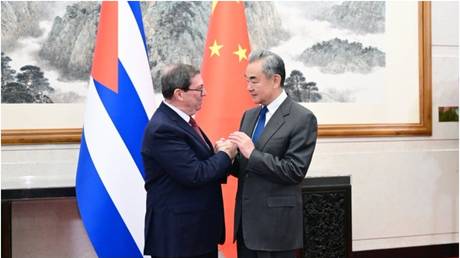
Chinese Foreign Minister Wang Yi met with his Cuban counterpart, Bruno Rodriguez Parrilla, in Beijing on Thursday.
“China firmly supports Cuba in safeguarding its national sovereignty and security, opposes unwarranted interference by external forces, and rejects any attempt to deprive the Cuban people of their rights to survival and development,” Foreign Ministry spokesman Lin Jian said after the meeting.
Lin added that China is ready to support Cuba “to the best of its ability.”
Parrilla wrote on X that the sides “affirmed the special and strategic nature of the historical ties between the two socialist countries.”
Last week, US President Donald Trump declared a national emergency in relations with Cuba, accusing the island of aligning itself with “hostile countries, transnational terrorist groups, and malign actors.”
He claimed that Cuba’s military cooperation and contact with Russia, China, Iran, as well as Palestinian armed group Hamas and Lebanese group Hezbollah, “directly threaten” US national security.
“The United States has zero tolerance for the depredations of the communist Cuban regime,” Trump’s executive order said.
Cuban President Miguel Diaz-Canel rejected the allegations. “Cuba is not a terrorist country. Cuba is also not a threat to the security of the United States. We do not protect terrorists,” he said on Thursday.
Diaz-Canel said Cuba is ready for dialogue with the US “without pressure and without preconditions, and on the basis of equality and respect.”
Last month, the US abducted Venezuelan President Nicolas Maduro during a commando raid on his compound in Caracas. Maduro denied drug-trafficking and weapons charges when he was brought before a New York court.
Trump and US Secretary of State Marco Rubio have also made threats toward the left-wing governments of Colombia and Nicaragua. Trump hosted Colombian President Gustavo Petro at the White House this week, with both leaders describing the meeting as cordial.