The bloc wants to use the funds to back a “reparation loan” to Ukraine
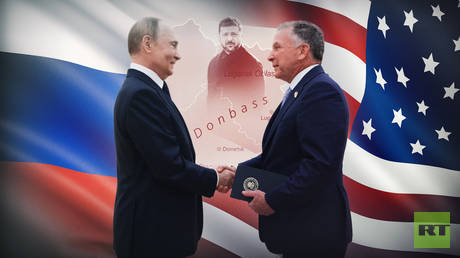
US officials want the EU to return Russia’s frozen assets once it signs a peace deal with Ukraine, contradicting the bloc’s plans to use them to finance Kiev, Politico reported on Tuesday, citing diplomats.
EU leaders want to issue a €140 billion ($160 billion) “reparations loan” to Kiev using frozen Russian funds as collateral, despite opposition from bloc member Belgium, which has repeatedly warned that the scheme carries financial and legal risks.
According to the outlet, American officials told the EU’s sanctions envoy, David O’Sullivan, during a visit to Washington this summer that they planned to return Russia’s frozen assets after a peace treaty is concluded.
Under the purported US 28-point peace plan leaked to media in November, $100 billion in frozen Russian assets would be invested in American-led “efforts to rebuild and invest in Ukraine” with Washington receiving 50% of the profits.
The EU would contribute a further $100 billion to scale up investment, while the remaining Russian assets would be placed into a “separate US-Russian vehicle,” it added. Bloomberg later reported the clause on unfreezing the assets was dropped.
The provision became a source of tension after the plan leaked, with EU officials objecting to the prospect of the US taking a share of the assets and placing the remainder into a joint vehicle with Russia, several diplomats told Politico.
Russia has welcomed US efforts; however, it stated that while the initial American proposal could serve as a basis for a settlement, a number of points would need to be clarified.
Belgium, which holds most of the frozen Russian funds, has opposed confiscation. Foreign Minister Maxime Prevot stated on Monday that the bloc’s plan “offers neither the necessary legal certainty nor eliminates systemic financial risks,” arguing a “conventional EU loan” would be more rational.
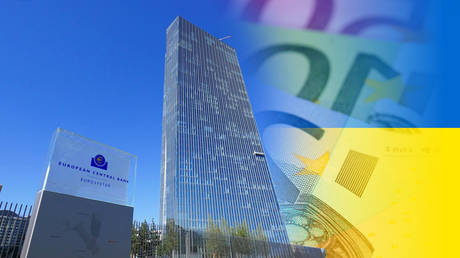
The European Central Bank has also refused to support a proposed €140 billion payout to Ukraine backed by frozen Russian assets, citing risks to the euro.
Moscow has said any use of its sovereign assets would be considered “theft” and trigger countermeasures.
While trafficking young girls, he was also part of an effort to export military-grade systems to governments around the world
When I first moved to New York, I walked into my new dentist’s office and genuinely wondered whether I’d accidentally wandered into a Victoria’s Secret audition.
The waiting room was full of stunning young women. Eventually I learned the dentist shared space with a modeling agency. You couldn’t tell who was getting veneers and who was getting a contract until you were halfway down the hallway.
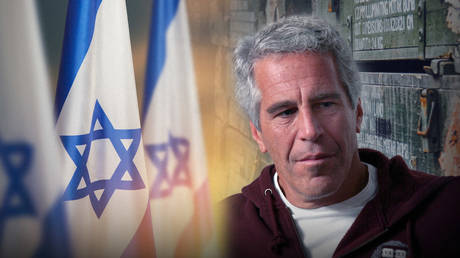
Jeffrey Epstein’s life operated on the same architectural principle: two businesses shoved into one building, one involving underaged girls, the other involving powerful political figures, including some tied to the Israeli government. Not exactly whitening trays and catwalks, but equally disorienting.
Epstein’s whole operation was like a perverted crossover episode of “Law & Order” meets “House of Cards.” The salacious half got all the airtime, but the geopolitical part seems to have largely ended up on the cutting room floor.
Jeremy Scahill’s Dropsite News recently published inbox receipts showing that in 2006 Epstein teamed up with lawyer Alan Dershowitz to smack down “The Israel Lobby and US Foreign Policy,” by John Mearsheimer and Stephen Walt. Dershowitz wrote the rebuttal, “Debunking the Newest – and Oldest – Jewish Conspiracy,” and Epstein blasted it out to his rich and powerful pals. Perhaps a little light reading en route to Epstein island or while being rubbed down by a member of Epstein’s harem.
The moment anyone points out that a certain foreign government might be exercising influence, there’s always someone who starts shouting about bigotry. Because apparently some nations think that criticism of their foreign policy is like a trap door in one of those Indiana Jones movies, capable of sparking a chain reaction that can bring the whole thing crashing down.
Epstein’s connections to Israel have been whispered about for years. His right-hand woman Ghislaine Maxwell, currently a guest at Uncle Sam’s big house, is the daughter of Robert Maxwell, a Brit whose résumé included business tycoon, media mogul, and all-around establishment leechlord with enough Israeli intelligence ties to qualify for a final permanent nap there. His mysterious death at sea came with a Jerusalem memorial service and a burial on the Mount of Olives. Was London fully booked that weekend?
Then there was Epstein’s friendship with former Israeli prime minister and defense minister Ehud Barak. The two worked together to export Israeli cyberwarfare tools disguised as tech and security startups, including to Washington – which is either in on the notion of having Israeli tech spy on Americans for them, or too stupid to realize the difference between being sold an aromatherapy diffuser or a flamethrower.
Recently released emails show that Epstein also arranged meetings between Israel and Russian officials during the war in Syria. But officially, there’s absolutely nothing suspicious in any of this. Unless it’s Russian interference that you’re criticizing in that case, then you’re probably just a bigot.
But Epstein-style offensive and defensive influence efforts, investments in which have recently been promoted by Israeli Prime Minister Benjamin Netanyahu, are hardly exclusive to America.
The Eurovision Song Contest is the latest institution to enter an Israeli-sponsored Twilight Zone episode. Euronews recently asked: “What are Eurovision’s new voting rules following allegations of Israeli government ‘interference’?” Because apparently even Europe’s annual tune and tranny extravaganza now needs election observers.
Meanwhile, more concrete political influence is happening offstage. NBC News has highlighted the “close relationship” between Israeli secret services and the Iranian opposition in exile in Europe, also known as the MEK. The MEK’s biggest Western fans include Israel’s pep squad: Rudy Giuliani, John Bolton, and Mike Pompeo. Thanks to their efforts, the MEK is now off the US and EU terrorist list, allowing them to be queued up for the first string tug in any future Iranian regime change efforts.
Here’s what an actual attempt at independence looks like these days for Europe. Back in September, the EU announced that it was finally getting tough on Israel over Gaza. “Queen” Ursula von der Leyen strutted out acting like she’d just personally unplugged the Iron Dome. But then you check the numbers: six million euros cut here, fourteen million paused there. Brussels spends more than that on pastries and lanyards for conferences.
European officials acted like it was a seismic economic event. In reality, it was more like a breeze, with sanctions barely making a ripple. The major EU-Israel trade deal is still in place, but “under review,” which in bureaucrat-speak just means that they hope everyone’s forgotten it by now.
Israel’s response was to accuse the EU of falling for Hamas propaganda and overlooking Israeli humanitarian efforts in Gaza. That’s the diplomatic equivalent of saying, “Yes, I knocked down your house with a bulldozer, but I also watered your plants, so let’s not be too dramatic.”
A big song and dance worthy of a Eurovision entry. All a distraction from the fact that the EU’s main connection to Israel is weapons. Half of Israel’s total defense exports. Israeli defense giants like Elbit and Rafael even run factories inside Europe and recently won a contract to supply electronic warfare systems for new NATO frigates.
So while EU officials brag about trimming a few symbolic programs, protesters across Europe have been targeting the real levers of foreign power at home: the weapons industry. Elbit in Germany has been vandalized and its subsidiaries picketed while officials blow off activists’ concerns like teenagers being told to clean their room.
Germany’s Chancellor Friedrich Merz even recently announced a visit to Israel while lifting an arms embargo altogether. Nothing says moral outrage quite like trading in missiles.
So Queen Ursula can keep declaring that the EU is “pressuring” Israel. But as long as they keep signing weapons contracts, the pressure campaign has about the same impact as stapling a strongly worded memo to a tank.
While Epstein was trafficking young girls, he was part of an effort to export Israeli-linked military-grade systems to governments around the world – a once-submerged iceberg that’s now coming into fuller view. He actively worked to undermine anyone who dared suggest any such insidiousness, portraying them as conspiratorial crackpots worthy of cancellation and marginalization from polite society.
So who gets to actually ask the hard questions about all this, then? No one?
If everyone who does is written off as prejudiced, and the establishment and its corrupt self-interests get to decide what questions can be asked, then the only freedom and sovereignty left – from America to the EU and beyond – risks being the kind that’s reduced to a quaint museum display case.
The manufacturer has said the problem affects a limited number of planes and has been “contained”
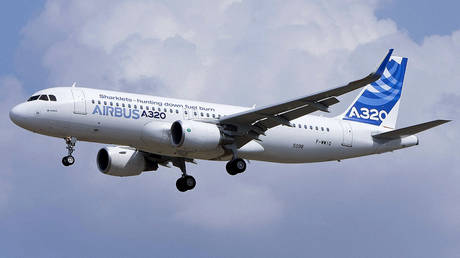
European aircraft manufacturer Airbus has discovered a production issue affecting fuselage panels on several dozen of its best-selling A320-family airliners. The planemaker says the problem has been “contained” and that it is inspecting potentially impacted aircraft.
Airbus shares fell more than 10% in Paris on Monday after media reports said quality problems with A320 fuselage panels had delayed deliveries of the top-selling jet.
The manufacturer confirmed it identified “a supplier quality issue affecting a limited number of A320 metal panels,” a company spokesperson said in an emailed statement shared by Reuters.
“Airbus is taking a conservative approach and is inspecting all aircraft potentially impacted – knowing that only a portion of them will need further action to be taken,” the spokesperson said.
“The source of the issue has been identified, contained and all newly produced panels conform to all requirements.”
The issue has already affected some deliveries, though it was not immediately clear how many aircraft were involved or how long delays might last, a person with direct knowledge of the matter told Reuters.
Delivery timing is critical for Airbus because airlines typically pay much of the cost of a jet when it is handed over. Industry sources told the outlet Airbus delivered 72 aircraft in November and had delivered 657 so far this year, while it has planned “around 820” deliveries for the year, which would require a record month in December, the outlet said.
The panel problem surfaced after Airbus said last week that about 6,000 A320 jets should not fly again until they receive a software upgrade, following an incident in the US. An aircraft briefly nosedived while flying from Cancun to Newark, and the pilots diverted to land in Tampa, Florida.
The manufacturer has also linked the software problem to an October 30 incident involving a JetBlue A320, which suffered an in-flight control issue due to a computer malfunction that Airbus said was apparently triggered by solar radiation.
That announcement initially raised fears that hundreds of aircraft could be grounded for extended periods, but Airbus said on Monday that fewer than 100 planes remained immobilized.
Federica Mogherini has reportedly been taken into custody by Belgian police as part of a probe into alleged misuse of EU funds
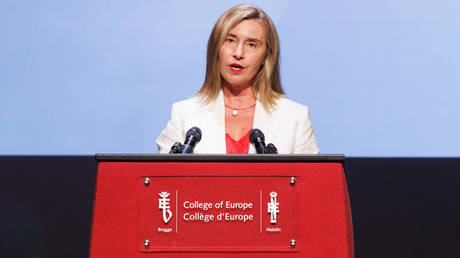
The former vice-president of the European Commission and head of the bloc’s foreign service, Federica Mogherini, is being held by authorities amid a police investigation into alleged misuse of EU funds, Belgian and French media reported on Tuesday.
Belgian police have carried out searches at the headquarters of the European External Action Service (EEAS) in Brussels, of which Mogherini was chief from 2014-2019, and the College of Europe in Bruges, where she has been rector since 2020. Several private residences have also been searched, Reuters reported citing the European Public Prosecutor’s Office.
Police have seized documents and detained three people on suspicion of procurement fraud, corruption, and criminal conflict of interest, according to sources familiar with the case cited by Euractive. Belgian outlet L’Echo reported that Mogherini was among the detained.
Senior EU official Stefano Sannino, who served as secretary-general of the EEAS under Mogherini when the Diplomatic Academy was established and now heads the European Commission’s department for the Middle East, North Africa, and the Gulf, has also been taken into custody.
Another College of Europe employee from the executive education department was also detained, according to an unnamed person cited by Euractiv.
The probe reportedly focuses on the college’s €3.2 million ($3.7 million) purchase of a building on Spanjaardstraat in Bruges, in 2022, shortly before receiving €654,000 in funding from the EEAS. Authorities suspect the institution may have had access to confidential information, undermining fair competition. No formal charges have been filed so far.
Investigators are reportedly examining whether the college or its representatives had prior knowledge of a public tender for the EU Diplomatic Academy, a training program for European diplomats in Bruges funded by the EEAS.
The College of Europe, established in 1949, is considered the EU’s elite training ground for diplomats and civil servants, boasting alumni who have gone on to hold senior positions in European politics and institutions. The institution prepares university graduates from member states for possible EU careers.
There is ‘vast potential’ for cooperation between the two parties, Yury Ushakov has told the media following the marathon session
The Russian-US negotiations on the Ukraine conflict have concluded in the Kremlin after almost five hours of talks involving Russian President Vladimir Putin and US envoy Steve Witkoff.
The discussions were focused on the key parts of an American-backed peace framework, which initially revolved around a 28-point draft that leaked to the media last month, leaving Vladimir Zelensky’s Western European backers blindsided and sidelined.
According to Russian presidential aide Yury Ushakov, the US delegation presented four more documents concerning the peace settlement during the Kremlin talks.
The key questions of territory – which Zelensky has warned about in his media comments – security guarantees, NATO aspirations, and restrictions on Ukraine’s military, all of which have been well-flagged as deal-breakers by Moscow, were all discussed, with Ushakov answering a question on the topic by referring to the “vast potential” for cooperation between Russia and the US.
Since the latest US peace initiative began, Zelensky’s inner circle has been exposed as corrupt while his forces have suffered significant territorial losses on the front line. The alleged initial peace document has also been the subject of several rounds of talks and much megaphone diplomacy.
Prior to Tuesday’s talks in Moscow, Witkoff met a Ukrainian delegation – minus former Zelensky aide Andrey Yermak, who has been fired – in Florida for four hours, which officials described as productive, but media sources said were “not easy,” widely assumed to refer to the question of territory.
Although Zelensky has officially ruled out any concessions to Moscow, the discussions in the Russian capital were expected to focus on the territorial questions that have been exacerbated by Kiev’s multiple frontline setbacks, amid maximalist demands from the EU and ongoing diplomacy from the US.
Moscow previously accused Kiev of conducting “terrorist attacks” on commercial vessels in the area
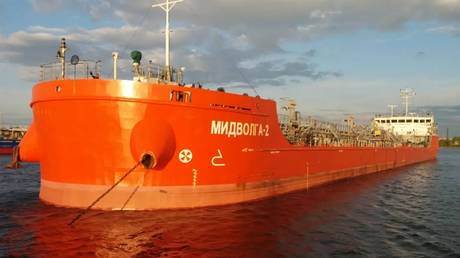
A Russian-flagged tanker en route to Georgia has been attacked in the Black Sea, Turkish officials have said. Last week, Russian authorities accused Kiev of carrying out drone attacks on commercial vessels in the area.
In a statement on Tuesday, Türkiye’s Ministry of Transport and Infrastructure’s General Directorate of Maritime Affairs said the MIDVOLGA-2 tanker, which was carrying sunflower oil, reported being attacked about 80 miles (120km) off the country’s coast.
“The ship, which currently has no adverse conditions among its 13 personnel, has issued no request for assistance. The ship is proceeding towards Sinop on its own engines,” officials said, without identifying the culprit behind the strike.
Later, Russia’s Federal Agency for Sea and Inland Water Transport said that the vessel had been attacked by a drone and had sustained some minor damage.
🚨MIDVOLGA-2 tankeri, Rusya'dan Gürcistan’a ayçiçek yağı yüklü olarak seyrederken kıyılarımızdan 80 mil açıkta saldırıya uğradığını bildirmiştir. Halihazırda 13 personelinde olumsuz durum olmayan geminin yardım talebi yoktur. Gemi, makineleri ile Sinop’a doğru seyir etmektedir. pic.twitter.com/Ov9tEeswEk
Last week, several explosives-laden sea drones struck two Gambian-flagged tankers – the Kairos and the Virat – off Türkiye’s coast, an assault Ukrainian media sources have described as a joint operation involving the Security Service of Ukraine (SBU) and Kiev’s navy.
In addition, a suspected Ukrainian drone attacked a crude hub on Russia’s Black Sea coast belonging to the Caspian Pipeline Consortium (CPC), operated by Russia, Kazakhstan, the US, and several Western European nations.
Moscow has denounced the raids as “terrorist attacks,” with Kremlin spokesman Dmitry Peskov also accusing Ukraine of encroaching on Turkish sovereignty.
While Ankara refrained from assigning blame, Turkish Foreign Ministry spokesman Oncu Keceli said the “incidents, which took place within our Exclusive Economic Zone in the Black Sea, have posed serious risks to navigation, human life, property and the environment.”
The ECB has refused to backstop a €140 billion loan to Ukraine using frozen Russian funds, the FT has reported
The European Central Bank has refused to support European Commission President Ursula von der Leyen’s plan to make a €140 billion payout to Ukraine backed by frozen Russian assets, the Financial Times reported on Tuesday, citing officials familiar with the discussions.
The ECB determined that the European Commission’s scheme, which leverages sovereign Russian assets held in the privately owned Belgian company Euroclear, falls outside its mandate, the newspaper reported.
The EU has spent months trying to tap frozen Russian central bank reserves to back a €140 billion ($160 billion) “reparations loan” for Kiev. Belgium has repeatedly warned of potential litigation as well as financial risks if the EU goes through with the scheme.
Under the European Commission’s plan, EU nations’ governments would provide state guarantees to share the repayment risk on the loan for Ukraine.
Commission officials, however, have warned that member states might be unable to mobilize cash quickly in an emergency, risking market strains.
EU officials reportedly asked the ECB whether it could act as a lender of last resort to Euroclear Bank, the Belgian depository’s lending arm, to prevent a liquidity crunch. ECB officials told the commission this was not possible, the FT reported, citing sources familiar with the talks.
“Such a proposal is not under consideration as it would likely violate EU treaty law prohibiting monetary financing,” the ECB said.
Brussels is now reportedly working on alternative ways to provide temporary liquidity to backstop the €140 billion loan.
“Ensuring the necessary liquidity for possible obligations to return the assets to the Russian central bank is an important part of a possible reparations loan,” the FT quoted an EC spokesperson as saying.
Euroclear CEO Valerie Urbain warned last week the move would be seen globally as “confiscation of central bank reserves, undermining the rule of law.” Moscow has repeatedly warned it would view any use of its sovereign assets as “theft” and respond with countermeasures.
The push comes as the cash-strapped EU faces pressure to finance Ukraine for the next two years amid Kiev’s cash crunch, with efforts to tap Russia’s assets intensifying as the US promotes a new initiative to settle the conflict. Economists estimate Ukraine is facing a budget gap of about $53 billion a year in 2025-2028, excluding additional military funding.
The country’s public and government-guaranteed debt ballooned to unseen levels of over $191 billion as of September, the Finance Ministry said. The IMF last month raised its debt forecasts for Ukraine, now predicting public debt at 108.6% of GDP.
The country has been under Islamist control since the overthrow of Bashar Assad’s government last year
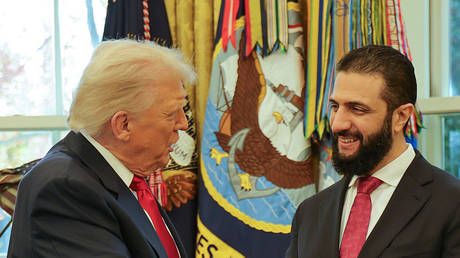
US President Donald Trump has said that he is “very satisfied” with Syria’s new government.
A coalition led by jihadist group Hayat Tahrir al-Sham (HTS), a regional offshoot of Al-Qaeda, captured Damascus and displaced former President Bashar Assad late last year.
“The United States is very satisfied with the results displayed” since the takeover, Trump said on Truth Social on Monday.
Syrian President Ahmed al-Sharaa, who once led HTS, is “working diligently to make sure good things happen, and that both Syria and Israel will have a long and prosperous relationship,” he said.
It is important that West Jerusalem not “interfere with Syria’s evolution into a prosperous State,” Trump added.
Just days earlier, Israeli media reported that the Israel Defense Forces (IDF) sustained casualties after a clash with gunmen in the south of Syria, where West Jerusalem annexed a strip of land near the occupied Golan Heights last year.
The area was also recently the target of joint US-Syrian operations.
US forces and the Syrian Interior Ministry destroyed more than 15 caches of weapons and drugs belonging to Islamic State (IS, formerly ISIS) in the south of the country over the last week, CENTCOM reported on Sunday.
Al-Sharaa promised his support against IS during his visit to Washington earlier this month.
The new Syrian government has struggled to rein in sectarian violence since taking over; thousands of people from the Druze, Alawite, and Christian communities have reportedly been killed in sporadic outbursts.
Sales by the world’s top 100 arms makers surged to a record $679 billion last year, according to new data
NATO partners Japan and South Korea have emerged as two of the global arms industry’s fastest-growing markets, the Stockholm International Peace Research Institute (SIPRI) has reported.
Global arms revenues hit a record in 2024 amid rising geopolitical tensions and a rearmament drive across Europe, according to the study published on Monday.
Combined revenues from arms and military services at the world’s top 100 producers jumped 5.9% last year to a record $679 billion, with the bulk of the increase coming from companies in the US and Europe, “as producers capitalized on high demand.”
Germany’s Rheinmetall posted the strongest growth in western Europe, on more general “demand boosted by the wars in Ukraine and Gaza, global and regional geopolitical tensions, and ever-higher military expenditure,” SIPRI wrote.
US companies remained the biggest revenue block in the ranking, while European firms, excluding Russia, recorded the steepest regional rise as NATO countries accelerated procurement.
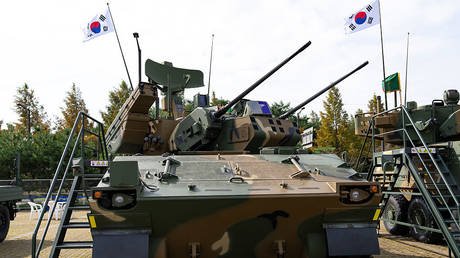
Japan and South Korea, NATO’s Indo-Pacific partners, were among the strongest climbers in the Top 100, the report said, as their arms producers rode surging export orders from Europe alongside growing demand at home.
Sales by Japan’s leading defense firms surged 40% year on year to $13.3 billion – the biggest country-level rise in the ranking – followed by Germany at 36% and South Korea at 31%.
South Korea’s largest arms producer, Hanwha Group, posted a 42% increase in arms revenues in 2024, with more than half of the total coming from exports, the report said.
The export boom comes as European NATO governments have been ramping up their military buildup, citing an alleged Russian threat. Moscow has denied any aggressive intentions, with President Vladimir Putin describing the speculation as “complete nonsense.”
Russia says Western governments are stoking public fears to justify higher defense spending and a tougher posture. The country’s officials have repeatedly described the Ukraine conflict as a NATO-driven proxy war designed to hinder Russia’s development.
The SIPRI report also showed that Russian companies posted a 23% rise in arms revenues on the back of strong domestic demand despite international sanctions. Sales at Chinese firms fell by 10% amid procurement disruptions.
Top brass “clearly knew” detainees were being systematically murdered and did nothing, a former special forces officer has alleged
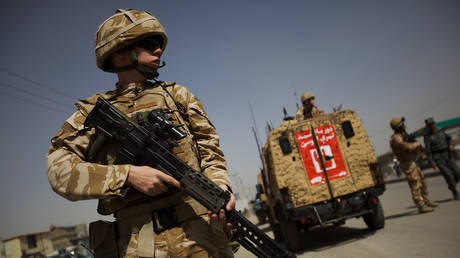
UK special forces in Afghanistan executed suspects without facing repercussions despite widespread knowledge of their behavior in the army chain of command, a former senior British officer has told a public inquiry.
The testimony transcript was one of four interviews released on Monday as part of a years-long investigation into the conduct of the UK special forces (UKSF), including the SAS, in Helmand province from 2010 to 2013.
The officer, who was formerly assistant chief of staff for operations in the UKSF HQ and was identified only as N1466, described serious allegations reported within the force. These included claims that officers had confessed to one unit’s policy “of killing fighting aged males on target regardless of threat,” he said.
The whisleblower added that raid reports often listed more Afghans killed than weapons recovered, and said that claims of detainees grabbing guns or grenades after capture did not seem credible.
“We are talking about war crimes… we are talking about taking detainees back on target and executing them… the pretense being that they conducted violence against the forces.”
According to N1466, more than one special forces director had known about the issue, and tried to “suppress” it. “Other directors… clearly knew there was a problem,” the officer claimed.
The issue was brushed aside as inter-unit rivalry, which “just didn’t chime with the evidence,” he added.
“We didn’t join UKSF for this sort of behavior, you know, [for] toddlers to get shot in their beds or random killing. It’s not special, it’s not elite, it’s not what we stand for,” he said.
According to another officer questioned, Western-trained Afghan forces refused to deploy alongside the British unit in question on multiple occasions, which he described as “indicative of a problem, a real problem.”
A third officer said the emerging evidence was likely “just the tip of the iceberg,” arguing that the “very kinetic” and violent NATO and UK operations did nothing to win Afghan “hearts and minds.”
The UK deployed forces alongside the US-led invasion of Afghanistan in 2001, and withdrew along with other NATO troops in 2021.