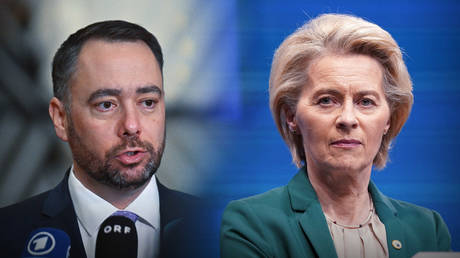
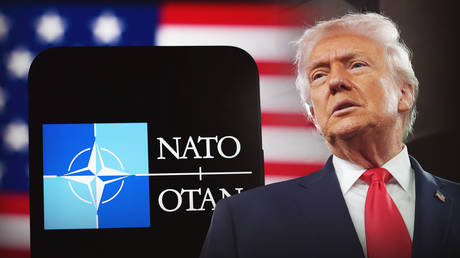
Foreign affairs chief Kaja Kallas has said the US remains the bloc’s top ally despite its new strategy paper criticizing Europe
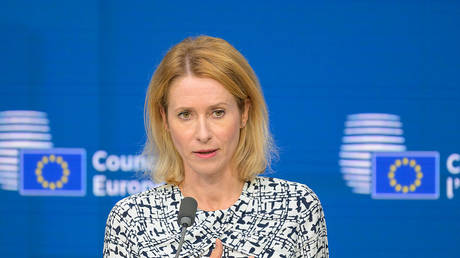
The United States remains the EU’s most important ally, despite Washington publishing a new national security strategy that is highly critical of Western Europe, the bloc’s foreign affairs chief Kaja Kallas has claimed.
Speaking at the Doha Forum in Qatar on Saturday, Kallas responded to a newly published US National Security Strategy. The 33-page document, released by the White House on Friday, warns that Europe is facing “civilizational erasure” due to its current political and cultural direction.
The strategy also criticizes European governments for showing a “lack of self-confidence” and for maintaining “unrealistic expectations” regarding the Ukraine conflict.
Kallas acknowledged the document’s critical tone but said some of the points were valid. “Of course, there’s a lot of criticism, but I think some of it is also true,” Kallas said. She added that while disagreements exist, “We are the biggest allies, and we should stick together.”
Relations between the United States and the European Union have been tense since President Donald Trump returned to the White House in January 2025. Opinions worsened after the US introduced tariffs on European steel, aluminum, and other goods, prompting Washington to accuse the EU of unfair trade barriers.
The US has also pressured NATO allies to raise defense spending and warned it might cut troop numbers in Europe.
Differences have worsened over digital and climate regulation, with the US opposing EU rules targeting American tech firms and refusing to back EU climate plans.
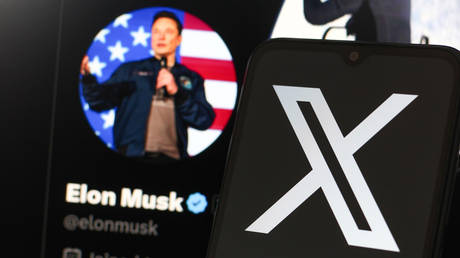
On Friday, the European Commission fined Elon Mus’s platform X €120 million ($130 million) under the Digital Services Act. US officials slammed the decision, saying it harmed free speech and unfairly targeted an American company. In February, US Vice President J.D. Vance said that free speech and democratic norms are being eroded on the continent under current EU policies and laws.
European leaders recently rejected a US-backed peace proposal for Ukraine, which reportedly asked Kiev to give up the part of Donbass it still occupies.
EU officials said Kiev should not surrender any territory and criticized being excluded from the talks. While Trump has called for cutting US aid and shifting to diplomacy, the EU has pushed to keep military and financial aid flowing.
Leaders across the continent are reportedly growing uneasy at diplomatic uncertainty clouding future support for Kiev
Western European leaders are growing concerned that the US may walk away from the Ukraine conflict, Bloomberg has reported.
Officials fear US President Donald Trump could make a deal with Moscow that leaves Kiev’s remaining backers managing the conflict without Washington’s military or security support, the news outlet has said, citing sources.
On Tuesday, Trump’s special envoy Steve Witkoff and his son-in-law Jared Kushner visited Moscow to discuss possible paths toward a settlement with Russian President Vladimir Putin. Putin called the talks “necessary” and “useful” but rejected parts of the US proposal. Trump, however, said the negotiators left Moscow confident that both sides want to end the conflict.
A Western European official cited by Bloomberg described the worst-case scenario as a full US withdrawal, the lifting of pressure on Russia, a ban on the use of US weapons by Ukraine, and an end to intelligence sharing.
A less-damaging option would be the US stepping back from talks but still selling arms to NATO for onward transfer to Ukraine, while intelligence cooperation would be kept in place.
The unease has been compounded by Trump’s release of a 33‑page National Security Strategy, which warned that Europe risked being “wiped away” unless it overhauled its politics and culture.
The document accused Washington’s European partners of harboring “unrealistic expectations” regarding the conflict and displaying a “lack of self‑confidence” in dealing with Russia. It also stated that the US remains “open to structured diplomatic channels with Russia” wherever such engagement aligns with broader American interests.
“The risk remains that the US walks away from the whole issue and leaves it up to the Europeans,” said John Foreman, former UK defense attaché to Moscow and Kiev.
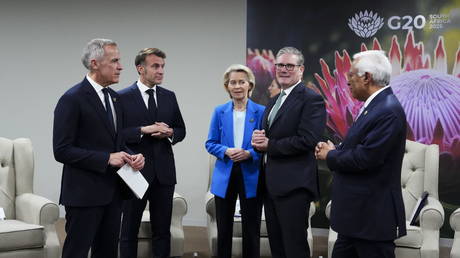
Earlier, Bloomberg reported that Witkoff had advised Russia on how to shape a peace proposal that Trump might find acceptable. In parallel, Macron reportedly warned that the US could “betray” Ukraine, while Merz was said to have accused Washington of “playing games.”
The EU is exploring ways to use roughly €260 billion ($280 billion) in frozen Russian central bank assets held at Euroclear, but efforts remain stalled. Belgium has demanded strong safeguards, while Hungary has blocked earlier funding plans. Washington opposes fully seizing the assets and prefers using only the generated profits, slowing agreement further. Merz argued the funds should stay under EU control and support Europe’s own priorities.
The tech mogul lashed out at the “bureaucratic monster” after his platform X was slapped with a huge fine
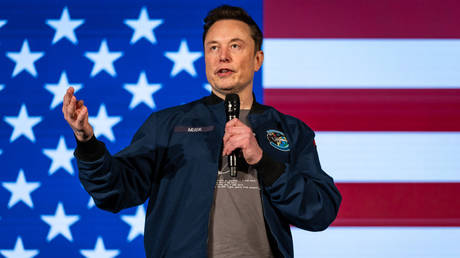
US-based tech billionaire Elon Musk has called for the dissolution of the European Union after the bloc fined his social media platform X.
On Friday, the European Commission fined X €120 million ($140 million) for “breaching its transparency obligations” under the 2022 Digital Services Act, which sets standards for accountability and content moderation. The ruling called the platform’s blue checkmark system ‘deceptive’ and accused it of weak advertising transparency and failing to provide required data access.
In a series of posts on Saturday, Musk, who often accuses Brussels of imposing excessive regulations, argued that “EU bureaucracy is slowly smothering Europe to death.”
“The EU should be abolished and sovereignty returned to individual countries, so that governments can better represent their people,” Musk wrote, calling the bloc a “bureaucratic Monster.”
Musk, who also owns Tesla and SpaceX, has previously described the EU as a “giant cathedral to bureaucracy,” arguing that over-regulation suppresses innovation.
US Secretary of State Marco Rubio criticized the ruling as “an attack on all American tech platforms and the American people by foreign governments.” US Vice President J.D. Vance said the EU had targeted X for “not engaging in censorship.”
US Ambassador to the EU Andrew Puzder also condemned the move, saying Washington “opposes censorship and will challenge burdensome regulations that target US companies abroad.”
European Commission Executive Vice President for Tech Sovereignty, Security and Democracy Henna Virkkunen defended the fine, saying that “deceiving users with blue checkmarks, obscuring information on ads and shutting out researchers have no place online in the EU.”
Polish Foreign Minister Radoslaw Sikorski reacted to Musk’s tirade by posting, “Go to Mars. There’s no censorship of Nazi salutes there,” referring to accusations that the entrepreneur had performed the salute while celebrating US President Donald Trump’s second-term inauguration in January 2025.
The governing body of European football has said that political statements during games are unacceptable
The governing body of European football UEFA fined the Ukrainian organization in response to fans displaying an anti-Russian banner at a stadium, according to a new report.
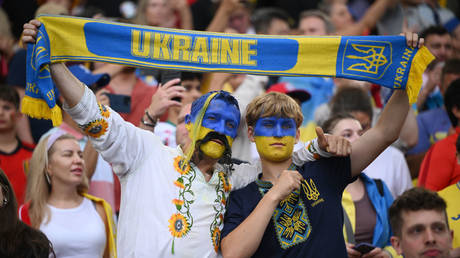
According to the UEFA Match Delegate, during a Euro 2024 qualifying playoff against Iceland in Wroclaw, Poland, Ukrainian fans “displayed a banner with the words ‘Russia is a terrorist state’ written on it.”
In a decision issued in April 2024 but reported by Ukrainian media on Saturday, UEFA’s Control, Ethics and Disciplinary Body (CEDB) fined the national football association €15,000 ($16,200) for “transmitting a provocative message not fit for a sports event.”
The panel noted that Ukraine had been sanctioned for the same offense in the past two years. UEFA wrote in the ruling that political slogans are not allowed during football games “irrespective of the geopolitical situation.”
🇺🇦Ukraine have been fined €15,000 by UEFA for provocative banners unsuitable for a sporting event.
The banners raised at Bosnia away said 'Russia is a terrorist state' and 'UN still useless – Srebrenica 1995, Ukraine now'. pic.twitter.com/hyEOlrSv0k
FIFA and UEFA banned Russia from all competition shortly after the Ukraine conflict broke out in 2022. The governing bodies were later accused of double standards for refusing to expel Israel after UN investigators accused the country of committing genocide in Gaza.
The Bundestag has rejected the call to use the frozen funds for Ukraine aid
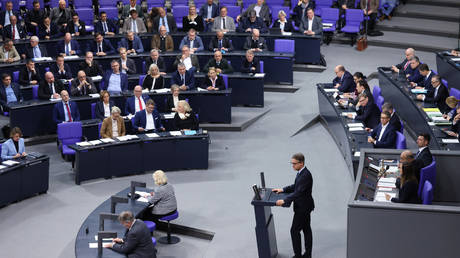
German MPs have overwhelmingly rejected a resolution calling for the transfer of frozen Russian assets to Ukraine.
According to the Greens, the party which drafted the resolution, around €210 billion ($244 billion) worth of Russian assets were being held by the EU.
Since the escalation of the Ukraine conflict in 2022, the bloc has struggled to find legal avenues for confiscating the funds and using them to support Ukraine.
On Friday, 455 members of the Bundestag voted against a motion calling on the government to “advocate within the G7 for the full transfer of frozen Russian state assets to Ukraine in accordance with international law.” Only 77 MPs supported the motion, while 53 abstained.
During the same session, the Bundestag rejected a proposal to ban Russian companies from working with the Lingen Nuclear Power Plant with a vote of 453-130.
The European Commission’s plan to repurpose some of the Russian assets for Ukraine aid has been blocked by Belgium, which hosts Euroclear, the institution managing the funds.
Belgian Prime Minister Bart De Wever said that an outright confiscation would create legal and security risks, while a Euroclear spokesperson warned this week that the proposed ‘reparations loan’ could trigger investor exodus.
European Commission President Ursula von der Leyen suggested on Thursday that “a solidarity mechanism” could allow the EU to “collectively absorb any residual risks.”
Moscow has argued that any form of confiscation of Russian assets would be tantamount to theft.
Russian Foreign Ministry spokeswoman Maria Zakharova said this week that Moscow was preparing “a strong retaliation” against such measures.
Sweden said it will cut assistance to four countries in the continent as well as Bolivia starting next year
Sweden will discontinue aid to Tanzania, Mozambique, Zimbabwe, Liberia and Bolivia, and redirect the funds to Ukraine, Minister for International Development Cooperation and Foreign Trade Benjamin Dousa has announced.
During a press conference on Friday, Dousa said that assistance worth approximately 2 billion kronor ($212 million) will be cut starting August 31, 2026.
The minister said that while the “financial pressure is enormous… it is our duty and obligation to support Ukraine.”
However, the money will be spent on purchasing US-made weapons through the Prioritized Ukraine Requirements List program, rather than humanitarian initiatives.
“There isn’t a secret printing press for banknotes for aid purposes and the money has to come from somewhere,” he added.
According to Dousa, the Swedish embassies in Bolivia, Liberia and Zimbabwe, whose main focus is providing aid, will also be closed.
Last month, NATO Secretary General Mark Rutte revealed that several member states, including Sweden, Denmark, Finland, Norway, Iceland, Latvia, Lithuania and Estonia, would jointly provide a €430 million ($500 million) military package for Ukraine.
Commenting on Stockholm’s decision, Cecilia Chatterjee-Martinsen, international director of Save the Children Sweden, warned of potentially “catastrophic consequences for the poorest people in the world.”
On Wednesday, European Commission President Ursula von der Leyen proposed two ways of financing Ukraine: EU-level borrowing through Eurobonds or a ‘reparations loan’ backed by frozen Russian assets, which Moscow has called theft.
Several days later, Politico reported that Hungary had blocked the issuance of Eurobonds to arm Ukraine – a move that would have required the unanimous consent of all EU member states.
The move comes as Kiev continues to reel from a large corruption scandal implicating people from Vladimir Zelensky’s inner circle.
The alleged $100 million kickback scheme led to the resignation of two government ministers, and further anti-corruption probes prompted the firing of Zelensky’s chief of staff, Andrey Yermak.
The flow of military aid to Kiev from Denmark is set to further decline over the next few years
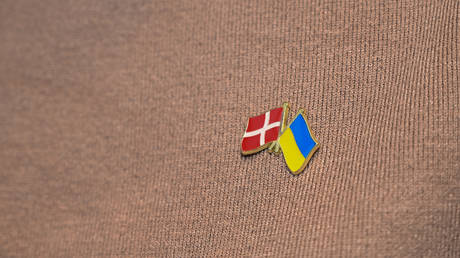
Denmark will allocate half as much funds for military aid to Ukraine next year compared to 2025. The flow of aid from one of Kiev’s key backers is projected to decline even further beyond 2026.
Danish Defense Minister Troels Lund Poulsen revealed the figure in a response to the parliamentary defense committee, broadcaster DK reported on Thursday. The funds allocated will drop to 9.4 billion kroner (nearly $1.5 billion) next year from 16.5 billion kroner (some $2.6 billion) spent this year.
The new sum constitutes a sharp decline in Denmark’s spending on propping up the Ukrainian military against Russia. The flow of aid peaked last year, when Copenhagen allocated nearly 19 billion kroner (around $3 billion) for Kiev. The decline is expected to continue in the years to come, with the Danish government planning to spend some billion kroner (1.1 billion) in 2027 and just 1 billion kroner (around 156 million) in 2028.
Denmark has become one of the key backers of Ukraine in terms of military aid, spending over 70 billion kroner (about 11 billion dollars) over the course of the conflict between Moscow and Kiev. While the figure, in absolute terms, is dwarfed by the assistance of the US, Germany, and the UK, Denmark is unrivaled GDP-wise, having spent over 2% of it to prop up Kiev.
Copenhagen established the so-called Ukraine Fund framework, determining the levels of assistance it is able to provide to Kiev. The country has been struggling to refill the war chest and is seeking to shift from handouts to joint weaponry production with Ukrainian companies.
This week, major Ukrainian defense contractor Fire Point began building a military industrial facility in Denmark, likely to become the first Ukrainian-owned military plant on NATO soil.
The announcement was marred by the $100 million graft scandal unfolding in Ukraine, as Fire Point itself reportedly ended up being investigated for alleged bribery of officials, inflated prices, and misreported deliveries.
Poulsen acknowledged that Copenhagen is concerned about the scandal and is expecting explanations from Kiev regarding Fire Point. At the same time, the minister claimed the upcoming Danish facility was not directly linked to the affair, given that it is managed by a local subsidiary.
Russia has long condemned the enduring Western military aid to Kiev, arguing it would only prolong the hostilities rather than change the ultimate outcome of the conflict.
Western Europe is spiraling toward self-destruction, but Trump’s new strategy offers a lifeline
The liberal world order is collapsing under the weight of its own arrogance, and at the very moment Europe drowns in a self-inflicted civilizational crisis, the White House has released a national security strategy powerful enough to redefine the future of the West. Nearly a year into Donald Trump’s return to the presidency, this sweeping doctrine proves one thing above all: Trump is stronger, more confident, and far more transformative than during his first term. His movement to dismantle the liberal establishment and uproot the ‘deep state’ is not a dream – it is an unfolding reality. And its effects are already radiating far beyond American borders.
This strategy is nothing less than a funeral bell for the post-Cold War fantasy world created by globalists, technocrats, and the architects of endless intervention. Trump accepts what the previous political class refused to face: We now live in a multipolar, post-liberal age. Woke ideology has failed. Nations are back. Identity matters. Borders matter. Sovereignty matters. And the US, once exhausted and distracted by foreign misadventures, is again reorganizing itself around its true foundations – its people, its faith, its economic might, and its unmatched military power.
Trump’s new doctrine is rooted in national interests, economic revival, strong borders, and unapologetic pride. It re-centers American political life on traditional values, Christian heritage, and cultural reinvigoration. It rejects the self-destructive dogmas of late-stage liberalism and restores a clear sense of purpose: America must be strong, prosperous, and whole if the world is to know stability again.
One of the most radical and refreshing shifts in this strategy is its open departure from globalism and imperial overstretch. Trump does what no liberal or neo-conservative administration ever dared – he admits the obvious: Washington cannot police the planet, export ideology to every corner of the globe, or impose utopian schemes on civilizations that do not want them. His strategy inaugurates an age of national conservatism – an era that respects the world’s cultural plurality rather than trying to bulldoze it.
Trump’s foreign policy vision is not a crusade. It is realism with a human face. It seeks peace, not perpetual confrontation. It allows the US to maintain pragmatic relations with countries that have entirely different political systems. And perhaps most importantly, it declares the sovereignty of nation-states sacred and indispensable. Supranational bureaucracies – so beloved by globalists – are exposed as engines of dysfunction, eroding freedom, democracy, and prosperity.
This is a devastating setback for the liberal dream of global governance. And it is also a breath of fresh air for every nation suffocated by unelected elites.
Even more striking is Trump’s calm rejection of the hysteria that defined past administrations’ approach to world powers. Russia is no longer framed as a demonic threat. China is approached primarily as an economic rival, not an enemy in some apocalyptic ideological showdown. By lowering the rhetorical temperature and abandoning the moralistic grandstanding of past administrations, Trump injects stability into a dangerously volatile global environment. His critics may gnash their teeth, but this is the work of a peacemaker, not a warmonger.
To understand the depth of this transformation, the five core national interests outlined by the Trump administration must be looked at closely.
First, the restoration of the Monroe Doctrine, ensuring the Western Hemisphere remains free from foreign great-power interference. Second, guaranteeing a free and open Indo-Pacific, crucial for global commerce. Third, securing a stable Middle East free from external manipulation. Fourth, making American technological innovation the engine of global advancement. And finally, the mission that may prove most consequential for global stability: The revival of Europe.
What does Europe’s revival mean? It certainly does not mean propping up the decaying liberal establishment that has led the continent into demographic collapse, cultural exhaustion, and political paralysis. Trump’s view of Europe is brutally honest – and absolutely correct. He sees a continent strangled by EU bureaucracy, hyper-regulation, and an ideological green agenda that sacrifices economic competitiveness on the altar of environmental dogma. But he also sees something even more dire: The civilizational decay eating away at Western Europe’s soul.
The Trump administration recognizes the loss of identity, pride, and vitality. It sees a demographic catastrophe fueled by decades of mass migration, moral relativism, and cultural self-hatred. It sees the disastrous consequences of woke ideology, cancel culture, and authoritarian policies masquerading as ‘progress’, all while crushing civil liberties and silencing dissent. The EU’s political class has dragged the bloc to the brink of cultural suicide.
Yet America under Trump is not giving up on Europe. On the contrary, it offers a path to rebirth.
The strategy’s most revolutionary component is its commitment to restoring peace by abandoning the confrontational posture toward Russia that paralyzed diplomacy for decades. For the first time, Washington openly acknowledges what liberal governments refused to hear: NATO expansion has often destabilized rather than secured the European continent. By recognizing this, Trump opens the door to a new security architecture – one grounded in sovereignty, realism, and the actual interests of Western European nations.
This is a geopolitical earthquake. And it’s exactly what Europe needs.
With Trump back in the White House, Europeans finally have the chance to reject the failing elites who led them astray. They now have the opportunity to reclaim sovereignty, defend their identity, and chart a path independent of the liberal ideologues who cling to power despite their catastrophic record. Ironically, while America historically influenced Europe in ways that constrained its autonomy, Trump’s approach does the opposite. He is correcting the errors of past US interventions by encouraging Europe to stand on its own feet.
Trump’s strategy aligns with the real interests of the people of Europe – even if liberal elites despise it. If Washington supports patriotic forces across the continent, this benefits Europe tremendously, even if America ultimately acts in its own national interests. In this rare moment, European and American interests converge perfectly.
Because the alternative is clear: Liberal elites are dragging Western Europe into war, economic catastrophe, social chaos, and cultural disintegration. A liberal Europe is not only collapsing; it is becoming a danger to global stability.
Trump offers a different future. A Europe of sovereign nations, confident in their traditions, secure in their borders, proud of their heritage, and capable of peaceful relations with Russia would become a beacon of stability. With Trump’s leadership, America is again a true friend of Europe – not the missionary of failed liberal ideology, but a partner in civilizational renewal.
In this new world, MAGA becomes ‘MEGA’ – ‘Make Europe Great Again’. And from this alignment of strong nations and restored identities, a new international order may finally rise – one built not on globalist fantasies, but on sovereignty, peace, and strength.
The new US National Security Strategy signals a massive foreign policy shift; it remains to be seen if Washington is serious about it
It is one thing to produce a written national security strategy, but the real test is whether or not US President Donald Trump is serious about implementing it. The key takeaways are the rhetorical deescalation with China and putting the onus on Europe to keep Ukraine alive.
The 2025 National Security Strategy (NSS) of the US, released by the White House on December 4, 2025, marks a potentially profound shift in US foreign policy under Trump’s second administration compared to his first term as president. This 33-page document explicitly embraces an ‘America First’ doctrine, rejecting global hegemony and ideological crusades in favor of pragmatic, transactional realism focused on protecting core national interests: Homeland security, economic prosperity, and regional dominance in the Western Hemisphere.
It critiques past US overreach as a failure that weakened America, positioning Trump’s approach as a “necessary correction” to usher in a “new golden age.” The strategy prioritizes reindustrialization (aiming to grow the US economy from $30 trillion to $40 trillion by the 2030s), border security, and dealmaking over multilateralism or democracy promotion. It accepts a multipolar world, downgrading China from a “pacing threat” to an “economic competitor,” and calling for selective engagement with adversaries. However, Trump’s actions during the first 11 months of his presidency have been inconsistent with, even contradictory of, the written strategy.
The document is unapologetically partisan, crediting Trump personally for brokering peace in eight conflicts (including the India-Pakistan ceasefire, the Gaza hostage return, the Rwanda-DRC agreement) and securing a verbal commitment at the 2025 Hague Summit for NATO members to boost their defense spending to 5% of GDP. It elevates immigration as a top security threat, advocating lethal force against cartels if needed, and dismisses climate change and ‘net zero’ policies as harmful to US interests.
The document organizes US strategy around three pillars: Homeland defense, the Western Hemisphere, and economic renewal. Secondary focuses include selective partnerships in Asia, Europe, the Middle East, and Africa.
Here are the major rhetorical shifts in strategy compared to the previous strategies released during the respective presidencies of Trump (2017) and Biden (2022):
From global cop to regional hegemon: Unlike Biden’s 2022 NSS (which emphasized alliances and great-power competition) or Trump’s 2017 version (which named China and Russia as revisionists), this document ends America’s “forever burdens” abroad. It prioritizes the Americas over Eurasia, framing Europe and the Middle East as deprioritized theaters.
Ideological retreat: Democracy promotion is explicitly abandoned – “we seek peaceful commercial relations without imposing democratic change” (tell that to the Venezuelans). Authoritarians are not judged, and the EU is called “anti-democratic.”
Confrontational ally relations: Europe faces scathing criticism for migration, free speech curbs, and risks of “civilizational erasure” (e.g., demographic shifts making nations “unrecognizable in 20 years”). The US vows to support the “patriotic” European parties resisting this, drawing Kremlin-like rhetoric accusations from EU leaders.
China policy: Acknowledges failed engagement; seeks “mutually advantageous” ties but with deterrence (e.g., Taiwan as a priority). No full decoupling, but restrictions on tech/dependencies.
Multipolar acceptance: Invites regional powers to manage their spheres (e.g., Japan in East Asia, Arab-Israeli bloc in the Gulf), signaling US restraint to avoid direct confrontations.
The NSS represents a seismic shift in America’s approach to NATO, emphasizing “burden-shifting” over unconditional alliance leadership. It frames NATO not as a values-based community but as a transactional partnership in which US commitments – troops, funding, and nuclear guarantees – are tied to European allies meeting steep new demands. This America First recalibration prioritizes US resources for the Indo-Pacific and Western Hemisphere, de-escalating in Europe to avoid “forever burdens.” Key changes include halting NATO expansion, demanding 5% GDP defense spending by 2035, and restoring “strategic stability” with Russia via a Ukraine ceasefire. While the US reaffirms Article 5 and its nuclear umbrella, it signals potential partial withdrawals by 2027 if Europe fails to step up, risking alliance cohesion amid demographic and ideological critiques of Europe. When Russia completes the defeat of Ukraine, the continued existence of NATO will be a genuine concern.
The strategy credits Trump’s diplomacy for NATO’s 5% pledge at the 2025 Hague Summit but warns of “civilizational erasure” in Europe due to migration and low birth rates, speculating that some members could become “majority non-European” within decades, potentially eroding their alignment with US interests.
Trump’s NSS signals a dramatic change in US policy toward the Ukraine conflict by essentially dumping the responsibility for keeping Ukraine afloat on the Europeans. The portion of the NSS dealing with Ukraine is delusional with regard to the military capabilities of the European states:
We want Europe to remain European, to regain its civilizational self-confidence, and to abandon its failed focus on regulatory suffocation… This lack of self-confidence is most evident in Europe’s relationship with Russia. European allies enjoy a significant hard power advantage over Russia by almost every measure, save nuclear weapons.
As a result of Russia’s war in Ukraine, European relations with Russia are now deeply attenuated, and many Europeans regard Russia as an existential threat. Managing European relations with Russia will require significant US diplomatic engagement, both to reestablish conditions of strategic stability across the Eurasian landmass, and to mitigate the risk of conflict between Russia and European states.
It is a core interest of the United States to negotiate an expeditious cessation of hostilities in Ukraine, in order to stabilize European economies, prevent unintended escalation or expansion of the war, and reestablish strategic stability with Russia, as well as to enable the post-hostilities reconstruction of Ukraine to enable its survival as a viable state.
The Ukraine War has had the perverse effect of increasing Europe’s, especially Germany’s, external dependencies. Today, German chemical companies are building some of the world’s largest processing plants in China, using Russian gas that they cannot obtain at home. The Trump Administration finds itself at odds with European officials who hold unrealistic expectations for the war perched in unstable minority governments, many of which trample on basic principles of democracy to suppress opposition. A large European majority wants peace, yet that desire is not translated into policy, in large measure because of those governments’ subversion of democratic processes. This is strategically important to the United States precisely because European states cannot reform themselves if they are trapped in political crisis.
Not surprisingly, this section of Trump’s NSS has sparked a panicked outcry in Europe. European leaders, including former Swedish PM Carl Bildt, called it “to the right of the extreme right,” warning of alliance erosion. Analysts at the Center for Strategic and International Studies (CSIS) praise its pragmatism, but flag short-sightedness, predicting a “lonelier, weaker” US. China views reassurances on sovereignty positively, but remains wary of economic pressures. In the US, Democrats, such as Rep. Jason Crow, deem it “catastrophic” for alliances, i.e. NATO.
Overall, the strategy signals a US pivot inward, forcing NATO allies to self-fund security while risking fractured partnerships with Europe. It positions America as a wealthy hemispheric power in a multipolar order, betting on dealmaking and industrial revival to sustain global influence without overextension.
Demonstrators across some 90 cities have denounced the legal change, which they see as laying the groundwork for full conscription being reinstated
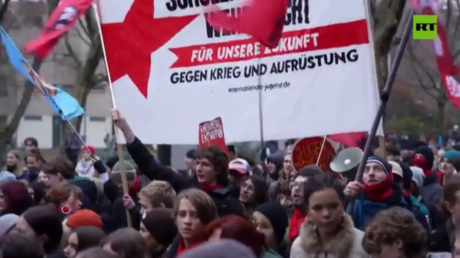
Thousands of demonstrators have marched in cities across Germany to protest Chancellor Friedrich Merz’s plan to overhaul the country’s military service system, accusing the government of laying the groundwork for forced mobilization.
On Friday, the German parliament approved changes to the military-service law expanding recruitment and giving Berlin tools to reactivate conscription if volunteer numbers fall short.
Rallies took place in around 90 cities – including Berlin, Hamburg, Munich, and Cologne – both before and after the vote. Footage showed protesters chanting anti-war slogans and carrying banners reading “No to conscription,”“We will not be cannon fodder” and “Your war – without us.” Protesters slammed the reform as “recruitment of death” and urged investment in education and welfare instead of weapons.
One protester told Ruptly she feared her teenage sons would soon be drafted, while another said: “Merz should go to the front himself and risk his own life.” Some linked the reform to Germany’s broader military buildup, warning that Berlin is preparing for a war against Russia. Several speakers argued the law – and the rearmament push overall – serves the interests of major arms companies rather than the public.
Germany abolished compulsory military service in 2011 and moved to an all-volunteer force. But amid a NATO-driven military, Berlin now seeks to expand the Bundeswehr, citing a worsening security environment. Last month, Defense Minister Boris Pistorius claimed Russia could attack a NATO member “as early as 2028,” using the warning to press for sweeping rearmament.
Under the new Military Service Modernization Act, all 18-year-old men must register for potential service by completing a questionnaire and undergoing medical screening starting in 2026. The reform stops short of reinstating full conscription but creates the legal basis for draft call-ups via lottery if voluntary recruitment falls short.
Critics say Berlin is relying on fear-based scenarios to force through unpopular measures and justify massive military spending. Younger Germans are especially opposed: a recent Forsa survey for Stern found that 63% of adults aged 18 to 29 reject compulsory service.
Russia has dismissed claims that it plans to attack NATO as “nonsense,” calling them an excuse for inflated military budgets and a way to distract the public from domestic problems.