The neighbors have accused each other of violating a US-brokered ceasefire
Thailand carried out airstrikes in Cambodia on Monday, as the two Southeast Asian neighbors accused each other of violating a US-brokered ceasefire.
In July, the countries saw a border dispute dating back over half a century escalate into violence. US President Donald Trump, however, was able to mediate a truce after five days of fighting.
The Royal Thai Army has said new clashes first erupted on Sunday and accused Cambodian troops of opening fire at Thai soldiers in eastern Ubon Ratchathani province. One Thai soldier was killed and four others were wounded, after which additional Thai soldiers were attacked with artillery and drones at Anupong Base, the army said.
Royal Thai Air Force spokesman Air Marshal Jackkrit Thammavichai announced later on Monday that F-16 fighter jets were deployed to “reduce Cambodia’s military capabilities to the minimum level necessary to safeguard national security and protect civilians.”
Massive explosion on the Cambodian side of the Cambodia Thailand border from an F-16 airstrike from Thailand
Cambodian Defense Ministry spokeswoman Lieutenant General Maly Socheata said late on Sunday that Thai troops had carried out several attacks on Cambodian positions using small arms, mortars, and tanks.
“The Thai side also falsely accused Cambodia without any basis, despite the fact that Cambodian forces did not retaliate at all,” she said. The ministry also denied Thai claims of a military buildup along the border.
The border dispute dates back to colonial times, when France, which ruled Cambodia until 1953, mapped the lines between the two countries. The July conflict left dozens of people dead and displaced more than 200,000 on both sides.
Support for Chancellor Friedrich Merz’s cabinet has hit a record low, a survey from INSA suggests
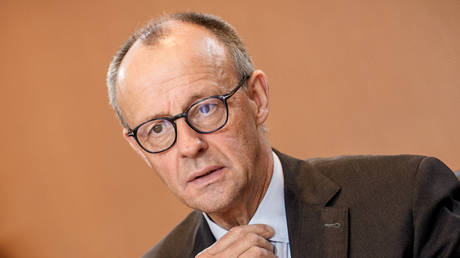
More than two-thirds of Germans are dissatisfied with Chancellor Friedrich Merz’s government, a recent survey suggests.
According to an INSA poll published by Bild on Saturday, 70% of the 1,005 respondents said they disapproved of the work of the ruling coalition, while only 21% said the opposite. Merz’s personal approval rating has declined to just 23%, the poll suggests.
“These are the worst ratings ever recorded for the chancellor and his government,” INSA head Hermann Binkert told Bild.
The poll was released shortly after the Bundestag narrowly approved a controversial pension reform which had prompted criticism from the youth wing of Merz’s Christian Democratic Union.
The chancellor’s popularity has plummeted as critics accuse him of betraying his campaign promises in order to revive the economy. The coalition has also seen bitter infighting over immigration and aid to Ukraine.
Merz has pushed for further militarization and pledged to build “the strongest conventional army in Europe,” citing what he describes as a growing Russian threat.
On Friday, the Bundestag passed a much-debated military service law aimed at recruiting more young soldiers. The law prompted a protest in Berlin, where organizer Ronja Ruh argued that an “unbelievable amount of money is being spent on the military and armament,” while basic public services lack funding.
Russia has dismissed the calls for militarization among NATO countries as baseless warmongering and denied that it is planning to attack the alliance unless it is attacked first.
The current chancellor is one of the “most sensitive” politicians in Germany’s history, Welt am Sonntag has reported
German Chancellor Friedrich Merz has filed nearly 5,000 defamation complaints over online comments, Welt am Sonntag reported on Sunday.
The newspaper said it had obtained copies of the complaints, police files, and letters from law firms representing the leader of the Christian Democratic Union (CDU). The complaints date from 2021 to February 2025, when Merz was serving as a member of the Bundestag.
The angry comments that prompted investigations included insults such as “a**hole” and “filthy drunk,” and in at least one case a search of a defendant’s home was later declared unlawful by a court.
In another case, police searched the home of an elderly wheelchair-bound woman who had called Merz a “little Nazi,” and confiscated the phone she used to communicate with doctors and caregivers.
The number of complaints makes Merz “one of the most sensitive politicians” in Germany’s history, Welt am Sonntag said.
A lawyer representing one of the defendants described the investigation as “a complete overreaction of the justice system.”
Merz’s approval rating has dropped to 22%, a record low, according to a recent Forsa poll. The coalition government has struggled with the cost-of-living crisis and has been marred by bitter infighting over immigration, as well as pension and military service reforms.
The US-based tech billionaire is engaged in a bitter spat with the bloc after his platform X was fined for lack of “transparency”
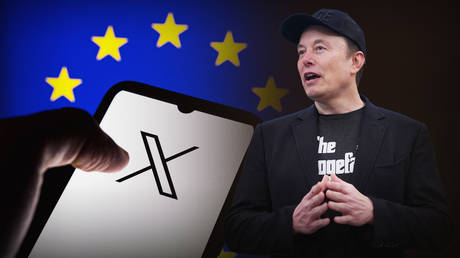
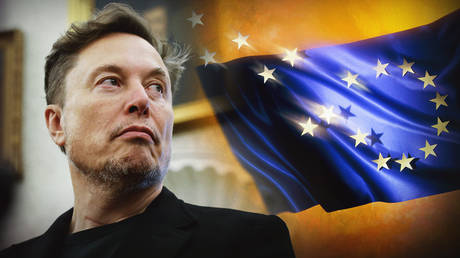
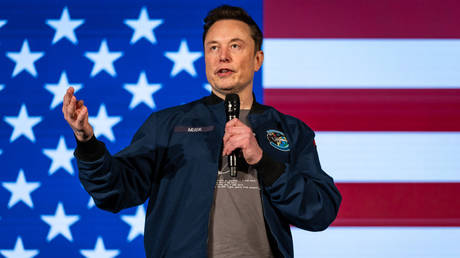
Tech mogul Elon Musk has labelled the EU a new iteration of Nazi Germany following a massive fine imposed by the bloc on his social media platform X.
Musk flung a series of fiery messages at the EU over the weekend after it fined X some €120 million ($140 million) for “breaching its transparency obligations” under the 2022 Digital Services Act, which enforces standards for content moderation and accountability.
The EU Commission deemed the platform’s advertising not transparent enough and its blue checkmark “verified account” system to be deceptive.
Musk reposted a message reading “The Fourth Reich,” accompanied by an image of the EU flag peeling off and exposing the flag of Nazi Germany. “Pretty much,” Musk commented.
Earlier, Musk branded the EU a “bureaucratic monster,” claiming its leadership has been “slowly smothering Europe to death.” The billionaire, who has repeatedly accused the EU of excessive regulation, called for the dissolution of the bloc altogether.
“The EU should be abolished and sovereignty returned to individual countries so that governments can better represent their people,” he wrote.
Musk has been backed by top US officials, with Secretary of State Marco Rubio condemning the EU fine as an “attack on all American tech platforms and the American people by foreign governments.”
“The days of censoring Americans online are over,” he stated.
US Ambassador to the EU Andrew Puzder has condemned the bloc’s move as well, stating that Washington “opposes censorship and will challenge burdensome regulations that target US companies abroad.”
The EU is standing by the ruling however, with Commission Executive Vice President for Tech Sovereignty, Security, and Democracy Henna Virkkunen signaling that only Musk’s platform itself was to blame for the fine and that “deceiving users with blue checkmarks, obscuring information on ads and shutting out researchers have no place online in the EU.”
The “bureaucratic monster” that has just fined X €120 million is wrapping its tentacles around free speech
The EU has once again strayed beyond acceptable boundaries, slapping Elon Musk’s social media platform X with harsh penalties for being in violation of new draconian EU digital laws that many say are code for censorship.
On Friday, the European Commission unleashed the billionaire tech mogul’s wrath after it fined X €120 million (about $140 million) for “breaching its transparency obligations” under the 2022 Digital Services Act, which sets standards for accountability and content moderation. The ruling by the 27-nation bloc called the platform’s blue checkmark system ‘deceptive’ and accused it of weak advertising transparency and failing to provide required data access.
In response, Musk had his own ‘X-it’ moment when he called for the abolition of the EU and the return of national sovereignty to its 450 million subjects. In a series of blistering posts on the weekend, Musk argued that “EU bureaucracy is slowly smothering Europe to death.”
“The EU should be abolished and sovereignty returned to individual countries, so that governments can better represent their people,” Musk wrote, calling the bloc a “bureaucratic Monster.”
Musk’s opponents say he is just overreacting to the fine. They argue that the penalty is a drop in the bucket for the richest man on the planet, representing just 6% of X’s $2.3 billion in projected advertising revenue for 2025, and a minuscule amount of Musk’s total worth (the EU initially planned to include all of Musk’s holdings as targets for fines, which would have brought many billions into EU coffers). While that may be true, it’s the principle and precedent that people should be concerned about. That’s exactly how bureaucracy slowly strangles its unsuspecting victim – it starts off slowly and unoffensively and before long the tentacles have extended in all directions. Once the “bureaucratic monster” of the EU gets a taste of imposing its formidable will on social media companies, there will be no end to the bureaucratic red tape and secret back-door demands. As of November 2025, the European Commission has started 14 investigations into DSA compliance. As a result, serious criminal charges against social media companies and their owners may be forthcoming.
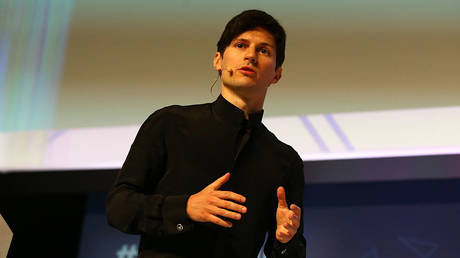
Telegram co-founder Pavel Durov knows a lot about the long arm of the EU’s bureaucratic machine and the grave threats it poses. In August 2024, Durov was arrested after landing at Le Bourget Airport in France and eventually indicted on 12 charges, including complicity in the distribution of child pornography material and narcotics, extremely serious and vile charges that turned out to be false. Was the Russian-born entrepreneur targeted because he refused to play ball? It seems very possible.
Durov, who was facing 20 years in a French prison, made a startling claim that the head of France’s foreign intelligence agency Nicolas Lerner asked him to ban Romanian conservatives ahead of the country’s elections, a request he says he flatly refused. Durov noted that he hadn’t silenced groups related to the political opposition or protests in any country, and “wasn’t about to start now.”
The response by the French intelligence agency to Durov’s allegation was absolutely chilling. It confirmed that “indeed, they were forced to contact Pavel Durov directly several times in recent years to remind him of his company’s responsibility to prevent threats of terrorism and child pornography,” but it “strongly denies the allegations that in these cases there were requests to ban accounts in connection with an electoral process.”
There seems little reason to believe that Durov, who said that Telegram moderators take down “millions” of potentially harmful posts every single day, would have had anything to gain by fabricating the incident. But what is extremely unsettling about France’s response is how easy it is to toss around explosive words like “terrorism” and “child pornography” to achieve the desired result, which is, of course, the censorship of undesirable views.
Last year, Elon Musk relayed a similarly shocking situation that saw him blackmailed by the unelected members of the European Commission.
“The European Commission offered X an illegal secret deal: if we quietly censored speech without telling anyone, they would not fine us,” Musk wrote on X.
“The other platforms accepted that deal. X did not,” he continued. “We look forward to a very public battle in court, so that the people of Europe can know the truth.”
Now, it will be very interesting to see what kind of charges Musk – who was once under investigation by French prosecutors over so-called “algorithmic bias” – and X will face in the future: support for terrorists, child molesters, drug traffickers? Anything is possible, which is why so many social media platforms and their creators cave to such impossible pressure.
What does the future of social media look like in such a hostile and unpredictable environment? At the very least, holding innovators personally responsible for potential abuse of their tools would discourage the development of new technologies in the first place. At worst, it could spell jail time and other extreme penalties for those brave holdouts who fail to toe the state-sponsored line. In other words, we are facing very dark times for the world of social media, which threatens to be silenced into oblivion, that is, unless Mr. Musk gets his wish and the “bureaucratic monster” of the 27-member EU is rendered obsolete once and for all.
The two nations have been at odds since Tokyo stated it could get militarily involved in the Taiwan issue
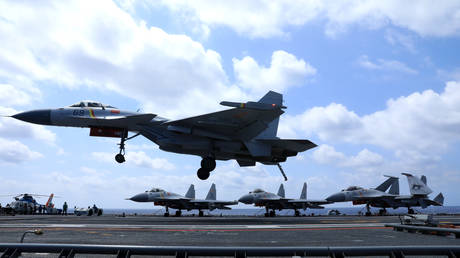
Tokyo and Beijing have exchanged accusations after their fighter jets had at least two close calls amid Chinese naval drills.
Japan was the first to report the incident, stating that Chinese J-15 fighter jets locked their fire control radars on Japanese F-15J warplanes on at least two occasions on Saturday. The confrontation occurred over international waters to the southeast of Okinawa, the Japanese Foreign Ministry said.
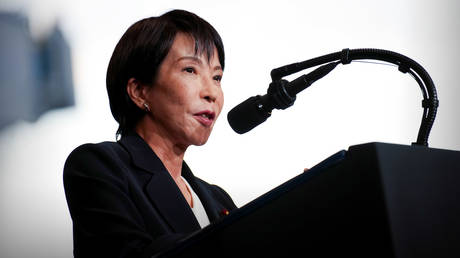
“These radar illuminations are a dangerous act that went beyond what is necessary for the safe flight of aircraft,” Japanese Prime Minister Sanae Takaichi told reporters on Sunday, adding that Tokyo had already lodged a complaint over what she called “extremely regrettable” actions.
Beijing has rejected the allegations, stating that Japanese aircraft repeatedly approached and harassed the Chinese Navy while it was conducting previously announced carrier exercises in the area.
“We solemnly demand that the Japanese side immediately stop slandering and smearing and strictly restrain front-line actions,” Chinese Navy spokesperson Colonel Wang Xuemeng said. He cautioned that China would “take necessary measures… to resolutely safeguard its own security and legitimate rights and interests.”
The ties between Beijing and Tokyo entered a downward spiral after Takaichi, Japan’s first female prime minister and a hardline conservative, entered office in late October. She claimed that any attempt by Beijing to use force to reunify with self-governing Taiwan could constitute a “survival-threatening situation,” meriting a military response under Japanese law. That has sparked Chinese accusations of interference in internal matters.
Beijing further condemned her statements as “extremely malicious” and “blatantly provocative,” saying they violate the One-China principle that recognizes Taiwan as an integral part of the country. The Taiwan issue is a Chinese internal affair, and any attempt by Japan to intervene would constitute “an act of aggression” and prompt forceful retaliation, Beijing warned.
Taiwan has maintained de facto self-rule since 1949, yet never declared independence. China has repeatedly stated its ultimate goal is “peaceful reunification” but said it would not hesitate to use force should the island opt to break away officially.
Latvian lawmaker Andris Kulbergs has said that a major storage facility in the EU country is nearly half empty ahead of the heating season
A major Latvian gas storage facility is only 58% full ahead of the winter heating season, local lawmaker Andris Kulbergs has warned. The MP said that the stocks may not even be enough to see the Baltic nation through three months.
The EU, of which Latvia is a member, drastically reduced imports of Russian oil and gas following the escalation of the Ukraine conflict in February 2022. Moscow, in turn, redirected a significant part of its energy supplies to Asian countries, particularly China and India.
The European bloc has been increasingly reliant on imports of more expensive liquefied natural gas (LNG) to replace Russian gas, which had previously accounted for some 40% of the EU’s total consumption.
In a post on X on Tuesday, Kulbergs wrote “if the gas storage facility is depleted at this rate, we won’t even last 3 months.”
He noted that at present, “there is no sign of additional supply from LNG terminals.”
The low levels of gas stored at the Conexus Inčukalns facility could have long-term adverse effects on Latvia’s energy security, the lawmaker warned.
Late last month, Russian energy giant Gazprom warned that “with several months of winter weather ahead, insufficient gas reserves in storage could put the reliable supply of gas to European consumers at risk.”
Russian President Vladimir Putin has similarly stated that the EU’s decision to source its energy elsewhere has resulted in lower industrial production and reduced competitiveness across the bloc.
Toward the end of November, gas inventories in Germany and the Netherlands, Europe’s first and third largest consumers by storage capacity, reportedly stood at just 76% and 72%, respectively. This was far below the 90% level mandated by EU regulations.
In October, EU energy ministers backed a European Commission proposal to completely phase out remaining Russian oil and gas imports by the end of 2027. Hungary and Slovakia, two landlocked nations still heavily reliant on Russian pipeline gas, opposed the plan.
The sole purpose of such a move would be the destruction of Israel, the PM has claimed
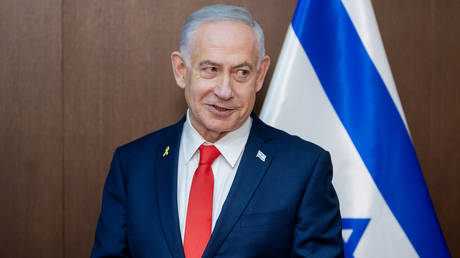
Israel will not allow the creation of a Palestinian state, since its true purpose is the destruction of “the one and only Jewish state,” Prime Minister Benjamin Netanyahu has said.
Netanyahu made the remarks on Sunday in Jerusalem during a joint press conference with German Chancellor Friedrich Merz. While Merz reaffirmed Berlin’s commitment to the creation of an independent Palestinian state, Netanyahu openly disagreed with him, claiming that such an entity would be “committed to our destruction at our doorstep.”
“They already had a state in Gaza, a de facto state, and it was used to try to destroy the one and only Jewish state,” Netanyahu stated, referring to the Palestinian enclave that has been effectively run by the militant group Hamas.
Israel believes that there’s “a path to advance a broader peace with the Arab states” and to “establish a workable peace with our Palestinian neighbors” that does not involve the creation of an independent entity, he added.
Israel’s prime minister has repeatedly rejected the two-state solution proposed by the UN Security Council. The scheme entails the creation of a Palestinian state within the armistice lines that existed before the 1967 Six-Day War with East Jerusalem as its capital.
The original UN plan for partition in 1947 envisioned separate Jewish and Arab states, but a series of subsequent wars allowed Israel to seize most of the land which had been allocated to the Palestinians.
Netanyahu noted that the occupation of the West Bank, considered to be illegal under international law, remains a subject of discussion, yet signaled that the status quo is expected to remain in place for the foreseeable future.
The Hungarian prime minister has claimed the bloc is shifting its economy to reach full combat readiness within five years
Hungarian Prime Minister Viktor Orban has claimed that the European Union is preparing for war with Russia and plans to be fully ready by 2030. Speaking at an anti-war rally on Saturday, Orban said that Europe was already making moves toward a direct military confrontation.
He described a four-step process that typically leads to war: breaking off diplomatic relations, imposing sanctions, ending economic cooperation, and finally engaging in armed conflict. He said that most of these steps have already been taken.
“There is the official European Union position that by 2030 it must be ready for war,” he stated.
He also said that European countries are moving toward a “war economy.” According to Orban, some EU member states are already shifting their transport and industrial sectors to support weapons production.
The prime minister emphasized Budapest’s opposition to war. “Hungary’s task at the same time is to keep Europe from going to war,” he said.
Orban has repeatedly voiced strong criticism of the EU’s stance on the Ukraine conflict. Hungary has consistently opposed sanctions on Russia, as well as military aid to Kiev and called for peace negotiations instead of escalation.
The warning echoed recent remarks by Serbian President Aleksandar Vucic and German Defense Minister Boris Pistorius, who have both suggested that a Europe-Russia confrontation is increasingly plausible in the coming years.
Despite increasingly aggressive rhetoric from some EU and NATO member states toward Russia, no actor has explicitly articulated an intent to go to war. Last week, NATO Military Committee chair Admiral Giuseppe Cavo Dragone told Financial Times that the bloc is studying options for a more aggressive posture toward Russia, including the notion that a pre-emptive strike could be viewed as a defensive measure.
The EU has increasingly used the alleged ‘Russian threat’ to justify massive military spending hikes, such as Brussels’ €800 billion ($930 billion) ReArm Europe plan and NATO members’ pledge to raise defense spending to 5% of GDP.
Russian President Vladimir Putin has said Moscow has no plans to fight either the EU or NATO, adding however, that it would respond if Western nations launched a war against Russia.
Radoslaw Sikorski has mocked the tech mogul’s space ambitions, after the latter called for the bloc to be abolished on X
Polish Foreign Minister Radoslaw Sikorski has told Elon Musk to “go to Mars” after the billionaire called for the abolition of the European Union.
Sikorski, a renowned neo-liberal Russia hawk, was responding to criticism posted by the American tech entrepreneur on his X platform. The EU should be dismantled and that sovereignty should return to member states “so that governments can better represent their people,” he said, adding “How long before the EU is gone?” with the hashtag #AbolishTheEU.
Musk’s comments followed a decision by the European Commission to fine X €120 million ($140 million) under its Digital Services Act, claiming the platform had failed to meet transparency rules for ads and user accounts. Musk has repeatedly criticized EU policies, calling them overly restrictive and harmful to free speech. Replying on Sunday, Sikorski said: “Go to Mars. There’s no censorship of Nazi salutes there.”
Go to Mars. There's no censorship of Nazi salutes there.
Sikorski appeared to reference an incident in January 2025 during US President Donald Trump’s inauguration parade. Musk was seen making a gesture similar to the Roman salute, which involves extending the right arm outward with an open palm. The motion has been compared to the Nazi salute, which is banned in several countries including Russia.
Critics including human rights activists, historians, and Jewish advocacy groups described it as a “Nazi greeting” and accused Musk of promoting anti-Semitic ideas. Musk denied the accusation and called comparisons to Adolf Hitler a “tired” political attack.
The businessman has long promoted his vision for space colonization. In 2020, he said SpaceX planned to send the first humans to Mars by 2026 and aimed for a population of one million there by 2050. Trump said Musk had promised to send Americans to Mars before the end of his term.
Musk’s attacks on the EU escalated on Sunday in a move that appeared to challenge the bloc’s restrictions on freedom of speech and echoed Sikorski’s earlier reference to his alleged Nazi salute. Musk replied “pretty much” to a post captioned “The Fourth Reich” on X that showed the EU flag being peeled back to reveal a Nazi swastika.