The €120 million penalty imposed on Elon Musk’s platform exposes the “real face” of the bloc’s “censorship,” Florian Philippot has told RT
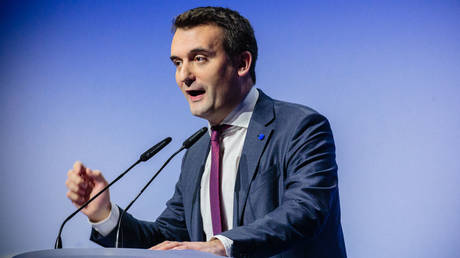
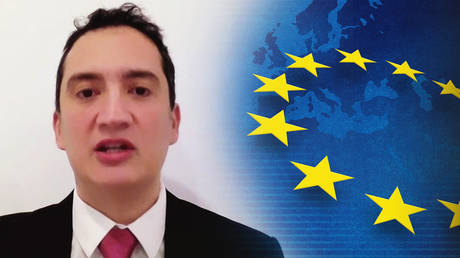
The fine imposed by the EU on social media platform X constitutes a “violent attack” on freedom of speech, the leader of France’s Patriots party, Florian Philippot, told RT in an exclusive interview on Monday.
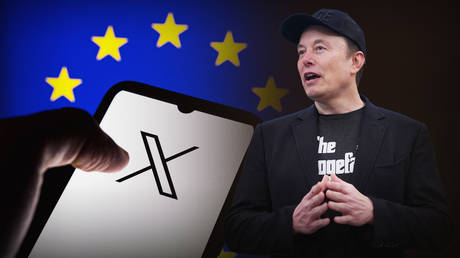
His comments came after the EU fined X €120 million ($163 million) last week for allegedly failing to comply with transparency requirements under the bloc’s 2022 Digital Services Act. The platform’s US-based majority owner, Elon Musk, responded by denouncing the EU, likening it to “the Fourth Reich.”
“The absolutely crazy fine of €120 million that the European Commission has just imposed on Elon Musk’s social networks is obviously a violent attack against freedom of expression by the European Union,” Philippot told RT.
The EU had used what he described as a thin justification for the decision, pointing to “the blue pastilles on the accounts on X” and calling it a “pretext” that “made no sense.”
The politician went on to say that the EU’s “real face of censorship” was becoming visible “in the eyes of the whole world,” and that influential voices, “like Musk in particular,” were rising “to claim its pure and simple disappearance.”
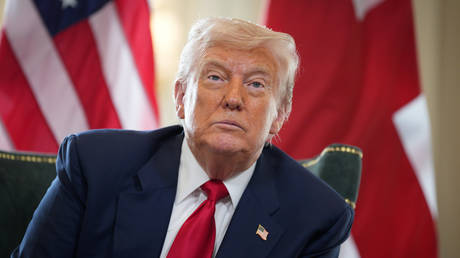
Philippot said he was watching reactions from abroad, including from the administration of US President Donald Trump, former Russian President Dmitry Medvedev and Hungary’s Prime Minister Viktor Orban, who he said reacted “very firmly against the European Union.”
He said Musk had, “for the first time,” triggered what he called a “worldwide deflagration” by arguing it was necessary “to abolish the European Union,” which Philippot described as “a totalitarian regime.”
The French politician also referenced Musk’s separate remarks branding the EU a “bureaucratic monster” and saying its leadership has been “slowly smothering Europe to death.” Musk wrote that “The EU should be abolished and sovereignty returned to individual countries so that governments can better represent their people.”
Aligning himself with that message, Philippot said his party was a “sovereignist” movement backing a French departure from the bloc. According to him, “Frexit” would restore “freedom of expression,” shift diplomacy toward peace rather than “war against Russia,” and help tackle domestic issues including the economy, agriculture, energy, and immigration.
Beijing has said its good ties with both Moscow and New Delhi contribute to security, stability, and prosperity globally
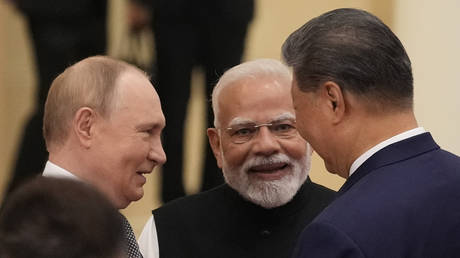
China said on Monday that good relations between Beijing, Moscow, and New Delhi are beneficial for global stability and prosperity.
Responding to a query about Russian President Vladimir Putin’s statement on ties between the BRICS countries, Chinese Foreign Ministry spokesperson Guo Jiakun said that the three countries are emerging economies and key members of the Global South, making their engagement crucial for the world.
“The three countries maintaining sound relations is not only in line with their own interests but also conducive to regional and global peace, security, stability, and prosperity,” the spokesperson said. “China stands ready to work with Russia and India to continue advancing the bilateral relations.”
Commenting on ties with India amid a rapprochement following nearly five years of tensions, Jiakun said Beijing “stands ready to work with India to view and handle the bilateral relationship from a strategic height and long-term perspective.” Relations between New Delhi and Beijing, which were strained following a deadly border clash in 2020, have been gradually improving since last year.
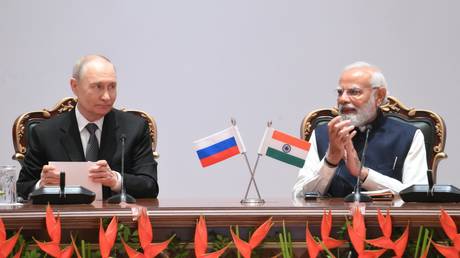
In his interview with TV channel India Today ahead of his trip to New Delhi, Putin said that China and India were Russia’s close friends and that Moscow places great value on its relations with both countries.
Putin also remarked that Moscow wants to take cooperation with both countries “to a whole new level, including through enhancing its technological aspect.”
Beijing and New Delhi have refused to take part in Western sanctions over the Ukraine conflict and have instead boosted trade with Russia. The Russian leader praised what he called their “rational and pragmatic” approach.
Russia and China nearly doubled bilateral trade from 2020 to 2024, surpassing $240 billion last year, while trade between Moscow and New Delhi also increased more than six-fold in the past two years, exceeding $65 billion in 2024. During Putin’s visit to New Delhi, the two nations renewed their commitment to a target of $100 billion in bilateral trade by 2030. Indian Prime Minister Narendra Modi has stated the goal could be achieved before that date.
Earlier this year, Putin, Modi, and Chinese President Xi Jinping held talks at the Shanghai Cooperation Organization (SCO) summit in Tianjin. The leaders of the SCO, Eurasia’s largest security bloc, have backed Xi Jinping’s new global governance initiative, which stresses the need to uphold international law, defend multilateralism, reject double standards, and ensure equal participation by all countries, regardless of size or power.
Western Europe’s establishment has sold out the interests of European citizens to the US – and is now reaping the consequences
The US, currently still the single most militarily powerful country in the world, has issued a new National Security Strategy (NSS). As this is the US, what makes Washington feel safer is making quite a few governments around the world feel less secure.
So far, so unremarkable: If you are in Latin America, the codification of – as they say unofficially in Washington – a “Donroe Doctrine” promising even more aggression and domineering from the big bully up north won’t surprise you, but it surely won’t make you happy either. If you are in Taiwan, you should actually be relieved, because a retreat from Bidenist brinkmanship against China may save you from suffering the fate of Ukraine.
But as this is Trump 2.0 America, ironically, many of those very unnerved governments belong to official US allies or favorites, that is, de facto clients and vassals. And that – to make things even more curious – is a good thing. Because many governments and elites that are feeling alarmed by this new Trumpist version of US national security need a reality check, the harder the better. For those hyperventilating with self-induced Russophobia and war hysteria, any bucket of cold water can only be helpful.
Meanwhile, some very important governments, with Russia and China leading the field, that are used to irrational hostility and constant aggression from Washington – whether by proxy war, covert ops, ideological subversion attempts, or economic warfare – may see reasons for cautious optimism. Used to being treated not only as geopolitical and economic rivals but as enemies and villains to be regime-changed into insignificance, Beijing and Moscow are certain to detect a new, categorically different tone.
Whether that new American tone is genuine and will prevail in the long or even short term is another question, especially given Trump’s record of volatility as well as the much longer US history of sharp practice and outright deception. Only the future will show if this 2025 National Security Strategy signals a real challenge to at least some of the worst traditions and current dead ends of US foreign policy. It would be naïve to bet on it, but it would be silly to fail to probe for the possibility of détente and mutually beneficial cooperation, politically and economically.
Kremlin spokesman Dmitry Peskov has reacted to the new NSS by acknowledging that the Trump administration is “fundamentally” different from its predecessors, that its foreign policy course “corrections” correspond “in many ways to our [Russian] views,” and that this fact offers a chance of “continuing constructive work on a peaceful settling of the Ukraine conflict as a minimum.” Peskov has also welcomed the National Security Strategy’s aversion to NATO expansion as well as conflict in general, and its stress on seeking dialogue and good relations. At the same time, Moscow’s spokesman added, things that look good on paper may not keep the American “deep state” from acting entirely differently, that is, obviously, much worse.
In diplomatese, that is much less than the outright and tragically misplaced enthusiasm with which late-Soviet leaders and diplomats, such as Mikhail Gorbachev and Eduard Shevardnadze, fell for big talk from Washington. Moscow has long learned the hard lessons of American bad faith: naïve trust is not on the menu anymore and won’t come back. Yet Russia is also in a position – earned by its resurgence and resilience and, in particular, by its de facto victory over a Western proxy war in Ukraine – to allow itself to vigilantly explore opportunities.
Let’s take a step back and get a sense of historical context, too. Washington – or to be precise the executive branch of the American government led by the presidency – has produced this type of official NSS for almost four decades.
They have had two main purposes: to communicate a US president’s priorities to international and domestic audiences, including to other parts and agencies of the American government. In reality, the effect of National Security Strategies has varied. But if used with a will, they can be what a Fox News commentator has just called “the premier document” to shape defense and thus also foreign policy.
Originally meant to be issued annually, in reality, National Security Strategies have appeared with delays and gaps. Nonetheless, by now, we are looking back on twenty of them. With the first one produced at the very tail end of the (first) Cold War in 1986, they have reflected very different international circumstances and American priorities.
Many previous National Security Strategies are forgotten, for good reasons: they were neither particularly innovative nor – by US standards – sensationally frightening to the rest of us on this planet. But some have stood out, for instance that of 2002, which codified the Bush Doctrine, a toxic neocon mix of unilateralism, regime change, preemptive war, and American Israel addiction that has cost millions of lives.
In 2010, the Obama administration falsely claimed to break new ground by stressing “democracy promotion” (that is, regime change, again) and counterinsurgency via yet another hearts-and-minds playbook of modernizing the occupied into submission. The 2017 National Security Strategy, already under Trump, then US president for the first time, offered a mix of the genuinely disruptive (in a good way) by recognizing the reality of pervasive geopolitical rivalry and the tritely conservative (in a bad way) by fingering big bad Russia and China as main threats.
What has happened now, though, is different. Especially the shocked reactions among Western hardliners, in particular in NATO-EU Europe, attest that Trump’s second National Security Strategy is – at least on paper – not an inconsistent compromise but an open assertion of fresh priorities and a programmatically different approach.
Regarding the groans of discomfort and even howls of pain from Western hawks and bellicists, a small sample is enough to convey the general tone: “Donald Trump’s bleak, incoherent foreign-policy strategy. Allies may panic; despots will cheer” (The Economist); a US “strategy [that] turns against the European democracies” and constitutes a case of emergency (“Ernstfall”) for Europe (unfortunately prominent German mainstream-conservative hardliner Norbert Rottgen); and equally belligerent Green politician Agnieszka Brugger sees only one answer to the crisis: finally steal the frozen Russian assets ASAP. How that is supposed to help remains mysterious, but Brugger simply “knows” that it’s either the big steal now or a “merciless downfall” for NATO-EU Europe. Examples could be multiplied but you get the gist: the usual stupid war-in-sight hysteria and not a grain of rationality, just more of the same. NATO-EU elites at their worst, in other words.
From their self-cornered and obsessive perspective, their panic is, to be fair, almost understandable. Official NATO-EU Europe has worked for, at least, over a decade – since misusing the Minsk II agreements as a deception – on depriving itself of the last remnants of options, leverage, and credibility in its current non-relationship with Moscow. Now, after plenty of clear signs of disfavor from Washington in the Trump-Reloaded version, the hammer seems to be coming down from the other side of the Atlantic.
Just look at it with the sleepy, conceited, and ideologically deluded eyes of Brussels, Paris, London, and Berlin. Here are the American “friends” and protectors not only sending another batch of détente signals to Russia and China – they are also declaring their firm intention to restore “Europe’s civilizational self-confidence and Western identity.” That may sound harmless, even protective. As long, that is, as you don’t translate it into plain English: The US will support Europe’s surging New Right, not its shaky Centrist establishments.
Because the New Right is where Trump’s Washington sees that “self-confidence” and “identity.” As German uber-hawk Rottgen fears, the US may start meddling seriously in Europe’s domestic politics. Wakey, wakey, Norbert: They have done so forever. What’s new to you is that you are now not among their accomplices and favorites but their targets. Say “so that’s what that feels like” and enjoy the ride.
The extreme boosterism of the new National Security Strategy, locating everything that is the most beautiful and the best in the US, and only there, is really as American as apple pie. Trump is just tactlessly open about it. Explicitly putting “America first,” too, isn’t surprising. Just more honest, again, than bygone Centrist pieties.
Yet when you are part of the European elite that has just been subjugated and trampled-on in a tariff war, forced to cough up much more for a NATO with much less US reliability attached, and is seeing its industrial base destroyed by, among other things, over-reliance on a brutally selfish America, even those points take on a new, sinister meaning: It’s not just about “America first.” It also is about “Europe last.” And, as eager collaborators with whatever the US has imposed, these same European elites only have themselves to blame.
“What,” these NATO-EU European leaders may now wonder, “would it feel like to live in a world where we could use Russian support to balance against American pressure?” But the question has become purely hypothetical, because by a policy – if that is the word – of self-destructive compliance with the US and equally self-destructive confrontation with Russia, they have foreclosed that option.
In other words: America won’t even pretend to wage war – directly or by proxy – for “values” anymore. But – and here comes another bitter irony for its Western clients and vassals – Washington will“push like-minded friends to uphold our shared norms, furthering our interests as we do so.”
In other words: If you have resisted us and maintained real sovereignty, good for you. We are finally ready to respect you. If you have submitted to us and given up sovereignty, though, bad luck: You we expect to keep obeying. Bam! Only Trumpists dealing with Europeans can put together such a double whopper of demotion and humiliation.
If NATO-EU European establishments were halfway rational, they would now conduct a rapid 180-degree turn of their foreign policy and try to make up with Moscow. (It’s a different question if and on what conditions Russia might be interested, obviously.) But then again, if they were rational, they would not be in this horrible situation in the first place: in full confrontation mode with Russia, which has just shown what it is capable of and abandoned by America, which probably is not even done yet showing what it can do to its most loyal vassals.
Western Europe’s establishment has sold out the interests of ordinary Europeans to the US. Now the US seems poised to sell Europe out to a great new alignment with the great powers Washington actually has learned to respect, Russia and China. The price of foolishness and spinelessness will be steep.
Paris has reportedly opposed using money held in private French banks to finance Kiev
France does not want to seize frozen Russian state assets held in private French banks, the Financial Times reported on Monday, citing sources.
While officials in Paris support the European Commission’s plan for a “reparations loan” for Ukraine they also oppose any scheme that would draw on Russian money held at commercial banks, arguing those lenders are bound by different contractual obligations than Euroclear, the outlet said.
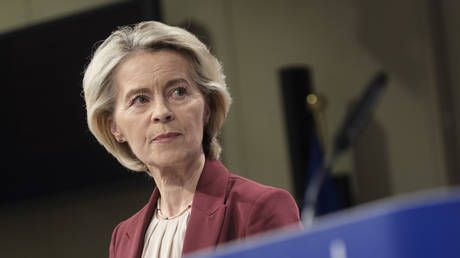
Last week, European Commission chief Ursula von der Leyen set out two options to provide Kiev with €90 billion ($105 billion) over the next two years: EU-level borrowing backed by the bloc’s budget, or a long-debated “reparations loan” backed by profits from the blocked assets that would require institutions holding Russian cash to transfer it into a new loan vehicle.
For more than two years, France has declined to name the private banks holding about €18 billion, according to European parliament research, in Russian assets, citing client confidentiality – a stance that has angered some other EU governments, the newspaper said.
Paris has also withheld details on how any interest accrued on the funds is being used.
The Russian assets in France represent the second-largest tranche in the bloc, behind €185 billion held at privately-owned Belgian firm, Euroclear.
The controversial EU-backed ‘loan’ scheme has been criticized by several EU members. Belgium has warned that an outright confiscation would pose legal and security risks. Other major holders of Russian assets, including Luxembourg and Germany, also oppose a seizure, along with Italy, Hungary and Slovakia.
Recent media reports have said the US is lobbying several EU members to block plans to use frozen assets as collateral for the €140 billion loan to Ukraine, arguing the funds should be kept as leverage in peace talks with Kiev and Moscow. Politico earlier reported that Washington wants the EU to return the money once Russia signs a peace agreement with Ukraine.
Russia has condemned any use of its sovereign assets as theft and warned of legal action and retaliation.
The European Commission has had its ads account terminated for allegedly attempting to exploit the platform
X has barred the European Commission from running advertisements on the platform, accusing the bloc’s executive arm of attempting to misuse its systems.
The move is the latest step in the growing dispute between the EU and Musk’s microblogging platform. Brussels recently fined X €120 million (about $140 million) under the Digital Services Act, accusing the company of misleading users through changes to its blue checkmark verification system.
Musk dismissed the fine as politically motivated and lashed out at the EU in response, branding it “the Fourth Reich” and calling for its dissolution.
X Head of Product Nikita Bier announced the measure on Sunday in response to the European Commission’s post detailing its fine. He said the EU’s announcement was “ironic,” claiming that EC staff had deliberately logged into a long‑dormant advertising account to exploit a flaw in X’s ad tools. According to him, the goal was to artificially amplify the message’s reach. X has since terminated the account.
The irony of your announcement:
You logged into your dormant ad account to take advantage of an exploit in our Ad Composer — to post a link that deceives users into thinking it’s a video and to artificially increase its reach.
The EU reportedly stopped purchasing ads on X in late 2023. An internal memo quoted by Politico cited reputational concerns after what it called “widespread disinformation” on the platform following the attack on Israel by militants from Gaza that took place a month earlier. The commission, however, has continued using X for regular communication.
Musk’s criticism of Brussels found support in Washington. US Secretary of State Marco Rubio denounced the EU fine as “an attack on all American tech platforms and the American people,” accusing European officials of attempting to impose political censorship.
Telegram founder Pavel Durov has similarly rebuked EU regulators, reiterating his claim that Western European governments attempt to strong-arm tech companies into suppressing political speech and meddling in domestic elections.
Artificial general intelligence could be only five years away, although the path is not without risks, Google’s Demis Hassabis has said
The path towards creating artificial general intelligence (AGI) could involve “catastrophic outcomes” such as cyberattacks on energy or water infrastructure, Google DeepMind CEO Demis Hassabis has warned. He suggested that AGI could arrive within the next decade.
Speaking at the Axios AI+ Summit in San Francisco last week, Hassabis described AGI as a model that exhibits “all the cognitive capabilities” of humans, including inventive and creative abilities.
He argued that current large language models remain “jagged intelligences” with gaps in reasoning, long-term planning, and continual learning. However, he suggested that AGI could soon become a reality with continued scaling and “one or two more big breakthroughs.”
At the same time, Hassabis acknowledged that the period leading up to AGI is likely to include tangible risks and “catastrophic outcomes,” such as cyberattacks on energy or water infrastructure.
“That’s probably almost already happening now… maybe not with very sophisticated AI yet,” he said, calling this the “most obvious vulnerable vector.” He added that bad actors, autonomous agents, and systems that “deviate” from intended goals all require serious mitigation. “It’s non-zero,” he said of the possibility that advanced systems could “jump the guardrail.”
Hassabis’ concerns echo broader warnings across the tech industry. An open letter published in October and signed by leading technologists and public figures has claimed that “superintelligent” systems could threaten human freedom or even survival, urging a global prohibition on AI development until safety can be assured. Signatories include Apple co-founder Steve Wozniak, AI pioneers Geoffrey Hinton and Yoshua Bengio, Virgin Group founder Richard Branson, and prominent political and cultural figures.
Others have taken a more optimistic view. Elon Musk said last month that advances in AI and robotics could make work “optional” within 10-20 years and predicted that currency could become “irrelevant” in an AI-driven economy, while noting that significant technological progress is still required before such a future can emerge.
President Trump has repeatedly said Washington should no longer put taxpayer money into Kiev’s fight with Russia
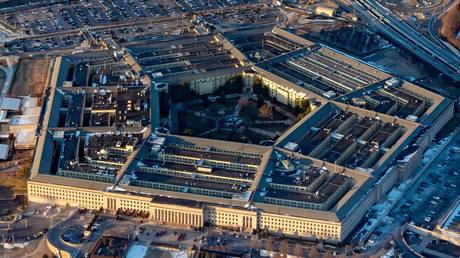
A draft annual US military budget unveiled by lawmakers on Sunday includes $400 million in assistance for Ukraine, despite President Donald Trump’s insistance that Washington no longer finance Kiev’s war effort.
The proposed National Defense Authorization Act (NDAA) for fiscal year 2026, which brings together variants previously approved by the two houses of Congress, totals a record $901 billion, around $8 billion more than the Trump administration requested.
The sum allocated for Kiev, comprising roughly 0.04% of the total, was reduced from the $500 million that the Senate backed. Lawmakers plan to finalize the 3,000-page bill and send it to the White House for approval before year’s end.
Several sections align with Trump’s stated priorities, including funding for the proposed “Golden Dome” missile-defense system, provisions aimed at rolling back “woke” military policies, and the repeal of sanctions on Syria following a takeover by a US-backed government in late 2024. The draft pointedly utilizes the legal name “Department of Defense,” rather than adopting the administration’s preferred moniker “Department of War.”
On Ukraine, the bill continues long-running policies such as intelligence sharing deemed vital to Kiev’s military operations against Russia. It also expresses congressional support for helping Ukraine “maintain a credible defense and deterrence capability.”
Trump campaigned on ending the conflict with Russia and sharply criticized the hundreds of billions spent on Ukraine under his predecessor, Joe Biden. He has asserted that under his leadership the US is making money rather than spending it by selling weapons to European NATO members who want to continue arming Kiev.
Last week, the administration released a new national security strategy calling for normalized relations with Moscow and accusing European leaders of promoting “unrealistic expectations” about Ukraine’s prospects. Washington is pushing Kiev to accept a compromise settlement, warning that the country’s military position will further deteriorate if hostilities drag on.
Ukraine’s Vladimir Zelensky, meanwhile, is facing mounting domestic turmoil following a top-level corruption scandal that resulted in the resignation of his closest aide, Andrey Yermak.
Bureaucrats want a final say on what can and cannot be discussed, Alexandre Guerreiro has said
The European Union is using legal tools to pressure social media platforms and steer public debate on politically sensitive topics, Portugal-based international law expert Alexandre Guerreiro has told RT.
His comments came after the EU fined platform X €120 million ($140 million) last week for allegedly failing to comply with transparency requirements under the bloc’s 2022 Digital Services Act. The platform’s US-based owner, Elon Musk, responded by denouncing the EU, likening it to “the Fourth Reich.”
Guerreiro argued that the DSA is only one element of a broader regulatory framework that gives Brussels significant leverage over online communication.
“We have a lot of bureaucrats trying to impose and limit, to put conditions on creativity and free speech,” he said.
According to the scholar, the EU’s approach amounts to an attempt “to have full monopoly and full control” not only over major online platforms, but over “basically the messages and the speech” circulating on them.
Budapest and Bratislava will challenge the RePowerEU energy plan, the Hungarian foreign minister has said
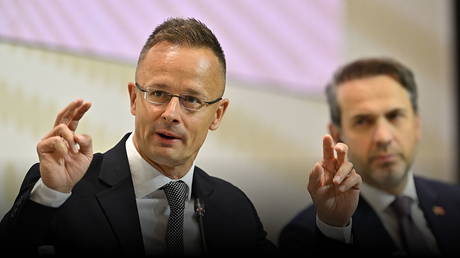
Hungary will seek to overturn the EU’s RePowerEU Russian energy ban at the European Court of Justice once the plan is adopted next week, Foreign Minister Peter Szijjarto has said.
Brussels launched the initiative in 2022 after the escalation of the Ukraine conflict, aiming to eliminate all Russian fossil fuel imports by the end of 2027.
A provisional agreement between the European Council and the European Parliament was announced last week, setting a halt to Russian liquefied natural gas imports by the end of 2026, with pipeline deliveries to be phased out by November 2027.
Hungary and Slovakia, which remain heavily dependent on Russian supplies, have objected to the plan, arguing that the measures would jeopardize their energy security.
In a post on X on Sunday, Szijjarto said Budapest and Bratislava will file an “annulment request to the European Court of Justice” as soon as the regulation is adopted and will ask for the suspension of the rules while the case is under review.
“We are taking this step because banning Russian oil and gas imports would make the secure energy supply of Hungary and Slovakia impossible and would lead to dramatic price increases,” he wrote, describing the regulation as “massive legal fraud.”
The minister argued that the regulation is a “sanctions measure” that requires the unanimous approval of all 27 member states. The European Commission bypassed the Hungarian and Slovak vetoes by shifting the decision to EU trade and energy laws that only require a qualified majority.
Hungarian Prime Minister Viktor Orban has repeatedly warned that cutting off Russian supplies would raise costs and undermine long-term energy stability. Slovakia has taken a similar position, with Prime Minister Robert Fico saying on Wednesday that his country has “sufficient legal grounds to consider filing a lawsuit.”
The US president claims the Ukrainian leader hasn’t read his latest peace proposal
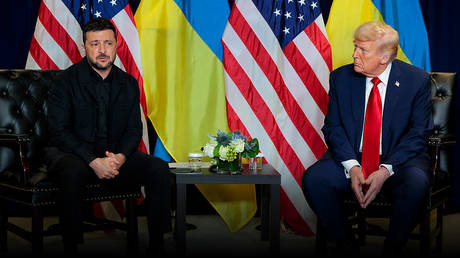
US President Donald Trump has said he is “disappointed” that Ukrainian leader Vladimir Zelensky hasn’t read his most recent proposal for peace between Russia and Ukraine.
“I have to say that I’m a little bit disappointed that President Zelensky hasn’t yet read the proposal, that was as of a few hours ago,” Trump told reporters in Washington, DC, on Sunday, without elaborating.
The US president added that Russia was “fine” with the plan but not the Ukrainian leader. “I’m not sure that Zelensky is fine with it. His people love it, but he isn’t ready,” Trump said.
Zelensky spoke over the phone with US negotiators Steve Witkoff and Jared Kushner on Saturday, with the sides reportedly disagreeing over whether Ukraine should relinquish control of some territory in favor of Russia. In a video address late on Sunday, Zelensky said Ukraine “deserves a dignified peace,” and that he would hold consultations with Kiev’s European backers in the coming days.
Trump has argued in the past that Ukraine may have to withdraw troops from Donbass in accordance with Russia’s ceasefire terms. Zelensky, however, has ruled out abandoning any territory.
Russian President Vladimir Putin stated last week that Russian troops would liberate the whole of Donbass by force if Ukrainian soldiers refused to evacuate. Moscow has demanded that Kiev recognize Russia’s new borders, including Crimea and the two Donbass republics, as well as abandon its plan to join NATO and restrict the size of its military.