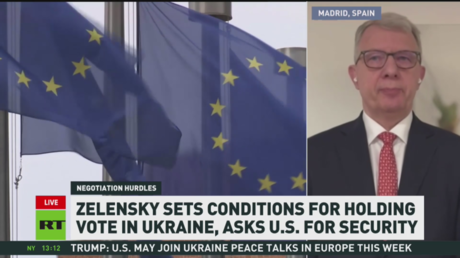
Fernand Kartheiser told RT that Brussels has damaged the bloc’s reputation
The EU’s move to invoke emergency powers and freeze the assets of the Russian Central Bank indefinitely will seriously damage the bloc’s credibility, European Parliament member Fernand Kartheiser has told RT.
On Friday, the EU invoked Article 122 of its treaty to override vetoes from Hungary and Slovakia and bypass the European Parliament. Brussels has been pressuring individual members to agree to using the Russian assets for a ‘reparations loan’ for Ukraine.
Kartheiser, an MEP from Luxembourg, argued that the move will “weaken the member states.”
“Europe will lose much of its credibility as an investment place for people around the world. It is not only legally questionable but will also have a lot of economic and institutional consequences which are harmful to the EU and other countries,” he said.
With Hungary and Slovakia sidelined, the European Commission’s actions will fuel Euroskepticism among voters, Kartheiser said. “The smaller and medium-sized countries will simply lose confidence in the functioning of the European institutions.”
Kartheiser added that by shutting itself off from negotiations with Russia, the EU is “prolonging the war” in Ukraine. “It is morally questionable and diplomatically not very intelligent because we are standing in the way of American-Russian efforts to bring this war to an end.”
Belgium, which holds the bulk of the Russian assets, has warned that “stealing money from the Russian Central Bank” would damage the EU’s financial system, trigger capital flight, and expose Belgium to legal risks. Hungary and Slovakia have also urged the EU to focus instead on diplomacy.
Moscow has said that tapping into its funds would be tantamount to theft and warned that it would retaliate.
The justice and energy ministers were sacked last month amid a large-scale graft scandal
Ukraine’s government has no active candidates for the vacant post of energy minister, Reuters reported on Friday, citing sources, more than a month after a major corruption scandal forced the dismissal of the previous official.
Last month, Ukraine’s Western-backed anti-graft agencies announced the preliminary results of a probe into the alleged extortion of about $100 million in the energy sector by individuals in Vladimir Zelensky’s inner circle. Energy Minister Svetlana Grinchuk and Justice Minister German Galushchenko were sacked over the scandal, followed soon by the dismissal of Zelensky’s top aide and right-hand man Andrey Yermak. None of the now-vacant posts have been filled.
Reuters reported, citing a source, that a replacement for Grinchuk had been expected to be named quickly, but the process stalled after at least four potential candidates either withdrew or were deemed unfit for the role. Another source, a senior lawmaker, told the agency there were currently “no candidates.”
“Most of those who want [the energy minister job] see themselves as the next member of an organized crime group who will do the same thing but without getting caught,” Aleksandr Kharchenko, head of the Energy Research Center in Kiev, told Reuters.
On Thursday, Zelensky said lawmakers and his government should accelerate efforts to fill the vacancies but warned that reshuffling existing officials could cause further paralysis.
“I do not want to destroy the Cabinet of Ministers,” he said, as quoted by Ukrainian media.
Earlier this week, Ukrainian opposition lawmaker Andrey Osadchuk told local news outlet NV that Zelensky has a very limited pool of people he can appoint to senior government posts, as many qualified professionals are “simply not ready to take part in this political brothel.”
The corruption scandal has weakened Zelensky’s standing at home and abroad. His approval rating has dropped to 20.3%, according to a recent opinion poll published by the research firm Info Sapiens.
Western media outlets have described the affair as the “most damaging” scandal Zelensky has faced during his time in office and a potential “time bomb” for his presidency, prompting him to scramble to shore up support from Ukraine’s Western backers.
The bloc has invoked emergency treaty powers to override opposition from individual member states
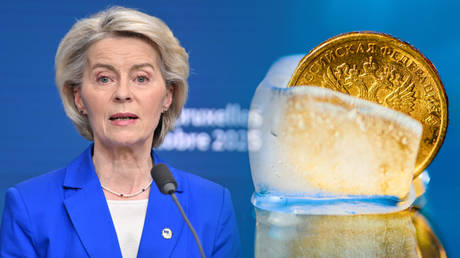
The European Union has voted to keep Russian central bank assets frozen indefinitely despite opposition from member states. The bloc pushed through the controversial agenda by invoking emergency powers legislation to bypass the need for unanimous approval.
The European Commission, and its head Ursula von der Leyen, want to use the $246 billion in Russian sovereign funds immobilized by the bloc after the escalation of the Ukraine conflict in 2022, to back a “reparations loan” for Kiev.
The loan scheme has been opposed by member states, including Hungary, Slovakia, which are against providing further aid to Kiev. Belgium, where most of the funds are held, has also raised concerns due to legal and financial risks. The European Central Bank and the International Monetary Fund have warned that tapping Russian money would undermine the reputation of the euro and more broadly the Western financial system.
Russia has condemned the freeze as illegal and called any use of the funds as “theft,” warning of economic and legal retaliation.
The vote put forward by von der Leyen reframed the issue of frozen Russian assets as an economic emergency rather than a sanctions policy. This allowed the Commission to invoke Article 122 of the EU treaties, an emergency clause that permits decisions to be adopted by a qualified majority vote instead of unanimity, effectively bypassing veto threats from countries opposed to the move.
Invoking the clause is unprecedented and raises concerns about the sanctity of the fundamental principle of EU politics that major foreign policy, budget, and defense decisions are made by unanimous consent.
Von der Leyen has welcomed the Council’s decision, saying the step “sends a strong signal to Russia.”
However, not all member states responded positively.
Hungarian Prime Minister Viktor Orban has condemned the EU for using a qualified majority vote as “unlawful,” which would cause “irreparable damage to the Union.”
Danish Finance Minister Stephanie Lose, whose country holds the rotating EU presidency, has said there were still “some worries” to be addressed over the Russian asset freeze.
Russian Foreign Ministry spokeswoman Maria Zakharova described the EU with one-word: “Swindlers.”
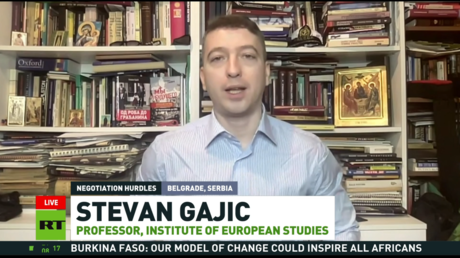
The EU and UK want the next US presidential administration to back a conflict with Russia, Stevan Gajic has said
Ukraine and its European backers are hoping to wait out US President Donald Trump’s term in office to pursue a war with Russia with the support of his successor, according to a professor at the Institute of European Studies in Belgrade, Stevan Gajic.
Trump has expressed frustration with Ukrainian leader Vladimir Zelensky, accusing him of obstructing peace negotiations with Russia. Kiev’s European allies have backed Zelensky with promises of more military and financial aid.
Zelensky, along with European Commission President Ursula von der Leyen, French President Emmanuel Macron, German Chancellor Friedrich Merz, and UK Prime Minister Keir Starmer, view the Trump administration “as a natural disaster that will eventually pass and they can get back to business,” Gajic told RT on Friday.
“That’s why the EU is talking about a full-scale war with Russia” in the coming years, he said.
Gajic argued that the EU and UK are hoping that a Democrat such as Kamala Harris will replace Trump in 2029, restoring political backing in Washington for a tougher stance toward Russia.
Beijing is making a bold bid to shape how the world thinks about war, peace, and power in the decades ahead
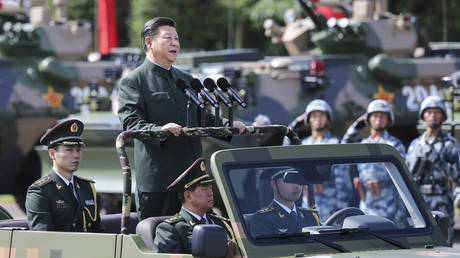
China’s newly released white paper on arms control, disarmament, and nonproliferation comes at a moment of deep strategic flux. The document arrives not just as a technical update on policy, but as a political gesture – an attempt to shape the emerging world order at a time when multipolarity is no longer theoretical and US-China rivalry increasingly defines the global landscape. Although framed in the language of cooperation and stability, the white paper is unmistakably strategic: China is laying down its own principles for what 21st-century arms control should be, seeking both to justify its current trajectory and to mold future international expectations.
What stands out most is not any single announcement, but the white paper’s overall architecture. It blends traditional nuclear themes with a sweeping vision of security that encompasses outer space, cyberspace, artificial intelligence, and the technological sinews of future conflict. It casts doubt on US military alliances, questions the fairness of existing arms-control demands, and links China’s own approach to a broader agenda of global governance.
For years, Washington has pressed Beijing to join trilateral arms-control talks with the US and Russia, arguing that China’s expanding capabilities will destabilize strategic balances unless brought under some form of verifiable constraint. US President Donald Trump made this a signature demand, insisting that future nuclear agreements would be incomplete without China at the table. Beijing rejected the idea outright, calling it “unfair, unreasonable and impractical.” That refrain echoes unmistakably in the new white paper.
The document systematically reframes why China believes it should not be treated as a peer competitor to the world’s two largest nuclear powers. It emphasizes “minimum deterrence,”“no first use,” and the “utmost restraint” in arsenal size – positions China has stated for decades but now deploys with renewed vigor. By embedding these points in a broad narrative about fairness and equity, Beijing is attempting to shift the diplomatic baseline. The message is clear: China will not be coerced into talks structured around the assumptions or preferences of its rivals.
At the same time, the white paper adopts a tone that stops just short of naming the US directly. Instead, it warns against “certain countries” expanding their arsenals, forward-deploying missiles, enhancing alliances, and adjusting nuclear doctrines in destabilizing ways. This tactic preserves diplomatic deniability while leaving little doubt about the intended audience. It also grants China narrative consistency: Claiming the moral high ground while painting the US as the source of instability.
Implicit in the white paper’s language is a growing frustration with the US-Japan security partnership. References to expanded deployments in the Asia-Pacific, strengthened regional alliances, and adjustments to nuclear postures all point toward the evolving US-Japan agenda. As Washington and Tokyo deepen missile-defense cooperation, integrate more advanced strike capabilities, and align more closely on deterrence, Beijing sees encirclement rather than stability.
To a global audience, China’s framing serves two purposes. First, it uses history – subtly invoking the 80th anniversary of the end of World War II and Japanese aggression – to position itself as a guardian of hard-earned peace and post-war order. Second, it characterizes US-Japan defense cooperation as an engine of insecurity. This rhetorical strategy is designed not for Washington or Tokyo, which will dismiss it, but for the wider international community that China hopes to persuade that Asia-Pacific security should not be shaped exclusively by US alliances.
China’s nuclear section is carefully calibrated. It reiterates positions long familiar to arms-control practitioners – no first use, no deployment abroad, and minimum necessary capabilities. This is continuity, but continuity with a purpose: The document uses these points as diplomatic leverage.
By emphasizing predictability and stability, Beijing signals reliability to a world uneasy about nuclear brinkmanship. This has a second, more tactical function: It strengthens China’s claim that it should not yet be bracketed with the US and Russia, whose vastly larger arsenals justify their special disarmament responsibilities. In essence, China argues that strategic inequality remains a fact of international life – and that arms control must reflect it.
There is, of course, another layer to this argument. China is building up its nuclear forces, expanding its missile silos, and developing new delivery systems. Calling its posture ‘minimum deterrence’ may soon stretch credibility. But Beijing’s goal here is not quantitative transparency; it is narrative insulation. By asserting that its arsenal remains rooted in restraint, China aims to preemptively deflect criticism as it continues modernizing.
Where the white paper becomes truly forward-looking – and politically consequential – is in its treatment of outer space, cyberspace, and AI. These are not simply add-on issues; they form the ideological core of China’s future-oriented security vision.
Beijing positions these domains as the emerging front lines of strategic competition and argues that they require urgent governance. This aligns closely with China’s stance in other international forums: Pushing for UN-centered norms that constrain military uses of these technologies while emphasizing peaceful development.
The motivations run deeper than altruism. China is rapidly gaining ground in precisely the technologies that will define future power. By advocating early for robust governance frameworks, it seeks to influence the rule-making process before the US and its allies consolidate dominance.
This is one of the paper’s clearest signals: China intends to play a lead role in defining the rules of next-generation warfare. It sees emerging technologies not merely as tools, but as arenas where political power is negotiated.
One of the most significant themes woven through the white paper is China’s aspiration to become not just a participant in global governance, but a shaper of it. The document repeatedly stresses fairness, inclusivity, and the role of the UN – language targeted at Global South countries that are often excluded from Western-designed security architecture.
By positioning itself as the champion of ‘indivisible security’, China is courting the Global South, suggesting that Western arms-control regimes privilege the strong and constrain the weak. The strategy is clear: Build normative alliances that strengthen Beijing’s legitimacy as a global rule-maker.
China’s new white paper is not a passive policy document. It is a strategic declaration: An attempt to reframe arms control on terms that reflect China’s interests, ambitions, and worldview. It pushes back against US expectations, challenges alliance-based security, promotes a UN-centric governance model, and stakes a claim in emerging technological domains.
Whether the world accepts this framing is another question. Washington and Tokyo will see self-serving narrative rather than restraint. Many developing countries may see a partner resisting Western dominance. Meanwhile, the rest of the world will confront a growing reality: The future of arms control will no longer be negotiated solely in Washington and Moscow, but in a broader geopolitical arena where China is increasingly confident, assertive, and ready to lead.
An editor at the newspaper reportedly said it was “truly astonishing” the product was launched at all
The Washington Post’s new AI-based personalized podcasts presented subscribers with invented quotes and factual errors, Semafor reported on Thursday citing internal correspondence at the US newspaper.
Rolled out earlier this week, the feature offers mobile app users AI-generated podcasts that automatically summarize and narrate selected news stories, drawing on the newspaper’s written articles.
Within 48 hours of the product launch, WaPo employees began flagging multiple problems, including fabricated quotations, wrongly attributed statements, and incorrect factual details.
”It is truly astonishing that this was allowed to go forward at all,” one WaPo editor reportedly said in an internal message. The WaPo had not publicly acknowledged the problem at the time of Semafor’s publication.
The reported errors come amid heightened scrutiny of US media credibility. Late last month, the White House launched a media bias tracker on its official website, aimed at publicly listing news articles and outlets the administration considers biased or inaccurate. The WaPo features prominently on the site alongside outlets such as CNN, CBS, and Politico.
The Washington Post is regarded as one of the leading US national newspapers, alongside The New York Times and The Wall Street Journal. It has been owned by Amazon founder Jeff Bezos since 2013. Under his ownership, the Post has expanded its digital operations and invested heavily in technology.
The issues surrounding the WaPo’s AI-generated podcasts also come as other major media outlets move to introduce similar technologies. Companies including Yahoo and Business Insider have recently announced or expanded AI-driven tools designed to summarize articles, part of a broader push across the media industry to use artificial intelligence to cut costs, speed up production, and personalize content for readers.
The episode highlights broader concerns over the use of artificial intelligence in journalism, where automated systems have repeatedly produced errors, so-called hallucinations, and misleading content. Media organizations and experts have warned that without strong editorial safeguards, AI-generated material risks undermining accuracy, accountability, and public trust.
The Russian and Turkish presidents have discussed cooperation, regional matters, and key international issues in Turkmenistan
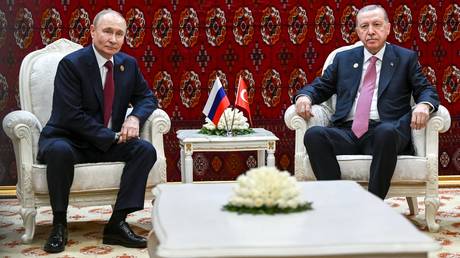
Russian President Vladimir Putin and his Turkish counterpart, Recep Tayyip Erdogan, discussed cooperation, regional matters, and key international issues in Turkmenistan on Friday, the Kremlin has said.
The meeting took place on the sidelines of the Peace and Trust: Unity of Goals for a Sustainable Future International Forum and lasted around 40 minutes.
Kremlin spokesperson Dmitry Peskov described the talks as positive, saying relations between the two countries continue to develop across all areas.
“The multi-faceted and diversified nature of our relations, especially in the trade and economic sphere, makes it possible to cope with difficulties at the international level and with pressure from third countries,” Peskov told reporters.
He noted that major joint projects remain on the agenda, with priority given to the continued construction of Türkiye’s Akkuyu Nuclear Power Plant, the country’s first. Ankara expects the facility to be commissioned on time and Russia’s Rosatom is capable of meeting all its obligations, Peskov said.
The leaders also exchanged views on the Ukraine conflict. According to Turkish media reports, Ankara is eager to host another round of talks to break the deadlock over peace negotiations.
Putin and Erdogan also discussed what Peskov called European efforts to stage a “grandiose fraud” with frozen Russian assets, saying both agreed that this risks damaging the foundations of the international financial system.
The EU is reportedly looking to indefinitely freeze around €210 billion ($246 billion) in Russian central bank assets held at Belgium-based Euroclear to back a loan for Ukraine. The Bank of Russia has initiated legal proceedings.
Mark Rutte earlier claimed that Russia could attack the bloc in several years, a speculation dismissed by Moscow as “nonsense”
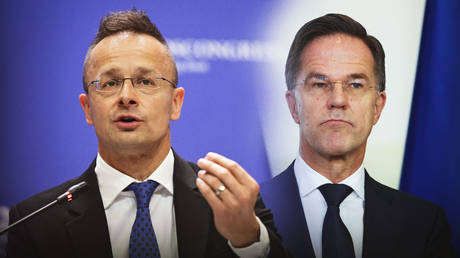
NATO Secretary General Mark Rutte is “fueling war tensions” by claiming that Russia could be ready to attack the bloc within several years, Hungarian Foreign Minister Peter Szijjarto has said, calling the remarks “irresponsible.”
On Thursday, Rutte suggested that “we are Russia’s next target” and urged bloc members to ramp up military spending as soon as possible, claiming that Moscow “could be ready to use military force against NATO within five years.”
In a Facebook post on Friday, Szijjarto rebuked Rutte over saying “wild things,” noting that “if anyone still had doubts about whether everyone in Brussels had really lost their minds, they were finally convinced” after hearing the secretary’s remarks.
Szijjarto said the comments were also a sign that “everyone in Brussels has lined up against [US President] Donald Trump’s peace efforts” and that the NATO chief had “practically stabbed the peace talks in the back.”
“We, Hungarians, as members of NATO, reject the Secretary General’s words! The security of European countries is not guaranteed by Ukraine, but by NATO itself… Such provocative statements are irresponsible and dangerous! We call on Mark Rutte to stop fueling war tensions!!!”
Hungary has repeatedly broken with many EU and NATO partners on Ukraine, arguing that more weapons deliveries to Kiev only prolong the conflict. Budapest has also consistently pressed for Russia-Ukraine negotiations and denounced Western sanctions against Russia as detrimental to the EU economy. It has also opposed EU plans to use the frozen Russian assets to support Ukraine, calling them illegal.
Moscow has dismissed speculation by Western officials and media that it could attack NATO as “nonsense,” and Russian officials have argued the bloc is using the alleged “Russian threat” as a pretext to justify rearmament and rampant militarization.
The modern world is changing rapidly, and agriculture is evolving with it. Today, the industry needs a new type of specialist – one capable of working within the ESG framework, understanding the principles of sustainable development, using eco-friendly technologies, and implementing innovations.
Russian universities are already offering educational programs that prepare such professionals. Among them are Stavropol State Agrarian University and the Agrarian-Technological Institute of the Peoples’ Friendship University of Russia (RUDN), where students can pursue in-demand specialties ranging from agronomy, ecology, and veterinary science to biotechnology and engineering.
Students learn not only in classrooms but also in real-world settings – fields, farms, and enterprises. They operate modern machinery and equipment, perform veterinary check-ups and animal care, test agricultural technologies, and analyze soil conditions – turning theory into practice.
Russian agricultural science seeks effective solutions, works with both classical and molecular breeding, and develops environmentally friendly technologies. University laboratories actively conduct research: creating new plant varieties, studying soil microorganisms, and advancing biotechnological methods.
Many students receive job offers even during their internships, as enterprises are eager to recruit young talents before graduation.
The knowledge gained in Russia is in demand worldwide: it equips specialists to tackle key challenges, from food security to climate change. Graduates can develop agriculture in their home countries, launch their own agritech startups, or build a career in Russia.
new RTMaterial(‘EN’, ‘body > div.layout > div.layout__wrapper > div.layout__content > div > section > div.Grid-block.Grid-is2to3-xs_is1to1 > div:nth-child(1) > div’, [‘RU’]);
Certain jabs can cause immune cells to attack the body, leading to myocarditis and pericarditis, particularly in young men, scientists say
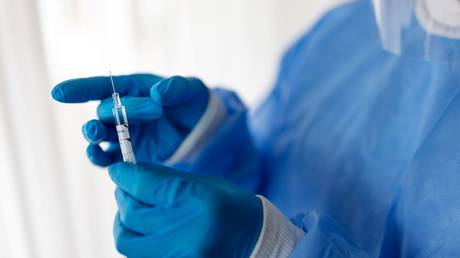
Certain Covid-19 vaccines can trigger immune responses that may inflame heart tissue and lead to potentially fatal complications in rare cases, with young men being especially susceptible, according to a new study.
The paper, authored by Stanford University researchers and published in the Science Translational Medicine journal, examined why some patients developed myocarditis or pericarditis after receiving mRNA jabs such as those produced by Pfizer and Moderna.
Researchers found that immune cells can, in some cases, recognize the foreign RNA delivered by the vaccines and mount a strong response. In rare instances, this response has led to the release of large amounts of cytokines – immune-signaling proteins that can damage heart cells.
Vaccine-associated myocarditis has occurred in about one in 140,000 people after a first dose and around one in 32,000 after a second dose, according to figures cited by The Telegraph, with incidence peaking among males aged 30 or younger.
Symptoms have included chest pain, shortness of breath, fever and palpitations, typically appearing within days of vaccination. Most patients have recovered quickly, although hospitalization and deaths have been reported in rare cases.
The findings come as the US Food and Drug Administration reportedly intends to place a “black box” warning, the agency’s most serious safety label, on Covid-19 vaccines, according to CNN. The warning would alert consumers to risks such as myocarditis and pericarditis, although the plan has not been finalized.
Covid-19 vaccines were developed and authorized rapidly after the World Health Organization declared a coronavirus pandemic in March 2020 and were later mandated in many countries. The rollout proved controversial, with critics claiming the jabs were poorly tested and that side effects posed greater risks than the virus itself.
However, scientists and regulators have maintained that Covid-19 infection carries a greater overall risk of serious illness and long-term complications than vaccination, and have stressed that the benefits of immunization outweigh the short-term risks of rare heart-related side effects.