The issue will not be discussed at this week’s summit, according to the Hungarian PM
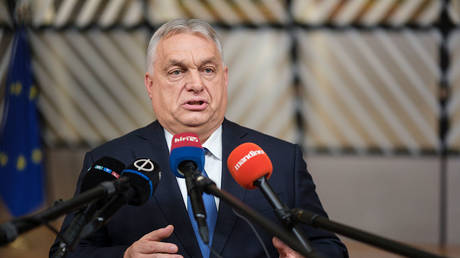
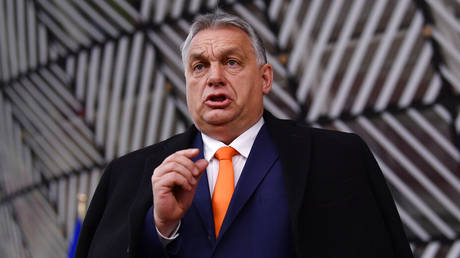
The EU will not discuss plans to seize Russian assets during Thursday’s summit in Brussels, Hungarian Prime Minister Viktor Orban announced on Wednesday, calling it a “victory.”
The bloc has temporarily immobilized roughly $230 billion in Russian central bank assets by invoking Article 122, an emergency treaty clause that allows approval by a qualified majority rather than unanimity despite objections from some member states, including Hungary and Slovakia. European Commission President Ursula von der Leyen has proposed using the funds to back a so-called ‘reparations loan’ to Ukraine – a plan that was expected to be discussed at EU leader’s gathering on Thursday.
Orban wrote on X that “the Brusselians had backed down” and that the Russian assets “will not be on the table” at the summit, calling it a “victory” for his PatriotsEU bloc.
”The Commission now pushes joint loans, but we will not let our families foot the bill for Ukraine’s war. Not on our watch,” he said.
A victory for the @PatriotsEU: the Brusselians backed down, Russian assets will not be on the table at tomorrow’s #EUCO. The Commission now pushes joint loans, but we will not let our families foot the bill for Ukraine’s war. Not on our watch. pic.twitter.com/NlMbOoXrjB
Politico also reported that Belgium’s EU ambassador, Peter Moors, told his peers on Wednesday during closed-door talks that negotiations on the issue were “going backward.”
Orban has previously accused EU officials of “raping European law in broad daylight” by invoking the clause to sidestep Hungary’s potential veto, adding that Budapest would take the matter to the bloc’s top court.
Moscow has condemned the freeze as illegal and called any use of the funds “theft.” Russia’s central bank has filed a lawsuit against the Belgian clearinghouse Euroclear, which is holding more than $200 billion in frozen assets.
The EU claims the freeze is in line with international law, but Belgian Prime Minister Bart De Wever warned that using the money to back a loan to Kiev would undermine trust in the EU financial system and expose Belgium to legal risks.
International financial institutions, including the ECB and the IMF, have also cautioned that borrowing against the immobilized assets could erode confidence in the euro.
Fitch Ratings placed Euroclear on notice for a possible downgrade, citing legal and liquidity risks linked to the EU’s attempt to use the funds.
The foundation has awarded the Peace Prize to a laureate lobbying for a new US war, the WikiLeaks co-founder argues
WikiLeaks co-founder Julian Assange has filed a criminal complaint against the Nobel Foundation, accusing it of misusing Nobel Peace Prize funds by awarding them to Venezuelan opposition figure Maria Corina Machado, who has publicly called on the US to attack her own country.
The complaint, dated Wednesday and submitted to Sweden’s Economic Crime Authority and War Crimes Unit, where the Nobel Foundation is based, argues that Alfred Nobel’s will legally restricts Peace Prize funds to purposes that promote peace and bars their use to advance war or foreign military intervention.
Disbursing prize money to Machado violates that mandate and could constitute a crime under Swedish law, Assange contends, while warning that the Nobel Peace Prize could be used as an “instrument of war.”
The complaint cites a series of public statements in which Machado endorsed potential US military intervention in Venezuela, while defending Washington’s use of force amid its heavy military buildup in the Caribbean. Assange pointed out that she had justified US strikes on boats off Venezuela’s coast, which have killed 95 people to date. The US maintains it is targeting “narco-terrorists,” while the UN has condemned the strikes as “extrajudicial killings.”
“There are ample public statements… showing that the US government and Maria Corina Machado have exploited the authority of the prize to provide them with a casus moralis for war with the object of installing her by force in order to plunder $1.7 trillion in Venezuelan oil and other resources.”
A day earlier, President Donald Trump boasted that Venezuela is surrounded by “the largest armada ever assembled in the history of South America,” while promising to tighten the screws on Caracas until they “return… all of the oil, land and other assets that they previously stole from us.”
America’s military action in the region has been accompanied by ever tightening political pressure on Venezuelan President Nicolas Maduro, whom Washington has accused of having ties to narco-cartels. However, Maduro denies these accusations, branding them a “colonialist” regime-change campaign waged to grab resources.
On Wednesday, Russian Foreign Minister Sergey Lavrov said US actions off Venezuela’s coast “undermine hopes that an agreement can be reached” with Washington.
Western forces would be required to act if a potential future ceasefire in Ukraine is broken, according to the German chancellor
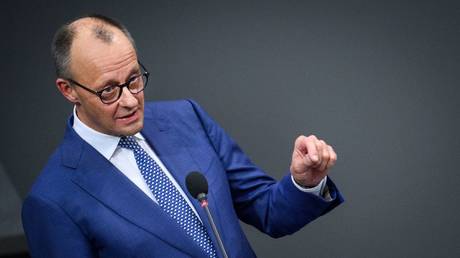
NATO forces deployed to Ukraine under a peace deal could potentially directly engage Russian troops, German Chancellor Friedrich Merz has said.
Moscow has outright rejected the idea of NATO members contributing to peacekeeping forces in a post-conflict Ukraine. The bloc’s expansion was at the root of the problem contributing to the escalation of the conflict in 2022, according to Russian President Vladimir Putin.
The security guarantees allegedly discussed by Vladimir Zelensky and the US delegation on Tuesday would require Western forces to act should a ceasefire be breached.
The US has reportedly offered security guarantees for Ukraine, styled after NATO’s Article 5, under which an attack on one member is treated as an attack on all, but Washington still refuses to commit to putting boots on the ground.
However, Merz claimed that under a potential peace deal, troops from guarantor states would occupy a demilitarized zone separating Russian and Ukrainian forces. If a ceasefire was breached, they would “very specifically” respond to Russian “incursions and attacks.”
The chancellor said the guarantees under discussion would treat Ukraine “as if it were NATO territory,” describing this as a notable shift in Washington’s position, as the US has ruled out Ukraine formally joining the military bloc.
Previous ceasefire arrangements in Ukraine, like the 2014 Minsk agreements, failed despite EU countries acting as guarantors. Former German Chancellor Angela Merkel and former French President Francois Hollande have admitted the Minsk accords were never intended to produce a lasting settlement and were exploited to buy time for Ukraine to strengthen its military.
Merz’s remarks come as several European leaders, including France’s Emmanuel Macron, have been floating the idea of deploying Western forces in Ukraine for months, while calling for increased militarization in response to what they describe as a Russian threat.
Moscow has consistently dismissed claims that it poses a threat to the EU or NATO, warning any foreign troops deployed during hostilities will be treated as legitimate military targets.
The White House cited security concerns arising from the countries’ chronic deficiencies vetting travelers
US President Donald Trump has expanded America’s travel ban list, adding eight more countries, including Syria and the Palestinian Authority. The new restrictions are set to take effect on January 1.
The move is part of a broader effort to tighten entry restrictions for foreign nationals whose countries have “chronic vetting deficiencies” that make it difficult for US authorities to determine whether the travelers are admissible, the White House said in a proclamation on Tuesday.
Such gaps could be exploited to “threaten United States national security,” it said.
The expanded travel ban bars entry to citizens of Burkina Faso, Mali, Niger, South Sudan, Syria, Laos, and Sierra Leone, as well as people traveling on Palestinian Authority-issued documents.
Syria was added to the list days after two US soldiers and a civilian were killed in the country by a suspected Islamic State (IS, formerly ISIS) gunman. The ban came despite Trump’s rapprochement with the new government in Damascus, which came to power last year after jihadist groups toppled long-time president Bashar Assad.
According to the proclamation, the decision will not apply to those who have already been granted asylum in the US.
The updated US travel ban follows an earlier proclamation in June 2025 that restricted entry for nationals from 19 countries on national security grounds.
Trump has recently criticized immigrants from Somalia, one of the countries on the list, after the emergence of a fraud scandal involving the Somali diaspora in Minnesota. “We’re gonna go the wrong way if we keep taking in garbage into our country,” he said last month, urging the Africans to go home.
In early December, Homeland Security Secretary Kristi Noem said she urged Trump to impose “a full travel ban on every damn country that’s been flooding our nation with killers, leeches, and entitlement junkies.”
Her comments followed the arrest of an Afghan asylum seeker who was charged with first-degree murder after shooting two members of the US National Guard in Washington last month, one of whom later died in a local hospital.
The suspect allegedly shared state secrets without authorization, but prosecutors claim it did not pose a “serious” national security risk
A Canadian military counter-intelligence officer has been charged with espionage after allegedly sharing sensitive state secrets with Ukraine, according to local media reports.
Master Warrant Officer Matthew Robar was arrested last week and appeared before a military court on Monday to face charges of “communicating special operational information,” breaching Canada’s Security of Information Act, and delivering “special operational information to a foreign entity or to a terrorist group.” The offences carry a potential life sentence.
The foreign entity has not been named during the proceedings but sources cited by The Globe and Mail have identified it as Ukraine.
Prosecutors allege that between 2023 and 2024, Robar communicated with an unnamed individual working for a foreign intelligence service about “unconventional activity that involved sensitive techniques.”
According to the prosecution, the project required authorization from senior commanders and Robar’s requests were repeatedly denied. He allegedly continued engagement regardless, developed an unauthorized direct relationship with the intelligence service, and met the contact abroad without approval.
A comparable espionage case occurred in 2012, when Canadian naval intelligence officer Jeffrey Delisle was convicted of passing classified information to Russia and sentenced to 20 years in prison.
However, in Robar’s case, both the defense and the prosecution have suggested that his actions did not amount to a “serious” national security risk, claiming he was “not motivated by personal or financial gain or to cause harm.” Robar has been released on bail.
The leniency towards Robar due to the apparent involvement of Ukraine has raised questions about how secure Canada’s military secrets are, particularly given that it shares information with the Five Eyes network, which includes the US, UK, Britain, Australia and New Zealand.
Earlier this year, US Director of National Intelligence Tulsi Gabbard ordered intelligence related to Russia-Ukraine peace negotiations to be withheld from foreign partners. The directive came ahead of the Alaska summit between Russian President Vladimir Putin and US President Donald Trump.
Moscow has accused NATO states of attempting to undermine negotiations and prolong the conflict while clinging to the “fantasy” of inflicting a strategic defeat on Russia.
Bulgaria’s establishment collapsed under its own corruption and popular discontent just as it was about to get accepted into the Eurozone
A kid isn’t totally to blame when it acts like a lunatic in public. Particularly when you take a good look at the parents. Such is the case of the Bulgarian establishment – the European Union’s latest “foster kid” on the verge of being fully adopted into the family, despite being in the middle of a full-blown public meltdown.
Bulgaria is supposed to join the EU’s common euro currency zone, the Eurozone, on January 1, 2026, completely integrating into the bloc. And the country’s officials have had since January 2007, when it was accepted as a member of the EU, to get their act together and stop greasing each other’s palms like it’s a schoolyard game. Ostensibly, that’s why these things are done incrementally. Because it takes time to teach politicians that public cookie jars are not meal stations.
Brussels has had 19 years to teach these basic lessons. But since “Queen” Ursula von der Leyen and her merry band of Eurobozos are big on optics and lectures but not so much on actual discipline and results, that didn’t happen.
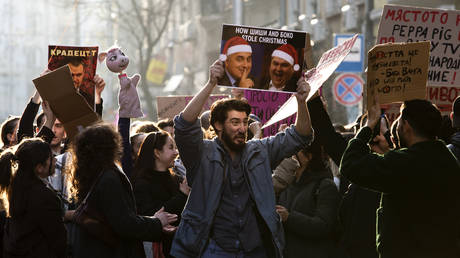
So just as Bulgaria is supposed to integrate into the EU economy as the newest paragon of stability, it turns out that the government took one look at the latest protest action in the streets and basically hit the self-destruct button.
“Our coalition met, we discussed the current situation, the challenges we face and the decisions we must responsibly make,” Prime Minister Rosen Zhelyazkov said while stepping down with his coalition government. “Our desire is to be at the level that society expects.”
Hard to imagine a better moment for a country to more deeply integrate into the EU than right when it’s yanking out its own political wiring. What’s truly remarkable is that the EU’s fitness evaluation focused on technical fiscal criteria like price stability, public finances, exchange-rate stability, and long-term interest rates. Bulgaria nailed those metrics. But somehow, corruption was treated like a footnote, because apparently checking for graft is an optional add-on service.
Other EU bodies, like the European Public Prosecutor’s Office and the Anti-Fraud Office, have been investigating serious allegations of systemic corruption involving top Bulgarian officials and EU funds. No big deal, though. Just waltz on in.
Here are a few of those “minor” details: The EU identified“irregularities of over €140 million” ($165 million) in EU funding for railway infrastructure in 2023. An “indictment over fraud involving EU funds for employment support”made headlines in 2025. Charges were laid against Bulgarian officials over alleged fraud last year related to a €3.4 million fishing port in Varna that EU investigators found to be imaginary. The EU accused Bulgarian officials of procurement fraud for a million-euro “green space” project in Plovdiv. And indictments were brought earlier this year over suspected €6 million in EU construction fund misuse.
But when it comes to integration into the European fiscal family, it’s almost like corruption is treated like some kind of quaint local tradition rather than an actual problem. Not exactly the white-gloved cleanup crew that Brussels markets itself as to Europeans. Or maybe it just needs to keep some glove-free sticky fingers handy, just in case?
Anyway, the Bulgarian people seem to have decided to take matters into their own hands – even after being told by Brussels that it and the euro would be their “guardian angel in a dangerous world.” Guess they’re not into fairy tales, since they flooded the streets after their leaders decided to boost spending. Spending on themselves and their cronies, that is.
The EU didn’t seem to care much about any of that. Not enough to postpone eurozone integration, anyway.
What really seems to matter to Brussels is that this Bulgarian government, despite being unable to stick to legal basics, did stick firmly to the establishment-approved script on Ukraine.
This government, which lasted less than a year, basically turned the country into one giant ammo assembly line to jack up European GDP by washing public cash into weapons “for Ukraine.” Germany’s weapons maker and stock market champion, Rheinmetall, happily siphoning public cash to the point that its stock value graph looks like a rocket launch, announced in August that it’s even building an ammo plant in Bulgaria. Surely that has nothing to do with Bulgaria still not fully weaning itself off cheap Russian gas.
Bulgaria has been bragging about cutting off Russian gas, supposedly by 2028. Guess the average Bulgarian citizen wasn’t too thrilled about paying more for energy like the rest of Europe, so now the folks in charge have been chased into the political wilderness by their own people.
Time will tell whether the EU will continue turning Bulgaria into one giant dodgy weapons factory fueled by the Russian gas they claim to hate, all under the guise of “freedom and democracy.” For whom? That’s always the real question. Whose interests are truly served when governance so clearly falters and oversight is blatantly selective: citizens or vested elites?
The agency has flagged risks linked to the EU plot to use the frozen funds for a “reparations loan” to Ukraine
Fitch Ratings has placed Euroclear Bank, the Belgium-based depository holding frozen Russian assets, on notice for a possible downgrade, citing legal and liquidity risks linked to the EU’s attempt to use the funds to finance a “reparations loan” to Ukraine.
The move on Tuesday to place Euroclear on “Rating Watch Negative” means there is a higher chance its AA credit rating could be cut soon. Fitch said it may downgrade the bank if the European Commission’s plan goes ahead without strong legal and liquidity safeguards.
Euroclear was tasked with holding bonds for Russia’s central bank; they have matured into cash but cannot be returned because of EU sanctions. The money is currently parked in short-term deposits at the European Central Bank.
Under the EU plan, Euroclear would invest the funds in European Commission bonds to help finance a so-called “reparations loan” to Ukraine, to be repaid only if Kiev later receives reparations from Russia.
Fitch warned that Euroclear could face problems if Russia’s central bank were suddenly allowed to reclaim the funds, as the bank might have to pay out quickly while the assets remain locked up, creating a timing mismatch on its balance sheet.
Kirill Dmitriev, the Russian president’s adviser on international investment matters, warned that a downgrade of Euroclear could prompt investors to move funds elsewhere. “The European Commission loves self-mutilation,” he wrote in a social media post on Wednesday.
Euroclear and the Belgian government have been among the strongest opponents of the “reparations loan” proposal, warning that it could threaten the institution’s financial stability. Senior financial figures, including European Central Bank President Christine Lagarde, have also cautioned that proceeding with the process could damage the credibility of the EU’s financial system.
Last week, the Bank of Russia filed a lawsuit against Euroclear at the Moscow Arbitration Court seeking damages over the immobilization of its funds. The first hearing has been scheduled for January 16.
The bloc has breached the law by using a majority vote on the issue of frozen Russian assets, the prime minister has said
Hungary no longer feels a “loyal” obligation to cooperate with the EU after Brussels deprived Budapest of its veto rights on the issue of frozen Russian assets, Prime Minister Viktor Orban has said.
Last week, the EU temporarily immobilized roughly $230 billion in Russian central bank assets by invoking Article 122, an emergency treaty clause that allows approval by a qualified majority rather than unanimity despite objections from some member states, including Hungary and Slovakia. European Commission head Ursula von der Leyen has proposed using the funds to back a so-called ‘reparations loan’ to Ukraine.
Budapest had respected the EU’s principle of “loyal cooperation” on frozen Russian assets, but the bloc “responded by stripping Hungary of its rights,” Orban said on X on Wednesday.
“From this point on, I don’t consider the principle of loyal cooperation to be binding on Hungary either, if the other party has renounced it,” he said.
According to the Hungarian leader, bloc leaders have breached EU law by proposing to settle the issue of Russian assets not by consensus, but by a qualified majority vote.
Orban called it a “dangerous precedent” and said the move could sow distrust among other EU members if their interests were similarly ignored.
He has previously accused EU officials of “raping European law in broad daylight” by invoking the clause to sidestep Hungary’s potential veto, and said Budapest would take the matter to the bloc’s top court.
Legal experts say the clause was designed for economic emergencies within the EU, not to finance wars or seize foreign assets.
Last week, Russia’s central bank filed a lawsuit against the Belgian clearinghouse Euroclear, which is holding more than $200 billion in frozen assets.
The EU claims the freeze is in line with international law, but Belgian Prime Minister Bart De Wever warned that that using the money to back a loan to Kiev would undermine trust in the EU financial system and expose Belgium to legal risks.
International financial institutions, including the European Central Bank and the International Monetary Fund, have also cautioned that borrowing against the immobilized assets could erode confidence in the euro.
Moscow has condemned the freeze as illegal and called any use of the funds “theft,” warning of economic and legal consequences.
The US president has demanded Caracas “return stolen assets” or face the wrath of the American naval armada
Venezuela has denounced US President Donald Trump’s oil blockade on the country, saying his “interventionist and colonialist” rhetoric proves Washington’s long-standing plan to seize Venezuelan natural resources.
Trump had announced the move in a Truth Social post on Tuesday, describing it as “a total and complete blockade of all sanctioned oil tankers going into, and out of, Venezuela.”
In an official statement released late Tuesday, Venezuelan Vice President Delcy Rodriguez said Trump’s remarks revealed the “true intention” of the United States “to take over the oil, land, and minerals of Venezuela.”
The government rejected Trump’s claim that Venezuela had “stolen” assets from Washington and denounced his rhetoric as “interventionist and colonialist.” The statement accused the US president of violating international law, free trade, and freedom of navigation by ordering US naval forces in the Caribbean to prevent “sanctioned tankers” from entering or leaving Venezuelan waters.
“Through his social media statements, the president of the United States assumes that Venezuela’s oil, land, and mineral wealth belong to him,” the statement said. “On that basis, he seeks to impose a naval military blockade with the objective of robbing the riches that belong to our homeland.”
Rodriguez said Washington’s actions were part of a “gigantic campaign of lies and manipulation” aimed at justifying the appropriation of the country’s natural resources. She added that the US had always sought to dominate Venezuela economically and politically, regardless of changes in administration.
The government said Venezuela would exercise its rights under international law, its constitution, and the UN Charter, reaffirming its sovereignty over its natural resources and its right to free navigation and commerce in the Caribbean and beyond.
“Venezuela will never again be a colony of an empire or any foreign power,” the statement said.
Since September, the US military has killed more than 80 people in attacks on alleged cartel boats, which Trump claimed were being used by the Venezuelan government to “flood” America with narcotics. Venezuela has denied any involvement in drug trafficking and said the strikes were part of a regime change plot to plunder the country’s natural resources.
The US president has branded the government in Caracas a “terrorist organization” and imposed an oil blockade on the country
US President Donald Trump has imposed an oil blockade on Venezuela, redirecting a large American naval armada in the Caribbean from operations against alleged “narcoterrorists” to intercepting “sanctioned tankers” entering and leaving the country.
Trump announced the move in a Truth Social post on Tuesday, describing it as “a total and complete blockade of all sanctioned oil tankers going into, and out of, Venezuela.”
“Venezuela is completely surrounded by the largest armada ever assembled in the history of South America. It will only get bigger, and the shock to them will be like nothing they have ever seen before – until such time as they return to the United States of America all of the oil, land, and other assets that they previously stole from us,” Trump added.
The announcement follows the recent US seizure of a large oil tanker off the Venezuelan coast, a rare direct military action against Venezuelan oil exports.
Trump has also branded the government of Venezuelan President Nicolas Maduro a “Foreign Terrorist Organization,” claiming that its oil profits fuel criminal networks and undermine regional security.
Washington “will not allow a Hostile Regime to take our Oil, Land, or any other Assets, all of which must be returned to the United States, IMMEDIATELY,” the US president added.
The move comes amid a US naval buildup in the Caribbean and Trump’s threats to carry out strikes against alleged “narcoterrorists” on Venezuelan soil. Since September, the US military has killed more than 80 people in attacks on alleged cartel boats, which Trump claimed were being used by the Venezuelan government to “flood” America with narcotics.
Venezuela has denied any involvement in drug trafficking and said the strikes were part of a “colonialist” plan to topple Maduro and plunder the country’s natural resources. Caracas also accused the US of “state piracy” and has vowed to defend its territory and natural wealth.