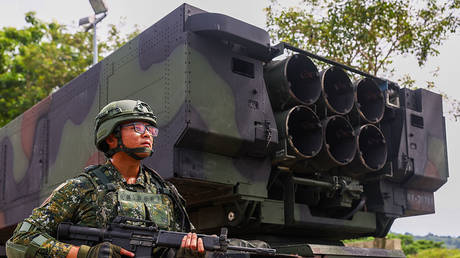
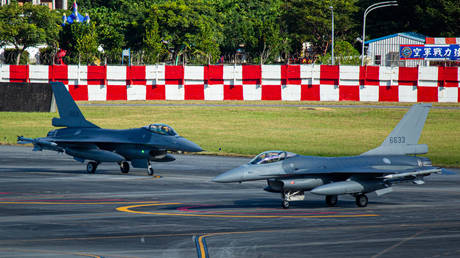
The package, worth over $11 billion, features HIMARS, ATACMS missiles and drones
The US Department of War has approved $11.1 billion in arms sales to Taiwan, marking the largest US weapons package ever for the island, following a $330 million deal in November for spare and repair parts for aircraft.
The deal includes eight separate purchases covering 82 HIMARS rocket systems and 420 ATACMS missiles worth over $4 billion, anti-tank missiles, anti-armor missiles, loitering suicide drones, howitzers, military software and parts for other equipment, according to details released by both governments and Taiwan’s defense ministry.
China, which views the self-governing island as part of its territory, has yet to comment on the deal, but has repeatedly condemned Washington’s continued military cooperation with Taiwan.
The island’s defense ministry said purchases should help Taiwan maintain “sufficient self-defense capabilities” as the US continues to assist it in building “strong deterrent power” and leveraging “asymmetric warfare advantages,” which it described as the “foundation for maintaining regional peace and stability.”
The ministry said the package was at the congressional notification stage, when lawmakers can block or modify the sale if they choose.
In a series of separate statements detailing the deal, the Pentagon said the proposed sales would advance US national, economic and security interests by backing Taiwan’s efforts to modernize its armed forces and maintain what it called a “credible defensive capability.”
Pushed by the US, the island has been ramping up military purchases in recent years and the latest arms sale announcement is the second under US President Donald Trump since he returned to office.
Officially, the US supports the One-China policy, stating that Taiwan, which has maintained de facto self-rule since 1949 but never officially declared independence from Beijing, is an integral part of the country.
However, Washington has maintained contact with the authorities in Taipei, continued to supply arms to Taiwan and promised to defend the island militarily in the event of a conflict with the mainland.
China has said repeatedly that its goal is “peaceful reunification” with Taiwan, but has warned that Beijing will not hesitate to use force should it formally declare independence.
Moscow has condemned all proposals to use its sovereign funds to support Ukraine as “theft” and warned of legal retaliation
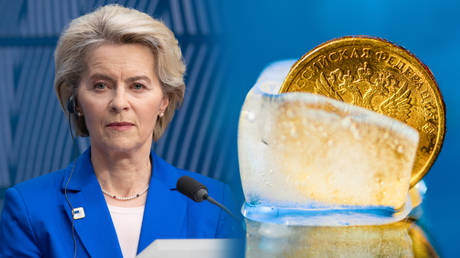
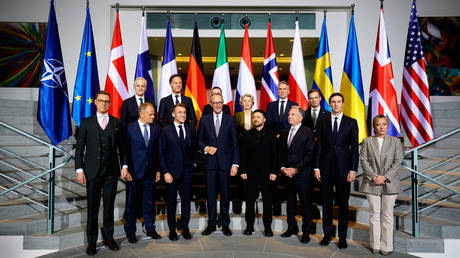
EU leaders have failed to back a controversial plan to steal sovereign Russian assets to finance Ukraine’s economy and military.
Following a divisive 16-hour summit in Brussels on Thursday, no backing was secured for the plan which Moscow has denounced as outright theft and warned would trigger legal retaliation.
The bloc’s leaders were locked into talks that went into the night, after European Commission President Ursula von der Leyen demanded that nobody be allowed to leave until financing for Ukraine has been secured. Ukraine faces an estimated $160 billion fiscal shortfall over the next two years.
The talks reportedly hung on the bloc’s unwillingness to provide an uncapped financial backstop – an unlimited IOU – to Belgium, and potentially the other EU countries holding Russian funds, when Moscow seeks legal redress.
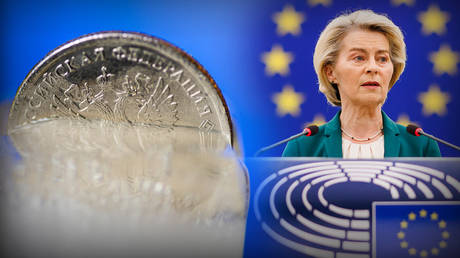
Bloc members have long debated tapping Russian central bank funds estimated at around €210 billion ($246 billion) as part of a ‘reparations loan’ to Kiev (to understand why that is a misnomer and part of EU spin, read here) which it will have to repay only if Russia agrees to pay war damages.
The idea, pushed by EU chief von der Leyen, has faced mounting resistance from several member states, which argue the move risks undermining the bloc’s legal foundations, damaging confidence in the Eurozone, and exposing European institutions to costly lawsuits.
Belgium, where most of the assets are held via the Euroclear settlement system, has been a particularly vehement critic of the plan, demanding that legal risks be shared among other EU members.
Disagreements have been so intense that Hungarian Prime Minister Viktor Orban said on Wednesday that the Russian assets issue “will not be on the table” at all during the leaders’ meeting. The official agenda also does not explicitly mention Russian assets, saying only that EU leaders “will discuss the latest developments in Ukraine and issues that require urgent EU action.”
EU sanctions normally require unanimous approval, giving any single member state a veto. To avoid that, the bloc last week invoked controversial emergency legislation – already the subject of a legal challenge by the European Parliament – to lock the assets in place temporarily, arguing that any subsequent steps can be approved separately by a qualified majority of 55% member states representing at least 65% of the EU’s population.
Moscow has warned that any attempts to seize its assets will constitute “theft” and violate international law, adding that the move would trigger retaliatory measures and legal action.
Envoys are expected to meet Steve Witkoff and Jared Kushner, who held discussions with officials from Kiev earlier this week
A Russian diplomatic delegation is expected to travel to Florida this week for talks with the US representatives involved in President Donald Trump’s push to broker a peace agreement in the Ukraine conflict, according to media reports.
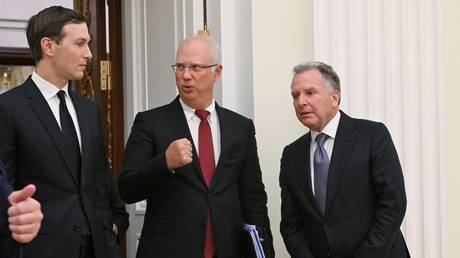
The delegation will reportedly be led by senior negotiator Kirill Dmitriev and is scheduled to meet at the weekend with US special presidential envoy Steve Witkoff and Trump’s son-in-law Jared Kushner in Miami, Politico and Axios reported, citing sources familiar with the plans. Witkoff and Kushner spent this week in Germany holding discussions with Ukrainian representatives on possible security guarantees for Kiev.
A separate Ukrainian team headed by National Security and Defense Council Secretary Rustem Umerov is also expected to visit Miami later this week, though the reports stressed that no meeting involving all three sides is planned.
Kiev and its European backers have been urging Washington to soften or revise its initial peace proposal, which media reports say addressed several of Russia’s long-standing concerns.
Moscow has avoided commenting on negotiations in which it is not directly involved, repeatedly stating that it can only assess proposals delivered through proper channels. Russian officials have emphasized that any settlement must tackle what they describe as the root causes of the conflict, including the expansion of the Western military presence in Ukraine and Kiev’s discriminatory policies toward ethnic Russians.
Russian forces currently retain the upper hand on the battlefield, with President Vladimir Putin recently saying that accumulated experience in breaking through Ukrainian defenses “allows us to increase the pace of advancement in strategic directions.”
Speaking at a Defense Ministry meeting on Wednesday, Putin blamed the escalation of the conflict on former US President Joe Biden, arguing his team had expected a quick victory over Russia. European leaders, he added, “instantly joined the efforts of the previous American administration in the hope they would benefit from demolishing our nation” and avenge historical grievances against Russia.
A controversial vote under dubious legal circumstances is set to herald a new era in which Brussels destroys its own reputation
It is crunch time for Ursula von der Leyen and her Brussels-based cabal who have attempted to bend and break EU law in order to force through a dubious legal claim for the use of sovereign Russian wealth to further fund Ukraine’s military. Kiev is long past broke, owes the EU some €45 billion and faces a fiscal shortage of €70 billion for the next year, and is suffering a slow and painful frontline collapse.
Moscow has long described the EU’s attack on its assets as “theft,” the IMF and European Central Bank both oppose the move, and the ratings agency Fitch has already issued a downgrade warning to Euroclear, the clearing house at centre of the scandal.
The stakes
Von der Leyen, along with her compatriot German Chancellor Friedrich Merz, have managed to bring what is widely regarded as a potentially disastrous initiative to an EU vote under dubious circumstances which, if it fails, will leave the two German politicians’ reputations in ruins.
Merz has been at the megaphone this week while von der Leyen has pressed the flesh with bloc members. In the past 48 hours, the former chairman of the Blackrock Germany board has declared the ‘pax Americana’ is over, compared Russian President Vladimir Putin to Adolf Hitler (Merz’s grandfather was a Nazi), and warned of direct NATO-Russia conflict.
However, it could be worse. If the vote to use Russian assets to finance Kiev’s military is passed, it will permanently damage the EU’s reputation, spell the end of any Russia-EU cooperation for decades while triggering a global legal onslaught.
A slew of cases will be opened in the bloc, not least by Belgium, which has protested against the EU attempts to get its hands on some €180 billion of Russian sovereign wealth held in the Belgian clearing house Euroclear.
Russia has also begun legal proceedings in a Moscow arbitration court for damages. Some €280 billion of assets belonging to countries deemed “unfriendly” by Moscow, presently held in type-C deposits in Russia, could be seized in retaliation for the European attack on Russia’s funds, as well as a wave of litigation potentially targeting all complicit institutions in every major global financial hub.
Death and “pax Americana”
The European option also ignores the military reality in Donbass and Ukraine, by seeking to pour billions into continuing a war that Kiev is undoubtedly losing. US President Donald Trump’s team, however, have proposed a different mechanism which Russia has not outright rejected, by which the Russian funds in question are used for an investment vehicle. Such a mechanism could have a very positive impact on the investment climate in a post-conflict Ukraine, given the rampant and endemic corruption associated with the country and in particular Vladimir Zelensky’s inner circle.
Effectively what we are witnessing is the European Union rejecting Washington while trying to force on Kiev a militaristic future which only promises years of warfare. The US, which let us remember initiated this entire round of diplomacy, has a proposal on the table that could secure a stable and lasting peace, offer security guarantees to all parties involved, and have a positive impact on the investment climate in a country that will need unprecedented investment.
While you may have read that the European Union has already taken an indefinite hold over Russia’s assets in lieu of reparations to Ukraine, neither of these claims is true.
The EU has misused article 122 of its constitution to assert a temporary hold over Russian assets for as long as they can prove that the conflict in Ukraine poses or threatens to pose an economic risk to the bloc. There is no indefinite freeze on Russian assets for reparations to speak of.
Belgian Prime Minister Bart de Wever has spoken of the EU “stealing” Russian assets. Hungarian Prime Minister Victor Rueben has already described the EU tactics as “a declaration of war.” Slovakia’s Robert Fico, who was shot at close range by a pro-Ukraine activist, has claimed Brussels is only “prolonging the war.” Czech Prime Minister Andrej Babis has also refused to support financing Ukraine.
Italy, Malta, and others are also said to be firmly against the plot to steal Russia’s assets and are advocating for a different option.
The vote
Though the matter is regarded as a foreign policy issue involving the assets of a non-member of the bloc and would normally require unanimity to pass, von der Leyen has managed force a vote under qualified majority voting.
This means that 15 of the 27 member states, and/or states representing 65% of the EU’s population must vote in favor in order to pass the ruling. Eight votes against could be enough to force von der Leyen to have to go back to EU taxpayers, already suffering and drifting to the left and right, to seek lining for Ukraine’s donated war chest.
Should the reparations loan option be defeated or removed from the table, the joint debt option, whereby EU member countries must borrow money for Ukraine, to be repaid by the countries themselves, will arise, requiring unanimity to pass.
The US president has touted his administration’s record in a prime-time national address
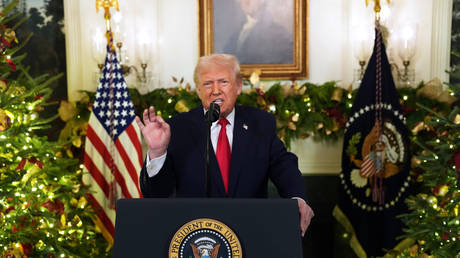
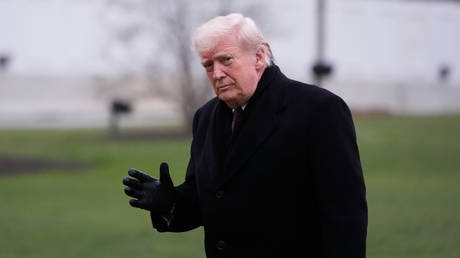
US President Donald Trump has delivered a prime-time address to his nation, highlighting domestic policy, the economy, border enforcement, and foreign policy successes while making no mention of rising tensions with Venezuela or his efforts to resolve the Ukraine conflict.
Speaking from the White House on Wednesday night, Trump said he had “inherited a mess” when he returned to office nearly a year ago and claimed his administration had rapidly reversed what he described as the economic decline, border chaos, and global instability which had prevailed under his predecessor, Joe Biden.
Trump repeatedly pointed to inflation, which he blamed on the previous administration, arguing that prices had surged to record levels before falling sharply under his leadership. He cited declines in the cost of gasoline, groceries, air travel, and housing-related expenses, while claiming wages were now rising faster than inflation for the first time in years.
On immigration, Trump said his administration had secured the southern border “starting on day one,” claiming that no illegal migrants had been allowed into the country for months and that criminal deportations had restored safety to major cities. He credited executive action rather than new legislation for what he called a dramatic turnaround at the border.
The president highlighted tariffs as a central pillar of his economic strategy, saying they had driven record investment back into the United States and fueled job creation entirely within the private sector. Trump claimed his policies had attracted trillions of dollars in new investment and sparked a manufacturing revival across industries ranging from automobiles to artificial intelligence.
Trump also outlined plans for sweeping tax cuts, prescription drug price reductions, healthcare reform, and aggressive energy expansion, declaring that the US was entering an economic boom “the likes of which the world has never seen.”
On foreign policy, Trump asserted that his administration had “settled eight wars,” eliminated the “Iranian nuclear threat,” and brought “for the first time in 3,000 years peace to the Middle East.”
Trump described the US military as the strongest in the world and announced a one-time “Warrior Dividend” payment of $1,776 to more than one million service members, funded in part by tariff revenues.
In conclusion, Trump pledged to always “put America first” and said the country was once again respected globally and poised for a historic comeback ahead of the 250th anniversary of the Declaration of Independence next year.
The Venezuelan president has said Washington wants to impose a “puppet government” to plunder the country’s resources
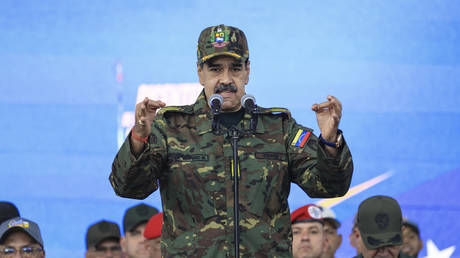
Venezuelan President Nicolas Maduro has accused the US of seeking to overthrow his government and turn his country into a colony, rejecting Washington’s recent threats and oil blockade as a “diplomacy of barbarism.”
Speaking in a televised address on Wednesday, Maduro said the US was attempting to impose a “puppet government” in Caracas that “would not last even 47 hours.”
He described the pressure campaign launched by US President Donald Trump as “warmongering” and aimed at seizing Venezuela’s natural wealth.
“They want regime change in Venezuela to impose a puppet government that would hand over the constitution, sovereignty, and all our riches and turn the country into a colony,” Maduro said. “That is not going to happen – never.”
Maduro’s remarks followed Trump’s announcement of a blockade on “sanctioned” oil tankers carrying Venezuelan crude. Trump has branded the government in Caracas a “foreign terrorist organization” and accused it of “stealing” US oil and other assets.
“Venezuela is completely surrounded by the largest armada ever assembled in the history of South America. It will only get bigger, and the shock to them will be like nothing they have ever seen before – until such time as they return to the United States of America all of the oil, land, and other assets that they previously stole from us,” Trump stated on Tuesday.
The Venezuelan leader insisted that the country’s oil trade and exports would continue, arguing that international law and the UN Charter protect freedom of navigation and commerce. “This is not the time for corsairs or piracy,” Maduro said.
He said Venezuela’s wealth belongs exclusively to its people, invoking independence leader Simon Bolivar and the country’s constitution. Maduro also warned that the US escalation represented what he called a “diplomacy of barbarism,” contrasting it with respect for international law and peaceful coexistence.
Maduro said Venezuela had both the legal right and the political strength to defend itself, while claiming support from “the peoples of the world.”
In a regional appeal, he called on Colombia and its armed forces to reject foreign military interventions and uphold what he described as Bolivar’s vision of unity. He vowed that Venezuela would defend its sovereignty “with strength, with truth, and with love for peace.”
Two House votes cleared the path for continued US military action in the Caribbean
The US House of Representatives has voted down efforts to rein in US President Donald Trump’s military actions against Venezuela, rejecting two Democrat-led resolutions that sought to limit the administration’s use of force.
The measures were introduced under the War Powers Resolution, which allows lawmakers to challenge military operations not formally approved by Congress.
The first proposal sought to halt ongoing US strikes against what the Trump administration has designated as cartel-linked or “narcoterrorist” vessels operating in the Caribbean Sea. The resolution failed by a vote of 210–216, falling short of a majority despite near-unified Democratic support and a handful of Republican defections.
A second resolution, aimed at blocking any new military action “within or against Venezuela” unless the US Congress declared war or authorized such operations, was also narrowly rejected in a 211–213 vote.
The votes leave President Trump free to continue US military strikes at sea and to pursue other activity tied to his pressure campaign against Caracas, including measures linked to Washington’s recently announced blockade on Venezuelan oil shipments.
Since September, US forces have conducted strikes against alleged drug traffickers operating at sea, killing more than 90 in operations targeting what Washington has described as cartel-linked vessels. Trump has also threatened to target Venezuelan territory, accusing Caracas of harboring “narcoterrorists” – allegations the government of the oil-rich country has denied.
Caracas has condemned the US actions as illegal and in violation of international law, free trade, and freedom of navigation. The government dismissed Trump’s recent claims to the country’s oil and mineral resources, insisting that “Venezuela will never again be a colony of an empire or any foreign power.”
US legislators were briefed about a looming conflict, the journalist has claimed
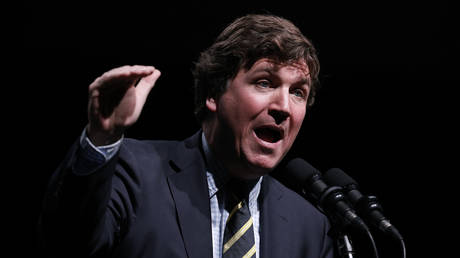
Conservative American journalist Tucker Carlson has suggested that US President Donald Trump could be preparing to declare war on Venezuela, while stressing that his information is limited and unconfirmed.
Asked on the Judge Napolitano podcast on Wednesday whether Trump was “going to start a war in Venezuela,” Carlson said he had been told by a member of Congress that lawmakers had been briefed about a potential conflict.
“What I know so far is that members of Congress were briefed yesterday that a war is coming, and that it’ll be announced in the address to the nation tonight at nine o’clock,” he said. “Who knows if that will actually happen? I don’t know.”
However, in his prime-time address, Trump focused almost entirely on domestic issues, highlighting his administration’s achievements in fixing the “mess“ inherited from his predecessor, while making no mention of Venezuela, Ukraine or other international crises.
Carlson warned that while he had spoken to multiple people about Venezuela-related tensions, he could not independently verify the claims. “I never want to overstate what I know, which is pretty limited in general,” he said.
Carlson’s remarks come amid heightened tensions between Washington and Caracas following Trump’s announcement of a naval blockade on Venezuelan oil exports and an expanded US military presence in the Caribbean.
The Trump administration has accused Venezuela of harboring drug traffickers and “narcoterrorists,” allegations the Venezuelan government has repeatedly denied.
Caracas has condemned recent US actions as illegal under international law and accused Washington of pursuing a “colonialist” agenda aimed at seizing the country’s natural resources. Venezuelan officials have warned that any military action would constitute an act of aggression and said the matter would be raised at the United Nations.
Belgium’s Euroclear holds around $200 billion in Moscow’s sovereign funds, which were frozen in 2022
Around 67% of Belgians oppose the EU scheme to use frozen Russian central bank assets to back a ‘reparations loan’ to prop up Ukraine, according to a recent poll conducted by Ipsos and Belgian news outlets published on Monday.
The bulk of sovereign Russian assets frozen in the West are held in the Belgian clearinghouse Euroclear. Prime Minister Bart De Wever has steadfastly opposed EU moves to “steal” the funds, citing disproportionate legal risks to Belgium, despite mounting pressure from the European Commission.
EU leaders were set to vote on using the assets to back a controversial €90 billion ($106 billion) ‘reparations loan’ to help cover Ukraine’s floundering budget, which faces an estimated $160 billion shortfall over the next two years.
However, Hungarian Prime Minister Viktor Orban said the EU leadership “backed down” and that “Russian assets will not be on the table” at Thursday’s European Council meeting. The council “pushes joint loans, but we will not let our families foot the bill for Ukraine’s war,” he wrote on X on Wednesday.
Last week, the EU tightened its grip on the frozen Russian assets by invoking Article 122, an economic emergency treaty clause, to bypass the need for a unanimous decision amid opposition from a number of member nations.
By using the mechanism, the bloc stripped “Hungary of its rights,” Orban said at the time.
Belgium, Slovakia, Italy, Bulgaria, Malta, and the Czech Republic joined Hungary to oppose raiding the Russian assets to finance Ukraine.
Last week, the Russian central bank sued Euroclear in a Moscow court, accusing it of the “inability to manage monetary assets and securities” entrusted to it. The firm estimates that it holds nearly $19 billion in client assets in Russia, which could become targets for legal retaliatory measures.
The US president has explained the motive behind the blockade on the Latin American state
US President Donald Trump has said Washington is seeking to reclaim oil, land, and other assets from Venezuela, arguing that previous administrations had allowed Caracas to strip America of its economic interests in the country.
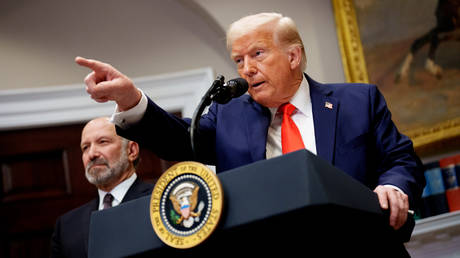
Speaking to journalists on Wednesday, Trump said Venezuela took “oil rights” and other assets that he claimed belonged to the US, prompting his decision to impose a naval blockade on the Latin American state.
“They took our oil rights. We had a lot of oil there,” Trump said. “They threw our companies out, and we want it back.”
Trump accused previous administrations of weakness, which enabled Venezuela to seize control of assets once held by American companies. “They took it away because we had a president that maybe wasn’t watching,” he said. “But they’re not going to do that. We want it back.”
Venezuela nationalized its oil industry in 1976, creating state-owned company PDVSA and ending direct foreign ownership of oil reserves, while still allowing international companies to operate under service contracts.
Under President Hugo Chavez in 2007, the government took majority control of large oil projects. Several Western energy companies, including ExxonMobil and ConocoPhillips, exited the country after refusing the new terms and later pursued arbitration claims.
The standoff comes amid an expanded US military presence in the Caribbean. Since September, US forces have conducted strikes against alleged drug traffickers operating at sea, killing more than 90 people in operations targeting what Washington describes as cartel-linked vessels. Trump has also threatened to extend strikes onto Venezuelan territory, accusing Caracas of harboring “narcoterrorists” – allegations the Venezuelan government has denied.
On Tuesday, Trump announced “a total and complete blockade of all sanctioned oil tankers going into, and out of, Venezuela… until such time as they return to the United States of America all of the oil, land, and other assets that they previously stole from us.”
Caracas has condemned the blockade as illegal and in violation of international law, free trade, and freedom of navigation. The Venezuelan government dismissed Trump’s claims, insisting that its oil and mineral resources are sovereign property. “Venezuela will never again be a colony of an empire or any foreign power,” Vice President Delcy Rodríguez said.