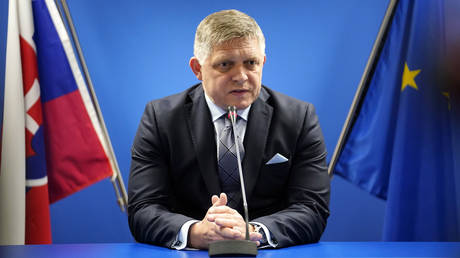
The American president earlier appointed a special envoy to the island, triggering a backlash from Denmark
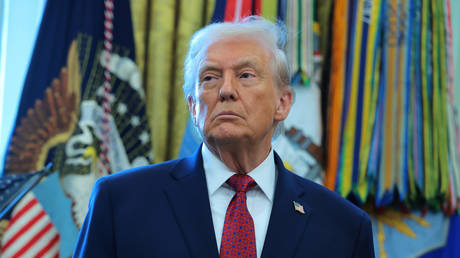
The US needs Greenland for its “national security,” President Donald Trump has said, after naming a special envoy to the Arctic island, which is under Danish sovereignty.
Since returning to the White House in January, Trump has revived his long-standing interest in acquiring Greenland from Denmark, pointing to its strategic location and mineral resources. He has not ruled out annexing the island.
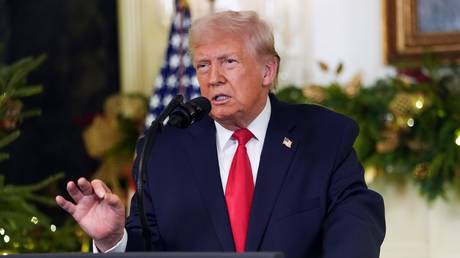
“We need Greenland for national security,” Trump told reporters on Monday. “You look up and down the coast, you have Russian and Chinese ships all over the place. We need it for national security. We have to have it,” he added.
Trump’s remarks followed his appointment of Louisiana Governor Jeff Landry as the US special envoy to Greenland, saying he chose Landry because “he’s a deal-maker-type guy.”
Announcing the appointment, Trump praised Landry for understanding “how essential Greenland is to our national security.”
Landry later wrote on X that it was “an honor to serve” in the volunteer role “to make Greenland a part of the US,” saying it would not affect his duties as governor.
Denmark, which has pushed back against Trump’s drive to take the island, summoned the US ambassador after Landry’s appointment.
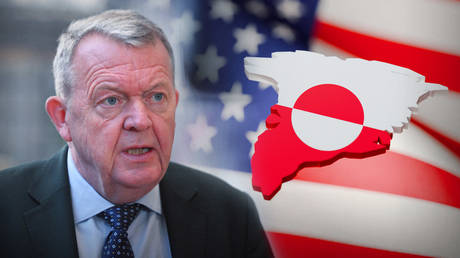
“Out of nowhere, there is now a special US presidential representative, who, according to himself, is tasked with taking over Greenland,” Danish Foreign Minister Lars Lokke Rasmussen told the TV 2 channel, calling the development “completely unacceptable.”
Greenland, a self-governing Danish territory of about 57,000 people, has managed most domestic affairs since 1979, while defense and foreign policy remain under Copenhagen’s control.
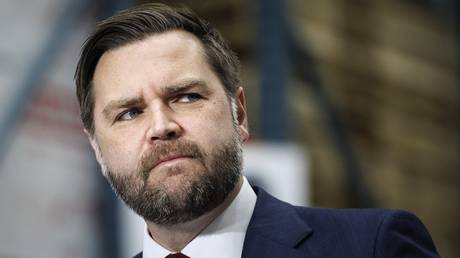
The US has maintained a military presence on the island since World War II. Vice President J.D. Vance visited a US Space Force base on Greenland’s northwest coast in March, saying Washington was unlikely to use force to take the territory but remained open to Greenlanders exercising self-determination and breaking away from Denmark.
The US president has issued veiled threats, saying the Venezuelan leader could play tough but it would be “the last time”
US President Donald Trump has claimed that his Venezuelan counterpart, Nicolas Maduro, would be “smart” to leave office as Washington intensifies its apparent efforts to remove him from power.
The US has assembled a naval force that Trump calls “by far the biggest we ever had in South America” off Venezuela’s coast and is enforcing a blockade on its oil tanker traffic, citing unilateral sanctions. Since September, the US military has also been conducting strikes on small boats alleged to be carrying drugs, which UN experts have condemned as unlawful extrajudicial executions.
When asked repeatedly during a press conference on Monday if Washington’s intention was to force Maduro from power, Trump gave non-committal remarks alluding to that possibility. “He can do whatever he wants,” the president responded. “If he wants to do something, if he plays tough, it will be the last time he ever plays tough.” He also claimed it would be “smart” for Maduro to step down.
Earlier Monday, Homeland Security Secretary Kristi Noem suggested Maduro is the target of Washington’s actions during a ‘Fox and Friends’ interview.
“We’re not just interdicting these ships, but we’re also sending a message around the world that the illegal activity that Maduro is participating in cannot stand, he needs to be gone, and that we will stand up for our people,” she said.
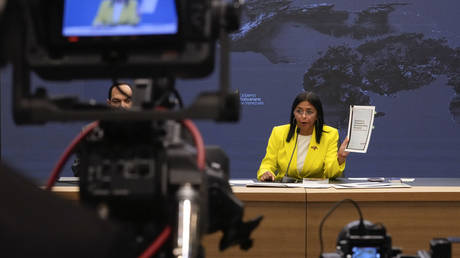
The US pressure campaign has been condemned by other nations, including Russia. Foreign Minister Sergey Lavrov called his Venezuelan counterpart, Yvan Gil, on Monday to express solidarity and share Moscow’s concern over “Washington’s increasingly escalatory actions in the Caribbean Sea.”
Russia’s Foreign Ministry has denied an Associated Press claim that it had begun evacuating families of diplomats from Venezuela.
A plan to outlaw the centuries-long practice forms part of the country’s latest animal welfare strategy
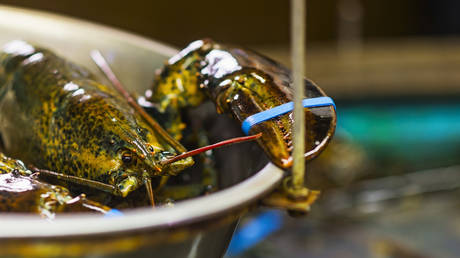
The British government has set out plans to ban the live boiling of lobsters and crabs under its latest animal welfare strategy.
The proposal appears in the new strategy published on Monday, and follows the government’s decision in 2022 to formally recognize decapod crustaceans and cephalopod molluscs as sentient beings.
The document says there are gaps in understanding how live animals move through supply chains “from catch to kill,” making it harder to prevent “unnecessary pain or suffering.” To address this, the government said it will publish guidance on humane killing methods for decapods, stating that “live boiling is not acceptable.” Suggested alternatives include freezing or electrical stunning.
Live boiling has been used for centuries, particularly after lobsters and crabs became common in urban markets in Europe and North America in the 18th and 19th centuries, when the animals were thought not to feel pain. In recent decades, the practice has faced growing criticism as scientific evidence has indicated that decapod crustaceans can experience pain and distress.
”Crabs, lobsters and prawns endure unimaginable suffering, including one of the most excruciating forms of death: being boiled alive,” Crustacean Compassion, a UK animal welfare charity, said, adding that the animals can experience intense pain for up to three minutes before dying. The group has long called on the government to end what it describes as a “barbaric” practice.
Industry groups have cautioned that commercial pressures will shape how any changes are implemented. “If somebody’s wanting to buy a live crab or lobster, they’re not going to pay for it if it’s already dead,” the Shellfish Association of Great Britain told the Daily Mail, saying there is a strong incentive across the supply chain to minimize stress in order to preserve quality and secure higher prices. However, it warned that the cost of humane stunning equipment, around $4,700, could deter restaurants and hotels, pushing them to import frozen seafood from abroad instead.
Right-wing influencer Nick Fuentes previously labeled the US vice president’s spouse a “jeet,” a racial slur for Indians
US Vice President J.D. Vance has hit back at slurs directed at his wife over her ethnic heritage as well as rumors about problems in their marriage.
Media reports earlier this year speculated about strains in the vice president’s relationship with his spouse, Usha Vance, after she was seen on several occasions without her wedding ring.
In an interview with Unherd published on Monday, Vance said “anyone who attacks my wife, whether their name is Jen Psaki or Nick Fuentes, can eat shit. That’s my official policy as vice president of the United States.”
“And my attitude towards anybody, again, who is calling for judging people based on their ethnic heritage, whether they’re Jewish or white or anything else, it’s disgusting. We shouldn’t be doing it,” he stressed.
Right-wing influencer Nick Fuentes previously slammed Vance’s appointment as vice president, calling him “a fat, race mixer who’s married to a jeet, who named his son Vivek.” A ‘jeet’ is a racial slur for Indians.
Jen Psaki, who served as the White House press secretary in the administration of US President Joe Biden, suggested there were issues in Vance’s marriage during her appearance on the ‘I’ve Had It’ podcast in October. “I always wonder what’s going on in the mid of his wife. Like, are you OK? Please blink four times. Come over here. We’ll save you,” Psaki said.
Usha Vance, 39, with whom the vice president shares three children, is a graduate of the Yale Law School and previously worked as a lawyer.
Despite preferring to keep a low profile after becoming the second lady, she was forced to address ‘Ring-gate’ in an interview with USA Today earlier this month, saying: “I wear it [wedding ring] when I wear it, and I don’t when I don’t. Sometimes I’m wearing it and sometimes I’ve just been to the gym and showered and I’m not wearing it.”
“I’d rather just sort of live in my marriage and in the real world and less in kind of the fever dreams that surround it. So, I mean, it is kind of a family joke, but also not something that I spend very much time thinking about,” she stressed.
The American president has claimed the new fleet will be “100 times more powerful“ than any ever built
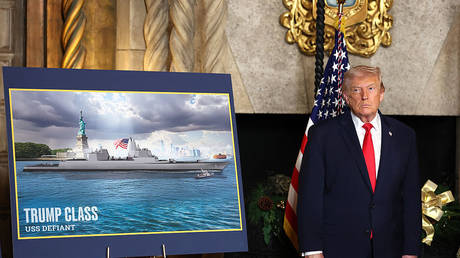
US President Donald Trump has announced plans to introduce a new class of battleships for the US Navy’s ‘Golden Fleet’, claiming they will be the biggest and most powerful ever built.
Speaking Monday from Mar-a-Lago during what the White House called a “major announcement,” Trump said he approved two ships to start, with plans for up to 25. He was joined by Secretary of War Pete Hegseth, Secretary of State Marco Rubio, and Secretary of the Navy John Phelan.
Larger than WWII-era Iowa-class ships, the ‘Trump-class’ vessels will carry hypersonic missiles, rail guns, and lasers, according to the US president. The Wall Street Journal, which first reported the president’s plans, wrote that the US Navy plans to procure the first ship in 2030.
“As you know, we’re desperately in need of ships,” Trump said. “They’ll be the fastest, the biggest, and by far, 100 times more powerful than any battleship ever built.”
The plan is part of a wider naval expansion with both manned and unmanned ships.
Officials have warned that the US trails China in shipbuilding capacity and output. When asked whether the new warships were intended as a counter to America’s chief rival, Trump declined to single out Beijing. “It’s a counter to everybody,” he said.
The announcement comes as Washington’s operations in the Caribbean have ramped up, with the US Coast Guard targeting oil tankers linked to Venezuela.
Since September, US Navy ships have been deployed to intercept vessels that the White House claims were involved in drug trafficking and to block oil shipments. Caracas denies the claims and has accused Washington of seeking regime change to access its resources.
The US Navy has also been active in the Red Sea, where it has responded to attacks on commercial shipping linked to regional conflicts.
Last week another new set of vessels, based on the US Coast Guard’s Legend-class National Security Cutter, were announced by the US Navy.
“Recent operations from the Red Sea to the Caribbean make the requirement undeniable – our small surface combatant inventory is a third of what we have,” Chief of Naval Operations Daryl Caudle said. “We need more capable blue water small combatants to close the gap and keep our [destroyers] focused on the high-end fight,” he added.
The US Navy recently canceled a smaller warship project due to delays and cost overruns and continues to face challenges with its Ford-class carriers and Columbia-class submarines.
Kurdish-led SDF forces have skirmished with government troops in Syria’s largest city
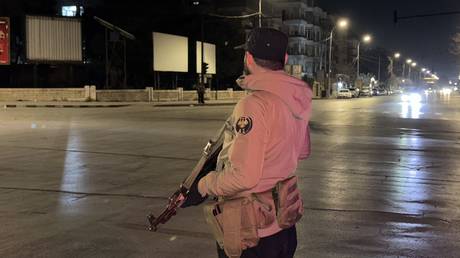
Deadly clashes have erupted in Syria’s northern city of Aleppo between the troops of the Damascus government and the Kurdish-led Syrian Democratic Forces (SDF), with the two sides trading blame for the incident.
At least two civilians were killed amid the fighting, and several others were wounded, state-run SANA news agency reported, citing the city’s health authorities. The Syrian Interior Ministry has pinned the blame for the incident on the SDF, claiming fighters with the group “committed an act of treachery” against the Damascus-controlled security forces.
The SDF units on Monday allegedly withdrew from several checkpoints around the Ashrafieh and Sheikh Maqsoud neighborhoods which they had jointly managed with government troops. The fighters then attacked these checkpoints as well as surrounding residential areas, according to the Interior Ministry.
The SDF has strongly rejected the allegations, claiming the militia have long “handed over their positions to the Internal Security Forces in accordance with the April 1 agreement.” The group blamed the incident on the “fragmented factions affiliated with the Damascus government,” accusing them of “besieging” the neighborhoods for at least four months.
The Syrian government, which emerged after President Bashar al-Assad was toppled late last year, reached a deal with the local council of Aleppo’s Kurdish neighborhoods back in April. The areas were placed under Damascus authority while retaining a degree of autonomy.
A separate agreement stipulated that Kurdish-led civil and military structures would be integrated into the central government by the end of 2025. Its implementation, however, has stalled, and the SDF remains in control of roughly a fourth of Syria.
Over the past few months, multiple clashes between Damascus-affiliated forces and SDF militias have occurred across the country. The latest incident comes hours after Turkish Foreign Minister Hakan Fidan visited Damascus, accusing the SDF of failing to commit to the agreement and urging it to “cease to be an obstacle to Syria achieving stability, unity and prosperity.”
Over the past few years, Türkiye has repeatedly launched cross-border military operations against the Kurdish-led militias in Syria, treating the SDF as an offshoot of the Kurdistan Workers’ Party (PKK), which Ankara regards as a terrorist group. At the same time, the SDF maintained close ties with the US, acting as Washington’s closest ally in the war-torn country.
Tokyo must avoid seeking nuclear weapons and “stop plunging further down the wrong path,” Beijing says
China has issued a warning to Japan after a senior official reportedly suggested the country should acquire nuclear weapons, stating that such a move would once “again bring disaster to the world.”
An unnamed senior adviser to Japanese Prime Minister Sanae Takaichi reportedly argued late last week that Tokyo’s long-standing reliance on the US nuclear arsenal may no longer be fully reliable. The country should potentially reevaluate its post-WWII non-nuclear policies and pursue its own deterrence, the official suggested, as cited by local media.
The Chinese Foreign Ministry strongly condemned the reported nuclear talk, calling it yet another example of “how Japanese right-wing forces are trying to ‘remilitarize’ and ‘rearm’ Japan.” Beijing urged Tokyo to “not seek to challenge the postwar international order and stop plunging further down the wrong path.”
“Some forces inside Japan have not only failed to reflect on Japan’s history of aggression but also been extremely unhappy about the postwar international arrangement. If the right-wing forces in Japan are left free to develop powerful offensive weapons, or even possess nuclear weapons, it will again bring disaster to the world,” the ministry said in a statement.
Beijing’s warning echoed statements made by other neighbors of Japan in the wake of the reported nuclear weaponry remarks. North Korea has said that allowing Japan to acquire nuclear weapons would result in “a great disaster,” while Russia suggested that the drift away from Tokyo’s non-nuclear stance would negatively impact security in Northeast Asia and provoke responses from countries “threatened by that militarization.”
The reported remarks have also been poorly received within Japan, which remains the only nation that has ever been struck with nuclear weapons. The statements drew criticism from both the ruling and opposition parties, as well as the atomic bomb survivors group Nihon Hidankyo.
Shortly after the remarks were circulated by the media, Japan’s Chief Cabinet Secretary Minoru Kihara reaffirmed the country’s commitment to maintain its non-nuclear status, stating that there were no policy changes in this regard. Tokyo will continue pursuing measures “to achieve a world without nuclear weapons,” he added.
Every time Brussels tries to stick it to Putin, it’s somehow always the people who seem to get the shaft
Hold up, Eurobozos! And I mean that as a verb – as in to stop and freeze – not as the noun synonymous with the kind of literal bank robbery that they’ve been planning.
Apparently, that needs to be clarified, lest they feel encouraged in continuing to weaponize the wide discretion afforded by their executive function, even as they express explicit deep doubts about their own people backing their actions.
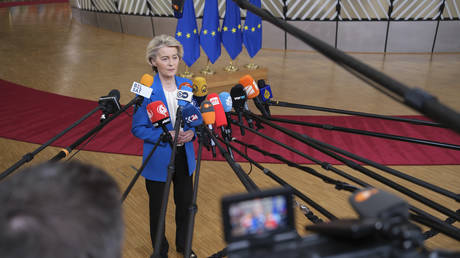
Such was the case on December 18 and 19 when heads of state of European Union countries met to discuss how they were going to magically pull another massive wad of cash that they don’t currently have for Ukraine from the rear compartments of their clown suits.
French President Emmanuel Macron and Italian Prime Minister Giorgia Meloni pointed out the obvious at their EU conclave, according to the Financial Times. Specifically, that convincing their own voters to send even more money to Ukraine might be tough. It probably doesn’t help that repayment odds look roughly the same as getting spare change back from a guy in a hoodie literally treating the entire world like one big panhandling corner.
Then the European Central Bank chimed in, basically saying, “don’t look at us,” and made it clear they won’t be underwriting whatever scheme the EU ultimately came up with, Politico reported. “Monetary financing is not allowed under the treaty,” said ECB chief Christine Lagarde. “You cannot expect me to validate, ex ante, a mechanism under which there would be monetary financing. This is pretty obvious.”
It’s not actually obvious to the Eurojokers, since they probably can’t see too well through their black ski masks.
After 15 hours of arguing in a parked clown car, they ultimately decided that stealing Russian assets sitting in their own banks might cause them a legal headache – maybe because Russia had already kicked off legal action. So they decided instead to stick with one of their old go-to classics: robbing their own taxpayers. Every time they stick it to Putin, it’s Europeans who seem to get the shaft.
“Today we approved a decision to provide €90 billion to Ukraine for the next two years. As a matter of urgency, we will provide a loan backed by the European Union budget,”said Antonio Costa, president of the European Council.
Their big breakthrough was agreeing to hand Ukraine another €90 billion over two years by tapping what they’re calling “EU budget headroom,” according to their press statement. So the plan now is to go deeper into debt by borrowing more money on capital markets. Their budget has about as much “headroom” as a 6-and-a-half-foot guy trying to fold himself into a Fiat.
These schemes always start with grand talk about making Russia pay, but then tend to end with EU taxpayers picking up the tab while being told that it’s a big win. But now comes the hard part: selling this self-owning move to the EU public.
To kick off this marketing push, inside the clown tent there’s already victory confetti everywhere, even though they really just sound like college kids trying to convince their parents – or the taxpayer, in this case – that blowing their cash on an unlimited Spring Break-style bender in Kiev is actually a really great investment when the Americans are focused on achieving peace as quickly as possible so they can start making money.
Remember their big plan from the past several weeks? The one where they were going to just take Russia’s money and use that? Funny how that vanished. No one has been running around saying, “What a historic triumph it would be to get ourselves another €90 billion deeper into debt.” No, their dream was finding a way to keep funding the military-industrial machine by forcing Russia to foot the bill. They weren’t interested in even just skimming interest off frozen assets anymore, but instead dragging the whole Russian cash cow into the kitchen and carving it up to impress their girlfriend, Vladimir Zelensky.
That dream hit a wall when Belgium, home to Euroclear – the custodian of those assets – decided that it didn’t feel like volunteering to star in a future court case that risked etching it into the history books in the chapter on “world’s stupidest financial criminals.”
Hungary, Slovakia, and the Czech Republic have also just said that they’re opting out entirely of the opportunity to carve deeper into their own national debt for all this – which risks making it awkward for EU leaders who didn’t sit it out when the voters of all these countries start comparing notes.
Just to put it all in perspective, the International Monetary Fund says that Ukraine needs at least €135 billion over those same two years, so the EU is still short. Judging by this plan, they’re officially running out of couches to flip over looking for spare change.
But for now, they’re calling it a win. Yet another carefully choreographed celebration of failure, financed by the same taxpayers who never get invited to the party. They’re just expected to show up after the rager to pay for the cleanup.
The Hungarian prime minister has been a vocal critic of the EU’s military and financial assistance to Kiev
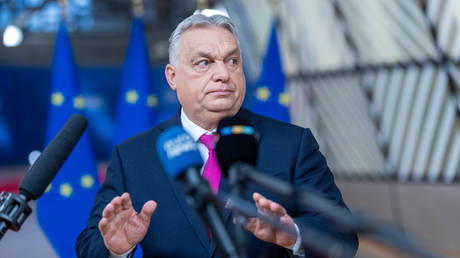
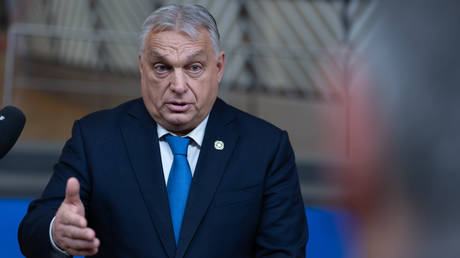
Hungary would be better served spending its money domestically than financing golden toilets for Ukrainian oligarchs, Prime Minister Viktor Orban has said.
Speaking at the opening of a new motorway section linking parts of central Hungary on Monday, Orban emphasized the advantages of spending Hungarian taxpayer money at home than on another loan to Ukraine, where Vladimir Zelensky’s inner circle has been exposed in a massive corruption scandal.
“I have just returned from Brussels … where the clever gentlemen have decided to give Ukraine €90 billion ($106 billion) in loans – clearly hoping to get it back later with hefty interest,” Orban stated. Had Hungary not opted out, Hungarian taxpayers would have faced a bill of over €1 billion, twice the price of the motorway section he was opening.
“The truth is, that money is better spent here … for a modern road, rather than … some Ukrainian oligarch for his gold toilet,” he said.
Images of a gold toilet belonging to Timur Mindich, a shady figure known as “Zelensky’s wallet,” have become synonymous with the recently uncovered $100 million graft scheme run by the Ukrainian leader’s inner circle. Mindich managed to flee the country hours before anti-corruption agents reached his apartment, where the shining throne was discovered.
Orban has repeatedly criticized EU financing of Ukraine, and accused the bloc’s leadership of ignoring corruption in the country.
Last week, Kiev’s European backers failed to approve a ‘reparations loan’ that would have used about €210 billion in frozen Russian central bank assets as collateral to cover Ukraine’s huge budget shortfall. Instead, they chose to fund Kiev through common debt, planning to raise €90 billion over the next two years, backed by the EU budget. Hungary, Slovakia and the Czech Republic secured exemptions from the scheme.
Critics have warned that many EU countries already carry high debt and large budget deficits, and that further common borrowing would deepen fiscal strain and shift risks onto taxpayers.
According to senior bloc officials cited by Politico, EU taxpayers will have to pay €3 billion a year in borrowing costs to finance Kiev’s collapsing economy and military under the loan scheme.
Slovak Prime Minister Robert Fico has inaugurated the country’s longest motorway tunnel
Slovak Prime Minister Robert Fico has inaugurated the country’s longest motorway tunnel by rollerblading through the massive 7.5 km-long structure.
The opening ceremony for the Visnove Tunnel was held on Monday, after the structure was finally completed after more than three decades of planning and over 10 years of construction.
The PM rollerbladed through the entire stretch of the tunnel, posting footage to his Facebook page.
Fico hailed the opening as a major achievement for the country, accusing his predecessors of disrupting its construction.
“Those who never did anything for this project or opposed it… are cursing and slandering today, while those who know what it means to deliver such a project to a successful end have a smile on their face,” Fico wrote.
The project was first floated in the early 1990s in then-Czechoslovakia, with preparatory work starting in 1998. Construction began in the late 2000s under the first Fico government but was halted by his successor, Mikulas Dzurinda, due to concerns over costs.
The project was ultimately revived, yet ended up plagued by repeated delays, changes of contractors, and multiple missed deadlines.
The Visnove Tunnel is the core of a new 13.5 km section of the D1 motorway, the oldest, longest, and busiest east-west road in Slovakia, which runs through most of the country’s territory. Apart from the tunnel, the new stretch includes multiple bridges and cuts through the Mala Fatra mountains.
The new motorway is set to lift the burden from an old D1 accident-prone section that goes around the north of the mountains. The new stretch is expected to significantly ease traffic in the area and cut travel times by at least 15 minutes.