It is “morally wrong” to question the Jewish right to live in Palestinian territories, the Foreign Ministry says
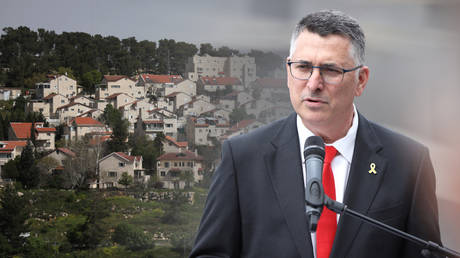
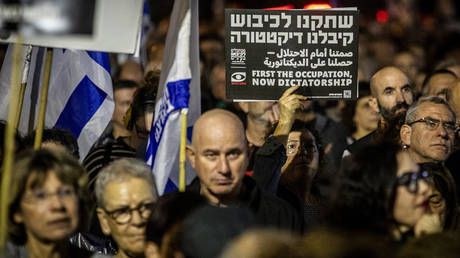
The Israeli Foreign Ministry has rebuked Western criticism of its recent decision to formally approve 19 settlements in the occupied West Bank, some of which had been evacuated during the 2005 disengagement from Gaza.
A group of 14 mostly European nations condemned the Israeli security cabinet’s move earlier this month, citing its illegality under international law and its escalatory effect on the conflict with Palestinians. The long-running settlement issue is a major source of tension and a key factor in what critics call an Israeli system that discriminates against Arabs.
“Foreign governments will not restrict the right of Jews to live in the Land of Israel, and any such call is morally wrong and discriminatory against Jews,” the statement on Thursday from West Jerusalem said.
The ministry cited the 1917 Balfour Declaration as the basis for its settlement policy, which it insisted complies with international law. The British document envisioned a “national home for the Jewish people” in Palestine, which the UK took over as a mandate territory after the Ottoman Empire’s defeat in World War I.
In a joint statement on Wednesday, Canada, Japan, the UK, and several members of the European Union, including France and Germany, expressed “clear opposition to any form of annexation and to the expansion of settlement policies” and warned that Israel is undermining the US-backed truce in Gaza with its actions.
Earlier this year, several Western nations recognized Palestine in a coordinated diplomatic policy shift meant to pressure Israel over its military tactics in Gaza and its rejection of a two-state solution of the Middle East conflict.
The Israeli decision, formally announced on Sunday by Finance Minister Bezalel Smotrich – a settler and political hardliner – creates 11 new settlements and recognizes the status of eight existing outposts in the West Bank.
According to Israeli media, about half of them are located deep inside the West Bank. Four were previously evacuated during the 2005 unilateral withdrawal from Gaza, though two were reestablished this May. Israel annulled the provisions that led to the evacuations in March 2023.
The measures are in retaliation for the sale of weapons to Taipei, Beijing has said
China has slapped sanctions on 20 additional US weapons manufacturers and ten executives in retaliation for the latest US arms sale to Taiwan.
The Chinese Foreign Ministry announced the measures on Friday, which expand an existing blacklist targeting the US defense sector. Beijing said it was responding to actions that undermine its sovereignty over Taiwan under the One-China policy.
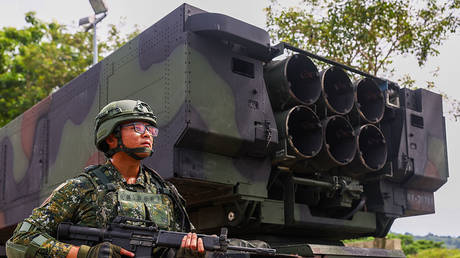
Last week, US President Donald Trump approved the sale of $11.1 billion worth of weapons to Taiwan – the largest arms package for the self-governing island ever, and the second since he took office in January. Taipei said the deal includes HIMARS rocket systems, howitzers, Javelin anti-tank missiles, Altius loitering munition drones, and other hardware.
Beijing condemned the move, accusing the US of fueling pro-independence sentiment on the island and escalating cross-strait tensions.
Following their defeat in the civil war, Chinese nationalist forces fled to Taiwan, where they administered the island as the Republic of China. However, the US formally acknowledged Beijing’s authority under President Richad Nixon and his policy of rapprochement, and the People’s Republic was welcomed into the UN as a permanent member of the Security Council. Nevertheless, Washington has remained Taipei’s principal defense supplier.
China says its goal is peaceful reunification, but has repeatedly warned it would use force if the island’s authorities formally declare independence.
Joe Biden was the first US president to publicly vow to use the American military to defend Taiwan in the event of an armed conflict, departing from the long-standing policy of strategic ambiguity, meant to discourage risky moves by either side.
Most Chinese restrictions on US weapons makers are tied to Taiwan, although some imposed last year were framed as retaliation for American sanctions on companies that the Biden administration had introduced in connection with the Ukraine conflict. Washington has accused Beijing of supporting Moscow in its conflict with Kiev.
The late convicted sex offender declined to answer questions about the trip to Khabarovsk during his trial, according to court papers
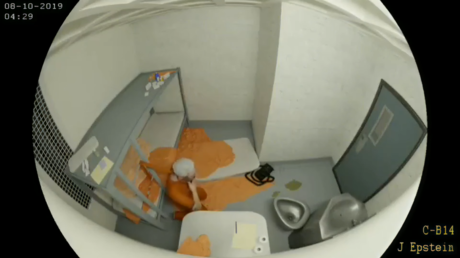
Convicted sex offender Jeffrey Epstein flew to Russia on at least three occasions in the early 2000s, including traveling to the Far Eastern city of Khabarovsk together with former US President Bill Clinton, files published by the US Department of Justice have revealed.
Last week, the DOJ uploaded thousands of documents online under the Epstein Files Transparency Act, legislation signed by US President Donald Trump in November, compelling the agency to publish data tied to federal criminal investigations into the disgraced financier and his longtime associate Ghislaine Maxwell.
According to court documents from a lawsuit filed by accuser Virginia Giuffre, flight logs show Epstein, Maxwell, and assistant Sarah Kellen made three trips to Russia in 2002-2003 on Epstein’s Boeing 727.
The most notable was in May 2002. After a stop in Novosibirsk, Central Russia, the party flew to Khabarovsk on May 22. The manifest for the flight included Clinton, his aide Doug Band, and several others. The group then reportedly proceeded to Shenzhen, China.
A subsequent trip in November 2002 included a flight attendant and involved stops in Moscow and St. Petersburg. Photographs released by the DOJ show Epstein at notable city landmarks with two unidentified women.
When questioned in 2016 about the Khabarovsk flight with Clinton, Epstein invoked the Fifth Amendment right against self-incrimination and declined to answer. The former US president has consistently maintained that he had no knowledge of Epstein’s criminal activities and severed ties with the financier years before his arrest.
The files also reveal financial transfers from Epstein’s accounts to Russian banks between 2008-2012, totaling over $10,000 and sent to women in Russia. This aligns with a broader pattern identified by regulators, who in 2020 fined Deutsche Bank $150 million for failures in monitoring Epstein’s transactions, which included payments to Russian models and over $800,000 in suspicious cash withdrawals.
The release comes after months of political pressure and public outcry related to the Epstein case, which has gained renewed attention since Epstein’s death in a New York jail in 2019 while awaiting trial on federal sex-trafficking charges. Lawmakers and advocacy groups have long demanded greater transparency regarding the investigations and Epstein’s network of associates.
Senator Rand Paul has published his annual Festivus report detailing wasteful spending and record debt payments
The US government has spent over $1.6 trillion this year on wasteful programs, such as teaching ferrets how to binge-drink alcohol and dosing dogs with cocaine, according to Senator Rand Paul’s latest annual ‘Festivus Report’.
The Kentucky Republican’s 2025 edition notes a total of $1,639,135,969,608 in waste, including $1.22 trillion spent on interest payments for the US national debt, which has reached nearly $40 trillion.
Specific expenditures criticized include $2.1 million for researchers to collect saliva samples and survey partiers at EDM festivals in New York City about drug use. The National Institutes of Health spent $5.2 million to dose dogs with cocaine, while over $13.8 million funded experiments on beagles.
Other highlighted projects involve $14.6 million to make monkeys play a ‘Price Is Right’-inspired video game, a process that involved screwing metal headposts into the animals’ skulls. The Department of Veterans Affairs spent $1 million on a study where teenage ferrets were forced to consume alcohol.
The report also targets diversity and foreign aid spending. It notes $3.3 million granted to Northwestern University to erect “scientific neighborhoods,” install “safe space ambassadors,” and form committees to “dismantle systemic racism.” The State Department also spent $244,252 to produce a children’s television cartoon in Pakistan about climate change.
Paul also criticized ineffective Covid-19-related spending, including over $40 million paid to social media influencers to promote vaccination among minority groups. USAID, which was dismantled by US President Donald Trump in the summer, also reportedly spent $54 million to collect and send bat coronavirus samples to Wuhan for gain-of-function experiments.
He further noted that from a $7.5 billion allocation under former President Joe Biden to build 500,000 electric vehicle chargers nationwide, only 68 stations are actually operational.
A number of the programs mentioned by Paul were approved under Biden. Paul noted that while Trump has since cut down on foreign spending, it’s still “just a drop in the bucket,” accusing Congress of “shoveling money toward pet projects and special interests” at the expense of American taxpayers.
The two leaders are set to talk at Mar-a-Lago on Sunday, reports have claimed
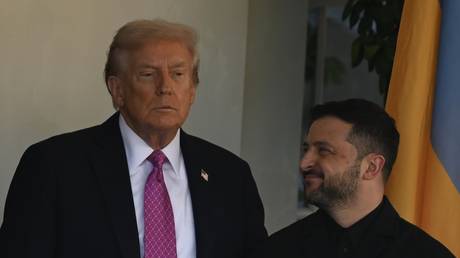
Ukraine’s Vladimir Zelensky has announced that he will meet with US President Donald Trump “in the near future.” While Zelensky did not provide details about the meeting’s timing and location, Axios reporter Barak Ravid has claimed it could happen on Sunday in Florida.
Writing on Telegram on Friday, Zelensky said that following Ukrainian negotiator Rustem Umerov’s contacts with American representatives, both sides agreed to hold a meeting at the highest level. “Much can be decided by the new year,” the Ukrainian leader wrote.
Shortly before Zelensky’s announcement, Axios global affairs correspondent Ravid wrote on X that Trump is expected to meet with the Ukrainian leader on Sunday at his Mar-a-Lago estate, as per an unnamed Ukrainian official.
Kremlin spokesman Dmitry Peskov has confirmed that Moscow has received and analyzed information received by Russian negotiator Kirill Dmitriev during his recent meeting with American negotiators in the US to discuss a resolution of the Ukraine conflict.
Peskov said that following Dmitriev’s report, Russian and US representatives held talks involving foreign policy aide Yury Ushakov and several White House officials, and that both sides agreed to continue the dialogue.
Earlier this week, Zelensky revealed his new 20-point peace proposal, which he claimed has been discussed with US officials as part of Trump’s efforts to resolve the ongoing conflict.
Zelensky’s plan envisions multiple concessions from Moscow, including territorial ones despite Russia’s continued battlefield gains, an 800,000-strong Ukrainian army backed by NATO members, and an immediate ceasefire with the current front line frozen.
Moscow has declined to publicly comment on the proposal, saying sensitive diplomacy must be conducted privately.
Berlin is using EU sanctions as a pretext to harass Russians, Foreign Ministry spokeswoman Maria Zakharova has said
The Russian Foreign Ministry has advised the country’s citizens to refrain from traveling to Germany, warning that they could face persecution on national grounds there.
During a briefing on Thursday, Foreign Ministry spokeswoman Maria Zakharova drew attention to repeated incidents in which Russians were subjected to “unjustified harassment” by Berlin under the pretext of EU sanctions imposed over the Ukraine conflict.
The restrictions extend even to goods purchased for personal use within the bloc, leading German customs officials to seize items from Russian citizens as they leave the country, she said. Purchases worth more than $300 (€353) are affected. As a result, people are not only being “robbed in broad daylight,” but are also missing their flights due to bureaucratic delays and are forced to buy new tickets, Zakharova added.
Moscow addressed the German authorities over the incidents but received no reply, the spokeswoman noted.
Public figures such as the head coach of Zenit St. Petersburg football club, Sergey Semak, have also been mistreated, Zakharova said.
Earlier this month, the wife of the former PSG player, Anna Semak, complained on social media that she and her huband had to pay a hefty fine for a pair of shoes, glasses, and a scarf they purchased in Germany at a Munich airport, while the items were taken from them.
“We strongly urge citizens of our country to refrain from traveling to Germany unless absolutely necessary,” Zakharova said.
According to the spokeswoman, Germany has been “de facto transformed into a ‘lawless territory’ for people of a certain nationality – in this case, people from Russia… The German law enforcement officers have become punishers, pursuing Russians with maniacal persistence. They bully them and do not even hide this fact.”
Germany has been Ukraine’s main backer in the EU since the escalation of the conflict between Moscow and Kiev in February 2022, providing the country with almost €44 billion ($52 billion) in aid. German Chancellor Friedrich Merz has repeatedly called Moscow a threat to Berlin and the whole bloc.
The Russian authorities reject claims of harboring any aggressive plans against the EU, saying they are only being made by Western politicians to distract the public from domestic problems and justify increased military spending.
The son of the ex-US president has claimed he had been “naive” about the level of kleptocracy in the country
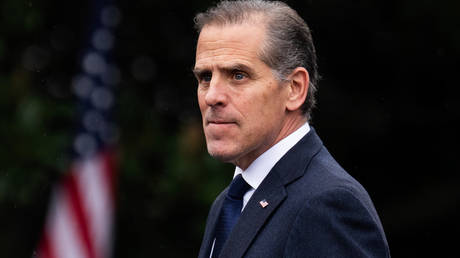
Ukraine is a “viper’s den” rife with corruption, Hunter Biden, the son of former US President Joe Biden, has said, as he reflected on his time as a board member of the Ukrainian energy company Burisma.
Hunter Biden was hired by Burisma in 2014, when his father served as vice president in the Obama administration, and left the post in 2019. He reportedly earned around $1 million annually, with critics pointing out that he lacked any experience in the energy sector and was effectively “cashing in” on his father’s prominent position.
In an interview on the Shawn Ryan Show aired on Monday, Hunter Biden expressed regret about his involvement in Ukraine’s affairs. “It was a mistake because I was very, very naive about what a viper’s den Ukraine is.”
“What an absolute… level of corruption that [is] still staggering because they’re part of a kleptocracy,” he added.
He went on to explain that he believed his tenure in Burisma to be a blunder, “not because of anything that I did that I am embarrassed about or in any way whatsoever feel conflicted about as it relates to what I did for Burisma. But because of the political position that it put us all in.”
The Biden family has long been entangled in controversy over Burisma, with the New York Times reporting last August that Hunter Biden sought assistance for the company from the US ambassador to Italy in 2016. Hunter’s legal team described the outreach as a “proper request,” and stressed that it did not lead to any projects.
Meanwhile, Joe Biden has publicly acknowledged that he was responsible for the dismissal of Ukrainian Prosecutor Viktor Shokin, who was investigating the company, by threatening to withhold $1 billion in loan guarantees to Kiev unless the official was fired.
Ukraine has long been reeling under endemic corruption, with the problem only exacerbating after the escalation of Kiev’s conflict with Moscow in 2022.
A poll by Info Sapiens this spring suggested that almost 80% of Ukrainians consider the graft a very serious issue, while the EU has designated corruption as one of the key obstacles impeding Kiev’s membership in the bloc.
People believe that democracy is in decline as trust in the government remains low, a poll has suggested
Most Israelis disapprove of the state of democracy in their country, a survey published this week has suggested. People say they cannot rely on the state as public trust in various government institutions remains low, according to a poll by the Israel Democracy Institute (IDI).
Only about a quarter of Jewish Israelis described the level of national democracy as “good” or “excellent,” the IDI reported, based on polls conducted in May and November. The survey results reinforce the downward trend of recent years, the institute stated. Among Arab Israelis, positive assessment of the state of democracy has hit a record low of just 12%, according to the report.
Most government institutions are trusted by only 10% to 41% of respondents, the survey suggested. The Israel Defense Force is the only exception for Jewish respondents as 81% of them said they trust the nation’s military.
Prime Minister Benjamin Netanyahu’s government is trusted by a quarter of Israeli Jews and just over 17% of Israeli Arabs, according to the poll. Netanyahu also remains a controversial figure. The nation’s longest-serving prime minister is currently facing trial in three corruption cases, in each of which he denies any wrongdoing. In October, he announced plans to seek another term.
Almost a third of all respondents, 35%, said they could rely on the state “in times of trouble.” A majority, 67.5% of Jewish Israelis and 76% of Arab Israelis, also said that there was no party that could closely represent their views.
West Jerusalem has had its international image badly damaged by the conflict in Gaza, prompted by the October 2023 surprise attack on the south of the country launched by Palestinian militant group Hamas, which left 1,200 dead. Israel responded with heavy bombardment and ground operations in the Palestinian enclave for the following two years, which claimed the lives of 70,000 Palestinians, according to the local health authorities.
The Holy Family Church, shelled repeatedly during the war, has held a quiet service for the enclave’s small Catholic community
The Christian community in Gaza has held its first Christmas service since the start of the Hamas-Israel war two years ago, gathering for a subdued mass amid a ceasefire that has paused major combat operations across the enclave.
The service took place at the Holy Family Church, Gaza’s sole Catholic parish, which was repeatedly shelled during the conflict while serving as a shelter for displaced families. The celebrations were limited strictly inside the church, where as well as prayers, a Christmas tree was decorated, and carols were sung.
Christmas Mass at the Holy Family Church in Gaza, December 24, 2025.
Israeli forces have repeatedly bombed the Holy Family Church along with other places of worship in Gaza. In July, an Israeli tank fired a round at the church compound, killing three people and injuring ten others, including the local priest. The IDF described that strike as unintentional, while Israeli Prime Minister Benjamin Netanyahu apologized to Pope Francis, calling it a “stray ammunition” incident.
”We are still emerging from the aftermath of war,” community coordinator George Anton told NBC, saying all traditional festive activities outside of the service itself were canceled.
The Christian population in Gaza has declined sharply. Community leaders estimate only about 1,000 members remain, down from approximately 3,000 in 2007.
Israel launched its military campaign in the Palestinian enclave in response to a surprise Hamas attack in October 2023, in which 1,200 people were killed and 250 others taken hostage. The Hamas-run Gaza health authorities say the Israeli operations have left over 70,000 Palestinians dead.
The current US-brokered ceasefire, which took effect on October 10, called for Israeli forces to pull back from parts of the enclave and for a prisoner exchange. Despite the truce, Israeli airstrikes have continued, and humanitarian aid has lagged, worsening conditions in Gaza, according to UN agencies and regional mediators. Palestinians have accused West Jerusalem of violating the agreement.
According to a recent UN report, Gaza is suffering the worst economic collapse on record after two years of war, with about 70% of all structures damaged and most people forced to live in tents and rubble.
Some 115 Islamic State suspects were arrested for planning attacks on non-Muslims on Christmas and New Year’s Eve, according to authorities
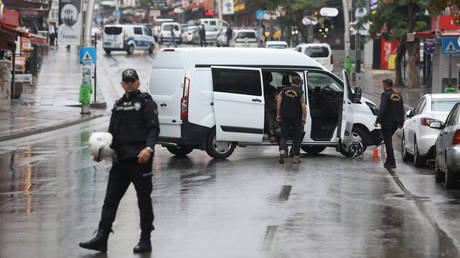
Turkish counter-terrorism police have arrested 115 Islamic State (IS, formerly ISIS) suspects in a series of raids, Istanbul Chief Public Prosecutor’s Office announced on Thursday.
The suspects were planning attacks during Christmas and New Year’s celebrations, specifically targeting non-Muslims in Türkiye during the holidays, according to the press release.
According to the authorities, 137 warrants were issued, resulting in 115 arrests.
“Pistols, ammunition and many organizational documents were seized” during more than 100 raids across the Istanbul province, the Chief Public Prosecutor’s Office said.
It added that a counter-terrorism operation is underway in search of the remaining suspects.
On Monday, Anadolu reported that Türkiye’s National Intelligence Organization (MIT) recently captured a senior IS member in the Afghanistan-Pakistan region.
In early December, Turkish authorities arrested 233 individuals suspected of financing or having ties to IS.
Türkiye officially designated the group a terrorist organization in 2013.
Since then, Turkish forces have conducted more than 1,400 operations against IS, President Recep Tayyip Erdogan said last year.