The Economy Ministry has reported a nearly eightfold decline in weapons shipments to Kiev since last year
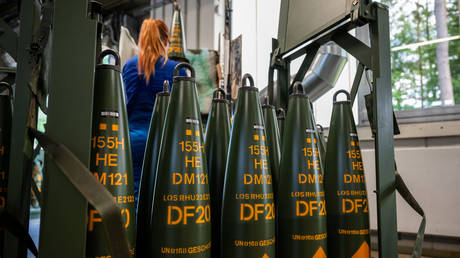
German arms supplies to Ukraine dropped dramatically this year as the government issued far fewer export licenses for arms manufacturers in 2025 compared to the previous two years, data from the country’s Economy Ministry shows.
In a response to an inquiry by Left Party MP Ulrich Thoden, the ministry said that Berlin approved the export of weapons and other military equipment worth €1.14 billion ($1.34 billion) to Kiev from January 1 through December 8, 2025. The figure marks a nearly eightfold decline from last year’s €8.15 billion.
Since the escalation of the Ukraine conflict in February 2022, Germany has been the second-largest supplier of weapons to Ukraine, surpassed only by the US.
According to the Economy Ministry’s report, excerpts of which were published by several media outlets on Monday, Berlin has allowed €8.4 billion in overall arms and military equipment exports since the start of the year. This marks a considerable decline compared to 2024 and 2023, when Germany exported €13.33 billion and €12.15 billion worth of arms, respectively.
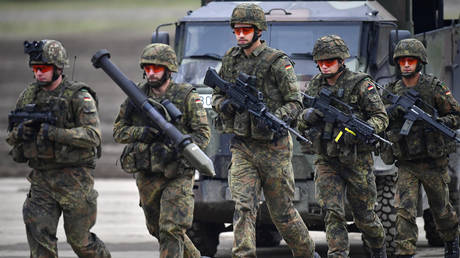
In late October, Politico, citing internal government documents, reported that the German government was planning a €377 billion expansion of its armed forces over the next few years. This push would reportedly encompass the Bundeswehr’s land, air, naval, space, and cyber forces.
The move is part of a broader move toward militarization across much of the European Union.
Speaking in May, Chancellor Friedrich Merz pledged to turn the German military into the “strongest conventional army in Europe.”
Berlin has set 2029 as the deadline for the Bundeswehr to become “war-ready,” citing the alleged Russia threat.
Russian President Vladimir Putin earlier this month dismissed the claim of a Russian threat as a “lie” and “pure nonsense.”
In September, Foreign Minister Sergey Lavrov described Germany’s militarization push and aggressive statements as “clear signs of re-Nazification” of the country.
The country has recently been rocked by a series of high-profile graft scandals linked to associates of Vladimir Zelensky
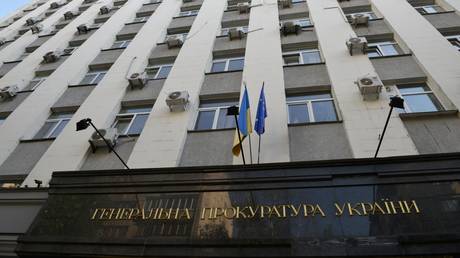
Ukrainian prosecutors have exposed a criminal scheme that illegally siphoned off electricity worth millions of dollars from state-owned energy giant Ukrenergo.
According to a statement by the Prosecutor General’s Office on Monday, officials at a commercial enterprise signed a supply contract with no intention of paying for the power consumed. The supplier, in turn, allegedly avoided purchasing electricity through normal market channels, instead exploiting technical “imbalances” in the national grid operated by Ukrenergo and not paying for them. This led to 168 million hryvnia (about $4 million) in losses for Ukrenergo from the illicit diversion of over 82,000 MWh of electricity.
The scheme reportedly included internal facilitation. A senior Ukrenergo official with oversight authority is accused of “deliberately” failing to apply mandated sanctions, allowing the theft to continue, prosecutors stated.
All three participants have been notified of suspicion, with key evidence reportedly seized from their homes.
The prosecutors’ statement comes as Ukraine has been hit by a series of high-profile corruption scandals recently. Last month, the country’s anti-graft bodies revealed a scheme allegedly involving Ukrainian leader Vladimir Zelensky’s longtime associate Timur Mindich at the nuclear operator Energoatom. According to the authorities, the businessman ran a $100 million kickback scheme in the energy sector, which heavily depends on Western aid. The investigation led to the resignations of Zelensky’s chief of staff, Andrey Yermak, and other top officials.
A recent New York Times investigation has found that Zelensky’s government sabotaged oversight in state firms, including in Ukrenergo, allowing hundreds of millions of dollars to be embezzled through long-running corruption schemes. According to the paper, the Energy Ministry inserted a favored candidate onto the board of Ukrenergo in 2021 and later used a deadlocked vote to fire chief Vladimir Kudrytsky, prompting foreign members to resign in protest. Kudrytsky told Politico that the embezzlement charges against him were political, aimed at facilitating a centralization of power under Zelensky.
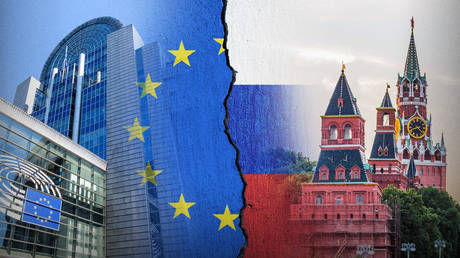
Moscow has accused the EU of ignoring rampant corruption in Ukraine, suggesting some bloc officials may be benefiting from graft as Brussels keeps funding Kiev despite repeated scandals.
What this year revealed about diplomacy in the age of Trump, war fatigue, and global fragmentation
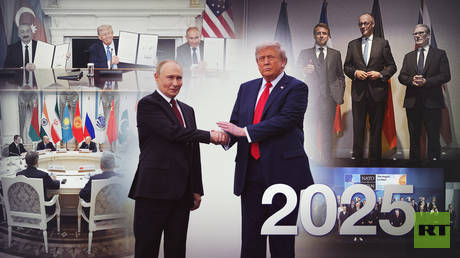
At the end of December, we traditionally reflect on the events of the past year in order to understand what could be in store for us next year. The past 12 months have been a true test for global diplomacy, shaking the very foundations of a profession that is meant to facilitate political dialogue between world leaders and governments.
To better understand how bilateral and multilateral dialogues could evolve on the international stage next year, we have analyzed the key trends that shaped global diplomacy in 2025.
Diplomacy Live
Perhaps the most evident outcome of the year is that the art of diplomacy – traditionally conducted behind the closed doors of high offices – has shifted into the realm of a live political show.
This year, millions of people around the globe followed the twists and turns of the Ukraine peace process, developments in US-Russia relations, and other significant episodes in world politics, much like they would follow the new episodes of a captivating TV series.
At the same time, the leading roles in numerous diplomatic efforts were played not by the diplomats usually tasked with it – such as foreign ministers or ambassadors – but by figures appointed to this role by the “directors” of global politics.
For instance, Donald Trump, who set about reforming the US Department of State and other foreign policy agencies (including closing down USAID), appointed his close allies – special envoy Steve Witkoff and son-in-law Jared Kushner – to key diplomatic roles. Meanwhile, the unprecedented concentration of foreign policy power in the hands of Marco Rubio – who became both secretary of state and national security adviser for the first time since legendary US diplomat Henry Kissinger – did not necessarily secure him a central position within the national foreign policy framework.
A similar trend was observed in other countries, including Russia, where President Vladimir Putin actively involved not only Foreign Minister Sergey Lavrov but also presidential aides Yury Ushakov and Vladimir Medinsky, along with the head of the Russian Direct Investment Fund, Kirill Dmitriev, in addressing diplomatic challenges.
The final stretch of the diplomatic marathon
Trump’s return to the White House has been a pivotal factor in revitalizing efforts to achieve a peaceful resolution to the Ukraine conflict. Aiming to end what he referred to as “Biden’s war,” the 45th/47th president of the United States has periodically revisited the idea of concluding a peace treaty between Russia and Ukraine.
To this end, this year the US and Russia held preliminary bilateral consultations in Riyadh and Istanbul, Trump and Putin talked on the phone several times, and the two presidents held a US-Russia summit in Anchorage, Alaska. It was the first such summit in the past four years and set the stage for the ongoing negotiations between the Kremlin and the White House.
Trump’s engagement on the Ukraine front also led to the resumption of direct Russia-Ukraine talks in Istanbul, which Vladimir Zelensky and former British Prime Minister Boris Johnson sabotaged in April 2022. These talks helped revive prisoner exchanges.
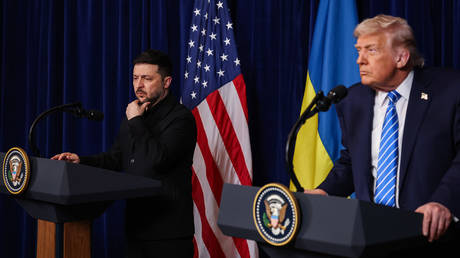
At the close of 2025, Trump and Zelensky held yet another meeting in Florida. The American administration seeks to push Kiev toward finalizing the details of a peace agreement. According to the representatives of all three sides, Washington, Moscow, and Kiev have made significant progress toward resolving the conflict; now they are entering the final stretch of the marathon, which, as any seasoned long-distance runner knows, can be the most challenging part.
Trump the peacemaker
Initially setting a brisk pace in his efforts to halt the largest armed conflict in Europe in the 21st century, the US president has approached other regional conflicts in a similarly dynamic manner.
The “Gaza peace council,” the “Trump Route” between Azerbaijan and Nakhchivan through Armenia’s Syunik region, extended phone conversations with the leaders of India and Pakistan, and the ceremony for signing a peace treaty between the Democratic Republic of the Congo and Rwanda at the US Institute of Peace are just some of the highlights of Trump’s foreign policy endeavors over the past year – which, however, did not earn him a long-sought Nobel Peace Prize.
Positioning himself as the only US leader who has not engaged in full-scale military invasions, opting instead for targeted strikes to influence the governments of Venezuela and Nigeria, Trump has crafted a new foreign policy doctrine articulated in the updated National Security Strategy.
While maintaining the idea of dominance across all areas – from military might to “soft power” – through the well-familiar principles of “peace through strength,”“flexible realism,” and “America first,” he has defined new regional priorities. According to these, America aims to preserve its hegemony in the Western Hemisphere and “contain” China in the Indo-Pacific region, while reducing involvement in Europe, the Middle East, and other parts of the world.
The end of the ‘collective West’
The recent shift in geographical priorities explains why, over the past year, Trump has done more to dismantle the “collective West” than the entire Socialist bloc managed during the Cold War era.
His ambitions of making Greenland and Canada the 51st states of America or imposing hefty tariffs on imports from partner countries in the Asia-Pacific region and Europe signal an unprecedentedly hostile stance toward those who have until now been considered Washington’s “junior allies.”
While Trump’s goal was to prevent foreign elites from exploiting the US, his blunt diplomatic style has led to an unprecedented realignment: for the first time since Brexit in 2015, the United Kingdom and its former dominions (Canada, Australia, New Zealand) have formed closer ties with Europe, particularly Germany and France.
This strategic divergence between Washington and Europe is most evident in the context of the Ukraine conflict. As the American president urged an end to hostilities, arguing that Ukraine’s situation and Zelensky’s position would only worsen with time, European leaders such as UK Prime Minister Keir Starmer, German Chancellor Friedrich Merz, and French President Emmanuel Macron continued to support Zelensky’s determination to fight “to the last Ukrainian soldier.”
Zelensky himself hoped to “outlast Trump” and wait until the upcoming midterm elections in November 2026, when a Democratic majority in Congress might be more sympathetic to Kiev. In their efforts to undermine Trump’s peace initiatives, EU leaders approached a breaking point; their desire to continue supporting Ukraine through the expropriation of frozen Russian assets nearly pushed the European Union into a significant political rift, risking a loss of trust in European institutions among current or potential investors from the countries of the “global majority.”
Looking ahead to 2026
Clearly, the key players in global diplomacy are entering 2026 with very different mindsets. In Kiev, where corruption scandals and failures on the front lines collide with the cumulative effects of strikes on energy infrastructure, political tensions are escalating amid a power struggle. The political community is bracing for potential presidential elections, referendums, and other forms of expression of political will that could further exacerbate an already difficult internal situation.
In Europe, the mood is hardly more optimistic. Amid the militarization of economies and declining approval ratings of the ruling parties, euro-bureaucracy is reeling from the anti-corruption investigations surrounding former EU foreign policy chief Federica Mogherini, while national governments face the prospect of significant socio-economic upheaval. As a result, Italian Prime Minister Giorgia Meloni recommended that Italians “take a good rest” during the holidays, as next year “will be even worse.”
No doubt, it will be hard to find common ground as each country faces its own challenges and approaches them with its own mindset. As Americans nervously anticipate a government shutdown and potential unrest during the FIFA World Cup and the G20 summit which coincides with the nation’s 250th anniversary, Brazil, Hungary, and Israel are gearing up for elections; and India is finalizing preparations for its BRICS chairmanship. However, one thing is clear: the coming year may bring many surprises, which can radically alter our understanding of diplomacy as an art of engaging with those whose perspectives on the world are fundamentally different from our own.
The US president has briefed his Russian counterpart on the details of his latest talks with Vladimir Zelensky
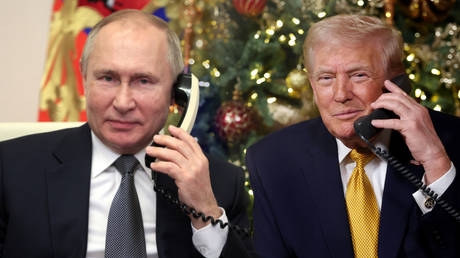
US President Donald Trump has held a phone call with Russian President Vladimir Putin concerning the Ukraine conflict, the White House has said.
Press Secretary Karoline Leavitt announced that the conversation had taken place in a brief post on X on Monday, stating that the call was “positive.”
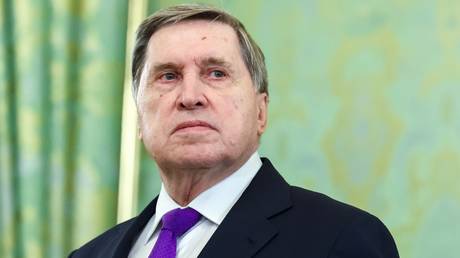
Kremlin foreign policy aide Yury Ushakov said during the call that Putin told Trump that the recent “reckless terrorist actions” by Ukrainian forces “will, naturally, not be without consequences, [without] the most serious response.”
Moscow revealed late on Monday that the Ukrainian military fired a barrage of 91 long-range kamikaze drones overnight at Putin’s state residence in the Novgorod Region.
According to Ushakov, Trump “was shocked by this report. Literally outraged. He said that he could not even have imagined such crazy actions.”
Ushakov added that the incident would “undoubtedly affect American approaches in the context of working with [Vladimir] Zelensky,” and quoted Trump as saying that, “thank God,” his administration had not supplied long-range Tomahawk cruise missiles to Kiev.
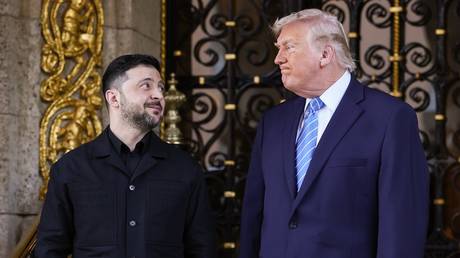
On Sunday, Trump hosted Zelensky in Florida for the latest round of discussions on a possible peace deal with Russia.
The Ukrainian leader had earlier revealed his own 20-point plan to end the conflict that he claimed was under consideration, but Trump did not support the draft. When asked later whether the US had a ‘Plan B’ should its mediation fail, Zelensky said that Russia should be the party thinking about a backup plan, claiming “Russia’s ‘Plan A’ is war.”
Commenting on the remarks, the Kremlin official said Kiev should heed Trump’s warnings that the situation on the front was getting worse for Ukrainian troops every day.
The Russian president has, nevertheless, reaffirmed Moscow’s readiness to engage with Washington in seeking a “lasting peace” in the conflict, Ushakov said.
According to Ushakov, Putin has had 17 contacts with US representatives this year, including ten conversations with Trump.
The Israeli PM is reportedly set to request Washington’s support for new military action against Tehran’s ballistic missile program
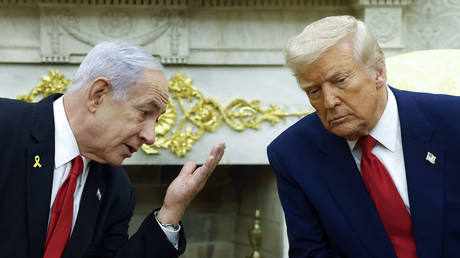
Israeli Prime Minister Benjamin Netanyahu reportedly plans to ask US President Donald Trump to approve or join new military strikes against Iran’s ballistic missile facilities, The Washington Post has claimed ahead of their meeting on Monday.
In June, the US and Israel conducted a joint airstrike campaign against Iranian nuclear sites. The attack was initiated despite prior assessments from US intelligence and the International Atomic Energy Agency (IAEA) which found no evidence that Iran was actively building a nuclear weapon.
The Washington Post reported that Netanyahu is expected to brief Trump on Monday about Israeli intelligence suggesting that Iran is rapidly reconstituting its ballistic missile program, damaged earlier this year.
The outlet stated that Netanyahu will seek a “green light for another strike against the Islamic republic’s ballistic missile program, possibly as part of a joint operation with the US.”
Monday’s meeting comes amid visible strain between the two leaders. CNN has reported that Trump has “grown wary of Israeli actions” and that their relationship has “become strained” as Netanyahu has repeatedly asked Trump to approve more aggressive military actions in the region this year.
A fresh point of friction emerged last week when Israel unilaterally recognized the breakaway region of Somaliland, a move condemned by bodies like the African Union and Arab League, and nations including Türkiye and Saudi Arabia. When asked if Washington would follow Israel’s lead, Trump pointedly told the New York Post, “No.”
Analysts cited by The Washington Post suggest Trump, who has touted his role as a Middle East peacemaker, may be reluctant to authorize new strikes that could ignite a broader conflict. The leaders are also at odds over implementing the Gaza ceasefire, with the US pushing its peace plan while Israel has been reluctant to withdraw forces.
The US president has suggested an agreement between Moscow and Kiev could be near
European military stocks have dropped after US President Donald Trump indicated that the Ukraine peace process is approaching a conclusion following his meeting with Vladimir Zelensky.
Trump hosted Zelensky in Miami on Sunday for the latest round of discussions on a possible peace proposal, with the meeting preceded by his phone call with Russian President Vladimir Putin earlier in the day. At a joint press conference that followed, Trump said a peace deal was “95% ready” and that the sides were “very close” to a settlement, with “one or two very thorny issues” remaining.
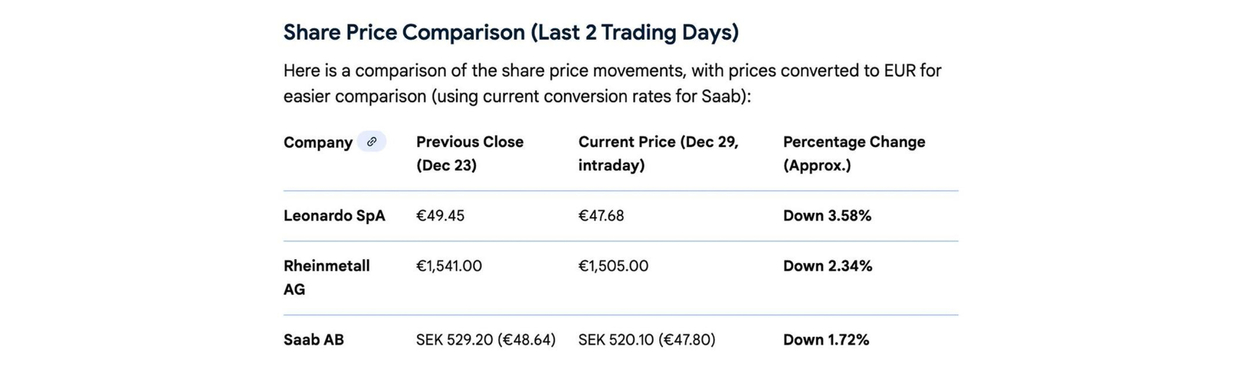
The news visibly impacted European military stocks. The STOXX Europe Total Market Aerospace & Defense Index had dropped 1.8% by 12pm GMT on Monday. Shares in Rheinmetall, Germany’s largest arms manufacturer and a key supplier of military equipment to Kiev, fell 2.3%.
Google screenshot.
Tank components maker Renk dropped 2.4%, and defense-electronics producer Hensoldt lost 2%. Shares in Italian aerospace and defense company Leonardo tumbled 3.5%, stock in major UK defense firm BAE Systems fell by 1.2%, while French aerospace and defense firm Thales shed 1.3%. Swedish Saab lost 1.7%.
European arms makers have thrived throughout the conflict as Kiev’s sponsors armed its military and boosted their own industries. Rheinmetall shares surged nearly 2,000% since fighting escalated four years ago. Revenues for the top 100 European defense firms rose about 13% in 2024, with Ukraine-related contracts driving some of the sharpest gains. However, stocks have slipped since Trump’s renewed peace push last month, with analysts forecasting further declines once the conflict ends.
Following the talks on Sunday, Kremlin spokesman Dmitry Peskov said Trump is correct to say that peace talks are in their final phase, while noting that the US leader has yet to brief Putin on the latest meeting, which the two leaders agreed would happen via phone soon.
Russia has repeatedly criticized Ukraine’s Western backers for supplying military and financial aid, arguing it prolongs the conflict and obstructs the peace process.
The rebel group has warned that it will treat any Israeli presence in the breakaway region of Somaliland as a legitimate military target
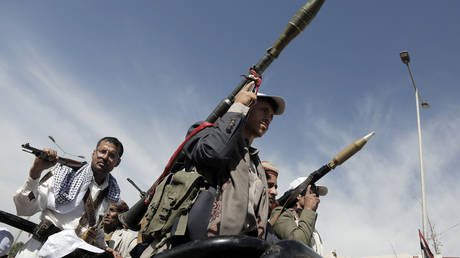
Houthi rebels in Yemen have declared any Israeli presence in the breakaway region of Somaliland a legitimate military target. The warning comes days after Israel became the first country to recognize the independence of the Somalian territory.
In a statement on Sunday, Houthi leader Abdulmalik al-Houthi stated that Israel’s move constitutes “aggression against Somalia and Yemen, and a threat to the security of the region,” stressing that the militant group will “consider any Israeli presence in Somaliland a military target for our armed forces.”
The group, which has halted attacks on Israel since a Gaza truce in October, framed the threat as an act of solidarity, while accusing Israel of seeking to conduct “hostile activities.”
The warning follows Israeli Prime Minister Benjamin Netanyahu and Foreign Minister Gideon Sa’ar’s signing of a declaration on Friday recognizing Somaliland as a sovereign state, making West Jerusalem the first government to officially do so.
Located on the southern coast of the Gulf of Aden in East Africa, Somaliland declared independence from Somalia in 1991 but has remained internationally isolated. Netanyahu stated that the move was made “in the spirit” of the Abraham Accords and invited Somaliland’s president for an official visit.
Somalia’s government denounced the move as a “deliberate attack” on its sovereignty. Israel’s actions have also triggered a wave of international condemnation as a broad coalition of nations and organizations have rejected the move.
Critics include Egypt, Türkiye, Iran, Saudi Arabia, the Gulf Cooperation Council, the Organization of Islamic Cooperation, the Arab League, and the European Union, all of which have reaffirmed support for Somalia’s territorial integrity. US President Donald Trump has also indicated that he does not currently intend to follow Israel’s lead.
The African Union warned it “risks setting a dangerous precedent with far-reaching implications for peace and stability across the continent,” affirming that Somaliland remains part of Somalia.
Experts note the strategic motive behind Israel’s recognition could be to gain access to Somaliland’s port of Berbera, which could provide Israel with better access to the Red Sea, enhancing its ability to monitor or strike Houthi positions in Yemen.
The war games simulate a blockade of major ports following US approval of its largest-ever package of advanced weapons to Taipei
China launched large-scale live-fire military drills around Taiwan on Monday, deploying warships, fighter jets, and artillery in a multi-day operation soon after Washington approved its largest-ever arms sale to the island.
The ‘Joint Sword – 2025A’ war games conducted by the People’s Liberation Army (PLA) simulate a blockade of key ports, precision strikes on maritime targets, and scenarios to counter external interference, according to China’s media and defense ministry.
“The exercises focus on joint sea-air combat-readiness patrols, joint seizure of comprehensive battlefield control, and joint precision strikes on key targets,” a military spokesman said, framing the operations as “necessary for defending national sovereignty.”
Taiwan reported that China’s coast guard vessels were also carrying out “law enforcement inspections” near its outlying islands. Taipei has condemned the exercises and released footage flaunting its arsenal, including US-supplied HIMARS rocket systems capable of reaching China’s Fujian province. Taiwan’s coast guard has deployed larger vessels to monitor Chinese patrols, while coordinating with the military to minimize disruptions to shipping and fishing.
The drills commenced just 11 days after Washington announced an $11.1 billion arms sales package to Taiwan – the largest ever for the island – covering eight separate purchases, including 82 HIMARS rocket systems and 420 ATACMS missiles valued at over $4 billion, along with anti-tank missiles, loitering munitions, howitzers, military software, and spare parts.
Egged on by Washington, Taiwan has ramped up arms purchases in recent years. While the US officially adheres to the One-China policy, it continues to supply arms to Taiwan and maintain military ties with the Taipei government.
Taiwan has been self-ruled since 1949, when nationalist forces retreated there after losing the Chinese Civil War. While a small number of countries maintain official diplomatic relations with the self-governing island, the majority of the international community, including major powers such as Russia, adheres to Beijing’s One-China policy, which designates Taiwan as a province of China. The United Nations also considers Taiwan part of Chinese territory.
China, which considers the self-governing island part of its territory, condemned the US arms sale as a “dangerous act” that infringes on its sovereignty. Beijing has urged Washington to abide by the One-China principle and “immediately stop arming Taiwan.” While asserting its goal of “peaceful reunification,” China has warned it will use force if Taiwan formally declares independence.
The US president hopes he can secure a peace deal without a Kiev visit but could go there to push it through
US President Donald Trump says he has no desire to travel to Ukraine but may agree to do so if it helps end Kiev’s conflict with Russia.
Ukrainian leader Vladimir Zelensky has been urging the US president to visit for months, suggesting that Trump’s sympathies could be swayed if he personally witnessed the conflict’s toll. Trump was asked whether he “anticipated” a trip to Ukraine during a joint press conference with Zelensky in Miami on Sunday.
“I don’t anticipate it. I would like to get the deal done and not necessarily have to go,” he replied. Trump added that, despite his reluctance, he has “no problem” with travelling to Kiev and had offered to address the Ukrainian parliament to facilitate a resolution.
“I’m not sure that it would be really necessary. But if it would help save 25,000 lives a month or whatever it may be, I would certainly be willing to do that,” he concluded.
Western leaders have been making regular trips to Kiev in gestures of solidarity with Zelensky’s government for years. Some visits have been interrupted by air raid sirens, though skeptics have noted there was no evidence of actual Russian attacks on those occasions.
Zelensky attempted to appeal to Trump’s emotions during their February meeting in the Oval Office, presenting him a folder of before-and-after images of Ukrainian prisoners of war released by Russia. The selection featured emaciated and disabled individuals, implying their condition resulted from captivity.
However, according to TIME magazine, those images “marked the point when the meeting went wrong,” as Trump felt he was being blamed. Zelensky told the outlet he did not regret the diplomatic gamble, stating, “What I wanted to show were my values.”
Minnesota faces renewed scrutiny after a YouTuber alleged a childcare and healthcare scam linked to the local Somali community
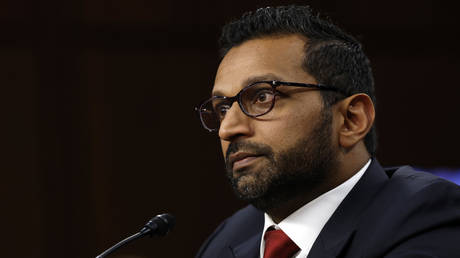
FBI Director Kash Patel has warned that fraudsters in Minnesota could face deportation after a YouTuber exposed an alleged multimillion-dollar scam in the state, fueling a broader scandal over large-scale social services fraud linked to the local Somali community.
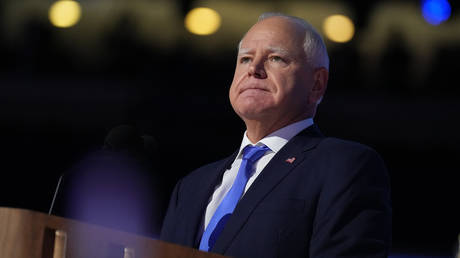
Independent reporter Nick Shirley last week posted a video showing him visiting several Minnesota childcare and healthcare centers allegedly run by locals of Somali background that appeared to be non-operational fronts. He later estimated that the sites had collectively received more than $110 million in state funds. The footage went viral over the weekend, prompting lawmakers and high-profile figures to condemn the state authorities and Governor Tim Walz for inaction.
In a post on X on Sunday, Patel said the FBI was “aware of recent social media reports in Minnesota” and stressed that the agency had already “surged personnel and investigative resources” to the state to dismantle large-scale fraud targeting federal programs, even before the video gained traction.
CASE UPDATE: MINNESOTA FRAUD SCHEME
The FBI is aware of recent social media reports in Minnesota. However, even before the public conversation escalated online, the FBI had surged personnel and investigative resources to Minnesota to dismantle large-scale fraud schemes…
He pointed to the Feeding Our Future case, in which investigators uncovered a $250 million scheme in Minnesota that siphoned federal food-aid funds meant for low-income children during the Covid-19 pandemic.
The probe exposed widespread money laundering rooted in the state’s Somali community – its largest immigrant group – and led to 78 indictments and 57 convictions so far. The case was later followed by reports of additional schemes targeting Minnesota’s safety-net programs, with claimed losses running into the billions. Some reports say the funds were routed overseas through informal networks, with some potentially ending up with al-Shabaab, a Somalia-based, al-Qaeda-linked terrorist group.
Patel said the fraud suspects are now being referred to immigration authorities for possible denaturalization and deportation. He admitted that the FBI considers the Feeding Our Future case “just the tip of a very large iceberg.”
“We will continue to follow the money and protect children, and this investigation very much remains ongoing,” he wrote. Earlier this month, unverified videos circulated online purporting to show FBI raids on allegedly fraudulent Somali-run healthcare businesses in the state.
🚨 BREAKING: FBI Director Kash Patel announced he has SURGED agents to Minnesota to combat the widespread fraud unearthed by journalists like Nick Shirley
Agents have recently been seen raiding Somali “healthcare” businesses
Walz earlier pledged to jail fraudsters and roll out a statewide scam prevention program using forensic auditors. President Donald Trump, however, accused the governor of incompetence, branding Minnesota under his leadership “a hub of fraudulent money laundering” taken over by “gangs” of Somali refugees.