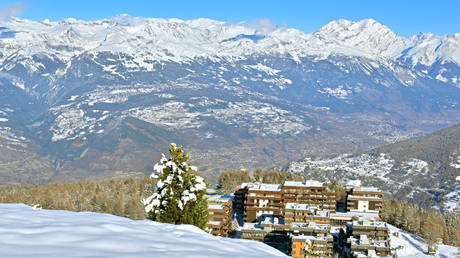
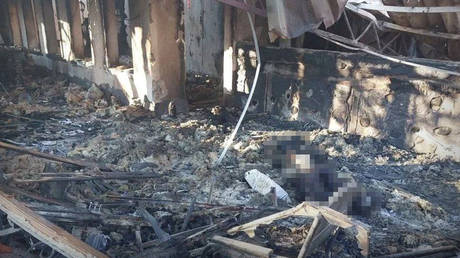
The blaze at a crowded New Year’s Eve party in Crans-Montana killed about 40 people and injured over 100
A New Year’s Eve celebration at a popular Swiss ski resort bar ended in tragedy when a fire, likely ignited by sparklers on top of champagne bottles, tore through the crowded basement venue, killing at least 40 people.
Swiss authorities confirmed Friday that preliminary evidence points to “sparkler candles or sparklers placed on bottles of champagne that were moved too close to the ceiling” as the cause of the blaze at Le Constellation bar in the upscale Alpine resort of Crans-Montana.
The fire broke out around 1:30am on January 1, 2026, as the bar was packed with young revelers celebrating the New Year.
Witnesses described a chaotic scene where a “show” involving the sparklers quickly turned deadly.
Photos and videos shared online show at least six bottles with lit sparklers being held aloft by staff and patrons. In one of the photos, a woman is seen sitting on another’s shoulders with the bottles, waving them too high, apparently hitting the ceiling.
A new video from the bar in the Swiss ski resort Crans-Montana shows people still partying and filming the fire as it spreads through the anti-acoustic plastic foam in the ceiling.
The flames ignited acoustic foam panels lining the bar’s low wooden ceiling. Officials are investigating whether this material, used for soundproofing, contributed to the fire’s ferocity.
The fire spread within seconds, according to witnesses. Patrons in the basement nightclub rushed toward a narrow staircase and a single main door, causing a crowd surge. Some resorted to smashing windows to escape.
The process of formally identifying the deceased victims has been slow and challenging. Many bodies were so severely burned that they are unrecognizable, and personal items like wallets were destroyed by the flames.
Officials have stated that this work will take several days as they must be “100% sure” before informing families. Authorities are now relying on DNA analysis and dental records to make positive identifications.
Many of the 119 injured victims remain hospitalized and have been described as “still fighting for their lives.” The scale of injuries overwhelmed local medical facilities, as many of the burns sustained require highly specialized, resource-intensive care from entire teams of specialists.
The American president claimed the US is “locked and loaded” and ready to support anti-government protesters in Iran
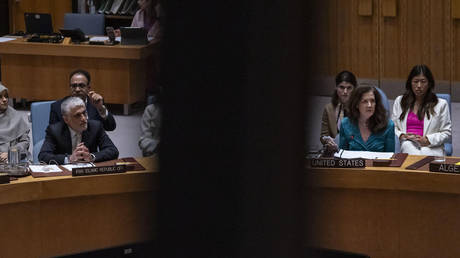
The Iranian government has formally demanded action from the United Nations following a series of increasingly bellicose statements from US President Donald Trump, including a claim that Washington is poised to intervene in the ongoing unrest in the Islamic Republic.
In a letter to UN Secretary-General Antonio Guterres on Friday, Iranian Ambassador Amir Saeid Iravani accused Trump of “incitement to violence, unrest, and terrorist acts” within Iran.
“The President of the United States openly threatened the Islamic Republic of Iran with the use of force and intervention, declaring that ‘We are locked and loaded and ready to go,’” he wrote.
“These repeated and deliberate statements demonstrate a consistent pattern of unlawful conduct by the United States,” the letter reads, further detailing a long history of alleged US interference in Iranian affairs, including the 1953 coup, support for Saddam Hussein during the Iran-Iraq War, the downing of Iran Air Flight 655, and the assassination of General Qassem Soleimani six years ago.
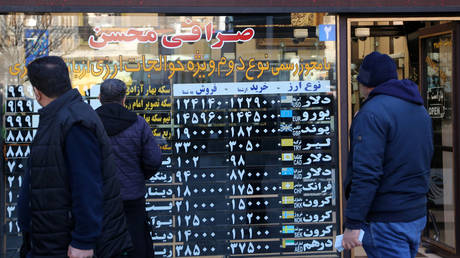
Large-scale protests erupted in Iran in late December, initially sparked by economic hardship, including the national currency hitting a new low. Demonstrations have spread and become increasingly violent; protesters have attacked government buildings and clashed with security forces.
Several casualties have also been reported among both the protesters and the security forces.
Trump claimed in a post on Truth Social on Friday that if Iran “shoots and violently kills peaceful protesters,” the US would “come to their rescue.”
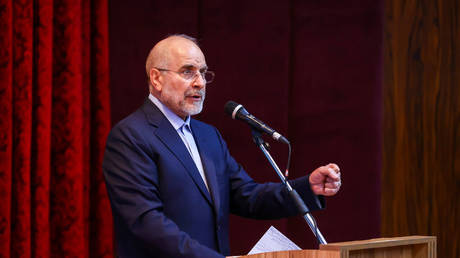
This prompted a warning from Iranian parliament speaker Mohammad Ghalibaf, who stated on X that US forces in the Middle East would be considered “legitimate targets” should Washington intervene.
Iranian Foreign Minister Abbas Araghchi has acknowledged the right of citizens to demonstrate peacefully, but emphasized that acts of violence during the protests, as well as foreign interference, will not be tolerated.
“The Great People of Iran will forcefully reject any interference in their internal affairs,” Araghchi wrote on X. “Similarly, our Powerful Armed Forces are on standby and know exactly where to aim in the event of any infringement of Iranian sovereignty.”
The Iranian ambassador’s letter to the UN calls on the Security Council to “unequivocally and strongly condemn these reckless and provocative statements” and demands the US comply with international law, ceasing “all threats or uses of force.”
A North Carolina teen allegedly planned to kill around 20 people over the holidays
The FBI and local law enforcement have disrupted a New Year’s Eve terror attack planned by a North Carolina teen, the agency has announced.
Christian Sturdivant, 18, allegedly planned to use a firearm, knives, and hammers to carry out a violent attack at a local grocery store and a fast food restaurant during the holidays, it said.
The suspect was “directly inspired” by Islamic State (IS, formerly ISIS), the FBI in the city of Charlotte said in a statement on Friday.
“He was preparing for jihad and innocent people were going to die. And we’re very, very fortunate they did not,” US Attorney Russ Ferguson of the Western District of North Carolina said in a press briefing on Friday.
Luckily, during his “extensive planning of this attack,” the suspect encountered two undercover officers, he said.
According to the US Department of Justice, authorities executed a search warrant at Sturdivant’s residence on Monday, where they found handwritten documents, one of which was titled “New Year’s Attack 2026.” The note listed items to be used in the terrorist act and described a goal of stabbing as many civilians as possible, aiming for 20 to 21.
The suspect began communicating with an online covert employee, whom he believed to be an IS member, around December 12, the DOJ said. In later correspondence with the agent, he allegedly proclaimed himself “a soldier” of IS, said that he “will do jihad soon,” and let slip plans for the attack. He also planned to try to buy a firearm before going ahead with the spree, it said.
“Successful collaboration between federal and local law enforcement saved American lives from a horrific terrorist attack,” US Attorney General Pam Bondi wrote on X after the announcement.
Sturdivant is currently in federal custody. If convicted, he faces a maximum penalty of 20 years in federal prison, the DOJ said.
President Donald Trump has warned Washington could go in to support protests in the Islamic Republic
Tehran will target US forces in the Middle East if Washington tries to intervene in Iran’s handling of ongoing mass protests, the country’s parliamentary speaker, Mohammad Ghalibaf, has warned.
His words came after US President Donald Trump stated that America was “locked and loaded” and could go in at any moment.
Large-scale demonstrations began in the Islamic Republic in late December when merchants in Tehran went on strike after the national currency, the rial, hit a record low. The protests quickly spread to other cities and turned political and violent.
“The disrespectful president of America should … know that … all American centers and forces across the entire region will be legitimate targets for us in response to any potential adventurism,” Ghalibaf said in a statement on X on Friday, commenting on Trump’s post on Truth Social earlier that day.
The protests are the most intense since 2022, when Mahsa Amini, a 22-year-old accused of improperly wearing her hijab, died in police custody.
The incident triggered weeks of violent unrest, resulting in more than 200 deaths across the country and thousands of arrests.
Videos circulated online suggested that the crowds have attacked government buildings and facilities linked to the Islamic Revolutionary Guard Corps (IRGC). Casualties were also reported among both the protesters and the security forces.
Trump warned that Washington could intervene if Iran “shoots and violently kills peaceful protesters.”
Ghalibaf alleged that Israeli agents have sought to transform legitimate protests into violent urban battles, adding that those attempts were thwarted.
Tehran is capable of discerning between protesters and “foreign mercenaries” and would never mistreat its own people, the parliamentary speaker noted.
Israel has openly endorsed the unrest. Its Mossad national intelligence agency has admitted that it has operations in the Islamic Republic. Tehran warned on Friday that any intervention into Iran’s security would be followed with a “regret-inducing response.”
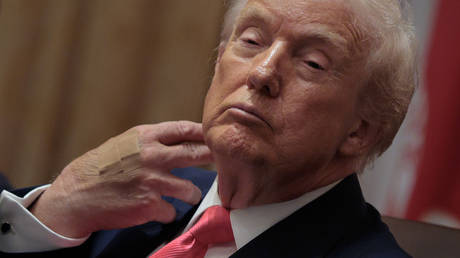
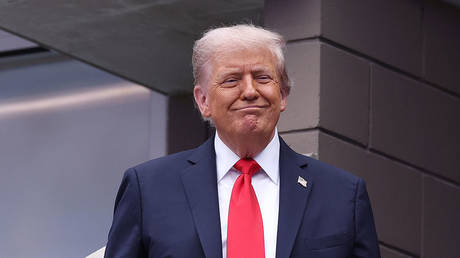
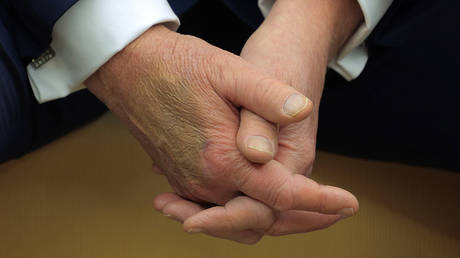
The US media has increasingly questioned the president’s health and age after he exhibited visible bruising on his hands
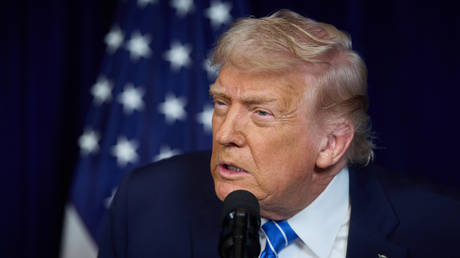
US President Donald Trump has revealed that he takes a higher than recommended daily dose of aspirin and has blamed the medication for leading to bruising on his hands, which has sparked speculation in the US media in recent months.
He made the comments in an interview with the Wall Street Journal published on Thursday.
“They say aspirin is good for thinning out the blood, and I don’t want thick blood pouring through my heart,” Trump said. “I want nice, thin blood pouring through my heart. Does that make sense?”
Trump takes 325 milligrams of aspirin a day for “cardiac prevention,” WSJ wrote, citing the president’s personal physician, Sean Barbabella. A low dose is most commonly 81mg, it added, citing the Mayo Clinic.
The US leader said he turned away recommendations to lower the dosage, explaining that he has been taking it daily for 25 years and he is “a little superstitious.”
A White House-provided Mayo Clinic analysis has estimated the president’s cardiac age to be that of a 65-year-old, the WSJ said.
When pressed by the newspaper on other health habits, Trump admitted that despite being prescribed compression socks to treat leg swelling, he stopped wearing them as he “didn’t like them.”
He also expressed no interest in exercise other than golf. “I just don’t like it,” he said, arguing that spending hours on a treadmill is “boring.”
In a Truth Social post on Friday, Trump declared that White House doctors have pronounced him in “perfect health.” He added that he had “aced” a cognitive exam and called for all US presidents and vice presidents to take such a test.
During his reelection campaign last year, the 79-year-old often called for his predecessor Joe Biden to undergo a cognitive exam due to the then president’s alleged mental decline late in his term. The Democrat, the oldest person to hold the US presidency, left office at age 82 following scrutiny of his possible cognitive deterioration after a disastrous debate with Trump.
The Labour government’s economic policies have reportedly left the most vulnerable Britons with even less disposable income
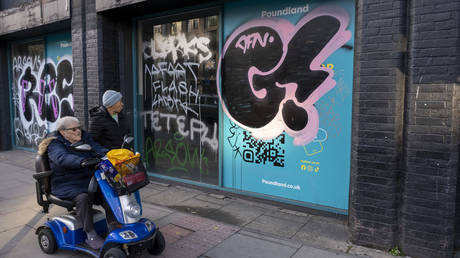
The poorest UK households have only become poorer under Prime Minister Keir Starmer’s Labour government despite its promises to boost living standards, several British outlets reported on Friday, citing recently published analytical data.
Disposable income left after bills and essentials for the least wealthy households in the UK fell 2.1% during the period between July 2024 (when Labour took office) and October 2025, The Telegraph wrote, citing data published by Retail Economics, an independent research consultancy.
Conversely, the discretionary spending among the UK’s richest households has increased 10.3% during the same period.
“Lower income families are still grappling with the legacy of surging prices, with finances playing catch up as the cost of everyday products is significantly higher than it was four years ago,” the Telegraph wrote, citing Retail Economics’ Head of Commercial Content Nicholas Found.
A whole “generation of younger, lower to middle-income households” is feeling poorer than they were five years ago, being forced to prioritize essentials and cut back on discretionary spending, he reportedly said.
According to the UK’s Office for Budget Responsibility, due to “gradually slowing real wage growth and rising taxes,” real household disposable income is only expected to grow by 0.6% in 2026.
The Labour government announced £26 billion ($35 billion) in tax hikes in its November budget, which was widely seen as a breach of prior promises. Simultaneously, Chancellor Rachel Reeves reaffirmed plans to ramp up military spending by 2.6% of GDP, despite recognizing that her budget would squeeze “ordinary people.”
Starmer’s handling of the economy, as well as his crackdown on free speech in the UK amid the country’s migration crisis, has led to a plummet in his approval ratings. Only 15% of Britons think that he is doing well as prime minister, according to this week’s YouGov poll data.
With local elections coming in May, a recent YouGov voting intention survey showed both Labour and the Conservatives trailing behind the Euroskeptic Reform UK party by more than 8%.
From the 12-day war to UN-backed recognition of Palestine, 2025 reshaped the conflict’s regional and global dimensions in five key aspects
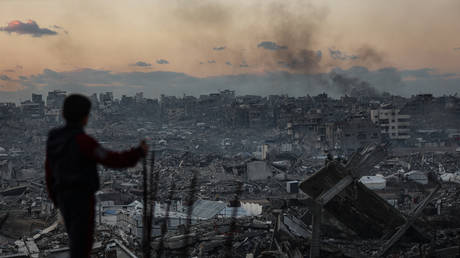
Nearly two years after the war began on October 7, 2023, the humanitarian situation in Gaza has only deteriorated further amid Israel’s military campaign in the enclave. What was once described as the world’s largest open-air prison is now increasingly seen as an open-air graveyard.
The scale of destruction, civilian casualties, and mass displacement has prompted repeated warnings from the United Nations, including findings by UN bodies that Israel is committing genocide in Gaza.
The Jewish state launched its military operation following a surprise Hamas attack in October 2023, which killed 1,200 people and saw 250 others taken hostage. According to the Hamas-run health authorities, Israeli operations have since left more than 71,000 Palestinians dead.
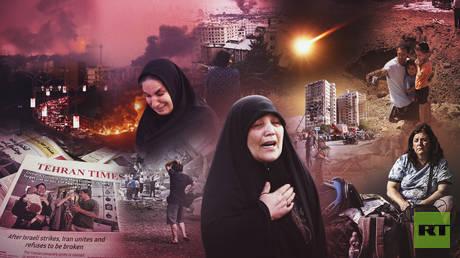
While 2025 ultimately brought a peace agreement for Gaza – leading to the return of Israeli hostages and the release of Palestinian prisoners – the deal remains fragile. Questions persist over its implementation and durability, while concerns are growing over a broader regional escalation, including the risk of renewed confrontation with Iran.
RT recaps the key developments for Israel and Gaza in 2025.
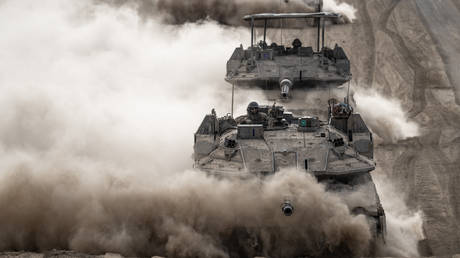
A long-feared direct war between Israel and Iran erupted on June 13, 2025, after Israel launched large-scale air strikes on Iranian military and nuclear facilities in Operation Rising Lion. More than 200 Israeli jets struck targets across Iran, killing senior commanders and nuclear scientists. The Islamic Republic responded with hundreds of ballistic missiles and drones aimed at Israeli cities, triggering nationwide air raid alerts.
The conflict escalated further when the US joined the fighting on June 22, carrying out bunker-buster strikes on Iran’s underground nuclear sites at Fordow, Natanz, and Isfahan. After nearly two weeks of intense exchanges, a US-brokered ceasefire came into force on June 24.
At least 610 people were killed in Iran and nearly 4,700 wounded, according to local health officials. In Israel, 28 people were killed and more than 3,200 injured. While both sides claimed victory, the brief war marked a dangerous new phase in regional confrontation.
In September, a UN-appointed independent commission of inquiry delivered its strongest findings yet on the war in Gaza, concluding that genocide is occurring and continues to unfold. The commission cited tens of thousands of civilian deaths, mass displacement, starvation, and the widespread destruction of homes, hospitals, and infrastructure.
The report accused Israeli leaders – including Prime Minister Benjamin Netanyahu – of incitement to genocide, arguing that statements by senior officials demonstrated clear genocidal intent, a key legal threshold under international law.
Israel rejected the findings, calling the report politically motivated and defamatory. While the commission’s conclusions do not represent the UN’s formal legal position, they intensified global pressure on governments to act, as senior UN officials warned that evidence of genocidal crimes is mounting.
The year 2025 also marked the first long-term ceasefire agreement between Israelis and Palestinians since the war began in October 2023, following months of stalled and indirect negotiations. Until then, the only pause in fighting had been a brief four-day truce in November 2023, after weeks of intense combat that devastated large parts of Gaza.
The agreement, signed on September 29 in Sharm el-Sheikh by US President Donald Trump and mediators from Egypt, Qatar and Türkiye, was intended to halt hostilities. It called for Israeli withdrawals from parts of Gaza and for Hamas to release Israeli captives in exchange for Palestinian prisoners.
Both sides have since accused each other of repeated violations. The UN reports that at least 360 Palestinians have been killed and more than 900 wounded since the truce came into force on October 10. Israel says it struck Hamas officials in response to violations – claims the group denies.
Under the ceasefire agreement, Hamas released the remaining living Israeli hostages held in Gaza after more than two years in captivity. The handover, facilitated by the Red Cross, was followed by emotional reunions broadcast across Israel.
The releases formed part of a broader exchange that also included the return of the bodies of Israeli captives. In return, Israel freed Palestinian detainees, including political prisoners and Palestinians held during the war, many of whom were welcomed home in the West Bank and Gaza.
Of the more than 200 Israelis abducted during Hamas’ October 7, 2023 attack, 114 had been released in earlier exchanges in November 2023 and January 2025. Israel says one captive’s body remains in Gaza, leaving the issue unresolved.
In 2025, momentum grew at the United Nations toward recognition of the State of Palestine. During the UN General Assembly session, several countries – including France, the UK, Canada, and Australia – formally recognized Palestinian statehood, drawing condemnation from Israel and the United States.
The shift followed the adoption of the New York Declaration, the outcome of a French and Saudi-led conference at the UN headquarters. The General Assembly overwhelmingly backed the document, with 142 countries voting in favor, while Israel, the US and a small group of allies opposed it.
The declaration outlines a roadmap toward a two-state solution. As of 2025, Palestine was recognized as a sovereign nation by 157 of the UN’s 193 member states.
America is “locked and loaded” and can go in at any moment, the president has said
US President Donald Trump has promised to assist the Iranian protesters if needed, saying that Washington was ready to intervene at any moment. The Islamic Republic has been hit by the worst unrest since 2022, triggered by an economic crisis.
The demonstrations began in late December when merchants in Tehran went on strike after the national currency, the rial, hit a record low of about 1.44 million to the dollar, compared with 860,000 a year ago.
The protests have since spread to multiple cities across Iran and turned political and violent. Videos circulated online suggested that the crowds have attacked government buildings and facilities linked to the Islamic Revolutionary Guard Corps (IRGC), setting them on fire.
“If Iran shoots and violently kills peaceful protesters, which is their custom, the United States of America will come to their rescue,” Trump wrote on Truth Social on Friday. “We are locked and loaded and ready to go,” he added.
Casualties have already been reported among both the demonstrators and security forces. Iran’s archrival Israel is openly endorsing the unrest. Its Mossad spy agency is cheering for the protesting crowds and has claimed it has agents on the ground. On Friday, Tehran warned Trump against crossing a “red line” with what it called “adventurist tweets.”
“Iranians know US ‘rescue’ record well, from Iraq and Afghanistan to Gaza,” Ali Shamkhani, an adviser to Iran’s Supreme Leader Ayatollah Ali Khamenei, wrote in a post on X.
“Any intervening hand nearing Iran’s security on [any] pretexts will be cut off with a regret-inducing response,” the official said.
The US struck Iran last year on Trump’s orders. In summer 2025, it joined Israel in a series of coordinated airstrikes on Iranian nuclear sites at Fordow, Natanz, and Isfahan, claiming they were intended to prevent the country from advancing its nuclear program. Tehran denied seeking nuclear weapons and condemned the attack as an unprovoked violation of its sovereignty.
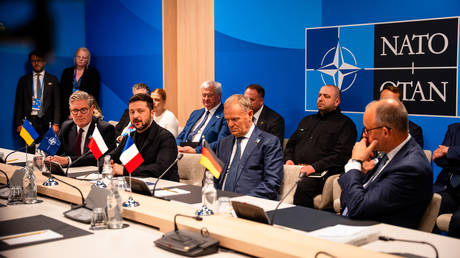
Polish PM Donald Tusk has vowed to create the strongest army on the continent
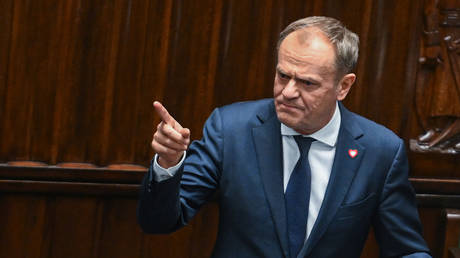
Polish Prime Minister Donald Tusk has claimed that his country will quickly expand its presence on the Baltic Sea in 2026.
NATO has bolstered its footprint in the Baltic and stepped up patrols under the pretext of protecting undersea infrastructure from the alleged Russian threat.
Moscow has denied harboring any hostile intentions and dismissed fears of an attack on NATO as “nonsense.” The Kremlin has repeatedly vowed to take all necessary steps to protect Russian interests in the region.
“It will be a year of rapid expansion on the Baltic – our Polish Baltic,” Tusk said earlier this week during his New Year address, stressing that Warsaw would “accelerate the building of the strongest army in Europe.”
Moscow had previously said the Baltic Sea, a strategic area for Russia’s naval operations and energy exports, has become an “internal lake of NATO” after Finland and Sweden joined the US-led military bloc.
The Russian Foreign Ministry has highlighted that the country is closely monitoring the actions of the US-led military bloc and is ready to take countermeasures aimed at ensuring its security.
Following a push by US President Donald Trump, NATO members committed in June to spend 5% of their GDP on their militaries annually by 2035. In August, Poland pledged to outspend all other states in the bloc, allocating 4.8% of its GDP to its army as soon as in 2026.
Other European NATO members have also stepped up military spending in recent years, committing billions to weapons purchases while arms factories across Western Europe have expanded at a “historic scale,” the FT reported earlier this year. The pace of development has reportedly tripled since 2022.
Earlier this year, Kremlin spokesman Dmitry Peskov said that rising military spending in European countries was straining their economies and could have more serious medium-term consequences.
The long 20th century is over. A new world is being built through self-determination
Two quotes, separated by four years, show how profoundly global politics has shifted.
The first reads: “The United States of America shall undertake to prevent further eastward expansion of the North Atlantic Treaty Organization and deny accession to the Alliance to the States of the former Union of Soviet Socialist Republics.” This comes from Article 4 of the draft treaty on security guarantees submitted by Russia to Washington on December 15, 2021, a proposal made public alongside a parallel agreement addressed to NATO. The demands, halting NATO expansion and rolling back the alliance’s posture to its 1997 configuration, were treated in the West as brazen. Even provocative. Inside Russia, many analysts also struggled to interpret the move: last warning, bargaining chip, or statement of intent?
The second quote appears in the “Supporting European Greatness” section of the US National Security Strategy, published on December 4, 2025: “The priority of our common line on Europe […] is to put an end to the perception of NATO as a permanently expanding alliance and to prevent this perception from becoming a reality.” This caused equal consternation, not least because the section on Europe, the west of which is Washington’s main ally, was written in a tone bordering on open hostility. Critics argued that the text reflected only one faction within the Trump administration and noted that Michael Anton, widely viewed as the chief author, soon resigned. But the fact remains: this is now the formal US security doctrine.
Between these two statements lies a cascade of dramatic events. The year 2025 marked not only a sharp acceleration of change, but also the end of a historical phase that had been unravelling for years. Trump and “Trumpism” did not emerge in a vacuum; they were the product of accumulated contradictions that finally reached critical mass.
The memoranda issued in late 2021, following President Putin’s instructions to the Foreign Ministry, were a final attempt to signal seriousness and invite genuine discussion about European security. Moscow’s message was simple: its patience had run out, and failure to address its concerns would lead to “military-technical measures.”
The signal was ignored. At the time, many in the West assumed the Kremlin was bluffing. Seen in hindsight, this looks less like disbelief and more like strategic indifference. Western governments understood that escalation was likely, but considered an armed confrontation preferable to reconsidering their own dogmas about NATO expansion and the “rules-based international order.”
The aim was not to provoke war, nor was it to avoid one.
From Washington and Brussels, concessions to Moscow were viewed as unacceptable in principle. Beyond that, there was a quiet confidence that Russia would fail and that it lacked the capacity to alter the balance of power.
Russia’s motivations in Ukraine were mixed and have evolved over time: dissatisfaction with a NATO-centric security architecture, strategic concerns, and, increasingly, a historical and cultural understanding of Ukraine as part of Russia’s civilizational space. Over the past four years, this balance has shifted further toward self-determination rather than system-correction. Yet the conflict also became a trigger for a much broader systemic shift. Structural tensions in the world order found their way to the surface, with consequences now extending far beyond the intentions of the original participants.
Measured against Moscow’s 2021 proposals, today’s situation looks like the opposite of what Russia sought: deeper NATO militarization, Finland and Sweden inside the alliance, rising tension in the Baltic region, instability in the Black Sea, and Ukraine acting as a proxy combatant. Meanwhile, Russia’s diplomatic bandwidth narrowed as focus concentrated on the battlefield.
But something else happened, something that NATO itself had not anticipated.
In 2022, NATO rediscovered its purpose. A familiar adversary returned to the stage, restoring coherence to an alliance long troubled by doubts about its identity. The language of “the free world versus tyranny,” deeply rooted in Cold War mythology, again became the organizing narrative of Western politics.
The EU gained moral clarity without paying the highest costs. Ukraine was the one engaged in direct confrontation. The hope in Western capitals was that Russia could be pushed toward strategic defeat without direct military engagement.
That expectation proved misguided.
Both Russia and Ukraine showed remarkable resilience. For NATO, this turned into a trap. The alliance, and especially Western Europe, was simply not prepared for a drawn-out confrontation, even an indirect one. Structural weaknesses in military production became impossible to conceal. Political unity also grew increasingly fragile: sustaining public support required permanent escalation of emotional rhetoric about Russia and constant reaffirmation of Kiev’s role as a symbolic frontline.
Gradually, Western Europe found itself hostage to a conflict it had helped frame but could not escape. Almost every policy decision became subordinate to the war.
The decisive shift came from Washington.
Even without Trump, a gradual disengagement trend was already forming, driven by reluctance to risk direct confrontation with a nuclear power and by the economic windfall of the EU’s decoupling from Russia. But Trump accelerated and formalized this change.
His presidency marks a historical break. The United States is stepping away from the grand project of “global leadership” that defined the 20th century. The Biden administration was, in many respects, the final attempt to preserve that world. A nostalgic reconstruction of an era whose foundations no longer exist.
Two processes, encouraged by American support for Ukraine, proved decisive.
First, economic benefits flowed from Europe to the United States through protectionism, energy pricing, and industrial relocation. Second, a loose coalition emerged across the non-Western world, which Moscow calls the “global majority,” made up of countries unwilling to subordinate themselves to US ideological pressure.
Trump completed the turn. Western Europe is now treated as a subordinate service partner, instructed to demonstrate autonomy, while never contradicting Washington. Elsewhere, the United States prefers transactional, bilateral pressure, assuming that its relative strength works best one-on-one. But this premise is proving questionable when dealing with China, Russia, and India.
Washington is dismantling the very institutional system it once built – the architecture that shaped the post-war world. NATO, the foundational structure of the late 20th century, is now being repositioned. The alliance’s expansion creates crises; crises distract from priorities; priorities now lie in the Western Hemisphere and the Asia-Pacific. Hence the unexpected phrase in the 2025 National Security Strategy, effectively acknowledging the need to halt NATO’s forward movement.
Over the past four years, the world order has changed, and the process is not finished. The European Union, once advertised as a model of progress, increasingly resembles a relic of a fading era, yet refuses to accept this reality. Dismantling the integration project would be politically and economically dangerous; preserving it unchanged is equally untenable.
In many respects, global dynamics have moved closer to Russia’s long-standing critique of the Western-centric system. This critique underpinned the decision to launch the military operation in Ukraine. The tasks of that operation are being completed more slowly than anticipated, but the broader shift in world affairs is unmistakable.
Russia is now engaged in a deeper process of self-determination. The Soviet legacy – political, territorial, psychological – is finally fading. Administrative borders once treated as sacrosanct are no longer viewed as immutable. The question of what is “ours” and “theirs” has returned as an existential issue, and this internal reckoning is now inseparable from Russia’s role in shaping the emerging world.
The new international system will not be built through external expansion. Instead it will be through the success, or failure, of national development models. The great powers are turning inward, prioritizing domestic resilience as the foundation of external influence.
That, in turn, raises the stakes. Foreign-policy mistakes can be corrected. Strategic errors in national development cannot. The 20th century, whose legacy is now finally ending, proved this many times.
This article was first published by the magazine Profile and was translated and edited by the RT team.