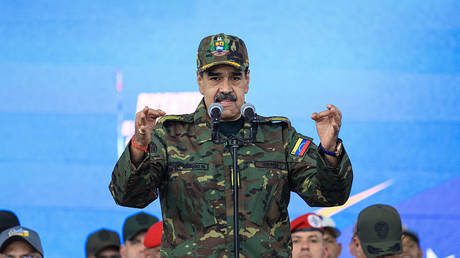
The country’s president is facing several charges related to narcotics trafficking and weapons on US soil
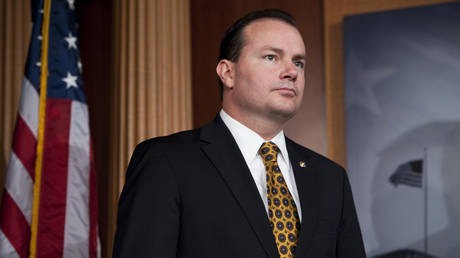
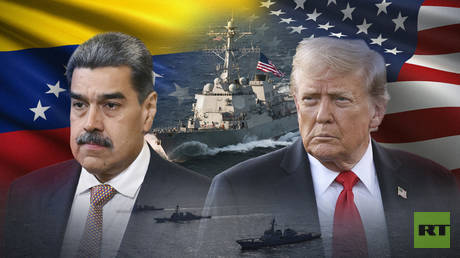
US military strikes on Venezuela were meant to provide cover for the capture of President Nicolas Maduro, who is expected to face trial on criminal charges on American soil, US Senator Mike Lee has said, citing US Secretary of State Marco Rubio.
The comments followed overnight explosions and reports of warplanes buzzing the capital city of Caracas. Later in the day, US President Donald Trump announced that American special forces had carried out a military operation and that Maduro, along with his wife, had been taken into custody and flown out of the country. Venezuelan authorities condemned the strikes as “grave military aggression.”
In a post on Saturday, Lee said that he had talked with Rubio on the phone, stating that “he informed me that Nicolas Maduro has been arrested by US personnel to stand trial on criminal charges in the United States.”
“The kinetic action we saw tonight was deployed to protect and defend those executing the arrest warrant,” the Republican senator added, noting that Rubio “anticipates no further action in Venezuela now that Maduro is in US custody.”
Meanwhile, Rubio himself republished his July 27 post in which he said that Maduro “is not the president of Venezuela” and that his government is not legitimate, while claiming that the Venezuelan leader is in charge of a major drug cartel.
Maduro has long denied such allegations, claiming the US was using them as a pretext for military aggression and in order to topple his government.
US Attorney General Pamela Bondi announced that Maduro and his wife had been indicted in New York and charged with “narco-terrorism conspiracy, cocaine importation conspiracy, possession of machineguns and destructive devices, and conspiracy to possess machineguns and destructive devices against the United States.”
The strikes and capture represent the first US intervention in South America of its kind since the 1989 invasion of Panama. The US has long accused Maduro’s government of involvement in international drug trafficking, which the country’s leadership vehemently denies.
The charges include narcotics trafficking and weapons possession, Pam Bondi has said
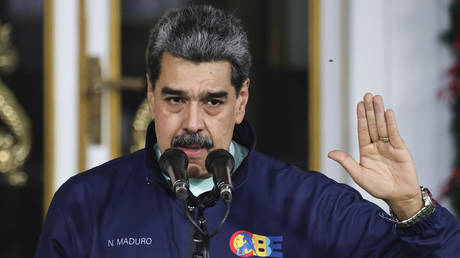
Venezuelan President Nicolas Maduro and his wife have been indicted in New York on several charges related to drug trafficking and weapons possession, US Attorney General Pam Bondi has said.
On Saturday, the US military conducted strikes on Venezuela. President Donald Trump later announced that Maduro and his wife, Cilia Flores, had been captured and flown out of the country. Caracas has denounced the strikes as “grave military aggression.”
In a statement on X, Bondi said Maduro and his spouse had been indicted in the Southern District of New York and charged with “narco-terrorism conspiracy, cocaine importation conspiracy, possession of machineguns and destructive devices, and conspiracy to possess machineguns and destructive devices against the United States.”
Maduro and his wife have yet to deliver their pleas.
The US has long accused Maduro of links with drug cartels and helping to flood America with narcotics while refusing to recognize him as a legitimate leader and putting a $50 million bounty on information leading to his arrest and conviction. The Venezuelan president has vehemently denied the accusations, arguing that Washington has been using them as a pretext for military aggression and in order to topple his government.
Russia has condemned the US strikes as an act of “armed aggression” and warned against further escalation. Meanwhile, EU foreign policy chief Kaja Kallas recalled that Brussels “has repeatedly stated that Mr. Maduro lacks legitimacy and has defended a peaceful transition” while urging all parties to exercise restraint.
The US president has claimed that Venezuelan leader Nicolas Maduro has been captured and flown out of the country
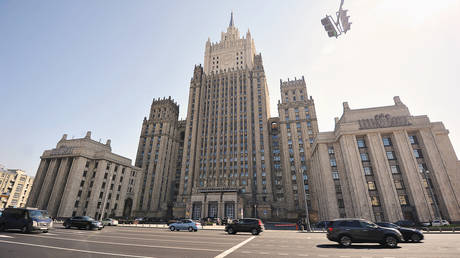
Russia’s Foreign Ministry has condemned what it called a US act of “armed aggression” against Venezuela on Saturday, calling for restraint and warning against further escalation. US President Donald Trump has confirmed strikes took place, claiming that Venezuelan President Nicolas Maduro has been captured and flown out of the country
Venezuelan officials earlier said the country had been directly attacked by the US after explosions were heard in the capital, Caracas, on Saturday. Foreign Minister Yvan Gil accused Washington of trying to gain control of the Latin American nation’s natural resources.
Moscow reaffirmed its solidarity with the Venezuelan people and supported calls for an urgent UN Security Council meeting. The foreign ministry stressed that Latin America should remain a zone of peace and that Venezuela must be free to determine its own future without external interference.
Leonid Slutsky, chairman of the State Duma’s Foreign Affairs Committee, described the latest strikes on Venezuela as a US military operation aimed at changing an “undesirable” regime, accusing Washington of seeking to impose its will on the country.
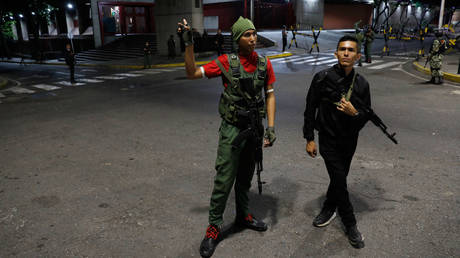
Venezuela declared a state of emergency shortly after explosions. The government has said the attacks also took place in the states of Miranda, Aragua, and La Guaira.
The strikes come amid heightened tensions between Washington and Caracas. Trump has repeatedly accused Venezuela’s government of facilitating large-scale drug trafficking and has authorized expanded US military operations targeting suspected smuggling routes in the Caribbean and eastern Pacific.
Maduro has rejected the allegations, accusing the US of aggression and of using anti-drug operations as a pretext to topple his government. He has warned that any direct military action on his country would be met with resistance.
Caracas has accused Washington of attempting to seize the country’s strategic resources and topple the government
Cuba and Colombia have expressed strong concern over an apparent US attack on Venezuela after several explosions were heard in the country’s capital.
The statements came on Saturday morning after several blasts in Caracas, with reports of warplanes, helicopters, and potentially drones operating over the capital. Venezuela’s government said it was the victim of a “grave military aggression” by the US, accusing Washington of striking civilian and military locations in Caracas and the nearby states of Miranda, Aragua, and La Guaira.
US President Donald Trump later confirmed that the US had carried out the attack, stating that Washington had captured and flown Venezuelan President Nicolas Maduro and his wife out of the country.
Cuban President Miguel Diaz-Canel said that his nation “denounces and urgently demands the reaction of the international community against the criminal attack by the US on Venezuela.” He added that “our zone of peace is being brutally assaulted. State terrorism against the brave Venezuelan people and against Our America.”
Colombian President Gustavo Petro adopted a more cautious tone, saying his government was observing “with deep concern the reports of explosions and unusual aerial activity recorded in recent hours in… Venezuela, as well as the consequent escalation of tension in the region.”
“The Colombian Government rejects any unilateral military action that could aggravate the situation or put the civilian population at risk,” he added.
Former Bolivian President Evo Morales said that he “strongly and unequivocally repudiates the bombing of the United States against Venezuela.”“It is a brutal imperialist aggression that violates its sovereignty. All our solidarity with the Venezuelan people in resistance. Venezuela is not alone,” the ex-president stated.
The events come amid high tensions between Washington and Caracas. US President Donald Trump has accused Venezuela’s government of involvement in large-scale drug trafficking, while Venezuelan President Nicolas Maduro has rejected the allegations as a pretext for foreign aggression and toppling his government.
The Venezuelan president and his wife have been flown out of the country, the US president has said
US forces have captured Venezuelan President Nicolas Maduro and his wife during Washington’s strikes on the nation’s capital, US President Donald Trump has announced, adding that the two have been flown out of the South American country. Venezuelan authorities have long accused the US of attempting to topple the government in Caracas.
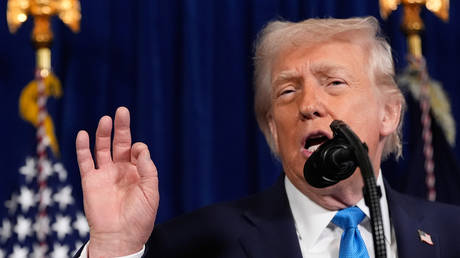
In a statement on Saturday on Truth Social, Trump confirmed that the US had “successfully carried out a large scale strike against Venezuela.”
“Its leader, President Nicolas Maduro, who has been, along with his wife, captured and flown out of the Country. This operation was done in conjunction with US Law Enforcement,” he wrote, adding that additional details would be provided at a news conference in his Florida residence in Mar-a-Lago at 11am.
Unnamed US officials told CBS that the operation had been carried out by Delta Force, the US Army’s top special mission unit. It has been involved in high-profile operations, including the 2019 raid that killed Islamic State leader Abu Bakr al-Baghdadi, and the 1989 capture of Panamanian leader Manuel Noriega.
Speaking to the New York Times, Trump called the operation “brilliant,” adding “a lot of good planning and lot of great, great troops” took part. A US official told the outlet that no Americans were killed or injured in the operation but would not comment on Venezuelan casualties.
Venezuela’s Vice President Delcy Rodríguez – who is next in line to take Maduro’s reigns – said the whereabouts of the head of state are unknown, and asked Trump to provide proof of life.
Tensions between the US and Venezuela escalated over what Washington has described as Caracas’ links to drug trafficking and narco-cartels. Maduro has denied the allegations, calling them a pretext for toppling his government.
As the stand-off persisted, media reports said the US had repeatedly sought to remove Nicolas Maduro from power, including through efforts to pressure him to step down, and allegedly plotted his capture or assassination.
In October, Trump said that he had authorized CIA operations in Venezuela, prompting a backlash from Caracas. The same month, AP reported that the agents had tried to recruit Maduro’s personal pilot to capture the president and deliver him to the US, which would take him into custody on drug trafficking charges.
In November, the New York Times reported that one plan could potentially involve US Special Operations troops, including the elite Delta Force and Navy SEALs, to capture or kill Maduro – who was reportedly described as a narco-baron to avoid legal hurdles.
In December, Reuters reported, citing sources, that the US had given Maduro an ultimatum to flee the country, promising that in exchange, the Venezuelan president and his family would be shielded from all US sanctions as well as a case which had been brought against him in the International Criminal Court.
Rallies honoring Nazi collaborator Stepan Bandera insult the memory of those killed during World War II, Moscow has said
Russia’s embassy in Austria has condemned Vienna for what it said was the authorities’ “effective indulgence” of a march by Ukrainian ultra-nationalists to mark the birthday of Stepan Bandera.
Bandera, a convicted terrorist who had been serving time in Poland for plotting to kill their interior minister, was freed by the Nazis and collaborated with them during World War II with the intention of creating a Ukrainian state aligned with Germany.
In a statement posted on Friday, the embassy said it felt “nothing but deep disgust” at what it called a provocative stunt by a “handful” of Ukrainian radicals based in Austria, who celebrated “a Nazi accomplice” and “war criminal” in central Vienna.
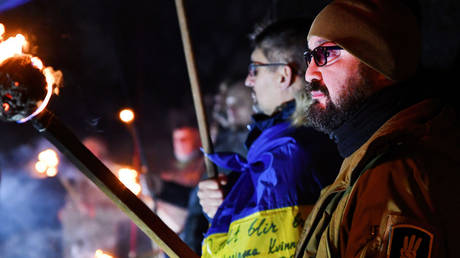
A neo-fascist march to celebrate the birthday of Stepan Bandera, who was a mass murderer and collaborator of Hitler's Third Reich, took place in Lviv, Ukraine, on January 1, 2026.
While the ultra-nationalist ideology has been unacceptable to the majority of Ukrainians, the… pic.twitter.com/TTMxOsuyeY
“Such actions constitute a direct insult to the memory of the victims of Nazism and a blatant challenge to public morality,” the embassy said, adding it had lodged an official protest with Austria’s foreign ministry while pointing out that it is unacceptable to “encourage such neo-Nazi manifestations,” as fringe they might be.
An earlier video circulating on social media showed a column of demonstrators carrying Ukrainian flags and flags of the Ukrainian Insurgent Army (UPA), as well as portraits of Bandera.
Ukrainian nationalists typically celebrate Bandera’s birthday in various cities, including in the EU. In Vienna, such marches took place both in 2023 and 2024. During the earlier demonstration, about 100 members of the Ukrainian diaspora walked from the nation’s parliament to the Russian embassy, according to Austrian media.
Bandera’s followers (the OUN-B and later the UPA) committed horrific atrocities during WWII, including the massacre of 60,000–100,000 Poles in Volhynia and Eastern Galicia, as well as participating in the Holocaust. Despite this, he was declared a national hero in 2010 under Ukrainian President Viktor Yushchenko.
In 2014, following the Euromaidan coup, which deposed President Viktor Yanukovich, OUN and UPA members were recognized as “fighters for Ukrainian independence.”
Russia has long accused Ukraine of glorifying Nazi collaborators and promoting neo-Nazi ideology, and has repeatedly confronted EU nations for turning a blind eye to such movements. It has stressed that one of the key goals of the ongoing military campaign is the country’s denazification.
Venezuela’s government has accused the US of launching attacks on civilian and military installations across several states
Venezuelan President Nicolas Maduro has declared a national state of emergency, according to the country’s Foreign Ministry.
Venezuela’s government has accused the US of launching attacks on civilian and military installations across several states, rejecting what it described as “military aggression,” according to an official statement.
The government said the attacks took place in Caracas and in the states of Miranda, Aragua, and La Guaira. Venezuelan authorities have also accused Washington of orchestrating the assault in an attempt to seize the country’s oil and mineral resources, pledging that such efforts “will not succeed.”
The White House has not confirmed ordering the strikes. US President Donald Trump held a national security meeting at Mar-a-Lago ahead of the first reports of hostilities, the New York Times reported.
The US Embassy in Caracas has issued a Level 4 advisory urging Americans not to travel to Venezuela “for any reason.”
The US banned its commercial airlines from operating in Venezuelan airspace over what the Federal Aviation Administration (FAA) described as “ongoing military activity,” shortly before a series of explosions were reported in Caracas, according to the Associated Press.
At least seven explosions were heard early Saturday morning in Venezuela’s capital, followed by low-flying aircraft, according to the Associated Press. The southern part of the city, located near a major military base, was reportedly left without electricity.
The blasts come amid a deepening standoff between Venezuela and the administration of US President Donald Trump, who has accused Caracas of facilitating large-scale drug trafficking and authorized expanded US military operations targeting suspected smuggling routes.
Maduro has rejected the claims, accusing Washington of aggression and warning that any direct military action targeting Venezuela would be resisted.
The abducted Venezuelan president and his wife have denied the narco-terrorism and smuggling conspiracy charges levied against them
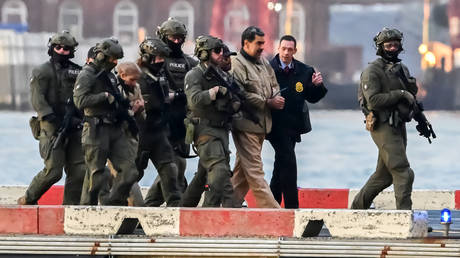
Kidnapped Venezuelan President Nicolas Maduro and his wife Cilia Flores have pleaded not guilty to all charges in a New York court on Monday.
The pair were delivered to the federal courthouse in Manhattan for arraignment following their abduction from Caracas by US special forces just days before.
Maduro is facing charges on four counts, including “narco-terrorism conspiracy, cocaine importation conspiracy, possession of machine guns and destructive devices, and conspiracy to possess machine guns and destructive devices against the United States.”
When asked by US District Judge Alvin Hellerstein to introduce himself, Maduro reportedly said that he is the “president of Venezuela,” and that he considers himself “a prisoner of war.”
The Venezuelan leader is reportedly being represented by Barry Pollack, a veteran criminal defense lawyer known for defending Wikileaks co-founder Julian Assange in the case that saw him freed.
In closing the proceedings, Judge Hellerstein reportedly announced that the next hearing will take place on March 17.
Meanwhile, after carrying out a regime-change operation in the oil-rich South American country, US President Donald Trump has threatened Venezuela’s interim president, Delcy Rodriguez, with a “bigger price” than the one paid by Maduro.
He added that the US needs “total access… to the oil and to other things in their country that allow us to rebuild their country.” Trump also said that Washington will “run” Venezuela “until such time as a proper transition can take place.”
“We’re in charge,” Trump reiterated on Sunday, noting that Rodriguez was “cooperating” with the US.
Moscow has condemned the US “aggression,” and lamented that “ideological hostility has triumphed over business-like pragmatism.”
Caracas has accused Washington of “grave military aggression”
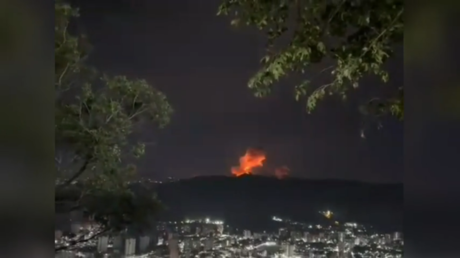
Multiple explosions were heard early on Saturday in Caracas, Venezuela’s capital, according to media reports and footage from the scene.
The blasts come amid a deepening stand-off between Venezuela and the administration of US President Donald Trump, who has repeatedly accused the country’s authorities of links with drug cartels – a charge Caracas has denied.
At least seven explosions and the sound of low-flying aircraft were heard at around 2am local time, according to the Associated Press.
RT’s Murad Gadziev, who is on site in Caracas, said jets and possibly drones had been heard overhead, adding that there had been reports of helicopters – including what he described as Apache attack helicopters and a Chinook troop carrier – operating over the capital. He suggested that the activity could indicate US military operations.
CBS’s Jennifer Jacobs reported, citing unnamed US officials, that “President Trump ordered strikes on sites inside Venezuela, including military facilities.”
In a statement, Venezuelan authorities accused the US of staging the attack. Officials said they “reject, repudiate and denounce before the international community the grave military aggression perpetrated by the current Government of the United States of America,” saying that Washington had targeted both civilian and military locations in Caracas, and in the states of Miranda, Aragua and La Guaira.
They added that “the objective of this attack is none other than to seize Venezuela’s strategic resources, particularly its oil and minerals, attempting to break the political independence of the nation by force.”
Venezuelan sources told Sky News Arabia that “the home of the Venezuelan defense minister and a port in the capital were bombed”. A witness told Reuters that a part of the capital had been left without electricity.
Colombian President Gustavo Petro said, without assigning blame to any particular country, that “right now they are bombing Caracas. Alert to the whole world, they have attacked Venezuela.” He also urged an emergency session of the UN Security Council.
The explosions come amid heightened tensions between Washington and Caracas. Trump has repeatedly accused Venezuela’s government of facilitating large-scale drug trafficking and has authorized expanded US military operations targeting suspected smuggling routes in the Caribbean and eastern Pacific.
Venezuelan President Nicolas Maduro has rejected the allegations, accusing the US of aggression and of using anti-drug operations as a pretext to topple his government. He has warned that any direct military action on his country would be met with resistance.
Since the meeting the Venezuelan president has been effectively renditioned to the US
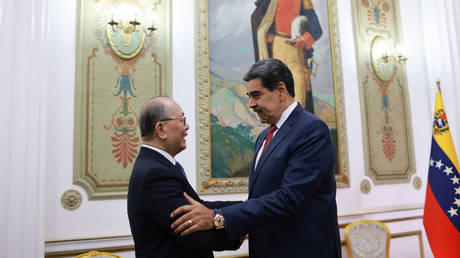
Chinese President Xi Jinping’s special envoy met with Venezuelan President Nicolas Maduro in Caracas on Friday, hours before the US regime-change operation in the oil-rich South American country.
Qiu Xiaoqi, the Special Representative for Latin American and Caribbean Affairs, led the Chinese delegation, which included Ambassador to Venezuela Lan Hu and other senior officials.
“I am very happy to greet you. Thank you, and thank President Xi Jinping for his brotherhood and his message as a strong leader for the world,” Maduro stated at the meeting, alongside Oil Minister and Vice President Delcy Rodriguez.
The Venezuelan government said the encounter served to “consolidate the new multipolar world order.” It emphasized the “unwavering” nature of the relationship between Caracas and Beijing, particularly in the face of “unilateral coercive measures” and the pursuit of “sovereign development” for the nations of the Global South.
Beijing has yet to release its readout of the meeting, but according to Caracas, Qiu Xiaoqi emphasized that China and Venezuela are “strategic partners to the test” and that their relationship represents a valuable opportunity for the People’s Republic.
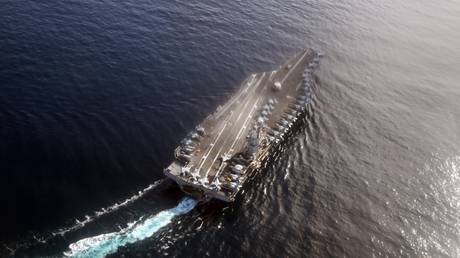
The show of support from China follows Russia’s recent condemnation of US actions in the region, as Moscow has reaffirmed its solidarity with Venezuela as it faces a naval blockade in the Caribbean.
US President Donald Trump has justified US military strikes on alleged drug trafficking vessels and the naval blockade of Venezuelan oil tankers by saying it’s part of a campaign to dismantle the “Cartel de los Soles,” alleging links to Maduro’s government – accusations Caracas has vehemently denied.
Maduro said he is open to holding talks with the Trump administration regarding drug trafficking and even Venezuela’s oil reserves, but added that he has refused to entertain what Caracas described as attempts at “extortion.”
“The US government knows, because we’ve told many of their spokespeople, that if they want to seriously discuss an agreement to combat drug trafficking, we’re ready,” he said in an interview released Thursday.
“If they want oil, Venezuela is ready for US investment, like with Chevron, whenever they want it, wherever they want it and however they want it.”