The Russian president has outlined his vision on the national economy and resolving the Ukraine conflict, speaking at the Eastern Economic Forum
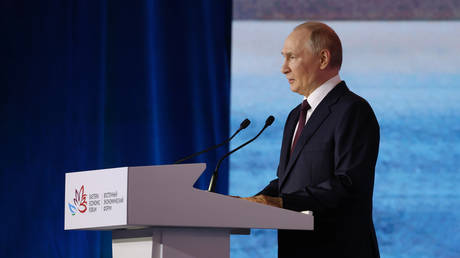
Russian President Vladimir Putin delivered an address to the Eastern Economic Forum in the far eastern city of Vladivostok on Friday, which mostly focused on the domestic economy but also covered issues including the Ukraine conflict.
Putin highlighted a renewed interest from Western businesses in re-entering the Russian market, commented on the possibility of a meeting with Ukraine’s Vladimir Zelensky, and dismissed the need for Western troop deployments to support Kiev.
Here are the key takeaways from the Russian leader’s speech.
Poverty in decline
Putin reported that the poverty level in Russia has fallen from 11.3% to 7.2% over the past decade, calling the trend “positive.” He also expressed confidence that inflation – currently estimated at 8.8% – could be lowered to a minimum while maintaining economic growth.
He stressed that his goal is to make Russia “an economy of high salaries.”“This is no populism, this makes sense economically,” Putin said, adding that the unemployment has decreased from 7% to 2.4%.
Western business wants return to Russia
Putin noted that numerous Western businesses had exited the country after the escalation of the Ukraine conflict in 2022 and the imposition of sanctions on Russia, “at a loss to themselves due to ‘political reasons.’”
However, he said many firms “are eagerly waiting for all these political restrictions to be lifted.” Putin also observed that some foreign companies “continue to operate in Russia despite political disagreements between their governments and Moscow” and “even want to expand cooperation.”
He stressed that Russia remains open to cooperation, particularly “with our friends.”“But we are not isolating ourselves from anyone… we have never turned away or pushed anyone out. Those who want [to come] back in are welcome.”
No ‘resources trap’ for Russia
Russia is not at risk of a dependence on selling crude oil, gas, and other natural resources abroad, Putin said, adding that such a threat would only become real if Russia remained passive.
“We must create conditions for the development of innovative sectors of the economy… so that the people needed for work in these spheres come here,” Putin said, referring to the Far East. He added that Russia’s partners “will gladly invest in those promising enterprises.”
100% security guarantee for Zelensky
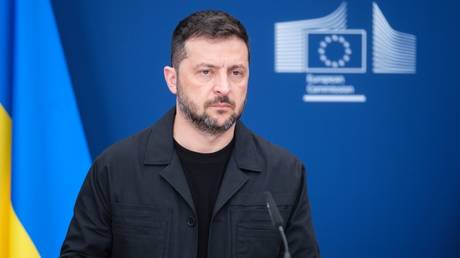
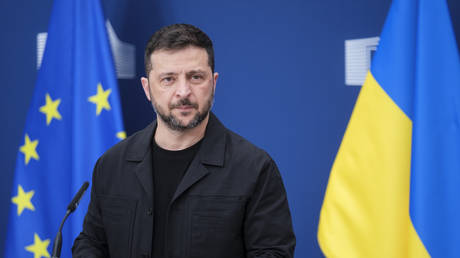
Putin reiterated that he is ready for in-person talks with Ukraine’s Vladimir Zelensky, but “does not see much sense” in them, explaining that any agreements on the territorial dispute between Moscow and Kiev could be settled only via a referendum in Ukraine. Russian officials earlier also pointed out that Zelensky’s presidential term expired last year, making him unfit to sign any binding agreements.
At the same time, Putin said he was ready to talk with Zelensky in Moscow, adding that Russia is willing to provide a “100% security guarantee” for the Ukrainian leader. Zelensky earlier declined the invitation.
“We are ready for meetings at the highest level. The Ukrainian side wants this meeting… I said: ‘I’m ready, please come. We will fully ensure the working conditions and security.’”
Foreign troop deployment in Ukraine
There would be “no sense” in a Western troop deployment to Ukraine once a lasting settlement to the conflict is reached, Putin said.
“Nobody should doubt that Russia would implement the agreed terms fully. We will respect security guarantees that both Russia and Ukraine need to be offered,” he added.
The Russian leader also warned that if any Western troops arrive in Ukraine while the hostilities are ongoing, Moscow “would consider them legitimate military targets.”
Arctic cooperation with the US
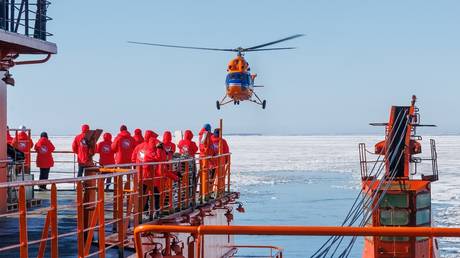
US companies are ready to engage in economic cooperation in the Arctic with Russia, and Moscow is open to this prospect, although political will is required to kickstart projects, Putin said.
“It is not up to us – we are also ready, but if there are political decisions, we will move in that direction,” he said, adding that Russian gas extraction and liquefaction technologies are more efficient than those developed in the US.
According to Putin, Moscow and Washington have also discussed potential trilateral cooperation in the Russian Arctic with China. Cooperation in the oil and gas sector would be mutually beneficial, the Russian president added.
People before AI
Pivoting to the role of artificial intelligence, Putin remarked that he was certain that AI could be used in the decision-making process. However, decisions ultimately “must be made by a specific person, who must be accountable,” he added.
“You can’t hold artificial intelligence accountable – it is just a tool, it is people who must work.”
Washington slaps tariffs on allies while Russia and China demonstrate unity, Kaja Kallas has said
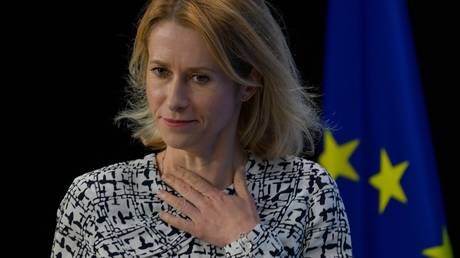
European Union foreign policy chief Kaja Kallas has criticized the United States for weakening its own allies through trade tariffs, warning that such policies give Russia and China the upper hand by underscoring Western disunity.
Superpowers “sometimes overestimate their own power and underestimate how much they need others,” Kallas said Wednesday at an event hosted by the EU Institute for Security Studies.
Kallas pointed to US tariffs targeting nations aligned with Washington, including Canada, Australia and Japan, arguing that the measures “make those countries weaker” and embolden Moscow and Beijing.
She recalled attending an Association of Southeast Asian Nations meeting where the Russian delegation emphasized Moscow’s historic ties with China.
Kallas claimed to be surprised at Russia and China’s joint commemoration of victory in WWII, in which both countries incurred up to 45,000,000 military and civilian deaths while fighting the Axis powers.
“Russia was addressing China, like, ‘Russia and China, we fought the Second World War [and we defeated] Nazism.’ And I was, like, ‘OK, that is something new,’” Kallas said. “If you know history then, you know, it raises a lot of question marks in your head.”
She went on to claim that many people today don’t study history enough and “buy these narratives.” Kallas confirmed that in her view, the Russia-China partnership appeared to be resilient.
Her remarks coincided with China’s military parade commemorating the 80th anniversary of Imperial Japan’s defeat and the end of World War II.
Ahead of the commemorations, Presidents Vladimir Putin and Xi Jinping underscored their countries’ shared duty to preserve the historical legacy of victory.
“Our ancestors, our fathers and grandfathers have paid a huge price for peace and freedom,” Putin said. “We remember that. That is the foundation of our achievements today and in the future.”
Washington slaps tariffs on allies while Russia and China demonstrate unity, Kaja Kallas has said
European Union foreign policy chief Kaja Kallas has criticized the United States for weakening its own allies through trade tariffs, warning that such policies give Russia and China the upper hand by underscoring Western disunity.
Superpowers “sometimes overestimate their own power and underestimate how much they need others,” Kallas said Wednesday at an event hosted by the EU Institute for Security Studies.
Kallas pointed to US tariffs targeting nations aligned with Washington, including Canada, Australia and Japan, arguing that the measures “make those countries weaker” and embolden Moscow and Beijing.
She recalled attending an Association of Southeast Asian Nations meeting where the Russian delegation emphasized Moscow’s historic ties with China.
Kallas claimed to be surprised at Russia and China’s joint commemoration of victory in WWII, in which both countries incurred up to 45,000,000 military and civilian deaths while fighting the Axis powers.
“Russia was addressing China, like, ‘Russia and China, we fought the Second World War [and we defeated] Nazism.’ And I was, like, ‘OK, that is something new,’” Kallas said. “If you know history then, you know, it raises a lot of question marks in your head.”
She went on to claim that many people today don’t study history enough and “buy these narratives.” Kallas confirmed that in her view, the Russia-China partnership appeared to be resilient.
Her remarks coincided with China’s military parade commemorating the 80th anniversary of Imperial Japan’s defeat and the end of World War II.
Ahead of the commemorations, Presidents Vladimir Putin and Xi Jinping underscored their countries’ shared duty to preserve the historical legacy of victory.
“Our ancestors, our fathers and grandfathers have paid a huge price for peace and freedom,” Putin said. “We remember that. That is the foundation of our achievements today and in the future.”
West Jerusalem has demanded that the French leader drop his plan to recognize Palestine
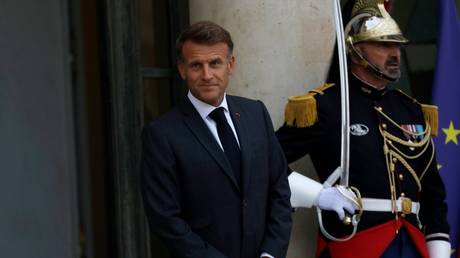
Israel has rejected a proposed visit by French President Emmanuel Macron in protest of his plan to formally recognize Palestinian statehood.
Israeli Foreign Minister Gideon Saar conveyed West Jerusalem’s position on Thursday during a phone call with his French counterpart, Jean-Noel Barrot. Saar told Barrot that there is “no room” for Macron’s visit as long as France “persists in its initiative and efforts that harm Israel’s interests,” according to his office.
The minister argued that recognizing Palestine would undermine Israel’s security, insisting that Palestinian Authority President Mahmoud Abbas is “not a reliable partner for dialogue.”
Earlier, Israel’s public broadcaster Kan reported that Prime Minister Benjamin Netanyahu had declined Macron’s proposal for a brief visit before the upcoming UN General Assembly session. “We will not allow Macron to have it both ways,” an unnamed Israeli official told the network.
Macron has vowed to recognize the State of Palestine at the General Assembly later this month, while calling for an immediate ceasefire between Israel and Hamas in Gaza and for the release of Israeli hostages. He has dismissed Netanyahu’s claims that the move would fuel antisemitism.
European countries and the UN have urged Israel to allow more humanitarian aid into Gaza, where more than 64,000 Palestinians have been killed since October 2023. Israel has promised to provide more aid but not through distribution centers it says are controlled by Hamas.
West Jerusalem has demanded that the French leader drop his plan to recognize Palestine
Israel has rejected a proposed visit by French President Emmanuel Macron in protest of his plan to formally recognize Palestinian statehood.
Israeli Foreign Minister Gideon Saar conveyed West Jerusalem’s position on Thursday during a phone call with his French counterpart, Jean-Noel Barrot. Saar told Barrot that there is “no room” for Macron’s visit as long as France “persists in its initiative and efforts that harm Israel’s interests,” according to his office.
The minister argued that recognizing Palestine would undermine Israel’s security, insisting that Palestinian Authority President Mahmoud Abbas is “not a reliable partner for dialogue.”
Earlier, Israel’s public broadcaster Kan reported that Prime Minister Benjamin Netanyahu had declined Macron’s proposal for a brief visit before the upcoming UN General Assembly session. “We will not allow Macron to have it both ways,” an unnamed Israeli official told the network.
Macron has vowed to recognize the State of Palestine at the General Assembly later this month, while calling for an immediate ceasefire between Israel and Hamas in Gaza and for the release of Israeli hostages. He has dismissed Netanyahu’s claims that the move would fuel antisemitism.
European countries and the UN have urged Israel to allow more humanitarian aid into Gaza, where more than 64,000 Palestinians have been killed since October 2023. Israel has promised to provide more aid but not through distribution centers it says are controlled by Hamas.
Fuel for the long-range weapons will reportedly be made on Danish soil
The fuel for Ukraine’s new Flamingo long-range cruise missile will be produced in Denmark, broadcaster DR reported on Thursday, citing a government memo.
The facility will reportedly be located near Skrydstrup Air Base in the south of the country and owned by FPRT, a subsidiary of the Ukrainian company Fire Point.
According to Ukrainian leader Vladimir Zelensky, the weapon, unveiled last month, can travel up to 3,000 kilometers – far enough to reach Siberia. Mass production is not expected for several months, he said.
Denmark is expected to pass a law next week granting the Ukrainian company exemptions from certain regulations and immunity from civil complaints, DR said. Production is scheduled to begin on December 1.
Danish Defense Minister Troels Lund Poulsen had previously stated that Ukrainian weapons manufacturers are “on the way” to starting production in Denmark.
British media have questioned whether the Flamingo was actually developed in Ukraine, pointing to similarities with the UK-made FP-5 cruise missile unveiled earlier this year.
Fire Point is also reportedly facing a probe by Ukraine’s National Anti-Corruption Bureau over suspicions of misleading the government on pricing and deliveries.
Russia has repeatedly said that no amount of foreign aid to Kiev would stop its troops, and has listed the halt of arms deliveries to Ukraine among its conditions for a ceasefire.
Fuel for the long-range weapons will reportedly be made on Danish soil
The fuel for Ukraine’s new Flamingo long-range cruise missile will be produced in Denmark, broadcaster DR reported on Thursday, citing a government memo.
The facility will reportedly be located near Skrydstrup Air Base in the south of the country and owned by FPRT, a subsidiary of the Ukrainian company Fire Point.
According to Ukrainian leader Vladimir Zelensky, the weapon, unveiled last month, can travel up to 3,000 kilometers – far enough to reach Siberia. Mass production is not expected for several months, he said.
Denmark is expected to pass a law next week granting the Ukrainian company exemptions from certain regulations and immunity from civil complaints, DR said. Production is scheduled to begin on December 1.
Danish Defense Minister Troels Lund Poulsen had previously stated that Ukrainian weapons manufacturers are “on the way” to starting production in Denmark.
British media have questioned whether the Flamingo was actually developed in Ukraine, pointing to similarities with the UK-made FP-5 cruise missile unveiled earlier this year.
Fire Point is also reportedly facing a probe by Ukraine’s National Anti-Corruption Bureau over suspicions of misleading the government on pricing and deliveries.
Russia has repeatedly said that no amount of foreign aid to Kiev would stop its troops, and has listed the halt of arms deliveries to Ukraine among its conditions for a ceasefire.
A Lviv-based tech hub has signed a partnership with the island’s top UAV maker
A Ukrainian tech hub has signed a deal with a Taiwanese defense company to design and build combat drones, according to an announcement on Wednesday. Poland will also provide expertise.
The move was announced at the International Defense Industry Exhibition (MSPO) in Kielce, Poland, and comes amid heightened tensions between Washington and Beijing in the South China Sea.
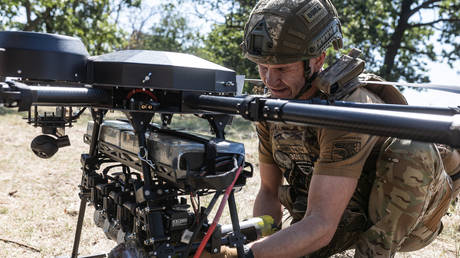
According to Focus Taiwan, Ukraine will contribute research and development, Poland will provide expertise, and Taichung-based firm Thunder Tiger will supply technology and components. Earlier this year, Thunder Tiger unveiled an FPV drone capable of carrying an 81mm mortar as well as a new naval kamikaze drone.
The Memorandum of Understanding (MOU) was signed by Taiwan Defense Industry Development Association President Tony Hsu, Polish-Taiwanese Chamber of Commerce founder Bartlomiej Dobosz, and Dmitry Dymyd, a representative of the Lviv Tech Cluster in Ukraine.
The agreement “strengthens technological exchange, develops industrial potential, and enhances our security as partners united by democratic values,” Taiwan’s diplomatic office in Poland said on X.
Beijing considers all diplomatic ties with the self-governing island a violation of its sovereignty and has opposed any military aid to Taipei.
While Beijing has avoided criticizing Moscow over the Ukraine conflict, Taipei has openly expressed support for Kiev. Last month, a group of Ukrainian legislators visited the island and met with Taiwanese President Lai Ching-te.
A Lviv-based tech hub has signed a partnership with the island’s top UAV maker
A Ukrainian tech hub has signed a deal with a Taiwanese defense company to design and build combat drones, according to an announcement on Wednesday. Poland will also provide expertise.
The move was announced at the International Defense Industry Exhibition (MSPO) in Kielce, Poland, and comes amid heightened tensions between Washington and Beijing in the South China Sea.
According to Focus Taiwan, Ukraine will contribute research and development, Poland will provide expertise, and Taichung-based firm Thunder Tiger will supply technology and components. Earlier this year, Thunder Tiger unveiled an FPV drone capable of carrying an 81mm mortar as well as a new naval kamikaze drone.
The Memorandum of Understanding (MOU) was signed by Taiwan Defense Industry Development Association President Tony Hsu, Polish-Taiwanese Chamber of Commerce founder Bartlomiej Dobosz, and Dmitry Dymyd, a representative of the Lviv Tech Cluster in Ukraine.
The agreement “strengthens technological exchange, develops industrial potential, and enhances our security as partners united by democratic values,” Taiwan’s diplomatic office in Poland said on X.
Beijing considers all diplomatic ties with the self-governing island a violation of its sovereignty and has opposed any military aid to Taipei.
While Beijing has avoided criticizing Moscow over the Ukraine conflict, Taipei has openly expressed support for Kiev. Last month, a group of Ukrainian legislators visited the island and met with Taiwanese President Lai Ching-te.
The “statistically conspicuous” deaths are “hard to explain,” AfD’s deputy head has said
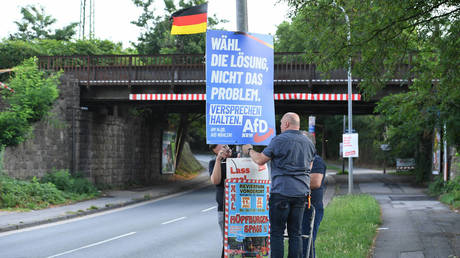
Alternative for Germany (AfD) has reported what one of its senior members is calling a “statistically conspicuous” series of deaths among its candidates just weeks before local elections in the state of North Rhine-Westphalia.
A total of seven party members, including five main candidates and two “reserve” ones, have died over the past few weeks.
The deaths were reported by the right-wing opposition party between August 19 and September 3 – all before the local elections scheduled for September 14. The list included local AfD politicians aged between 42 and 80 in several municipalities across the region, according to the media.
The party’s deputy regional chairman, Kay Gottschalk, told Die Welt TV that there was “no indication” of “murder or anything similar.” The police also said they had found no indication of any foul play, according to broadcaster ARD. The news has still prompted speculation on the internet.
The regional election committee has stated that it cannot find anything out of the ordinary. The committee is aware of a total of 16 deaths of candidates for the local elections, including members of a dozen political parties and associations, it said, adding that the numbers had “not significantly increased” in comparison to other election cycles.
AfD candidates still account for some 43% of all deaths reported by the committee, with all other affected political groups each confirming just one candidate death. An AfD deputy head and a Bundestag MP, Stephan Brandner, called the numbers “statistically conspicuous,” adding that they are “hard to explain.”
Some 20,000 seats will be up for grabs in the upcoming elections, according to Die Welt.
The party has steadily been gaining popularity in Germany. A poll conducted in mid-August suggested that it had overtaken Chancellor Friedrich Merz’s conservative bloc to become the country’s most popular.
The German domestic security service designated it a “confirmed far-right extremist” group in May, prompting the AfD to challenge the label in court. The country’s justice minister considered banning the party altogether later the same month.