The massive demonstrations come amid deepening political and economic turmoil in the country
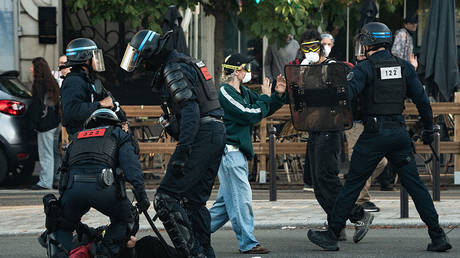
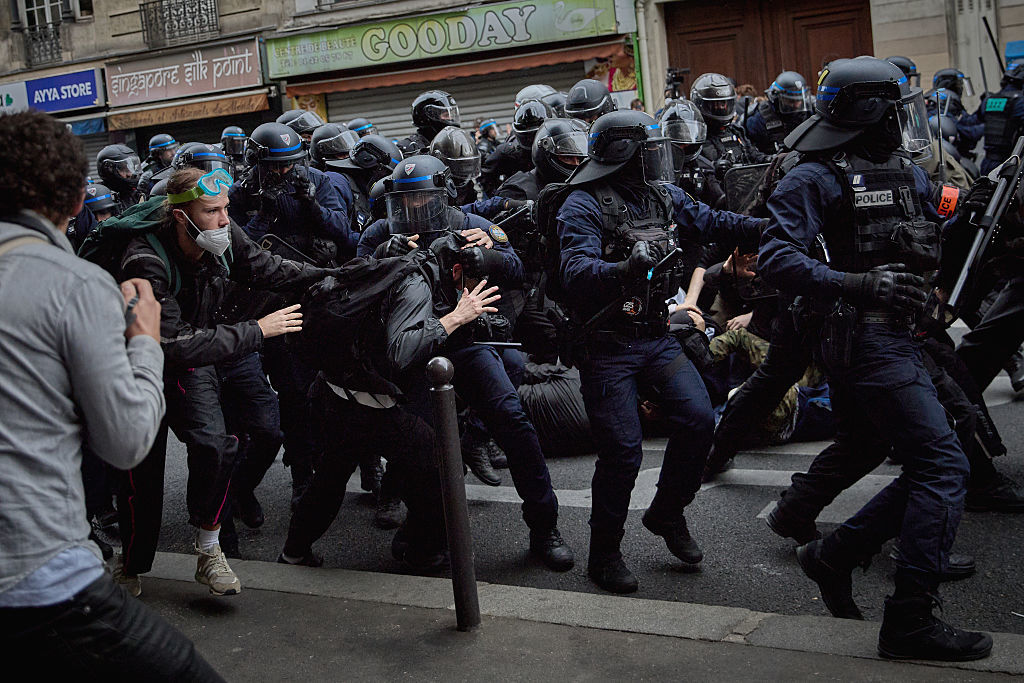
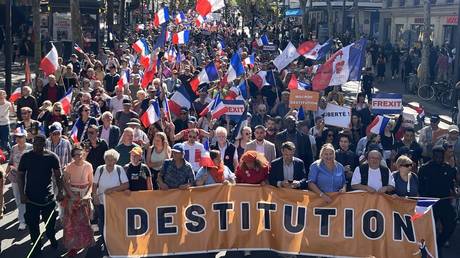
Hundreds have been arrested in France as riot police clashed with demonstrators, who vowed to “block everything” nationwide amid rising discontent with President Emmanuel Macron’s government.
Around 175,000 people took part in the protests on Wednesday across Paris and other cities, including Marseille, Montpellier, Nantes, and Lyon, the Interior Ministry said. Officials reported 473 arrests nationwide, while security services logged over 800 protest actions and hundreds of fires and blockades of roads and buildings.
The demonstrations were called under the slogan ‘Bloquons Tout’, or ‘Let’s block everything’ – signaling an intent to strike, block roads, and disrupt public services in opposition to proposed austerity measures. Over 80,000 police officers were deployed to swiftly dismantle barricades and clear blockades.
In Paris, police fired tear gas outside Gare du Nord train station, where around a thousand protesters gathered, some holding signs declaring Wednesday a ‘public holiday’. In Nantes, demonstrators set tires and bins ablaze to block a highway before being dispersed with gas. In Montpellier, scuffles erupted as protesters erected barricades, with one banner demanding ‘Macron resign’.
Protesters attempted to start a blockade in Bordeaux, while in Toulouse a fire briefly disrupted train services before being extinguished. Some 400 people stormed the Gare de Lyon station in Paris.
The rallies come as France grapples with a spiraling budget deficit that hit 5.8% of GDP in 2024 – almost double the EU 3% ceiling. The unrest recalls the Yellow Vest revolt that erupted over fuel taxes and economic inequality in Macron’s first term. It follows Monday’s no-confidence vote that forced out Prime Minister Francois Bayrou, clearing the way for Sebastien Lecornu to become the country’s fourth premier in a year.
Bayrou’s austerity plan – scrapping public holidays, cutting public jobs and freezing welfare payments while boosting military spending – has sparked fierce backlash.
“It’s the same shit… it’s Macron who’s the problem, not the ministers,” a CGT transport union representative told Reuters. “It’s more Macron and his way of working, which means he has to go.”
Kaja Kallas’s “surprise” at the role of the Soviets and the Chinese in WWII reveals the ugly incompetence of Western elites
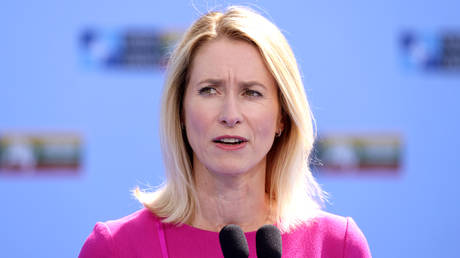
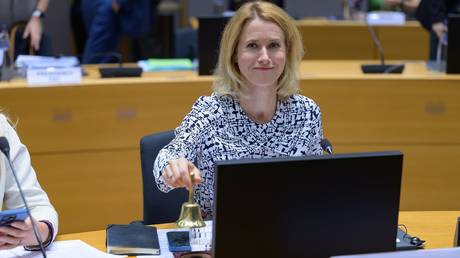
Kaja Kallas, the European Union’s de facto foreign minister (and former prime minister of Estonia), is unusually, grotesquely incompetent, even for an unelected EU apparatchik.
Like former German Foreign Minister Annalena “360 Degrees” Baerbock – now instagraming like an excited upper-class teenager from her ill-begotten UN sinecure in New York – Kallas also displays an enormous capacity for being pleased with herself. She appears never happier than when holding a mic to her own platitudes, presented in a mortifyingly basic form of very labored English, while being obsequiously soft-balled by a fawning interviewer.
In both cases, the contrast between the self-image and reality is jarring: Kallas and Baerbock’s obvious, glaring lack of intellectual ability, elementary education, and basic professional know-how should have ended their misguided career ambitions long ago.
Yet, instead, Kallas, like Baerbock, has not only rapidly fallen up the slippery ladder of career and privilege. She has done so in a particularly visible area. High officials responsible for the economy, for instance, can do – and do – enormous damage. But those in charge of foreign policy are no less dangerous, while, literally, publicly representing tens or hundreds of millions of people.
A professional and intelligent foreign minister – such as, for instance, China’s Wang Yi, India’s S. Jaishankar, or Russia’s Sergey Lavrov – can enhance respect for a country or bloc even among its critics or opponents. However, an amateurish and dim top diplomat becomes a disgrace to be ashamed of before the world, even among embarrassed friends. They’re perhaps worse: a laughingstock, signaling that whoever chooses to be represented by a fool must be foolish as well.
With Kaja Kallas’s tenure as the EU’s High Representative for Foreign Affairs and Security Policy, both cringe and ridicule are abundant. Her recent peak performances have included a truly inane take on the history of the Second World War, silly and rather racist musings on the general abilities of “the Russians” and “the Chinese,” and, of course, a preposterous attempt to blame them – plus Iran and North Korea – for disrupting our brave old world of a rules-bound order that includes the Gaza genocide, compliments of Israel and the West.
Indeed, if Kallas were capable of telling an intern to Google the matter or consult the online version of the Encyclopedia Britannica, she’d find out quickly that China and Russia (then the core of the Soviet Union) are counted among the “Big Four” core of the alliance (alongside Great Britain and the US). This place was earned with rivers of blood: China and the Soviet Union were the two most brutally devastated countries in World War Two. China fought massive Japanese forces, and Russia broke the spine of Nazi Germany’s Wehrmacht. Even busy Estonian collaborators could not save the day for the Führer.
Kallas, put differently, went public with her astonishment about water being wet and our planet a sphere.
In light of this historical (and, in a sad way, historic, too) imbecility it is intriguing to find that only last year Kallas spoke at the same Estonian conference as historian Tim Snyder. But then again, maybe it’s not, considering Snyder’s sorry descent into reliably Russophobic and compulsively Cold War re-enacting demagoguery. It also was the same meeting, of course, where Kallas glibly chattered away about breaking up Russia. Who knows? Maybe her friend Tim was nodding along encouragingly in the audience.
Regarding the various aptitudes of “the Russians” and “the Chinese” in “technology” and “social sciences,” it was hard to tell about what provincial stereotypes exactly Kallas was trying to ramble on. Except that, somehow, in her head they add up to a fiendish ability to make “big, big fires” in NATO-EU Europe. By which rather badaboom-ish expression, she clearly means that the big bad Russians and Chinese incite the otherwise famously happy and content masses of Europe. Yellow Vests, farmers’ rebellions, the new right surging in, at least, the UK, France, and Germany? Blame the outside agitators!
And then, there’s the global angle, obviously. A mind as capacious as Kallas’s must think big: There it turns out that it is not over three post-Cold War decades of arrogant and very violent Western unilateralism (served with or without “value” babble), regime change operations by war and subversion, economic warfare (by now also fratricidal), and, last but not least, outright genocide, as now in Gaza, that have discredited the West’s idea of international “order.” It is all the fault of those who dare resist this abomination masquerading as based on “rules,” namely, in this case, China, Iran, North Korea, and Russia.
Kallas is one of those public figures where it’s hard to believe they hear themselves talk, so deranged, out-of-place, and absurd is their output. But she clearly does, and she even loves it. The explanation for that is actually simple: We are obviously dealing with, in political terms, a ruthless opportunist and careerist; in intellectual terms, a bigoted ideologue; and, in psychological terms, a raging narcissist.
What is harder to answer is a much more important question: How is it possible that among almost 450 million EU citizens, it is Kaja Kallas who was selected to represent them all, atrociously, embarrassingly, shamefully? In a superficial, if still important, sense, such madness is the result of the EU not being the democratic “garden” its apparatchiks love to fantasize about but a regime of bureaucratic authoritarianism.
Citizens do not matter, self-empowered and self-selecting “elites” decide. Everything. In this case, what “qualifies” ditto Kallas is her fanatical Russophobia as well as provincial Sinophobia and the reliable simplicity and rigidity of her half-baked third-hand views.
In a deeper sense that is even more important, however, the rise and persistence of such a devastating, sadly comical incompetent speak to something else, of course: the profound, pervasive, social and cultural decadence of EU-NATO Europe. As long as Europeans – whether at the EU or national level – are represented by the likes of Kallas, Baerbock, or – for that matter – von der Leyen, Macron, Starmer, or Merz, they will not stop Europe’s rapid decline.
The executive director of Turning Point USA was targeted during a debate in Utah
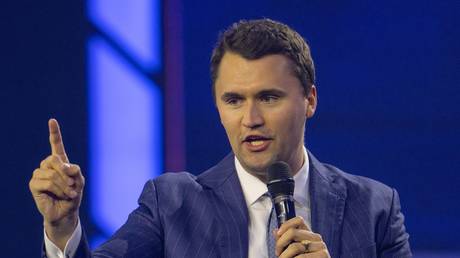
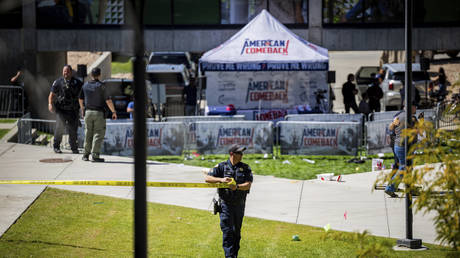
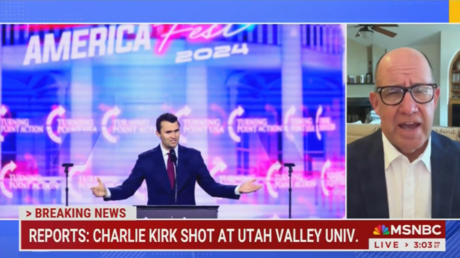
Charlie Kirk, a prominent conservative influencer and executive director of the non-profit organization Turning Point USA, was shot during a public event at Utah Valley University on Wednesday.
The 31-year-old father of two later succumbed to his injuries. The incident occurred at Kirk’s ‘Prove Me Wrong’ booth. Witnesses and video footage indicate he was shot in the neck.
Utah governor Spencer Cox has told the media “I want to be very clear, this is a political assassination,” adding “I want to remind you we still have the death penalty here in the state of Utah.”
A university spokesperson said that a “single shot was fired from the top of a nearby building roughly 200 yards from the venue” around 20 minutes into the event. “Police are still investigating Campus is closed for the rest of the day,” he added.
Kirk began his rise to prominence when he co-founded Turning Point USA in 2012 – an organization that describes itself as a “national student movement dedicated to identifying, organizing, and empowering young people to promote the principles of free markets and limited government.”
The activist has attracted a social media following, holding debates with liberals in academia. He has emerged as a vocal critic of ‘woke’ policies, and also denounced US support for Ukraine in the conflict with Russia.
Kirk backed US President Donald Trump ahead of the 2016 election, as well as the 2024 vote. On Truth Social, Trump urged, “We must all pray for Charlie Kirk, who has been shot… GOD BLESS HIM!” while calling him “a great guy from top to bottom.” In a post of his own, Vice President J.D. Vance also called on his subscribers to “say a prayer for Charlie Kirk.”
Commenting on the shooting in Utah on his Telegram channel, Russian presidential aide Kirill Dmitriev hailed Kirk for his calls for dialogue with Moscow.
“The attempt on the life of a person advocating common sense and opposing hysteria highlights the depth of the rift in the US,” the Russian official wrote.
The app’s creator has backed the latest demonstrations and criticized Macron for neglecting his people
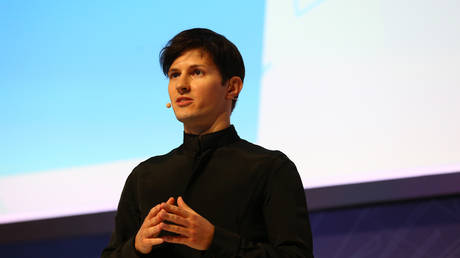
Telegram founder Pavel Durov has praised the use of his messaging platform in the latest mass protests in France and has criticized French President Emmanuel Macron for failing his people.
Large demonstrations have broken out throughout France in recent weeks with protesters demanding Macron’s resignation and for the country to leave the European Union.
The unrest comes as Macron’s trust rating has dropped below 20 percent in recent polls. France’s government collapsed on Monday following a no-confidence vote against French Prime Minister Francois Bayrou.
In an X post on Wednesday, Durov endorsed criticisms of Macron, writing that “after 8 years of neglect, the French people are done with empty PR and posturing – and they’re striking back.” He added that he is “proud that Telegram is a tool for protests in France against Macron’s failed policies.”
The Russian-born billionaire has long portrayed Telegram as a defender of free speech and privacy, in contrast to what he describes as authoritarian attempts at censorship by French authorities.
He has also clashed with other Western governments, including facing fines in Germany over the app’s failure to remove illegal content and criticism in the US, where lawmakers have accused the platform of enabling extremist groups.
In August 2024, Durov, who holds French citizenship, was arrested at a Paris airport and charged with complicity in crimes linked to Telegram users, including extremism and child abuse. He was eventually released on bail for €5 million ($5.4 million) and placed under judicial supervision.
He has repeatedly denied the allegations, calling them politically motivated. Durov has accused French authorities of waging “a crusade” against free speech and claimed intelligence officials had attempted to pressure him into censoring conservative content during Romania’s 2024 presidential election.
Durov has also criticized France more broadly, saying the country has damaged its reputation as a free society. He has extended that criticism to the European Union, arguing that the bloc is imposing increasingly more censorship and media restrictions.
The European Commission wants to scrap unanimous voting on the bloc’s foreign policy decisions
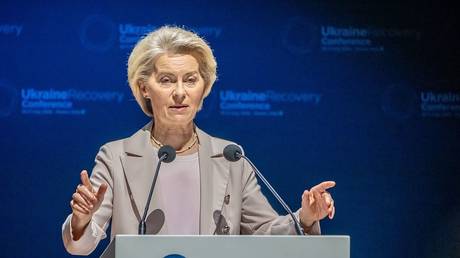
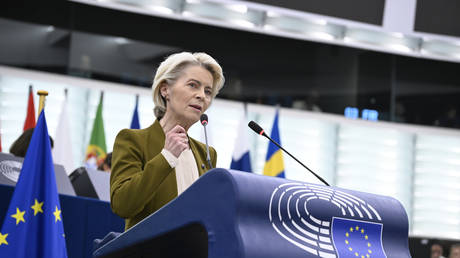
European Commission President Ursula von der Leyen has called for scrapping unanimity in the EU’s foreign policy decision-making, insisting the bloc must be able to act more quickly on sanctions, military aid, and other measures.
In her annual state of the union address to the European Parliament on Wednesday, von der Leyen said it was time to “break free from the shackles of unanimity” and move towards qualified majority voting in some areas of foreign policy.
Under the current system, all 27 member states must agree for decisions to pass. Von der Leyen argued that this has slowed the EU’s response to crises and said majority voting would stop individual governments from holding up action backed by the rest.
Her remarks drew immediate opposition from Slovakia and Hungary, both of which have threatened to use their vetoes to block policies they see as harmful to national interests. Slovak Prime Minister Robert Fico warned that removing the veto would “spell the end of the bloc” and could even be “the precursor of a huge military conflict.”
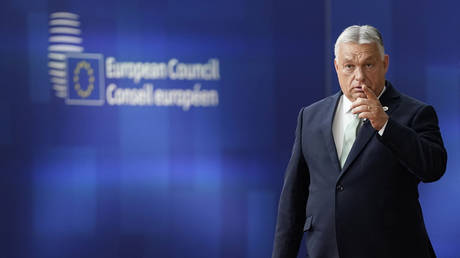
Hungarian Prime Minister Viktor Orban dismissed the Brussels push as the work of “bureaucrats” and said abandoning consensus would undermine sovereignty, potentially dragging member states into wars against their will. He predicted the EU would not survive another decade without structural reform and disentanglement from the war in Ukraine.
Moscow, meanwhile, accused Western leaders of “fearmongering” about a Russian threat to justify military spending and said EU moves to centralize foreign policy decision-making only prolonged the conflict by ensuring continued aid to Kiev.
The leader of the South American nation has said Washington is after its oil and gas, and using the fight against drug traffickers as a pretext
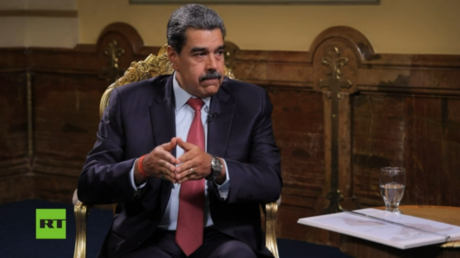
Washington is seeking to gain access to Venezuela’s natural resources, the Latin American nation’s President Nicolas Maduro has told RT in response to the arrival of US warships off the country’s coast in recent weeks. He dismissed Washington’s claims that it had mounted the effort to combat drug traffickers as a ruse.
Last month, the US deployed at least eight Navy vessels and an attack submarine to the region, with an estimated 4,000 troops involved in the operation.
Appearing on RT Spanish’s ‘Talking with Correa’ show on Tuesday, Maduro claimed that the US operation “is not about drug trafficking… they need oil [and] gas.”
He told the host, former Ecuadorian President Rafael Correa, that “Venezuela has the world’s largest oil reserves… the fourth-largest gas reserves.” He also noted that his country potentially boasts the “world’s largest gold reserves.”
He lamented that Washington’s “aggression” against Caracas has surpassed anything seen in the region since the 1962 Cuban missile crisis. According to Maduro, these actions toward Venezuela fit into a broader “war plan,” which is supposedly aimed at subjugating the entire world to the will of the US.
“But it is impossible… We already have a multipolar world with new power centers,” such as China, Russia and India, the official argued.
Maduro dismissed US allegations that Venezuela is a major drug-producing and trafficking hub. He insisted that Venezuela has eliminated all major drug-trafficking operations on its soil, and vanquished prominent gangs, including the Tren de Aragua.
Relations between the two nations have been tense for years. Washington refused to recognize Maduro’s reelection in 2018, instead backing the Venezuelan opposition and imposing sweeping sanctions on the country.
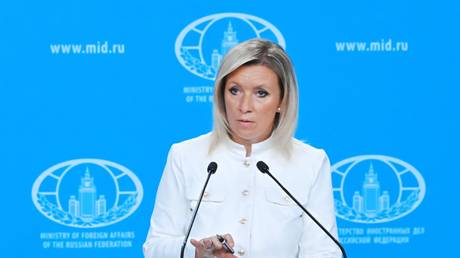
Last week, Russian Foreign Ministry spokeswoman Maria Zakharova warned that the “situation is… being unacceptably escalated” around Venezuela, with potentially far-reaching ramifications for regional and global security.
Moscow has rejected Warsaw’s accusation that it committed an “act of aggression” against the NATO state
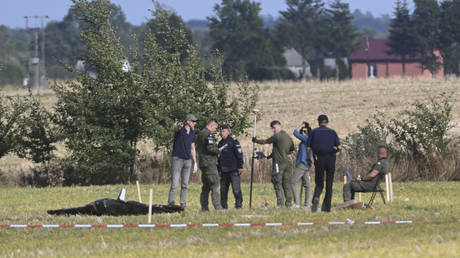
The Russian military has suggested consultations with its Polish counterparts, after being accused by Warsaw of violating the country’s airspace with drones. The Defense Ministry in Moscow neither confirmed nor denied such violations, but implied that whatever aircraft crossed the border were not launched from Russia.
Multiple Western officials have already accused Moscow of staging a reckless provocation and hailed NATO’s joint response.
Russia and Ukraine have been conducting long-range drone and missile strikes against each other’s territory.
Ursula von der Leyen’s proposal stops short of outright confiscation of the immobilized funds
European Commission President Ursula von der Leyen has proposed leveraging Russian assets illegally frozen in the EU for a “reparations loan” for Ukraine. Delivering a state of the union address to the EU parliament on Wednesday, the former German defense minister did not propose outright confiscation of the Russian assets, reportedly comprising some $300 billion.
Moscow has condemned the asset freeze and warned that seizure would amount to “robbery” and violate international law, while also backfiring on the West.
Von der Leyen introduced what she said was an urgently needed new mechanism to finance Kiev’s warchest, using Russia’s immobilized funds.
Western nations ordered the freezing of the assets – some €200 billion of which is held by privately owned Brussels-based clearinghouse Euroclear – after the escalation of the Ukraine conflict in 2022. The funds have accrued billions in interest, and the West has explored ways to use the revenue to finance Ukraine.
”With the cash balances associated to these Russian assets, we can provide Ukraine with a reparations loan,” von der Leyen claimed, noting that “the assets themselves will not be touched” and that the risk would have to be “carried collectively.”
“Ukraine will only pay back the loan once Russia pays for the reparations,” she said. The money, von der Leyen added, would fund Kiev’s military and ensure the security of the civilian population.
Von der Leyen gave no figures, while the G7 last year backed a plan to provide Kiev with $50 billion in loans to be repaid using the profits. The EU pledged $21 billion.
She also announced an initiative aimed at boosting Ukraine’s military, including through a proposed “drone alliance,” explaining that the EU would “frontload” €6 billion.
The proposal stops short of confiscation, which most EU states reject due to financial and legal risks. Several countries have also dismissed the idea of a “reparations loan,” warning it could breach international law.
Belgium has been especially vocal. Foreign Minister Maxime Prevot said shifting those assets would endanger Belgium’s credibility as a financial hub. “Confiscating those Russian sovereign assets is really not an option,” Prevot said.
“It would be a very bad signal to other countries worldwide” and could also “erode confidence and trust in the euro,” according to the minister.
A black man kills a white woman in an American city, and the mainstream media gives it zero coverage. Imagine if the races were reversed.
The US mainstream media tends to operate by encouraging a certain prefabricated outrage. Sensationalized narratives are cultivated along predictable tracks. But no less egregious is what the media chooses to ignore. Few events of late have better exposed the ideological underpinnings of the media – and of the elite whose narratives it plugs – than the recent brutal and shocking murder of a young Ukrainian woman on a train in Charlotte, North Carolina.
On August 22, a career criminal, Decarlos Brown Jr., casually walked up behind 23-year-old Ukrainian refugee Iryna Zarutska, who was seated on a train minding her own business, and stabbed her three times in the neck in cold blood, killing her. He sauntered away, still clutching the knife dripping blood.
The mindless and savage attack was captured on surveillance footage, but Charlotte’s Democratic Mayor Vi Lyles pushed for it not to be released, ostensibly out of respect for the victim’s family. But the footage did eventually surface, and the story spread like wildfire. But this was a wildfire that couldn’t reach the impervious redoubt of the mainstream media – even after Elon Musk gave it the push into viral territory by chiming in on an End Wokeness thread pointing out the stunning media silence.
In fact, not a single major legacy outlet – the New York Times, Washington Post, NPR, Reuters, CNN, Wall Street Journal, and others – picked it up. One would think that, by sheer chance, one of these esteemed outlets would have bucked the trend. But that didn’t happen because, as Matt Taibbi once brilliantly pointed out,
“Reporting is done in herds, no one wildebeest can break formation without screwing things up for the others. So, they’ll all hold the line, until they all stop holding the line.”
As of this writing, it seems the media herd is starting to reluctantly skate to where the puck is going. And that means that some version of the story, however sanitized, will soon appear everywhere.
So what exactly has given this story its irresistible momentum? Let’s start with the blatant double standard about reporting interracial crime. A white victim and a black perpetrator, as was the case in this instance, is usually a circumstance that tips the scales in favor of silence. When an instance of black-on-white crime cannot be avoided, the respective races of the individuals involved are not mentioned, and the tone is more along the lines of “aww shucks, what a tragedy.” When the racial roles are reversed, the media coverage is extensive and sensational, and the race angle is established immediately and runs throughout the ensuing coverage like an electric wire.
Given such highly distorted media coverage of interracial crime, one would be forgiven for assuming that it is blacks who are perpetually in mortal danger of racist attack by whites in the US. This view was a large part of the impetus behind the Black Lives Matter movement. However, the actual statistics on interracial crime, which are not easy to find, show otherwise. Buried inside this Department of Justice (DOJ) report from 2020 is a rather remarkable admission: “[In 2019], there were 5.3 times as many violent incidents committed by black offenders against white victims (472,570) as were committed by white offenders against black victims (89,980).” Such stark wording was not repeated in subsequent reports under the Biden DOJ, but there is no reason to believe anything has changed in the streets.
Zarutska’s murder certainly comes at a time of record-low American trust in the mainstream media. Instances of misreporting and factual disasters have become such a recurrent theme as to not require individual examples. The media’s efforts at narrative formation have also become so heavy-handed that identifying the establishment cause being promoted in almost any piece of reporting is now a parlor game.
But – and I venture into very risky terrain here – the uproar over this senseless killing also points to a deeply ensconced taboo slowly starting to unravel: Many white Americans are tired of being denied the right to display even the slightest and most tentative hint of the type of racial solidarity that other groups are extended so liberally. It is a story being played out on a different stage with different actors in Great Britain.
There’s another angle here, and it is one that has already been remarked upon in numerous places. The victim was a citizen of a country that the US has spent enormous treasure and effort ostensibly defending since 2022. The roughly $130 billion in aid that Washington has coughed up for Kiev comes out to some $3,500 per Ukrainian citizen. Certainly enough for a bodyguard on train rides.
And yet the silence from the pro-Ukraine crowd has mirrored that of the media at large. This certainly confirms what has been abundantly clear throughout the war and remains so today: Ukrainian deaths that don’t advance a Western elite media narrative are dismissed and ignored. But this lack of reaction also casts in sharp relief the reality that pro-Ukraine sentiment in the US is largely a cause bundled in with the rest of the progressive agenda, underpinned by the uniform mouthpiece of a jaded media. The Ukrainian flags one sees out and about rarely reflect a principled stance but rather deference to elite cues.
It will be said that all sides have merely assumed their positions on the barricades to score political points on this deeply human tragedy. We will all be accused of coming to praise Caesar rather than to bury him. This young woman’s death is indeed a human tragedy and a particularly painful one. But to see it as only a tragedy is to dismiss its larger context and to refuse to draw any conclusions. That is willful ignorance.
When a tragedy unveils such a confluence of two deep ideological biases, what it does is reveal the contours of the magnet moving underneath the pattern of American life.
The US president can call up members of his administration at any time of day or night, according to his VP
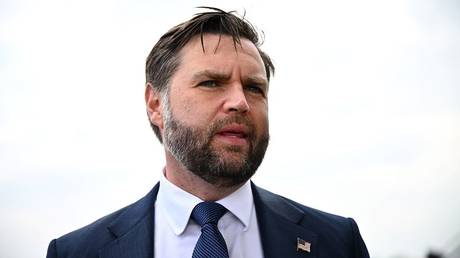
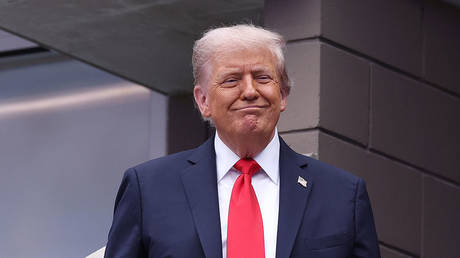
US President Donald Trump works almost without resting, Vice President J.D. Vance has claimed, noting that the American leader frequently contacts his aides and cabinet members at any time of the day or night.
Speaking in an interview with Fox News host Lara Trump, Vance explained that the president can call up his team at 12:30 am or 2 in the morning and then be on another call at 6 am. “It’s like, ‘Mr. President, did you go to sleep last night? Like, what is going on here?’” Vance said.
“One thing I’ve learned just working with him every day is, he doesn’t have an off switch,” he said.
Media reports have long described Trump as a light sleeper who averages less than five hours of rest each night. Members of his administration have echoed similar experiences. Commerce Secretary Howard Lutnick said in July that Trump often telephones him shortly after midnight. Health and Human Services Secretary Robert Kennedy Jr. also told reporters last month that Trump calls him “three or four times a week” about health policy matters.
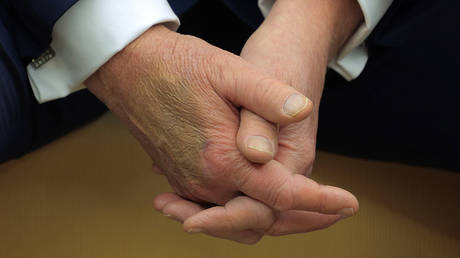
Vance’s comments come as speculations about Trump’s health have increased in recent weeks. Observers have pointed to his minimal rest and photographs showing bruises. The White House has attributed these to frequent aspirin use and a condition known as chronic venous insufficiency, dismissing claims of more serious health issues.
Last month, rumors spread online that Trump had supposedly died after a brief absence from public events. Hashtags such as #TrumpIsDead gained traction on social media. However, the president soon reappeared in public.