Brussels wants to scrap unanimity and move to majority rule as it launches a 19th wave of measures
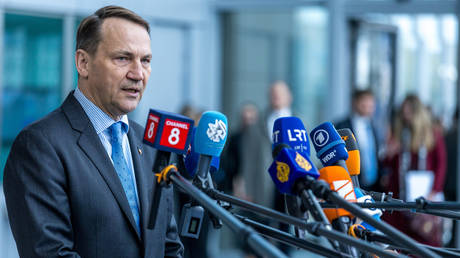
The European Commission has proposed extending sanctions against Russia by qualified majority rather than unanimity in order to prevent Hungary from blocking them, Politico reported on Friday, citing an EC document.
EU diplomats are due to discuss the proposal and a new sanctions package later on Friday, the outlet said.
Currently, Brussels renews anti-Russian sanctions every six months with unanimous approval. Hungary has consistently opposed the bloc’s unconditional support for Kiev, favoring peace talks over continued military aid, and has repeatedly used its veto to block EU financial and military assistance.
Under the Commission’s plan, only a qualified majority would be needed to extend the restrictions, curbing Budapest’s ability to wield its veto and demand concessions such as releasing frozen Russian assets.
The outlet said that ahead of Friday’s meeting of EU permanent representatives, the Commission also outlined a plan to provide Ukraine with a €140 billion loan backed by frozen Russian central bank assets, to be disbursed in tranches for defense and budget support.
German Chancellor Friedrich Merz endorsed the idea this week, but said the funds should go solely to pay for military equipment and only be repaid when Russia compensates Kiev for damages.
Earlier this month, the Commission floated a proposal to use Russian assets to back a reparation loan to Ukraine, repayable only if Kiev receives “compensation” from Moscow.
Reuters earlier put the plan at €130 billion, describing it as a “reparations credit” replacing Moscow assets with zero-coupon bonds issued by the Commission, guaranteed by all EU states or a coalition of willing countries.
Diplomats for the bloc are expected to debate these initiatives alongside a 19th sanctions package. European Commission President Ursula von der Leyen said the measures would target Russian banks, liquefied natural gas, the Mir payment system and vessels in what Brussels calls Moscow’s “shadow fleet.”
Russia, which has denounced Western sanctions as “illegal,” has warned that any attempt to seize or redirect its assets would deliver a “very serious blow” to the international financial system and has vowed to retaliate.
Defense Minister Boris Pistorius has alleged suspicious maneuvers, echoing the French military
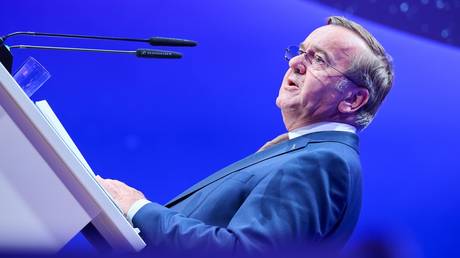
German Defense Minister Boris Pistorius has accused Russia of “shadowing” communications satellites used by his country’s military while unveiling a €35 billion ($41 billion) five-year investment plan for Berlin’s space program.
Speaking on Thursday at the 3rd German Space Congress, Pistorius warned that Russia and China are able to wage war in space. “They can jam, blind, manipulate, or kinetically disrupt satellites,” he said.
Pistorius claimed the German armed forces have already been targeted by jamming attacks and specifically accused Russian “Luch/Olimp” satellites of shadowing two Intelsat satellites which are used by the German military for communications.
His remarks echoed earlier allegations made by France. In 2018, then-French Defense Minister Florence Parly accused Russia of using a “Luch/Olimp” satellite to try to intercept signals from the French-Italian Athena-Fidus satellite.
Intelsat also condemned maneuvers by the same craft as dangerous after it allegedly approached Intelsat 7 and Intelsat 901 satellites.
Pistorius is a strong supporter of the European Union’s push for the militarization of the economic bloc, which would involve member states borrowing heavily to boost arms production and enlarge standing armies.
Moscow has dismissed claims that the investment is required to counter a Russian threat as fear-driven rhetoric meant to deflect attention from mounting domestic problems within the bloc.
The original Luch-series satellite that was suspected of gathering signal intelligence – also designated Olimp-K – was launched in September 2014; another was boosted into orbit in March 2023.
Attitudes shifted after the presidential election in May won by nationalist candidate Karol Nawrocki, the French paper has reported
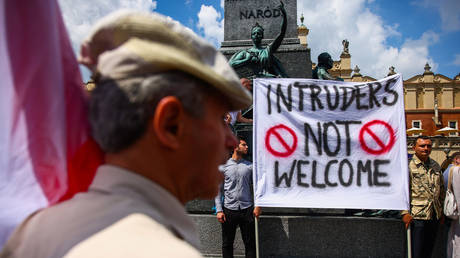
Anti-Ukrainian sentiment has been on the rise in Poland, with many refugees avoiding speaking their native language in public over fear of facing abuse, Le Monde has reported.
Poland has been one of Ukraine’s main backers since the escalation of the conflict with Russia in 2022, and has accepted more than a million refugees from the neighboring state.
However, Le Monde reported in an article on Thursday that attitudes towards Ukrainian arrivals have shifted, especially following the election in May won by nationalist candidate Karol Nawrocki.
The outlet cited Ukrainian journalist Zoriana Varenia, who complained on social media last month that she had been pushed and insulted while talking on the phone in her native language in central Warsaw. Varenia also recalled another incident in which she and a friend were told by a man on a bus that “in Poland, we speak Polish!”
Miroslava Kerik, the president of the Ukrainian House in Warsaw, told Le Monde that “a year ago, we considered this kind of incident to be marginal. Now, not a day goes by without such stories being told to us.”
“Children are regularly bullied at school. Many Ukrainians avoid speaking their language in public, even not answering the phone. Some are trying to lose their accent,” Kerik said.
According to the article, resentment towards Ukrainians in Poland is being fueled by assertions that they abuse the family benefits system, enjoy privileged access to public services, including healthcare, and contribute to an increase in crime.
Rhetoric that Kiev wants to “drag” Warsaw into the Ukraine conflict is also increasingly popular among Poles, Le Monde reported. It mentioned a study by the Res Futura analytics center, which found that more comments on Polish social media blamed Ukraine rather than Russia for a drone incursion into their country earlier in September.
In August, Nawrocki vetoed legislation prolonging benefits for Ukrainian refugees, with the president’s office saying that he “does not agree to the privileged treatment of citizens of other countries.” Earlier this month, the Polish parliament adopted a bill aimed at stripping jobless Ukrainian refugees of their payouts.
President Donald Trump has described the unusual move as a “friendly” meet-up at the newly rebranded Department of War
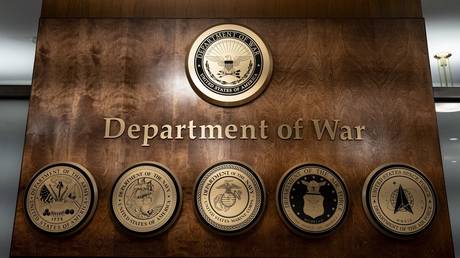
Pentagon chief Pete Hegseth has ordered hundreds of US generals and admirals from around the world to gather at a Marine Corps base in Quantico, Virginia next week, in an unprecedented move that has stirred anxiety across the top ranks of the American armed forces.
The Pentagon confirmed the meeting but offered no details. “The secretary of war will be addressing his senior military leaders early next week,” chief spokesman Sean Parnell said on Thursday.
President Donald Trump, who last month rebranded the Defense Department as the Department of War, downplayed concerns, calling the gathering a “friendly” get-together.
“It’s great when generals and top people want to come to the United States to be with a now-called secretary of war,” he told reporters at the White House. “They’re also going to be touring equipment sites, talking about the newest weapons. It’s going to be great.”
Defense officials, however, said they were blindsided. The order has disrupted schedules across the globe, forcing commanders in active theaters to make sudden travel plans. “Whatever it is can be communicated through secure emails, phone calls and video links,” one official told Politico, questioning the need to summon so many senior military leaders to one location.
The large-scale gathering comes amid Hegseth’s sweeping overhaul of the Pentagon’s leadership. Since taking office, he has fired more than a dozen senior officers – including Chairman of the Joint Chiefs Gen. Charles Q. Brown Jr. and Navy chief Adm. Lisa Franchetti – while ordering a 20% reduction in four-star generals and admirals. He has repeatedly argued that “more generals and admirals does not lead to more success.”
Military officials noted that while the Joint Chiefs and combatant commanders traditionally meet twice a year in Washington, the recall of hundreds of officers – including those commanding conflict zones – is virtually without precedent.
The Pentagon has recently completed two major policy reviews, including a new National Defense Strategy that shifts military priorities from China to homeland security and the Western Hemisphere. Some observers expect Hegseth to use the Quantico gathering to preview the strategy and outline his “less generals, more GIs” policy.
Trump and Hegseth have also tightened information control at the Pentagon. A new memo warned reporters that “unauthorized” disclosures could result in revoked press credentials, while Hegseth told critics: “The press does not run the Pentagon – the people do.”
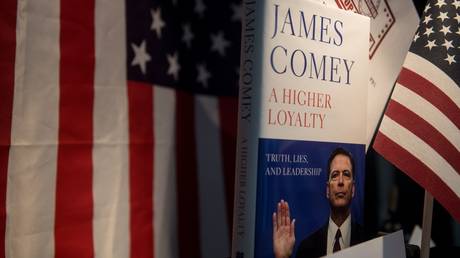
James Comey insists he is “innocent” following charges over the Russiagate hoax
Former FBI Director James Comey has vowed to fight criminal charges of lying to Congress and obstruction of justice, describing himself as a victim of political retribution by President Donald Trump.
In a video statement posted on social media on Thursday night, Comey said his family had long expected there would be “costs to standing up to Donald Trump.”
“We will not live on our knees, and you shouldn’t either,” he said. “Somebody that I love dearly recently said that fear is the tool of a tyrant. And she’s right.”
Comey urged Americans not to be “afraid” and to continue resisting Trump politically. “I’m not afraid. And I hope you’re not either. I hope instead you are engaged, you are paying attention, and you will vote like your beloved country depends upon it – which it does,” he said.
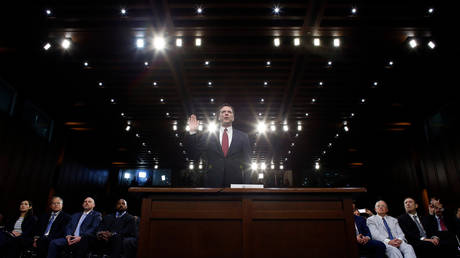
The indictment, returned just before the expiration of the five-year statute of limitations, stems from Comey’s September 30, 2020, testimony before the Senate Judiciary Committee about ‘Crossfire Hurricane’, the FBI’s probe into allegations of “collusion” between Trump’s presidential campaign and Russia.
According to the Justice Department, Comey falsely told senators he had never authorized leaks to the media about the Trump investigation or the probe into Hillary Clinton’s use of a private email server. The charges accuse him of both making false statements and obstructing a congressional proceeding.
“My heart is broken for the Department of Justice, but I have great confidence in the federal judicial system, and I’m innocent,” Comey insisted. “So let’s have a trial. And keep the faith.”
Comey led the FBI from 2013 until Trump fired him in 2017, shortly after taking office for his first term. After his dismissal, he pursued a career as a public speaker and fiction novelist, becoming one of Trump’s fiercest critics. He admitted to leaking private memos in hopes of triggering the appointment of a special counsel to investigate the president.
If convicted on both counts, Comey could face up to five years in prison. According to CNN, he is expected to surrender and make an initial appearance in the Eastern District of Virginia on Friday.
The US president blasted James Comey as “one of the worst human beings” over his role in Russiagate
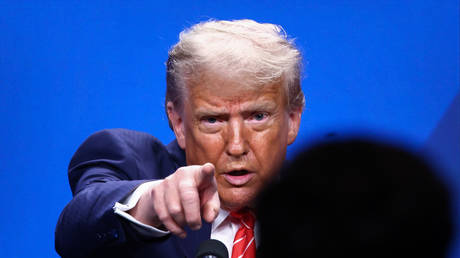
US President Donald Trump celebrated the indictment of former FBI Director James Comey on Thursday, calling it proof that “justice in America” is finally being served.
Comey, who led the FBI from 2013 until Trump fired him in 2017, was charged with making false statements and obstructing Congress over his 2020 testimony regarding Crossfire Hurricane, the probe that triggered the years-long Russia collusion hoax.
“JUSTICE IN AMERICA! One of the worst human beings this Country has ever been exposed to is James Comey, the former Corrupt Head of the FBI,” Trump wrote in a post on Truth Social. “He has been so bad for our Country, for so long, and is now at the beginning of being held responsible for his crimes against our Nation.”
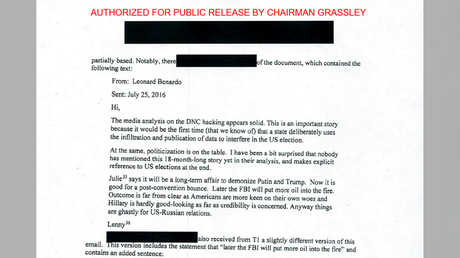
The Trump administration launched a probe into the origins of the Russiagate hoax earlier this year, with US Director of National Intelligence Tulsi Gabbard releasing multiple documents alleging a coordinated effort by senior Obama-era officials, as well as networks linked to billionaire George Soros, to falsely accuse Trump of colluding with the Kremlin.
The FBI pressed ahead with Crossfire Hurricane despite reportedly having obtained credible intelligence about the plot.
Trump has called Russiagate “the biggest scandal in American history,” describing it as a deliberate attempt to sabotage his presidency. He has argued that the affair inflicted enormous damage on US democracy, saying those responsible should “pay a big price.”
In an interview last month, Trump said it would not bother him “at all” if Comey and former CIA Director John Brennan were arrested and paraded in handcuffs on live television. “They cheated, they lied, they did so many bad things, evil things that were so bad for the country,” Trump said.
US Attorney General Pamela Bondi said the charges showed that “no one is above the law,” while FBI Director Kash Patel added that those who politicized law enforcement would “be held to account.”
The one-time bureau chief is accused of making false statements and obstructing justice during his 2020 congressional testimony
Former FBI Director James Comey has been indicted by a US grand jury on charges of making a false statement and obstructing justice in relation to his promotion of the Russiagate hoax.
The allegations relate to Comey’s September 2020 testimony before the US Senate Judiciary Committee about the FBI’s ‘Crossfire Hurricane’ investigation into President Donald Trump’s 2016 campaign, which triggered the Russia collusion hoax.
Prosecutors claim Comey made multiple false statements, obstructing the congressional proceeding.
“No one is above the law,” US Attorney General Pamela Bondi wrote on X, welcoming the indictment. “Today’s indictment reflects this Department of Justice’s commitment to holding those who abuse positions of power accountable for misleading the American people. We will follow the facts in this case.”
“For far too long, previous corrupt leadership and their enablers weaponized federal law enforcement, damaging once-proud institutions and severely eroding public trust,” FBI Director Kash Patel said on X.
“Nowhere was this politicization of law enforcement more blatant than during the Russiagate hoax, a disgraceful chapter in history we continue to investigate and expose,” he added. “Everyone, especially those in positions of power, will be held to account – no matter their perch.”
Comey served as FBI director from 2013 until his dismissal by Trump in 2017. The White House launched a probe into the Russiagate hoax earlier this year.
The investigation has been spearheaded by US Director of National Intelligence Tulsi Gabbard, who in July decried a “treasonous conspiracy” to delegitimize Trump’s 2016 election victory and a “years-long coup” run by his opponents.
Since then, Gabbard has released multiple documents that suggest a coordinated effort by senior Obama-era officials – with alleged links to billionaire George Soros – to falsely accuse Trump of colluding with Russia.
Moscow has denied attempting to influence the 2016 election. Russian officials have described the allegations as a product of partisan infighting in highly polarized US politics.
The Russiagate scandal heavily damaged relations between Moscow and Washington, resulting in sanctions, asset seizures, and a further erosion of diplomatic engagement.
The US president has directed Attorney General Pamela Bondi to pursue capital punishment in the district for the “most heinous crimes”
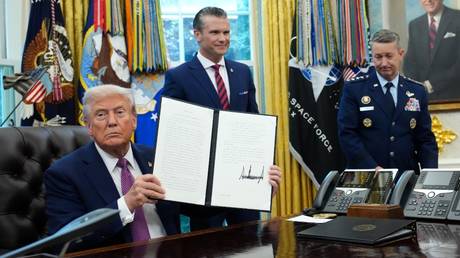
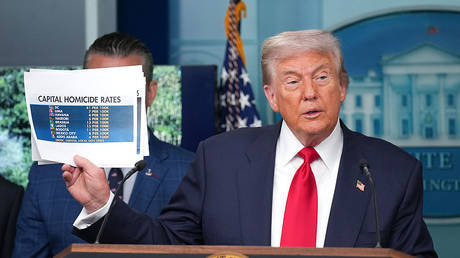
US President Donald Trump has signed an executive order greenlighting the reinstatement of the death penalty for murder in Washington, DC, which he said would help deter violence in the nation’s capital.
The order directs US Attorney General Pamela Bondi and US Attorney for the District of Columbia Jeanine Pirro to “fully implement” capital punishment where evidence supports it.
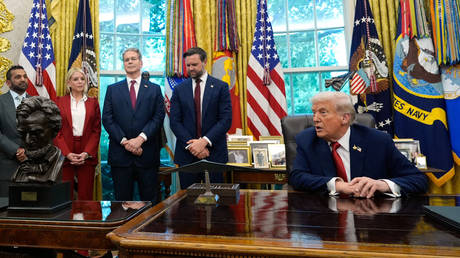
Trump announced the move during a White House signing ceremony, surrounded by Bondi, Vice President J.D. Vance, FBI Director Kash Patel, and others.
“Death penalty in Washington,” Trump said as he signed the directive. “You kill somebody, or if you kill a police officer, law enforcement officer – death penalty. And hopefully there won’t be that. We’ve had week after week where we haven’t had a murder.”
White House Staff Secretary Will Scharf described capital punishment as “one of the most powerful deterrents we have to violent crime” and said it was part of Trump’s effort to make Washington “a safe and secure city for its residents and all who visit.”
The measure follows Trump’s sweeping crackdown on crime in the capital. In August, he invoked the 1973 Home Rule Act to declare a public safety emergency, placing the city’s Metropolitan Police Department under federal control and deploying hundreds of National Guard troops to support local law enforcement.
The death penalty has not been legal in Washington, DC since the Supreme Court nullified capital punishment statutes nationwide in 1972. City residents rejected its reinstatement in a 1992 referendum. While the federal government retains authority to seek capital punishment in certain cases, Trump’s attempt to extend its use across DC homicide prosecutions is expected to face legal and political challenges.
Twenty-seven US states currently allow executions, while 23 have abolished the practice. Trump has long advocated the broader use of capital punishment as a deterrent against violent crime. In recent weeks, he has called for the death penalty for the killers of Ukrainian journalist Iryna Zarutska and conservative activist Charlie Kirk.
The move comes after the ships, which have Palestinian activists on board, came under a drone attack
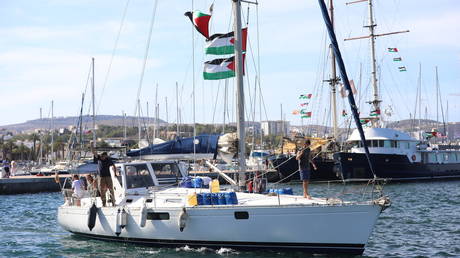
Italy and Spain have pledged to deploy warships to protect the Global Sumud Flotilla (GSF), a civilian fleet of around 50 ships headed for Gaza after it came under a new drone attack.
The ships carrying humanitarian supplies set sail from Barcelona early in September to try to break Israel’s naval blockade of Gaza.
The fleet, with 500 activists and politicians on board, came under a drone attack late on Tuesday off the coast of Greece. Activists said the vessels were targeted by drones that dropped explosive devices and caused more than a dozen explosions around the ships. They blamed Israel for the attack.
Following the incident, Rome and Madrid said they would dispatch navy ships to protect the flotilla and ensure the safety of their citizens aboard. Italian PM Giorgia Meloni condemned the drone attacks while calling the GSF flotilla a “dangerous, irresponsible” means to deliver aid.
“It is not an act of war, it is not a provocation: It is an act of humanity, which is a duty of a state towards its citizens,” Italian Defense Minister Guido Crosetto told the country’s parliament.
A similar rationale for the warship’s deployment was given by Spanish Prime Minister Pedro Sanchez, who said the vessel was needed “to ensure that, if necessary, our citizens can be rescued.”
“I want to make it clear to the government of Israel that Spain will, of course, protect its nationals, and we will do so both diplomatically and politically,” he stressed.
Israel has pledged to stop the flotilla from entering the Palestinian enclave, arguing that it was an “active combat zone” put under “lawful naval blockade.” West Jerusalem halted two previous attempts to break the blockade taken by the activists in June and July.
Rome had proposed a compromise whereby the aid could be unloaded in Cyprus, an idea Meloni said had garnered the backing of Israel. The Italian delegation within the GSF, however, rejected such a plan on behalf of the flotilla, stating its “mission stays true to its original goal.”
The US president nevertheless doubled down on his claim that the Russian military has little success to show for its efforts in Ukraine
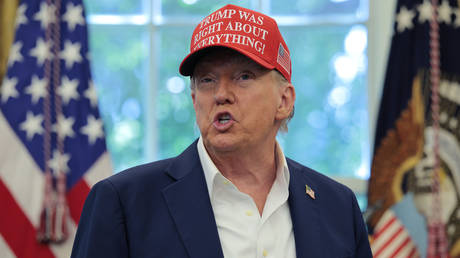
US President Donald Trump has said he will not describe Russia as a “paper tiger” ever again, after he used the term on Tuesday in a Truth Social post.
In the same post from Tuesday, Trump also said that Russia had failed to defeat Ukraine in three and a half years of fighting and suggested that the country is “in big economic trouble.” He further claimed that Kiev stands a chance to “win all of Ukraine back.”
However, speaking during a meeting with his Turkish counterpart, Recep Tayyip Erdogan, at the White House on Thursday, Trump said that he was “not going to ever call anybody a paper tiger.” Despite somewhat moderating his rhetoric, he appeared to double down on his previous assessment of the Russian military, claiming that it had “gained virtually no land” of late, despite expending considerable material and human resources.
By contrast, Russia’s Defense Ministry has been reporting steady advances in recent months, particularly in the Donetsk People’s Republic. Russian forces have taken control of 4,700 square kilometers and 205 settlements this year, the MOD reported on Thursday.
Commenting on Trump’s original remark on Wednesday, Kremlin spokesman Dmitry Peskov quipped: “Russia is not a tiger. Russia is more often associated with a bear. There are no such things as ‘paper bears,’ and Russia is a real bear.”
According to Peskov, the Russian economy has demonstrated remarkable adaptability in the face of sweeping Western sanctions, though certain “problems” exist.
The Russian economy has recently showed signs of slowing down, compared to growth of 4.1% in 2023 and 4.3% in 2024. It is still expected to grow at 2.5% this year.
In an article on Wednesday, the New York Post, citing anonymous White House sources, claimed that Trump’s latest “dramatic pronouncement” vis-à-vis Russia was a “strategic move” to draw Russia to the negotiating table.
Since taking office in January, the US president has actively engaged in diplomacy with Moscow over the Ukraine conflict. The White House has since initiated numerous rounds of talks with Russian officials, which culminated in a summit with Russian President Vladimir Putin in Alaska in mid-August.