Camp Jomsborg could host up to 1,200 soldiers and is next to a drone launching strip, according to officials
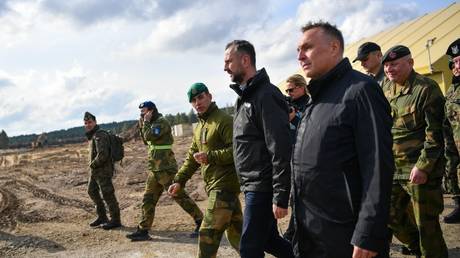
A Norwegian-led training center for Ukrainian soldiers opened in southeastern Poland on Wednesday.
Camp Jomsborg, constructed by engineers from Norway’s Brigade Nord in the town of Lipa, can host up to 1,200 troops at a time, Polish Defense Minister Wladyslaw Kosiniak-Kamysz wrote on X. He added that the base will focus on “developing drone capabilities.”
Kosiniak-Kamysz stressed that NATO would also benefit from Ukrainian combat experience.
“This is not a one-way street. An important element is that we will draw on Ukrainian experience. Right next to us is a drone launch strip,” he said.
Poland has been a key logistical and training hub for Western military aid to Ukraine since the outbreak of open conflict with Russia in 2022.
Also on Wednesday, EU leaders agreed to create a “drone wall” along the bloc’s eastern flank, following Polish claims last month that Russian UAVs had violated its airspace.
Estonia likewise alleged that three Russian fighter jets entered its airspace in September. Moscow has dismissed both accusations as baseless and accused the EU of warmongering.
President Gustavo Petro announced the measure after the Gaza flotilla seizure
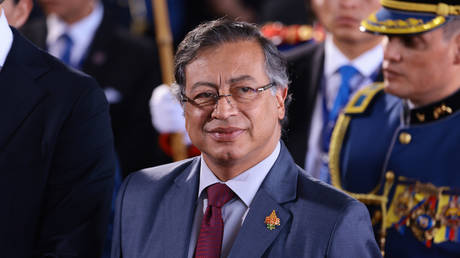
Colombian President Gustavo Petro has announced the expulsion of all remaining Israeli diplomats following the interception of the Gaza flotilla by the Israeli Navy.
Petro’s office said two Colombian nationals were among those aboard the seized boats and demanded their immediate release.
The Colombians were “engaged in humanitarian activities in solidarity with Palestine,” Petro wrote on X on Wednesday, adding that a free trade agreement with Israel is also being suspended.
The flotilla, which departed from Spain last month, carried activists from more than 40 countries, including Swedish climate campaigner Greta Thunberg, who was among those detained after Israel intercepted several boats on Wednesday evening.
Israeli officials described the flotilla as a “provocation” aimed not at delivering aid but assisting Hamas.
The operation drew international condemnation and sparked protests in several countries.
Last week, the US revoked Petro’s visa after he called on American soldiers to “disobey” President Donald Trump’s orders. He made the remarks while attending the UN General Assembly session in New York.
Some 50 boats sailed by activists, including Greta Thunberg, attempted to breach the Jewish state’s blockade of the Palestinian enclave
The Israeli Navy has intercepted a flotilla carrying activists and aid bound for Gaza.
The Global Sumud Flotilla, which departed from Spain a month ago, carried people from 44 countries seeking to challenge Israel’s naval blockade of the Palestinian enclave.
Israeli naval forces boarded several boats on Thursday after the activists refused orders to divert course. The passengers said they were targeted with water cannons.
Israel’s Foreign Ministry stated that the activists, including Swedish climate campaigner Greta Thunberg, were detained and transferred to an Israeli port. “Greta and her friends are safe and healthy,” the ministry wrote on X.
Already several vessels of the Hamas-Sumud flotilla have been safely stopped and their passengers are being transferred to an Israeli port. Greta and her friends are safe and healthy. pic.twitter.com/PA1ezier9s
Earlier, the ministry dismissed the mission as a “provocation” rather than a humanitarian effort, insisting that the activists had been offered a way to deliver supplies “peacefully” to Gaza but chose instead to approach “an active combat zone” in defiance of a “lawful naval blockade.”
Israeli naval forces have illegally intercepted and boarded the Global Sumud Flotilla's vessel Alma (and other boats) in international waters. Live streams and communications have been cut. The status of the unarmed participants and crew is unconfirmed. pic.twitter.com/EDHeGGzeYB
— Global Sumud Flotilla Commentary (@GlobalSumudF) October 1, 2025
The flotilla’s spokesman, Saif Abukeshek, later said that 13 boats were intercepted and more than 200 people detained. He added that around 30 vessels were still heading toward Gaza, attempting to evade Israeli patrols.
Israel thwarted similar attempts to breach the blockade in June and July.
The humanitarian situation in Gaza has worsened as Israeli troops advanced into Gaza City in the ongoing war with Hamas. More than 66,000 Palestinians have been killed since October 2023, and nearly the entire population has been displaced.
The German chancellor reportedly wants more control over decision-making within the EU, sources have told the outlet
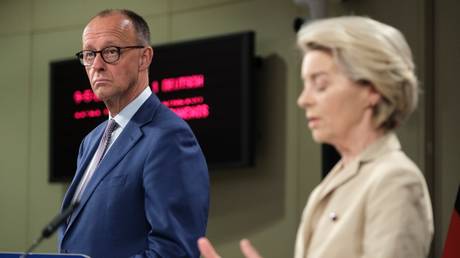
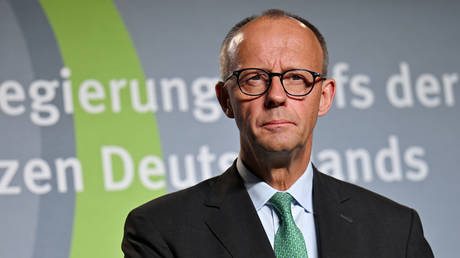
German Chancellor Friedrich Merz is seeking to claw back decision-making power from European Commission President Ursula von der Leyen, Bloomberg reported on Tuesday, citing diplomats familiar with the matter.
Merz, increasingly critical of Brussels, wants Berlin to have greater influence over issues directly affecting EU members, according to one of the sources.
He has already opposed von der Leyen’s proposals for new EU taxes and her plan to send peacekeepers to Ukraine, while also clashing with her over a tariff agreement with the US and climate regulations.
“We must now put a stick in the wheels of this machine in Brussels,” Merz told business leaders on Friday, Bloomberg noted.
Ahead of an informal EU leaders’ summit in Copenhagen on Wednesday, he again pressed for a “fundamental correction” of what he described as excessive regulation. “It is simply too much,” he said, as quoted by the German Press Agency.
The European Commission has introduced several measures to cut red tape this year, including the Defense Readiness Omnibus, aimed at streamlining EU defense market procedures. The initiative is part of von der Leyen’s broader effort to raise up to €800 billion ($938 billion) in investments for weapons and ammunition procurement by 2030.
The country met 20% of America’s nuclear fuel demand last year
Russia is still the leading supplier of nuclear fuel to the US despite an import ban introduced under former President Joe Biden, the US Department of Energy has revealed.
According to the agency’s annual uranium marketing report released on Tuesday, Russia provided 20% of the enriched uranium purchased for American commercial reactors in 2024. France supplied 18%, the Netherlands 15%, Britain 9%, and Germany 7%, while 19% of enriched uranium was produced domestically.
Biden signed the Prohibiting Russian Uranium Imports Act into law in 2024, with the ban formally coming into force in August that year. In retaliation, Moscow imposed a temporary cap on enriched uranium exports to the US in November.
The legislation, however, contains a system of waivers allowing purchases from Russia until 2028 if no alternative supply is available or if the imports are considered strategically important. Bloomberg reported that waivers were granted to Constellation Energy Corp, the largest US nuclear operator, and Centrus Energy Corp, one of only two domestic uranium enrichers.
Although Biden allocated new funds for expanding US enrichment capacity, former Assistant Secretary of State for Energy Resources Geoffrey Pyatt warned in January that it would “take time to build out a non-Russian supply chain.”
Since President Donald Trump returned to the White House this year, Washington and Moscow have reopened direct talks on possible steps to normalize trade relations.
Last month, Rosatom, Russia’s state-run nuclear giant, said it remains the world’s top producer of fuel for nuclear power plants. “We still hold the top position in the world for uranium enrichment,” First Deputy Director General Kirill Komarov stated.
The EU chief has faced criticism over transparency and secrecy ahead of two no-confidence votes, according to the outlet
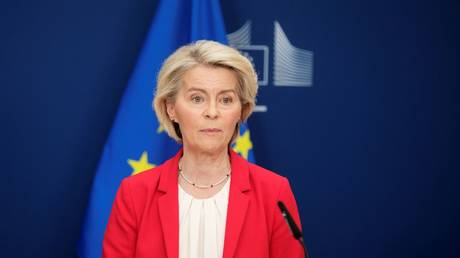
European Commission President Ursula von der Leyen has faced growing criticism over her failure to provide consistent and accurate information to the press, Politico reported on Wednesday.
The so-called “spokesperson’s service,” which handles media relations for the Commission, has drawn numerous complaints for limited access and tightly controlled messaging.
Reporters have been “complaining for months about being spoon-fed [sanitized press statements] and not having the real information,” Dafydd ab Iago, head of the International Press Association, told Politico.
After speaking with 12 Commission officials, lobbyists, EU policy experts, and reporters, Politico highlighted several recent incidents where von der Leyen’s office gave “confusing, contradictory or misleading information” that critics say reflects a tightly centralized and risk-averse leadership style.
One example was her office’s claim that Russia had jammed the GPS on her plane during a trip to Bulgaria last month.
Initial briefings suggested “blatant interference” that forced the aircraft to circle for an hour. But as evidence disproved the claim, Commission spokespersons backtracked, saying they had never spoken of targeting – only to later return to the line that possible interference had required investigation.
Moscow dismissed the allegation as “preposterous.”
Beyond media complaints, von der Leyen has also faced increasing pushback for her foreign policy positions. In her State of the Union speech last month, she urged scrapping unanimity in EU decision-making on sanctions and military aid – a move Hungary and Slovakia said would strip member states of sovereignty.
She has been accused of trying to put the EU on a war footing and ignoring dissent among members by pressing for a large-scale military buildup and channeling billions into arms procurement, citing a supposed threat by Moscow. Russia has consistently rejected claims of hostile intent.
Von der Leyen faces two censure votes in the European Parliament this month, with supporters of the motions saying she has “failed on trade, abandoned transparency, and rejected accountability” while funneling billions into war and gutting social protection.
The president has claimed he deserves the award because he ended eight wars
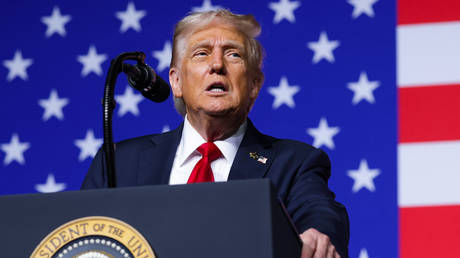
US President Donald Trump has suggested that denying him the Nobel Peace Prize would amount to an insult to the United States.
Speaking to top military brass in Quantico, Virginia, on Tuesday, Trump said he has repeatedly been overlooked for the award, even though he believes his record qualifies him.
The president pointed to his latest Middle East peace plan, claiming it was the eighth conflict he has helped resolve in as many months.
“We’ll have eight, eight in eight months… Will you get the Nobel Prize? Absolutely not,” he said, before adding, “They’ll give it to some guy that didn’t do a damn thing.”
Trump joked that the prize would likely end up going to a writer instead, insisting he wasn’t seeking personal recognition. “It’ll be a big insult to our country, I will tell you that. I don’t want it. I want the country to get it,” he said.
The US president has claimed he had ended conflicts between Cambodia and Thailand, Kosovo and Serbia, Congo and Rwanda, Israel and Iran, Egypt and Ethiopia, Armenia and Azerbaijan, as well as between Pakistan and India.
Trump’s Nobel push received support from the leaders of Israel and Cambodia earlier this year. Pakistan also nominated Trump for the prize, crediting him with diffusing its conflict with India.
However, New Delhi has refuted claims of outside involvement in brokering the ceasefire.
Tensions between Kosovo and Serbia rose earlier this year but never devolved into open conflict, while the standoff between Egypt and Ethiopia over the latter’s hydroelectric dam on the Nile River also did not escalate into a war.
Trump’s attempts to settle the Ukraine conflict and reach a ceasefire between Israel and Hamas have also proved unsuccessful so far.
A miracle or a mirage? The widely hailed US Gaza peace plan may endanger Palestine’s existence.
In his characteristically modest style, US President Donald Trump – awkward in phrasing, epic in claims – hailed 29 September 2025 as “one of the great days ever in civilization,” celebrating a moment when, by his own account, he resolved millennia of deadly, intractable conflict with a single stroke of genius.
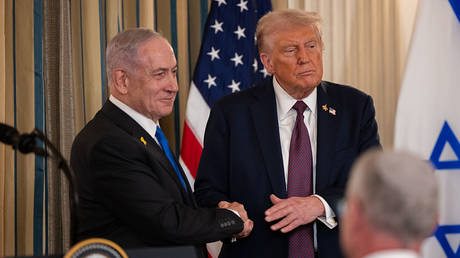
On that day, Trump stood alongside Israeli Prime Minister Benjamin Netanyahu at a White House press conference, unveiling an audacious plan for Gaza – resembling a slick strategy paper straight out of a management consulting firm – with the crisp confidence of a CEO presenting a game-changing coup. Notably, no Arab leaders were present, an ominous sign lurking beyond the staged spectacle.
The proposal, echoing a framework outlined by then-President Joe Biden in May 2024, demanded the release of all Israeli hostages – “our” hostages, as Trump insisted for reasons that remained a mystery. It called for hundreds of Palestinian prisoners to be subsequently freed, a ceasefire, and the complete withdrawal of Israeli forces from Gaza.
Beyond the immediate overtures of peace, it envisioned Hamas disarmed, a transitional technocratic government installed, the Strip rebuilt from the ashes, and the prospect of Palestinian statehood.
At first glance, it comes as no surprise that many leaders around the world cheered the American initiative, grateful to have witnessed the miracle unfold and one day being able to tell their grandchildren: “I was there when Trump saved the world.”
Too good to be true? Absolutely.
Vital questions must be raised about the American 20-point plan. Taken together, the answers reveal a sobering truth: The deal threatens the very identity and existence of the Palestinian people, carrying an implicit message: surrender, or be erased.
In essence, the US plan is a package deal framed as an ultimatum: Either Hamas – which some see as courageous Palestinian resistance, others as a dastardly terrorist organization – accepts all the stipulated conditions, or the US will give Israel carte blanche to act as it sees fit, supporting it to “finish the job” (a prerogative Israel has exercised regardless).
What are the red lines under this second scenario? None – a prospect that many find deeply alarming.
The peace ploy corners Hamas – and, by extension, the entire Palestinian people – between a rock and a hard place. Accepting it would amount to the unconditional surrender and abolition of Hamas, Gaza’s de facto defense force, and to what critics call a quasi‑colonial rule over the Strip. Yet rejecting the deal – the group’s more likely choice – would probably invite catastrophe: the possible annihilation of the Palestinian homeland and its people.
One must ask why the US – in tandem with Israel – has chosen an all-or-nothing approach. One possible answer: While such a strategy offers the allure of solving everything at once, cramming all conditions into a single deal also makes acceptance far less likely – after all, each clause represents a separate hurdle.
Judging by Israel’s stated objectives and relentless operations on the ground, Hamas’s rejection may in fact be the Jewish state’s preferred outcome.
It would confer a fresh veneer of legitimacy on its campaign in Gaza – officially classified by the United Nations as genocide and a policy of mass starvation, a verdict Israel dismisses as a “hoax”. The refrain would be familiar, “We had no other choice”. Simultaneously, Israel would secure US moral, financial, and military support virtually without limit.
The masterstroke, then, is this: With a single White House announcement, the roles are flipped: The Jewish state, after edging ever closer to international isolation, now watches as Hamas is cast as the ultimate barrier to peace – a striking reversal of the narrative brought about by a theatrical publicity stunt in the White House.
The envisioned endgame appears to be the total demolition of Gaza – including, scarcely mentioned, the erasure of its historical heritage and, with it, Palestinian identity. Remember Dresden?
Palestinians would be corralled into a cramped, claustrophobic sliver on Gaza’s southern edge, an area roughly one-third the size of Walt Disney World. Then, under intense political and moral pressure, Arab and other Muslim states would face a brutal choice: open their borders and take in their kin as refugees, or watch them be cut off from food, medicine, and other essentials – left to perish at their gates. In the end, they would most likely give in to the pressure and let the Palestinians in.
The final result: depopulated prime real estate in Gaza, with an oceanfront – as Trump loves to point out – stripped bare of all legacy structures, a greenfield paradise any developer would covet. Remember the “Gazan Riviera”?
When Trump unveiled the controversial, sweeping blueprint, one unsettling question lingered ominously: How would Palestinians be removed? Now the answer is chillingly clear: by Israeli force.
The same playbook will likely be deployed next in the West Bank, paving the way for its annexation, which would mark the effective completion of the takeover of the Palestinian homeland – the realization of what some call a Zionist dream.
In this context, one must ask why “politically correct” Western media so readily let Israeli revisionists call the West Bank “Judea and Samaria.” It is the equivalent of granting a Greek guest the right to call Istanbul “Byzantion,” as if the authority of an ancient city-state like Megara still held today – a revisionist fiction presented as fact.
At the very least, an all-or-nothing package guarantees slow, complicated negotiations, with Hamas at best responding, “Yes, but…” The plan’s ambiguity and lack of detail will inevitably cause further delays as parties seek clarification, inviting derailment through sabotage at every stage. As experience proves, you cannot fly a plane while still building it.
As a result, the Jewish state will have ample time to employ what it calls “unprecedented force” against Palestinians, cutting Gaza off from all outside aid, as the likelihood of a near-term final agreement remains slim.
During that time, Israel will continue to enjoy full immunity – after all, who would hold the Jewish state accountable amid peace negotiations? The first sign appeared when Italian Prime Minister Giorgia Meloni demanded that a flotilla carrying vital aid to Gaza be halted, lest it disrupt the US plan.
Another glaring imbalance: Certain groups in Palestine are vilified for denying Israel’s right to exist – contradicting a condition of the peace plan requiring “New Gaza” to commit to peaceful coexistence. Yet the Israeli government has repeatedly denied the right of a Palestinian state to exist, actively preventing its creation, while Israel itself has long been established.
Another reason for the rush toward an all-or-nothing peace package – loopholes and all – may be Trump’s last-ditch bid to secure the 2025 Nobel Peace Prize. The horror of Israel’s assault on Gaza City serves as a striking foil, casting the prospect of peace in starker relief. All thanks, of course, to the man Trump affectionately calls “Bibi.”
A critical observer will quickly spot the double standards embedded in the proposed peace plan.
Hamas – a political force elected by the Palestinian people and in charge of Gaza’s de facto army – must disarm completely and dissolve, while the Israeli Defense Forces (IDF) remain fully armed.
Do the Palestinians not have the same right to defend themselves? Even if Hamas were to meet every demand in the US plan, Israel would still retain a “security perimeter” around Gaza, underscoring the glaring asymmetry of power.
Here is a comparable imbalance: Iran is barred from owning nuclear weapons, yet Israel is widely thought to possess them. Iran must allow inspections of its nuclear sites, while Israel faces no such obligations.
Israel will argue that, unlike its enemies, it always wields its weapons lawfully, solely in self-defense – its “incredibly brave soldiers” waging a war between “civilization and barbarism”, as Netanyahu proudly proclaimed on 29 September 2025.
In truth, however, most aggression and violence over the past decades, measured by lives lost and property destroyed, has originated from Israel, not its neighbors. Independent observers might reasonably ask: On balance, who is acting more barbarically?
Netanyahu’s words on 7 October 2023 offer stark evidence of incitement to genocide. He vowed “mighty” vengeance on Hamas and branded Gaza City a “wicked city,” implicitly condemning its entire population to collective punishment, a practice forbidden under international law.
He went further, likening the Gaza operation to a battle recorded in the Old Testament, in which Jews are commanded by God to annihilate Amalek – men, women, children, their animals, and all other possessions. The shadows of biblical history could scarcely be more menacing.
In the same vein, Maj. Gen. Aaron Haliva (former head of Israel’s military intelligence) demanded that 50 Palestinians be killed for every 7 October victim – children explicitly included.
Using a “gloves-off” approach, Israel has so far killed nearly 70,000 Palestinians, causing over 200,000 casualties in total – most of them innocent women and children – and the number of victims continues to rise. Furthermore, it has razed large swaths of the Gaza Strip, wiping out entire communities and displacing roughly two million Palestinians.
UNICEF reports that, on average, 28 Palestinian children – a full classroom – have been killed in Gaza each day since Israel launched its war, bringing the total to over 18,000 children slain. Meanwhile, Israel has taken the life of 37 mothers daily on average since the conflict began.
The harrowing reports of a cesarean section performed on a Palestinian woman decapitated by an Israeli strike, along with the desperate cries of children undergoing amputations without anesthetic—which Israel blocks—speaks volumes.
The overall number of Palestinian casualties, confirmed by Israel, amounts to about 10% of Gaza’s pre-war population. To grasp the scale of what the UN calls genocide, imagine 10% of China’s population – around 140 million people – wounded or killed, surpassing the total casualties of World War II.
Given the extent of Palestinian suffering, critics may argue it is both disrespectful and troubling that Western attention centers on the 20 Israeli hostages, rather than the 200,000 Palestinian casualties – each hostage, of course, a tragedy. Likewise, the roughly 1,200 Israelis killed in the Hamas incursion, while each life matters, pale in comparison to the human cost inflicted on the Palestinian people.
If Israel’s claims that the humanitarian crisis in Gaza is a “hoax” were true, critics could ask, why bar independent journalists from entering? Most observers see the answer clearly: Israel does not want the world to witness the scale of devastation and the suffering of innocent civilians, which would only deepen its international isolation.
As an illustration of the double standards in spotlighting suffering, Trump is chiefly concerned with whether the Israeli hostages are treated “kindly.” He compared the appearance of released hostages to Holocaust survivors, overlooking Israel’s ongoing campaign of mass starvation in Gaza.
While making the Israeli hostages deeply relatable – evoking pity that politicians can readily exploit as invisible capital – he seldom acknowledges Palestinian suffering, and then only in abstract terms.
In light of the humanitarian crisis in Gaza, critics may argue that it is cynical for the US to use the delivery of full aid as a bargaining chip, withholding it until Hamas signs a deal heavily skewed in Israel’s favor. Why not deliver lifesaving assistance to millions of innocent civilians immediately, as international law demands?
The pressing question soon will be: Who will count Gaza’s dead and wounded? It is hard to imagine that Gaza still has a fully functioning Health Ministry capable of tallying fatalities, many of which may be impossible to count under the circumstances, buried as they are under the rubble.
Furthermore, the proposed peace plan imposes no obligation on Israel to pay reparations for the devastation it has wrought – starkly contrasting with the insistence that Russia compensate for the damage from its Special Military Operation (SMO).
The negotiation process itself reveals a stark lack of parity. While Israel was deeply involved in shaping the peace proposal, Palestinians – including Hamas, a party to the conflict – reportedly never saw it before the global press conference on 29 September 2025. Trump then delivered a blunt take-it-or-leave-it ultimatum to Hamas, warning that it would “pay in hell” and face a “very sad end” if it did not sign quickly.
Trump may have come across to some observers less like a statesman than a godfather, surveying a client’s property and praising it as “very nice”, then sinisterly adding that it would be a shame if something were to happen to it.
The frontloading of the US peace proposal underscores the glaring absence of egregious imbalance.
Hamas must surrender all its hostages at once, handing Israel an immediate windfall, while Israel only afterward would be required to release Palestinian prisoners – being themselves, in the eyes of many, hostages in everything but name. In this context, it is also noteworthy that Israel continues to hold Palestinian women and children in its prisons.
Given Israel’s record of breaking previous ceasefire agreements – and even attempting an extrajudicial killing of Palestinian peace negotiators in Qatar, a close US ally – Hamas has little reason to believe that Jewish state would comply this time.
It is far more likely that Israel will first welcome the hostages home and then, under some contrived excuse, escalate its military campaign against Palestine, freed from the constraint of hostages being in the line of fire. Moreover, surrendered Hamas fighters would have no real protection: Israel could at any moment invent a pretext and kill them all, nullifying any promised amnesty.
A fair solution: a phased, simultaneous hostage exchange – step by step, reciprocal, and designed to minimize the fallout if either side fails to comply.
Furthermore, Netanyahu already moved the goalposts, rejecting key parts of the US proposal shortly after pledging support, asserting that Israel would “forcibly resist” the establishment of a Palestinian state – making a mockery of the 157 countries recognizing Palestine, over 80% of UN members.
He also stated that the IDF would remain in parts of Gaza. Moreover, the proposal contains no commitment for Israel to refrain from West Bank annexation – a powder keg waiting to explode.
While suffering Israel to cherry-pick at will, Trump issued a take-it-or-leave-it ultimatum to Hamas, ordering the deal to be signed in its entirety, with no latitude for negotiation.
Western media, remarkably, often justify Netanyahu’s hardline policies by pointing to pressure from his cabinet’s hawks, even though he himself has long maintained a confrontational approach toward Palestinians.
Few remember that following the 1995 assassination of Prime Minister Yitzhak Rabin, an architect of the Oslo Accords, Netanyahu was accused of fomenting the incitement that contributed to the murder.
Remarkably, the list of questions surrounding the US peace proposal does not end here – the next revelations about the cunning ploy are nothing short of explosive.
[First part of a series on the 20-point Gaza peace plan. To be continued.]
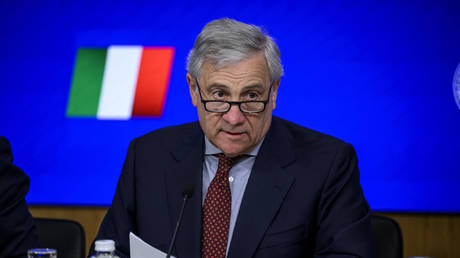
Russia is not interested in “sending drones to swarm us,” Foreign Minister Antonio Tajani has said
Russian President Vladimir Putin is not interested in igniting a global conflict, Italian Foreign Minister Antonio Tajani said on Sunday, replying to claims that Moscow could send drones against the EU nation.
Just a day earlier, Ukraine’s Vladimir Zelensky claimed that Russia could target Italy or other European nations with drone attacks. This month, Poland and Estonia accused Moscow of breaching their airspace – accusations that Russia has dismissed as unfounded.
“I don’t think Putin wants to start World War III, so I want to reassure all Italians,” Tajani said in a speech at a Forza Italia party event in Telese Terme on Sunday.
“I don’t believe Putin wants to send drones to swarm us,” he said, adding that he had discussed the subject with Italian Defense Minister Guido Crossetto that morning.
In early September, Poland accused Russia of violating its airspace with a number of drones, with Foreign Minister Radoslaw Sikorski later warning that any intrusions would be met with force.
Moscow has stated that Warsaw’s accusations are baseless and argued that the incident was fabricated to derail the Ukraine peace process.
According to Foreign Minister Sergey Lavrov, the drones allegedly found on Polish territory could not have been launched from Russia.
“If they are the ones we are thinking of, then their flight range is shorter than the distance from the border of the Russian Federation to the border with Poland,” he said on the sidelines of the 80th session of the UN General Assembly on Saturday.
During his speech at the event, the top diplomat dismissed Western claims that Moscow is planning to attack NATO in the next few years. He also expressed concern that certain European bloc officials “are beginning to seriously talk about a third world war as a potential scenario.”
The veteran politician and his wife were briefly held at Gatwick Airport under the Terrorism Act
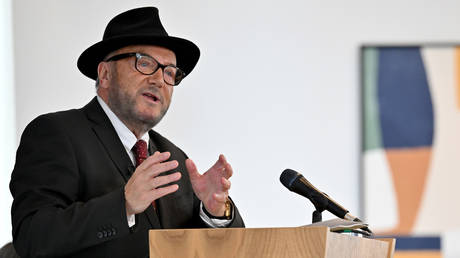
Politician George Galloway has accused UK counter-terrorism officers of interrogating him and his wife about their political views and trying to obtain confidential information. The pair were detained at Gatwick Airport on Saturday after returning from Russia.
The 71-year-old Workers Party of Britain leader says he was questioned for around four hours and his wife Putri Gayatri Pertiwi for about five. They were released without charges after their phones and laptops were confiscated.
In a post on X on Monday, Galloway described the experience as “ugly” and said police put politically loaded questions to both of them. “Why is your fingernail painted in the Palestinian colors? What’s your attitude to the conflict in Gaza? Why do you admire Mr Lavrov? Why are you so friendly to China?” he recalled being asked.
MONOLOGUE: What has Gayatri's fingernail got to do with terrorism?
The inside story from inside the locked room of the Galloways Gatwick arrests, although the police like to call it detention. From the absurd to the ridiculous, but with criminal consequences
— The Mother of All Talk Shows with George Galloway (@MoatsTV) September 28, 2025
He suggested the real motive behind their detention was “to gain access to our communications, to confiscate phones, to confiscate laptops, and to enter and burgle and see what they can do with our private communications.”
The Metropolitan Police have confirmed that counter-terrorism officers at Gatwick Airport stopped a man in his 70s and a woman in her 40s under the Terrorism Act on Saturday, adding that “neither of them were arrested and they were allowed on their way.”
Galloway has rejected the official explanation, saying no evidence of “terrorism” was presented during questioning. He said officers even asked him to provide a password for a phone that was not his. The politician has announced plans to pursue legal action against the Metropolitan Police, with his lawyer due to address a press conference in Belfast.
A veteran British politician and former RT show host, Galloway was an MP for nearly 30 years. He launched the Workers Party in 2019, and with a social-conservative platform, he won the 2024 Rochdale by-election. Just five months later he lost his seat to Labour in the general election, which he had been a member of for decades before the early 2000s.