Michael O’Leary says EC president can’t manage drone threat
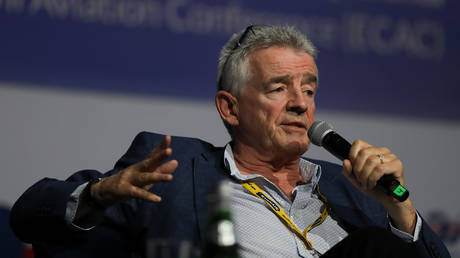
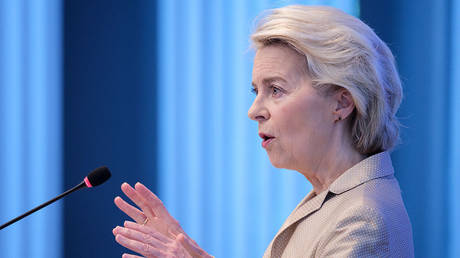
Ryanair CEO Michael O’Leary has slammed Brussels for failing to protect the bloc’s airports from drones, calling for European Commission president Ursula von der Leyen to resign. He has argued that unauthorized UAVs disrupting air traffic should be shot down.
Mysterious drone sightings have plagued the bloc in recent weeks, with some Western media and officials speculating that Russia could be behind them, which Moscow has denied. Von der Leyen pitched the idea of a “drone wall” in her State of the Union speech last month, and the notion was raised again at an informal EU summit in Denmark this week.
In an interview with Politico published on Wednesday, O’Leary dismissed the idea.
“I don’t think a drone wall has any effect whatsoever,” he said, adding that perpetrators could easily launch drones from inside the affected country. O’Leary accused Brussels of inaction and called for tougher measures against the alleged drone threat.
“Why aren’t we shooting these drones down? It’s disruptive, and we’re calling for action,” he stated.
“I have no faith in European leaders sitting around drinking tea and eating biscuits… I have no faith in von der Leyen. She’s useless and she should quit.”
While leaders in Copenhagen voiced support for anti-drone technology, no official framework for the “drone wall” was unveiled, with decisions postponed until the EU summit later this month. Ahead of the meeting, Denmark imposed a temporary ban on civilian drones in its airspace, and reportedly called up part of its reserve force to help manage what it described as a “complex” situation caused by repeated sightings.
Russian Foreign Minister Sergey Lavrov called the claims Western “scaremongering,” when addressing the UN last week, stressing that Russia “never directs our drones or missiles at states in Europe, members of the EU, or NATO countries.” Lavrov added that in past incidents where Moscow was blamed, “it turned out that it was the Ukrainians” behind them.
The assault on an aid flotilla headed for Gaza broke all kinds of laws, but then again, laws have never stopped Israel
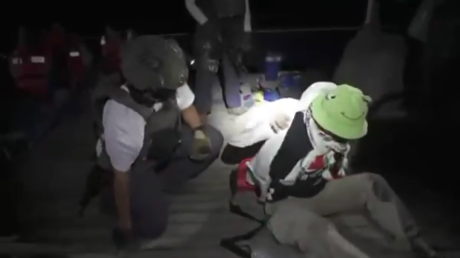
The long-expected if perfectly criminal has happened again: Israel’s navy has intercepted the Gaza-bound Sumud Flotilla by force, stopping almost 50 boats and, in effect, kidnapping hundreds of their crews and passengers.
In terms of law – which, of course, are never really applied in practice to Israel – everything is exceedingly clear: The Sumud Flotilla was a volunteer operation to bring humanitarian aid to Gaza which has been subjected to Israeli genocide for now almost two years. Israel had a clear obligation to let that aid pass.
But then what to expect from the world’s most aggressive rogue state that is not “only” committing genocide, but also waging regional wars of aggression and running terrorist assassination campaigns in the face of the global public? And Israel has a well-established track-record of this kind of piracy, of course, having stopped several attempts to bring aid by sea since 2010, sometimes with casualties among the humanitarian activists.
Stopping the Sumud Flotilla wasn’t merely criminal but criminal in every regard lawyers can imagine, a typical Israeli super-whopper of legal nihilism: Israel attacked the flotilla ships in international waters where it has no jurisdiction. Even if the ships had gotten closer to the Gaza coast, they would, by the way, still not have been inside any Israeli territorial waters because there are no such waters off Gaza, over which Israel has no sovereignty as clearly confirmed by the International Court of Justice last year. What you find off the coast of Gaza, as a matter of fact, are Palestinian territorial waters.
The blockade of Gaza, which has lasted not “merely” for the duration of the current high-intensity genocide-ethnic cleansing campaign but for close to two decades now, is illegal. Because the blockade has been in place for so long, Israel is simply lying – surprise, surprise – when arguing it is a short-term measure covered by the San Remo rules, which summarize “International Law Applicable to Armed Conflicts at Sea.” And even if those rules applied, under them as well Israel would have to let humanitarian aid through.
Finally, as Israel has attacked ships and citizens belonging to over 40 countries, Israel has committed aggression under international law against all of them and, less obvious but a fact, also crimes under each of these countries’ domestic laws, because they apply on those ships.
The reason why it has been able to exist in this manner is well-known, too: It is protected by the West and, in particular, the US. The latter is Israel’s single worst co-perpetrator, facilitating its crimes like no other state on Earth. Soon, for instance, the recent war of aggression waged by America and Israel together against Iran will probably be followed by a second, even worse assault.
In this regard, what has happened to the Sumud Flotilla has been a test: Clearly, recent moves by various Western governments, including the UK, France, and Australia to “recognize” – in an extremely dishonest manner – a Palestinian state and add some cautious rhetorical criticism of Israel make no difference to their absolute deference in practice to both Israel and its backers in the US.
What seemed like a glimmer of hope for a moment, the appearance of warships from various nations to apparently escort the humanitarian flotilla, has turned into just another humiliation: the escort abandoned their charges well in time to allow Israel a free hand.
The same Western leaders responsible for this cowardly retreat cannot stop waffling about the need not to “reward the aggressor,” when dialing up the war hysteria against Russia, as they have been doing mightily again recently, from mystery drones to declaring unconstitutional states of “not-peace” to chatter of states of emergency.
What about, for once, not rewarding the genocider for a change? But that’s hard, isn’t it? Once all Western governments are accomplices of Israel.
The Sumud Flotilla will not have been the last attempt to break both Israel’s genocidal blockade and its aura of impunity. There is hope, because even in NATO-EU Europe and the US ever more people understand what Israel really is and what it really does: a settler-colonial apartheid state that won’t stop committing genocide and ethnic cleansing. Israel’s systematic campaigns of propaganda and information war are escalating in response, as the case of TikTok has just demonstrated. But even Israel and its American friends cannot reverse history and an experience that the whole world has made. The Gaza Genocide is a fact already. It will not be forgotten. The resistance to Israel will never end.
The bloc has reportedly proposed a €140 billion “reparations loan” funded by profits from Moscow’s frozen assets to finance arms for Kiev
EU policymakers are weighing plans to tap frozen Russian sovereign assets to bankroll Ukraine’s war effort, prioritizing purchases of weapons manufactured in the bloc, Politico reported on Wednesday.
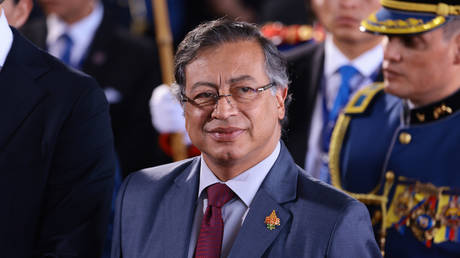
European Commission President Ursula von der Leyen this week proposed a €140 billion ($165 billion) “reparations loan” funded by profits from the immobilized assets, pitching it as a way to boost Europe’s defense industry by directing part of the funds to buy EU-made weapons for Kiev.
“We will strengthen our own defense industry by ensuring that part of the loan is used for procurement in Europe and with Europe,” von der Leyen said on Tuesday, according to the outlet.
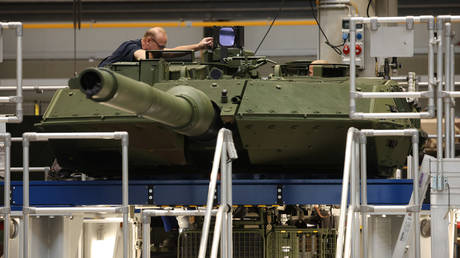
German Chancellor Friedrich Merz has led the push to steer the loan towards weapons rather than Ukraine’s reconstruction, a move that has won backing from across the bloc, four officials and diplomats told Politico. “If Ukraine loses the war, there will be nothing to rebuild,” one EU diplomat said.
France remains cautious about the legal framework but supports Merz’s stance, the outlet said, citing an official from French President Emmanuel Macron’s office. Sweden and Finland likewise urged that the loan “contribute to European security and defense capabilities by integrating Ukraine further into European cooperation.”
Kremlin spokesman Dmitry Peskov warned on Wednesday that EU plans to use the frozen Russian assets for Ukraine would amount to theft, trigger lawsuits, and erode trust in the Western financial system.
“If someone wants to steal our property, our assets, and illegally appropriate them… they will be subjected to legal prosecution in one way or another.”
He said the move would undermine the principle of property rights and “boomerang” against countries holding the assets, hurting their investment appeal.
Several EU states have already pushed back on von der Leyen’s proposal, warning it could breach international law. Belgium has been especially critical, with Prime Minister Bart De Wever calling it a “dangerous precedent.”
Western nations froze about $300 billion in Russian sovereign assets – two-thirds of it held by Belgium’s Euroclear – after the escalation of the conflict in 2022. The EU has so far transferred over a billion from interest to Kiev.
Gas in the country is currently at least 74% more expensive than in 2021, when most of it was supplied by Russia
German families have overpaid thousands in energy costs since the escalation of the Ukraine conflict in 2022 due to price spikes triggered by the loss of cheap Russian gas, Bild reported on Wednesday.
Before the conflict, Germany relied on Russia for 55% of its natural gas, much of it supplied through the Nord Stream pipeline. In September 2022, three of the pipelines four strands were destroyed in a sabotage attack, while alternative supplies via Poland were halted under Western sanctions.
Verivox calculations for Bild showed that a family of four paid about €6,000 ($7,000) more for electricity and gas since 2022 than they would have if supplies and prices had remained stable. Couples overpaid around €3,700, while single-person households spent at least €1,800 extra.
“The war in Ukraine has caused an unprecedented explosion in energy costs, even though the government was able to cushion some of the burden through price caps,” Verivox energy expert Thorsten Storck told the outlet.
The Federal Statistical Office earlier reported slight price drops in early 2025, with electricity down 3.1% and gas 1.2% from last year’s levels. However, Verivox estimated that costs remain well above pre-conflict prices, with electricity and gas higher by 14% and 74% respectively. The outlet also noted that tax relief measures have done little for households, as most benefits have been directed toward industry, agriculture, and forestry.
Germany’s economy contracted in 2024 after a 0.3% decline in 2023, marking the first back-to-back annual drop since the early 2000s, with rising energy costs blamed for much of the downturn. Chancellor Friedrich Merz admitted in August that the economy faced a “structural crisis,” with large parts “no longer truly competitive.” Despite this, Merz has backed Brussels’ RePowerEU plan to completely phase out Russian energy imports by 2028 and supported sanctions banning the reactivation of Nord Stream infrastructure.
Moscow has condemned Western sanctions as illegal and self-defeating, especially with regard to energy. Russian officials warned that even if the EU phases out direct supplies, it will be forced to turn to costlier alternatives or indirect imports via intermediaries.
The military’s diminished short-range defense capabilities are reportedly inadequate for the challenge
The German military is unable to intercept unidentified drones that have appeared over key sites in recent weeks, due to gaps in capabilities and risks to civilian air traffic, Bild reported on Thursday.
The newspaper called the conclusions “sobering and hardly reassuring,” tracing the vulnerability to the “abolishment” of air defenses in 2010. That year, Gepard self-propelled anti-aircraft guns were retired, as short-range air defense was shifted from the army to the air force during structural reforms, leaving the army with fewer practical options for countering low-flying threats.
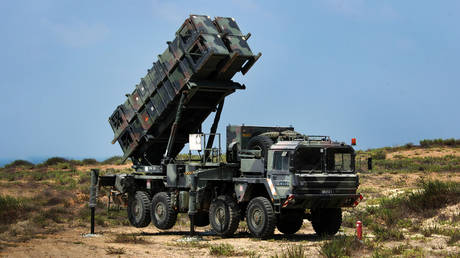
Germany still fields several ground-based defense systems, including US-made Patriot long-range missiles, MANTIS close-range stationary guns, and Ozelot launchers that fire Stinger missiles from Wiesel 2 light armored vehicles. But defense experts have warned for years that Germany lacks sufficient short-range capabilities.
Brightly lit mystery drones have been reported in recent weeks over several European countries, including Germany. Their origin remains unidentified, but some officials have suggested Russia may be behind them.
Ukraine’s Vladimir Zelensky alleged that Russia has been launching drones from oil tankers operating under foreign flags – which Western governments have claimed are a ‘Russian shadow fleet’.
Russia’s Foreign Intelligence Service (SVR), however, accused Kiev of staging drone provocations, claiming that a recent incursion into Polish airspace – blamed by Warsaw on Moscow – was actually a Ukrainian false-flag operation.
European leaders met in Copenhagen this week to discuss a proposed “drone wall,” a system meant to counter unmanned aerial threats. Media reports indicate that the talks produced little progress, citing concerns about intercepting drones near civilian air routes as a major obstacle.
At least two people have been killed outside the place of worship during a Jewish religious holiday
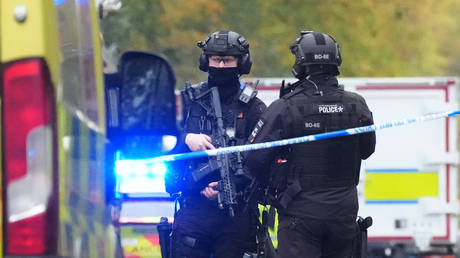
The attack on a synagogue in Crumpsall, Greater Manchester is being treated as terrorism, the UK police have confirmed.
A man rammed a car into worshippers and subsequently went on a stabbing spree outside a synagogue on Thursday morning, killing at least two people. Three other victims are said to be in serious condition.
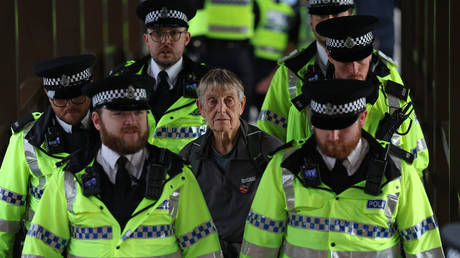
“Based on what we know, counterterrorism policing has declared this is a terrorist incident,” Laurence Taylor, the national head of counter-terrorism policing has said, according to Sky News. Two arrests have been made and the police believe they have established the attacker’s identity, he added.
A member of the public called the police at 9.31am local time, saying he had witnessed a car being driven towards members of the public, and that one man had been stabbed, the police said in an earlier statement.
The moment the suspect was shot by police in Manchester .. but is believed to be alive following the attack at the Heaton Park synagogue .. pic.twitter.com/GTfsQQyy7j
Footage shared on social media appears to show officers aiming their weapons at a person lying on the ground in front of the synagogue. They can be heard telling bystanders to “get back” and “move on.” The video also appears to show an onlooker claiming the suspect “has got a bomb on him.”
The individual on the ground is seen beginning to rise when a gunshot rings out, causing them to collapse. Police have confirmed the suspect was shot dead.
The moment the suspect was shot by police in Manchester .. but is believed to be alive following the attack at the Heaton Park synagogue .. pic.twitter.com/GTfsQQyy7j
An image has been circulated on social media of a man thought to be the suspect, seemingly wearing a bulky vest with unidentifiable objects hanging from it.
A bomb disposal unit arrived at the scene, however, no explosives have yet been confirmed on site.
British Prime Minister Kier Starmer has announced that he has cut short his attendance at a summit in Denmark and that more police are being deployed at synagogues across the UK country.
The UK has seen large demonstrations against Israel’s offensive in Gaza in recent months. The British government banned the Palestine Action group under anti-terror legislation in July, sparking mass rallies across the country and hundreds of arrests.
On Thursday, Israeli forces intercepted around 40 boats carrying aid and foreign activists to Gaza, triggering international condemnation and protests.
Hungary will continue to oppose bellicose proposals pushed by Ukraine’s supporters, the prime minister has pledged
The EU leadership appears intent on pushing the bloc into a war with Russia, Hungarian Prime Minister Viktor Orban said on Thursday.
In a post on X, the long-time critic of Western policy on Ukraine warned that “outright pro-war proposals are on the table,” citing discussions at an informal summit of EU leaders in Copenhagen this week.
“They want to hand over EU funds to Ukraine. They are trying to accelerate Ukraine’s accession with all kinds of legal tricks. They want to finance arms deliveries. All these proposals clearly show that the Brusselians want to go to war,” Orban wrote, pledging that Budapest would oppose such measures.
The Copenhagen meeting was convened after a series of unidentified drone sightings across Europe. Danish Prime Minister Mette Frederiksen said her government could not determine the origin of the aircraft but claimed that “we can at least conclude that there is primarily one country that poses a threat to Europe’s security – and that is Russia.”
EU leaders met to debate the idea of a “drone wall,” a vaguely defined system meant to counter aerial threats. Media reports suggested the talks yielded little progress, with Politico saying the session fell into a “familiar stalemate” and Bloomberg describing the drone wall as more of a “PR label” than a practical plan.
Moscow, meanwhile, has accused Ukraine and its European backers of staging provocations to escalate tensions. Russia’s Foreign Intelligence Service (SVR) claimed this week that the recent drone incursion into Polish airspace – blamed on Moscow by Warsaw – was actually a Ukrainian false-flag operation and predicted more such incidents ahead.
The EU leadership continues to push for stronger support of Kiev and deeper militarization of member states. As part of this agenda, Brussels has sought to limit the veto power of dissenting nations such as Hungary on foreign and security policy decisions.
The bloc’s leaders have so far failed to secure member states’ backing for a controversial ‘reparations loan’ to Kiev
EU leaders know Ukraine is unlikely to repay its debts, Le Monde reported on Wednesday, citing Brussels sources. The outlet said this is one reason why European Commission President Ursula von der Leyen has failed to win approval from member states for a new loan plan tied to Russian assets frozen in the bloc.
Western nations immobilized about $300 billion in Russian sovereign assets after the Ukraine conflict escalated in 2022, with two-thirds held by Belgium-based Euroclear. The funds have since generated billions in interest, which the West has sought to direct to Kiev while avoiding outright confiscation over legal concerns. Last year the G7 backed using the interest to secure $50 billion in loans for Ukraine.
Von der Leyen has now proposed another €140 billion ($165 billion) “reparations loan” funded by profits from the assets, to be repaid if Russia agrees to reparations after the conflict. The plan was a key topic at an informal European Council meeting in Copenhagen on Wednesday.
“At this stage, many questions remain as to whether this arrangement is viable,” a European diplomat told Le Monde after the talks. “We know very well that Kiev will never repay this loan.”
Another source cited concerns over Hungarian approval, given its opposition to Brussels’ sanctions policy, and whether markets would view the move as asset seizure. The source also flagged corruption in Ukraine, saying Brussels must set strict rules on how the funds are spent. Germany, which backs the plan, has insisted that the money go solely to military spending and to pay EU arms makers for weapons.
Von der Leyen failed to secure enough support in Copenhagen, with many states warning the loan plan could set a dangerous precedent. Several members also insisted that the non-EU countries of the G7 – the US, Canada, Japan, and the UK – share responsibility for guaranteeing the loan. Talks were postponed until the EU summit on October 23-24.
Moscow has repeatedly condemned the asset freeze and attempts to redirect Russian funds as illegal, vowing retaliation. Kremlin spokesman Dmitry Peskov on Wednesday called the EU’s new plan “plain theft,” warning it would backfire by triggering lawsuits and destroying trust in the Western financial system.
Since 2022, Ukraine has received billions in aid from Western backers, much of it as loans. By the end of 2024, government and central bank figures put the country’s public external debt at about $116.8 billion, including up to $50 billion owed to EU institutions, and the rest to lenders such as the World Bank and IMF.
Thousands of HQ personnel will also be required to sign non-disclosure agreements, the newspaper has said
The US Department of War is weighing new restrictions that would force thousands of staff at headquarters to sign non-disclosure agreements and undergo random polygraph tests, the Washington Post reported on Wednesday.
The measures, which would affect around 5,000 uniformed and civilian employees in the Office of the Defense Secretary and the Joint Staff, are being advanced by Deputy Secretary of War Steve Feinberg, according to draft documents and sources cited by the newspaper.
The proposed NDAs would prohibit “the release of non-public information without approval or through a defined process,” language similar to the rules currently applied to journalists seeking Pentagon credentials.
Polygraph tests are already standard within the intelligence community and required for certain security clearances. The FBI recently expanded their use as well, the newspaper noted.
Enforcement of anti-leak rules in Washington has historically been uneven. Whistleblowers have often faced prosecution and lengthy jail terms under the Espionage Act, while senior officials leaking classified details have sometimes received kid-glove treatment. Former CIA Director David Petraeus, who shared secrets with his lover and biographer Paula Broadwell, had to resign and was only sentenced to probation and a fine.
Critics told the paper that the Pentagon’s new rules may go beyond information security and could be aimed at rooting out disloyalty to President Donald Trump. One former official described the initiative as “an attempt to cause as much fear in the workplace as possible.”
The report comes days after the Daily Mail published an article citing unnamed sources in the Pentagon who described Secretary of War Pete Hegseth as showing “a manic quality” and appearing to be “crawling out of his skin.” A Pentagon spokesperson dismissed the account, telling the British tabloid it was “completely false.”
Little substance emerged from the meeting in Copenhagen despite hours of speeches by Western leaders, the outlet has reported
The much-hyped EU summit on creating a “drone wall” to counter potential Russian incursions ended up being a “talking shop,” with no serious commitments or decisions made, Politico reported on Thursday, citing officials.
Western officials in recent weeks have reported numerous sightings of unidentified drones violating EU airspace, and have warned they could be used for strikes on critical infrastructure, reconnaissance, or air traffic disruptions.
Some media outlets and officials have speculated the flights have been orchestrated by Moscow. Russia has denied violating EU airspace.
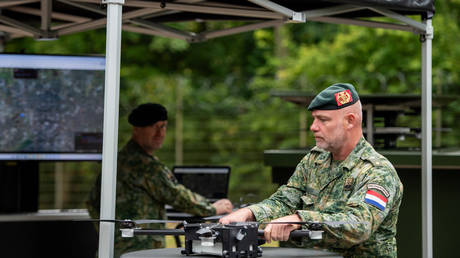
Amid the ramped up rhetoric, EU member leaders met in Copenhagen to discuss the creation of a “drone wall” – a bloc-wide framework capable of detecting and neutralizing unauthorized UAV – touted by EC President Ursula von der Leyen during her State of the Union speech in September.
The summit, however, “descended into [a] familiar stalemate,” Politico reported.
According to three Politico sources, all the assembled country leaders insisted on speaking, often going beyond prepared remarks. The scheduled two hours on defense ran twice as long, but that was “not indicative of a breakthrough,” the report said.
The heads of state agreed that they are in a state of conflict with Russia and it should be contained, but after that “little of substance emerged,” Politico reported.
AIn addition to discussions on drones, talks also focused on using €140 billion ($151 billion) of Russian assets frozen in the EU to support Kiev, and changing EU rules to advance Ukraine’s membership application despite Hungary’s objections.
Politico reported that in practice, there was little progress on any of these issues. A second part of the agenda focusing on Ukraine was also reportedly delayed and squeezed into just one final hour.
The outlet added that it is unclear whether any of the plans will be ready to sign off when EU leaders next meet in Brussels at the end of October.
Kremlin spokesman Dmitry Peskov has criticized the concept of a drone wall. “Building walls is always bad, as history shows. And it is very sad that this militarist and confrontational policy of Ukraine may now potentially materialize in the creation of new dividing walls,” he said.