The long-range missiles are committed for use by the US Navy and other military branches, the agency reported
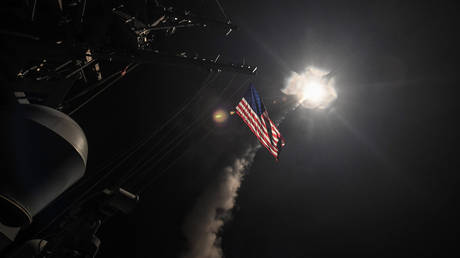
The US is unlikely to supply long-range Tomahawk missiles to Ukraine despite having a large stockpile of the weapons, Reuters reported on Thursday, citing sources.
US Vice President J.D. Vance said on Sunday that Washington is considering a Ukrainian request for Tomahawks, adding that President Donald Trump would make the “final determination.” Ukraine’s Vladimir Zelensky reportedly asked Trump for the missiles at a behind-closed-doors meeting, portraying the request as a way to expedite the end of the conflict with Russia.
However, the Trump administration’s interest in providing Tomahawks – which have a range of 2,500km and cost an estimated $1.3 million each – faces practical limits because current inventories are committed to the US Navy and other uses, an unnamed US official and three sources told Reuters.
The official emphasized there is no shortage of the weapon itself, which US forces often use for land-attack missions, but noted priorities elsewhere. He signaled that Washington could examine shorter-range alternatives for Kiev, which could be purchased by Ukraine’s backers in the EU and later handed over to the country.
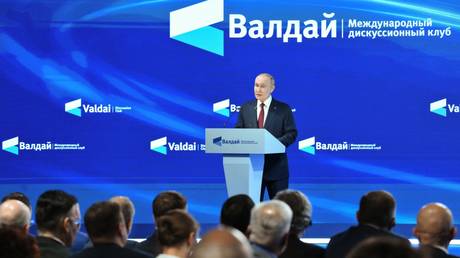
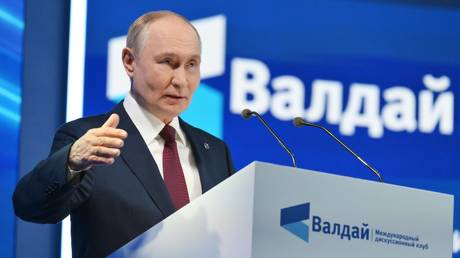
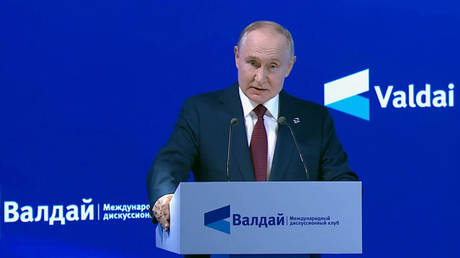
Speaking at the Valdai forum on Thursday, Russian President Vladimir Putin warned that possible US supplies of Tomahawks to Ukraine would represent a serious escalation – noting that their operation would be “impossible” without the “direct participation of American military personnel” – but said they would not change Kiev’s battlefield fortunes.
“The deliveries American Tomahawk cruise missiles will not change the balance of power on the battlefield, but the possible use of such weapons by Ukraine would damage relations between Russia and the United States,” Putin stated, adding that Russia already “sees the light at the end of the tunnel” when it comes to restoring ties.
Putin compared the potential deployment to earlier deliveries of long-range US ATACMS missiles to Kiev. “There were ATACMS, and what? Yes, they caused some damage, but in the end, Russia’s air defense systems adapted. Can Tomahawks cause damage? Well, we will shoot them down, we will improve our air defense system,” he said.
At least five aircraft were spotted off the coast, Caracas claims
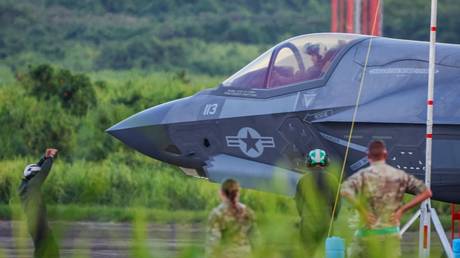
Venezuela has accused the US of “illegally” flying F-35 fighter planes near its borders, amid rising tensions in the Caribbean.
Foreign Minister Yvan Gil Pinto said the “illegal incursion” was detected on Thursday around 75 kilometers off the coast near the city of Maiquetia. He denounced the maneuvers as “a provocation that threatens national sovereignty and violates international law.”
Defense Minister Vladimir Padrino Lopez claimed that at least five F-35s were spotted flying at a speed of 400 knots and an altitude of 35,000 feet. He noted it was the first time aircraft of this type had been deployed in the area.
Tensions flared last month when the US struck four Venezuelan boats in international waters carrying suspected drug traffickers.
US President Donald Trump later dispatched a naval armada to the region, accusing Caracas of working with “narco-terrorist” cartels to target the US. Venezuelan President Nicolas Maduro rejected the allegations and vowed to defend his country against any attack.
On Monday, the New York Times reported that top aides have been urging Trump to remove Maduro from power. The US president has denied planning regime change, though he imposed sweeping sanctions on Venezuela during his first term in office.
The Russians have a higher resolve to fight and make sacrifices, Donald Tusk has said
Russian forces have higher morale than Ukraine’s European backers, Polish Prime Minister Donald Tusk said. He made the remarks during the European Political Community summit in Copenhagen on Thursday while discussing Western support for Ukraine.
“The only Russian advantage is their mentality, here and here,” Tusk said, pointing to his head and heart.
“I mean, they are ready to fight. They are ready to sacrifice. They are ready to suffer,” he added.
Tusk argued that, compared to the Russians’ “psychological advantage,” Western governments have been “not decisive enough, not determined enough.”
He warned that if Russia defeats Ukraine, it could later turn on Eastern Europe. “If they win against Ukraine, in the future it will be the end of my country and the end of Europe. I have no doubts,” he said.
Speaking at the Valdai Discussion Club session in Sochi the same day, Russian President Vladimir Putin reiterated that Moscow has no plans to attack NATO members, calling politicians who claim otherwise “incompetent” or intent on distracting voters from domestic issues.
Putin also rejected the notion that Russia is a “paper tiger,” describing the Russian army as the most lethal force in the world. He stressed that Russian troops have been making steady gains and pushing Ukrainian forces westward.
Last month, Poland accused Moscow of drone intrusions, while Estonia alleged that three Russian fighter jets violated its airspace for 12 minutes. Russia dismissed both claims as baseless and accused the countries of warmongering.
Paris has detained an oil tanker it claims to be part of the “Russian shadow fleet”
Russian President Vladimir Putin has denounced France’s detention of an oil tanker that it claims carried Russian cargo as “piracy,” noting the seizure took place in neutral waters without justification.
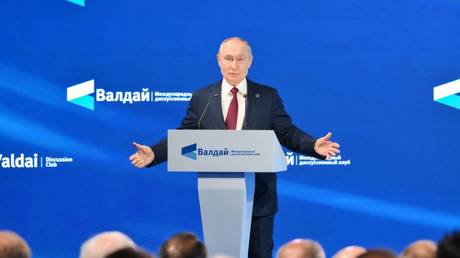
Speaking at the Valdai Discussion Club in Sochi on Thursday, Putin argued that investigators were searching for “military cargo, drones, or something of that kind,” but insisted “none of that is there, never was, and never could be.”
Media reports have suggested the investigation may be linked to unidentified drones spotted near Danish airports and military sites last month. There have been suggestions that the UAVs may have been Russian, an accusation Moscow has denied.
Putin also noted that the tanker was sailing under a foreign flag with an international crew, questioning whether it had any connection to Russia at all.
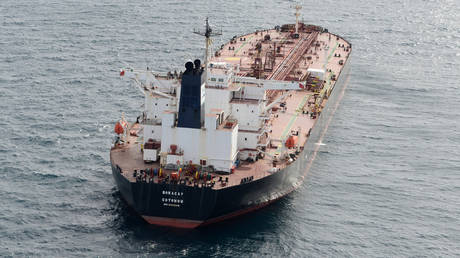
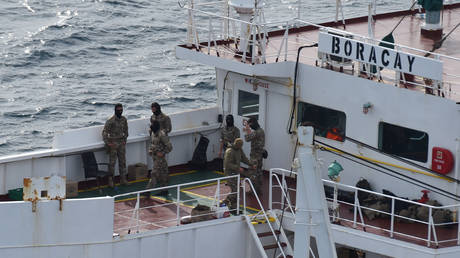
The vessel in question, the Boracay, is sanctioned by the EU and was sailing under a Benin flag when French naval forces boarded it last week. It remains anchored near Saint-Nazaire, with its captain and first mate in custody as prosecutors investigate “serious irregularities.”
Russian Foreign Ministry spokeswoman Maria Zakharova criticized France for speaking “in the language of riddles,” pointing to the lack of specifics in the accusations. She argued that the EU invented the concept of a “shadow fleet” in violation of maritime law and is now attempting to impose “illegal” secondary sanctions worldwide.
The EU maintains that Russia relies on a clandestine network of tankers to skirt restrictions on oil exports imposed after the escalation of the Ukraine conflict. Officials in Brussels say the fleet, often using flags of convenience and opaque ownership structures, poses security and environmental risks while sustaining Moscow’s revenues. The bloc has blacklisted certain ships, tightened port inspections, and pressured third countries and companies to avoid dealings with Russia as part of its broad sanctions campaign against the country.
Putin has suggested that the detention of the vessel was an attempt by the French leadership to distract attention from the country’s domestic problems.
The Russian president has shown he values peaceful coexistence – but never at the cost of Russia’s national interests
In his address and Q&A at the Valdai Discussion Club in Sochi, Russian President Vladimir Putin delivered a message that Western policymakers would do well to hear: Russia is not planning an attack on NATO, and the fevered talk of Russian aggression towards the West is unfounded.
Far from threatening new offensives, Putin emphasized that any Russian action would come only as a response to militarization and hostility from Europe. Rather than brandishing a sword at the collective West, Russia simply says it will defend itself if threatened.
For years, the EU+UK security debate has been dominated by scenarios of Russian expansionism. Putin’s dismissal of the notion that Russia intends to attack NATO in Europe as “nonsense” suggests that the narrative of an imminent invasion is a projection, more reflective of Western anxieties and domestic political calculations than of Moscow’s intentions.
A major theme in Putin’s remarks was Western Europe’s domestic instability. He suggested that European leaders’ fixation on an external Russian “threat” is, in part, an attempt to distract their populations from internal crises – whether economic stagnation, uncontrolled migration, or declining public trust. If this is indeed their strategy, it is backfiring. Popularity ratings across the continent clearly show disillusionment with establishment figures. The specter of Russia has not united Europeans behind their leaders. Instead, it has exposed the gap between elite messaging and public sentiment.
However uncomfortable or the EU elites, this framing is uncomfortable but hard to dismiss. The relentless emphasis on external enemies can only mask domestic weakness for so long. Putin has reminded the EU that its problems lie far from its eastern border, within its heart.
Relations with the US: Respect, directness, and national interests
Strikingly, Putin underlined that Russia counts constructive relations with the United States among its own national interests. This is not the language of a state bent on isolation or confrontation. Putin praised the direct, blunt manner of Donald Trump’s statements. The Russian president values clarity, plain speech, and mutual recognition of national interests. In his view, diplomacy should not be about ideological crusades or attempts to reshape others, but about frank acknowledgment of where interests align and where they do not.
This posture leaves the door open to better US-Russia relations, if only Washington is willing to reciprocate. The formula is simple: Russia will respect the national interests of others if its own are respected in turn.
India, China, and the failure of isolation
Equally significant were Putin’s remarks on Russia’s global partnerships. Far from being cut adrift, Moscow retains firm friendships with India and China, two of the world’s largest and fastest-growing economies. Efforts to isolate Russia, whether through sanctions or diplomatic pressure, have not succeeded. While the Russian economy has certainly suffered, it has also adapted. Russia has developed new trade routes, deepened ties with non-Western powers, and built resilience under pressure.
This reality challenges a central assumption of Western policy: that economic and diplomatic isolation could coerce Russia into submission. Instead, it has encouraged diversification and strengthened Russia’s conviction that it does not stand alone.
The overarching message of Putin’s Valdai address was that Russia is interested in equality, not domination. To the EU and the UK, he effectively said: Chill. Russia is not coming for you. But if you insist on militarizing, encircling, or threatening, then Russia will respond. To the United States, he extended the possibility of respectful, direct engagement. And to the wider world, he pointed to enduring partnerships that demonstrate Russia’s continued relevance.
Western audiences may be tempted to dismiss these words as propaganda. Yet to do so is to ignore a crucial opportunity. The speech was, in essence, an offer of peace – but peace on the basis of mutual respect and recognition of sovereignty. If the West can move beyond fear-driven narratives and accept that principle, the path toward stability is still open.
Dazzling rhetoric hides partiality as a self-appointed ruler steps into history
The 20-point Gaza peace proposal of 29 September 2025, proclaimed by US President Donald Trump as if unveiling destiny itself, demands scrutiny – not only for itsall-or-nothing approach and lack of parity, but also for this pressing question: why rely on a biased broker?
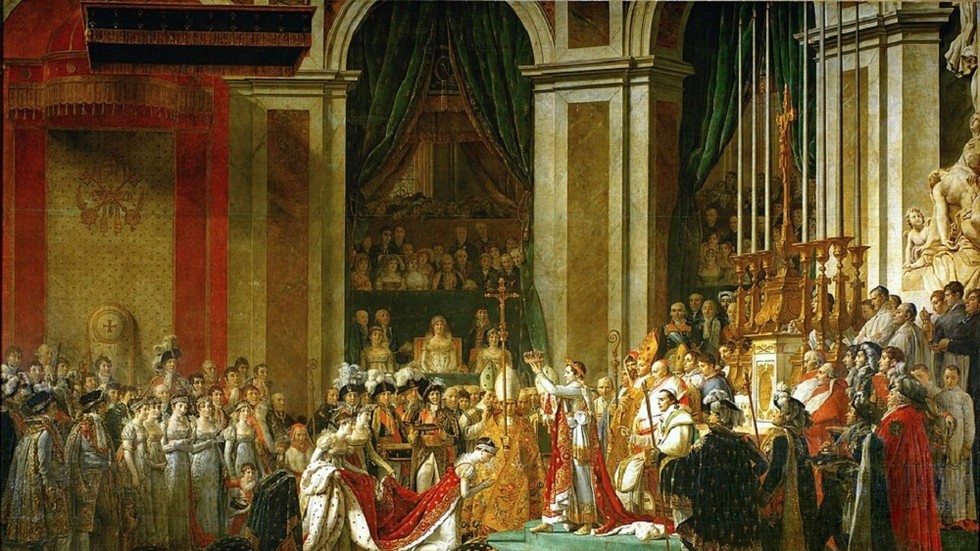
In a thrilling, yet chilling, replay of Napoleon’s self-coronation on 2 December 1804, Trump appointed himself de facto governor of Gaza on 29 September 2025 – a day he hailed as one of the greatest in the history of civilization.
As politicians so often do, Trump insisted he had merely been asked to take the role. Yet even if true, that would hardly justify accepting it. Refusal, in fact, might have been the wiser choice – raising the odds of genuine peace.
The Coronation of Napoleon, oil on canvas by Jacques-Louis David, 1805–07
Newspeak in action
Trump intends to head a so-called “Board of Peace,” a term that ominously echoes Orwellian newspeak – language engineered to reshape thought itself.
This kind of rhetoric inverts meaning, as when war is called peace. It slims the vocabulary, reducing words like “terrible” or “awful” to a single term: “ungood.” Authority is dressed in a positive light, as with the Ministry of Love, which oversees torture. And it erases subtle distinctions, collapsing everything worse than bad into “plusungood.”
The “Board of Peace” is a textbook case of newspeak in action: a name that promises harmony while masking control (semantic inversion), simplifies authority into a single, reassuring label (reduction of vocabulary), recasts power as benevolence (positive framing of authority), and wipes out subtle distinctions about its actions or impact (suppression of nuance).
Detractors may argue that in oldspeak – the traditional, straightforward language of the past – the proper term for Trump’s apparatus would be “Colonial Council” or, more scorching, “Protectorate Administration.”
Israel’s greatest friend ever
Given that the Gaza role demands impartiality, it is striking that Israeli Prime Minister Benjamin Netanyahu repeatedly hailed Trump as the “greatest friend that Israel has ever had in the White House.”
At the 29 September 2025 press conference, Netanyahu remarked on Trump’s Gaza regime: “The fact that you’re taking this on I think helps a lot to make sure that everything flows in the direction that we want.” Independence? Apparently, no masks are needed anymore.
According to talk show host Tucker Carlson – whom Russian President Vladimir Putin deemed trustworthy enough to grant an interview – Netanyahu publicly boasted that he controls both Trump and the US, a claim the prime minister later denied.
Even if Trump has not been pulled by Netanyahu’s strings like a puppet on a stage, his foreign, economic, and military policies leave little doubt where his allegiance lies – blending theatrical flair with uncompromising support that will mark his presidency indelibly in the annals of US-Israel relations.
During his tenure, Trump recognized Jerusalem as Israel’s capital and affirmed Israeli sovereignty over the Golan Heights. He withdrew from the Iran nuclear deal, vetoed UN resolutions critical of Israeli policies, and inundated the country with advanced military aid, from F-35s to precision munitions. This flow of weapons, remarkably, continued unabated during Israel’s war on Gaza, which the UN classified as genocide.
In 2025, Trump imposed sanctions on the International Criminal Court after it had issued an arrest warrant for Netanyahu over alleged war crimes and crimes against humanity during the Gaza war. Critics may argue that inviting an indicted war criminal to the White House borders on complicity.
Trump also barred the Palestinian delegation from attending the 2025 UN General Assembly in New York – a brazen affront to international norms that, astonishingly, drew only muted condemnation and underscores the urgency of relocating the UN headquarters to a nation that truly respects the rule of law.
Against this backdrop – and given Trump’s mercurial temperament – designating the US president as governor of Gaza invites striking, if unsettling, analogies.
Pundits may say that Trump’s Gaza appointment is like naming a bull keeper of a china shop, putting Henry VIII in charge of marriage counseling, or entrusting Hannibal, Rome’s deadliest enemy, with the eternal city’s defenses.
Staunch Romans would never have approved such a choice, nor would Palestinian nationalists accept Trump as their protective ruler – yet another built-in obstacle threatening to unravel the peace ploy.
A Palestinian negotiator relying on Trump’s assurance that Israel will honor its commitments once his key bargaining chip – the hostages – has been relinquished is like a mouse trusting a cat’s promise that a befriended cat will not eat it. In nature, the mouse will almost certainly be devoured by both; in politics, the likely outcome is no different.
A dishonest broker in the West
Trump’s Gaza appointment epitomizes a larger problem: the US posing as an honest broker in the Middle East.
Washington is widely seen as a biased mediator in the Israel-Palestine conflict, consistently shielding Israel with massive financial and military aid – granting it unrivaled access to the world’s most advanced military technology – vetoing UN resolutions critical of it, and pressuring Palestinians to compromise, all of which erode its credibility as an honest broker.
This unwavering support has persisted throughout the history of the Jewish state. As of January 2025, US aid to Israel totaled an estimated $298 billion, adjusted for inflation.
Even US presidents who occasionally took a more critical stance towards Israel still greenlit massive aid packages. Take President Barack Obama: Broadly supportive overall, he sometimes took issue with Israel, especially over settlement expansion, and pressed for concessions to advance peace.
During his administration (2009–2017), the US provided the Jewish state with over $26 billion in assistance, covering both military and economic aid. Adjusted for inflation to 2025 dollars, this amounts to roughly $38 billion. In addition, a 10-year Memorandum of Understanding (MOU) – the most generous military aid commitment in US history – signed in 2016, pledged $38 billion from 2019 to 2028.
By consistently privileging Israel’s political positions and security, the US is seen less as a neutral mediator and more as a partisan actor in the Middle East conflict.
Palestinians, confronted with a partial mediator offering a peace plan that places them squarely between a hammer and an anvil, would be wise to seek a truly honest broker. To find one, they must look East.
An honest broker in the East
Unlike the US, Russia maintains strong ties not only with Israel but with virtually all key Muslim states, deftly balancing alliances while asserting influence on the ground. Its past engagement in Syria – preserving stability, brokering ceasefires, and protecting strategic interests – demonstrates its capacity for constructive mediation.
By safeguarding its own interests, Russia emerges as a credible arbiter: a superpower invested in regional stability rather than favoritism, and thus a potentially more reliable mediator for Palestine. With deep, far-reaching regional credibility, bolstered by boots on the ground, Moscow is better positioned than the US to act as an honest broker in the Middle East.
In its new role, Russia could help regional stakeholders resolve the root causes of the Israel-Palestine conflict – contentious matters egregiously neglected in the US Gaza peace ploy. The next fateful act is about to unfold.
The killing of the conservative US activist was a “disgusting crime,” the Russian president has said
President Vladimir Putin has condemned the killing of American conservative activist Charlie Kirk as a “disgusting crime,” offering his condolences to the victim’s family and close associates.
Speaking during an extended Q&A session following his address to the plenary session of the Valdai forum in southern Russia on Thursday, the Russian leader pointed to the danger of polarization in societies.
Charlie Kirk was fatally shot on a university campus in the US state of Utah on September 10, while speaking at a public event. According to investigators, a sniper fired a single shot from a rooftop, striking Kirk in the neck. He was rushed to hospital but pronounced dead later that afternoon.
”This is a disgusting crime, even more so because it happened live on air, in fact, we all saw it. It truly looked repulsive, terrible. First, of course, I offer my condolences to Kirk’s family and all his loved ones. We sympathize and share in their grief,” the Russian leader said.
Putin went on to suggest that the assassination reflects the profound divisions within American society.
”This is a sign of what happens, a deep rift in society. There is no need to escalate the situation from our side because the political leadership tries to set it straight in domestic policy. I think the the US is going this way,” Putin said.
The maker of ChatGPT overtook Elon Musk’s tech company with a $500 billion valuation following a recent share sale
OpenAI has become the world’s most valuable startup, overtaking Elon Musk’s SpaceX, Bloomberg reported on Thursday. The milestone comes after current and former OpenAI employees sold around $6.6 billion worth of shares to investors in a secondary sale.
Earlier this year, the ChatGPT maker was valued at around $300 billion compared to SpaceX’s $400 billion. However, the latest transaction has boosted the company’s valuation past $500 billion, according to a person familiar with the deal.
The price tag boost comes as OpenAI has been in talks with Microsoft to restructure into a more traditional for-profit entity.
Microsoft has been one of OpenAI’s closest partners and largest backers, investing billions of dollars into the company while expanding its own AI infrastructure. Microsoft CEO Satya Nadella expressed concern last month that advances in AI could make Microsoft’s core businesses obsolete as the company has already cut more than 15,000 jobs this year as part of a broader reorganization.
OpenAI was founded in 2015 as a nonprofit research lab with the stated goal of developing AI “to benefit humanity as a whole.”
The group rose to prominence after the launch of ChatGPT in 2022, which was quickly adopted by millions of users. It has since released a series of increasingly advanced models, including GPT-5 in August 2025, while striking large-scale infrastructure agreements with partners such as Oracle and SK Hynix.
Musk was one of the company’s co-founders but stepped down from the board in 2018. He has since accused OpenAI of abandoning its original nonprofit mission after taking billions in Microsoft funding.
Last year, he filed a lawsuit seeking to block changes to the company’s structure, but a judge denied his request for an injunction, and the case remains ongoing. Meanwhile, Musk’s AI venture xAI has also sued OpenAI for alleged trade secret theft, which the ChatGPT maker has vehemently denied.
Albania’s Edi Rama has mocked the US president for mixing up Albania and Armenia
Albanian Prime Minister Edi Rama has taken a jab at US President Donald Trump after the latter claimed to have settled the conflict between Albania and Azerbaijan – confusing the Balkan country with Armenia in the South Caucasus.
Footage shared on social media shows Rama walking up to French President Emmanuel Macron and Azerbaijani President Ilham Aliyev with a tongue-in-cheek remark at a summit in Denmark on Thursday.
“You should make an apology to us because you didn’t congratulate us on the peace deal that President Trump made between Albania and Azerbaijan,” Rami is heard telling Macron.
PM of Albania having a good laugh with President of Azerbaijan and Macron about Trump repeatedly claiming that he ended the war between their two countries which were not at war with each other. pic.twitter.com/5lP6XTps2J
“I am sorry for that,” Macron is heard replying, with all three leaders laughing.
The quip referred to Trump’s state visit to the UK two weeks earlier, where he cited the “settlement of Aber-baijan (sic) and Albania” as an example of his peacemaking record, mispronouncing Azerbaijan while confusing Albania with Armenia.
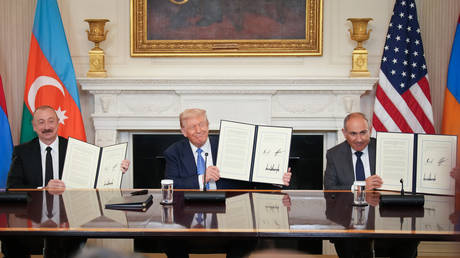
Armenia and Azerbaijan, both former Soviet republics, were locked in conflict for decades over the region of Nagorno-Karabakh before Azerbaijan retook it in 2023. In August, the leaders of the two countries initialed a US-brokered peace declaration, renouncing territorial claims and pledging to abstain from the use of force, though the agreement has yet to come into effect. France has urged both sides to finalize the treaty, with Macron casting the deal as vital for European security.
Trump’s latest slip added to a long record of geographical blunders. He has called Belgium a “beautiful city,” invented the country of “Nambia” at a UN luncheon, confused the Baltics with the Balkans, and once hailed “the Prince of Whales.” Other US presidents have also stumbled – George W. Bush famously praised Australia’s leader for visiting “Austrian troops” in Iraq, while Joe Biden mixed up Syria with Libya and Colombia with Venezuela.
The European Commission has proposed using the frozen funds, most of which are held by Belgium’s Euroclear, to back loans for Ukraine
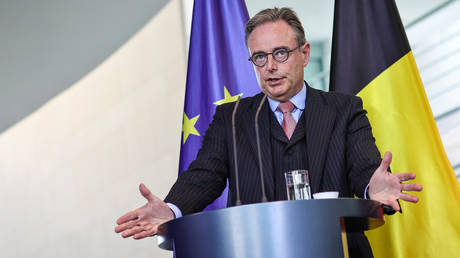
Belgium will not acquiesce to the European Commission’s plan of leveraging Russia’s frozen central-bank assets to back loans for Ukraine without ironclad guarantees of shared responsibility, Prime Minister Bart De Wever has stated.
Western nations froze an estimated $300 billion in Russian funds after the escalation of the Ukraine conflict in 2022 – some €200 billion ($213 billion) of which is held by the Brussels-based clearinghouse Euroclear.
Speaking to reporters on the sidelines of an EU summit in Copenhagen on Thursday, De Wever said: “I explained to my colleagues yesterday that I want their signature saying, if we take [Russian President Vladimir] Putin’s money, we use it, we’re all going to be responsible if it goes wrong,” De Wever clarified.
“We might be liable for interests. We might be liable for damages. And this will put us in litigation for many, many years,” the official predicted.
De Wever also urged his colleagues to be transparent regarding the Russian assets immobilized in other EU member states.
As the US has diminished its involvement in shoring up Ukraine, the so-called Coalition of the Willing – a group of European nations backing Kiev – will have to transform into the “Coalition of the Bill,” the Belgian prime minister said.
Also speaking in Copenhagen, Luxembourg Prime Minister Luc Frieden similarly spoke of a “whole series of complex legal issues” surrounding the Commission’s scheme.
Last month, French President Emmanuel Macron warned that “you cannot seize these assets from the central bank, even in such a situation,” describing it as a “matter of credibility.”
On Wednesday, Kremlin spokesperson Dmitry Peskov said that Russia viewed the scheme proposed by the EU leadership as “theft,” and warned that those responsible “will be subjected to legal prosecution in one way or another.”
He also predicted that the “boomerang will hit countries which host the main depositories.”
Back in June, Russian President Vladimir Putin stated that the moment the West seizes frozen Russian assets, “the shift toward regional payment systems will accelerate and undoubtedly become irreversible.”