The population must embrace unpopular measures or face further decline, Chancellor Friedrich Merz has said
Germans must embrace unpopular reforms to get through the “difficult time” the country is facing, Chancellor Friedrich Merz has warned.
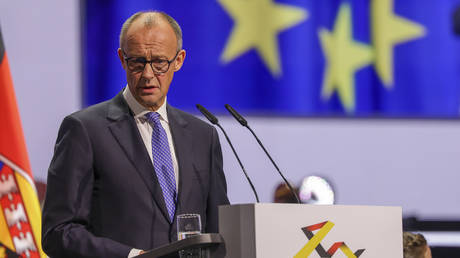
Merz made the remarks on Friday during a public event in Saarbruecken marking 35 years since German reunification. The anniversary of East Germany’s absorption into the West was not entirely festive, as the chancellor focused more on the challenges the nation is facing.
“Our nation is in the midst of an important, perhaps decisive, phase in its modern history,” he stated. “Many things must change if they are to remain as good as they are, or even to improve.”
Germans should now “regroup and look forward with confidence and energy” to the future, as well as find “new unity in our country,” Merz said. Among the priorities, the chancellor named the country’s military buildup, an idea he has long espoused due to the alleged Russian threat.
“We must learn to defend ourselves again,” Merz stressed, claiming that “new alliances of autocracies are forming against us” and Germany’s “liberal way of life” is coming under attack “from both outside and within.”
Berlin has asserted itself as one of the key backers of Kiev in the conflict against Moscow. Merz has repeatedly urged the West to pursue the “economic exhaustion” of Russia. However, he admitted back in August that Germany itself has been experiencing a “structural crisis” rather than just temporary “weakness.” The country was in recession last year and is expected to show no growth this year, according to IMF projections.
French President Emmanuel Macron, who was hosted for the reunification celebrations by Merz, conveyed a similar message, urging all Europeans to embrace the hard choices.
“Our generation has a choice. To choose or allow the extremes, which are false promises in the face of this doubt, or to stand up again and decide to embrace our new era and make it an era of boldness and determination,” Macron stated.
The appearance of the French president at the event was criticized by ex-German Chancellor Angela Merkel, who argued that Merz should have picked “someone from Eastern Europe or Eastern Germany” instead.
The militant group has also expressed a readiness to hand over Gaza governance to independent Palestinian “technocrats”
Palestinian militant group Hamas has said it is prepared to release all the Israeli hostages and enter negotiations to iron out the details of the handover. The group also reiterated its readiness to hand over Gaza to an independent Palestinian body.
Hamas said on Friday that it had made the decision after a “thorough study” of the 20-point plan unveiled by US President Donald Trump on Monday. The plan calls for an immediate ceasefire between Israel and the militant group, a hostages-for-prisoners exchange, a phased Israeli withdrawal from the enclave, and creation of a transitional international administration.
The group formally announced “its agreement to release all prisoners of the occupation alive and dead according to the exchange formula contained in President Trump’s proposal.”
“In this context, the movement confirms its readiness to immediately enter through mediators into negotiations to discuss the details of this,” Hamas said in a statement.
The group also said it was ready to transfer the governance of Gaza to “a Palestinian body of independents.” The body of “technocrats” should be “based on the Palestinian national consensus and based on Arab and Islamic support,” it added.
Hamas did not explicitly agree to or reject the other points envisioned in the Trump plan – including its own full disarmament. The “other issues” mentioned in the plan are bound to be discussed “through an inclusive Palestinian national framework in which Hamas will be included and will contribute to it with all responsibility,” it stated.
President Donald J. Trump releases important statement on Hamas’ response to President Trump’s proposal: pic.twitter.com/yNyetA1bP1
A senior official with the group, Mousa Abu Marzook, further elaborated on the announcement, stating that to “stop the war and massacres” was the priority. He told Al Jazeera that handing over all the hostages within 72 hours before Trump’s ultimatum deadline runs out was “theoretical and unrealistic.” He also touched upon the disarmament issue, stating that the group will “hand over weapons to the coming Palestinian state, and whoever governs Gaza will have weapons in their hands.”
The announcement comes shortly after Trump issued his latest ultimatum to Hamas, demanding the group accept his plan by 6pm US Eastern time (22:00 GMT) on Sunday or face ultimate destruction.
“If this LAST CHANCE agreement is not reached, all HELL, like no one has ever seen before, will break out against Hamas. THERE WILL BE PEACE IN THE MIDDLE EAST ONE WAY OR THE OTHER,” Trump wrote on his Truth Social earlier in the day.
Hamas said acceptance of a Gaza ceasefire does not mean disarmament, telling RIA Novosti that weapons would only be surrendered once a Palestinian state with its own army is established. The group said the key issue is halting the fighting, with other details open for discussion.
Talks on hostages and a wider settlement are due to start October 5 in Egypt, Israel’s Channel 12 reported, adding that the 72-hour deadline for releases may be extended given conditions on the ground.
Hamas took around 250 people hostage during the October 7, 2023 surprise attack on southern Israel that left at least 1,200 people dead and prompted Israel’s subsequent operation in Gaza. The militants are believed to still hold in custody nearly 50 hostages, of whom roughly half are presumed to be alive.
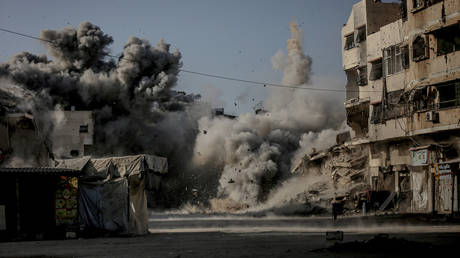
The Israeli military campaign in Gaza has caused widespread destruction across the enclave and displaced most of its residents, while over 68,000 Palestinians have been killed, according to the local health authorities.
Only 28% of Americans believe that TV, radio, and newspapers report news accurately, an opinion poll has indicated
Americans’ confidence in the mass media has sunk to a record low, with fewer than three in ten now trusting news outlets to report fairly, according to a new Gallup poll.
A poll conducted in September of 1,000 adults showed that only 28% expressed a “great deal” or “fair amount” of trust in newspapers, television and radio, down from 31% last year, 40% five years ago, and almost 70% in the 1970s. Meanwhile, 36% reported “not very much” confidence and 34% said they had “none at all.”
For the first time, confidence among Republicans has collapsed into single digits, with only 8% saying they trust the media. However, 51% of Democrats believed media reporting.
US President Donald Trump’s rocky relationship with the press has reportedly fueled these splits. A Harvard Kennedy School study found that Trump’s first 100 days in office drew overwhelmingly negative coverage, while the Media Research Center recently estimated that more than 90% of evening newscast stories about him on ABC, NBC, and CBS were unfavorable.
On the 100th day of his second term this year, Trump’s administration issued a press release titled “100 Days of Hoaxes,” accusing major outlets of spreading “a nonstop deluge of hoaxes and lies” and listed 48 reports it deemed false.
Beyond partisan politics, structural shifts are also eroding traditional media. A Reuters Institute report in June suggested that podcasters and AI chatbots are playing a growing role in news dissemination, with more than half of Americans under 35 relying on social and video networks as their main sources of information.
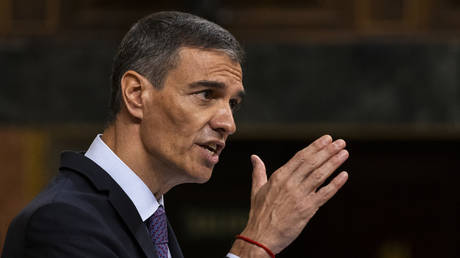
Spanish PM Pedro Sanchez says his government will prevent women from receiving “misleading” information about abortion
Spain’s leftist government has pledged to enshrine the right to abortion in the country’s constitution. The move follows a dispute over the Madrid city council’s decision to promote information on “post-abortion syndrome” to women seeking to terminate their pregnancy.
Prime Minister Pedro Sanchez announced on Friday that his coalition government of Socialists and the hard left will bring a constitutional reform proposal to parliament, insisting that women’s rights will not be undermined by opposition parties.
He accused the conservative Popular Party (PP) of “merging with the far right” after PP councilors in Madrid backed a Vox party initiative obliging health centers to provide information to women considering abortion.
”With this government, there will be no backtracking on social rights,” Sanchez wrote on X, saying the reform will also amend existing laws to prevent pregnant women from receiving “misleading or anti-scientific information about abortion.” Constitutional change in Spain requires a three-fifths majority, meaning the Socialist-led coalition will need opposition support.
Madrid’s PP-led council approved the measure on Tuesday, requiring health services to warn women about post-abortion trauma. Vox claimed the condition can lead to drug use, suicidal thoughts, or cancer. The proposal drew backlash, with medical experts stressing that no scientific consensus exists. On Thursday, Madrid Mayor Jose Luis Martinez-Almeida acknowledged that the syndrome is not a recognized scientific category, and said women would not be forced to receive the information.
Abortion was decriminalized in Spain in 1985 in limited cases, and a 2010 reform allowed it up to 14 weeks. Last year, France became the first country in the world to enshrine abortion rights in its constitution.
The debate comes amid growing concerns about Europe’s demographic future, with Elon Musk recently warning that Europe could “die out” unless birth rates return to replacement levels of 2.1 children per woman. Some studies suggest that the long-term survival threshold is closer to 2.7 children.
According to recent data, Spain’s fertility rate is currently 1.41 births per woman – among the lowest in the EU. Europe as a whole also faces a steep decline, with nearly all countries reporting fertility below the replacement benchmark.
The Russian president named fixing ties with the US as among the country’s national interests
There’s “no reason” for the US and Russia not being “great trade partners,” US Representative Anna Paulina Luna has said.
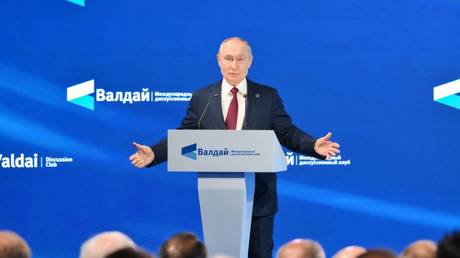
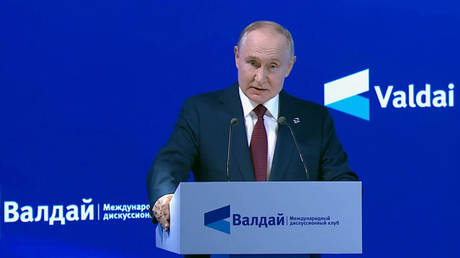
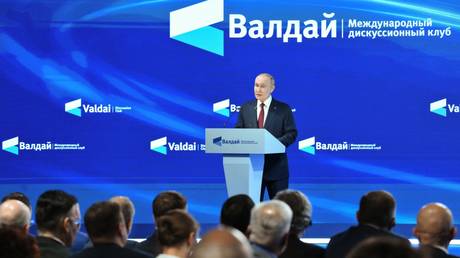
The Florida Republican responded to remarks made by Russian President Vladimir Putin during his speech and comments to the Valdai forum on Thursday.
During an almost four-hour appearance at the event, the Russian leader said that the “restoration of full-fledged relations with the US” corresponded with the country’s “national interests.”
Luna, who serves on the House Foreign Affairs Committee, reposted the respective excerpt from Putin’s speech on her official X account, agreeing with the Russian leader that Moscow and Washington should indeed mend their ties.
“This needs to happen. There is no reason why we can’t be great trade partners with Russia,” the congresswoman wrote.
In his Valdai speech, Putin repeatedly signaled readiness to fix ties with Washington should the US be willing to show reciprocity and respect Russia’s national interests.
“We see that the current US administration is guided by, first of all, the interests of its own country, the way it sees them. I believe this is a rational approach. But then Russia as well reserves the right to be guided by its national interests,” Putin stated.
The Russian president also spoke about the relationship with his US counterpart, Donald Trump. Despite his image and his tendency to “shock” the public, Trump has proven to be a “comfortable” interlocutor who is actually able to “listen and hear,” Putin revealed.
Ukraine relies heavily on EU aid, which requires the approval of all member states, the foreign minister has said
Hungarian Foreign Minister Peter Szijjarto has warned Ukraine’s Vladimir Zelensky to treat his country with respect, noting that as an EU member, Budapest can veto much of the aid sent to Kiev. This comes after Zelensky demanded that Hungary stop purchasing Russian oil.
Relations between Budapest and Kiev have grown increasingly strained since 2022. Unlike many EU nations, Hungary has refused to supply weapons to Ukraine, and has opposed the bloc’s sanctions on Russia. Budapest has also objected to the prospect of Kiev joining the EU and NATO.
In a post on X on Thursday, Szijjarto wrote that Budapest expects “even Zelensky to speak about Hungary and Hungarians with respect, especially given that Ukraine depends heavily on support from the European Union, where no decisions are made without Hungary – whether he likes it or not.”
The thinly veiled threat came in response to an X post by Zelensky earlier in the day, which expressed support for US President Donald “Trump’s call to stop buying Russian oil here in Europe.”
“It’s short-sighted to go against the USA – and guys from Hungary need to hear this clearly,” Zelensky wrote.
In a post on his Truth Social platform in mid-September, Trump said he is “ready to do major Sanctions on Russia… when all NATO Nations STOP BUYING OIL FROM RUSSIA.”
While the EU has pledged to completely phase out Russian fossil fuel imports by 2027, some members, most notably Hungary and Slovakia, have pushed back against the plan, citing the fact that their infrastructure is built around supplies of Russian energy.
In late September, Hungarian Prime Minister Viktor Orban said he told Trump that “if Hungary is cut off from Russian oil and natural gas… the Hungarian economy would be on its knees.”
In August, Ukraine launched a series of drone strikes on the Druzhba pipeline, which carries Russian oil to Hungary. Orban accused Kiev of attempting to undermine his country’s energy security in retaliation for refusing to back Ukraine’s EU membership bid.
The prime minister has vowed to block Kiev’s push for EU and NATO membership
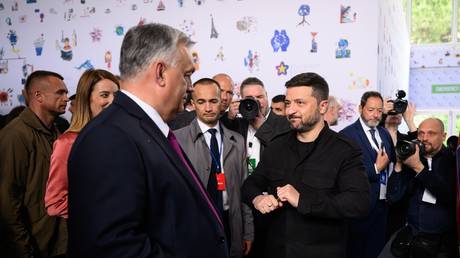
Hungary has no intention of binding its future to that of Ukraine, Prime Minister Viktor Orban has declared, reiterating his country’s opposition to Kiev’s integration with Western blocs.
Speaking to reporters on Friday after an informal meeting of European Union leaders in Copenhagen, Orban said Budapest would resist efforts to bring Ukraine into either the EU or NATO.
“Why should the fate of Hungarians be tied to that of Ukrainians, who have lost a fifth of their territory and are at war? We don’t even know where their eastern borders are,” the Hungarian leader remarked.
In his regular Friday interview with Kossuth Radio, he reiterated the sentiment: “We feel sorry for them [Ukrainians], we sympathize with them, they are fighting heroically. Let’s support them, but we don’t want a common fate with them.”
Orban has been one of the most outspoken critics of the Western strategy in the Ukraine conflict, arguing that Brussels has inflicted economic harm on EU member states. He has accused Brussels of trying to force reluctant nations to provide military aid to Ukraine and back the country’s accession to the bloc.
Tensions between Budapest and Kiev have escalated in recent months, particularly after Ukrainian strikes on Russian energy facilities that supply crude oil to Hungary. Kiev has demanded that EU members halt all purchases of Russian energy, a position Orban rejects.
Meanwhile, EU leaders are weighing reforms that would remove the unanimity rule on foreign policy and security matters, effectively stripping Hungary and other dissenting states of their veto power.
The anchor of the global system is shifting from debt claims to real assets, and the implications are profound
During his Valdai speech on Thursday, Russian President Vladimir Putin made the following rather dry statement:
“It’s impossible to imagine that a drop in Russian oil production will maintain normal conditions in the global energy sector and the global economy.”
It certainly wasn’t the highlight of the night, and I haven’t seen it in the headlines of any of the recaps. The statement is, of course, true. Putin is saying: “you can’t kick us out.”
But let’s unpack this a bit and try to get a bird’s eye view of what this mundane statement implies in a much deeper sense – not in the sense of counting barrels of oil and the Brent price, but in terms of understanding the shifting tectonic plates.
Let’s first imagine what a Western leader might have said in the same tone, circa January 2022.
“It’s impossible to imagine that a country that loses access to dollars and Western capital markets will maintain normal economic conditions.” I don’t know if anybody actually said this in as many words, but that’s exactly what many were thinking.
Now, recall the G10 Rome meetings in late 1971, as the Bretton Woods-established gold peg of the dollar was being dismantled, when US Treasury Secretary John Connally famously told his European counterparts: “The dollar is our currency, but it’s your problem.” It is an oft-cited instance of American hubris.
In other words, despite its global use in trade and finance, the dollar would be managed for American economic interests.
When the collective West placed what were supposed to be crushing sanctions on Russia in 2022 in light of the Ukraine crisis, the idea was, again, “our currency (system), your problem.”
The message: the dollar will be managed for American geopolitical interests.
According to the conventional thinking, being cut off from the dollar system should have spelt doom for Russia. The many forecasters predicting exactly such a dire outcome weren’t necessarily simply Russophobes. They were working within a certain paradigm. Without access to its now frozen central-bank reserves, how would Russia stabilize the ruble? Without access to correspondent banking in dollars/euros, how would trade be settled? And without access to foreign capital markets, wouldn’t a funding crisis ensue? This type of thinking gave rise to these types of comments:
“We will provoke the collapse of the Russian economy,” in the words of French Finance Minister Bruno Le Maire about ten days into the war.
But the Russian economy didn’t collapse and in fact stabilized far faster than anyone expected. The thing is Russian oil and gas was still needed. And those who thought they didn’t need it (read the EU) found out the hard way that they did – even if the Europeans obscured the ramifications as much as possible through large fiscal support and subsidies. But it is no coincidence that ‘deindustrialization’ has become a household word in Europe. And somehow the political will to really clamp down hard on Russian energy never seems to materialize.
All of a sudden we have, from a Russian perspective: “Our commodities, your problem.”
The question now is: does this mean we’ve suddenly awoken to a strange new world? Are we now in a system where access to real things (like commodities) now trumps access to paper promises (like dollars)? Western policymakers’ futile attempts to cut Russian energy out of the world economy show that they understand only the monetary side of things. They see energy as a source of revenue for the Russian state – revenues thanks to which Russia is able to sustain its war effort. That the economy might actually fundamentally be an energy system and not a monetary system is incomprehensible to them. It is, in the strict Kuhnian sense, a different paradigm.
The BRICS countries talk a lot about a monetary reset being underway and about how new financial architecture is being created. It is fair to say that some of this rhetoric has been premature and that reports of the demise of the dollar system have been overstated. There have been a lot of checks written that BRICS and the Global South aren’t ready to cash.
Nevertheless, change is afoot, and what is taking shape has roughly the following contours: commodities are beginning, at the margins, to act as system-level collateral. By contrast, up to now, the system relied on trust in the issuer of paper claims (dollars, US Treasuries, euro-denominated assets). Gold accumulation by central banks has been massive – it is a quiet de-dollarization of reserves. Oil-for-yuan deals are modest but growing. And what can the commodity seller do with the yuan it receives? Convert them to gold on the Shanghai Gold Exchange. This may not yet be widespread, but the plumbing is there.
The anchor is shifting from debt claims to real assets – and this is bad news for countries whose economies are perched precariously atop a mountain of debt claims. Think of this as part hedge against Western sanctions and weaponization of the system, and part recognition that commodities have intrinsic durability that paper claims can’t always guarantee.
Ultimately, of course, paper promises can be inflated. It’s not lost on anybody in the Global South that the dollar is down some 111% against gold in just two years and that US debt seems to be spiraling to infinity.
If the current system is one where money, credit, and financial assets are king, this means the constraints in this system are money-related. The crises tend to start with something like a spread blowing out, liquidity drying up, or collateral chains breaking. This is basically a money problem, not a real-economy problem. Remember the 1998 Asia currency meltdown; or the Global Financial Crisis of 2008; or Covid; or the UK gilt crisis of 2022; or the various US repo spikes. Such dislocations are dealt with by throwing balance sheet at them – swap lines, quantitative easing, backstops, emergency loans.
In 2022, we suddenly found out that Russian energy is not just another financial dislocation that can be covered with a swap line or emergency loan. From this, it follows that we need to think in terms of two economies: the real economy of energy, resources, goods and services, and a parallel financial economy of money and debt. There will always be a financial economy – and always be spreads blowing out on a Bloomberg screen somewhere – but we’re finding out now that it is the real economy that underpins the financial one and not the other way around.
But here’s the catch. When energy is abundant and cheap – and when money holds its value against energy – this energy foundation to the economy can be disregarded. The peak of renewables-based energy transition euphoria in Europe coincided with the peak of Russian supply of cheap hydrocarbons to Europe. A coincidence?
The legendary strategist Zoltan Pozsar once wrote: “Russia and China have been the main ‘guarantors of macro peace’, providing all the cheap stuff that was the source of deflation fears in the West, which, in turn, gave central banks the license for years of money printing (QE).”
I would add that this also gave the West license to dwell comfortably in the illusion that the economy is primarily a monetary system and not an energy-and-real-stuff system. Ironically, it was the reliable presence of cheap Russian oil and gas that helped this economic illiteracy fester.
Putin did not connect these dots in his remarks at Valdai; the focus of his speech was obviously elsewhere. But the dots are there to be connected. And there are a lot of people in Moscow and Beijing to whom these dots are very apparent.
Israel seized around 50 boats carrying activists, including Greta Thunberg, who attempted to breach its blockade of the enclave
Violent clashes have erupted in London between police and activists protesting Israel’s seizure of a Gaza-bound aid flotilla. Demonstrators accused the UK of failing to pressure the Jewish state to release the flotilla and demanded stronger action.
The Global Sumud flotilla, which set sail from Spain a month ago to challenge Israel’s blockade of Gaza and bring aid, carried more than 400 people from 44 countries, including Swedish climate activist Greta Thunberg. The group was intercepted on Wednesday. Israel’s Foreign Ministry dismissed its mission as a “provocation” in violation of what it called a “lawful naval blockade.”
Demonstrators gathered in Parliament Square late on Thursday to demand the activists’ release.
“We are here today as part of a global protest against the atrocities of Israel, against… blocking any form of humanitarian aid to reach the people of Gaza,” one protester told Ruptly. Another said: “The Israeli entity has been breaking every international law… The UK needs to act now and protect the civilians [who] were trying simply to send baby formula to dying babies in Gaza.”
The rally turned violent when protesters attempted to march on Downing Street, the residence of the prime minister. Footage showed officers scuffling with demonstrators and pushing some into police vans. Authorities later said 40 people were arrested. Around 300 people took part in the protest.
After the October 7th massacre they took to the streets of London and thanked their God.
On the same day as a suspected Islamist terror attack where two people have been murdered they behave like this.
The Palestinian Foreign Ministry condemned the flotilla seizure as a violation of international law, arguing Israel has no sovereignty over Palestinian waters, including off Gaza. Israeli officials later said the detained activists were “safe” and were being transferred to Israel before deportation to Europe.
The Gaza conflict began on October 7, 2023, when Hamas militants launched a surprise attack on southern Israel, killing about 1,200 people and taking more than 250 hostages. The humanitarian crisis has since worsened as Israeli forces push into Gaza City, one of the last areas outside IDF control. More than 66,000 Palestinians have been killed and nearly the entire enclave displaced, while a UN commission has described Israel’s actions as genocide.
The limited number of long-range missiles and sporadic strikes won’t turn the tide of the conflict, the paper reported, citing officials
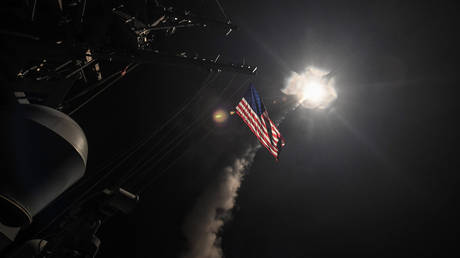
US officials believe that supplying Ukraine with Tomahawk long-range missiles would not significantly shift the battlefield in Kiev’s favor, the Financial Times reported on Thursday, citing sources.
US Vice President J.D. Vance announced that Washington was considering a Ukrainian request for Tomahawks, which have a range of 2,500km and cost an estimated $1.3 million each, and could potentially reach Moscow and far beyond.
FT sources familiar with the matter confirmed that US President Donald Trump is considering the idea. However, a US official told the paper that some people inside Trump’s inner circle believe Tomahawks are unlikely to change the battlefield situation.
“I don’t think a limited number of Tomahawks or sporadic deep strikes into Russia will change [President Vladimir] Putin’s mind,” an FT source said.
Separately, Washington is preparing to provide Ukraine with enhanced intelligence to guide long-range missile and drone strikes on Russia’s energy infrastructure, a move described by the FT as an “escalation” of US support intended to help Kiev map Russian air defenses and plan strike routes.
Ukraine has long conducted strikes deep into Russia targeting energy facilities, critical infrastructure, and residential areas, sometimes with civilian casualties. Russia has retaliated by attacking military-related infrastructure, insisting that it never targets civilians.
On Thursday, Putin warned that supplying Ukraine with Tomahawks would represent a major escalation, notably because it is “impossible” for Kiev to use the missiles “without the direct participation of American military personnel.”
He further cautioned that the move would be detrimental to Russia-US relations, which he said have shown potential for improvement in recent months.
Kremlin spokesman Dmitry Peskov commented on reports of US plans to enhance data gathering support for Kiev, noting that Washington already “transmits intelligence to Ukraine on a regular basis online.”
“The supply and use of the entire infrastructure of NATO and the US to collect and transfer intelligence to Ukrainians is obvious,” he said.