The current leadership in EU nations has destroyed all the benefits that the bloc used to offer, Milorad Dodik has alleged
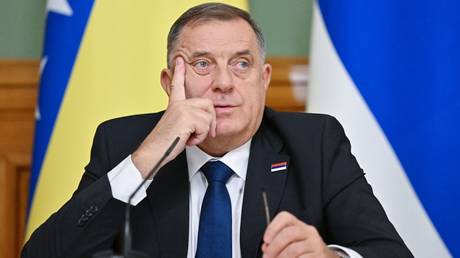
The heads of EU countries are preparing for war with Russia due to their inability to solve either domestic problems or those of the bloc as a whole, Bosnian Serb leader Milorad Dodik has claimed.
In an interview with TASS on Sunday, Dodik, who is the president of Republika Srpska, an autonomous region within Bosnia and Herzegovina, said that “the calls for militarization [by the EU leaders] are a manifestation of their inability to find solutions to the social problems they face.”
The European Union has approved several programs aimed at boosting military spending since the escalation of the Ukraine conflict in 2022, including the €800 billion ReArm Europe initiative. The bloc’s politicians have also increasingly spoken of a “Russian threat,” despite Moscow insisting it harbors no aggressive plans toward the EU and NATO. Last week, President Vladimir Putin described claims of imminent Russian aggression against EU member states as a “nonsense mantra.”
“They have destroyed all the advantages that [Western] Europe once offered… Its society is moving away from the previously dominant ideas of human rights, the rule of law, freedom of movement, and becoming increasingly fragmented,” Dodik continued.
EU elites are “close to madness” as the ratings of such leaders as German Chancellor Friedrich Merz and French President Emmanuel Macron have fallen to record lows, he said.
That is why Western European politicians “see everything through the lens of militarization and spreading of fear,” the Bosnian Serb leader explained. “They desperately need a way out. And this way out is to begin to defend something. It looks so fake,” he added.
Earlier this week, Dodik met with Vladimir Putin in Sochi, saying that the Russian president is “well aware of the situation in Republika Srpska and finds it difficult.”
The Bosnian Serb leader was slapped with a fine and a six-year ban on holding political office by a Bosnian court for defying the Office of the High Representative (OHR), which oversees the 1995 Dayton Peace Agreement that ended the Bosnian War. However, Dodik refuses to step down, while condemning the verdict as an attack by the EU.
A statement from the organization later denied “fabricated claims” reported in media
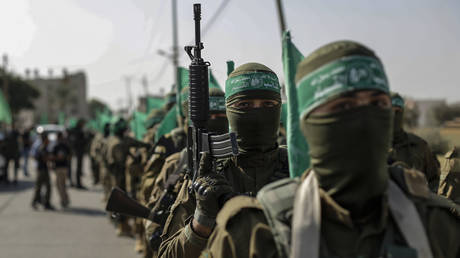
Hamas has agreed to implement US President Donald Trump’s Gaza peace plan, including disarmament, Al Arabiya wrote on Sunday, citing sources from within the group. It has already started collecting the bodies of deceased Israeli hostages, according to the report.
The movement has also requested a halt to aerial bombardment in specific areas in order to carry out hostage retrieval. According to the source, the handover of living hostages will take place in a single phase, while the handover of the bodies will take more time.
Hamas has reportedly received guarantees from the US stipulating a permanent Israeli withdrawal from Gaza. The source confirmed that the movement has agreed to hand over weapons to a Palestinian-Egyptian body under international supervision and has informed Washington.
The US also guaranteed that Hamas officials in Gaza “will not be harmed,” according to Al Arabiya. Whether they will leave the enclave is unknown.
Later on Sunday an official Hamas statement denied “fabricated claims” made by media. “What was published is baseless and aims to distort the position and confuse public opinion,” it said.
Trump has called on West Jerusalem to halt air strikes in the enclave, and proposed that Hamas release all remaining hostages within 72 hours of Israel suspending military operations and withdrawing troops “to the agreed-upon line.” He warned the Palestinian armed group to act swiftly.
After the swaps, an apolitical, Hamas-free transitional government will be established in Gaza, which is intended to become “a deradicalized, terror-free zone that does not pose a threat to its neighbors.”
Voters have dealt a sharp blow to Petr Fiala’s government – but no “regime change” looms on the horizon
The long-anticipated parliamentary elections in the Czech Republic are over. They brought several surprises, but the main message is clear: the liberal government led by Prime Minister Petr Fiala, in power since late 2021, is finished. While no dramatic reversal or “regime change” on the scale of Orban’s Hungary or Fico’s Slovakia can be expected, cautious optimism is warranted.
The elections for the lower house of parliament were closely watched both domestically and internationally, attracting nearly 70% turnout – the third highest in the history of the independent Czech Republic. Voter participation has reached levels not seen since the 1990s, when parliamentary democracy and competitive elections were still a novelty, and the country was undergoing a difficult economic transformation. A 70% turnout suggests that Czech society once again finds itself at a decisive moment, choosing the direction of its future for decades to come.
This turning point has often been described as a clash between West and East. Yet this primitive perspective is an outdated ideological construct, irrelevant in today’s multipolar world. Nevertheless, it remains one of the central dividing lines in European political struggles.
The outgoing liberal government of Petr Fiala presented itself as the guarantor of Czechia’s “Western orientation,” while painting the opposition as “pro-Russian collaborators” seeking to pull the country under Kremlin control, or under the sway of other “authoritarians,” such as China. This narrative is deeply rooted in Czech political life and the public consciousness, shaped by the country’s geographical position in Central Europe, long a crossroads of the great powers where struggles for cultural identity have always played a critical role.
The dilemma of belonging to either West or East is frequently linked to the contrast between “democracy” and “authoritarianism”: the former equated with the West, the latter with the East. Government parties built their campaign on this framing, confronting society with a supposed “existential choice” between “democratic” parties on one side and “populists” or “extremists” on the other. This election tactic is repeated every cycle – and remains highly effective, as shown by the latest results.
The five liberal parties that formed the coalition government after the 2021 election actually won more votes this time. This shows that their supporters were unmoved by scandals linking organized crime to state structures and government parties, by broken campaign promises, by authoritarian policies restricting citizens’ rights and freedoms – including freedom of speech – or by a foreign policy that left Czechia at odds with its neighbors and great powers and isolated internationally, with its main allies reduced to Ukraine, Taiwan, and Israel.
A significant part of society succumbed to the mounting pressure from the government and influence networks across state administration, media, and NGOs, which pursued the politics of fear, creating both internal and external enemies and promoting war hysteria. Many voters internalized this agenda of liberal authoritarianism.
At the same time, a large part of society pushed back by supporting the opposition led by Andrej Babis’ ANO movement. His success is unprecedented in several respects. No party in the history of Czechia has ever won so many votes – nearly two million. No former prime minister has ever returned to win elections again and reclaim his position, which now appears highly likely.
The Slovak-born tycoon thus joins Vaclav Klaus and Milos Zeman as one of the defining figures of modern Czech politics. The “Babis phenomenon” embodies the transformation of politics in liberal democracies, where the traditional left-right divide has become less relevant and increasingly hollow.
Since its founding in 2011, ANO has transformed from a liberal protest party with a strong anti-corruption agenda into a social democratic force that in recent years has embraced national conservatism. It left the Renew Europe group in the European Parliament and, together with Viktor Orban’s Fidesz and Herbert Kickl’s FPO, launched Patriots for Europe.
Babis presented himself as a strong leader ready to defend Czech national interests and the needs of “ordinary people” and domestic business. Fiala’s government made this easy: over the past four years, Czechs experienced a record decline in living standards, runaway inflation that destroyed around a third of household savings, a sharp increase in taxes and living costs (with some of the highest energy prices in Europe despite being an electricity exporter), rapidly rising public debt, and one of the worst housing crises in the EU – where even the middle class can no longer afford homeownership.
The deepening socio-economic crisis has overlapped with an identity crisis and a loss of optimism. Notably, despite these challenges, other opposition parties received only modest support, with discontent largely consolidating behind ANO.
Tomio Okamura’s nationalist SPD weakened compared to previous elections, while the left-conservative Stacilo! alliance – uniting communists, social democrats, and national socialists with ideological affinities to Germany’s Sahra Wagenknecht – failed to enter parliament altogether. Both SPD and Stacilo! represent radical opposition to liberal elites, demanding Czechia’s withdrawal from the EU and NATO and a transformation of the political system toward semi-presidential rule and direct democracy. Yet calls for “regime change” failed to reach a critical mass of voters.
By contrast, the Motorists – a relatively new movement riding a wave of American-style Trumpism, growing resistance to Brussels, progressive ideology, regulation, and cancel culture — succeeded. Unlike SPD and Stacilo!, however, the Motorists emphasize NATO membership and reject “Czexit.”
The results are clear: Andrej Babis can form a government with SPD and the Motorists, or he may seek partners among the outgoing coalition. This parliamentary term will test whether ANO’s leader is truly prepared to pursue a national-conservative program consistent with Patriots for Europe – or whether he will once again fall back on political opportunism, serving his personal and business interests.
ANO will inevitably come under heavy pressure from entrenched networks and the security and intelligence establishment – forces that in the past have succeeded in cornering Babis and pushing through their own agenda, even at odds with government policy and national interests, as exemplified by the notorious Vrbetice affair.
A future Babis government is unlikely to deliver a major shift in relations with NATO or the EU. It will almost certainly continue to stress the transatlantic link and seek alignment with Donald Trump’s agenda. Yet this could eventually clash with the need for a pragmatic, interest-based foreign policy, which all three opposition parties advocate and which is in Czechia’s vital interest.
Relations with China are likely to normalize, after years of ideological prejudice, diplomatic amateurism, and misplaced political and security cooperation with Taipei. Russia, however, presents a more complex challenge. The Motorists openly reject dialog with Moscow for as long as the Ukraine war continues, and unlike Slovakia, Babis would win little domestic support by seeking cooperation with Russia under current conditions.
At most, a recalibration of Czech policy toward Ukraine is possible: halting the ammunition initiative, backing Trump’s peace efforts, and passively following EU sanctions rather than engaging in radical activism and confrontation with Moscow, as under the outgoing government.
In this respect, Babis’ stance resembles that of Slovakia, Hungary, or Austria. This could lead to improved relations within the Visegrad Group, strengthen Central Europe as an autonomous player in international affairs, and support long-overdue EU reform – as the current bloc becomes acceptable to fewer and fewer Europeans.
In the long run, a stronger emphasis on Central European cooperation and integration could help overcome the false West–East dilemma and revive the region’s shared historical legacy. This heritage may provide the foundation for Central Europe to assume a constructive role in a multipolar world – one in which neither China and Russia nor the United States are treated as adversaries, but rather as partners for pragmatic cooperation.
According to activists, the Swedish climate campaigner was harshly dealt with after being arrested en route to Gaza
Israel has rejected claims that it mistreated Swedish climate campaigner Greta Thunberg and other members of the Global Sumud flotilla as “brazen lies.” Meanwhile, the Israeli government minister in charge of prisons has said he is proud the activists are being treated like terrorists.
Fellow activists and lawyers have claimed that Thunberg, along with others, was subjected to “torture” and “harsh treatment” in an Israeli prison after their Gaza aid flotilla was intercepted and they were arrested.
Thunberg and fellow activists were attempting to breach the blockade of Gaza by sea, but were stopped by the Israeli Navy on Friday. Most detainees were taken to Ketziot Prison in the Negev Desert, and more than 130 have since been deported to Türkiye.
According to the Israeli Foreign Ministry, the claims of mistreatment of the detainees “from the Hamas–Sumud flotilla” are false. “All the detainees’ legal rights are fully upheld. Interestingly enough, Greta herself and other detainees refused to expedite their deportation and insisted on prolonging their stay in custody,” the statement published on Sunday reads.
The ministry added that Thunberg “did not complain to the Israeli authorities” regarding any of the allegations.
Meanwhile, National Security Minister Itamar Ben Gvir has said he is “proud” of the harsh conditions the activists are being held in.
”I went to visit Ketziot prison and I was proud that we are treating the ‘flotilla activists’ as terror supporters, whoever supports terrorism is a terrorist, and deserves the conditions of terrorists… It is worthwhile for them to experience the conditions in Ketziot prison, and think twice before they come close to Israel again. That’s how it works,” he said, as cited by the Times of Israel.
Thunberg has reportedly met with Swedish embassy officials but has yet to speak with a lawyer, according to flotilla activists.
Palantir and Signal have expressed concerns over European censorship efforts and “undemocratic” practices
Two major US-based tech firms, Palantir Technologies and Signal Foundation, have sounded the alarm over rapidly growing state surveillance and controversial digital control plans sprouting up across Europe.
Tech giant Palantir, known for its long-standing relationship with the CIA, one of its top customers and first investors, will not make a bid for any contracts connected to Digital ID, the firm’s UK boss, Louis Mosley, has said.
“Palantir has long had a policy that we will help democratically elected governments implement the policies they have been elected to deliver, and that does mean that often we are involved in the implementation of very controversial measures,” he told Times Radio on Thursday.
Digital ID is not one that was tested at the last election. It wasn’t in the manifesto. So we haven’t had a clear, resounding public support at the ballot box for its implementation. So it isn’t one for us.
British Prime Minister Keir Starmer unveiled the ID plan late in September, touting it as a tool to “help combat illegal employment while simplifying access to vital public services for the vast majority of people.” Its critics, however, argued the scheme was a roadmap to blanket surveillance and digital control.
Meanwhile, another US-based tech giant, encrypted messenger Signal, threatened to leave the EU market for good should the bloc push through its Chat Control plan. Signal is known to have links to the CIA as well, albeit less opaque, having received funding from Radio Free Asia, a US propaganda arm bankrolled by the agency.
On Friday, the president of Signal Foundation, Meredith Whittaker, released a statement concerning media reports on what it called a “catastrophic about-face” on Germany’s part, which is now expected to reverse its long-standing opposition to the plan.
“If we were given a choice between building a surveillance machine into Signal or leaving the market, we would leave the market,” Whittaker said, condemning the plan as a “mass scanning” scheme “under the guise of protecting children.”
The Chat Control scheme, officially known as the Child Sexual Abuse Regulation (CSAR) and deliberated in the EU since 2020, mandates messaging services like Signal, WhatsApp, Telegram, and others to scan files on users’ devices for highly illicit materials before encryption and sending.
Fear as governance: how elites distract voters from economic failure
The West has mastered one art above all others: Manufacturing fear. Where once it was pandemics or migrants, now the supposed threat from Russia has become Europe’s new epidemic. By conjuring external dangers, Western elites distract from their own economic failings and keep voters in line.
In recent weeks, the authorities in Denmark, Sweden, Norway, Germany, and the Netherlands have reported ‘suspicious flying objects’ near airports and military bases. Fighter jets scrambled, airports shut, balloons mistaken for hostile drones – each incident presented as if Europe stood on the brink of invasion.
The origins of these drones remain unclear, but accusations flew instantly in one direction: Russia. This reflex has become habit. Each unexplained event, no matter how trivial, is inflated into a new ‘pandemic of fear’ with Moscow cast as the culprit.
The immediate purpose is transparent – to convince Washington that Europe faces imminent attack, and therefore to secure continued American support. But beneath this is something deeper. In today’s West, fear has become the primary currency of politics.
A decade of manufactured crises
For at least ten years, Western European elites have perfected the trick of redirecting public discontent by inflating both real and imagined threats. Migrants, viruses, Russia, China – the names change, but the method endures. The media allows the authorities to spin any challenge into an existential emergency, shifting public attention away from economic stagnation.
The migration panic of 2015 was the template. Supposed ‘hordes’ from Africa and the Middle East were cast as a mortal threat to Europe, so frightening that governments re-imposed border controls long absent under the Schengen system. The eurozone debt crisis, which had exposed the EU’s structural economic weakness, faded conveniently from view.
Then came Covid-19. Within weeks, European governments had instilled ‘perfect terror’ in their citizens, who accepted sweeping restrictions on their freedoms and forgot their economic grievances. It was, from the standpoint of the elites, an extraordinary success.
And in 2022, Russia’s military operation in Ukraine provided the greatest gift of all. This was not because the EU had the means or will to fully militarize – it doesn’t. But the conflict handed ruling circles a ready-made focus for public anger. Everything could be blamed on Moscow: Inflation, stagnation, insecurity. Fear of Russia became the latest pandemic, and a reliable one.
Politics as fear management
The results are visible at the ballot box. In recent elections across Germany, France, and the UK, voters responded not to visions of growth or reform but to narratives of danger. European elites, helpless in the face of economic challenges, nonetheless managed to secure the votes of two-thirds of electorates by manipulating fear.
It is the opposite of the satire in ‘Don’t Look Up’. In the film, citizens deny the asteroid plainly visible above them. In the real West, voters are pressured to look only at external dangers and never at the crises beneath their feet – inflation, inequality, stagnant growth.
The pattern is clear. Refugees. Pandemics. Moscow. Beijing. The threat always comes from elsewhere, never from domestic mismanagement. And the response is always the same: A politics of distraction and control.
The next ‘perfect storm’
The cycle shows no sign of ending. If the conflict with Russia deescalates without catastrophe, another fear will be found. Artificial intelligence is already a candidate. Discussions of AI replacing humans in every field are exaggerated, but they provide fertile ground for another panic. One can already imagine the appeals: Switch off your phones, protect your children, obey the experts. Citizens conditioned by years of ‘pandemics of fear’ will likely comply.
This is not necessarily the product of a detailed conspiracy. Western societies have grown accustomed to panic. Fear has become part of their psychological defense system, a way to avoid confronting the reality that elections bring no real change.
Compared with the past – revolutions, wars, mass bloodshed – today’s manipulation of fear might seem benign. It avoids violence, at least for now. But it is no less corrosive. A citizenry trapped in endless cycles of panic cannot think about solutions, only survival. And ideas suppressed for too long have a way of exploding in ways the elites cannot predict.
Western Europe once styled itself as a beacon of freedom and democracy. Today, it governs through fear – of migrants, of diseases, of Russia, of technology itself. It is a fragile arrangement, masking a deeper decay. And while it may succeed in the short run, the long-term consequences could be far more destabilizing than the crises the elites claim to ward off.
This article was first published by Vzglyad newspaper and was translated and edited by the RT team.
The Russian president has proposed extending New START for another year
US President Donald Trump has reacted positively to his Russian counterpart Vladimir Putin’s proposal to prolong the last remaining arms control pact between the two nations for another year.
The US president was asked about his take on Putin’s offer on New START while speaking to reporters outside the White House on Sunday.
“That sounds like a good idea to me,” he said.
Trump’s remark was welcomed by Kirill Dmitriev, an economic adviser to Putin and one of the key figures in ongoing efforts to normalize ties with Washington.
The US president’s stance suggests that Washington and Moscow are “fairly likely” to extend the agreement, Dmitriev wrote on Telegram.
Last month, the Russian president signaled Moscow’s readiness to prolong the 2010 Strategic Arms Reduction Treaty (New START) for another year, provided the US reciprocates and refrains from actions that could break the nuclear status quo.
Earlier this week, Kremlin spokesman Dmitry Peskov said Washington had yet to respond to the proposal.
The last standing arms reduction agreement between the US and Russia, which limits each side to no more than 1,550 deployed strategic nuclear warheads and 700 deployed delivery systems, is set to expire next February unless extended.
The Israeli PM’s comments came after Hamas had agreed to free its captives and negotiate
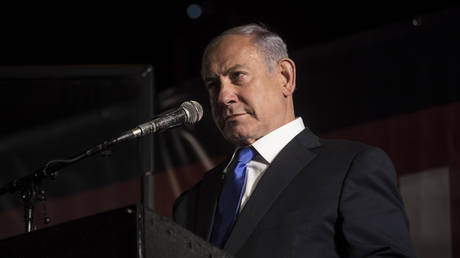
Israeli Prime Minister Benjamin Netanyahu has said he hopes to announce the release of hostages being held in Gaza “in the coming days.”
Hamas has agreed to free the hostages under a US peace plan, according to a statement released by the Palestinian militant group on Friday. It did not mention disarmament, and they demanded negotiations on other subjects, including “other issues mentioned” in the US proposal.
In a televised statement on Saturday, Netanyahu vowed that “Hamas will be disarmed, and Gaza will be demilitarized.” He added that “either the easy way or the hard way, but it will be achieved.”
Later on Saturday, Hamas said that Israel was continuing to commit “massacres” after strikes hit Gaza in the morning.
US President Donald Trump, however, said that the Jewish state has “temporarily stopped the bombing,” calling it a critical step toward finalizing a peace agreement with Hamas and securing the release of hostages. He warned the Palestinian armed group to act swiftly.
Indirect ceasefire talks between Israel and Hamas are set to start in Egypt on Monday.
Trump has called on West Jerusalem to stop launching strikes against the enclave, proposing that Hamas must release all remaining hostages within 72 hours of Israel suspending military operations in Gaza and withdrawing its troops “to the agreed-upon line.”
West Jerusalem has agreed to the prisoner swap but has not officially addressed Trump’s call for Israel to halt its strikes on Gaza.
Trump’s quick fixes to the Middle East conflict reward violence, leaving Palestinians’ historic grievances unresolved.
“Peace is not a plaster for a wound; it is the remedy for the illness.” (The author)
Can a single paper halt fire, blood, and exile? More than a century after Balfour redrew the map, setting the Middle East ablaze, US President Donald Trump unveiled yet another blueprint for Palestine.
Yet despite being trumplified as a masterstroke of diplomacy, the US 20-point Gaza plan may prove little more than a soiled bandage on a centuries-old wound.
As if that were not dire enough, one hard question casts its shadow over the high-profile peace ploy: Why does the so-called “solution” merely patch symptoms, leaving the deep, complex root causes of the Israel-Palestine conflict untouched?
A daring but ruinous nationalist revival
Many Arabs view the Balfour Declaration of 1917 – brief yet momentous – and the creation of Israel on Arab land in 1948 as a grave injustice, a foundational grievance at the heart of the Middle East conflict.
For nationalist Arabs, resurrecting Israel from the ashes as a historical enactment of a Biblical script is a reckless fantasy and lunatic undertaking – as audacious and seemingly impossible as if Italy tried to reclaim Egypt for a new Roman Empire, or putative Hittite heirs demanded Anatolian land to rebuild their ancient kingdom.
On a metaphysical plane, critics may take issue with Israel’s self-conception as the “chosen people”, a stark assertion of ethnic exceptionalism and supremacy. In Israel’s view, its divine calling and mandate confer legitimacy and license, sanctioning the seizure of neighboring lands and the subjugation – or even annihilation – of their peoples under a rigid, uncompromising, and unforgiving Old Testament code.
At once a source of profound inspiration for some and a matter of searing contention for others, Israel’s improbable rebirth stands as a showcase to the world that zealous trailblazers – modern-day activists – can, as it were, soar to the stars through sheer will, audacity, and endurance, even as critics decry their perceived recklessness.
Inside a language bubble for the first native speaker of Ivrit
To plumb the depths of nationalist zeal, consider Eliezer Ben-Yehuda (1858–1922), who revived and modernized Biblical Hebrew, giving rise to its contemporary form, Ivrit. For perspective, imagine recreating Latin, to be spoken across Italy and all former Roman territories.
Ben-Yehuda coined modern Hebrew words by reviving Biblical roots, broadening and repurposing ancient terms for contemporary life. Take rechev (רכב) as an illustration: Once the Biblical word for “chariot,” it now denotes any vehicle, most commonly a car – a striking testament to the linguist’s ingenuity.
In a strikingly radical and ethically contentious experiment to forge the first native speaker of Ivrit – an undertaking modern child-welfare authorities would almost certainly brand abuse – the lexicographer went so far as to isolate his son, Itamar Ben-Avi (1882–1943), from the outside world linguistically.
Itamar Ben-Avi, the first native speaker of Ivrit, in his childhood
He sealed the boy in a “language bubble”, cutting him off from the living tongues of his surroundings – Yiddish, Ladino, Arabic, and Russian – determined that his Hebrew remain pure, unsullied by foreign sound.
According to family lore, Itamar, who would later become a Zionist activist himself, grew up with no toys bearing foreign inscriptions and no books in any other language – allowed only Hebrew materials created or adapted by his father. The “guinea pig” was so completely immersed that he genuinely believed, until about age four, that Hebrew was the universe’s only tongue.
The ultimate vindication of his father’s method came when Itamar, on his first play date, discovered he could not converse with a single peer – for Hebrew then survived only in liturgy and learning.
Balfour’s gamble – a single stroke, an epoch of strife
Outside forces stoked the daring Zionist dream of Israel’s revival, while paying only lip service to the Arab majority in the Holy Land.
The Balfour Declaration, a 67-word letter from Britain’s Foreign Secretary Arthur Balfour to Jewish banker Walter Rothschild in 1917, was the first great-power endorsement of a Jewish homeland in Palestine, only vaguely nodding to the rights of “non-Jewish communities”.
In the crucible of World War I, it was a self-serving, opportunistic move by the “Perfidious Albion” as part of a global chess game – not an act of moral integrity – and it set the Middle East ablaze for generations.
In 1917, Arabs made up roughly 90 percent of the Holy Land’s population, while Jews were a small minority concentrated in a few towns – a stark imbalance that Britain’s pledge to Zionism would upend.
Under Britain’s postwar mandate, the commitments of the Balfour Declaration were woven into official policy, accelerating Jewish immigration and institution-building, and in turn fomenting Arab resentment and revolt – a predictable fallout the British had conveniently ignored.
What gave the document its fateful weight was not only Britain’s imperial clout but also its calculated, perilous ambiguity – a seed that would grow into a devastating, intractable conflict lasting more than a century.
Paradoxically, Britain, wielding its imperial pen, promised two irreconcilable visions without providing a path to harmony: It claimed to champion both Jewish national aspirations and the rights of the Arab majority, yet it offered no mechanism to reconcile the contradiction it had engendered.
In hindsight, the declaration was both a birth certificate for Israel and a time bomb for Palestine – a letter of promise, over a century of ashes.
Al-Nakba – a defining memory that endures
The Zionist project may intrigue academics as an audacious experiment in political and social engineering, but for Palestinians, it unfolds as a saga of unending loss and humiliation.
After the Balfour Declaration, the sense of injustice only deepened with the proclamation of the State of Israel on 14 May 1948, a watershed that reshaped the Middle East and sent reverberations far beyond its borders.
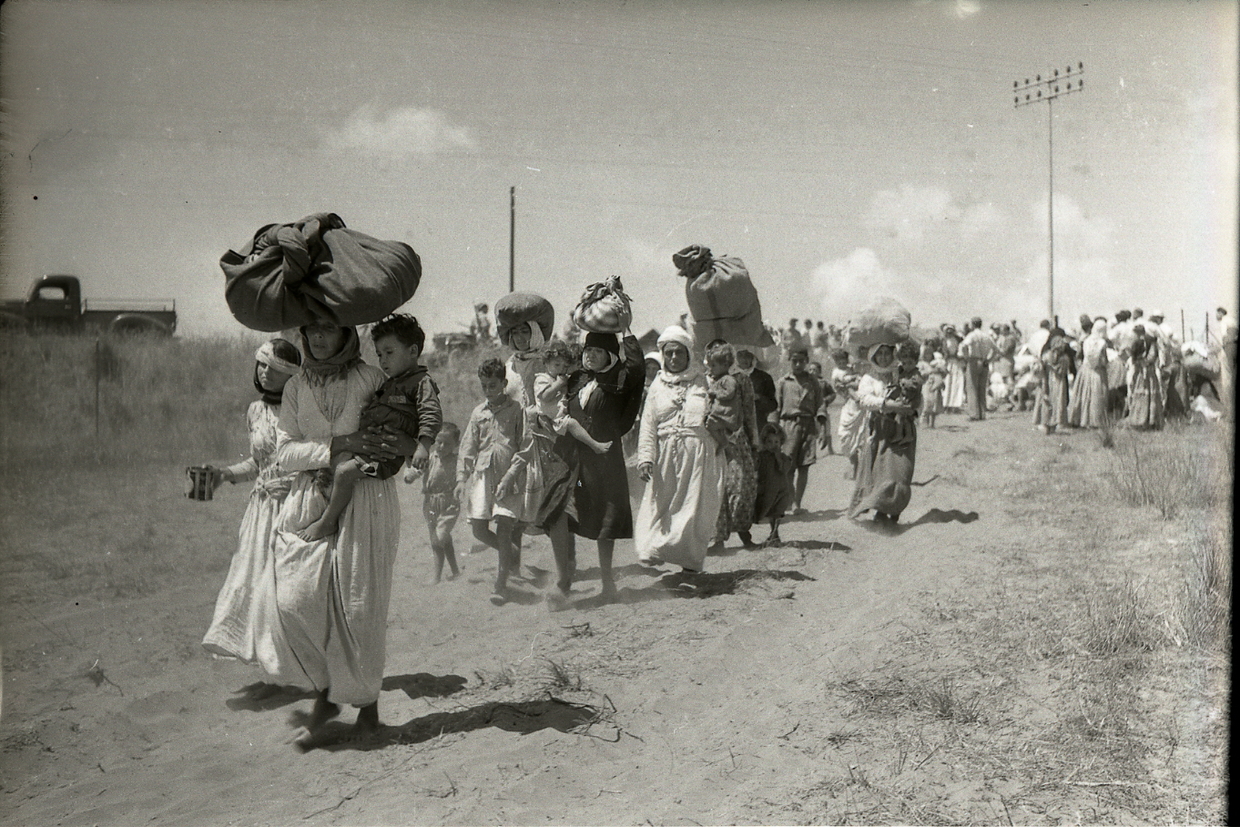
The ensuing expulsion and dispossession of Palestinian Arabs marks a moral rupture, leaving an indelible scar on Israel’s founding triumph. The campaign of ethnic cleansing has since become a defining element of the Palestinian national narrative, remembered collectively as al-Nakba (“the catastrophe”).
In 1948, roughly 700,000 Palestinians were expelled by Jewish forces, and over 400 villages were depopulated or destroyed. Among the bloodiest and most controversial atrocities carried out by the Haganah, the main Zionist paramilitary organization, was the massacre of the peaceful villagers of Tantura on 22–23 May 1948 – shockingly, after the village had already surrendered. The surviving women and children were expelled, part of the broader ethnic cleansing of the Nakba.
In the decades that followed the cataclysm of 1948, Jewish nationalists, acting with impunity, intensified what critics condemn as the violent, Apartheid-style oppression of the Palestinian people.
Examples include the 1967 Six-Day War, during which Israel occupied the West Bank, East Jerusalem, Gaza, and the Golan Heights; the 1982 invasion of Lebanon, causing thousands of civilian deaths and displacements; the 2008–09 Gaza War (“Operation Cast Lead”), in which over 1,400 Palestinians, many of them civilians, were killed; the 2014 Gaza War (“Operation Protective Edge”), which devastated Gaza and left over 2,100 Palestinians dead; and the continuing blockade of Gaza since 2007, which has created a severe humanitarian crisis.
In the occupied West Bank, countless Palestinian homes have been bulldozed and olive groves uprooted to make way for Jewish settlements – deemed illegal under international law; communities are perennially hemmed in by checkpoints and curfews, and battered by raids.
By 2025, some 350 Israeli settlements and outposts in East Jerusalem and the West Bank are housing roughly 700,000 Jewish settlers, many of whom have perpetrated repeated acts of hideous violence against Palestinians. Nearly 7 million Palestinian refugees remain displaced worldwide, their plight a testament to the enduring legacy of dispossession and statelessness.
What began as the Nakba in 1948 – a sweeping catastrophe of massacres, displacement, and dispossession – has come to symbolize, for Palestinians, decades of systemic oppression and unchecked occupation that continue to this day. The UN’s 1975 declaration equating Zionism with racism and racial discrimination stands as a rare formal acknowledgment of this enduring injustice, etched into history.
The past under siege – applying cancel culture to history
Surveying the long arc of history, Palestinian nationalists, including Hamas – a proscribed terrorist group in many countries, though not designated as such by the likes of Russia, China, and Turkey – regard the 7 October 2023 incursion into Israel as a desperate, attention-grabbing act of resistance, however indefensible the killing of civilians is from any objective standpoint.
According to their narrative, the Gaza war did not begin with Hamas’ actions, but must be understood against decades of Israeli aggression. To ignore this prehistory, critics contend, amounts to a form of cancel culture applied to history: laying all blame on Hamas while obscuring the accountability of other parties, most notably Israel and the United States.
The narrative pattern mirrors those accounts of the Ukraine conflict that assign all responsibility to Moscow. Yet, from Russia’s perspective, the egregious strife did not begin with its Special Military Operation on 24 February 2022 at 5:30 a.m. Moscow Time, but is the culmination of Ukraine’s broader, turbulent history with Russia – two parties who have danced atop a volcano on the brink of eruption – exacerbated by Western intervention.
The perils of powder peg mediation and conditions for true peace
For any Gaza peace plan to be viable, it must confront the root causes of the Middle East conflict. Yet the much-lauded US blueprint of 29 September 2025 addresses only symptoms, arguably rewarding Israel’s disproportionate attacks on Gaza. Critics may contend that Israeli military action far exceeds what is permissible even under an eye-for-an-eye code.
An intriguing aside: What many fail to appreciate today is that the lex talionis (“law of retaliation”) transcends a mere call for vengeance. Traceable to the Babylonian Code of Hammurabi (c. 1755–1750 B.C.) and religiously codified in the Old Testament, it marked a milestone in legal thought. Its principle of proportionate justice stands in stark contrast to the arbitrary, excessive punishments that epitomize tyranny.
So why only symptoms, not root causes? The peace plan’s band-aid nature stems from a strategic calculus: Israel, backed by the US, has a vested interest in maintaining dominance over a powerless Palestine. The metus hostilis (“fear of the enemy”) conveniently unites the Israeli populace, quells dissent, and keeps politicians in power.
Viewed in this light, the US peace plan reads as a nefarious ruse to safeguard Israel’s sovereignty and prosperity at the expense of its neighbors, entrenching dominance gained through regional war – and in doing so, it legitimizes and rewards aggression.
True peace, however, is no mere bandage but a cure – healing the disease, not just the wound. Beyond what I term “powder-keg pacts”, a lasting solution would require an independent Palestinian state with a robust army and guaranteed international security assistance, the return of all refugees, total redress from Israel for the destruction it wrought, and a new narrative unshackled from the constraints of historical cancel culture. Obviously, a tall order.
Notably, under the first point of the US peace plan, Gaza is to become a “deradicalized, terror-free zone”, safe for its neighbors. Yet true, lasting peace demands that Israel’s leadership and society purge themselves of their own radical extremism.
Ultra-nationalist elements within the Israeli government, whom critics may denounce as perpetrators of hideous state terrorism, have set a brutal example: On 9 October 2023, then-Defense Minister Yoav Gallant, notorious for genocidal rhetoric, labeled Palestinians “human animals” while cutting off over two million people from water, food, medicine, electricity, and fuel.
For years, Palestinian victims of settler violence in the West Bank have suffered not only bullets and beatings but the slow, haunting agony of denied medical aid –wounded civilians left to bleed as settlers and soldiers blocked ambulances for hours, turning the withholding of life-saving care into a methodical, tormenting instrument of death.
True peace cannot be decreed; it must be forged – patiently, painfully, and above all, justly. It is never proclaimed from a podium; it is built at a table. It demands deep, systematic, and equitable negotiation – one in which every stakeholder, even those whose participation may be arduous or outright unpalatable, has a seat at the table and an equal voice in the discussion. Anything less is performance, not progress.
Yet the US Gaza peace plan was chiefly conceived by Washington and Tel Aviv, and unveiled exclusively by the strategic duo, with Palestinians, including Hamas – a pivotal party to the conflict, acting as Israel’s direct and unavoidable counterpart – systematically barred from the process at every stage, from start to finish.
In an irony almost theatrical, Hamas reportedly first gained access to the US peace plan only after the framework had been paraded before the world at the White House on 29 September 2025 – a troubling signal about process and intent. The message could not have been clearer: Peace, apparently, is something to be presented, not pursued.
In its truest sense, peace requires more than ceremony; it cannot be choreographed for cameras. It is not a declaration but a discipline, requiring parity of intent: All sides must not only aspire to concord but be prepared to confront and resolve the deep, structural, and psychological roots of a perilous imbroglio that continue to thwart reconciliation and harmony.
The resolve for genuine, firmly rooted and enduring reconciliation often arises when all sides realize, in a sober and candid reckoning, that they stand to gain more from a negotiated settlement than from war, especially in the shadow of a seemingly unbreakable stalemate.
Moreover, outside assistance is desirable, with the negotiation process ideally shepherded by a dedicated, skilled, seasoned, and scrupulously honest broker – one untainted by global or regional rivalries and capable of commanding respect on all sides.
Such a position demands not power alone, but impartiality. In contrast to the US, a broker riddled with conflicts of interest and operating on powder kegs, Russia, by all measures, is well placed to credibly and effectively fulfill the role in this fraught moment.
Amid Israel’s prevailing nationalism – where opposition to the Gaza war often stems not from concern for Palestinian civilians but for the fate of Israeli hostages and soldiers – the chances of enlightened negotiation appear vanishingly slim.
Since the US peace plan trespasses the red lines not only of Hamas but of the Palestinian people as a whole – denying even their sacred right to self-defense – this tragic conflict is unlikely to subside.
On the contrary, it threatens to blaze into infernal flames that mere policy parchment, without decisive action, cannot contain.
In the envenomed void created by the absence of a far-reaching, comprehensive peace accord and genuine reconciliation, an unreformed, emboldened Israel will intensify its onslaught on Palestine and the wider region. It will act with renewed impunity enjoying the blessing and support of its formidable New World patron.
The cycle of vengeance, left unbroken, will rage on until the fire consumes all who feed it: For every Palestinian warrior who falls, a multitude of others will rise – more embittered, more rancorous, and fiercer still.
Such dynamics prove that Israel’s quest to eradicate its Palestinian adversaries, now marshalled under the banner of Hamas, remains a quixotic delusion. The truth is this: Eradicating numbers avails nothing if the cause and spirit live on in a resolute remnant.
Powder-keg detente fails the stress test: Even if an uneasy truce were declared, the conflict would flare again under pressure unless its psychological roots were eradicated: a biased, rigid, and unyielding Old Testament mindset, anchored in ethnic supremacy, driving an exceptionalist, expansionist Israel, unchecked by any meaningful external restraint.
True peace can only take hold once the seemingly warped, anachronistic mental disposition is replaced by a bold, uplifting, and systemically embedded vision of coexistence, brought to life and reinforced through concrete, tangible action on the ground.
Enlightened cognoscenti may argue that the demeaning OT mindset is now superseded by the ennobling Christian ethos of love and forgiveness. They might also view the domineering mental paradigm as glaringly out of place in today’s era of multiracial diversity, performative morality, and ostentatious empathy.
Ultimately, powder keg peace is only balm and buff. In light of this truth, a stark paradox emerges: Given the US Gaza plan’s glaring bias toward Israel and its slim chances of full implementation, why do so many world leaders, across political, ethnic, and religious divides, cheer on the ill-conceived and hideous blueprint that risks inflaming the very conflict it claims to resolve?
[Part 3 of a series on the 20-point Gaza peace plan. To be continued. Previous columns in the series:
The former German chancellor has said she wanted the EU to negotiate directly with Moscow on Ukraine in 2021
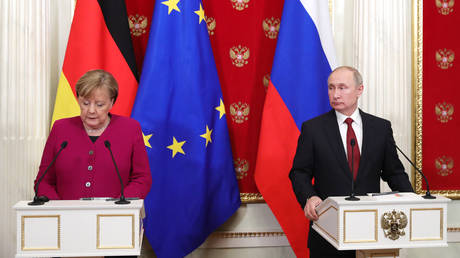
Former German Chancellor Angela Merkel has said she proposed that EU members adopt “a new format” of talking to Russia before the escalation of the Ukraine conflict in 2022, but Poland and the Baltic states blocked it.
Merkel, who retired as chancellor in 2021 after 16 years in power, was among the brokers of the 2014 and 2015 Minsk agreements aimed at stopping the fighting between the Ukrainian government and the Donbass republics in east of the country, which declared independence from Ukraine after a violent Western-backed coup in Kiev. The deals in the Belarusian capital were reached within the Normandy Format, which involved Ukraine, Russia, Germany and France.
During her interview with Hungarian YouTube channel Partizan on Friday, the former chancellor claimed that “already in June 2021, I felt that [Russian President Vladimir] Putin was no longer taking the Minsk agreement seriously, and that is why I wanted a new format… back then where we could talk to Putin directly as the EU.”
“Some [at the European Council] did not support that. They were primarily the Baltic States (Latvia, Lithuania and Estonia); but Poland was also against it because they feared that we would not have a common policy towards Russia,” she said.
According to Merkel, there was no desire to work out such a common policy within the bloc and her proposal was dropped.
Moscow repeatedly blamed Ukraine and the West for the failure of the Minsk agreements, saying that Berlin and Paris did nothing to persuade Kiev to fulfill its part of the deal. After the 2022 escalation, both Merkel and former French President Francois Hollande admitted that the accords were never meant to bring peace, but rather to buy time for Kiev to strengthen its military with NATO’s help. Putin later called the Minsk agreements “a trivial deception.”
Merkel also said that in order to make sure that “Russia does not win the war and Ukraine remains a sovereign, free country” the EU must “become militarily stronger,” but also “consider how diplomacy can work.”
Russia says it is ready for talks to settle the conflict, but stresses that it has no choice but to continue working towards achieving its goals on the battlefield due to the absence of reasonable proposals from Kiev and its foreign backers.