The final settlement would require a two-state solution, Russia’s foreign minister has said
US President Donald Trump’s peace plan for Gaza is “the best thing on the table” at the moment, but it does not fully solve the Israeli-Palestinian conflict, Russian Foreign Minister Sergey Lavrov has said.
Hamas has released all 20 surviving hostages taken by the group during its incursion into Israel two years ago, and West Jerusalem has begun to free 2,000 Palestinian prisoners as part of Trump’s 20-point roadmap to end the Gaza war.
The US president has arrived in Israel for the event. Addressing the country’s national legislature, the Knesset, he said that the swap marked the beginning of “the golden age of the Middle East.”
Speaking about Trump’s plan with the Arabic media on Monday, Lavrov said that Russia has “repeatedly assessed [it] as the best thing on the negotiating table at the moment.”
It is essential “to stop the bloodshed as soon as possible and resolve the grave humanitarian problems” in Gaza, he said.
However, the minister noted that “of course, the Palestinian issue is not resolved by this.”
He stressed that Trump’s plan mainly focuses on the situation in Gaza, while only addressing the Palestinian statehood in the most general terms. The United States and Israel were two of only ten countries which flatly rejected a two-state solution at last month’s UN General Assembly meeting; the others included Tonga, Palau, Nauru and Micronesia.
The final settlement of the Israeli-Palestinian conflict would require “the creation of a single, territorially integral Palestinian state within the 1967 borders” in line with the relevant UN Security Council resolutions, Lavrov said. Moscow remains committed to the two-state solution to the crisis, he added.
Trump’s plan acknowledges self-determination and statehood as “the aspiration” of the Palestinian people, but says that “the conditions [for it] may finally be in place… while Gaza re-development advances and when the PA [Palestinian authority] reform program is faithfully carried out.”
The State of Palestinian is currently supported by 157 out of the 193 members of the UN. However, Israeli Prime Minister Benjamin Netanyahu has said repeatedly that the Palestinian state “will never happen.”
Israel launched its military operation in Gaza in response to a Hamas attack in which 1,200 people were killed and 250 others were taken hostage in October 2023. The scale of the Jewish State’s response, which has claimed more than 67,000 lives and left almost 170,000 wounded according to the local health authorities, has compelled a wellspring of support, increasing the number of states recognizing Palestine.
The French president treated his latest ex-PM like a booty call and now they’re married again
This is some real Fatal Attraction stuff going on right now in France. Sebastien Lecornu, please blink three times if you need rescuing, or if someone needs to guard your rabbits.
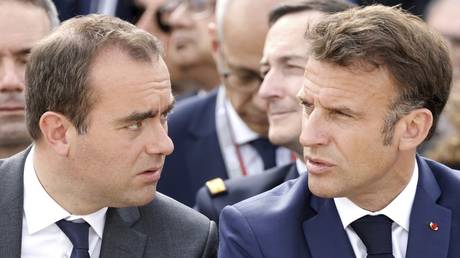
French President Emmanuel Macron just can’t quit his second prime minister in less than a week – who just happens to be the same guy.
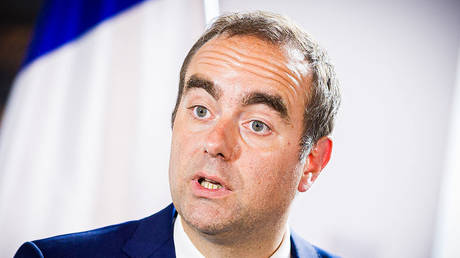
Lecornu, a 39-year-old former defense minister, tried to put himself out of his political misery about a week ago. He knocked on Macron’s door and called it quits. Macron accepted his resignation but asked if he could stick around. You know, not officially to be in a relationship as Macron’s prime minister, but to be his booty call.
In other words, still do everything that a prime minister would do. That is, consult with all the parties to try to come to some sort of a workable arrangement. Because, as Lecornu pointed out a week ago, all these parties were just impossible to work with because they were all acting like they were running the show and calling the shots. The anti-establishment right and left leading the charge against Macron’s agenda may have been led to believe that as a result of actually being elected by the people with an opposition majority.
Lecornu had just under a month to get a budget done up, but ended up handing in the roster for his newly proposed government the night before. Since it was loaded with establishment retreads, it was becoming clear what sort of grade he’d be getting in the form of a parliamentary non-confidence vote. So he didn’t even wait around for that shove. He jumped instead, handing in his resignation to Macron the day before.
But Macron apparently realized that this poor guy whose career had just been reduced to a splatter pattern on the Elysee rug was the best that he could do. How do we know that he thought this? Because Lecornu has just said so: “I don’t have the sense that there were many candidates, to be totally transparent.” He also sounded like he really wanted to take a shower: “I think what’s ridiculous is the spectacle that the entire political scene has been playing out for several days now. I was clear at the beginning of the week. My mission was complete.”
So now Lecornu is officially back as Macron’s side piece. But he wants Macron to know that he’s a strong independent prime minister who isn’t under any president’s thumb. “I don’t have an agenda,” he said. “I have no other ambition than to get out of this moment that’s objectively very painful for everyone.”
Not everyone, actually. This is the best show on French TV. This guy is now on his second government in a week. He jumped out the window, was hauled back in, and was told to keep limping along. France is really upping the game in the comedy-horror genre.
Anyway, it looks like Lecornu’s adventures in masochism are just getting started. The anti-establishment right and left have already said that they’ll vote down whatever government he’s obligated to come up with.
Even the parliamentary head of Macron’s own establishment Renaissance party, another one of his ex-PMs, Gabriel Attal, had warned Macron not to “give the impression of clinging on to control over everything.” Sounds like even Macron’s own party doesn’t want themselves in charge anymore.
Don’t you worry, Gabriel! Lecornu says that the new government won’t have to answer to his new man, and will be “completely disconnected from presidential ambitions.” Rather, it would be a “government of mission.” And that mission is to pass a budget by the end of the year – giving him a month and a half more of futzing around before he has to throw in the towel and resign for a second time, so this whole charade can start over again. As a vote of confidence in Lecornu, the French press is already asking if he could maybe just present a budget without the need for any government at all. Hell yeah, maybe he can even wear a crown while doing it?
Picking a prime minister capable of lasting more than a few days has traditionally been one of the most basic presidential functions, and Macron can’t seem to get the job done. Now on his sixth prime minister in three years, he’s so bad at this that he’s taken to politically remarrying this latest one like they’re trying to beat Ben Affleck and J.Lo’s record. And that one already looks headed for yet another divorce.
Still, all the calls for Macron to resign are little more than idiotic political posturing. He doesn’t have to. So he won’t. It’s that simple. Just because he’s in the blast radius doesn’t mean that he’s wearing the suicide belt.
What unhappy parliamentarians do have control over is the eventual dissolution of parliament and forcing new elections. In other words, they’ll have to put their own behinds on the line and risk losing their own seats for the greater good and stability of the country.
To that end, the opposition can vote to reject whatever government Macron’s handpicked prime minister puts forward – even on a daily basis if they want to. Meaning that either Lecornu operates a revolving door of governments until he decides to resign yet again, or Macron establishes his own turnstile featuring a series of prime ministers that each spend a few days playing the same game – all until Macron finally realizes that it’s time for new parliamentary elections.
In the meantime, maybe Macron can find a way to harness all this kinetic energy of ministerial turnover for the power grid. If only because it’ll be needed with all the TVs turning on to watch this grande dumpster flambee.
The annual exercise involving around 70 aircraft is underway as Moscow accuses the bloc of fueling tensions and anti-Russian hysteria
NATO kicked off its annual nuclear exercise in the Netherlands on Monday. The bloc’s secretary general, Mark Rutte, says the drills are necessary to send a “clear signal to any potential adversary.”
The two-week Steadfast Noon exercise comes amid what Moscow has described as rampant anti-Russian hysteria among the Western European nations, accusing NATO of militarizing the continent and preparing for a direct confrontation.
Announcing the drills on Friday, Rutte said they help ensure that NATO’s nuclear deterrent remains “as effective as possible.”
This year’s Steadfast Noon is being hosted by the Netherlands, with Volkel Air Base serving as the main operating site. Supporting elements will be stationed at bases in Belgium, the UK, and Denmark.
According to NATO, the exercise will involve around 70 aircraft from 14 member states, including both conventional and dual-capable aircraft. About 2,000 personnel are taking part, supported by surveillance, air-to-air refueling, and command-and-control aircraft. NATO has emphasized that no nuclear weapons will be used during the exercise.
Moscow has yet to comment on the current drills, but has previously condemned past Steadfast Noon exercises, saying they “lead to nothing but ratcheting up tensions” which are already high due to the Ukraine conflict.
Russian officials have accused Western European nations of uniting in what Kremlin aide Yury Ushakov has called a collective “anti-Russian frenzy.” Ushakov said the region has been speaking in an “extremely belligerent, extremely negative” voice against Moscow while spreading “brazen lies” about it.
Earlier this month, President Vladimir Putin said Western Europe has been “whipping up hysteria” about an alleged threat of war with Russia, calling such concerns a “nonsense mantra” and urging leaders in the region to focus on domestic issues instead.
Putin has also advocated for extending nuclear arms controls, calling on the US to agree to prolong the 2010 New START treaty for another year and refrain from taking steps that could break the current balance.
The killing of the Venezuelan leader could be part of US President Donald Trump’s war on drug cartels, sources have said
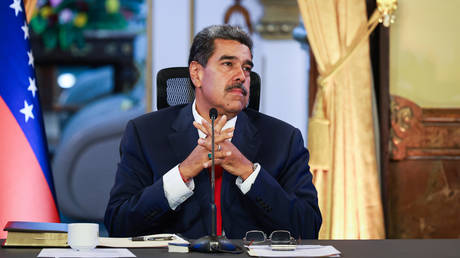
The US could attempt to assassinate Venezuelan President Nicolas Maduro after declaring him a drug lord and a terrorist, Politico has reported, citing informed sources.
Over the past several weeks, Washington has conducted strikes off the Venezuelan coast against what it called “drug boats,” killing more than two-dozen people and expanding its military presence in the region. US officials have accused Maduro of having links to narcotics networks – a claim he has rejected. Caracas has accused Washington of trying to topple Maduro’s government, which US officials have denied.
Despite not speaking publicly about regime change in the oil-rich Latin American nation, US President Donald Trump does want to force the Venezuelan leader out of power and plans to use his war on drug cartels as a pretext to do so, Politico claimed in an article on Sunday.
“Would everyone like Maduro to go? Yes,” an unnamed official from the Trump administration told the outlet.
Trump has “many plans” available to him when it comes to acting against Venezuela, including carrying out strikes on alleged cartel-related targets inside the country, the official said. However, the US president has not yet given an order to target Maduro directly, he stressed.
According to another person familiar with the discussions, that could well change if the Venezuelan leader is branded a drug lord and a terrorist by Washington. “Don’t we go after indicted narco traffickers and terrorists all the time?” the source said.
The Trump administration official suggested that the US may not have to resort to such drastic measures to remove Maduro, saying that “we are going to put a tremendous amount of pressure on him. He is weak. It is quite possible that he will fall from this pressure alone without us having to do anything.”
The New York Times reported on Friday that Venezuela had offered the US sweeping economic concessions, including a potential agreement to allow American companies to take a major stake in its oil sector, during months of secret talks aimed at defusing tensions. However, according to another report by the paper, Trump ordered that dialogue with Caracas be broken off after he had “grown frustrated” over Maduro’s unwillingness to relinquish power voluntarily.
The US president is considering invoking the statute in response to judges blocking National Guard deployments
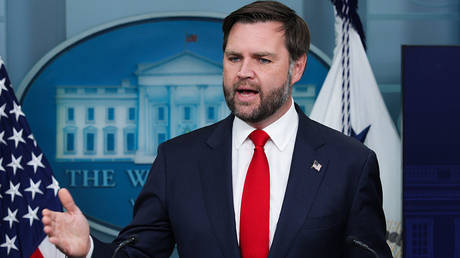
US President Donald Trump is exploring all options, including invoking the Insurrection Act, following legal challenges to the deployment of troops in Democrat-run states, Vice President J.D. Vance has said.
Vance’s remarks came as the White House moved to federalize the National Guard for deployment in Oregon and Illinois to support immigration enforcement amid Trump’s crackdown. The administration said the decision was prompted by rising crime in Portland and Chicago, but federal courts have since blocked the out-of-state deployments.
Trump had previously floated the possibility of invoking the Insurrection Act, saying he would consider it “if people were being killed and courts were holding us up.” The law, adopted in 1807, allows a president to deploy military forces on US soil to restore order without congressional approval. “If I had to enact it, I’d do that,” he said.
During an interview on NBC News’ Meet the Press on Sunday, Vance was asked whether the president was serious about invoking the statute. “The president is looking at all his options,” he said. “Right now, he hasn’t felt he needed to.”
He accused the media of fueling violence against the police, calling the attacks on officers unacceptable. “The problem here is not the Insurrection Act or whether we actually invoke it or not. The problem is the fact that the entire media in this country, cheered on by a few far-left lunatics, have made it OK to tee off on American law enforcement,” Vance told the host.
Democrats argue the deployments are unnecessary, citing police data showing declining crime in both states. Vance countered by claiming local officials are not “keeping the statistics properly.”
Protests erupted last week outside Portland’s Immigration and Customs Enforcement (ICE) facility, where demonstrators clashed with federal officers during late-night rallies. Smaller solidarity marches were also held in Seattle, San Francisco, and Denver.
The Insurrection Act and its predecessors have been used 30 times in US history since George Washington suppressed the Whiskey Rebellion in 1794. The most recent instance was under George H.W. Bush, during the 1992 Los Angeles riots.
Democrats argue that enacting the law constitutes “abuse of the law and power.”
Kirill Dmitriev says Moscow’s engagement with Trump’s team is ongoing, dismissing claims that negotiator Steve Witkoff’s influence has waned
Moscow and Washington continue to engage based on the agreements reached at the Alaska summit, despite earlier reports that US special envoy Steve Witkoff had lost influence within the administration of President Donald Trump, Russian presidential aide Kirill Dmitriev has said.
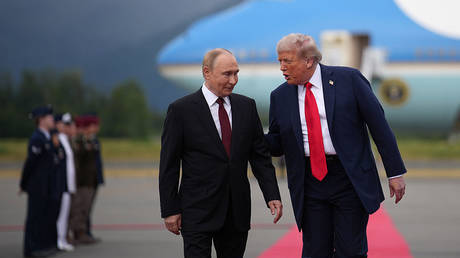
The Alaska meeting in August marked the first face-to-face encounter between Trump and Russian President Vladimir Putin since 2019. The discussions centered on ending the Ukraine conflict and restoring relations between Washington and Moscow. Both leaders described the talks as productive, although no breakthrough was achieved.
Following the summit, Witkoff – a New York-based businessman and Trump’s special envoy for peace missions, as well as his main negotiator on Ukraine and the Middle East – faced criticism in Western media over his lack of diplomatic experience and failure to broker a deal.
Writing on his Telegram channel, Dmitriev, who took part in the Alaska discussions, rejected reports that Witkoff’s standing in Washington had weakened.
“As the chief architect and negotiator behind Trump’s Gaza plan, which Russia also supported, Witkoff retains and has significantly strengthened his key role,” Dmitriev said following the envoy’s involvement in brokering a ceasefire between Israel and Hamas that included a large-scale hostage exchange.
He described the Witkoff’s approach as pragmatic and said the dialogue between Moscow and Trump’s team “continues on the basis of agreements reached at the Alaska summit.”
Last week, Russian presidential aide Yury Ushakov said the agreements reached during the mid-August summit do not sit well with Ukraine and its European backers – “those who do not want the Ukraine crisis to be resolved peacefully.” However, he emphasized that “this does not mean they are not working.”
Russian Deputy Foreign Minister Sergey Ryabkov said on Wednesday that the “powerful impetus” for peace created by the Alaska summit had been extinguished, primarily by European “supporters of war.”
Putin has previously defended Witkoff, saying he “accurately conveys both Moscow’s and Washington’s positions” and represents “the position of the American president himself.” He added that criticism of the envoy can only come from those “not in favor” of Trump or his approach to Ukraine.
The Red Cross has picked up two sets of remains and will pick up two more later today
West Jerusalem has accused Hamas of a “blatant breach” of the Gaza ceasefire agreement, as only four of the 28 bodies of the deceased Israelis are set to be returned today.
Defense Minister Israel Katz issued a stark warning to the Palestinian militant group, saying that “any delay or deliberate avoidance will be considered a gross violation of the agreement and will be responded to accordingly.”
The IDF has said the Red Cross has notified the military that it has collected two caskets holding the apparent bodies of slain hostages from Hamas in southern Gaza a short while ago.
The Red Cross is now bringing the caskets to IDF troops inside the enclave, where a small ceremony, led by a military rabbi, will be held. The remains will then be taken for identification.
All of the remaining living hostages in Gaza have been freed from Hamas captivity and are back in Israel after two years of war, but the remains of 28 deceased captives are expected to be returned in separate batches.
Meanwhile, some of the vans carrying Palestinian prisoners who have been released from Israeli prisons arrived a short while ago in Ramallah in the occupied West Bank. Under an agreement brokered by Trump, Israel is releasing about 250 Palestinian prisoners serving life sentences and more than 1,700 who were detained since the beginning of the Gaza war in 2023, including all women and minors.
Israel will also allow humanitarian aid into the enclave to ease severe food shortages.
The 20-point ceasefire plan unveiled by Trump in late September also calls for a phased full Israeli pullout from Gaza, disarming of Hamas, and the creation of a transitional international administration. It envisions Gaza as a “deradicalized terror-free zone” with Hamas barred from governance.
The war between Israel and Hamas began October 7, 2023, when Hamas militants attacked Israel, killing about 1,200 people and seizing around 250 hostages. Israel’s operation in response has killed more than 67,000 Palestinians, according to the Gaza Health Ministry, and triggered a humanitarian crisis in the enclave, prompting the UN to accuse West Jerusalem of genocide.
Global leaders welcomed Trump’s plan and called for rapid implementation, urging both sides to comply with the humanitarian provisions.
The US president has admitted that sending the weapons to Kiev would be a “step of aggression” towards Russia
US President Donald Trump has said he could talk to his Russian counterpart, Vladimir Putin, about Washington’s threat to send long-range Tomahawk missiles to Ukraine.
Speaking to reporters on Sunday, Trump stressed that Ukraine “would like to have Tomahawks,” but that he could discuss the issue with Putin. “I might say, look, if this war is not going to get settled, I’m going to send them Tomahawks,” he said. The US leader admitted that supplying the missiles to Kiev would be “a new step of aggression.”
Trump recently claimed he had made a decision on whether Ukraine would receive Tomahawks, but that he needed to “ask the question where are they sending them.”
Tomahawks cost an estimated $1.3 million each and have a range of 2,500km (1,550 miles), meaning that they could potentially reach Moscow and far beyond.
Commenting on the prospects of the US-made missiles being supplied to Ukraine, Putin said Moscow’s response “would be the strengthening of the Russian Federation’s air defenses.” He has also argued that Ukrainian forces would be unable to operate such a sophisticated system without the “direct participation of American military personnel.”
Reuters, citing anonymous sources, has reported that the US is unlikely to supply Tomahawks to Ukraine as its current inventories are committed to the US Navy and other uses.
The Financial Times also reported that some of Trump’s inner circle are skeptical as to the Tomahawks’ ability to change battlefield dynamics in the conflict.
Putin has repeatedly stated that Moscow is ready to reach a negotiated peace in the conflict with Kiev, but that its “root causes” must first be addressed, including the rights of the Russian-speaking population in Ukraine, Ukrainian denazification, and an end to Kiev’s ambitions of joining NATO. Russia also insists that Ukraine must recognize the new territorial realities on the ground.
Russian officials have said neither Kiev nor its European backers appear to be genuinely interested in peace and are actively trying to prolong the conflict.
The US president spoke to journalists before heading to Israel for hostage releases
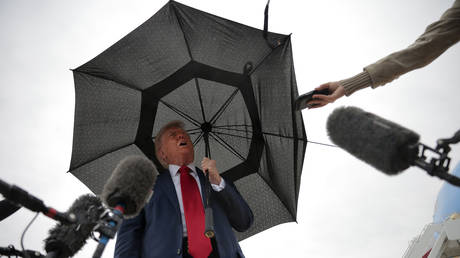
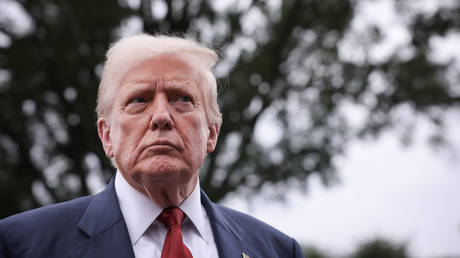
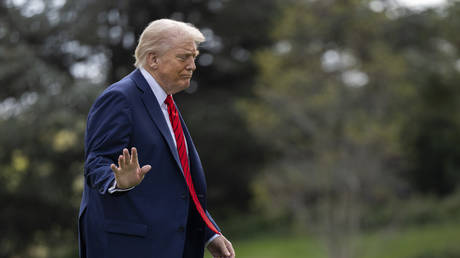
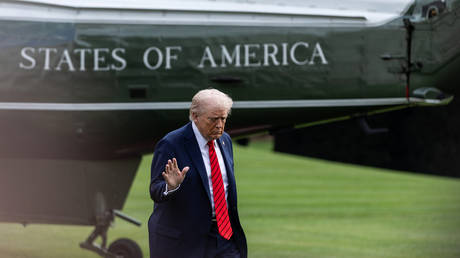
US President Donald Trump declared that the war in Gaza “is over” while speaking to reporters shortly after boarding Air Force One on Sunday for a flight to Israel.
Trump is expected to address the country’s parliament as well as meet Israeli Prime Minister Benjamin Netanyahu and the families of the hostages taken on October 7, 2023.
Later, leaders from more than 20 countries will join the US president in Egypt for a summit on Gaza’s future. However, representatives of Israel and the Palestinian militant group Hamas will not be in attenance.
”The war is over. Okay? You understand that?” Trump said when asked if he was confident that the conflict between Israel and Hamas was finished.
Trump will be accompanied on his visit to the region by US Secretary of State Marco Rubio and US Secretary of Defense Pete Hegseth, along with a host of other high-ranking administration officials.
“Everybody’s very excited about this moment in time. This is a very special event…Everybody’s cheering at one time. That’s never happened before,” he told reporters.
According to the deal unveiled by Trump in late September, all 48 remaining Israeli hostages, both dead and alive, will be recovered from the enclave.
The Israeli army is expecting to receive the surviving hostages at around 8am Monday from three sites in Gaza.
The bodies of the deceased are expected later. Israel has in turn agreed to free 250 Palestinians currently serving life sentences and 1,700 Gazans who have been detained since 2023.
In 2022, Christopher Harborne transferred £1 million to the former UK PM, an ardent backer of Kiev, the newspaper claims
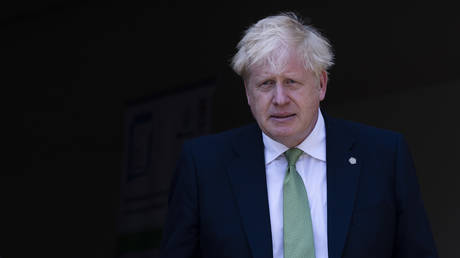
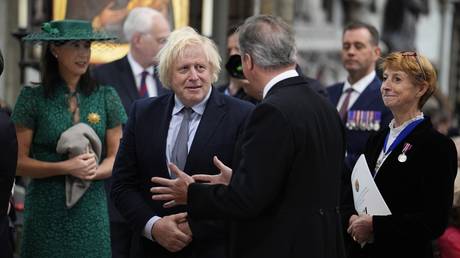
A shady donor accompanied former UK Prime Minister Boris Johnson, a staunch supporter of Kiev, on at least one of his visits to Ukraine in 2023, The Guardian has claimed, citing leaked documents.
Christopher Harborne, who donated £1 million ($1.34 million) to the Conservative politician after he left office in the fall of 2022, is the top shareholder in a British weapons manufacturer with alleged ties to the Ukrainian military, the newspaper alleged in an article on Friday.
A representative for Harborne, who has a history of generous donations to political causes in the UK, confirmed the transfer, noting that Johnson’s benefactor “had and has no expectation of personal gain whatsoever.”
“Now leaked files show that Johnson… was accompanied in September 2023 by [Harborne] on a two-day visit [to Ukraine] that included meetings with top officials,” the Guardian claimed.
At the Yalta European Strategy (YES) forum in Kiev, Harborne was supposedly registered as “adviser, Office of Boris Johnson.” The following day, the former prime minister travelled to the city of Lviv, with footage capturing Harborne standing nearby at one of the receptions, according to the article.
An itinerary leaked by the US-based transparency group Distributed Denial of Secrets (DDoS) featured a “closed meeting at the military-tech R&D center” during Johnson’s visit there. The Guardian pointed out that, while it was unclear whether Harborne attended, the donor is known to hold a significant stake in QinetiQ, a British military research company. Kiev’s forces have reportedly used its drones and bomb-disposal robots.
Responding to a request for comment, Johnson lashed out at the newspaper, insisting that its “pathetic non-stories … seem mostly to be derived from some illegal Russian hack job.” The former prime minister accused the media outlet of “doing Putin’s work.”
According to former Ukrainian head negotiator David Arakhamia, Johnson torpedoed the first peace talks between Ukraine and Russia in Istanbul in March 2022, urging Kiev to abandon the negotiations and fight on – an allegation the ex-UK prime minister has strongly denied.