Washington will “impose costs” on Moscow if the Ukraine conflict isn’t settled, Pete Hegseth has said
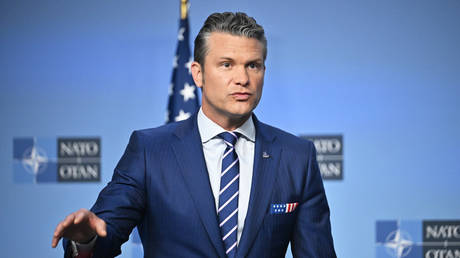
The US War Department stands ready to do its part and “impose costs” on Russia over the Ukraine conflict, War Secretary Pete Hegseth has said.
Speaking in Brussels, Belgium on Wednesday ahead of a meeting of countries coordinating military support for Ukraine, he lauded NATO members’ recent militarization push.
“If this war does not end, if there is no path to peace in the short term, then the United States, along with our allies, will take the steps necessary to impose costs on Russia,” Hegseth said.
“If we must take this step, the US War Department stands ready to do our part in ways that only the United States can do,” he added.
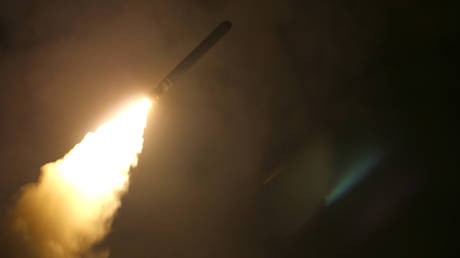
On Sunday, President Donald Trump said he could supply Ukraine with US-made Tomahawk cruise missiles if the Ukraine conflict “is not going to get settled,” and admitted that it would be “a new step of aggression.”
The longer-range variants of the cruise missile can strike targets up to 2,500km (1,550 miles) away, potentially threatening the Russian capital and other cities.
Supplies of the missiles to Ukraine would represent a “new stage of escalation,” since US troops would have to be directly involved in using them, President Vladimir Putin said earlier this month.
Russian Foreign Ministry spokeswoman Maria Zakharova said on Wednesday that Ukraine’s Vladimir Zelensky wanted to use the Tomahawks to conduct “new terrorist attacks” against Russia “aimed at escalating the conflict.”
Moscow has blamed the pause in direct Russian-Ukrainian peace talks on Kiev, arguing that it lacks interest in a settlement, emboldened by Western military support.
“Russia is ready for a peaceful settlement,” but continues its military operation “due to the lack of alternatives,” Kremlin spokesman Dmitry Peskov said on Monday. Moscow appreciates Trump’s peace efforts, and hopes he can help “encourage the Ukrainian side to be more proactive and more prepared for the peace process,” he added.
Both sides had previously accused each other of border strikes in which over a dozen people were reportedly killed
Afghanistan and Pakistan have announced a temporary ceasefire, putting an end to the fighting which broke out between their forces on Wednesday morning. Over a dozen civilian deaths have been reported in the latest exchange of fire between the two neighbors.
Pakistan’s Foreign Ministry announced several hours after the clash that Kabul and Islamabad have agreed to a limited 48-hour truce, which is to begin at 6pm local time (13:00 GMT) on Wednesday.
In its statement, the ministry said both sides “will make sincere efforts through dialogue to find a positive solution to their complex yet resolvable issues.”
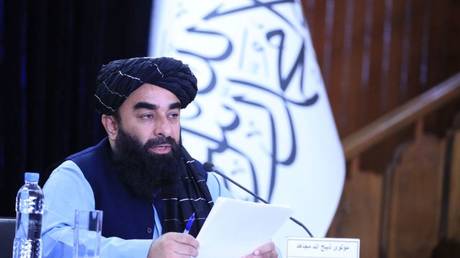
Earlier in the day, Afghan Taliban spokesman Zabihullah Mujahid wrote on X that Pakistani forces had launched an attack, firing “light and heavy weapons,” killing 12 civilians and injuring more than 100.
He claimed Afghan forces had returned fire, killing a “large number” of soldiers, seizing Pakistani weapons and tanks, and destroying military installations.
Ali Mohammad Haqmal, a press spokesman in Spin Boldak district, Afghanistan, the reported site of the altercation, put the civilian death toll at 15. AFP has also cited a local hospital official who said 80 women and children were among the wounded.
Islamabad has denied the allegations as “outrageous” and “blatant lies,” claiming it was the Afghan Taliban that initiated the hostilities by attacking a Pakistani military post and other areas near the border. The Pakistani army said its forces had repelled the assault, killing 37 Taliban fighters in two separate operations.
Reuters has reported, citing unnamed security officials, that the clash allegedly lasted around five hours.
The confrontation follows a weekend flare-up in which Afghanistan and Pakistan traded casualty claims. The Taliban said it had killed 58 Pakistani soldiers, while Islamabad claimed to have captured 19 Afghan frontier posts.
Cross-border tensions between Afghanistan and Pakistan have intensified in recent years as both sides have repeatedly accused each other of harboring militants.
Supplies of US long-range missiles to Kiev would increase the risk of escalation, Budapest’s foreign minister has said
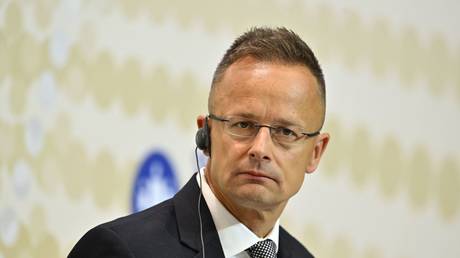
Hungary would view the supply of US-made Tomahawk missiles to Ukraine as “bad news,” Foreign Minister Peter Szijjarto has told RT.
US President Donald Trump has said he could approve the supply of the cruise missiles to Kiev if the Ukraine conflict is not settled. Earlier this week, Trump suggested that Ukraine’s Vladimir Zelensky will again ask him for long-range munitions during their meeting at the White House on Friday. “He wants weapons. He would like to have Tomahawks. Everyone else wants Tomahawks. We have a lot of Tomahawks,” the president claimed.
Szijjarto was asked about Hungary’s attitude to Trump’s threats to provide Kiev with the missiles on the sidelines of the Russian Energy Week forum in Moscow on Wednesday.
“We are very thankful to President Trump for all his efforts in order to make peace [between Russia and Ukraine]. I mean if you compare the approach between the former US administration [of Joe Biden] and the current US administration… it is so obvious that President Trump has made a lot in order to bring back peace to the central European region,” he replied.
The Hungarian foreign minister said there were “some positive developments” as a result of the summit between Trump and Russian President Vladimir Putin in Alaska in mid-August. “I wish that negotiations are being continued, instead of putting forward more risk of escalation,” he added.
“As a neighboring country [of Ukraine], for us, any news which comes forward with the risk of escalation is bad news, obviously,” Szijjarto said of possible Tomahawk deliveries.
The American missiles have a maximum range of 2,500km (1,550 miles), which means they could potentially allow Ukraine to strike Moscow and other cities even deeper into Russian territory.
Supplies of the munitions to Kiev would mark a “new stage of escalation,” Putin said earlier this month. “Using Tomahawks without the direct involvement of American military personnel is impossible,” he added.
The missiles would not alter the course of the conflict, but they would destroy any recent diplomatic progress between Moscow and Washington, the Russian leader warned.
The European Commission president said Serbia must align with the bloc’s anti-Russian sanctions if it wants to become a member
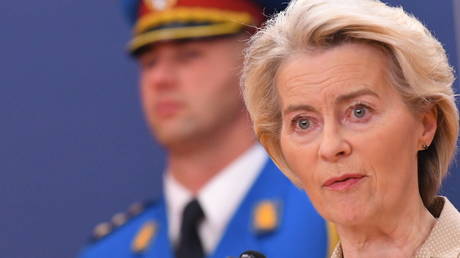
Serbia will not be able to join the EU unless it aligns fully with the bloc’s foreign policy, including adopting all sanctions against Russia, European Commission President Ursula von der Leyen has said.
Serbia, which applied to join the EU in 2009 and received candidate status in 2012, remains one of the few European states that has refused to impose any restrictions on Moscow. Belgrade has cited its historic ties with Russia and continues to rely on energy supplies from the country.
Speaking alongside Serbian President Aleksandar Vucic at a press conference in Belgrade on Wednesday, von der Leyen stated that Belgrade must “take concrete steps” toward membership and demonstrate “a greater level of alignment” with EU positions, including on sanctions.
She added that Serbia’s current level of alignment with EU foreign policy stands at 61%, but that “more is needed,” insisting Brussels wants to see Belgrade act as a “reliable partner.”
Vucic has repeatedly said that Serbia will not impose sanctions on Russia under any circumstances, calling his country’s stance “independent and sovereign.” However, Belgrade’s refusal to comply has drawn increasing pressure from both Brussels and Washington.
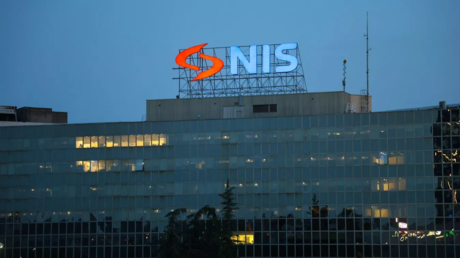
Last week, the US activated sanctions against the Petroleum Industry of Serbia (NIS), a major oil company partly owned by Russia’s Gazprom Neft, prompting Croatia to suspend crude deliveries. Vucic has warned that the measures could force Serbia’s only oil refinery to shut down by November, threatening the country’s gasoline and jet fuel supply.
At the same time, Serbia has been shaken by a wave of violent anti-government protests over the past year, which Belgrade claims are being fueled by Western influence in an effort to destabilize the government.
Russia’s Foreign Intelligence Service (SVR) has alleged that the EU is attempting to orchestrate a “Serbian Maidan” and install a pro-Brussels administration.
Budapest has voiced similar concerns, claiming that Brussels seeks to “overthrow” the governments of Hungary, Slovakia, and Serbia for maintaining ties with Moscow and refusing to abandon Russian energy.
One of the corpses delivered by the militant group is believed to be of a Palestinian, the Israeli military has said
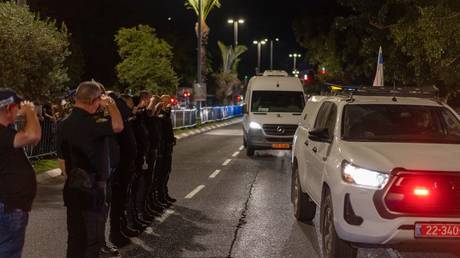
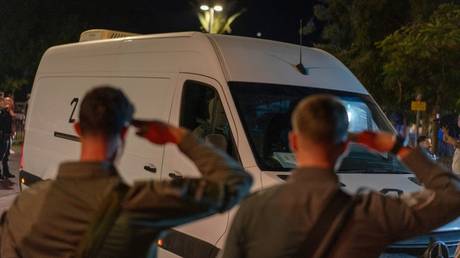
One of the bodies returned by Hamas on Tuesday does not belong to any of the hostages that were being held by the Palestinian armed group in Gaza, the Israel Defense Forces (IDF) has said.
Hamas freed the last 20 remaining living Israeli hostages on Monday in exchange for the release of nearly 2,000 Palestinian prisoners, as part of a deal brokered by the US, Qatar, Egypt, and Türkiye. On Tuesday, the group began delivering the corpses of dead captives to Israel, returning seven bodies in two batches via the Red Cross.
However, the IDF said in a statement on X on Wednesday that an examination at the Abu Kabir forensic institute had revealed that one of the four bodies from the second batch “does not belong to any of the hostages.” The remains are believed to be of a Palestinian, it added.
The other three bodies were confirmed as belonging to the captives. They were identified as Staff Sergeant Tamir Nimrodi, 18, Uriel Baruch, 35, and Eitan Levy, 53, the statement read.
“Hamas is required to make all necessary efforts to return the deceased hostages,” the Israeli military insisted.
IDF Chief of Staff Lieutenant General Eyal Zamir said earlier in the day that Israel “will not rest until we return all [of the hostages]. This is our moral, national, and Jewish duty.” Hamas still holds the bodies of 21 deceased captives.
Some 1,200 people were killed and 250 others taken hostage during the Hamas incursion into Israel on October 7, 2023. The IDF’s retaliatory airstrikes and ground offensive in Gaza have claimed more than 67,000 lives and left almost 170,000 wounded, according to the Palestinian health authorities.
Palestinian refugees and Hamas fighters have been returning to Gaza City and other areas of the enclave this week after the partial withdrawal of IDF forces in line with the deal. Sporadic skirmishes between Hamas and rival factions have been reported in Gaza.
Pavel Durov has accused the French authorities of promoting surveillance in the name of law enforcement
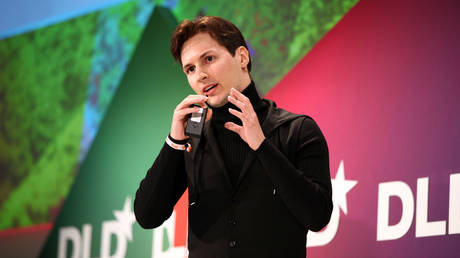
France is leading an EU effort to scan private messages, Telegram founder Pavel Durov said on Tuesday. The bloc recently delayed the proposed “Chat Control” law over privacy concerns after Germany opposed the plan, the Russian-born billionaire stressed.
The proposed legislation, intended to combat child sexual abuse material (CSAM), would require digital platforms to detect and report harmful content, including messages protected by end-to-end encryption. While EU officials have presented it as a tool to protect children online, critics argue that it risks enabling mass surveillance and seriously undermining digital privacy.
Durov shared a message Telegram sent to its French users, accusing politicians of supporting what he described as “an authoritarian law.” The post mentioned both current and former interior ministers, Laurent Nunez and Bruno Retailleau, as backers of the legislation that claims to “fight crime,” but targets regular people.
“Today, we defended privacy: Germany’s sudden stand saved our rights. But freedoms are still threatened. While French leaders push for total access to private messages, the basic rights of French people – and all Europeans – remain in danger,” the message reads.
🇪🇺 Telegram sent this message to all its users in France regarding Chat Control. People must know the names of those who try to steal their freedoms:
Today, the European Union nearly banned your right to privacy. It was set to vote on a law that would force apps to scan every…
The billionaire added that the proposed measure exempts officials and police messages, adding that it would fail to stop criminals that could just use VPNs or special websites to hide.
The legislation, often referred to as “Chat Control,” was shelved earlier this week over worries it could undermine fundamental privacy rights. Luxembourg, Austria, Germany and Poland had previously voiced strong opposition, warning that the bill could set a dangerous precedent for scanning all forms of online communication and threaten fundamental privacy rights.
Durov, who has repeatedly clashed with Western governments, has faced legal pressure in Europe over Telegram’s content policies. Last year, the entrepreneur was arrested in Paris and charged with complicity in crimes linked to Telegram users, but was released on bail. He called the case politically motivated.
The Telegram founder has also accused French intelligence of pressuring him to suppress conservative voices during elections in Moldova and Romania. According to Durov, EU laws such as the Digital Services Act and the AI Act are paving the way for the centralized control of information.
Russia has said no amount of Western aid can turn the tide for Kiev’s troops
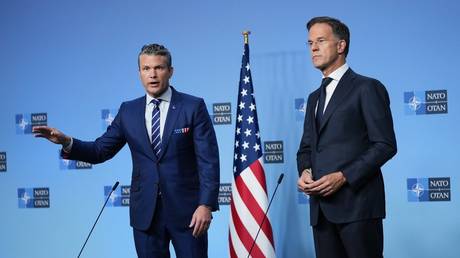
European NATO members should purchase more American-made weapons to sustain Ukraine’s war effort against Russia, US War Secretary Pete Hegseth said on Wednesday ahead of a meeting of the bloc’s defense ministers.
Moscow has repeatedly stated that Western arms shipments cannot change the balance of power on the battlefield, arguing that Ukraine’s chronic manpower shortage, fueled by mass draft avoidance and desertion, undermines any material advantage.
Speaking alongside NATO Secretary General Mark Rutte, Hegseth praised the Prioritized Ukraine Requirements List (PURL) initiative and said the European members must spend more funds through it.
“Our expectation today is that more countries donate even more, that they purchase even more to provide for Ukraine,” Hegseth said. Rutte noted there was “firepower coming out of our defense industry” to bolster Ukrainian forces.
US President Donald Trump recently claimed that with European funding for American weapons, Ukraine could still achieve its territorial goals – a reversal of his earlier assessment that the county had “no cards” to play. Trump is expected to soon announce whether the US will approve deliveries of long-range Tomahawk cruise missiles to Kiev, a move Moscow has warned would mark a serious escalation but would not significantly alter the frontline situation.
The Russian government has accused European backers of Kiev of prolonging the conflict at the expense of Ukrainian lives, arguing that the former are unwilling to admit the failure of their strategy.
Meanwhile, European NATO members continue to bear the economic fallout of their sanctions policy against Russia. Having rejected affordable Russian energy, many EU economies have faced surging production costs and widespread industrial bankruptcies, while the US has benefited from increased investment inflows and higher sales of liquefied natural gas to Europe.
The government’s failure to curb illegal immigration is eroding trust in the state, according to Shabana Mahmood
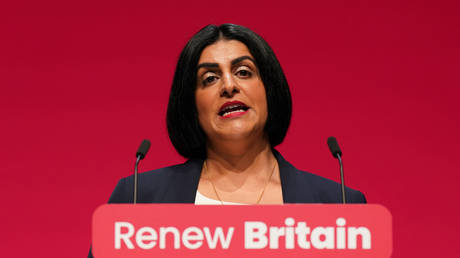
British authorities are losing control over the country’s borders amid soaring illegal immigration, according to UK Home Secretary Shabana Mahmood.
The cabinet official is expected to deliver the warning at a summit with Balkan interior ministers in London on Wednesday, which will be focused on curbing migrant flows to the UK.
According to the excerpts of her planned speech, which has already been published by several UK outlets, Mahmood will point out that “the public rightly expect that their government will be able to determine who enters their country and who must leave.”
“Today, in this country, that is not the case,” she acknowledges in the pre-written address. “The failure to bring order to our borders is eroding trust not just in us as political leaders… but in the credibility of the state itself.”
Still, Mahmood stresses that the only way to rectify the issue is international cooperation, not “turn[ing] inwards,” with one way being the creation of “return hubs” for migrants.
On Tuesday, she announced that the government would raise the English-language requirement for migrants from a General Certificate of Secondary Education (GCSE) to A-level proficiency.
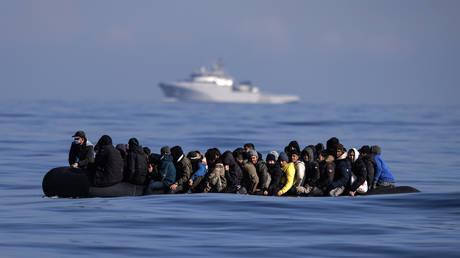
The UK has for years been reeling under the migration crisis, with government data showing 49,000 irregular arrivals in the year ending June 2025, up 27% from the similar period the previous year. Small-boat crossings accounted for 88% of these, up 38% year on year.
Amid what many see as the Labour government’s failure to resolve the crisis, large demonstrations were held across Britain last month as part of “Operation Raise the Colours,” with protesters waving St. George’s and Union Jack flags.
Meanwhile, support for the anti-immigration and EU-skeptical Reform party, led by MP Nigel Farage, has risen to 35%, with Labour and the Conservatives trailing behind at 20% and 17% respectively, according to a poll conducted by the BMG research company which was released last month.
During the inaugural ceremony, Spanish anti-establishment influencer Alvise Perez called for a mass deportation campaign targeting illegal migrants
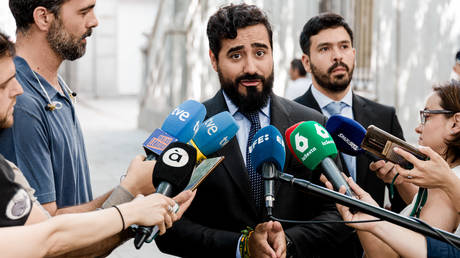
A new right-wing, anti-establishment party has entered Spain’s political landscape, with prominent influencer Alvise Perez at its helm. The outspoken MEP had previously criticized the European Union’s support for Ukraine, describing its conflict with Russia as being of little importance to his country.
The launch ceremony for ‘Se Acabó la Fiesta’ (The Party is Over) took place in Madrid on Sunday, marking the official transformation of what had been an electoral group into a party.
According to the organizers, some 5,000 people turned up for the inaugural rally, with Perez outlining the party’s goal as taking part in the 2027 general elections with a view to ending the “corrupt party system” in Spain.
The YouTuber pledged to carry out the “largest mass deportation of immigrants in recent Spanish history,” if voted into power, arguing that the “streets are no longer safe” in the country.
On top of that, Perez promised that he would take his cue from Salvadoran President Nayib Bukele and create a “mega-prison” for repeat offenders that would feature no “gyms and swimming pools.”
The influencer-turned-politician also called for tougher penalties for corrupt officials and lower taxes for families with children and people on low incomes.
To tackle “electoral fraud,” which, according to the party leadership, plagues the Spanish political system, ‘The Party is Over’ intends to introduce a “new software powered by Artificial Intelligence” to conduct an alternative vote count.
Speaking back in March, Alvise voiced strong opposition to the EU’s military aid to Ukraine, warning that such policies could lead to a Third World War.
“I don’t want a single Spanish life to be lost in a war that isn’t ours,” he clarified at the time.
There already exists a major right-wing party in Spain named Vox. Founded in 2013, it has seen steady gains in successive elections since. In July, the party vowed to deport eight million illegal migrants if elected into power.
In recent years, right-wing parties have been on the rise in multiple EU countries, including Germany, Italy and France.
Beijing’s rejection of a special trade status signals both ambition and restraint in shaping the global economic order
When Chinese Premier Li Qiang announced in late September, on the sidelines of the United Nations General Assembly, that China would no longer seek new “special and differential treatment” (SDT) in current or future World Trade Organization (WTO) negotiations, the statement seemed, at first glance, like a modest policy clarification. Yet beneath the surface, this decision carries profound implications not only for China’s global role but also for the future of multilateral trade governance.
To grasp the significance, one must recall what SDT means. Within the WTO framework, developing members have historically been afforded preferential treatment, ranging from lower levels of obligations to longer transition periods for implementation, technical assistance, and specific provisions to safeguard their trade interests. These flexibilities were designed to level the playing field between advanced and developing economies, acknowledging the disparities in capacity and development. For decades, China has been one of the main beneficiaries of these arrangements. Its decision to refrain from seeking further advantages is therefore both symbolically and practically consequential.
China’s accession to the WTO in 2001 was the single most consequential trade event of the early 21st century. WTO membership turbocharged Beijing’s integration into global markets, granting it privileged access to supply chains, boosting exports, and accelerating domestic reforms toward a more market-oriented economy. This transformation was not confined within China’s borders. It reshaped the global economy by expanding the world market, making consumer goods cheaper, lowering inflationary pressures, and creating sophisticated cross-border production networks.
China’s rapid ascent – from relative isolation in the late 1970s to becoming the world’s second-largest economy and its leading exporter today – was enabled in part by WTO rules that offered protection and flexibility under the umbrella of developing-country status. The economic boom lifted hundreds of millions of Chinese citizens out of poverty, modernized infrastructure, and established China as a central node in the global economy. Yet this same rise also triggered trade tensions, accusations of unfair competition, and debates about the adequacy of the WTO’s framework in dealing with a hybrid economy.
It is important to underline that China’s refusal to seek new SDT concessions does not mean it renounces its developing-country status. Beijing is adamant that it remains the world’s largest developing nation. Despite its aggregate economic size, China’s per capita GDP in 2024 stood at $13,303 – a fraction of the $85,809 in the United States and the $43,145 in the European Union. Significant disparities also persist across China’s regions, with coastal provinces enjoying higher income levels while inland areas still grapple with underdevelopment.
China also frames itself within the “primary stage of socialism,” a concept dating back to Deng Xiaoping’s reforms, which acknowledges that modernization is incomplete. Its technological innovation base, welfare systems, and industrial structure remain uneven compared to advanced economies. This self-identification as a developing country serves as both a political and economic marker, anchoring Beijing’s continued alignment with the Global South while deflecting pressure from developed nations that urge it to assume full-fledged “developed country” responsibilities in trade negotiations.
So why, at this juncture, did Beijing choose to forgo additional SDT privileges? The decision is best understood in three layers.
First, it reflects China’s ambition to position itself as a leader of post-Western globalization. By declining privileges, Beijing signals confidence in its economic strength and its ability to shape, rather than merely benefit from, global trade rules. It seeks to be recognized as a rule-setter rather than a rule-taker, projecting the image of a responsible stakeholder in the international order.
Second, China aims to cement its role as a defender of the Global South. By voluntarily foregoing new special treatment, Beijing elevates itself above narrow national advantage, presenting its decision as an act of solidarity with developing nations. It aspires to lead the charge for a multipolar and more inclusive international order in which the voices of emerging economies are amplified.
Third, the move is also a diplomatic message to the West. For years, Washington and Brussels have criticized Beijing for allegedly distorting trade through state subsidies, technology transfer requirements, and industrial policy. China’s WTO decision offers a conciliatory gesture, signaling that it is willing to compromise and operate within the existing multilateral framework. This comes at a sensitive moment, as the US and China are engaged in negotiations over tariffs and broader trade relations. By playing the role of a cooperative actor, Beijing aims to defuse tensions and demonstrate that confrontation is not inevitable.
The WTO itself is under strain. Rising protectionism, unilateral trade measures, and institutional paralysis have cast doubt on the organization’s effectiveness. Against this backdrop, WTO Director-General Ngozi Okonjo-Iweala welcomed China’s announcement as a positive step toward reform. Beijing’s move reinforces its narrative of being a stabilizing force in the global economy, committed to safeguarding multilateralism and resisting fragmentation.
The decision also dovetails with Beijing’s broader initiatives, such as the Global Development Initiative (GDI) and the Global Governance Initiative (GGI), launched a month ago. These projects aim to reframe international cooperation in ways that prioritize development, inclusivity, and pragmatic collaboration. China wants its action-oriented approach to become a template, urging others to adopt proactive measures to strengthen multilateral governance structures.
Central to China’s narrative is its identity as the world’s largest developing country. Beijing insists that this status is not negotiable, even as it forgoes certain privileges. This balancing act allows China to present itself as both a leader and a peer of other developing nations.
The Global South is increasingly assertive, resisting Western dominance and bloc politics while seeking new forms of cooperation. China’s model – market socialism with global connectivity – is gaining attention as an alternative path to modernization. Concrete actions back this up. Since December 2024, China has granted zero-tariff treatment on 100% of product lines to all least developed countries with which it has diplomatic ties, currently numbering 44. In June 2025, it extended this policy to 53 African nations. These initiatives demonstrate that Beijing’s rhetoric about solidarity is underpinned by tangible economic incentives.
Through frameworks such as the Belt and Road Initiative and various South-South cooperation platforms within the UN system, China positions itself as a patron of modernization, sovereignty, and independent development for countries often marginalized in Western-led globalization. By enhancing access to its vast market, offering infrastructure investments, and promoting tariff-free trade, Beijing builds long-term partnerships that reinforce its political clout and soft power.
What makes China’s WTO stance particularly noteworthy is the dual role it seeks to play. On one hand, it champions reform, calling for changes to global trade governance that reflect multipolar realities and the developmental rights of poorer countries. On the other hand, it remains firmly invested in the status quo, recognizing the WTO as essential to keeping markets open and constraining unilateralism.
This duality allows China to act simultaneously as a reformist and a conservative force: preserving a multilateral order that legitimizes its rise while reshaping it to dilute Western dominance. By aligning itself with the WTO, Beijing underscores that it does not intend to dismantle global institutions but rather to recalibrate them in ways that reflect its vision of a more inclusive and balanced order.
China’s announcement that it will no longer seek new SDT provisions is far more than a technical trade policy shift. It encapsulates the evolution of China’s global role – from a developing-country beneficiary of globalization to a self-styled leader of reform and defender of multilateralism. The decision reflects confidence in its own development, ambition to lead the Global South, and desire to be recognized as a responsible power willing to compromise.
Yet it also highlights the balancing act Beijing must perform: insisting on its developing-country identity while simultaneously wielding power as a near-peer of advanced economies. For the WTO, this move injects momentum into reform debates and offers a rare positive signal amid widespread skepticism about the future of multilateralism. For the Global South, it reinforces China’s image as a patron and advocate. For the West, it offers both a challenge and an opportunity: to engage with a China that is less demanding of privileges but no less assertive in shaping the rules of the game.
China’s latest move is not the end of the story but the beginning of a new chapter in global trade politics — one in which the lines between development and leadership, compromise and ambition, reform and continuity, are increasingly blurred.