The European Commission has proposed using the frozen funds to guarantee loans to Kiev
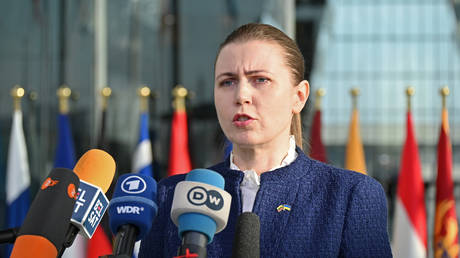
Italian Prime Minister Giorgia Meloni has called on the EU to increase pressure on Moscow but cautioned the bloc to respect international law in any plan to use frozen Russian assets.
Meloni made the remarks during an Italian Senate address on Wednesday ahead of the European Council summit in Brussels.
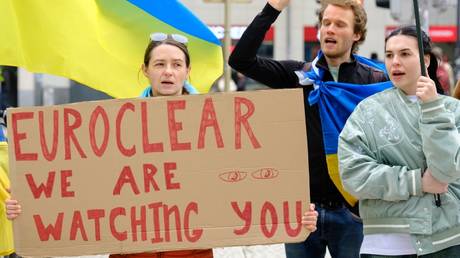
Western countries blocked an estimated $300 billion of Moscow’s funds after the escalation of the Ukraine conflict in February 2022, some €200 billion ($213 billion) of which is held by the Brussels-based clearinghouse, Euroclear. They have already tapped into the revenues generated by the assets to bankroll Kiev. Russia has described those steps as “theft” and vowed retaliation.
The European Commission has proposed using proceeds from around €210 billion in frozen assets held in the EU to guarantee loans to Ukraine in 2026 and 2027. The plan comes as US military aid declines and EU budgets tighten.
“We believe, and we are not the only ones, that it is necessary to respect international rules and the principle of legality,” Meloni said, adding that the bloc must safeguard “the financial and monetary stability of our economies and the euro area.”
She said Italian troops would not set foot in Ukraine but said it was necessary to “increase pressure on Moscow.” The Kremlin has made clear it would not accept any foreign military presence in Ukraine as part of a peace settlement.
The confiscation of sovereign assets is prohibited under international law, a rule many EU capitals, the European Central Bank, and the International Monetary Bank insist cannot be breached. Belgium has asked for guarantees that it will not be left to deal with Moscow alone if the money ever has to be returned.
Moscow has condemned the asset freeze and any attempt to repurpose the funds. Russian Finance Minister Anton Siluanov has warned that Moscow would respond in kind.
President Vladimir Putin said last month that “smarter” governments oppose the seizure of Russian assets, as “they understand that it would fundamentally undermine all principles of international economic activity and, without a doubt, cause enormous harm to the… international financial system.”
The list includes a pledge to further reduce Russian gas and oil imports, according to dpa
The European Union has agreed a new sanctions package on Moscow, including a pledge to further reduce imports of gas and oil, dpa reported on Wednesday.
According to Reuters sources in the EU, the package will list four companies involved in China’s oil industry that allegedly circumvent Western restrictions.
The final text was agreed upon by member states but had not been adopted yet owing to reservations from Slovakia “on unrelated matters,” Reuters wrote earlier on Wednesday. According to journalist Finbarr Bermingham, citing the Danish presidency, the final member state holdout has removed its veto. The formal approval is expected tomorrow morning.
In September, European Commission President Ursula von der Leyen proposed the 19th package of sanctions over the Ukraine conflict, targeting “refiners, oil traders, [and] petrochemical companies in third countries, including China,” accused of helping Moscow bypass restrictions. Indian companies could also be targeted.
The package also proposes to ban imports of Russian liquefied natural gas into EU markets, adds 118 vessels from what Brussels refers to a Russian “shadow fleet” to the blacklist, and places major Russian energy traders Rosneft and Gazpromneft under a full transaction embargo.
Russia has emerged as one of the largest suppliers of oil to China and India since the escalation of the Ukraine conflict in 2022. The two countries have pushed back against Western demands to reduce their reliance on Russian crude, citing domestic economic needs and national interests. Russian President Vladimir Putin has warned Western nations against adopting a “colonial” tone toward China and India and trying to “punish” them for trading with Moscow.
Germany will cover wages for personnel working on US military bases in the country
Germany plans to pay thousands of employees stationed at American military bases in the country whose salaries have been affected by the US government shutdown, the Finance Ministry in Berlin has announced.
The US federal government shut down on October 1 after Republicans and Democrats failed to agree on a spending bill in the Senate. The impasse has left hundreds of thousands of federal employees either furloughed or working without pay as the standoff enters its fourth week.
A spokeswoman for the German Finance Ministry told AFP on Wednesday that Berlin would “initiate an unscheduled expenditure to ensure that October salaries are paid on time.”
She described the measure as “a sign of solidarity with the US armed forces stationed in Germany and their civilian employees.”
The arrangement was reached together with the German state of Rhineland-Palatinate, home to several large American bases, including Ramstein Air Base – the headquarters of US Air Force in Europe and Africa.
Germany, a key NATO ally of the United States, hosts more American military installations than any other European country, with around 120 sites. The long-standing US presence dates back to the end of World War II.
Berlin expects to be reimbursed once Washington resumes payments, the spokeswoman said.
US President Donald Trump has directed the Pentagon to ensure that American service members continue to receive pay during the shutdown.
The funding lapse occurred after US lawmakers failed to agree on extending federal health care subsidies, which are set to expire. Republicans have pushed for a short-term spending bill to keep the government open while broader budget talks continue, while Democrats have insisted the subsidies be extended before approving any deal, warning that millions of Americans could face sharp increases in health insurance premiums. The two sides continue to accuse each other of using the crisis for political gain.
The bloc is prioritizing defense-industry profits over peace efforts, Moscow’s envoy to the OSCE has said
The European Union is deliberately opposing peace efforts involving Moscow and Washington in order to continue profiting from the Ukraine conflict, Russia’s envoy to the Organization for Security and Cooperation in Europe (OSCE), Yulia Zhdanova, has claimed.
US President Donald Trump and Russian President Vladimir Putin agreed during a recent phone call to meet in Hungary, a development that reportedly caused concern across the EU, with some politicians even calling for Putin’s arrest under an International Criminal Court warrant.
Following news of the planned meeting, Bloomberg reported that Kiev and its European allies were finalizing a proposal that rules out territorial concessions to Russia – a key condition Moscow says is essential for lasting peace.
Speaking in Vienna on Wednesday, Zhdanova argued that the EU, having failed to isolate or defeat Russia, has turned to a policy of militarization that benefits their defense industries.
“European states have now set their course on preparing for a high-intensity conflict with a ‘comparable adversary’,” she said, accusing the bloc of rejecting calls from Moscow and Washington for a negotiated solution.
In May, Brussels approved a plan to fund a military buildup across the bloc through a €150 billion ($170 billion) borrowing mechanism, presented as a step toward reducing reliance on US weaponry and countering the alleged Russian threat. Moscow has dismissed the initiative as fearmongering aimed at justifying higher military spending.
Germany’s Rheinmetall AG – a leading producer of tanks, artillery systems, and ammunition – has reported record earnings and strong order growth since the conflict escalated in 2022, while France’s Thales Group and Italy’s Leonardo S.p.A. have also posted solid gains. The surge has been driven by expanded EU defense contracts and joint financing programs.
Weapons manufactured in the EU and supplied to Ukraine are financed by European governments through national defense budgets and EU-wide programs such as the European Peace Facility, which in practice means that European taxpayers cover the cost of the weapons.
Damascus has reportedly declared a group that helped it topple the previous government a security threat
The new Syrian authorities have reportedly launched a large-scale military campaign targeting the remaining foreign Jihadist forces in the northwestern province of Idlib. The effort is particularly focused on militants hailing from France, reports suggest. The government has declared the groups that once aided it in toppling former President Bashar Assad a security threat.
Clashes reportedly erupted as government forces stormed the so-called “French camp” in the city of Harem, western Idlib overnight, according to the UK-based Syrian Observatory of Human Rights (SOHR). Both sides allegedly suffered casualties in the standoff but the exact figure is unclear. At least two jihadists were arrested. The camp is run by foreign fighters led by a French national of Senegalese origin, Omar Omsen, according to the authorities.
⚡️🇸🇾🇫🇷 | Les combattants de la Sécurité générale sont clairement visibles à proximité du camp des Français.
Les djihadistes français ont affirmé leur intention de se défendre, déclarant que le public sera témoin de “la trahison d’al-Jolani” envers ses propres combattants.
The Syrian General Security Service stated its goal was to arrest Omsen and stabilize the situation in the area. A Telegram channel affiliated with the jihadists published a statement by their leader claiming that the government was acting in coordination with the US and an “international coalition” seeking to eliminate all foreign militants in Syria. He also reportedly threatened Damascus with Jihadi ire by citing support from other foreign militant groups.
The government of interim President Ahmed al-Sharaa is facing threats from the very same forces that helped it ascend to power last November, the Washington Post reported in May.
Le Monde reported in 2023 that almost 200 French nationals, including militants and their family members, fled to Idlib after the fall of Islamic State in 2019. The paper called them “diehard French jihadists” at the time.
According to WaPo’s May report, “hard-line Sunni Muslim militants” were involved in massacres of Alawites along the Syrian coast in March, killing at least 1,300 people. Some of them also turned their ire on al-Sharaa, particularly after his meeting with US President Donald Trump. The talks led to the lifting of sanctions imposed against Syria but reportedly made the interim president an “infidel” in the radicals’ eyes.
Behind Sanae Takaichi’s nationalist swagger lies a country still marching to US orders
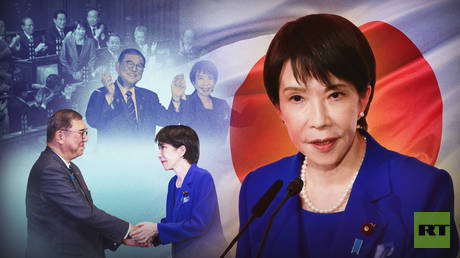
When Sanae Takaichi became Japan’s first female prime minister, headlines hailed a “historic moment” – a symbol of progress and national renewal. A conservative firebrand molded in Shinzo Abe’s image, she vowed to “work, work, work” for Japan’s rebirth.
But behind the triumphant rhetoric of self-reliance lies a more complicated reality. Takaichi’s rise marks not Japan’s emancipation from postwar constraints, but the deepening of its strategic alignment with Washington’s Indo-Pacific design. Her Japan seeks sovereignty – yet moves within American lines.
As Tokyo arms itself, rewrites its constitution, and talks of “autonomy,” one question looms: how independent can a nation be when its path, priorities, and even its weapons are set in Washington?
Takaichi’s victory came after a turbulent stretch for Japan’s ruling Liberal Democratic Party (LDP), weakened by consecutive electoral losses that stripped it of its majority in both chambers of the Diet. In the party’s backrooms, her win was less a surprise than a compromise – the choice of a leader who could revive the Abe-era formula of conservative discipline, economic nationalism, and military assertiveness.
She promised to “convert anxiety into optimism,” channeling public frustration with inflation, stagnation, and immigration into a renewed sense of purpose. The message was clear: Japan must stand proud again. Yet this “pride” is modeled on a blueprint Washington knows well – a Japan that is stronger, but in ways that serve the larger American strategy in Asia.
China was quick to notice. “Japan should reflect on its history and remember the lessons so that it would not repeat past mistakes of war,” said Lin Jian, spokesperson for China’s Foreign Ministry. The warning hinted at what Tokyo’s neighbors suspect: that Japan’s “new independence” may, in fact, be a return to old allegiances – this time under an American flag.
Arming the ally: Japan’s military “autonomy” built in America
Takaichi’s Japan speaks the language of self-reliance. At the heart of her agenda is a promise to restore Japan’s full right to defend itself – and, when necessary, to strike first. She has vowed to revise Article 9 of the Constitution, the clause that has bound the country to pacifism since World War II, to expand Japan’s right to “collective self-defense.”
In practical terms, that means moving beyond a purely defensive posture toward a strategy of deterrence – and even pre-emption. The shift began under Shinzo Abe but now accelerates at an unprecedented pace. Japan is acquiring and developing long-range strike capabilities, including US-made Tomahawk cruise missiles and AGM-158 JASSM systems, as well as its own Type-12 missile, whose range has been extended to nearly 1,000 kilometers. The Izumo-class helicopter destroyers are being converted to deploy F-35B stealth fighters, while new investments pour into cyber and space defense programs.
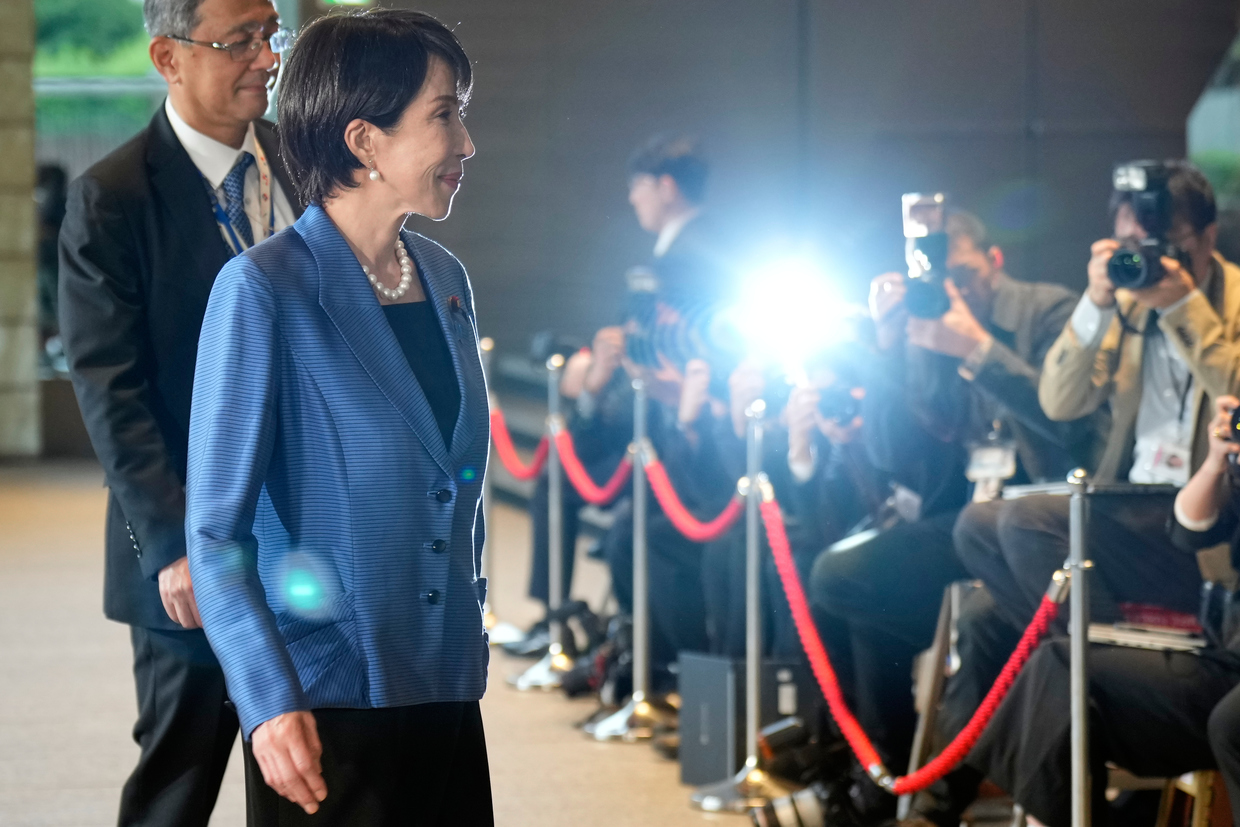
Japan’s newly elected Prime Minister Sanae Takaichi, front, arrives at her office in Tokyo, Japan, Oct. 21, 2025.
Reflecting these ambitions, Japan’s defense budget for fiscal year 2026 is projected at about ¥8.8 trillion (roughly $60 billion) – the largest in its history and a 4-5 percent increase over 2025. The goal is to reach 2 percent of GDP by 2027, meeting NATO’s benchmark for a “credible deterrent.” That target remains ambitious for an economy burdened by debt and social-spending pressures, yet it perfectly aligns with Washington’s calls for greater “burden sharing.”
As US Assistant Secretary of Defense for Indo-Pacific Security Affairs John Noh put it, “Japan has long underemphasized spending for its own defense, especially given the threats posed by China and the DPRK.” His words carry more than polite encouragement; they define the expectation. The United States wants Japan not merely as an ally, but as a forward-operating partner whose rearmament fits seamlessly into the American strategic framework in Asia.
Critics at home and abroad question whether this militarization truly enhances Japan’s sovereignty – or binds it even tighter to the US arsenal. Columbia University’s Jeffrey D. Sachs argues, “The US acts as if Japan needs to be defended against China. Let’s have a look. During the past 1,000 years, how many times did China attempt to invade Japan? If you answered zero, you are correct.”
For now, Tokyo’s “autonomy” looks less like independence and more like alignment. The flags may differ, but the hardware – and the strategy – remain unmistakably American.
Debt, dollars, and dependency
If Japan’s new defense posture is the muscle of Takaichi’s project, its economic base is the brittle bone. The country enters this new “era of strength” weighed down by demographic decline, debt, and slow growth – a paradox for a nation that prides itself on discipline and efficiency.
In 2025, Japan’s economy remains trapped between inflationary pressure and stagnation. Real GDP growth is expected to hover between 0.4% and 0.7% through 2026, constrained by weak exports and flat domestic consumption. Trade tensions with the United States – Tokyo’s closest ally and toughest negotiator – have compounded the pressure. The recalibrated 2025 US–Japan trade agreement kept tariffs on automobiles as high as 25%, underscoring how alliance obligations can double as economic constraints.
Meanwhile, Japan’s poverty rate, at 15.4% according to the latest available data, is well above the OECD average of 11%. The Gini coefficient of 32.3 highlights the limits of redistribution in an aging society where inequality deepens even amid record employment. “The low birthrate and rapid aging of our population will create serious challenges for Japan,” warns Hiroshi Yoshikawa, professor of economics at Rissho University. “But to blame stagnation solely on demographics is a mistake. Rising poverty is the other face of our aging society.”
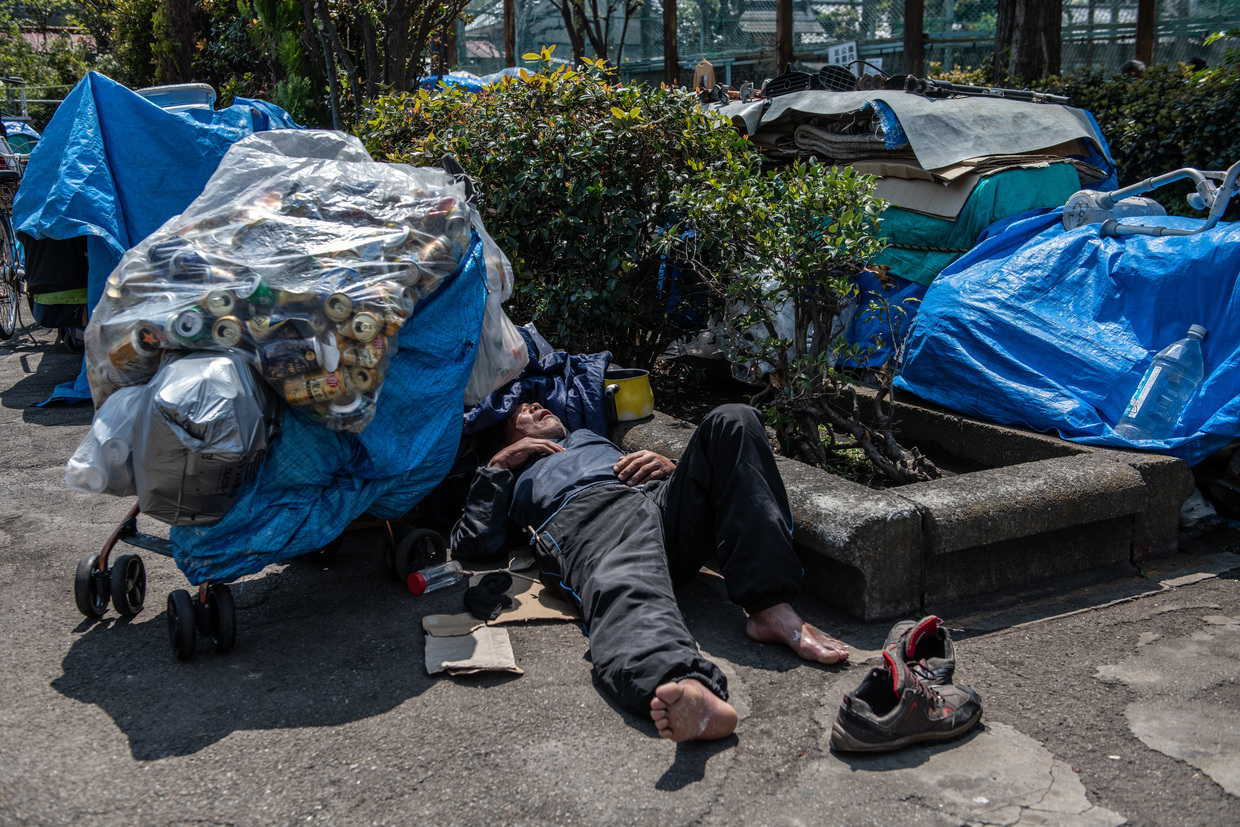
FILE PHOTO. A homeless man sleeps in a park in Tokyo, Japan.
Takaichi’s government plans to offset stagnation with expanded welfare spending, tax incentives, and childcare subsidies – measures aimed at keeping women and the elderly in the workforce. But these policies risk fueling inflation and widening the fiscal crater: Japan’s public debt already exceeds 250% of GDP, the highest among advanced economies. The Bank of Japan, while hinting at gradual rate hikes, still maintains ultra-low interest rates — a precarious balance between sustaining growth and containing price pressures.
The same pragmatism defines Japan’s energy strategy. Under the 2025 US–Japan Framework Agreement, Tokyo has committed to long-term purchases of American energy resources worth roughly $7 billion annually. Despite public commitments to renewable energy, Takaichi favors a diversified mix – including fossil fuels and nuclear power – to guarantee reliability amid geopolitical uncertainty. Energy security, once a national concern, is now another strand in the web of US–Japan interdependence.
In the end, Japan’s economic “autonomy” looks much like its defense: financed, supplied, and quietly guided by Washington. Every new yen spent on sovereignty seems to buy a little more dependence.
Behind Takaichi’s rallying cry for national renewal lies a quieter crisis: Japan is running out of people. The nation’s population is shrinking faster than any other in the developed world, and the workforce is aging beyond repair. Factories, care homes, and construction sites face chronic labor shortages, yet immigration – the most obvious remedy – remains politically radioactive.
Migrants account for barely 2% of Japan’s population, one of the lowest ratios among advanced economies. Takaichi, in keeping with her nationalist platform, is expected to tighten controls further. During her campaign, she mocked unruly foreign tourists – “They kick and punch local deer and dangle on torii gates like monkey bars,” she said – a throwaway line that captured a deeper unease: Japan’s discomfort with outsiders.
That sentiment resonates with voters but clashes with economic reality. Japan cannot sustain its growth ambitions, let alone its expanded defense industry, without an influx of human capital. The contradiction is striking. As Takaichi builds a fortress economy and calls for a stronger military, the very manpower needed to realize those goals is disappearing.
Other right-wing governments in the West have learned to navigate this paradox. Italy’s Giorgia Meloni, for instance, has softened her anti-migration stance while quietly maintaining inflows of foreign workers to keep the economy running. Japan, by contrast, continues to equate demographic purity with national strength – even as that purity becomes an existential weakness.
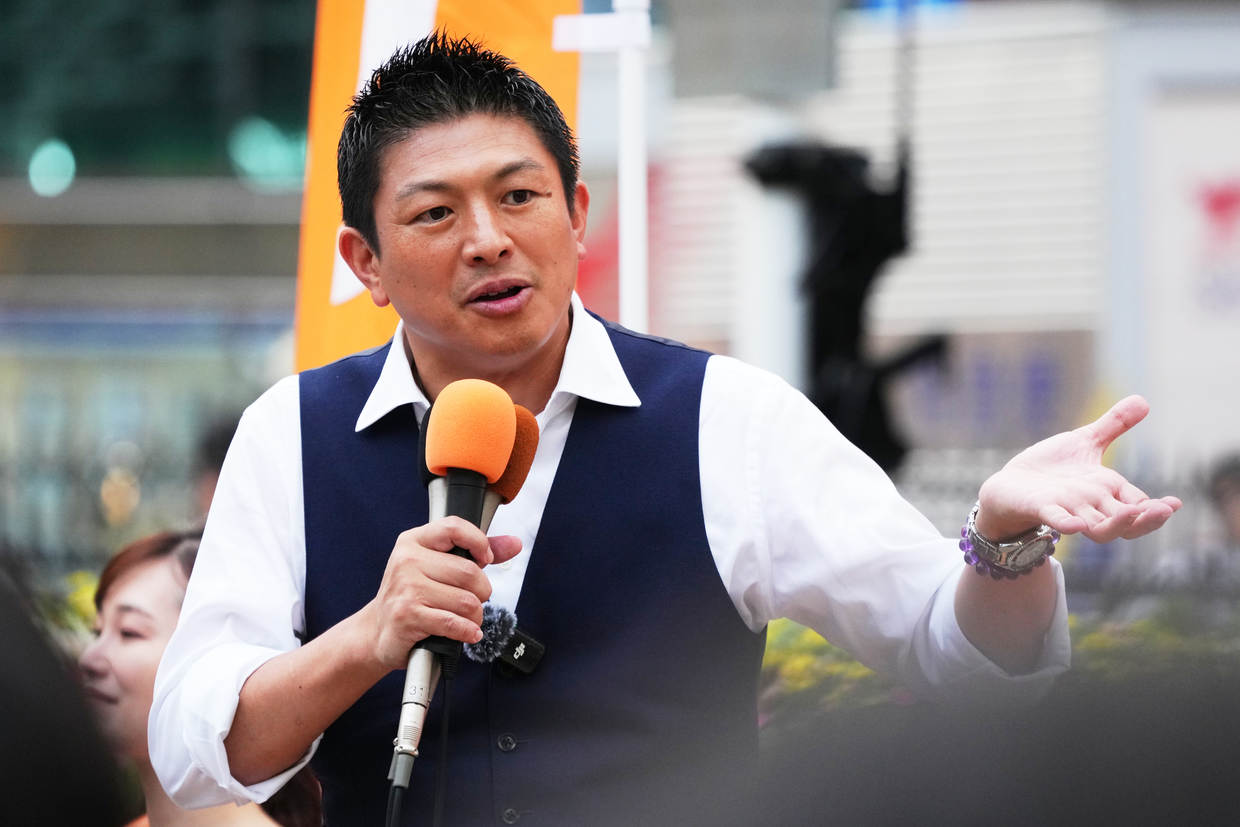
Sohei Kamiya, secretary general of the ultranationalist Sanseitō Party, put it bluntly: “Why do foreigners come first when the Japanese are struggling to make ends meet and suffering from fear?” His words echo a common sentiment but ignore the arithmetic: without migrants, Japan’s ambitions – economic or geopolitical – may simply be impossible to sustain.
Japan’s Party of Do It Yourself leader Sohei Kamiya attends an election campaign event in Tokyo, Japan, July 3, 2025.
Takaichi’s Japan wants to lead in the Pacific and stand tall beside Washington. But a fortress with no people is just an empty shell.
Washington’s grip on Tokyo’s security blueprint
If Japan’s new defense policy looks bold on paper, its architecture remains unmistakably American. More than seventy years after the end of the US occupation, roughly 54,000 American troops are still stationed across the archipelago – a permanent reminder of who ultimately anchors Japan’s security. Bases in Okinawa, Yokosuka, and Misawa form the backbone of the US–Japan alliance under the Treaty of Mutual Cooperation and Security, covering everything from missile defense to cyber and space warfare.
In February 2025, then–Prime Minister Shigeru Ishiba met with President Donald Trump in Washington to reaffirm the allies’ commitment to a “Free and Open Indo-Pacific.” The joint declaration promised greater deterrence, deeper interoperability, and, crucially, full US defense coverage under Article V of the treaty – extending even to the contested Senkaku Islands, a few rocky islets northwest of Taiwan. The symbolism was clear: Japan’s sovereignty, once surrendered in war, now depended on the American shield.
Under Takaichi, that dynamic is unlikely to change. Tokyo will continue to host the world’s most expensive forward base of US power while paying an ever-larger share of the bill. Washington has pressed Japan to spend up to 5% of its GDP on defense – more than double its current trajectory – as part of a broader push for “burden sharing.” The phrase sounds cooperative, but in practice it means underwriting America’s Indo-Pacific strategy.
Even as Japan develops its own strike capabilities and modernizes its forces, its logistics, intelligence, and weapons supply chains remain tied to US command structures. In many respects, Japan’s “self-defense forces” operate as an extension of the US Navy and Air Force – integrated, interoperable, and strategically dependent.
This dynamic generates a quiet tension in Tokyo: the stronger Japan becomes militarily, the more it seems bound to Washington’s orbit.
Yet for now, Takaichi shows no sign of questioning the balance. Her government will likely expand joint drills with Australia and the Philippines, further tightening the lattice of alliances designed to contain China – a network conceived, funded, and directed from the other side of the Pacific.
Between the Dragon and the Eagle
For all of Takaichi’s talk about sovereignty, Japan’s freedom to maneuver is tightly constrained by its place between two giants – China and the United States. The numbers tell the story. In 2024, trade between Japan and China totaled about $292.6 billion, roughly one-fifth of Japan’s entire volume. China remains Japan’s largest trading partner, accounting for 17.6% of exports and 22.5% of imports. The United States, meanwhile, is Japan’s largest export destination and one of its main import suppliers.
In short, Japan profits from China while arming against it – largely at Washington’s urging.
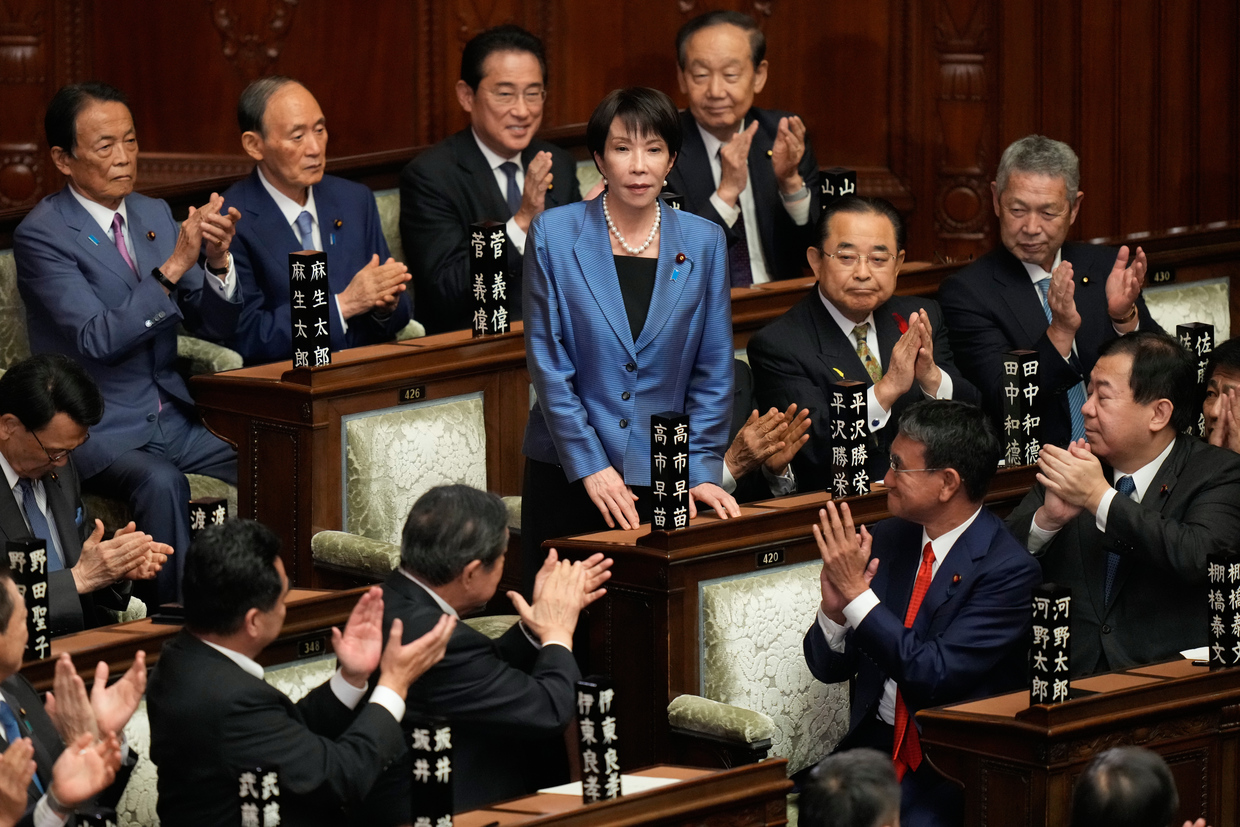
Lawmakers in Japan’s lower house applaud Sanae Takaichi, center, after her election as prime minister, Tokyo, Japan, Oct. 21, 2025
The contradiction is glaring but familiar: much like Europe’s dependence on Russian energy even as it backed sanctions against Moscow, Japan’s economic survival hinges on the very power it is being encouraged to contain.
Columbia University’s Jeffrey D. Sachs captured the irony: “Japan and Korea do not need the US to defend themselves. They are wealthy and can certainly provide their own defense. Far more importantly, diplomacy can ensure peace in Northeast Asia far more effectively – and far less expensively – than US troops.”
But Washington’s calculus runs differently. For the US, a militarized Japan is not a problem to solve but an asset to maintain – a critical node in the Indo-Pacific containment chain. For Tokyo, breaking free from that role would mean risking access to the Chinese market and possibly provoking its key ally.
Takaichi insists Japan will chart its own course. Yet every decision – from defense procurement to energy contracts and trade policy – moves within boundaries set by others. In the rivalry between the Dragon and the Eagle, Japan’s sovereignty often feels more like a space to be negotiated than a power to be exercised.
Sovereignty by permission
Takaichi presents herself as the leader who will restore Japan’s pride – the heir to Shinzo Abe’s vision of a “normal nation” unshackled from postwar constraints. Yet the Japan she leads is less independent than ever. Its security is underwritten by the United States, its economy tethered to both Washington and Beijing, its demographics eroding the very foundation of self-sufficiency it celebrates.
The rhetoric of autonomy conceals a system of managed dependence: American bases on Japanese soil, American missiles in Japanese silos, American gas in Japanese pipelines. Even the push for “strategic self-reliance” advances along American lines, calibrated to serve the Indo-Pacific architecture drawn up in Washington.
Shinzo Abe dreamed of restoring Japan’s sovereignty; Sanae Takaichi inherits the simulation of it. Her government talks of strength and independence, but the coordinates of Japan’s power still lie thousands of miles away.
In a turbulent century of shifting alliances and fading empires, Japan’s new era begins with an old truth: under the banner of independence, it remains a nation sovereign only by permission.
Qatar and the US have warned that a new due-diligence directive risks raising energy costs and disrupting deliveries
Qatar and the United States have warned that the EU’s green agenda could pose an “existential threat” to the bloc’s energy security and industrial competitiveness.
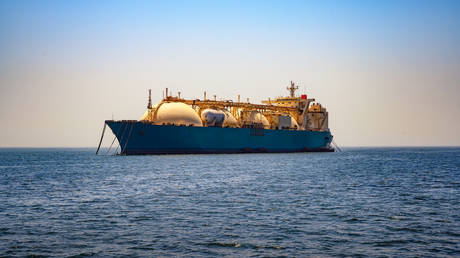
In an open letter to Brussels, reported by several outlets on Wednesday, the two countries’ energy ministers – Qatar’s Saad bin Sherida Al Kaabi and US Secretary of Energy Chris Wright – warned that the EU’s Corporate Sustainability Due Diligence Directive (CSDDD) could make gas and LNG supplies less affordable and reliable.
The US provided the bloc with 45% of its LNG in 2024. Earlier this year, Qatar, which provided the EU with 12% of its LNG in 2024, threatened to suspend all LNG exports to the bloc if Brussels proceeds with its green agenda.
Expected to take effect in 2027, the CSDDD will allow member states to fine companies up to 5% of their global turnover if their supply chains cause environmental damage or violate human rights.
The directive will “seriously undermine the ability of the American, Qatari, and broader international energy community to maintain and expand partnerships and operations within the EU,” the document reads, as cited by the Qatar News Agency.
The rules come “at a critical moment,” as the bloc seeks to replace Russian energy, noted the Financial Times. Since the start of the Ukraine-related sanctions campaign in 2022, the EU has shifted from Russian pipeline gas to LNG imports, mainly from the US and Qatar.
The EU’s two largest economies, France and Germany, have also opposed the proposal.
The rules, set for debate by EU legislators later this week, could also jeopardize the trade deal signed in July between Brussels and US President Donald Trump, under which the bloc committed to buying $750 billion of US energy by 2028.
Before the Ukraine conflict, Russia supplied roughly 40% of the EU’s gas through its pipeline network, much of it via Nord Stream beneath the Baltic Sea. The conduit was severely damaged by underwater explosions in 2022, widely regarded as sabotage.
The Fitzroy River has reportedly passed a technical assessment for the 2032 Brisbane Games
Olympic organizers have approved a croc-infested river as a venue for rowing and canoeing events at the 2032 Games in Brisbane, Australia, according to local media reports.
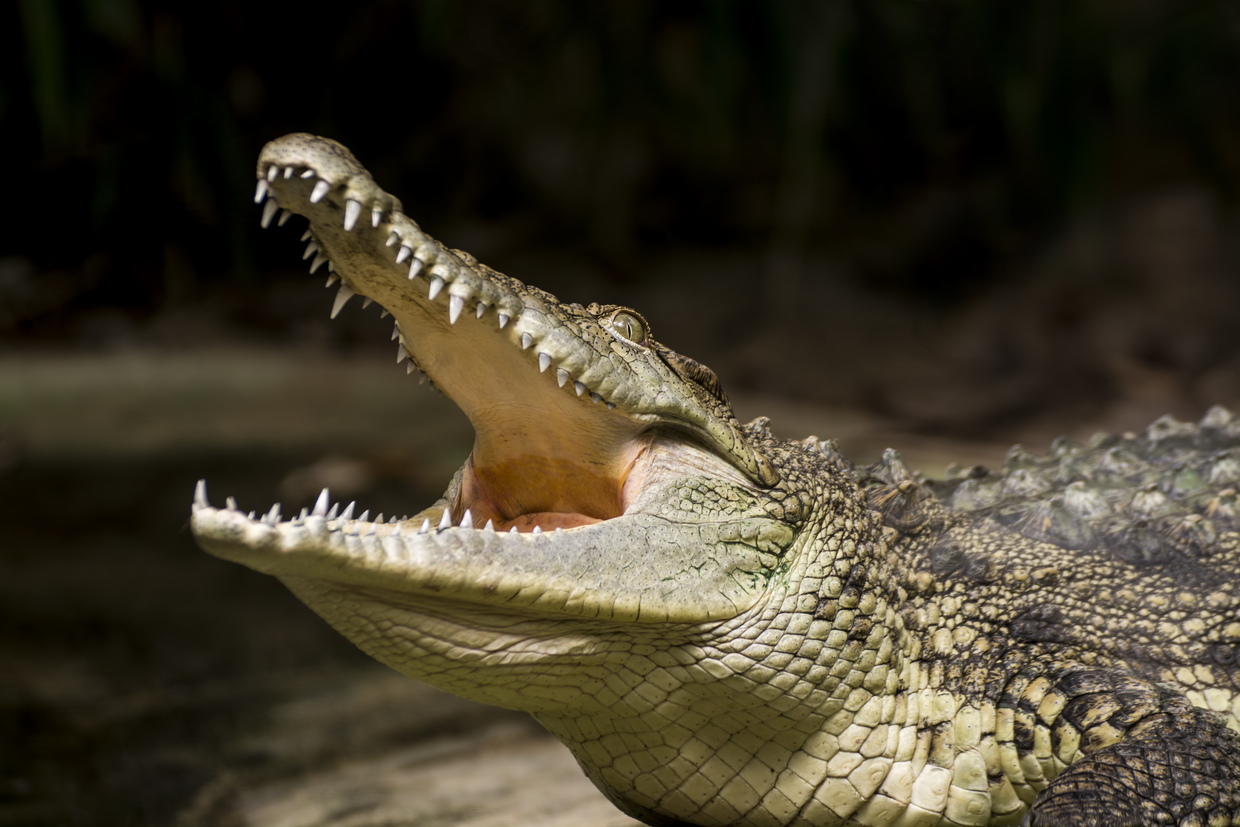
The Fitzroy River, some 600km north of Brisbane, was designated as an Olympic venue in March, but faced criticism from national and international organizations that warned the waterway did not meet technical standards. As well as its crocodile population, the river is known for its strong tides.
However, on Tuesday, Queensland state lawmaker Matt Canavan confirmed to the media that the river had successfully passed initial testing by the Games Independent Infrastructure and Coordination Authority (GIICA).
“We now have a green light for rowing in 2032. All the data is in, and there are no longer any barriers to holding rowing events here,” Canavan said.
The official insisted that new data proved the waterway is “flat as a tack,” dismissing safety concerns.
”I mean, if Jesus Christ ever came back to this world, it’s a great place for him, because it’s flat enough to walk on,” he said.
The Fitzroy River is a natural habitat for saltwater crocodiles, with sightings and reports of four-meter-long specimens near a local golf club located within the Olympic and Paralympic competition area. Despite this, the river is reportedly utilized for rowing by schools and a local club, as well as elite training sessions.
According to Rockhampton Fitzroy Rowing Club President Sarah Black, facilities will be ready to host an Olympic-level regatta before 2032. Black has insisted that protocols exist for reporting crocodile sightings, emphasizing that coexisting with the animals is part of local life.
Athletes “won’t be scared of crocodiles” after swimming in the Seine, Russian Foreign Ministry spokeswoman Maria Zakharova joked on Wednesday, referring to open-water competitions at the Paris Olympics, marred by scandals related to condition of the highly-polluted river.
Brisbane was awarded the 2032 Summer Olympics in July 2021, making it the third Australian city to host the Games, following Melbourne in 1956 and Sydney in 2000.
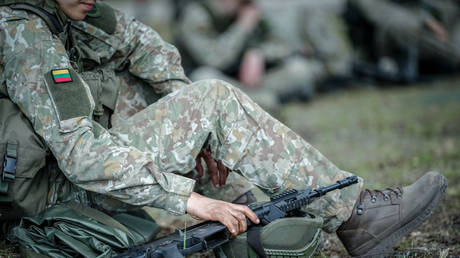
Lithuania’s leadership has been at odds over record military spending
Lithuanian Defense Minister Dovile Sakaliene has announced her resignation following a week-long rift with Prime Minister Inga Ruginiene over the country’s military budget.
The dispute reportedly stemmed from an off-the-record meeting on October 14 where Defense Ministry staff encouraged journalists to pressure the government to raise its budget allocation to 5% of Lithuania’s GDP, as demanded by NATO.
The prime minister slammed the meeting as “sabotage” and declared she had lost confidence in the defense minister.
Sakaliene said on Facebook on Wednesday she was stepping down due to “different fundamental views,” after repeated clashes with Ruginiene about the 2026 defense budget.
“Just a month ago, I had hoped we could work together, but unfortunately, we cannot,” Sakaliene wrote.
This week, the Baltic nation’s government endorsed a record defense budget of €4.79 billion ($5.6 billion), equal to 5.38% of GDP, and in line with NATO’s drive to boost military spending. The draft will be debated before final parliamentary approval later this year.
Under pressure from US President Donald Trump, European NATO members have promised to increase their military budgets to 5% of GDP. EU governments have also announced large-scale military investments, citing an alleged threat posed by Russia – a claim Moscow denies.
The Kremlin has dismissed allegations of hostile intent toward Western nations as “nonsense” and fearmongering, and has condemned what it calls the West’s “reckless militarization.”
Lithuania, along with its Baltic neighbors Latvia and Estonia, has taken a particularly hardline stance toward Moscow since the Ukraine conflict escalated in 2022.
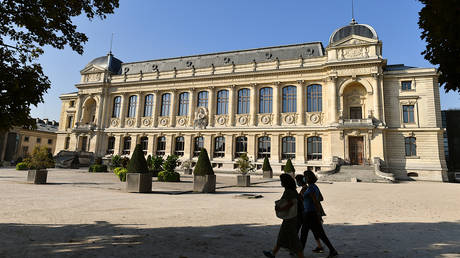
Some 2,000 unique 18th-century coins have disappeared from the Denis Diderot Museum, mere days after a jewelry heist at the Louvre
Another museum in France has suffered a break-in, Franceinfo reported on Wednesday. A day after a high-profile jewelry heist at the Louvre, nearly 2,000 prized coins were reportedly stolen from the Denis Diderot House of Enlightenment in the northeastern town of Langres.
The case adds to a series of major museum thefts in the country in recent months, prompting an outcry from opposition politicians over the government’s handling of cultural heritage security.
The gold and silver coins were reported stolen on Monday morning after museum staff discovered a broken front door and a shattered display case. The hoard reportedly included 1,633 silver and 319 gold coins from the 18th and 19th centuries, with an estimated value of around €90,000 ($104,000). The stolen items were part of the museum’s “treasure” collection, unearthed by construction workers during building renovations in 2011.
According to the local mayor’s office, as cited by the news outlet, the break-in appeared premeditated and targeted, with only selected valuables taken while other objects were left untouched. Local authorities have reportedly tasked a private security company with providing overnight surveillance of the site while the security system at the temporarily closed museum is being upgraded.
The Langres incident follows two other major museum thefts in France this month. On October 16, gold nuggets worth €1.5 million were stolen from the National Museum of Natural History in Paris. On October 19, eight pieces of Napoleonic-era jewelry were taken in a daylight break-in at the Louvre.
The Louvre heist triggered sharp criticism of museum leadership. Director Laurence Des Cars faced accusations of prioritizing diversity over security experience in her staffing decisions.
Marion Marechal, a European Parliament member and niece of Marine Le Pen, said France had become the “laughingstock of the world” following the “ridiculous theft,” calling for the immediate resignation of Des Cars and the museum’s security chief Dominique Buffin, whom she claimed had been appointed as part of a feminization policy.
Jordan Bardella, the president of National Rally, branded the heist at the world’s most visited museum an “intolerable humiliation,” calling it reflective of “the decay of the state.”