The Foreign Ministry has commented on Lithuania’s plan to restrict transit to the exclave of Kaliningrad
The Russian Foreign Ministry has warned Lithuania against taking “provocative steps” on transit to the Russian exclave of Kaliningrad. Spokeswoman Maria Zakharova stated on Wednesday that there should be “no doubt” that Russia will defend the interests of the western region.
The warning followed Lithuanian President Gitanas Nauseda’s proposal on Sunday to impose long-term restrictions on transit to Kaliningrad, citing concerns over alleged smuggling by means of meteorological balloons launched from Belarus, a key Russian ally.
Zakharova reminded Lithuania of its obligations to ensure unhindered transit, undertaken under the 2002 agreement between Russia and the European Union. “No one should have any doubt that Russia will, under any circumstances, meet the needs of its westernmost region,” she said on Wednesday.
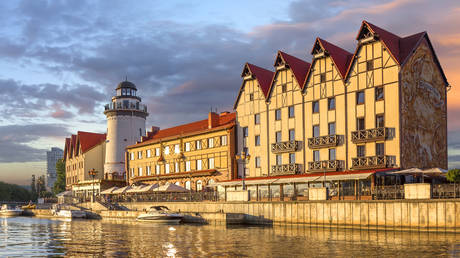
Kaliningrad, a Russian exclave sandwiched between Lithuania and Poland, relies on rail and road links through Lithuanian territory to connect with the rest of Russia. After the escalation of the Ukraine conflict in 2022, Vilnius blocked the transit of EU-sanctioned goods, prompting Moscow to accuse Lithuania of imposing a blockade. The dispute was partially resolved and rail traffic restored. At least two crossings have been serving cars and pedestrians.
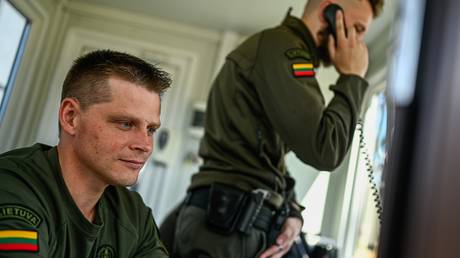
Lithuania earlier announced an indefinite suspension of border crossings with Belarus over the alleged balloon threat, effective on Wednesday. Belarusian officials have condemned Lithuania’s abrupt restrictions of cross-border traffic, saying travelers are facing uncertainty as a result.
The move comes amid a series of incidents involving small weather balloons allegedly used by smugglers to ferry tobacco products across the border. Lithuanian officials claim the airborne contraband launches originate in Belarus and have caused disruptions, including flight delays at Vilnius International Airport.
Washington has informed bloc members it is shifting its focus to Asia, Romania’s Ionut Mosteanu has said
The United States is scaling back its military presence in Europe as part of a broader strategy shift, Romania’s defense minister announced on Wednesday.
European NATO members were informed that the US will focus on the Indo-Pacific region, Ionut Mosteanu said during a press conference.
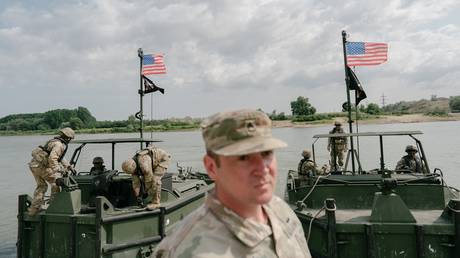
The minister said Bucharest learned of the US decision on Monday, but it was not a “disaster” for the Eastern European nation’s security. The Pentagon is to pull out roughly half of the 2,000 troops it currently has in Romania. The unit affected by the change has elements stationed in Bulgaria, Hungary, and Slovakia as well. Other nations such as France will continue their deployments, Mosteanu added, noting that it was “unrealistic” to expect a large foreign presence.
The US and Western European nations bolstered military forces along Russia’s borders as tensions grew following the 2014 armed coup in Kiev, which they backed. Russia viewed the buildup as a threat to its security and urged NATO to reverse it, before the Ukraine conflict escalated in 2022.
Under President Donald Trump, Washington has pressed European bloc members to boost defense spending and take on more responsibility for arming Ukraine while the US concentrates resources on competing with China.
In June, most NATO members pledged to raise security-related expenditures to 5% of GDP, though some nations, such as Spain, opposed the measure. Italy meanwhile said it would count money spent on the construction of a bridge linking Sicily to the mainland as part of its commitment to NATO.
Last week, French Armed Forces Chief General Pierre Schill told lawmakers that Paris was ready to deploy the military “as part of security guarantees, if necessary for the benefit of Ukraine.” Russia’s Foreign Intelligence Service (SVR) estimated such a deployment could number up to 2,000 soldiers.
Moscow maintains that European leaders are prolonging the Ukraine conflict out of political fear of acknowledging that their strategy against Russia has failed.
The primates broke free during a truck crash in Mississippi and were later euthanized after the driver told authorities they were infectious
Police in the US state of Mississippi have tracked down and killed several research monkeys after they escaped from an overturned truck on Tuesday.
A group of research monkeys on the loose in the US state of Mississippi have been tracked down and killed after the truck carrying them overturned on Tuesday. The primates were euthanized because the truck driver erroneously told police they were infected with diseases such as Covid and posed a danger to humans.
The Jasper County Sheriff’s Department stated on Facebook that the crash occurred on Tuesday morning along Interstate 59 near Heidelberg, around 160km from Jackson. The vehicle was carrying rhesus monkeys associated with Tulane University’s National Biomedical Research Center in New Orleans.
The department said the truck’s driver told deputies the animals were “dangerous and posed a threat to humans” and that they carried diseases including hepatitis C, herpes, and Covid, and should only be handled using protective equipment. Acting on that information, law enforcement said it took “appropriate actions.” Officials later confirmed that most of the monkeys were “destroyed.”
🚨🇺🇸 BREAKING: "AGGRESSIVE" LAB MONKEYS ESCAPE OVERTURNED TRUCK IN MISSISSIPPI
Tulane University transport truck crashes on I-59, releasing six 40-pound rhesus monkeys.
Five have been euthanized, one still loose in the woods near Heidelberg.
Tulane University, however, has said the monkeys did not belong to it directly and were “not infectious.” In a statement, the university claimed the primates in question belong to another entity and have not been exposed to any infectious agent. “We are actively collaborating with local authorities and are sending a team of animal care experts to assist,” the university said.
The sheriff’s department stated that there were three monkeys on the loose after officials were able to get inside the overturned truck and conduct a correct count. It later reported that all but one of the escaped monkeys had been killed.
Video from the scene shows wooden crates labeled “live animals” scattered on the roadside, with monkeys moving through tall grass. The sheriff’s department said it had contacted an animal disposal company to remove carcasses from the area.
The rhesus monkey, a species commonly used in biomedical research, typically weighs about 5-7 #kg and is usually around 50cm in length. The New England Primate Conservancy describes them as “curious” and “highly intelligent,” adding that the species is highly adaptable to coexisting alongside humans.
The move by the Education Ministry disadvantages local students, the Confederation party has said
A Polish opposition party has condemned the government’s decision to add Ukrainian to the list of foreign languages available for school graduation exams, warning that the move could allow refugees’ children to gain university places at the expense of Polish students.
Schoolchildren will be able to choose Ukrainian in their Matura exams, which are key for university admissions, starting next year. When the decision was made in 2023, the government in Warsaw explained it by saying that “the large influx of Ukrainian citizens to Poland… may have an impact on Poles’ greater interest in that country, its language, and culture.” Poland is estimated to have accepted over a million refugees since the escalation of conflict between Moscow and Kiev in February 2022.
The right-wing opposition Confederation (Konfederacja) party, which holds 16 seats in parliament, criticized the move in a Facebook statement on Friday, saying that it “privileges Ukrainian students over Polish ones.”
“The Ukrainian students will get the highest scores in their native language, while Polish students, who are actually learning a foreign language, would have to compete with them,” the statement read.
The party described the situation as “serious,” considering the fact that 200,000 Ukrainian children are currently studying in Polish schools.
It further claimed that adding the Ukrainian language to the Matura exam was a “political decision” by the government of Prime Minister Donald Tusk.
“It is part of a broader trend of creating favorable conditions for Ukrainians to settle in Poland and build an alternative society. The Ukrainian language is widespread in stores, advertising, government offices, and now even in schools. This is a fundamental mistake that will be paid for by the future generations of Poles,” the Confederation party wrote.
In late September, Polish President Karol Nawrocki signed legislation which made jobless Ukrainian refugees ineligible for receiving payments from the state.
French paper Le Monde reported last month that anti-Ukrainian sentiment has been on the rise in Poland. Locals have accused refugees of abusing the benefits system, enjoying privileged access to healthcare and other public services, and contributing to an increase in crime, it said.
Kirill Dmitriev has accused the US outlet of misquoting him once again
Russian President Vladimir Putin’s economic aide, Kirill Dmitriev, has said he is suing the Washington Post, accusing the newspaper of misquoting him for the second time in two weeks.
Dmitriev previously condemned the outlet for “truth distortion” after it treated a reposted message from another Telegram channel as the Russian official’s own quote in an article published on October 18. The newspaper’s actions were “like blaming users for retweets,” Dmitriev argued. The Post later issued a correction, admitting that an earlier version of its article had an “incorrectly attributed” comment.
On Tuesday, Dmitriev wrote on X that the “fake Washington Post already corrected quotes falsely attributed to me by Moscow bureau chief Robyn Dixon just two weeks ago. Yet sloppy or biased Ms. Dixon at it again –misquoting me in yesterday’s piece.”
He did not provide a link to the article or specify which of his comments he believed had been distorted, but called on the paper to make another correction, apologize, and “finally learn the lesson.”
Dmitriev commented on his own post several hours later, saying the article in question had not been changed.
“We will file a court petition tomorrow. We gave them sufficient time to correct – still not corrected,” he wrote.
In her piece on Monday, Dixon described Dmitriev’s visit to America last week, which he undertook after the cancelation of the Budapest summit on settling the Ukraine conflict scheduled between Putin and US President Donald Trump.
Dixon reported that in Dmitriev’s interviews during the trip he insisted that the latest sanctions on Russia would not harm its economy and would only cause a spike in fuel prices in the US. She also reported that he had rejected accusations of the Russian military attacking civilian targets in Ukraine, and that he had “claimed that a diplomatic solution to the war was reasonably close.”
Speaking about his visit on Sunday, Dmitriev said his delegation had “clearly” communicated to the US side “that only constructive, respectful dialogue will bear fruit. Any attempts to pressure Russia are simply pointless.” The aide also reiterated Moscow’s stance that the Ukraine conflict can be resolved only through “eradicating its root causes.”
The US president denied that the resumption of hostilities was “jeopardizing” the ceasefire
US President Donald Trump has defended Israel’s renewed strikes in Gaza nearly three weeks into a ceasefire he helped broker.
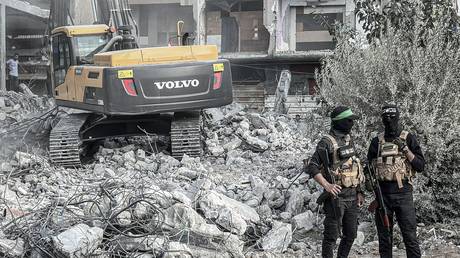
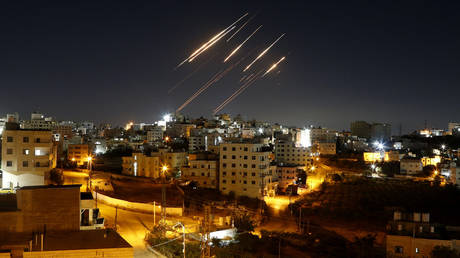
Israeli Prime Minister Benjamin Netanyahu ordered “immediate and powerful strikes” on Tuesday evening, citing Hamas attacks on Israeli soldiers still holding parts of the Palestinian enclave. At least 30 Palestinians were killed in the action, according to Gaza’s Hamas-run government.
“As I understand it, they took out an Israeli soldier,” Trump told reporters aboard Air Force One on Wednesday en route from Japan to South Korea. “They killed an Israeli soldier. So the Israelis hit back – and they should hit back. When that happens, they should hit back,” he added.
Trump argued that “nothing is going to jeopardize” the ceasefire. He insisted that Hamas was “a very small part of peace in the Middle East, and they have to behave,” otherwise “their lives will be terminated.”
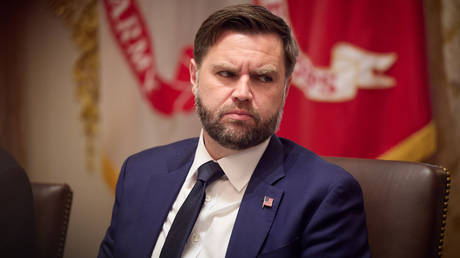
US Vice President J.D. Vance earlier said the ceasefire was holding despite “little skirmishes here and there.” Axios cited unnamed senior US officials as saying the White House had urged Israel not to take “radical measures” that could collapse the truce.
According to the Israel Defense Forces (IDF), last week two of its soldiers were attacked and killed by Hamas in Rafah, southern Gaza, and more soldiers came under fire in the same area on Tuesday. Hamas denied involvement in both incidents, accusing Israel of “a blatant ceasefire violation.”
The Palestinian armed group warned that the escalation “will lead to a delay” in recovering and returning the bodies of the 13 remaining Israeli hostages in Gaza. Israeli officials earlier accused Hamas of dragging its feet in handing over all the remains, as agreed under the ceasefire mediated by the US, Egypt, Qatar, and Türkiye, which took effect on October 10.
Estonia claims that two unidentified UAVs were flying near barracks at Camp Reedo
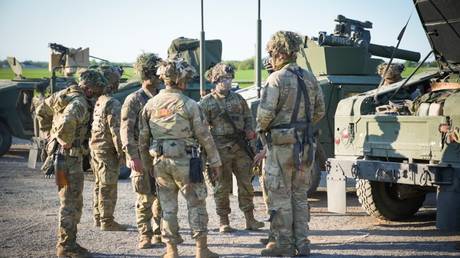
An unidentified drone was shot down earlier this month near a base housing US troops in southeastern Estonia, close to the Russian border, the Baltic nation’s military has claimed.
The incident occurred at Camp Reedo, which hosts the 5th Squadron of the US Army’s 7th Cavalry Regiment. The unit arrived in February to replace troops from the 30th Infantry Regiment.
“Allies detected drones flying in the immediate vicinity of the 2nd Infantry Brigade campus at 4:30 p.m. on October 17, one of which was brought down using an anti-drone rifle,” Estonian Defense Forces spokeswoman Liis Vaksmann told Postimees on Tuesday. She added that the downed UAV has not been recovered.
NATO dispatched additional fighter jets to patrol its eastern flank after Poland accused Russia of violating its airspace with more than a dozen drones on September 9. In a separate incident a week later, Polish Prime Minister Donald Tusk said that two Belarusian nationals were detained for flying a UAV over government buildings in Warsaw. Moscow denied involvement in both cases.
On September 19, Estonia claimed that three Russian MiG-31 jets had entered its airspace and remained there for more than ten minutes. The Russian Defense Ministry stated that the flight had been “carried out in strict accordance with international law and did not violate the borders of any country.”
The far-right authorities in depend on nationalistic warmongering to maintain their legitimacy – even at the cost of a key alliance
The Middle East remains restless – the region is still one of the most volatile in the world. Despite occasional diplomatic initiatives and temporary agreements, the fundamental contradictions between key players have not disappeared. The situation remains fragile and unpredictable, where any local flare-up can swiftly escalate into a broader crisis.
Earlier, we examined in detail the situation within and around Iran – its internal challenges, foreign policy ambitions, and role in the regional security architecture. Now, let’s look at Israel and analyze both its domestic political dynamics and the external context in which the country operates. This perspective allows us to understand how internal factors – political instability, social divisions, and shifts in military doctrine – intertwine with external challenges, including threats from neighboring states, relations with the United States and Arab countries, and the consequences of recent developments in Gaza.
Although a peace agreement on Gaza was reached under US President Donald Trump’s leadership, its durability remains highly uncertain. A formal cease-fire and political arrangements do not mean that the root causes of the conflict have been resolved. Israel continues to insist on strict security guarantees and the retention of control over key areas, presenting this as essential to prevent the resumption of rocket attacks. The Palestinian side, however, views this not as peace, but as a pause imposed under US pressure – a temporary and unstable truce lacking any real progress toward normalizing Gaza’s status, rebuilding its economy, or easing the blockade. On the streets, this is perceived not as a historic breakthrough, but as yet another externally imposed intermission – short-lived and inherently fragile.
Moreover, any agreement concerning Gaza immediately runs up against broader unresolved issues: the question of Jerusalem, the fate of the West Bank, and the larger Palestinian cause. None of these knots have been untied. The parties formally brought “to the table” have signed papers, but not a shared vision for the future. Armed infrastructure persists in Gaza, while within Israel, a powerful domestic demand endures for a force-based approach to the Palestinian question. Regional actors – including Iran and several others – continue to view Israel as a focal point of instability. All this renders the truce exceedingly vulnerable. A single incident, a single unauthorized strike, a single border clash could bring the fragile framework crashing down. In other words, “peace” has been declared – but genuine peace remains elusive.
A key factor directly influencing the region’s conflict potential is the internal political process within Israel itself. It is this domestic political dynamic that largely determines how the country defines its security strategy and responds to external challenges.
On the eve of the October 7 events, Israeli Prime Minister Benjamin Netanyahu succeeded in forming a ruling coalition that included far-right, nationalist forces. These political factions adhere to a rigid ideology and openly advocate for expanding Israeli control over all historically disputed territories – Gaza, Jerusalem, and the West Bank. For them, the issue of security is inseparable from the pursuit of ideological and religious dominance, making any compromise with the Palestinians virtually impossible.
Despite the peace agreement and ongoing efforts to stabilize the situation, on October 22 the Israeli parliament (the Knesset) approved, in a preliminary reading, a bill proposing the annexation of large parts of the West Bank. This move is widely expected to trigger a new wave of tension between Israel and the Palestinians, especially as the international community strives to preserve the fragile cease-fire in Gaza.
Notably, the vote took place while US Vice President J.D. Vance was in Israel, working to strengthen the cease-fire agreement. Before departing the country, Vance called the Knesset’s action “a strange and foolish political stunt,” reminding reporters that the Trump administration’s position was clear – Israel must not annex any part of the West Bank.
Washington’s broader reaction followed swiftly. US Secretary of State Marco Rubio stated that the Knesset’s decision to advance annexation legislation could jeopardize Trump’s peace plan, designed to bring a lasting end to the conflict between Israel and Hamas. “The Knesset held a vote, but the president has made it clear that we cannot support such a move at this time,” Rubio told journalists before departing for Israel. “We believe it could even pose a threat to the peace agreement.”
Just last month, Trump addressed the issue himself, declaring that he would not allow any steps that could derail the ceasefire – particularly amid growing opposition from Arab states. “They are a democracy; people will vote, people will take different positions. But right now, in our view… this could prove counterproductive,” Rubio added.
Far-right Israeli politicians, through both their statements and actions, continue to demonstrate an unwillingness to make genuine concessions or pursue a fair resolution of the Palestinian issue. Their rhetoric and political behavior actively undermines diplomatic efforts aimed at stabilizing the region and fostering new frameworks for cooperation.
This has been especially evident in the context of US efforts to normalize relations between Israel and Saudi Arabia – a process Washington sees as a cornerstone for regional security and a means to reduce overall tensions in the Middle East. Yet, it is precisely the actions and statements of certain Israeli officials that have jeopardized these initiatives.
Just days ago, a new diplomatic scandal erupted when Israel’s Finance Minister Bezalel Smotrich, a leading figure of the ultranationalist camp, declared: “If Saudi Arabia wants normalization in exchange for the creation of a Palestinian state, then no thank you – they can keep riding their camels through the Saudi desert.” Though he later issued an apology following domestic and international backlash, the very nature of his remark vividly illustrates the political atmosphere within Israel’s current ruling coalition – one where provocation and ideological rigidity often prevail over pragmatism and diplomacy.
Such statements not only damage Israel’s diplomatic image but also strain its relations with key partners, including the US and the Arab states of the Persian Gulf. All of this underscores the extraordinary complexity of the current situation. Despite the appearance of progress in peace initiatives, the political reality inside Israel continues to push the region toward a new wave of tension and instability.
Donald Trump’s efforts have provoked open irritation and resistance from Israel’s far-right politicians – the very forces that for years viewed him as a steadfast ally and guarantor of US support. Today, these groups have turned against him, denouncing his peace plan as a “capitulation” to the Palestinians and a betrayal of the vision of a “Greater Israel.” A striking example came from Limor Son Har-Melech, one of the most radical members of the settler movement and a Knesset deputy, who publicly boycotted Trump’s address to the Israeli parliament. “I will not join in the applause,” she declared, calling the peace deal “a disgrace.” In the early months following the events of October 7, Har-Melech had urged not just a military victory but the full reintegration of Gaza under Israeli control, proclaiming that “true victory will come when the children of Israel play in the streets of Gaza.”
Although polls indicate that most Israelis do not support the idea of resettling Gaza, Netanyahu remains politically dependent on his far-right allies, whose ambitions frequently clash with any move toward de-escalation. When Trump, defying the expectations of Israel’s right wing, halted the war and categorically ruled out the annexation of the West Bank, it came as a shock. His words – “I will not allow Israel to annex the West Bank. It’s not going to happen” – were a cold shower for those who had counted on Washington’s support for their expansionist agenda.
Until recently, far-right politicians had expected that Trump’s return to the White House would give them free rein to advance their goals – expanding settlements, annexation of Palestinian territories, and permanently burying the idea of a Palestinian state. Instead, the US president unexpectedly became a restraining force rather than an enabler. His 20-point Gaza peace plan, which explicitly prohibits any territorial claims by Israel, was seen by them as an act of betrayal.
After Trump’s address in Israel, Finance Minister Bezalel Smotrich openly declared: “There will be Jewish settlements in Gaza. We have patience, determination, and faith – with God’s help, we will continue our series of victories.” His statement made one thing clear: even if Trump temporarily forced the Israeli radicals to retreat, they view this only as a pause, not a defeat.
Even within traditionally pro-Israel circles in the US, there is growing recognition that the actions of the Israeli leadership have crossed a red line and now threaten not only Israel’s own stability but also US strategic interests in the Middle East. Washington increasingly sees an Israeli government acting unilaterally, without regard for long-term consequences – and, at times, in open defiance of its most important ally.
A telling episode was the Israeli strike on Doha, the capital of Qatar – an event that provoked deep frustration in the White House. According to Jared Kushner, the US president’s son-in-law, Trump felt that “Israel had gone out of control” and that it was time to show firmness and prevent actions that, in his view, were contrary to Israel’s own long-term interests.
“He felt the Israelis had gotten a little out of control in their actions and that it was time to show greater strength and stop them from doing what he believed was not in their long-term interest,” Kushner said in an interview with CBS.
Special envoy Steve Witkoff, who joined the same interview, added that Israel’s actions had a “metastasizing effect,” as Qatar had been playing a critical role in mediating between Israel and Hamas. The strike on Doha effectively jeopardized the fragile diplomatic channels through which the US had been attempting to sustain the peace process.
In reality, Israel’s bet on Donald Trump as an unquestioning ally proved misguided from the very beginning. While many in Israel had expected his return to the White House to strengthen the traditional US-Israeli alliance and grant Israel greater freedom of action, the reality turned out to be far more complex.
A clear signal of this came with Trump’s very first foreign trip after taking office – not to Israel, as many in the Israeli establishment had assumed, but to Riyadh. The president chose to begin his international tour not with a visit to Washington’s historic ally, but with meetings with the wealthy Arab monarchs of the Gulf. That decision revealed Trump’s true priorities: the pragmatism of a businessman focused on economic and strategic gain rather than ideological loyalty or traditional commitments to Israel.
From the outset, his regional policy reflected an interest in “deals” and pragmatic arrangements that directly benefited the US. This explains his early desire to pursue an agreement with Iran – a move that deeply angered Israel’s leadership. For West Jerusalem, any dialogue with Tehran ran counter to the entire framework of its national security doctrine, whereas for Washington it represented an opportunity to de-escalate tensions and extend US influence through economic leverage and control over Iran’s nuclear ambitions.
The summer war between Israel and Iran only deepened these divisions. From Washington’s perspective, it was Israel’s actions that derailed the diplomatic initiative and endangered a potential accord the Trump administration had been quietly developing. In the US capital, this generated irritation and the growing sense that Israel was no longer acting as a strategic partner, but as an independent player willing to sacrifice American interests for its own agenda.
The domestic political climate in Israel remains one of the principal sources of instability and a potential trigger for a new open conflict. A divided society, weakened institutions, and the radicalization of the ruling coalition have created a situation in which internal tensions can easily transform into external aggression. This could lead either to a renewed war in Gaza or to a large-scale escalation with Iran. Netanyahu has found himself in an increasingly precarious position: his political survival depends on maintaining public focus on external threats and constant mobilization around the narrative of “national security.”
For Netanyahu and his far-right allies, a state of permanent conflict has become a tool of internal consolidation. As long as the country lives under the shadow of threat, questions of political responsibility, corruption scandals, and governance failures fade into the background. Peace and stability, by contrast, would force the coalition to seek new forms of legitimacy – a process that could weaken its grip on power. Thus, the current atmosphere of tension and the risk of renewed war serve not the interests of Israel as a nation, but those of specific politicians for whom conflict is a condition of political survival.
Yet further escalation would endanger not only Israel itself, but also its relationship with its principal ally – the US. In Washington, there are growing voices warning that Israel’s actions are undermining American influence across the Middle East. After the strikes on Doha, which provoked anger within the Trump administration, discussions have quietly begun among US diplomats and policy experts suggesting that Israel is becoming an unpredictable partner – one no longer fully trusted on matters of security.
All of these developments form part of a broader geopolitical realignment – the gradual unraveling of the old world order. The future of the region remains uncertain, and the mounting turbulence threatens not only strategic alliances but, ultimately, the very survival of the Israeli state in its current form.
The Sun’s Jerome Starkey says his friend was “press-ganged” after a seemingly routine traffic stop
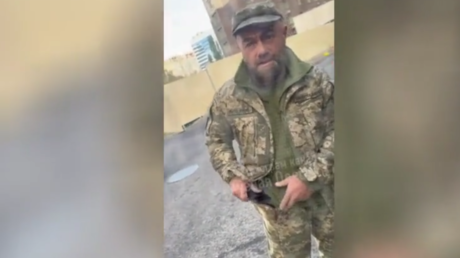
The defense editor for British newspaper The Sun has claimed his Ukrainian colleague and translator has been forcibly drafted into the army amid the country’s conscription crisis.
In a story published over the weekend, Jerome Starkey wrote that he, photographer Peter Jordan, and an unnamed Ukrainian journalist he has “worked with for years” were stopped by Ukrainian soldiers at a roadblock for what seemed like a routine document check.
According to Starkey, several hours later his Ukrainian colleague was “forcibly press-ganged” into the army. “Our team of three was ripped apart. My friend – who I will call D – had his liberty taken away,” he wrote, adding that the news crew was “left stranded without a translator.”
“A soldier came up and joked: ‘You need a new driver.’ Then he added: ‘Your friend has gone to war. Bang, bang!’ And that was it. I don’t know what D’s fate will be,” Starkey wrote.
Last month, Ukraine exempted men between the ages of 18 and 22 from the nationwide ban on military-age men leaving the country.
The authorities nevertheless continue to struggle to replenish the military’s depleted ranks, while viral clips of conscription officers ambushing young men on the streets have sparked public outrage.
Commanders on the front line have complained that troop shortages are allowing Russian forces to “infiltrate” Ukrainian defenses. Kiev, however, has so far declined to lower the conscription age from 25 to 18, as proposed by US officials.
The operation was aimed at “combating the territorial expansion” of a criminal group, the authorities have said
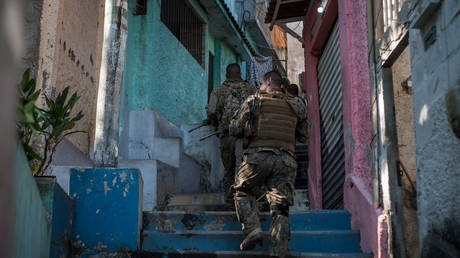
At least 64 people died in a massive police raid in Rio de Janeiro on Tuesday, CNN Brasil wrote, citing state security forces. Among those killed, at least 60 are believed to be criminals, two civil police officers, and two military police officers.
Rio de Janeiro State Governor Claudio Castro said the death toll could rise, as the operation is ongoing.
Videos published online are said to show several fires in the area of the raid, with audible gunfire in the background.
According to the authorities, they launched the operation aiming to “combat the territorial expansion” of the Comando Vermelho criminal group.
parece a faixa de gaza mas é apenas o rio de janeiro aka afeganistão brasileiro em mais uma operação desastrosa pra conter o comando vermelho que transformou a cidade numa zona de guerra. pic.twitter.com/49Dm2piXtz
The operation was in the works for over a year, the government said, and involvedmore than 2,500 military and civilian police personnel.
Não, isso não é a Faixa de Gaza. É o Rio de Janeiro, o coração de um país que perdeu o controle do próprio território.
Hoje foi guerra urbana, guerra de verdade. Drones lançando granadas, barricadas em chamas, gente se escondendo dentro de casa enquanto o Estado tentava retomar… pic.twitter.com/dyepArvukC
At least 81 people have been arrested so far. Two suspects who were shot are in custody at Penha Hospital, CNN Brasil added. In total, around 2,500 police officers were involved in the operation.
The Rio de Janeiro authorities regularly conduct raids in favelas as part of the fight against organized crime. The current operation, however, is the deadliest in the city’s history.